A place to grow your relationship with God

Archive for the ‘Peter and Polly Series’ Category

Peter and Polly (in Winter)
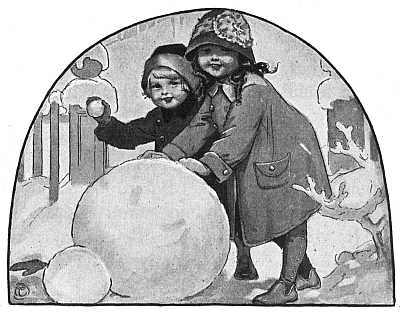
PETER AND POLLY

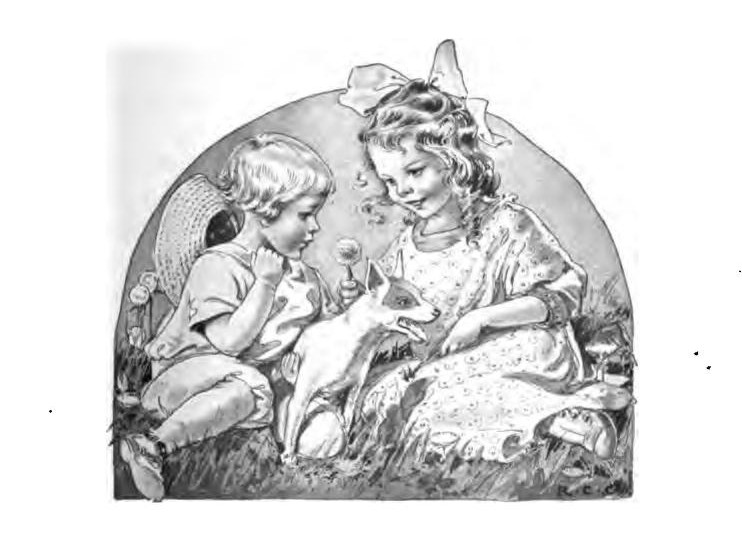
Peter Howe is a little boy. Polly is his sister. She is older than Peter.

They live in a white house. The house is on a hill. It is not in the city. It is in the country.

There are no houses close about it. But there are trees and fields around it.

In summer these fields are green. In winter the snow covers them.

The fields and the hills are as white as the house. Then there is fun playing in the snow.

Peter likes to watch the snowflakes. He calls them “white butterflies.” But he knows what they are.

His friend, the Story Lady, told him. They are just frozen clouds.

Peter said to her, “I think they are prettier than raindrops. They can sail about in the air, too. Raindrops cannot. I like winter better than summer.”

“It will be winter soon, Peter,” said the Story Lady. “But many things must happen first.

“The birds must fly away. The leaves must turn red and yellow. Then they will fall and you can rake them into heaps. We will go to the woods for nuts.

“All these things will happen before winter comes.”

“Yes,” said Peter. “And my grandmother must knit me some thick stockings. And my father must buy me a winter coat. Grandmother must knit some stockings for Wag-wag, too.”

“But Wag-wag is a dog, Peter. Dogs do not need stockings.”

“My dog does,” said Peter. “He needs a coat, too. His hair is short. It will not keep him warm. I shall ask father to buy him a coat.”

“Do, Peter,” said the Story Lady. “It is good to be kind to dogs. And when Wag-wag wears his coat and stockings, bring him to see me. I will take his picture.”
Peter and Polly Series: The Dog on the Ice Cake

THE DOG ON THE ICE CAKE

One morning father called, ” Wake up, P0U7! Wake up!”

“I am awake, father,” said Polly. “Why?”

” The ice on the river is breaking. After breakfast we will go down and watch it.”

” Oh, goody, goody ! ” cried Polly.

Peter said, “Then we can’t skate anymore.”

“We have not skated for a long time, Peter. I am glad that the ice is breaking. It cannot be spring with ice on the river. And I must have it spring soon.”

After breakfast, father said, “Now we will go and stand on the bridge. The water is taking the ice down the river. We will watch the cakes.”

” What a noise the water makes, father,” said Polly. ” See, there is a big cake of ice coming over the dam. And there is another and another.”

^^ Yes,” said father. ” They are coming fast now. The ice above the dam is all broken into cakes. Those will soon be gone. Then the ice from up the river will come.”

” The water is high,” said Polly. ” Last spring it was just like this. I remember it.”

“Watch,” said father. “Can you see anything besides the ice ? “

“Look, look!” cried Peter. “On that big cake ! I can see a barrel. And there is a box.”

“I see some logs. They are floating in the water,” said PoUv.

“There is part of an old sleigh,” said Peter.

“Now let’s walk up the river above the dam, children,” said father. “The water was over the road in one place. It brought big cakes of ice nearly to the road.”

” Is that up by the cowslip field? ” asked Polly.

” Yes,” said father. ” And your cowslip field is full of ice cakes. They are floating around in the water that was left by the river/’

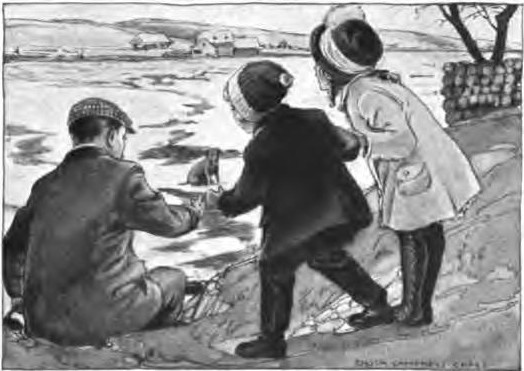
Just then some one shouted, ” There’s a dog ! There’s a dog ! He’s on an ice cake ! “

Peter and Polly looked. Yes, there was a small black puppy. He was on a large cake of ice. He was floating down the river toward the dam.

“That will never do,” cried Mr. Howe. ” He must not go over the dam.”

Mr. Howe ran to the bank of the river. He called to the dog. He whistled to him.

The dog heard. He ran all around the edge of the ice cake. He looked at the water. He almost jumped in. Then he turned back.

“Come, come, old fellow,” called Mr. Howe. ” Come here, sir, come here.”

Again the dog ran aroimd the ice cake. He wished to jump into the water. But he did not dare.

” father, get him,” cried Polly. ” He’ll be killed, if he goes over the dam.”

Just then the ice cake came nearer the shore. It moved very slowly for a minute.

“Now, old fellow, come here,” called Mr. Howe. And he snapped his fingers and whistled again.

Then the dog made up his mind to jump. Down he went into the cold water. In a minute more he was near the bank. Mr. Howe stepped into the river to pull him out.

“Lucky dog,” he said. “You almost went over the dam. Here, children, take him home quickly. You must let him dry by the kitchen stove. Keep it hot.

” Tomorrow he may come with me to the store. Someone will see him who knows where he belongs.”

Peter and Polly in Spring

  • Peter and Polly
  • The Dog on the Ice Cake
  • The Ice-cake Ships
  • Pussy Willows Trees
  • Salted Maple Sugar
  • The First Bluebirds
  • Peter’s Jumper
  • How Peter and Polly Played Never-still
  • Polly’s Robin
  • Stick-in-the-mud
  • Mayflowering
  • Willow Whistles
  • Tim’s Jelly Road
  • The Robins’ Nest
  • What Happened in the Robins’ Nest
  • The Empty Nest
  • The Apple-blossom Snowstorm
  • Peter’s Garden
  • Dandelion Curls
  • Decoration Day
  • What Peter’s Fish- Hook Caught
  • Mud Pies and Marbles
  • The Brook in the Woods
  • Hunting Dryads
  • The Soft Gray Pussy
  • Forget-me-nots
  • The Princess of the Glass Hill
  • Daisy Dolls
  • Melted Buttercups
  • Mother’s Thunderstorm Story
  • The Shiny Land

Peter and Polly (In Spring)

PETER AND POLLY

This book is about Polly Howe when she was eight years old. It is about her brother Peter, too. It is about Wag-wag. He is Peter’s dog. And about Brownie. She is a pony. Then there is Tim, a httle boy who lives near Peter. Tim’s dog is named Collie.

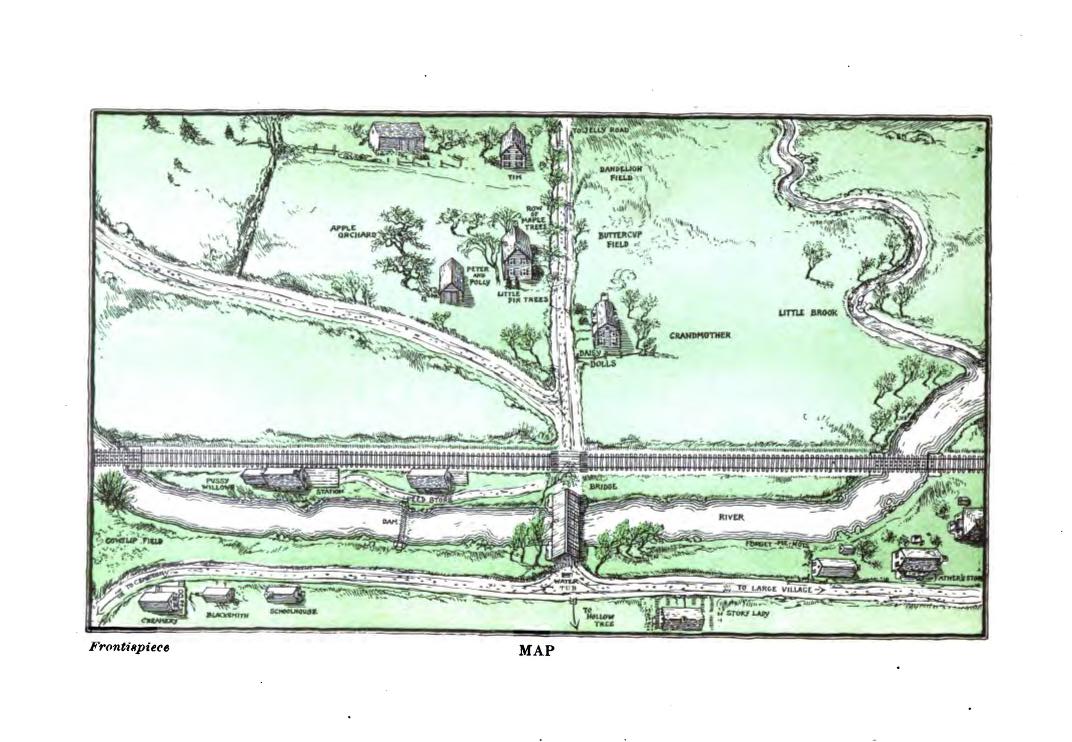
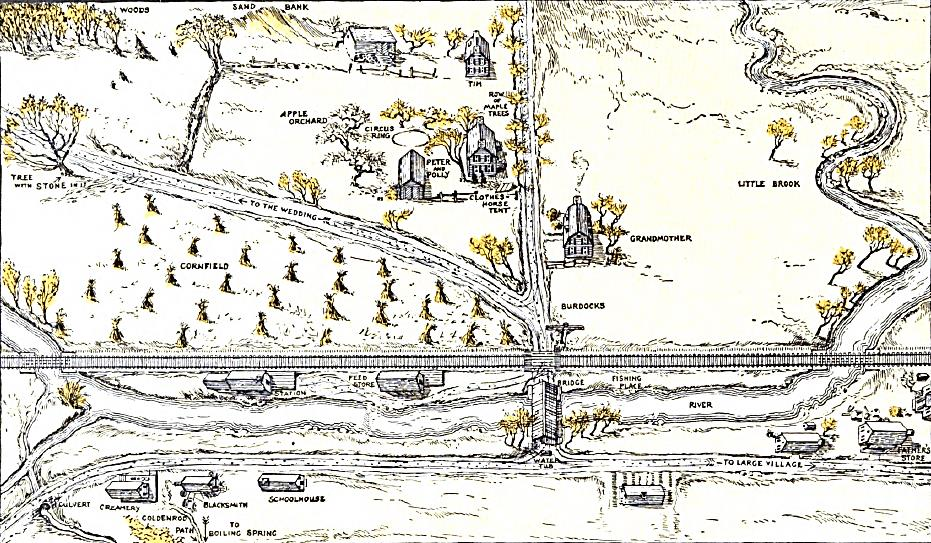
Look at the map in the front of this book. It will show you where all these people live.

Do you wish to know what Peter and Polly play? If you do, you must read these stories.

Peter and Polly live in the country. There are no tall buildings near their house. There are no crowded streets in their village.

But there are many trees along the streets. There are large fields near the houses. And there are hills all around.

In the spring the fields are yellow with buttercups. In the summer they are green with tall grass. In the winter they are white with snow.

It is very, very cold in the winter. The snow is deep. Sometimes it covers the fences.

Peter and Polly like to play in the snow. They like to build snow forts and to make snow men. But Polly is glad when the snow melts. She knows that spring is coming. She watches for the first birds to come back. She looks for the first flowers.

One day she said to father, “I have a hole in my rubber boots.”

” That will not do,” said father. ” We must mend it, if we can. If we cannot, you must have a new pair.

” It is nearly spring. Soon the roads and the sidewalks will be wet.”

” Yes,” said Polly. ” All the snowflakes will turn into water fairies again. Then they will run away to their homes in the brook.

“We can go fishing and wading. We shall not have to put on so many clothes. I shall be glad of that.”

“Peter likes winter best. But I like spring and summer.”

” Sugaring comes in the spring,” said Peter. “I like that. May we tap our maple trees, father ?”

” Yes,” said father. ” I think this will be a good sugar year. Perhaps you can make enough sugar to keep you sweet for a long time. You may try.”

Peter and Polly in Autumn

PETER AND POLLY IN AUTUMN

BY

ROSE LUCIA

“Peter and Polly in Autumn” by Rose Lucia is a children’s story written in the early 20th century. This book is part of a series that likely follows the adventures of Peter and his older sister Polly throughout the seasons. The narrative focuses on the joys of Autumn, highlighting the children’s imaginative play, their love for nature, and their interactions with animals and family. 

Peter and Polly Series: The Boiling Springs Part II

Up the path the children went. It was a narrow path. The cows had made it. On each side, there was lovely goldenrod. Peter picked a long stalk.


“Now I am captain,” he said. “See my gold sword.”

“I see something just as pretty,” said Polly. “Over there in the tall grass.”

“Oh, yellow daisies, yellow daisies!” shouted Peter. “I like those, too. I like them better than white daisies.”

“I call them Black-eyed Susans,” said Polly.

“Why do you, Polly?”

“Because they have a dark center, Peter. Here are the bars. Climb over and hold the egg. Then I will climb over.”

In the pasture the grass was shorter. But a part of the field was covered with goldenrod. It looked like yellow plumes. It was very bright.

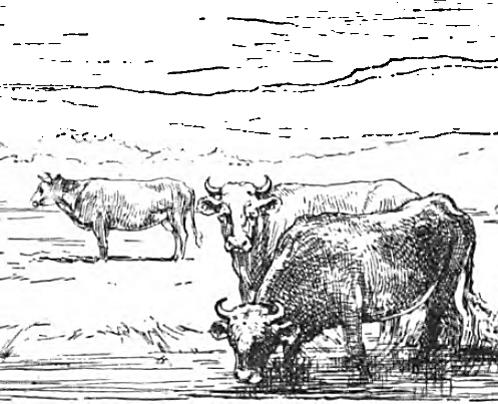
“There are some cows, Polly. Are you afraid of them? I am not.”

“No,” said Polly. “What is there to be afraid of? We are not afraid of Black Bess.”

“We are not afraid of Tim’s Jersey cows,” said Peter. “But Tim says that some cows do not like red. They will chase you, if you have on red things.”

“Well, I have nothing on that is red,” said Polly. “So I am not afraid.”

“Yes, you have, Polly. Yes, you have. You have on your red hair,” cried Peter.

“Oh, dear!” said Polly. “I forgot that. Do cows chase hair? I do not believe that they do. I shall go along.”

Soon they came to the fir trees. There, at the foot of a great rock, was the boiling spring. It was larger than a dish pan. It was not deep.

At one side the water ran out of the spring. It made a brook down the hill.

“See the sand at the bottom move, Peter,” said Polly. “See the water at the top jump up and down. I do believe that it boils. Oh, goody, goody!

“Now I will drop in the egg. Do not put your fingers into the water. It might burn them.”

The children sat by the spring for a long, long time. They watched the clear water bubble up and down. They waited for the egg to cook.

At last Polly said, “That egg must be boiled hard by this time. I shall not wait any longer. I will poke it out with these sticks. Then I will break it. We can eat it. I have some salt.”

When she took it up to break it, it felt very cold.

“Why,” said Polly, “this egg is cold. Eggs just boiled are hot. Father burns his fingers when he breaks ours in the morning. What do you suppose is the matter with this?”

“I know,” said Peter. “The water is cold. I stuck my finger into it to see. You cannot boil anything in cold water.”

“So it is cold,” said Polly. “It must be good to drink. Let’s drink. It is the oddest boiling water that I ever saw. I shall take the egg and go down now to ask the blacksmith about it.”

Peter and Polly Series: The Boiling Springs Part I

“Mother, may I have an egg and some salt? And may Peter and I go walking?”

“Where, Polly?”

“Up the road to the blacksmith’s shop. Then on the hill in his pasture.”


“What is up there, Polly?”

“I am not sure, mother. The big boys say that there is a boiling spring on the hill. Do you think so, mother?”

“You may go to see, Polly. Peter may go, too. Yes, you may have an egg and some salt.”

The children started down the hill. They came to the railroad track.

“Look for the trains, Peter,” said Polly.

“I do not see any, so come along, Polly.”

Next, they crossed the bridge. It was high above the river. Some big boys were fishing from the bridge.

“Have you caught anything?” asked Peter. “I caught a fish once, when I went to sleep.”

The big boys laughed.

“I heard that your cat catches your fish for you,” said one. “I should like such a smart cat.”

“She does not always,” said Peter. “Sometimes I do. Goodbye.”

At the water tub, Polly turned to the right. The other road would take them to father’s store.

“Where are we going, Polly?”

“To find the boiling spring, Peter. It is up in the blacksmith’s pasture.”

“There is the schoolhouse, Polly. When I am as old as you, I am going to school. I am five years old now.”

“Not yet, Peter. Not until October. Your birthday is then. It is only August now.”

“Then I am most five and that is more than half past four. I was half past four a long time. See, there is the blacksmith. Let’s call to him.”

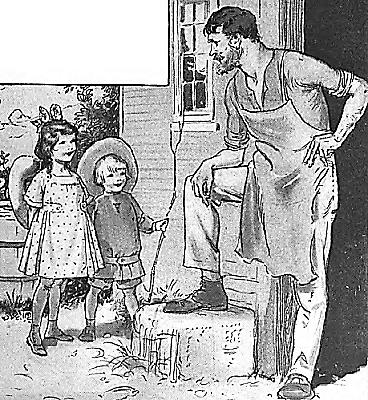
The blacksmith was standing in the shop door.

When he heard them, he said, “Good morning, Polly. Good morning, Peter. Where are you going?”

“We are going to find the boiling spring,” answered Polly. “It is up in your pasture. Do you know just where it is?”

“Yes,” said the blacksmith. “Do you boys and girls call it that, too? When I was a boy, we always called it so.”

“Isn’t it a boiling spring?” asked Polly. “See, here is an egg I brought. I am going to boil it in the spring.”

“It will be fun to try,” said the blacksmith. “Come, and I will show you where the spring is.

“Do you see the path back of the creamery? Follow it up the hill. When you get to that clump of fir trees, stop.

“The boiling spring is there. Come into the shop on your way back. Goodbye.”

“Goodbye, and thank you,” said Polly.

Peter and Polly Series: The Tree with a Stone in it

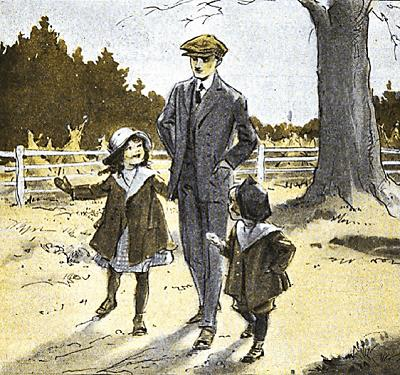
Should you children like to go to walk with me?” asked father. “It is a nice Sunday afternoon. I know something interesting to show you.”


“Oh, yes!” shouted Peter and Polly. “Where shall we go? Tell us fast!”

“Up the road on this side of the river,” said father. “You do not often walk there. Get your coats and your mittens. It is cold.”

“Oh,” said Peter, “if we have to wear mittens, then winter is here.”

“The snow has not come yet,” said Polly. “So the very best part of the winter is not here. I shall be glad of the snow, myself.”

“See how hard the ground is,” said father as they walked down the hill. “It is frozen. The sun cannot thaw it any longer.”

“There are no leaves left on the maple trees,” said Polly. “And there are no leaves left on the elm trees.”

“Let us look for signs of late fall and winter,” said father. “What can you see, Peter?”

“The birds have gone,” said Peter.

“Yes,” said father. “Just those are left that stay with us all winter. Now Polly.”

“I said about the leaves, father.”

“Very well. Peter, you tell next.”

“The squirrels have taken the nuts,” said Peter. “There are no more on the ground.”

“I know two boys who took some of those nuts,” father said. “Didn’t you and Tim have as many as you wished?”

“Oh, yes,” said Peter. “And the squirrels must have had all that they wished, too.”

“They need them in the winter,” said Polly. “And we do not. I know more signs. The goldenrod is not yellow anymore. And the other flowers have dried up.”

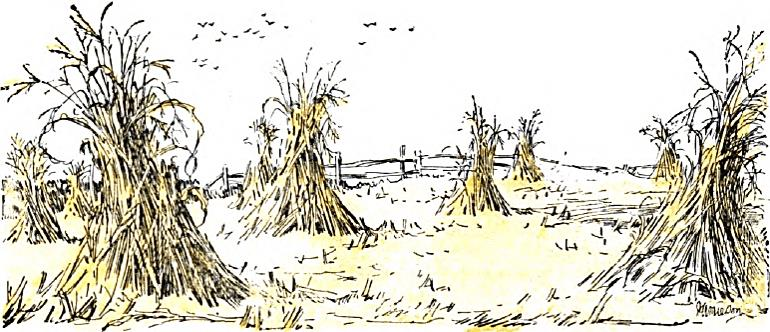
“The corn is cut,” said Peter. “It is standing up in bundles.”

“Yes,” father said. “Mother calls those bundles of corn dancing ladies. See, that field is full of them.”

“Some of the ladies are very fat,” said Peter. “And they do not dance very fast. I can think of something else. The pumpkins are all taken from the fields.”

“And I go to school,” said Polly.

“People have been making bonfires,” said Peter.

“People have been cutting boughs,” said Polly. “They have covered up plants with them. They have piled them around their houses, too. That is a good sign of winter.”

“The road is frozen,” said Peter. “And it is cold enough to wear mittens.”

“Thanksgiving is coming soon,” said Polly. “That is the best sign yet. It is coming this very month.”

“Goody, goody!” cried Peter. “I know that we are going to eat Thanksgiving dinner at grandmother’s.”

“I know it, too,” said Polly. “Father, what are you going to show us? Are we nearly there?”

“Very nearly, Polly. Do you see that big maple tree? It has no leaves now. But I know that it is a maple by the shape and by the bark. Can you tell that, too?”

“I see it,” said Polly. “But what is there interesting about it?”

“Come and look. The interesting thing is at this side. It is near the bottom of the tree. Find it, if you can.”

“It looks just like all the other maple trees,” said Peter. “Are they all interesting?”

“Yes,” said father. “But not in this way. What have you found, Polly?”

“A hole,” said Polly. “I will kneel down and see if there is anything in it.”

“You are getting very warm,” said father. “If you look hard, you will find the interesting thing.”

“I see it! Oh, I see it, father!” cried Polly. “There is a flat stone in this hole. It is a big one. How could it get in there?”

“The tree has grown right around it,” said father. “I do not know just how. But that stone has been in this tree ever since I can remember.

“The tree was not so large when I was a boy. We boys always used to call it ‘the tree with a stone in it.'”

“Do the other children know about it now, father? I never heard of it before. May we show them?”

“Of course you may show them,” said father. “They ought to see such an interesting thing.”

“This is as good as our dwarf kitten,” said Polly. “I wish that we could have it in a circus with her.”

“You can, if you have your circus up here,” said father.

Peter and Polly Series: The Stone-Wall Post Office

Around Peter’s house is a beautiful field. This is Mr. Howe’s hayfield. You can find it on the map at the bottom of this page.

The children like this field. All the year round, it is a pleasant place.

In the spring they find blue violets here. In the summer, they watch the birds that make nests in the tall grass. In the winter, they slide here on the crust.

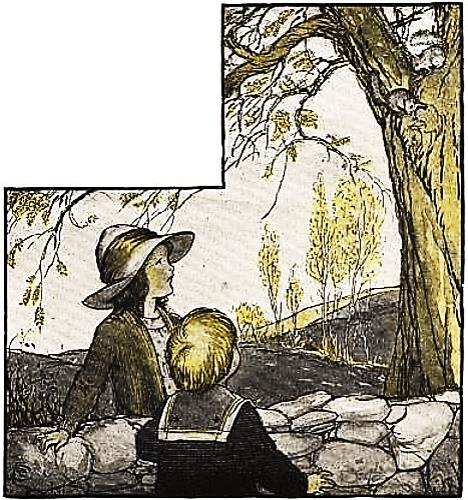
At the farther side of the field, there are some trees. These are butternut trees. In front of the trees is a stone wall.

Peter and Polly like to play by this wall. Sometimes they play that it is a post office.

The holes in the wall are the boxes. There is a box for everyone in the village. Peter has more than one box, and so has Polly.

The children take turns being the postmaster. If Peter is the postmaster, Polly calls for the mail.

The real post office is in their father’s store. So they have often seen Mr. Howe put the mail into the boxes.

They use little sticks for the post cards. Leaves are the letters. Stones are the packages. Sometimes the boxes are full of mail—especially Peter’s and Polly’s.

Often they play that it is Christmas time. Then the boxes are full of packages. It is fun to guess what is in each package.

One day Peter said, “There is a knife in this package. I like it. There is a hammer in this package. I will build a house with it.

“There is a game in this package. Will you play it with me, Polly? And, Oh Polly! There is a pony in this package! That is what I wish for most of all.”

“But, Peter, a pony is too big to be in your post office box. It would not come by mail.”

“Then Santa Claus will bring it,” said Peter. “If I get it, I do not care how it comes.”

One day the children saw that the butternuts were falling.

Polly said, “Let’s pick up all we can. We will put them in our post office boxes. When they are full, we will bring your cart. Then we can take the nuts home. We will crack them next winter.”

So they filled the boxes with nuts. The nuts were still green. The children stained their hands with them.

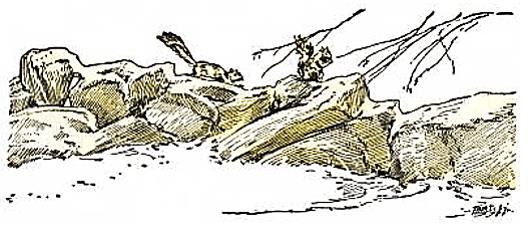
While they were playing with the nuts, they saw two squirrels. These sat in the trees above them. They watched Peter and Polly with their bright eyes, and scolded them a great deal.

“They want our nuts,” said Polly. “But we have put them into our post office boxes. We will keep them.”

The next day the children went for their nuts. They took Peter’s cart with them. What do you think they found?

Why, they found their boxes empty! The nuts were all gone!

“Someone bad has been here,” said Peter.

Polly laughed. “You always say that, Peter. I think it was those squirrels. And I don’t care, because they need the nuts to eat this winter.”

“I don’t care, either,” said Peter. “I think we forgot to lock our boxes.”

“Perhaps we did,” said Polly. “But I guess the squirrels thought the boxes were theirs. When they called for their mail, they found the boxes full. How pleased they must have been! Let’s pick up more nuts for them.”

So the children again filled the post office boxes with nuts. Then they went home and left them for the squirrels.


Peter and Polly Series: Peter’s Funny Bed

Peter’s Funny Bed

One morning Peter said to Polly, “I have seen plenty of red leaves. I am glad about it. I wish to have winter soon.”

“I am not glad about it, Peter. I think that the red leaves are pretty. But by and by they will all fall from the trees. After that, cold weather will come.”

“Yes, it will,” said Peter. “The snow and the ice will be here. That is what I like. I think that summer has been long enough.”

“I wish that it would last all the year,” said Polly. “We stay out of doors more in the summer. It is Saturday, today. I am going to play up at Tim’s. Will you come?

“Yes,” said Peter, “I will. I am glad that it is Saturday. You can play with me all day.”

Polly and Peter and Tim went into the pasture back of Tim’s house. There had been a frost in the night. But it had not hurt the grass and the flowers much.

“It is time for nuts,” said Tim. “We will get butternuts over in your field, Peter. But we can get beechnuts up here in my woods. Shall we today?”

“No,” said Polly. “Let’s not today. Let’s go to the sandbank and play in the sand. We can hunt for beechnuts some other time.”

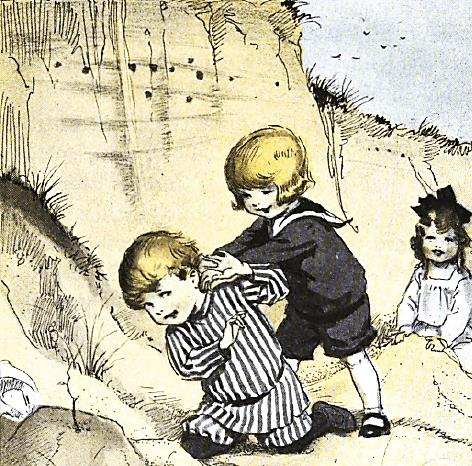
The sandbank was high. Near the top there were many, many round holes. The children knew what made them.

“See the swallows’ holes,” said Polly. “I believe that there are more than ever.”

“I should like to see inside one,” said Tim. “It must be dark.”

“We must let those holes alone,” said Polly. “I think that the swallows have all gone south, but maybe they have not. We must not touch their homes.”

“We cannot reach them anyway,” said Tim. “I tried it the other day. I was not going to hurt the holes. I just wished to look into them.”

“Let’s build forts,” said Peter. “I will build one here.”

At the bottom of the sandbank the soft sand was deep. It was a fine place to play.

“I will get some sticks for soldiers,” said Polly. “Then they will capture your fort.”

“They will not,” said Peter. “I shall make my fort too strong. Besides I shall have some big guns on the top.”

“I shall not play war,” said Tim. “I shall build a city. See, here are my streets. Here are my houses. These sticks are my people. This great big house is a church.”

It was fun playing in the sand. It got into the children’s shoes. And Tim put some sand down Peter’s neck. The sun was very bright and hot. It did not seem like autumn.

At last Peter said, “I have built enough things. What else shall we play?”

“I know,” said Polly. “Let us dig holes and bury ourselves.”

Soon three holes were dug. But the children could not cover themselves up very well. So Polly said, “We will take turns.”

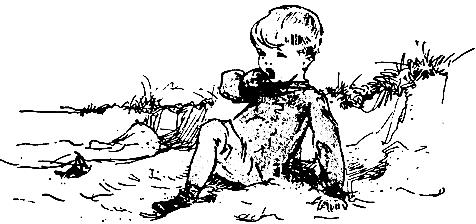
“Bury me first, then,” said Peter. “I have worked hard. I am tired. The hole will be a nice soft bed.”

“You are always tired or hungry,” said Polly. “I think that you are just lazy. But Tim and I will bury you. We will let you be first this time.”

So Polly and Tim covered Peter all over except his face. Then Polly put Peter’s hat over his face so that the sun would not shine in his eyes.

She said, “You may stay buried until we call you. Then it will be our turn.”

She and Tim played in the sand for a few minutes. Then they went farther up the field. In this way, they could get on top of the high sandbank.

They lay down and looked over the edge. They could see Peter. He was perfectly still.

Polly called to him. “Peter, Peter,” she said. “Do you wish to come up here with us?”

Peter did not answer. He did not move.

“He has gone to sleep,” said Polly. “How funny! I know something. Let’s leave him there. He will get enough of being buried. He will not wish to be first, the next time.”

After quite a long while, Peter woke. He had forgotten where he was. He tried to turn over. But he could not.

“What is the matter with me?” he thought to himself. “Where am I? What is on my face? I feel very odd.”

At last he remembered. Then he called, “Polly! Polly! Come and dig me out! I have been buried long enough. I do not like my bed anymore.

Polly did not answer.

He called again and again.

Then he said to himself, “Well, I do believe that she has gone off and left me here. I must dig myself out.”

At last he stood up. He was covered with sand. But that would brush off. He was not very much pleased with Polly and Tim.

As he started home he said, “Sometimes, when I go to sleep, nice things happen. Once I caught a fish. And sometimes things happen that are not nice. It was not nice to be left all alone.”