A place to grow your relationship with God

Archive for the ‘Peter and Polly Series’ Category

Peter and Polly Series: A Cap of Burdock Burrs

One day, Peter and Polly went to their father’s store for mother. On the way home, they noticed some burdock plants.
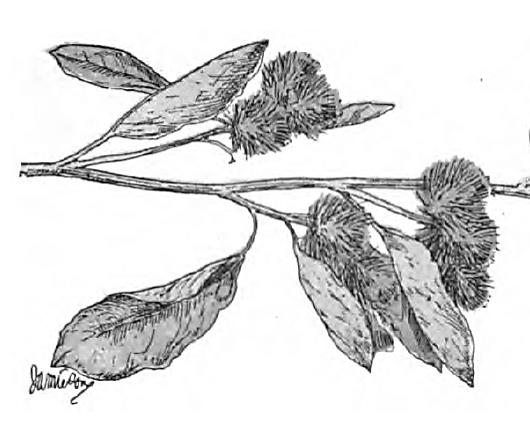


“See,” said Polly, “they are just covered with burrs. As soon as we carry this sugar home, we will come back here and pick some.”

“I will pick one now,” said Peter. “Oh, my! Oh, my! How prickly it is! Why shall we come back and pick burrs? I do not like to.”

“Burrs are prickly,” said Polly. “I felt of them yesterday. One of the big girls had some. She was making baskets out of them. It will be fun for us to do that.”

So the children carried home the sugar. They told mother about the burdock burrs. Then they went back to pick them.

Have you ever picked any? If you have, you know that they cling to your fingers. And they cling to one another. They do not wish to let go.
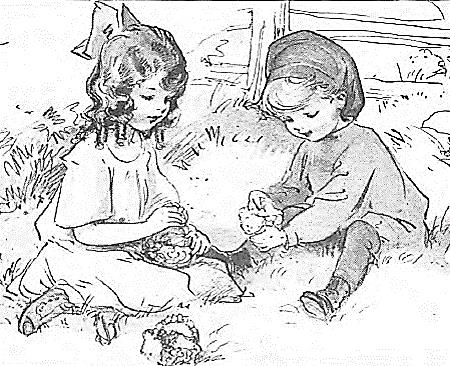
Peter made his burrs into a round ball. He said, “Here is a good baseball. In a minute, I shall make it as large as a football.”

“Your baseball is a soft one,” said Polly. “You cannot bat it very well. If you kick your football, it will come to pieces.”

“I shall try it just the same,” said Peter. “When are you going to make your baskets?”

“I have picked enough burrs now,” said Polly. “Let us sit on the grass near the sidewalk. Then I will show you how to make them.”

Polly stuck ten or twelve burrs together. She kept them flat like a mat. Then around the edge she stuck a row which stood up straight. Then another on that, and another until the outside of the basket was high enough.

After that she made a handle from one side to the other. She said, “That is a good basket. Of course, I cannot carry it by the handle, for then the handle would come off.”

“Let us make some other baskets,” said Peter. “I can make one that is smaller than yours. I wish that the burrs did not stick to my fingers so.”

“I will make a basket with square corners, now,” said Polly.

“I wish that I could make a hat,” said Peter. “You do it for me.”

Polly made a very good hat. Then she made another.

She said, “Those hats are too small. I am going to make quite a large plate. I am going to have that for my hat.”

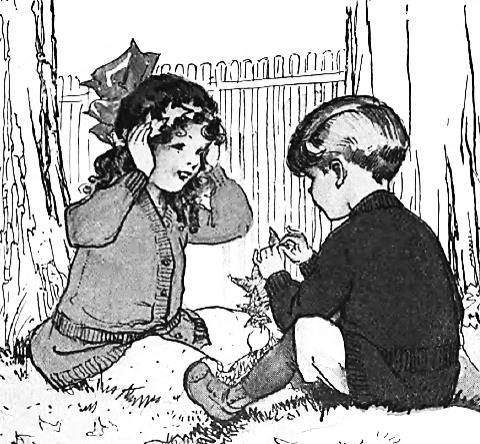
She made the plate. She put it on her head. She pressed it down hard. Her hair was very thick and curly. The burrs caught in her thick hair. The hat stayed nicely.

“I have found a hat that will not come off when the wind blows,” said Polly. “I like it very much.” And she pressed down the burrs again.

“Let’s go home now,” said Peter. “We can take our football and the baskets and the hats. You can take off your big hat to show to mother.”

Polly put up her hand. She pulled at the burdock burrs. The hat began to come to pieces. A few burrs came off her head. But the others were caught in her hair.
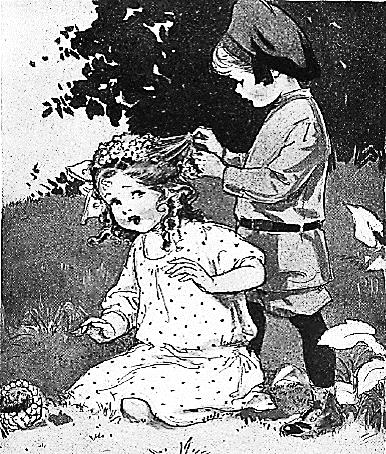
She could not get rid of them without pulling her hair very badly. The more she tried, the more her hair became gnarled.

At last she said, “Oh Peter! What shall I do I What shall I do? My hair is all mixed up with those old burrs. I cannot get them out.”

“Let me do it,” said Peter. He pulled off a few more pieces. He tried to be careful. But he pulled Polly’s hair very badly.

At last she said, “You cannot do that anymore. It hurts too much. Besides you will pull out all my hair. Oh, dear! Oh, dear!”

“Come,” said Peter. “Mother will fix it.”

The children ran to find mother.

“Oh mother!” Polly cried. “See what I have done. I put some burdock burrs on my head for a hat. Now I cannot get them off. Can you, mother?”

“Perhaps I can, dear. I will try. But I may hurt you. Can you be a brave little girl? Or should you rather have me cut some of your hair?”

“Have it cut, Polly,” said Peter, “It is fun to have short hair.”

“No,” said Polly. “I like my hair. It curls. I can be brave and let you pull, mother.”

So mother carefully picked the burrs from Polly’s curls. It took a long, long time. Before she was finished, Polly was very tired. So was mother. But Polly was not cross once.

She said, “I know that you cannot help pulling, mother. And I think it is good of you to help me. If you did not, I should have to get Peter’s barber to cut my hair short like Peter’s. I am never going to wear a burr hat again.”

Polly’s mother only said, “I shall be glad, if you do not.”

Peter and Polly Series Lesson 6: In the Woods

Let us go after those beechnuts today,” said Tim to Peter. “My mother says that I may.”


“The squirrels take all the nuts,” said Peter. “We cannot find any.”

“Yes, we can,” said Tim. “We can get the beechnuts before the squirrels do. Only we must hurry. See if you may go.”

Mother said, “Yes.” Then the boys went through the field back of Tim’s house. They passed the sandbank. Soon they came to the edge of the woods.

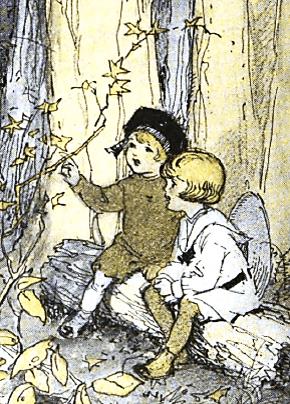
The woods were not green any longer. The trees were bright with colors. There were many red and yellow sugar maples. Tim’s father always tapped these in the spring.

A few of the trees in the woods were evergreens. Their needles were a dark green.

And there were many beech trees. Their leaves had turned brown and yellow.

“See, Peter,” said Tim. “Some of the leaves have come down. I am glad. We can play in them.”

“No,” said Peter. “We must hunt for beechnuts. Let us find a beech tree. Then we will look on the ground for nuts.”

“All right,” said Tim. And he began to hunt for beechnuts under a maple tree.

He looked on top of the leaves. He scraped up the leaves. But not one single nut did he find.

“There are no nuts,” he said. “This is not a beechnut year. I shall not hunt anymore.”

Just then Peter shouted, “Oh, come here, come here! I have found some! See, see! The squirrels have not taken them all.”

He held out his hand. In it were some small, brown nuts. They were three-cornered nuts. Two were in a prickly burr.

“There are more on the ground,” he said. “And, Oh Tim! Look up into the tree! I can see burrs all over it. I wish that we could climb up and knock them off.”

“I wish so, too,” said Tim. “I am going back to look up into my tree. Maybe they have not come down from my tree.”

When Peter saw Tim looking up into a maple, he laughed.

“Oh Tim!” he said. “Of course, you cannot find any beechnuts there. Beechnuts do not grow on maples. Find a beech.”

Soon Tim found a tree like Peter’s. The leaves were not the shape of maple leaves. The bark was smoother than maple bark. It had gray spots on it.

Tim began to find nuts, too. He put them into his pocket. That is where Peter put his.

It was not easy work to find such little nuts. Sometimes they were lying on the leaves. Sometimes the leaves hid them.

“It is easier to pick up butternuts,” said Peter. “I could fill my pockets with them very quickly. I shall never get my pockets filled with beechnuts. I have enough any way. Let’s go home.”

“In a minute,” said Tim. “Let’s sit here a little while. See the leaves come down. I can hear them, too. Can you?”

“Yes,” said Peter. “And I shall be glad when they are all down. I am wishing for winter all the time. My mother says that it will come soon.”

The woods were very still. The boys heard no birds singing. Some of them had gone south. Those that were left did not sing.

There was no noise but the sound of the leaves as they fell down from the trees.

Peter got up and scuffed in the fallen leaves.

“I like the smell of them,” he said. “Now I am going home. Come on.”

So home through the field they went. Collie met them. He jumped around them and barked. Perhaps he said, “Why didn’t you take me with you?”

Tim put his hand into his pocket to show Collie his beechnuts. But he could not find them.

He turned his pocket inside out. Still he found no nuts. Instead, he found a large hole.

He said to Peter, “The squirrels take most of the nuts, and the hole takes the rest. I think that is a good joke. Let us go for more, tomorrow.”

Peter and Polly Series: Peter’s Fifth Birthday

Mother, when is my birthday?” asked Peter. “I wish I could be five years old soon.”

“You will be five years old soon, Peter. Your birthday is the very last day of this month. It comes on Halloween. Do you know about that?”

“Yes, mother, I know. The big boys and the big girls go out with Jack-o’-lanterns and scare people.”

“Sometimes they do,” said mother. “I am going to let you have a birthday party this year. Are you glad?”

“Oh, goody, goody, mother! May Tim come?”

“Yes, Peter, and you may ask three other boys to your party. Which shall you choose?”

“I shall choose Ned and Jack and Will. When may I ask them?”

“Any time you wish, Peter. Ask them to come to your party on the last day of October. I will speak to their mothers about it.”

Peter awoke early on the morning of his birthday. He called to Polly. Mother heard him.

She said, “Turn on the light, Peter. You may begin to dress, if you wish. There are some presents for you downstairs.”

“Did Santa Claus leave them?” asked Peter. “I must hurry and look. May I go down before I dress?”

“If you wish,” said mother.

When he ran downstairs, he found a sled, a pair of mittens, a book, and a new fur cap. He liked these very much.

All that day Peter was quite busy. First, he had to help father. Father was working in the barn. He was making Jack-o’-lanterns.

He made big ones and middle-sized ones and little ones. All had funny faces. All were smiling at something. Peter helped to scrape out the insides of the pumpkins.

He said, “I never before saw so many Jack-o’-lanterns. I am glad that you planted lots of pumpkin seeds. What shall we do with so many?”

“Mother will show you by and by,” said father.

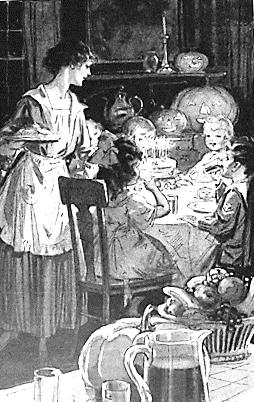
When the lanterns were done, Peter helped mother. They put the lanterns in the dining room. Some were on a table. Some were on a shelf. Some were on the sideboard. The room was full of smiling lanterns.

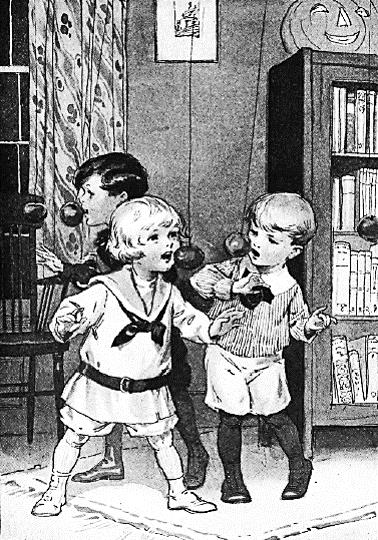
Next Peter helped mother wash and polish five apples. These were for an apple game. They hung by strings from the top of the room. They hung down into the middle of the room.

The boys would try to take a bite of these apples without touching them with their hands. This would be fun.

At last it was time for the party to begin. Tim came first. He wished to start playing at once. But just then the three other boys came. Then the fun began.

Tim tried to take a bite out of one swinging apple. But he got only some hard knocks on his nose. The apple was so slippery that he could not get a piece without using his hands.

“I do not wish a bite anyway,” said Tim. “You play that game, Ned. I will do something else.”

“Here is my train of cars,” said Peter. “Let us play with that.”

“I shall be the engineer,” said Tim. But he ran the engine so fast that the train went off the track.

Then they all played tag. This was fun until Jack tumbled over a chair. He bumped his nose, but he did not care much.

Mrs. Howe said, “You must play a quieter game now. Try puss in the corner. There are four corners in this room and there are five boys.”

“Peter, you must be the first one without a corner.”

What fun it was changing corners! At last Tim was in the middle. He could not get a corner. He grew tired of trying.

He said, “May we play leapfrog? I will be the first frog.”

All the boys but Peter could jump quite well. Peter got stuck. He had to be the next frog.

Then Ned tumbled over his back. So Ned had to be the frog.

At last Mrs. Howe said, “You boys must be hungry. You; nave worked hard. Supper is almost ready. There is time for one game of hide and seek. You may all hide. I will hunt for you. Hurry, while I count five hundred.”

Off they ran. After a minute, they heard her call, “One, two, three; look out for me, for I am coming; one, two, three.”

She uncovered her eyes and turned around. She saw Peter behind a chair. Then she said, “I spy Peter, and touch the goal before him.”

Behind the door she found Will. So she said, “I spy Will, and touch the goal before him.”

Just at that minute somebody under the couch sneezed and then somebody laughed. Mother found Jack and Ned there.

She said, “I spy Jack and Ned, and touch the goal before them.”

Only Tim was left. He could not be found. Mother hunted everywhere for him. At last she called, “I give up, Tim. You are safe. Come out now.”

Tim walked in from the hall. He had been hiding under Mr. Howe’s long coat. It hung from a hook nearly to the floor.

“I beat, didn’t I?” asked Tim.

“Yes, indeed,” said Mrs. Howe. “Now come to the dining room. I hear grandmother. She and Polly have just come in. We were waiting supper for Polly.”

She opened the door and the children looked in.

“Oh, oh, oh!” they cried. Then they began to laugh. You see, every Jack-o’-lantern was lighted. Everyone was grinning at them.

And besides, there, on the table, was Peter’s birthday cake. That looked very good.

What fun those children had at supper! And the Jack-o’-lanterns must have had fun, too. Anyway, they smiled a great deal.

When the boys went home, each carried a large piece of Peter’s cake and a box of candy with him.

The Jack-o’-lanterns stayed all night. They had never before been to a party. Perhaps they talked about it, when everyone had gone to bed.

Peter and Polly Series: The Maple-Leaf Chain

One day, Polly brought something pretty home from school. She showed it to Peter.

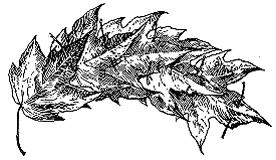
She said, “See this wreath of red leaves. I made it. One of the big girls taught me how. I will teach you.”

“All right,” said Peter. “I have been waiting for you to come home. I thought that you would play with me.”

“I will,” said Polly. “Let us both hunt for red leaves. They have begun to fall from the trees.

“There are none under these trees in our yard. These are elms. See, their leaves are all yellow.”

“I know where to get red leaves,” said Peter. “Come down by the fence. The trees down there have red leaves. They have yellow ones, too.”

“Yes, they have, Peter. Those are the trees that we tap in the spring. They are sugar maples.”

“See,” said Peter, “here are many red maple leaves on the ground. And here are many yellow maple leaves, too. And here are a few green leaves.

“I shall use some of the yellow ones in my wreath. They will be pretty.”

Polly said, “I will make one wreath all yellow. This is the way to do it. Watch!

“Break the stem off every leaf. Then lay the point of one leaf over the bottom of another. Lay it over just a little.

“Now use one of the stems for a pin. Pin through both leaves. That will hold them together. Then you can pin on another, like this”:


“I see,” said Peter. “I can do it. First, I shall take a red leaf. Next I shall take a yellow leaf. It is a good way.”

“Yes, it is, Peter. See my wreath. It is large enough. I shall wear it on my head. First, I must fasten the ends together. I will show you how to do it.”

Polly took another stem-pin. She pinned the first leaf and the last leaf together. This made a circle. She put the wreath on her head. It fitted very well.

“Now I have a crown,” she said. “So, of course, I am a queen. Finish your wreath and you may be a king.”

Peter put his on his head. Then he made a larger one. He wore this around his neck.

“What are you doing now, Polly?” he asked. “Why are you making such a big one?”

Polly had made a very long chain of maple leaves.

She said, “I am not going to make this into a wreath. I am just going to keep on making a chain.

“I shall hang it on the fence. By and by, it will be so long that it will reach to Tim’s house. You help.”

Peter made short chains. Polly joined these to the long one. She hung the long one over the pickets of the fence. The red and the yellow leaves looked very pretty on the white fence.

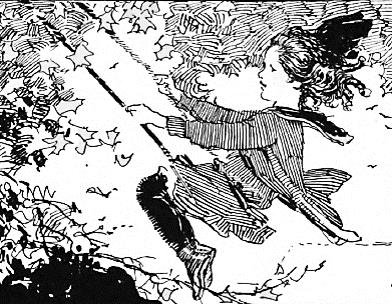
“I believe I like autumn,” said Polly. “I like to swing way up into the yellow elm leaves. I like to make wreaths.

“It is fun playing in the leaves. Only I do wish that they could stay on the trees always.”

“Then you could not play in them,” said Peter. “But most of them are up on the trees yet.”

“I know that,” said Polly. “But they keep falling down. See the wind blow them. Their stems are all loose. Look at our long chain.”

“We can never make one all the way up to Tim’s,” said Peter. “I am going to stop until tomorrow. We can do more then.”

“All right,” said Polly. “It is getting dark anyway. We could not see much longer. I wish that night would not come so early. Let’s go in.”

When morning came, the children ran to look at their lovely chain. What do you think had happened?

Why, in the night, the red and yellow leaves had begun to curl up. They had begun to grow brown. The chain was no longer very pretty.

story image

Peter and Polly Series: A Bite of Apple


Children,” said father, “I must have you work for me this morning.”

“What shall we do?” asked Polly. “I almost always like the things you ask us to do.”

“This time I am sure that you will like it,” said father. “You see, mother is ready to make some jelly. And the apples are ready to be made into jelly.”

“Goody, goody!” cried Polly.

“Goody, goody!” cried Peter.

“Why are you saying that?” asked father.

“Because I like apples,” said Peter.

“Because I like jelly,” said Polly.

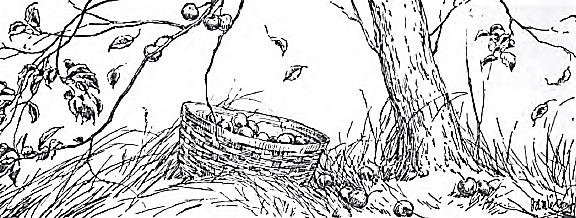
“Then come with me, children. Put on your boots. The grass is still wet with dew. Here are two baskets. You may fill them. When they are filled, bring them to mother.”

“Shall we fill them just once?” asked Polly. “That isn’t much work.”

“Oh, no. You must fill them as many times as mother says.”

“They are so small that they will not hold many big apples,” said Polly. “I could carry a larger basket, and so could Peter.”

“These are large enough,” said father. “And you are not going to fill them with large apples, but with crab apples. They make good jelly. Some of the large apples are not ripe yet.

“Here we are. Now I will get up in this tree. I will shake the branches. Keep out from underneath. If you do not, you will get hit.”

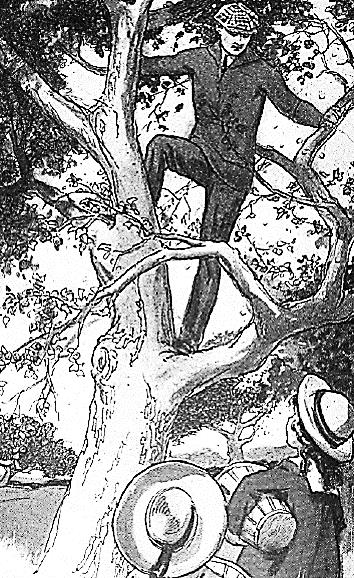
Father climbed the tree. He shook the branches. Down came the crab apples.

“Oh father! How pretty they are!” shouted Polly. “They are red and yellow. Do you think that the jelly will be red and yellow, too?”

“There were some on the ground before,” said Peter. “But just look at them now. It will take us all day to pick them up.”

“I shall take the very largest ones, Peter,” said Polly. “Maybe they will make the best jelly.”

Polly and Peter filled their baskets. Mother emptied them. She said, “Please get me some more. I must make many tumblers of jelly. It will be for you to eat next winter.”

“Will the largest crab apples make the best jelly, mother?” asked Polly.

“I think not. But bring me those that have not been lying on the ground, if you can.”

“I will fill my basket before you fill yours, Peter,” shouted Polly. “Come and let us race.”

This time the baskets were full before mother was ready for the apples. The children thought that this was a joke.

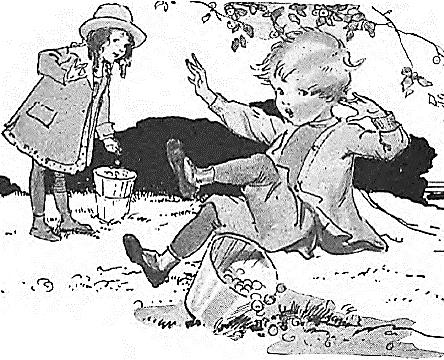
They hurried back for more. Peter set his basket down and picked up the apples with both hands. His basket was almost full, when he fell against it.

Over it went and the apples were spilled out. He did not like this very well.

Polly said, “I will wait for you. It is no use to hurry so. I will stop working and eat one of these big apples. They are ripe.”

“How do you know?” asked Peter. “If they are not, you will have a stomach ache.”

“The seeds are all black. See!” said Polly. “Besides, father took some into the house last night. He told mother that they were ripe. So I dare to eat one.”

“Then I will eat one, too, Polly. I am hungry. I have worked hard.”

“You are always hungry, Peter. And I think that you ought to work hard enough to put those apples back into your basket.”

“Wait until I get this big one eaten and I will,” said Peter. “You don’t eat yours very fast. I think that you are afraid of it.”

Polly had been walking about. She had been kicking the apples which lay on the ground. She had been watching the clouds. She had forgotten all about eating her apple. You see, she was not very hungry.

“I am not afraid,” she said. And she put the apple to her mouth for a bite.

But she did not take that bite. Instead, she dropped the apple. She opened her mouth wide. She cried, “Ow, ow, ow!”

“What is it? Oh, what is it?” asked Peter.

“Something stung me!” said Polly. “Something stung me on my tongue. I know what it was, too. It was a wasp. I saw him eating my apple a minute ago.”

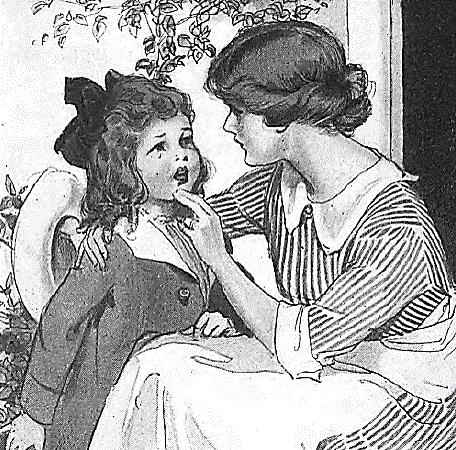
Mother looked at Polly’s tongue. It was swollen.

“Poor Polly,” she said. “I am sorry. But it is not a very bad sting. It will soon feel better. Why did you put the wasp into your mouth?”

“He was on the apple when I took a bite, mother. So he got into my mouth.”

“I guess he did not like it,” said Peter.” I guess, he flew away as soon as Polly said, ‘Ow.'”

Mother laughed. “Oh Polly,” she said, “this will teach you something new. When father comes home, he will say that you must always ‘ Look before you bite.’ “

story image

Polly’s Pupils

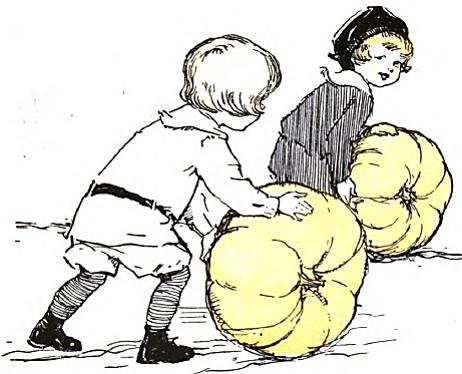
In the barn the children looked for pumpkins which had no stems left on them. Some of them were so large that they made good seats.

“We will put four small seats in the front row,” said Polly. “Those are for the four dolls. Then we will have four in the next row. Those are for you two boys and Wag-wag and Collie.

“My chair is out here in front. I shall be the teacher. I shall always be the teacher.”

“We do not care,” said Peter. “If you are the teacher all the time, we shall be naughty boys some of the time.”

“No, you will not,” said Polly. “Now, boys, take your seats.”

“If you say, ‘Take your seats,’ I shall not do it,” said Tim. “You must say, ‘Take your pumpkins.'”

“If you say, ‘Take your pumpkins,'” said Peter, “I shall really take mine and go away.”

“Oh, dear!” said Polly. “What shall I do with two naughty boys? I know. You get the dogs and make them sit on their pumpkins.”

The two biggest pumpkins had been put in the row for the two dogs. Tim showed Collie what he was to do.

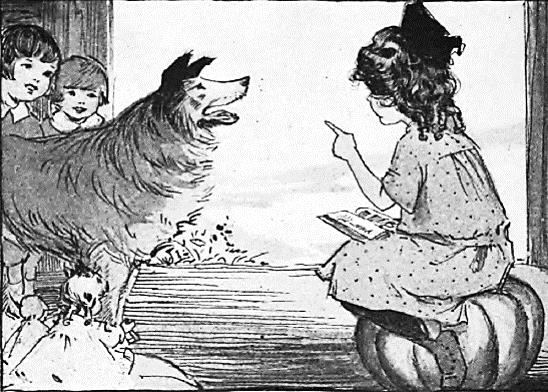
Collie is a very smart dog. He knew what Tim meant. He was willing to play school. So he tried to sit upon the pumpkin. He was so big that one of his legs kept slipping off.

When Wag-wag saw Collie on his scat, he jumped up on the next one. He was small, so it was easy for him to sit there. “Now, Collie,” said the teacher, “how many are two and three?”

Just then Collie slipped off his pumpkin. Polly played that he meant to stand.

“That is right,” said the teacher. “You must always stand, when you answer a question. Now, can you tell me I Then come down here and I will help you.”

Collie walked out to the teacher.

“You mind very well,” said she. “I will show you about two and three. Speak, Collie!”

Collie barked. His master had taught him to do that.

“Speak again!”

Collie barked again.

“That is right, little boy. That is two. Now do it three times more. Speak! Speak! Speak! “

Collie barked three times more.

“Very good,” said the teacher. “You have barked five times. That is what two and three make. Do you understand about it?”

Just then she heard a noise. It was Tim and Peter. They were rolling their seats over the barn floor.

“Children, children, stop, stop!” cried the teacher. “What are you doing? Take your seats!”

“We have taken them,” shouted Peter. “We have taken them away. It is recess. We are playing it is winter. We are rolling snowballs. See how big they are.”

“I will have a bigger one,” said Polly. And she ran to get Collie’s seat.

Out of the barn and down the driveway rolled the pumpkins. And that was the end of playing school for that day.

Peter and Polly Series

These stories can be used for a starting point in science for 1st grade. This is part of a series that likely follows the adventures of Peter and his older sister Polly throughout the seasons. The narrative focuses on the joys of the various seasons highlighting the children’s imaginative play, their love for nature, and their interactions with animals and family. I am using these stories as part of my 1st grade lesson plans.

  1. Two Children and Their Pets
  2. Playing School
  3. Polly’s Pupils
  4. A Bite of Apple
  5. The Maple-leaf Chain
  6. In the Woods
  7. A Cap of Burdock Burrs
  8. Peter’s Fifth Birthday
  9. Peter’s Funny Bed
  10. The Stone-Wall Post Office
  11. The Tree with a Stone in it
  12. The Boiling Springs Part I
  13. Peter and Polly Series: The Boiling Springs Part II
  14. At the Blacksmith’s Shop
  15. The Four Horseshoes
  16.  The Bonfire
  17. Tim’s Football
  18. The First Snowflakes
  19. Jack Frost’s Celebration
  20. Taking Orders
  21. Peter’s Haircut
  22. Comfort
  23. The Lost Pig
  24. The Doll Family
  25. Clotheshorse Tents
  26. The Tent Store
  27. The Circus
  28.  Starting for the Fair
  29. A Bunch of Balloons
  30. The Broken Show Case
  31. Blacky’s Fish
  32. Fisherman’s Luck
  33. How Peter Catches Fish
  34. Polly Goes to a Wedding Part I
  35. Polly Goes to a Wedding Part II
  36. The Geography Lesson

Playing School

Early in September school began. The schoolhouse was a small white building. In front of it was a large yard. This was a good place to play.


Polly went to school every day except Saturdays and Sundays. She liked it very much. Peter stayed at home and played with Tim and Wag-wag and Collie. He liked that better than going to school.

Polly came home from school early. She had plenty of time to play.

One day Polly said, “I know something to do. Let’s have a school.”

“We used to do that,” said Peter.

“Yes, we did, Peter. But I know how to play it better than I did. I go to school now, so I can play it better.”

“I do not like to play school,” said Tim. “Let’s not.”

“We are going to,” said Polly. “You need not, if you do not wish.”

“Well,” said Tim, “I will, if Collie may play, too.”

“Of course, Collie may,” said Polly. “Dogs make good pupils. Wag-wag must play, too. Peter, please go into the house and get some of the doll family. Then we shall have quite a large school.”

“Shall we have it out of doors?” asked Peter. “You do not have your real one out of doors.”

“Sometimes we do,” said Polly. “I like that very much. You and I will have ours out of doors until it is winter.”

“I wish it were winter now,” said Peter. “I am tired of autumn.”

“Well, I am not,” said Polly. “I hope that it will be autumn for a long, long time.”

“It will not,” Tim said. “My father thinks that a hard frost will come any night. He has taken all our pumpkins into the barn.”

“So has my father,” said Polly. “Oh, I know something! We will play school in the barn. Then we will use the pumpkins for chairs. Come on!”

Polly and Peter picked up the doll family, and away the three children ran. After them ran Collie and Wag-wag.

Taken from the Peter and Polly series.

Vocabulary:

School: A place where children learn.
Schoolhouse: A building where school is held.

Two Children and Their Pets

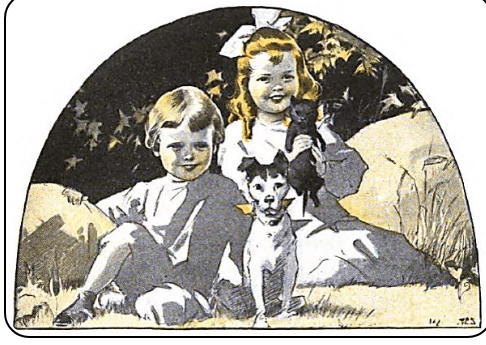
Do you know Peter and Polly Howe? Polly is a little girl. She is about as old as you.


She has blue eyes. She has red curls. She has freckles on her face.

Peter is Polly’s little brother. Have you a little brother, too? Perhaps your brother is like Peter.

Do you play out of doors every day? Do you pick flowers? Do you go fishing? Do you wade in the brook? Peter and Polly do.

In the winter they play in the snow. Perhaps their games are just like yours.

They roll snowballs and make snowmen. They slide and they build snow forts.

Often, they play with their pets. Their father’s cow, Black Bess, is one of them. Their mother’s horse, Mary, is another.

Their father gave them a dog. Their mother gave them a cat.

The dog has a short tail. He wags his whole body when he wags his tail. So they named him Wag-wag.

You can guess why the cat is called Blacky.

One of Blacky’s kittens never grew large. She stayed as small as a little kitten. She was a dwarf.

Peter named her Black Baby. Wag-wag likes Black Baby. He lies close beside her. He laps her with his soft red tongue.

Black Baby likes Wag-wag, too. She cuddles up to him and goes to sleep.

Best of all she likes Black Bess. She sits for hours in the cow’s manger.

One evening Peter and Polly went to the barn. They were hunting for Black Baby.

At last, they found her. Where do you think she was? Why, she was curled up on the cow’s back!

After that she took many naps there. At night, she nearly always sleeps with Black Bess.

Taken from the Peter and Polly series.

Vocabulary:

Brook: A small stream.
Snow Fort: A walled structure made from snow.
Manger: A food box from which cows, horses, or other animals eat.