A place to grow your relationship with God

Archive for the ‘A First Book in American History’ Category

Young George Washington

George Washington was born in a plain, old-fashioned house in Westmoreland County, Virginia, on the twenty-second day of February, 1732. He was sent to what was called an “old field school.” The country schoolhouses in Virginia at that time were built in fields too much worn out to grow anything. Little George Washington went to a school taught by a man named Hobby.

In that day the land in Virginia was left to the oldest son, after the custom in England, for Virginia was an English colony. As George’s elder brother Lawrence was to have the land and be the great gentleman of the family, he had been sent to England for his education. When he got back, with many a strange story of England to tell, George became very proud of him, and Lawrence was equally pleased with his manly little brother. When Lawrence went away as captain, in the regiment raised in America for service in the English army against the Spaniards in the West Indies, George began to think much of a soldier’s life, and to drill the boys in Hobby’s school. There were marches and parades and bloodless battles fought among the tufts of broom-straw in the old field, and in these young George was captain.

This play-captain soon came to be a tall boy. He could run swiftly, and he was a powerful wrestler. The stories of the long jumps he made are almost beyond belief. It was also said that he could throw farther than anybody else. The people of that day went everywhere on horseback, and George was not afraid to get astride of the wildest horse or an unbroken colt. These things proved that he was a strongly built and fearless boy. But a better thing is told of him. He was so just, that his schoolmates used to bring their quarrels for him to settle.

When Washington was eleven years old his father died, but his mother took pains to bring him up with manly ideas. He was now sent to school to a Mr. Williams, from whom he learned reading, writing, and arithmetic. To these were added a little book-keeping and surveying.

George took great pains with all he did. His copybooks have been kept, and they show that his handwriting was very neat. He also wrote out over fifty rules for behavior in company.” You see that he wished to be a gentleman in every way.

His brother Lawrence wanted George to go to sea as a midshipman in the British navy, and George himself liked the plan. But his mother was unwilling to part with him. So he stayed at school until he was sixteen years old.

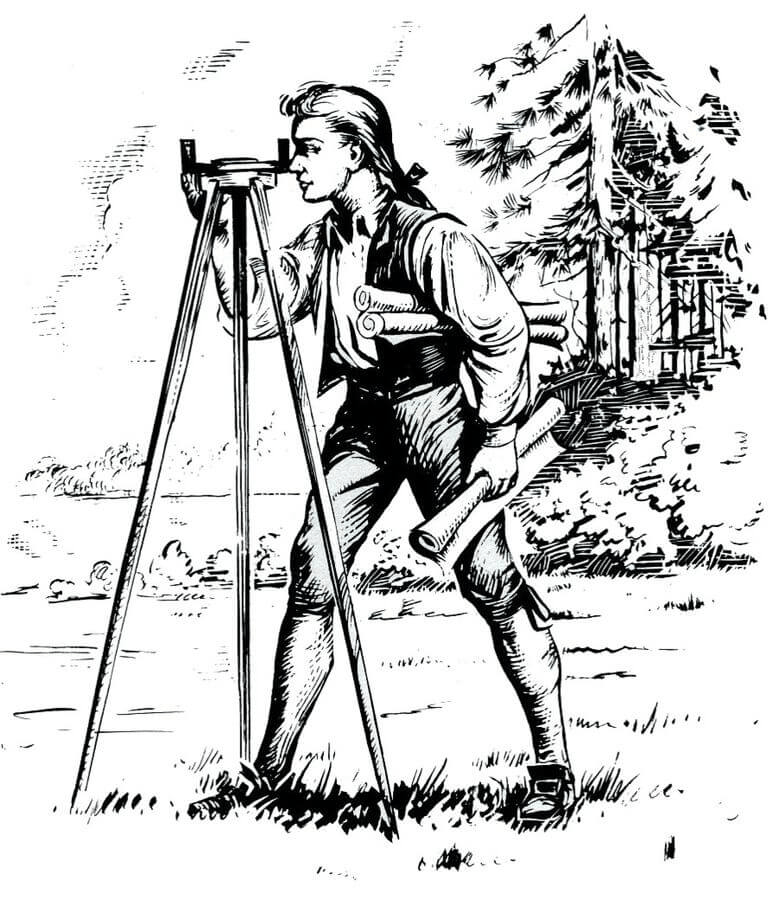
A great deal of the northern part of Virginia at this time belonged to Lord Fairfax, an eccentric nobleman, whose estates included many whole counties. George Washington must have studied his books of surveying very carefully, for he was only a large boy when he was employed to go over beyond the Blue Ridge Mountains and survey some of the wild lands of Lord Fairfax.

So, when he was just sixteen years old, young Washington accepted the offer of Lord Fairfax, and set out for the wilderness. He crossed rough mountains and rode his horse through swollen streams. The settlers’ beds were only masses of straw, with, perhaps, a ragged blanket. But George slept most of the time out under the sky by a campfire, with a little haw straw, or fodder for a bed. Sometimes men and women and children slept around these fires, “like cats and dogs,” as Washington wrote, “and happy is he who gets nearest the fire.” Once the straw on which the young- surveyor was asleep blazed up, and he might have been consumed if one of the party had not waked him in time. Washington must have been a pretty good surveyor, for he received large pay for his work, earning from seven to twenty-one dollars a day, in a time when things were much cheaper than they are now.
The food of people in the woods was the meat of wild turkey and other game. Every man was his own cook, toasting his meat on a forked stick, and eating it off a chip instead of a plate. Washington led this rough life for three years. It was a good school for a soldier. Here, too, he made his first acquaintance with the American Indians. He saw a party of them dance to the music of a drum made by stretching deer-skin very tightly over the top of a pot half full of water. They also had a rattle, made by putting shot into a gourd. They took pains to tie a piece of horse’s tail to the gourd, so as to see the horse-hair switch to and fro when the gourd was shaken.

When Washington was but nineteen years old the governor of Virginia made him a major of He took lessons in military drill from an old soldier, and practiced sword exercises under the instruction of a Dutchman named Van Braam. The people in Virginia and the other colonies were looking forward to a war with the French, who in that day had colonies in Canada and Louisiana. They claimed the country west of the Alleghany Mountains. The English colonists had spread over most of the country east of the mountains, and they were beginning to cross the Alleghanies. But the French built forts on the west side of the mountains and stirred up the Indians to prevent the English settlers from coming over into the rich valley of the Ohio River.

The governor of Virginia resolved to send an officer to warn the French that they were on English ground. Who was so fit to go on this hard and dangerous errand as the brave young Major Washington, who knew both the woods and the ways of the Indians? So Washington set out with a few hardy frontiersmen. When at length, after crossing swollen streams and rough mountains, he got over to the Ohio River, where all was wilderness, he called the Indians together and had a big talk with them, at a place called Logtown. He got a chief called “The Half-king,” and some other Indians, to go with him to the French fort.

The French officers had no notion of giving up their fort to the English. They liked this brave and gentlemanly young Major Washington and entertained him well. But they tried to get the Half-king and his Indians to leave Washington and did what they could to keep him from getting safely home again. With a great deal of trouble, he got his Indians away from the French fort at last and started back. Part of the way they traveled in canoes, jumping out into the icy water now and then to lift the canoes over shallow places.

When Washington came to the place where he was to leave the Indians and recross the mountains, his packhorses were found to be so weak that they were unfit for their work. So Major Washington gave up his saddlehorse to carry the baggage. Then he strapped a pack on his back, shouldered his gun, and with a man named Gist set out ahead of the rest of the party.

Washington and Gist had a rascally Indian for guide. When Washington was tired this fellow wished to carry his gun for him, but the young major thought the gun safer in his own hands. At length, as evening came on, the Indian turned suddenly, leveled his gun, and fired on Washington and Gist, in the dark, but without hitting either of them. They seized him before he could reload his gun. Gist wanted to kill him, but Washington thought it better to let him go.

Afraid of being attacked, they now traveled night and day till they got to the Alleghany River. This was full of floating ice, and they tried to cross it on a raft. Washington was pushing the raft with a pole, when the ice caught the pole in such a way as to fling him into the river. He caught hold of the raft and got out again. He and Gist spent the cold night on an island in the river and got ashore in the morning by walking on the ice.

They now stopped at the house of an Indian trader. Nearby was a chief, who was offended that she had not been asked to the council Washington had held with the Indians at Logtown. To make friends, he made her a visit, and presented her with a blanket such as the Indians wear on their shoulders. Washington bought a horse here, and soon got back to the settlements, where the story of the adventures of the young major was told from one plantation to another, producing much excitement.
The Great Doctor Franklin

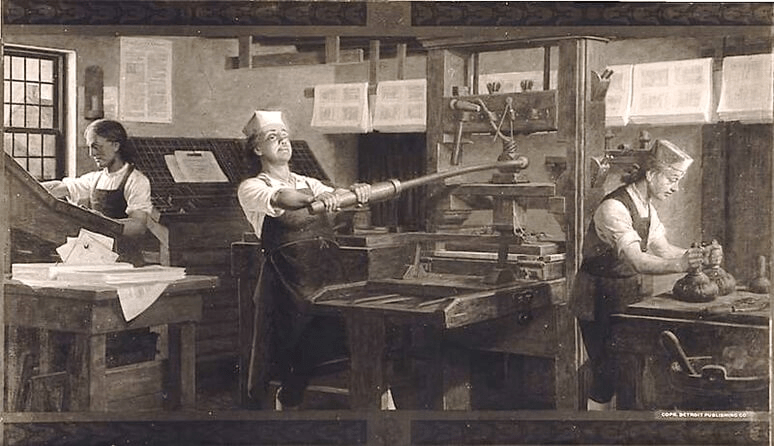
After a time, Franklin started a printing office of his own. He was very much in debt for his printing press and types. To pay for them he worked very hard. Men saw him at work when they got up in the morning, and when they went to bed at night the candle in his office was still shining. When he wanted paper, he would sometimes take the wheelbarrow himself and bring it from the store at which he bought it to his printing office.

People began to say: “What an honest, hard-working young man that Franklin is! He is sure to get on!” And then, to help him get on, they brought their work to his office.

He started a newspaper. Now his reading of good books and his practice in writing since he was a little boy helped him. He could write intelligently on almost any subject, and his paper was the best one printed in all America at that time.

Franklin married Miss Deborah Read, the same who had laughed when she saw him walking the street with a roll under each arm and his spare clothes in his pockets. His wife helped him to attend the shop, for he sold stationery in connection with his printing. They kept no servant, and Franklin ate his breakfast of plain bread and milk out of an earthen porringer with a pewter spoon. In time, he paid off all his debts and began to grow rich.

In those days books were scarce and people had but few of them. But everybody bought an almanac. Franklin published one of these useful little pamphlets every year. It was known as “Poor Richard’s Almanac,” because it pretended to be written by a poor man named Richard Saunders, though everybody knew that Richard was Franklin himself. This almanac was very popular on account of the wise and witty sayings of Poor Richard about saving time and money.

Franklin did not spend all his time making money. He studied hard as usual and succeeded in learning several languages without the help of a teacher. This knowledge was afterward of the greatest use to him.

Like other people in America at that time, he found it hard to get the books he wanted. To help himself and to do good to others, he started a public library in Philadelphia, which was the first ever started in America. Many like it were established in other towns, and the people in America soon had books within their reach. It was observed, after a while, that plain people in America knew more than people in the same circumstances in other countries.

Franklin did many other things for the public. Seeing how wasteful the old fireplaces were, since they burned a great deal of wood and made the rooms cold and full of draughts, and often filled the house with smoke, he invented a system of saving heat by means of a small iron fireplace or open stove. He founded a high school, which afterward became a great university. When the frontier people were slain by American Indians during the French War, he was the chief man in raising and arming troops for their relief.

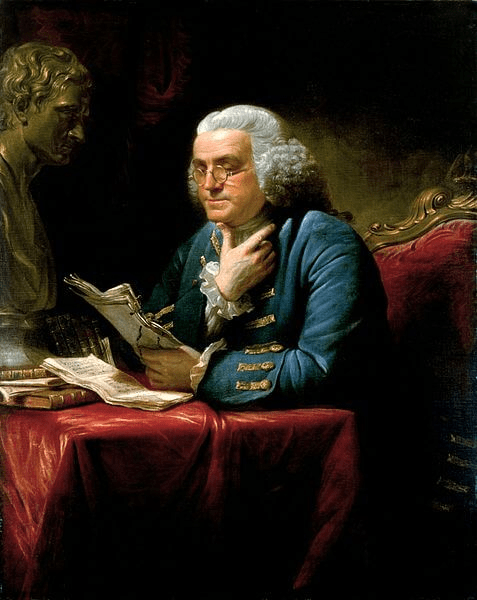
These and other acts of the sort made Franklin well known in Pennsylvania. But he presently did one thing which made him famous all the world over. This one thing was accomplished in a very short time; but it came from the habits of study he formed when he was a little boy. He was always reading, to get more knowledge, and trying experiments, to find out things. People did not know a great deal about electricity at that time. In Europe many learned men were trying to find out what they could about various sorts of electricity, and lectures on the subject had been given in Philadelphia. Something made Franklin think that the electricity which was produced by a machine was of the same nature as the lightning in the sky. So he devised a plan to find out. He set a trap to catch the lightning. He made a kite by stretching a silk handkerchief on frame. Then he fastened a metal point to the kite and tied a hemp string to it to fly it with. He thought that if lightning were electricity, it would go from the metal part down the hemp string. At the lower end of the string he tied a key, and a silk string to catch hold of, so that he should not let the electricity escape through his hand.

Franklin knew that if a grown man were seen flying a kite he would soon be surrounded by a crowd. So one stormy night he went out and sent up his kite. He waited under a shed to see if the electricity would come. When he saw the little fibers of the hemp stand up charged with electricity, he held his hand near the key and felt a shock. Then he went home, the only man in the world that knew for certain that lightning was electricity. When he had found out this secret he invented the lightning-rod, which takes electricity from the air to the earth and keeps it from doing harm.

When the learned men of Europe heard that a man who had hardly ever been to school had made a great discovery, they were struck with wonder, and Franklin was soon considered one of the great men of the world and was called Dr. Franklin.

When the troubles between England and her colonies began, there was no one so suitable to make peace as the famous Dr. Franklin. Franklin went to England and tried hard to settle matters. But he would not consent to any plan by which Americans should give up their rights.

When the war broke out Dr. Franklin came home again. He was made a member of Congress, and he helped to make the Declaration of Independence. After the Americans had declared themselves independent they found it a hard task to fight against so powerful a country as England. They wanted to get some other country to help them. So Franklin, who was well known in Europe, and who had studied French when he was a poor printer, was sent to France.

When Franklin went to France he had to appear at the finest court in the world. But in the midst of all the display and luxury of the French court he wore plain clothes and did not pretend to be anything more than he was in Philadelphia. This pleased the French, who admired his independent spirit and called him “the philosopher.” He persuaded the French Government to give money and arms to the Americans. He fitted out vessels to attack English ships, and during the whole War of the Revolution he did much for his country.

When the war was ended there came the hard task of making peace. In this Franklin took a leading part. When peace had been made, Dr. Franklin set out to leave Paris. As he was old and feeble, the queen’s litter, which was carried by mules was furnished to him. On this litter he traveled till he reached the sea. After he got home he was the most honored man in America next to Washington. He became a member of the Convention of 1787, which formed the Constitution of the United States. He died in 1790, at the age of eighty-four.

When Franklin was a boy his father used to repeat to him Solomon’s proverb, “Seest thou a man diligent in his business? he shall stand before kings.” This was always an encouragement to him, though he did not expect really to stand before kings. But he was presented to five different kings in his lifetime.

Something about the Great Civil War

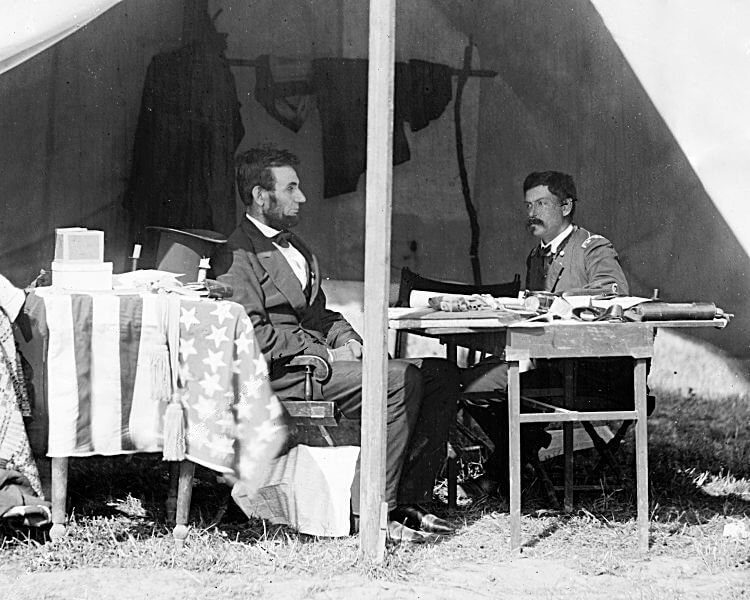
Soon after Abraham Lincoln became President, there broke out the civil war, which caused the death of many hundreds of thousands of brave men and brought sorrow to nearly every home in the United States. Perhaps none of those who study this book will ever see so sad a time. But it was also a brave time, when men gave their lives for the cause they believed to be right. Women, in those days, suffered in patience the loss of their husbands and sons, and very many of them went to nurse the wounded or toiled at home to gather supplies of nourishing food for sick soldiers in hospitals.

The war came about in this way: There had been almost from the foundation of the Government a rivalry between the Northern and Southern States. Long and angry debates took place about slavery, about the rights of the States and the government of the Territories. These had produced much bitter feeling. When a President opposed to slavery was elected, some of the Southern States claimed that they had a right to withdraw from the Union. This the Northern States denied, declaring that the Union could not be divided; but before Lincoln was inaugurated, seven States had declared themselves out of the Union. They formed a new government, which they called “the Confederate States of America,” and elected Jefferson Davis President.

President Lincoln refused to acknowledge that the Confederate States were a government. He refused to allow the United States fort in the harbor of Charleston, South Carolina, to be surrendered to the Confederates, and he sent ships with provisions for the small garrison of this fort. The Southern troops about Charleston refused to let these provisions be landed and at length opened fire on the fort. This began the war. Four other States now joined the Confederacy, making eleven in all.

It was a time of awful excitement in every part of the country. All winter long angry passions had been rising both in the North and in the South. When the first gun was fired at Sumter, in April, 1861, there was such a storm of fierce excitement as may never be seen again in America. At the North, a hundred thousand men were enlisted in three days. The excitement at the South was just as great, and a large portion of the Southern people rushed to arms. In those stormy times the drums were beating all day long in the streets; flags waved in every direction, and trains were thronged with armed men bidding farewell to friends and hastening forward to battle and death. Men and women wept in the streets as they cheered “the boys” who were hurrying away to the war. For a while, people hardly took time to sleep.

We cannot tell the story of the war here; you will study about it in larger histories. The armies on both sides became very large, and during the war there were some of the greatest conflicts ever seen in the world. The first great battle was fought at Shiloh, in Tennessee. Others took place at Murfreesboro [mur’-freze-bur’-ro], Chickamauga [chick-a-maw’-gah], and Nashville, in Tennessee; at Antietam [an-tee’-tam], in Maryland; and at Gettysburg, in Pennsylvania. Very many battles, great and small, were fought in Virginia, between Washington and Richmond.

On the side of the Union, the three most famous generals were U. S. Grant, W. T. Sherman, and Philip H. Sheridan. The three greatest generals on the Confederate side were Robert E. Lee, Joseph E. Johnston, and Thomas J. Jackson, commonly called “Stonewall Jackson.”

Both sides showed the greatest courage. The generals on both sides were very skillful. Victory was now with one party and now with the other; but, as the years passed on, the Union armies, being the stronger, gradually gained one advantage after another. By means of troops and gunboats sent down from the North under Grant and a fleet under Admiral Farragnt, which was sent around by sea to capture New Orleans, the whole of the Mississippi River was secured. Between Washington and Richmond, the Confederates won many victories, but they were at length compelled to fall back behind the fortifications of Richmond and Petersburg, where they were besieged by General Grant.

During the time of this siege, General Sherman marched directly into the heart of the Confederacy, where he was for weeks without any communication with the North. He marched across the great and fertile State of Georgia, from Atlanta to Savannah, on the sea coast, and then from Savannah northward toward Richmond. By destroying the railroads and the food by which General Lee’s army in Richmond was supplied, this march of Sherman’s made it impossible for the Confederates to continue the war.

Lee was forced to retreat from Richmond, and he surrendered his army on the 9th of April, 1865. All the other Confederate forces soon after laid down their arms. The war had lasted four years. As a result of the long struggle, slavery was abolished in all the territory of the United States.

Weekly Recap of Articles for Christians Jan 4th to Jan 10th

Bible

Franklin, the Printer

When Ben Franklin left his brother, he tried in vain to get a place in one of the other printing offices in Boston. But James Franklin had sent word to the other printers not to take Benjamin into their employ. There was no other town nearer than New York large enough to support a printing office. Franklin, who was now but seventeen years old, sold some of his books, and secretly got aboard a sloop ready to sail to New York. In New York he could find no work but was recommended to try in Philadelphia.

The modes of travel in that time were very rough. The easiest way of getting from Boston to New York was by sailing vessels. To get to Philadelphia, Franklin had first to take a sailboat to Amboy, in New Jersey. On the way, a squall of wind tore the sails and drove the boat to anchor near the Long Island shore, where our runaway boy lay all night in the little hold of the boat, with the waves beating over the deck and the water leaking down on him. When at last he landed at Amboy, he had been thirty hours without anything to eat or any water to drink.

Having but little money in his pocket, he had to walk from Amboy to Burlington; and when, soaked by rain, he stopped at an inn, he cut such a figure that the people came near arresting him for a runaway bond servant, of whom there were many in that time. He thought he might better have stayed at home.

This tired and mud-spattered young fellow got a chance to go from Burlington to Philadelphia in a rowboat by taking his turn at the oars. There were no street lamps in the town of Philadelphia, and the men in the boat passed the town without knowing it. Like forlorn tramps, they landed and made a fire of some fence rails.

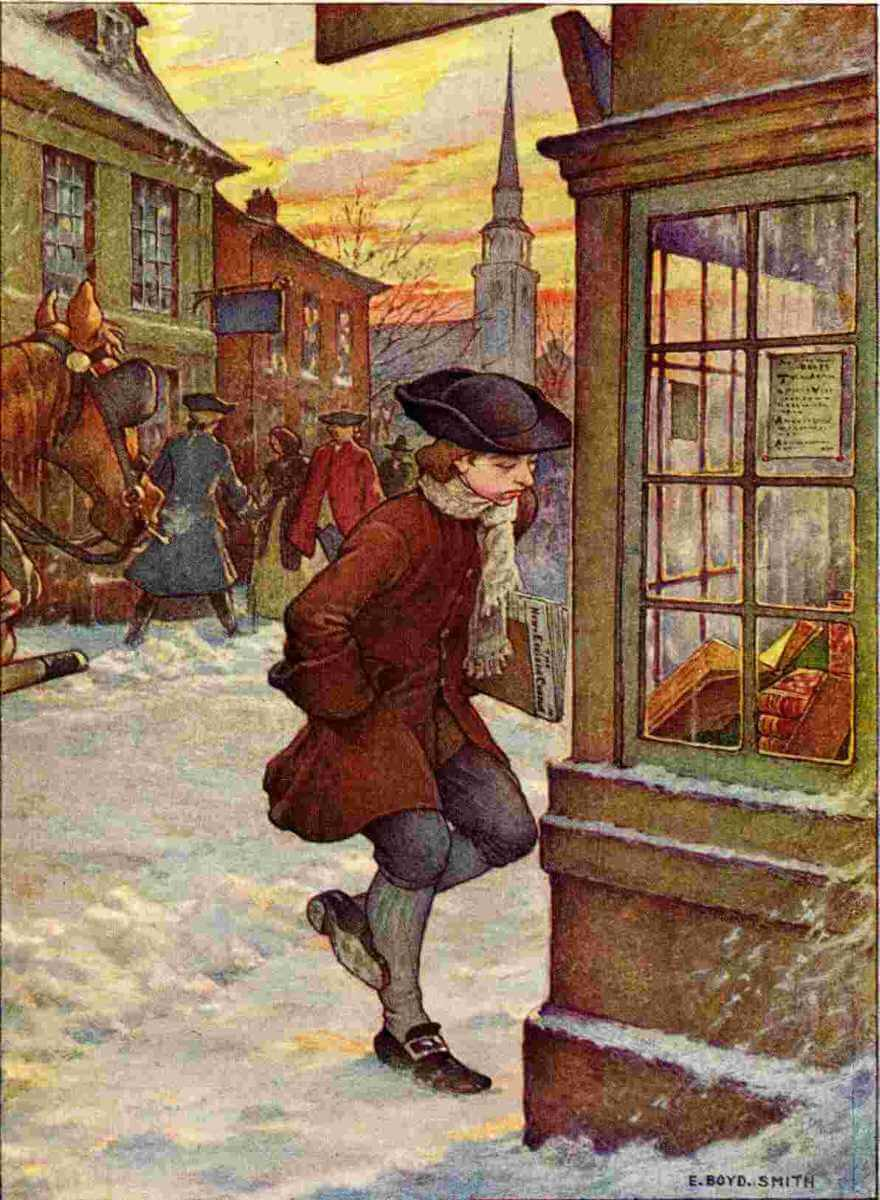
When they got back to Philadelphia in the morning, Franklin — who was to become in time the most famous man in that town — walked up the street in his working clothes, which were badly soiled by his rough journey. His spare stockings and shirt were stuffed into his pockets. He bought three large rolls at a baker’s shop. One of these he carried under each arm; the other he munched as he walked.

As he passed along the street, a girl named Deborah Read stood in the door of her lather’s house and laughed at the funny sight of a young fellow with bulging pockets and a roll under each arm. Years afterward this same Deborah was married to Franklin.

Franklin got a place to work with a printer named Keimer. He was now only a poor printer-boy, in leather breeches such as workingmen wore at that time. But, though he looked poor, he was already different from most of the boys in Philadelphia. He was a lover of good books. The child who has learned to read the best books will be an educated citizen, with or without schools. The great difference between people is shown in the way they spend their leisure time. Franklin, when not studying, spent his evenings with a few young people who were also fond of books. Here is the sort of young person that will come to something.

I suppose people began to notice and talk about this studious young workman. One day Keimer, the printer for whom Franklin was at work, saw coming toward his office, Sir William Keith, the governor of the province of Pennsylvania, and another gentleman, both finely dressed after the fashion of the time, in powdered periwigs and silver knee buckles. Keimer was delighted to have such visitors, and he ran down to meet the men. But imagine his disappointment when the governor asked to see Franklin and led away the young printer in leather breeches to talk with him in the tavern.

The governor wanted Franklin to set up a printing office of his own, because both Keimer and the other masterprinter in Philadelphia were poor workmen. But Franklin had no money, and it took a great deal to buy a printing press and types in that day. Franklin told the governor that he did not believe his father would help him to buy an outfit. But the governor wrote a letter himself to Franklin’s father, asking him to start Benjamin in business.

So Franklin went back to Boston in a better plight than that in which he had left. He had on a brand new suit of clothes, he carried a watch, and he had some silver in his pockets. His father and mother were glad to see him once more, but his father told him he was too young to start in business for himself.

Franklin returned to Philadelphia. Governor Keith, who was one of those gentlemen that make many promising speeches, now offered to start Franklin himself. He wanted him to go to London to buy the printing press. He promised to give the young man letters to people in London, and one that would get him the money to buy the press.

But, somehow, every time that Franklin called on the governor for the letters he was told to call again. At last, Franklin went on shipboard, thinking the governor had sent the letters in the ship’s letterbag. Before the ship got to England the bag was opened, and no letters for Franklin were found. A gentleman now told Franklin that Keith made a great many such promises, but he never kept them. Fine clothes do not make a fine gentleman.

So Franklin was left in London without money or friends. But he got work as a printer, and learned some things about the business that he could not learn in America. The English printers drank a great deal of beer. They laughed at Franklin because he did not use beer, and they called him the “Water American.” But Franklin wasn’t a fellow to be afraid of ridicule. The English printers told Franklin that water would make him weak, but they were surprised to find him able to lift more than any of them. Franklin was also a strong swimmer. In London, Franklin kept up his reading. He paid a man who kept a secondhand bookstore for permission to read his books.

Franklin came back to Philadelphia as clerk for a merchant, but the merchant soon died, and Franklin went to work again for his old master, Keimer. He was very useful, for he could make ink and cast type when they were needed, and he also engraved some designs on type metal. Keimer once fell out with Franklin and discharged him, but he begged him to come back when there was some paper money to be printed, which Keimer could not print without Franklin’s help in making the engravings.

Boyhood of Franklin

Benjamin Franklin, the youngest in a family of seventeen children, was born in Boston in 1706. Benjamin learned to read when he was very young, but he was only sent to school for two years. When he was ten years old he had to help his father. Franklin’s father made his living by boiling soap and making tallow candles. Little Benjamin had to cut wicks for the candles, fill the molds with the melted tallow, tend the shop, and run on errands. He did not like the soap and candle trade. Playing about the water, he had learned to swim and manage a boat. Like many other boys, he got the notion that it would be a fine thing to go to sea and be a sailor. But his father did not think so.

Franklin and his playmates used to fish for minnows in a millpond which had a salt marsh for a shore, so that the boys had to stand in the mud. He was a leader among the boys and already very ingenious. So he proposed that the boys should build a little wharf in this marsh to stand on. Near the marsh there was a pile of stones, put there to be used in building a new house. In the evening, when the workmen were gone, Franklin and the other boys tugged and toiled until they had managed to carry all these stones away and build them into a wharf or pier reaching out into the water.

In the morning, the workmen were very much surprised to find that their pile of stones had walked away during the night. They soon found out where the stones were and complained to the parents of the boys. Franklin and some of the other boys were punished for their mischief. Benjamin tried to make his father see that it was a very useful work to build such a pier, but the father soon showed him that “nothing was useful that was not honest.”

When Franklin had worked for two years with his father at the trade of making tallow candles, the father began to be afraid that Ben would run away and go to sea, as another of his sons had done before. So Franklin’s father took him walking with him sometimes to look at men working at their trades, such as bricklaying, turning, and joining, to see if the boy would not take a fancy to one of these occupations. Meantime, Benjamin became very fond of reading. He read his father’s books, which were very dull for children, and he sold some little things of his own to buy more. As the boy was so fond of books, Benjamin’s father could think of nothing better than to make him a printer. So Benjamin was apprenticed to his older brother, James Franklin, who already had a printing office. Benjamin liked this trade and learned very fast. As he was often sent to bookstores, he got a chance to borrow books. He sometimes sat up all night to read one of these, taking great care to keep the books clean and return them soon.

Benjamin took a fancy to write poetry about this time. His brother printed this “wretched stuff,” as Franklin afterward called it, and sent the boy around the town to peddle it. Ben was very proud of his poetry until his father made fun of it and told him that “verse makers were generally beggars.”

Franklin had a notion as a boy that it was wrong to eat meat, so he told his brother that if he would give him half of what his board cost, he would board himself. After this, Benjamin made his dinner on biscuit or a tart from the baker’s. In this way, he saved some of his board money to buy books and used the time while the other printers were at dinner to study.

James Franklin, Benjamin’s brother, printed a little newspaper. Franklin was printer’s boy and paper carrier, for after he had worked at printing the papers, he carried them around to the houses of the subscribers. But he also wanted to write for the paper. He did not dare propose so bold a thing to his brother, so he wrote some articles and put them under the printing office door at night. They were printed, and even Benjamin’s brother did not suspect that they were written by the boy.

The two brothers did not get on well together. The younger brother was rather saucy, and the older brother, who was high-tempered, sometimes gave him a whipping.

James Franklin once printed something in his newspaper which offended the government of the colony. He was arrested and put in prison for a month; for the press was not free in that day. Benjamin ran the little paper while his brother was in prison and put in the sharpest things he dared to say about the government. After James got out of prison, he was forbidden to print a newspaper any longer. So he made up his mind to print it in the name of his brother Benjamin. In order to do this, he was obliged to release Benjamin Franklin from his apprenticeship, though it was agreed that Ben was to remain at work for his brother, as though still an apprentice, till he was twenty-one years old. But Benjamin soon got into another quarrel with his brother, and now that he was no longer bound, Benjamin left him. This was not fair on his part, and he was afterward sorry for it.

Bacon and his Men

In 1676, just a hundred years before the American Revolution, the people of Virginia were very much oppressed by Sir William Berkeley, the governor appointed by the king of England. Their property was taken away by unjust taxes and in other ways. The governor had managed to get all the power into his own hands and those of his friends.

This was the time of King Philip’s War in New England. The news of this war made the American Indians of Virginia uneasy, and at length the Susquehannas and other tribes attacked the frontiers. Governor Berkeley would not do anything to protect the people on the frontier, because he was making a great deal of money out of the trade with friendly Indians. If troops were sent against them, this profitable trade would be stopped.

When many hundreds of people on the frontier had been put to death, some three hundred men formed themselves into a company to fight the Indians. But Berkeley refused to allow anyone to take command of this troop or to let them go against the Indians.

There was a young gentleman named Nathaniel Bacon, who had come from England three years before. He was a member of the governor’s council and an educated man. He begged the governor to let him lead this company of three hundred men against the Indians, but the old governor refused.

Bacon disagreed and wished to fight the Indians. He went to the camp of these men, to see and encourage them. But when they saw him, they set up a cry, “A Bacon! A Bacon! A Bacon!” This was the way of cheering a man at that day and choosing him for a leader.

Bacon knew that the governor might put him to death if he disobeyed orders, but he wished to defend his fellow colonists.

Berkeley gathered his friends and started after Bacon, declaring that he would hang Bacon for going to war without orders. While the old governor was looking for Bacon, the people down by the coast rose in favor of Bacon. The governor had to make peace with them by promising to let them choose a new legislature.

When Bacon got back from the Indian country, the frontier people cheered him as their deliverer. They kept guard night and day over his house. They were afraid the angry governor would send men to kill him.

The people of his county elected Bacon a member of the new Legislature. But they were afraid the governor might harm him. Forty of them with guns went down to Jamestown with him in a sloop. With the help of two boats and a ship, the governor captured Bacon’s sloop, and brought Bacon into Jamestown. But as the angry people were already rising to defend their leader, Berkeley was afraid to hurt him. He made him apologize, and restored him to his place in the Council.

But that night, Bacon was warned that the next day he would be seized again, and that the roads and river were guarded to keep him from getting away. So Bacon took horse suddenly and galloped out of Jamestown in the darkness. The next morning, the governor sent men to search the house where Bacon had stayed. Berkeley’s men stuck their swords through the beds, thinking Bacon hidden there.

But Bacon was already among friends. When the country people heard that Bacon was in danger, they seized their guns and vowed to kill the governor and all his party. Bacon was quickly marching on Jamestown with five hundred angry men at his back. The people refused to help the governor, and Bacon and his men entered Jamestown. It was their turn to guard the roads and keep Berkeley in.

The old governor offered to fight the young captain single-handed, but Bacon told him he would not harm him. Bacon forced the governor to sign a commission appointing Bacon a general. Bacon also made the Legislature pass good laws for the relief of the people. These laws were remembered long after Nathaniel Bacon’s death, and were known as “Bacon’s Laws.”

While this work of doing away with bad laws and making good ones was going on, the Indians attacked at a place only about twenty miles from Jamestown. General Bacon promptly started for the Indian country with his little army. But, just as he was leaving the settlements, he heard that the governor was raising troops to take him when he should get back; so he turned around and marched swiftly back to Jamestown.

The governor had called out the militia, but when they learned that instead of taking them to fight the Indians they were to go against Bacon, they all began to murmur, “Bacon! Bacon! Bacon!” Then they left the field and went home, and the old governor fainted with disappointment. He was forced to flee for safety to the eastern shore of Chesapeake Bay, and the government fell into the hands of General Bacon.

Bacon had an enemy on each side of him. No sooner had Berkeley gone than the Indians again attacked. Bacon once more marched against them and killed many. He and his men lived on horseflesh and chinquapin nuts during this expedition.

When Bacon got back to the settlements and had dismissed all but one hundred and thirty-six of his men, he heard that Governor Berkeley had gathered together seventeen vessels and six hundred sailors and others, and with these had taken possession of Jamestown. Worn out as they were with fatigue and hunger, Bacon persuaded his band to march straight for Jamestown, so as to take Berkeley by surprise.

As the weary and dusty veterans of the Indian war hurried onward to Jamestown, the people cheered the company. The women called after Bacon, “General, if you need help, send for us!” So fast did these men march that they reached the narrow neck of sand that connected Jamestown with the mainland before the governor had heard of their coming. Bacon’s men dug trenches in the night and shut in the governor and his people.

After a while, Bacon got some cannon. He wanted to put them up on his breastworks without losing the life of any of his brave soldiers. So he sent to the plantations nearby and brought to his camp the wives of the chief men in the governor’s party. These ladies he had sit in front of his works until his cannon were in place. He knew that the enemy would not fire on the ladies. When he had finished, he sent the ladies home.

Great numbers of the people now flocked to General Bacon’s standard, and the governor and his followers left Jamestown in their vessels. Knowing that they would try to return, Bacon ordered the town to be burned to the ground. Almost all of the people except those on the eastern shore sided with Bacon, who now did his best to put the government in order. But the hardships he had been through were too much for him. He sickened and died. His friends knew that Berkeley would soon get control again, now that their leader was dead. They knew that his enemies would dig up Bacon’s body and hang it, after the fashion of that time. No one knows where they buried Bacon’s body, but as they put stones in his coffin, they must have sunk it in the river.

Governor Berkeley got back his power and hanged many of Bacon’s friends. But the king of England removed Berkeley in disgrace, and he died of a broken heart. The governors who came after were generally careful not to oppress the people too far. They were afraid another Bacon might rise up against them.

Engaging Children’s Books, Fun Facts and Delicious Recipes

Children’s Bible books

  • For older kids
    • THE CHILDREN’S SIX MINUTES by Bruce S. Wright: The Children’s Six Minutes by Bruce S. Wright features a collection of themes exploring growth, kindness, faith, and life’s lessons through various engaging stories and reflections.
    • The Wonder Book of Bible Stories: “The Wonder Book of Bible Stories” by Logan Marshall shares simplified biblical narratives for children, conveying essential moral lessons through engaging tales from the Bible.

Children’s books

  • For younger kids
    • McGuffey Eclectic Primer: textbook focused on early literacy, teaching reading and writing through simple lessons and moral stories for young children.
    • McGuffey’s First Eclectic Reader: educational textbook for young readers, combining phonics, sight words, moral lessons, and simple narratives to enhance literacy skills.
    • MCGUFFEY’S SECOND ECLECTIC READER: educational book for children, promoting literacy and moral values through engaging prose, poetry, and vocabulary exercises.
    • The Real Mother Goose: a collection of nursery rhymes, reflecting childhood’s whimsical essence through well-known verses and engaging illustrations.
    • THE GREAT BIG TREASURY OF BEATRIX POTTER: The Great Big Treasury of Beatrix Potter features beloved stories like The Tale of Peter Rabbit and The Tale of Jemima Puddle-Duck, celebrating whimsical animal adventures.
    • The Tale of Solomon Owl is a whimsical children’s book by Arthur Scott Bailey, exploring themes of friendship and adventure through Solomon Owl’s humorous encounters with forest animals.
    • THE TALE OF JOLLY ROBIN: follows a young bird’s adventures as he learns life skills, values friendship, and explores youthful curiosity through humorous encounters in the wild.
    • Peter and Polly Series: The content describes a series of stories for 1st graders featuring Peter and Polly, exploring seasonal adventures, imaginative play, nature, family, and interactions with pets and animals.
    • The Adventures of Old Mr. Toad: recounts Old Mr. Toad’s humorous nature-filled journeys, emphasizing lessons on friendship, humility, and personal growth amidst various animal encounters.
    • The Wonderful Wizard of Oz: follows Dorothy’s adventures in Oz as she seeks to return home, meeting memorable friends while exploring themes of courage, friendship, and self-discovery.
  • For older kids
    • Stories of Don Quixote Written Anew for Children retells key adventures from Cervantes’ novel, preserving its spirit while engagingly presenting them for young readers in a cohesive narrative.
    • Heidi by Johanna Spyri follows a young girl adapting to life in the Swiss Alps with her grandfather, highlighting themes of family, love, and the power of nature.
    • Swiss Family Robinson by Johann David Wyss: is a beloved adventure novel by Johann David Wyss about a Swiss family stranded on a deserted island, relying on their creativity and teamwork to survive and build a new life.
    • Rebecca Of Sunnybrook Farm: follows the spirited Rebecca Randall as she navigates life with her aunts in Riverboro, experiencing adventure, growth, and identity exploration.

Children’s history book

  • For younger kids
    • Great Stories for Little Americans: introduces young readers to American history through engaging tales, fostering national pride and knowledge of heritage via accessible storytelling.
    • The Bird-woman of the Lewis and Clark Expedition: A Supplementary Reader for First and Second Grades- tells Sacajawea’s vital role in guiding the explorers, emphasizing her contributions and experiences during this historic journey.
    • The Story of Mankind: chronicles human history from prehistory to the modern era, highlighting key events, cultures, and figures that shaped civilization.
    • A First Book in American History: A first book in American history: with special reference to the lives and deeds of great Americans. This book chronicles pivotal figures in American history, from Columbus and John Smith to Franklin and Lincoln, highlighting their contributions and the nation’s expansion.
  • For older kids

Poem and stories

  • THE PLYMOUTH HARVEST by Governor Bradford
  • The Real Mother Goose Poems Book: a collection of nursery rhymes, reflecting childhood’s whimsical essence through well-known verses and engaging illustrations.
  • Top Poems for Children by Famous Authors: A list of children’s poems organized by author, with future additions anticipated, includes works by notable poets and authors. [Coming soon]
  • Poems and stories by Bell: Bell, a young poet, shares her love for God through inspiring poems and stories centered on nature, love, and faith, aiming to bless and bring joy to readers.
  • Explore Heartfelt Poems and Stories for Inspiration: Poems and stories to warm your heart.
  • Heartfelt Tales of My Beloved Pets: The author shares stories of various animals that have impacted their life, encouraging love for pets and providing comforting Bible verses for grieving pet owners.

Children bible study

Captain Church in Philip’s War

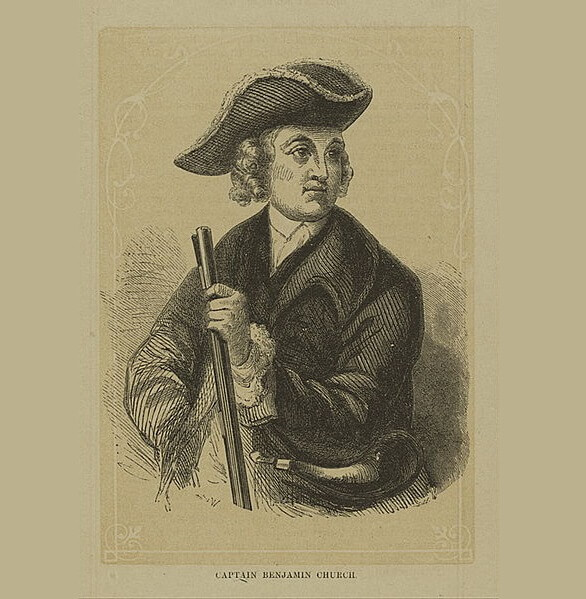
The colonists had not learned how to fight the Wampanoag and Narragansett Indians, who moved swiftly from place to place, and hid themselves in the darkest swamps. But at last the man was found who could battle with the American Indians in their own way. This was Captain Benjamin Church.

Church could not only fight the Indians, but he knew how to make them his friends. The Sakonet tribe, not far from his home, was under control of a woman chief. Her name was Awashonks. She and Benjamin Church were good friends, and after the war broke out Church tried to go to see her. Some of the Indians of her tribe who were friendly to Philip attacked Church and his men, so that they had to hide behind a fence till a boat came and took them away.

Later in the war, Church sent word to Awashonks that he would meet her and four other Indians at a certain place. But the rulers of Plymouth Colony thought it too dangerous for Church to go to see the woman chief. They would not give him any men for such an expedition.

However, Church went on his own account, with one colonist and three Indians. He took some tobacco and a bottle of rum as presents suited to the taste of this Indian queen. Church ventured ashore, leaving his canoe to stand off at a safe distance, so that if he should be killed the men in the canoe might carry the news to the other colonists. Awashonks and the four Indians met him and thanked him for venturing among them. But soon a great number of warriors, frightfully painted and armed, rose up out of the tall grass and surrounded Captain Church. The captain knew that if he showed himself frightened he would be killed.

“Have you not met me to talk about peace?” he said to Awashonks.

“Yes,” said Awashonks.

“When people meet to talk of peace they lay down their arms,” said Captain Church.

The Indians now began to look surly and to mutter something.

“If you will put aside your guns, that will do,” said Church.

The Indian warriors laid down their guns and squatted on the grass. But during the discussion, some of them grew angry. One fellow with a wooden tomahawk wished to kill Church, but the others pushed him away. The captain succeeded in making peace with this tribe, who agreed to take the side of the English against Philip and the Wampanoags.

Awashonks held a war dance after this, and Church attended. The Indians lighted a great bonfire and moved about it in rings. One of the braves stepped inside the circle and called out the name of one of the tribe fighting on Philip’s side against the colonists. Then he pulled a firebrand out of the fire to represent that tribe, and he made a show of fighting with the firebrand. Every time the name of a tribe was called, a firebrand was drawn out and attacked in this way.

After this ceremony, Church could call on as many of these Indians as he wished to help him against Philip. With small bands of these Indians and a few colonists, Captain Church scoured the woods, capturing a great many enemy prisoners.

At last so many of Philip’s Indians were taken, that Philip himself was fleeing from swamp to swamp to avoid falling into the hands of the colonists. But he grew fiercer as he grew more desperate. He killed one of his men for telling him that he ought to make peace with the colonists. The brother of this man whom he killed ran away from Philip, and came into the settlement to tell the colonists where to find that chief.

Captain Church had just come from chasing Philip to make a short visit to his wife. The poor woman had been so anxious for her husband’s safety that she fainted when she saw him. By the time she had recovered, the Indian deserter came to tell Church where Philip could be found, and the captain galloped off at once.

Church placed his men near the swamp in which Philip was hidden. The Indians took the alarm and fled. In running away, Philip ran straight toward Church’s hidden men and was shot by the very Indian whose brother he had killed. His head was cut off and stuck up over a gatepost at Plymouth. Such was the savage custom of the colonists in that day.

Philip’s chief captain, Annawon, got away with a considerable number of Indians. Church and half a dozen of his Indian scouts captured an old man and a young woman who belonged to Annawon’s party. They made these two walk ahead of them carrying baskets, while Church and his men crept behind them. In this way, they got down a steep bank right into the camp of Annawon, whose party was much stronger than Church’s. But Church seized the guns of the Indians, which were stacked together.

“I am taken,” cried Annawon.

Annawon later came with a bundle in his arms. “You have killed Philip and conquered his country. I and my company are the last. This war is ended by you, and therefore these things are yours.”

He opened the bundle, which contained Philip’s belts of wampum and the red blanket in which Philip dressed on great occasions.

This ended King Philip’s War.

Metacomet (King Philip)

When the Pilgrims first came to New England, they found that the nearest tribe of American Indians, the Wam-pa-no’-ags of which Massasoit was chief, had been much reduced in number by a dreadful sickness. The bones of the dead lay bleaching on the ground.

The next neighbors to the Wampanoags were the Narragansetts. The Narragansetts had not been visited by the great sickness but were as numerous and strong as ever. Massasoit was, therefore, very glad to have the English, with their superior guns and long swords, near him, to protect his people from the Narragansetts.

The two sons of Massasoit remained friendly to the settlers for some time after their father’s death. But many things made the Wampanoags discontented. They sold their lands to the colonists for blankets, hatchets, and such like things. The ground was all covered with woods, and, as they only used it for hunting, didn’t perceive what it meant to “sell” the land. But when the Wampanoags realized what selling their land entailed, they wished to be paid more.

Many of this tribe of Indians became Christians through the preaching of John Eliot, who was called “The Apostle to the Indians.” These were called “praying Indians.” They settled in villages, though they continued to dwell in bark-houses, because they found that the easiest way to clean house was to leave the old one and build a new. They no longer followed their chiefs or respected the charms of the medicine men. It made the great men among the Wampanoags angry to see their people leave them.

The young Wampanoag chief, Wamsutta, or King Alexander, began to show ill-feeling toward the colonists. The rulers of Plymouth Colony retaliated with harsh measures against him. They sent some soldiers to detain him and brought him to Plymouth. When the Wampanoag chief saw himself arrested and degraded in this way he felt it bitterly. He was taken sick at Plymouth and died soon after he got home.

The Wampanoags suspected that King Alexander had died of poison given him by the colonists. Sometime afterward the colonists heard that King Alexander’s brother, the new Wampanoag chief, Metacomet, now called King Philip, was sharpening hatchets and knives. The colonists immediately sent for the chief and forced him and his men to give up the seventy guns they had brought with them. They also made Philip promise to send in all the other guns his men had.

When the colonists first came, the Wampanoags had nothing to shoot with but bows and arrows. In Philip’s time they had given up bows, finding guns much better for killing game. So once Philip once got away from the colonists, he did not send in the guns. But he wisely hid his anger and waited for a more opportune chance to strike.

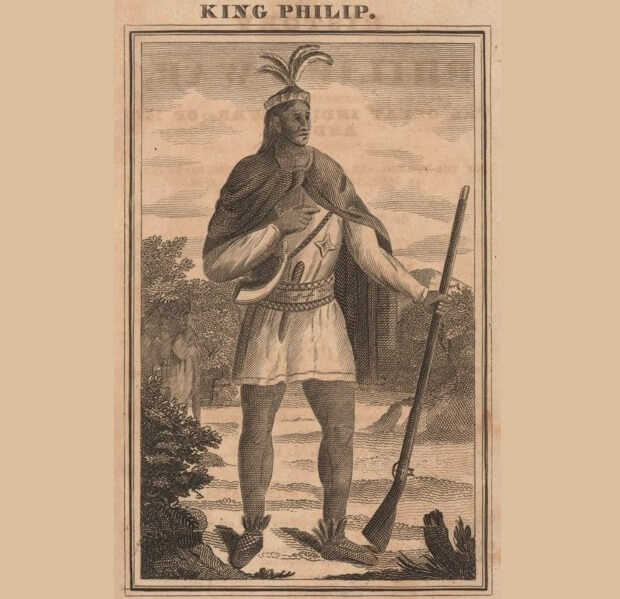
As Wampanoag chief, Philip had a coat made of shell-beads, or wampum. These beads were made by breaking and polishing little bits of hard-clam shells, and then boring a hole through them with a stone awl, as you see in the picture. Wampum was used for money among the Indians, and even among the colonists at that time. Such a coat as Philip’s was very valuable. Philip dressed himself, also, in a red blanket; he wore a belt of wampum about his head and another long belt of wampum around his neck, the ends of which dangled nearly to the ground.

The quarrel between the colonists and the Wampanoags grew more bitter. A Wampanoag, who had told the colonists of Philip’s plans, was put to death for his treachery. The colonists retaliated by hanging the Wampanoags who had killed their informant.

The Wampanoags under Philip were now resolved on war. But their medicine men, or priests, consulted their spirits and told them that whichever side should shed the first blood would be beaten in the war. The Wampanoags burned houses and robbed farms, but they took pains not to kill anybody, until a colonist had wounded a Wampanoag. Then, when blood had been shed, the Wampanoags began to kill the colonists.

War between the Wampanoags and the colonists broke out in 1675. The New England people lived at that time in villages, most of them not very far from the sea. The more exposed towns were struck first. The colonists took refuge in strong houses, which were built to resist attacks. But everywhere colonists who moved about were killed.

The colonists sent out troops, but the Wampanoags strategically waylaid the soldiers and killed them. Philip cut up his fine wampum coat and sent the bead money of which it was made to neighboring chiefs to persuade them to join him. Soon other tribes, entered the fight against the colonists.

As the Wampanoags grew bolder, they attacked the colonists in their forts or block-houses. At Brookfield they shot burning arrows on the roof of the block-house, but the colonists tore off the shingles and put out the fire. Then the Wampanoags crept up and lighted a fire under one corner of the house; but the men inside made a dash and put the fire out. Then the Wampanoags made a cart with a barrel for a wheel. They loaded this with straw and lighted it, and backed the blazing mass up against the house, sheltering themselves behind it. Luckily for the colonists, a shower came up at that moment and put out the fire.

A very curious thing happened at Hatfield. An old gentleman named Colonel Goffe was hid away in a house in that town. He was one of the judges that had condemned Charles I to death twenty-six years before. When the son of King Charles I came to be king he put to death the people were gone to such of these judges as he could find, and Goffe had to flee from England and hide. Nobody in the village knew that Goffe was there, except those who entertained him. While the people were gone to church one Sunday, the old colonel ventured to look out of the window, which he did not dare to do at other times. He saw the Wampanoags coming to attack the town. He rushed out and gave the alarm, and, with long white hair and beard streaming in the wind, the old soldier took command of the villagers and saved the town. But when the fight was over, the people could not find the old man who had led them, nor did they know who he was or where he came from. They said that a messenger had been sent from heaven to deliver them.

The powerful tribe of the Narragansetts promised remain peaceable, but some of the Narragansetts joined Philip, and their great fort was a respite for Philip’s men. In retaliation, the colonists resolved to strike against the Narragansett town while it was yet winter. A thousand men from Massachusetts and Connecticut assaulted the Narragansett town by night, which was inside a fortification having but one entrance, and that by a bridge. Nearly two hundred of the colonists were killed in this fight, and many hundreds of Narragansett people were slain, and their fort and all their provisions were burned.

After the colonists burned their town, the Narragansetts joined Philip at once. The colonists in armor could not catch the nimble Indians, who attacked one village only to disappear and strike another village far away.