A place to grow your relationship with God

Archive for the ‘Pilgrim’s Stories’ Category

Pilgrim Stories: Chapters 11 and 12

A LITTLE MILK PEDDLER

IN a cottage near the Pilgrims lived Mevrow van Ness and her three children. Karl was twelve years old and did not like being called a child. Had he not been “mother’s right-hand man” all these long weeks while his father was away in his fishing boat? And did he not peddle milk every day to earn money for the family?

11

“The dogs knew where to take the milk almost as well as Karl”

Karl had two trusty dogs, and every morning he harnessed them to a little cart. Into the cart he put three shining kettles filled with milk and a long-handled dipper to measure it. Sometimes there were round, yellow cheeses or butter-like balls of gold to put into the cart, for people were always glad to buy Mevrow’s butter and cheese.

The little Pilgrim boys liked to go with Karl when he peddled milk. They liked to help him harness the dogs, and when the cart was ready, away they would all go over the rough stone street. It was hard to tell which made the most noise, Karl’s wooden shoes, the heavy wheels of the cart, or the clanging of the milk kettles as they bumped together.

The dogs knew where to take the milk almost as well as Karl did. They stood very still while he went to the door. Often as Karl raised his hand to rap, the door opened, for the good housewife had seen him in her looking-glass. Many of the Dutch women had two looking-glasses just outside their windows. In them they could see far up and down the street without leaving their chairs.

There was at least one pair of wooden shoes on nearly every doorstep, for the children of Holland are taught to take off their shoes before they go into the house.

One morning there was a pretty blue pincushion on the door of a house where Karl and Jonathan Brewster left milk. It was made of silk and trimmed with ribbon and lace.

“What a queer place for a pincushion!” exclaimed Jonathan.

“Don’t you know what that means? The storks have brought a baby girl to this house,” answered Karl.

“The storks!” exclaimed Jonathan, in surprise.

“The storks, of course,” answered Karl. “If you are kind to the storks, and never hurt them or say cross things about them, they will bring you all sorts of good luck. Perhaps they will like you well enough to build a nest on your chimney. If you nail a cartwheel across the largest chimney, it will make a better place for a nest.”

“There goes a stork now, with a frog in his mouth. As he flies he looks like a great goose, except for those long legs stretched out behind him,” said Jonathan.

“Oh, he is much larger than a goose, and his bill is three times as long.”

“Are storks as good to eat as geese?” asked Jonathan.

“To eat! Eat a stork!” cried Karl, in horror. “We would not kill a stork for anything. Did I not tell you storks bring good luck?”

“It would be good luck to get such a big bird if it tasted as good as Christmas goose,” replied Jonathan.

“Greedy! it would be the last good luck you would ever have,” answered the little Hollander.

“Pooh!” said Jonathan, “My father says there is no such thing as luck.”

“Just let me tell you what happened to Jacob Pelton,” said Karl. “For two hours he had sat on the dike with his rod and line and had caught only three little fish, so Jacob was very cross.

“Just as he came up to his house with his basket on his arm, down flew one of the storks which lived on his chimney. I suppose the stork had not had good luck with his fishing, either, and his babies and their mother were hungry.

“When the stork saw Jacob’s basket of fish he put in his long bill and helped himself to the largest one there. Oh, how angry Jacob was! Before the stork had time to spread his wings, Jacob struck him with his staff. I am sure he did not mean to kill the bird, but there he lay dead.

“And now listen,” said Karl, in a low voice. “That very week the cows got in and ate up all of his garden. Then little Peter fell off the dike and broke his arm. Not long after that Jacob lost his place in the mill. He has had bad luck ever since he killed that stork.”

“I do not believe the storks had a thing to do with it,” said Jonathan, when the story was ended.

“You just ask anybody in Amsterdam whether storks bring luck,” answered Karl.

“You have a nest of storks on your chimney. What good luck did they ever bring you?” asked Jonathan.

“Oh, we are always lucky,” answered Karl. “Every season father catches a great boat load of fish. We can always sell our milk and vegetables, butter and cheese. We are almost always well, and all last year I stood at the head of my class at school. Yes, the storks have brought us much good luck.”

“I do not believe in storks, anyway,” insisted the little Englishman.

“Hush!” whispered Karl. “You would better not let the storks hear you say that.”

WINTER IN HOLLAND

WHEN the days grew shorter and cooler there were no baby storks in their homes on the chimney tops. Those that were little birdlings when the Pilgrims went to Holland had grown large and strong. For weeks their parents had taken them on long flights into the country, that their wings might grow strong for a longer journey.

Still the days grew shorter. The cold north wind blew off the sea. Even the nest on the chimney was no longer comfortable.

The storks knew it was time to fly to their winter home in the far south. So they spread their wings and away they flew in long lines across the sky, hundreds and thousands of them.

Then came a still, cold night, and a day just as cold. There were no little girls knitting on the street that day. Their fingers were hidden in warm red mittens, and they hurried home as fast as their wooden shoes would carry them.

Boys swung their arms to keep warm, and talked of the fun there would be on the ice if it stayed cold until to-morrow. There would be no school, and the stores and mills would be closed, for the first day of skating is a holiday in Holland.

The next morning the Pilgrims were awakened at daybreak by merry shouts on the canal. Bartholomew Allerton ran to the window, but the frost on the panes was so thick he could not see out. He breathed upon the glass and scraped away some of the frost. Down the canal came eight boys in a row, each holding to the jacket of the boy in front of him. They flew past the house like a flash of light.

12

Bartholomew could hardly wait to eat his breakfast, he was so eager to go out upon the canal. Suppose we put on our skates and go with him.

What a merry place the canal is this morning! Everybody is on skates to-day. Here come three market women from the country. Each has on her shoulders a wooden yoke from which hang baskets of vegetables. There is a man with a yoke, too. He must have milk in those bright cans. I am afraid it will freeze if he has far to go.

Just see Mevrow Vetter! What is she carrying on her back? Oh, it is her baby in a snug little nest made of his mother’s shawl. He puts his arms around her neck and she holds his little hands. He is warm and happy, and he coos and chatters, trying to tell her about the people he sees on the canal. He thinks skating is great fun.

There goes Doctor Fuller, skating to see a sick man at the other end of town. At the rate he goes he will soon be there. And who is this pushing a sled before him as he skates? Bartholomew knows him. That is Peter Houten with his lame sister. She cannot skate, so Peter has fixed her chair on a sled and covered it with warm fur. On the sled is a little foot stove filled with hot coals, so she will not get cold. Her pale cheeks have grown rosy and her eyes shine with pleasure.

Now we have come to the great canal beyond the city. It is much wider than the others. Here are beautiful sleighs drawn by horses, their bells making merry music on the canal.

There is a group of boys on skates, playing the game boys play all the world over. They hit a ball with their clubs and away it flies over the smooth ice. Look out, boys! See these white sails flying down the canal. Whoever saw a sleepy canal boat go so fast! Has it too put on skates?

Whiz! Whir-r-r! It is past. What was it? Lookout! Here comes another! Whir-r! whiz! whir-r-r!

They are ice boats and have runners like a sled. The wind fills their sails and they go faster than a ship on the water, faster than the swiftest horse. They are too dangerous to run on the crowded canals in the city. They must stay on the lakes, or river, or on the great canals outside of the town. Even here they must stay on their own side of the canal and we must stay on ours, or some one will be hurt.

Pilgrim Stories chapter: Chapters 7 and 8

IN HOLLAND

audio

AT last the ship bearing the rest of the Pilgrims reached Holland. The captain had told them that soon they would land in Amsterdam. All were upon the deck eager to catch the first glimpse of the city which was to be their home.

“If it were not for this fog, I think you could see the city now,” said one of the sailors to the group of children at the bow.

They peered into the mist, but not a sign of the city could they see. Above, a ball of soft, yellow light showed where the sun was trying to shine through the haze. Sometimes a great, shadowy sail floated toward them out of the mist. Many little fishing boats passed quite close to the ship.

In one of these a little boy sat on the big brown net piled up in one end of the boat. He looked up and saw the children on the ship high above him, and waved his hand. Of course, the children waved to him, and, of course, when their ship had passed the little fishing boat, they ran to the other end of the deck and waved again. They waved until boy, net, and boat were all lost in the fog.

Then the children turned again to watch for the city.

“Oh! Oh!” cried Jonathan Brewster.

“O-o-o-o-oh!” echoed a dozen others.

What was it they saw? Out of the mist rose high, shining towers, golden church spires, and tall pointed roofs with wonderful chimneys. For a minute all were speechless.

“The city looks as though it were floating right on the water,” said Mary Chilton, when she had found her voice.

“It is, almost,” answered her mother. “I am told there is water all around it, and through it. In many of the streets are waterways where boats pass to and fro between the houses.”

“How beautiful it is!” said Mistress Brewster, who had just come upon the deck with baby Love in her arms. “I am sure we shall be very happy here. See, the sun is coming out and the mist is almost gone.”

It took the ship a long time to make its way past the other boats in the harbor, and up to the landing. On the shore stood a number of Englishmen who had waited hours for this ship to arrive. Some had lived in Holland several years, but most of them were Pilgrims who had been carried away from England in the Dutch ship.

Mary Chilton’s eyes moved quickly from one to another of the men on the shore. She was looking for a beloved face. “There he is, there!” she cried. “Mother, mother, there is father! He does not see us. Wave your handkerchief!”

The Brewster children had soon picked out their young friend William Bradford, and were waving and calling to him, though the deep shouts of the sailors drowned their voices. Nearly every one had seen some dear friend in the group on the shore.

Would the ship never make the landing? How very slow the sailors were!

Most of the men had prepared little homes for their families. They had rented small houses near together, that they might not be lonely in this strange city.

“I have taken a cottage for you near Master Robinson’s,” said Bradford to Elder Brewster, when greetings were over. “It is not such a fine large house as your home in Scrooby, but it is comfortable.”

“You are very kind,” answered the older man. “We do not need a large house. If it will shelter you and us, it is large enough.”

“Yes,” said Mistress Brewster, “we want you to make our house your home until you have one of your own.”

Bradford thanked his friends, then, taking little Fear in his strong arms, he led the way.

7

Before them was what looked to be a long hill, very flat on top. There were stairs up the side, and when these had been climbed, the Pilgrims found themselves on a wide, smooth road. They were as high as the tree tops and could look down upon the shining red roofs of the houses.

On many of the chimneys were great nests of sticks and straw. In some of them the Pilgrims saw young storks with their hungry mouths wide open for the frogs or little fishes their mothers brought them. On one chimney the mother-bird sat on the nest and the father stood on one leg beside her, guarding his home. He must have known there was no danger, for he seemed to be fast asleep.

From this high road the Pilgrims looked over the cottages into the pretty gardens behind them. They could see beautiful churches, large shops, and narrow streets.

In every direction they saw great windmills with four long arms stretched out to catch the breeze. They were taller than the highest houses, and one might fancy them to be giant watchmen guarding the city.

7.1

“In every direction they saw great windmills”

Beyond the town were a river and a large lake, and in the city itself were scores of little streams running in every direction. How strange it looked to see hundreds of masts and sails scattered about among the trees and houses!

On the other side of the road was the sea with the shining sails of many ships. How broad and smooth the water looked!

“Is this a hill, or did the people build this high street?” asked one of the boys.

“This is a dike,” answered Bradford. “Holland is a very low country. In many places it is lower than the sea, so the people have built these strong walls of earth and stone to keep the water from overflowing the land.”

“When the hard storms come, will they not push the dike over?” asked Patience.

“No, they cannot do that, because the wall is so much wider at the bottom than at the top; but the waves often dash high against the dike. They seem to try to get through the wall. The wind helps them, but the dike is too strong.

“Yet sometimes the water does make its way through the wall. At first only a tiny stream of water is seen trickling down the side of the dike. If this leak were not mended at once, the stream would soon grow larger and larger until nothing could stop it. The land would be flooded and many people lost.

“Every day and every night watchmen go up and down looking for a leak in the wall. When they find one, they ring a large bell, and all who hear it run to the dike to help stop the leak. They know there is not a moment to be lost if they would save their homes. Their swift fingers weave mats of straw which they crowd into the hole. Then, with earth and stone, the wall is made as strong as before. Even the little children are taught to watch for a leak in the dike.”

Then he told them how a whole city was once saved by one brave little Hollander who held back the water by filling a tiny leak with his small hand.

THE HOME IN AMSTERDAM

7.1

THE Pilgrims soon found the street where their new homes were. But how different it was from the streets of Scrooby!

Down the middle of it was a broad stream of water called a canal. On each side of the canal was a narrow road paved with stones. The roads were not wide enough for a horse and wagon. When the people wished to ride, or had heavy loads to carry, they used a boat on the canal.

The houses looked more odd than the street. They were made of brick of every shade of red, and pink, and yellow. They stood close to the street and quite near together. But strangest of all, many of them did not stand straight.

This is because they were not built upon walls of stone, as ours are. These houses were built upon great posts driven deep into the earth. In Holland the ground is often soft and wet. The weight of the house often makes the posts sink in deeper on one side than the other, and then the house leans to one side.

When William Bradford reached the house he had taken for his friends, he unlocked the front door with a huge brass key. Then the Brewsters stepped into—the hall or the parlor do you suppose? No, they were in the kitchen, for that is the front room in a Dutch house. The sitting room looks out on the pretty garden behind the house.

But the kitchen is often the dining room and sitting room too. At night it is very likely to be a bedroom as well, though you would never think it until you saw the queer box-like bed drawn from its hiding place in the wall.

In this kitchen the floor was made of tiles. There were fresh, white curtains in the little windows, and a row of blossoming plants on one of the window sills. A long shelf held a row of plates, a blue and white water pitcher and two tall candles.

zpage053

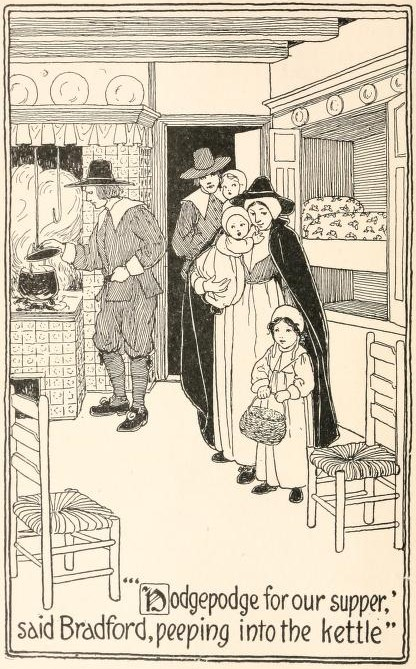
There was the queerest little fireplace in the room. It looked like a great brass pan filled with hot coals. A long chain from the shelf above it held a shining copper kettle. How it boiled, and bubbled making its bright little lid dance merrily!

“That is hodgepodge for our supper,” said Bradford, peeping into the kettle.

“What is hodgepodge? I hope it tastes as good as it smells.”

“Indeed it does, Jonathan. It is the best stew of meat and vegetables you ever tasted. Our neighbor, Mevrow van Zant, taught me how to make it. Here are some little seedcakes she gave me for you children. Our Dutch neighbors are very kind. They have done much to help us make the homes ready for our friends.”

When bedtime came, Mistress Brewster took Fear and Patience upstairs to their own little room. In the corner was a large bed quite hidden behind long curtains which reached from ceiling to floor. When Patience pulled back the curtains and saw the high feather bed she thought she would need a little ladder to get into it.

8.0

Patience thought she would need a little ladder to get into this bed

As their mother tucked the children in and kissed them good night, Patience whispered, “Isn’t this just like a dream! I fear when I waken in the morning this queer little house will be gone, the windmills and canals, the boats, the storks, and the dikes will all be gone, and we shall be in England again.”

Pilgrims Stories by Margaret B. Pumphrey

Pilgrim Stories

by

Margaret B. Pumphrey

Pilgrim Stories: Chapters 5 and 6

PILGRIMS

audio

THE next night the stars looked down upon a strange sight. On the shore of the sea near a large city, a group of Pilgrims waited for the ship which was to carry them to Holland.

It grew very late. One by one the lights of the city went out, and all was dark and still. Even the little waves seemed to speak in whispers as they crept up to the shore.

3.1

“On a wooden box sat a mother with her baby asleep in her arms”

On a wooden box sat a mother with her baby asleep in her arms. Two tired little children, with the warm sand for a bed and a blanket for a pillow, slept beside her. Some of the older children were too excited to sleep. They amused themselves by throwing pebbles into the water or playing in the sand.

Others of the company sat on boxes or on the sand, talking in low tones. They did not speak about the homes and friends they were leaving; that would make them too sad. They talked of the better times they would have in the new home.

One by one the children fell asleep, some on the warm sand, others pillowed in their mothers’ arms.

As the night wore on the men paced anxiously up and down the shore. They peered out over the black water hoping to see the dark form of the vessel which was to take them to Holland.

At any time the soldiers might be upon them. Every minute they waited on the shore added to their peril.

Watchmen were placed at points along the shore to warn the Pilgrims of any approaching danger.

A terrible dread was sinking into their hearts. What if the ship should not come at all? What if the soldiers should suddenly swoop down upon them? But these thoughts they would not speak aloud. They tried to cheer each other with encouraging words.

From a distant clock tower the bells chimed three. The Pilgrims drew closer together and spoke in hushed voices.

“Are you quite sure this is the place where the captain of the ship promised to meet us?” asked William Bradford.

“This is the very spot, just where this little brook flows into the sea,” answered Elder Brewster.

“It will soon be dawn,” said John Robinson. “I fear daylight will find us still waiting here for the ship.”

“That must not be,” replied Elder Brewster, “for the soldiers would soon be upon us. If the ship does not come within an hour we must seek the homes of our friends. Hark! What is that? I thought I heard the splash of oars.”

In silence they listened, straining their ears to catch the sound. Again they heard it, and their hearts leaped with hope and thankfulness.

A moment later a boat rowed by two men was seen approaching the shore. Quickly and quietly the boat was loaded and rowed back to the ship, which lay out in the deep water. Then it returned for another load, and another, until all the people and their goods had been carried to the ship.

“Now, Captain, let us set sail at once, and by daylight we shall be safe out of the king’s reach,” said Elder Brewster.

“Oh, do not be too sure of that,” said a stern voice by his side. In a moment the Pilgrims found themselves surrounded by soldiers.

“What does this mean, Captain?” cried Elder Brewster. But the captain was nowhere to be seen. He was ashamed of his wicked deed, and dared not face the men whom he had betrayed into the hands of the soldiers.

It was of no use to resist the king’s men, so when the first gray light of morning came, the Pilgrims again stood on the shore.

Last night the stars had twinkled merrily when they saw the Pilgrims about to escape King James. Now they saw them with their burdens on their backs, and their children in their arms, going toward the great, black prison. The little stars still twinkled faintly but seemed to say, “Be brave! The One who made us and made you is stronger than King James.” Then one by one they closed their eyes, as if unwilling to see the prison doors close upon women and babies.

In a few days the doors of the prison opened again, and the women with their children passed out. I think they were not so very glad to be free, for their husbands were still in prison and they had no homes to which they might go. Some had friends there in the city who gladly welcomed them. Others returned to Scrooby, where they lived with friends and neighbors. It was several months before all the men were allowed to return to their families.

Because he had hired the ship and made most of the plans for leaving England, Elder Brewster was the last to leave the prison. He soon found Mistress Brewster and the children in the old house which had always been their home. Another man kept the inn now, but he and his wife were kind-hearted people and had gladly opened their house to these homeless ones.

“Jonathan seems two years older than he did last fall,” said his father that night, after the children had gone to bed.

“Yes, Jonathan is quite a man for his thirteen years. He helps care for the horses and does many errands for the innkeeper. The girls, too, help about the house, that they may not be a burden to these kind people.”

“To-morrow we will look for a little home of our own, where we can be comfortable until spring,” said Elder Brewster.

“And what shall we do in the spring?” asked Mistress Brewster.

“Go to Holland!” answered her husband.

AWAY TO HOLLAND

WHEN spring came, the Pilgrims again planned to leave England. Elder Brewster knew a Hollander who had a ship of his own. So he arranged with this Dutch captain to carry the Pilgrims to Holland.

They now went to a lonely place on the shore, far from any town where they thought they would be safer. All day they waited for the ship, fearing every minute to be taken by the king’s men.

At last, late in the afternoon, a sail appeared. When the ship had come as close to the shore as it could, it anchored and waited for the people to row out to it. The Pilgrims had a large boat of their own in which they had brought their goods down the river to the sea.

It was agreed that most of the men should go first and load the heavy boxes upon the ship, then to come back for those left on shore. The boat had started toward the shore for its second load when the ship’s captain saw something which filled his heart with terror. A long black line was curving down the hill. He raised his glass to his eyes. “Soldiers and horsemen! Look, men!” he cried.

One glance told them that the soldiers were marching straight toward the place where the Pilgrims were waiting.

“Quick! Lower another boat!” cried William Bradford. “We can row to the shore and get the others before the soldiers reach them.”

But already the sailors were lifting the anchor. The wind filled the sails and the ship began to move.

“Let us off,” cried the men. “If you are afraid to wait for the others, at least let us go back to our families.”

“The soldiers will capture my ship,” answered the captain. “My ship is all I have in the world. They shall not have it.”

“They do not want your ship, and they could not reach it if they did. They only want us. Let us go!”

But the frightened man would not listen to them. He had heard of many captains who had lost their ships through helping people escape from England, and he would not stop a moment. The ship sailed out into the sea, and the darkness soon hid the shore from the sight of those on deck.

That night a great storm arose. The little ship was tossed about like a chip upon the waves. Not a star was to be seen in the black sky to guide the pilot. No friendly lighthouse sent out its rays to show them where to go.

For more than a week the ship was driven before the wind, they knew not where. When the storm was over, the sailors found they had been going away from Holland instead of toward it. They were hundreds of miles out of their course.

“If we have a good wind and fair weather we shall reach port in a few days,” said the captain, when the ship had been turned and headed for Holland.

But they did not have a good wind and fair weather. That very night a heavy fog settled down upon the sea. They could not see ten feet from the ship. Two days later another storm came up, much worse than the first one.

Surely the little vessel could not brave this storm. One of the masts was gone, and the water poured in through a hole in the side of the boat. Worst of all, the food and fresh water were almost gone. None on board expected ever to see land again.

The captain thought God was punishing him for his cowardly act in leaving the helpless women to the soldiers. The sailors all joined the Pilgrims in their prayers for help and pardon.

At last the clouds broke, and bits of blue sky peeped forth. Soon the wind went down, and the waves, too, slowly grew quiet. With the sun to guide them by day, and the stars by night, the ship finally reached the city of Amsterdam in Holland.

But what had become of the Pilgrims who had been left on the shore?

When the soldiers came up they found only a group of very miserable women, frightened children, and two or three men. They saw the ship sailing out to sea and knew they were too late to take those they most wanted.

What should they do? It seemed a shame to imprison women and children who had done no one any harm. But they had their orders, and there was nothing to do but obey.

So the Pilgrims were placed in their boat and rowed to the city. It was a long tiresome ride, and before they reached the landing the night had grown quite dark, and most of the children were fast asleep.

When the lights of the city were seen, one big soldier thought of his wife and babies there, safe at home. Then he looked at his prisoners, a few tearful women and some tired, sleeping children. He did not feel very brave. Risking his life in battle were more pleasant than this.

The other soldiers seemed to feel much as he did, for when the shore was reached, they gently helped their prisoners from the boat. Then each took a sleeping child in his arms and soon all disappeared down the dark street.

The Pilgrims were not kept in prison long this time. A few days later they returned to the homes of their friends. The judges were tired of them. The king, too, was tired of the trouble.

“Since their husbands have gone, let the women go to them. I am tired of hearing about it,” said King James.

But few of them had money to go then, and it was many months before the men in Holland could earn money enough to send for their families.

Pilgrim Stories chapter: Chapters 9 and 10

ON THE CANAL

audio

NEXT morning, the pretty blue and white dishes washed, the kettles scoured, and fresh white sand sprinkled on the kitchen floor, Patience took baby Love and went out on the doorstep to watch the boats on the canal.

There were many of these boats passing to and fro. Some carried fuel or grain. Some carried fish, and others were loaded with boxes of goods from the mills. Some were passenger boats and carried people from one town to another.

Soon Jonathan came out with a large stone jar, which he set upon the wall of the canal. On the next doorstep sat Mary and Remember Allerton, and they, too, had a large jar. There was one at Mistress Chilton’s door, and all up and down the street might be seen these brown jars.

What were they for? Water, to be sure! These children were waiting for the water barge to come along and fill their jars. This seems strange in a land where there is more water than anything else. But the water in the canals is not fit to drink, so the people must buy fresh water every day. This is brought from the river far beyond the city.

While the children waited for the water barge, they saw a large boat coming down the canal. There was no wind, so the sail was down. At first they could not see what made it glide along so easily. As it came nearer they saw that there was a long rope tied to the bow, and the boat was being drawn by a large dog and a boy, who walked along the bank of the canal.

When the boat was in front of Elder Brewster’s house, it stopped. The father came ashore and tied his boat to a strong post, and then went back to his breakfast.

This was not served in the neat little cabin with the white curtains at the windows. The breakfast table was spread on the deck of the boat. There was no cloth, but the table was scoured as white as Katrina’s strong little arms could make it.

While Katrina and her mother were washing the dishes, the water barge was seen coming slowly down the canal, stopping at each house. The mother saw the little barge, and, calling her son, said something to him which the little Pilgrims could not understand.

But Jan understood. He took up a large, shining can and came over where Jonathan and Patience were.

“Good morning,” said Jonathan, “Are you waiting for the water barge, too?” But Jan only smiled and said nothing. He had not understood one word.

When Mevrow Vedder came up in her flat little boat, with its rows of shining brass water cans, Jan talked fast enough. He seemed to know Mevrow Vedder, and Karl and Hans, who had come with their mother to help steer the boat.

9

“Mevrow Vedder . . . in her flat little boat, with . . .shining brass water cans”

How fast they all talked, and how strange the language sounded to the English children! The Dutch language was so different from their own. The little pilgrims thought they could never learn to speak or understand this strange tongue.

But they did, and Jan and Katrina were their first teachers. After a few days, when Jan called in Dutch, “Can you come up on the boat to play?” the English children would answer, “Yes,” or “No,” in his language.

They soon learned the Dutch names for the games they played, for the different parts of the boat, and for many things in their own homes. Little by little they grew to understand what their neighbors said to them. The children learned the language much easier than their parents did.

Jan and Katrina lived on the canal boat winter and summer. They had no other home, and they did not wish for one. They thought a canal boat much better than a house, which must always stay in one place.

Many families lived in their boats all of the year. In winter they had to live in the little cabin, but in summer the kitchen, dining room, and sitting room were all on deck.

All Hollanders are fond of flowers and you are sure to see them somewhere about each home. Of course Katrina had her little flower garden. It was in one corner of the deck, and her mother had a long box of plants in the cabin window.

All fall and winter this canal boat stayed in the same place. While their father worked in the mill, Jan and Katrina went to school. Katrina often knitted as she walked to and from school. Little Dutch girls often knit on the street. They can knit and walk as easily as we can talk and walk.

THE WEEKLY SCRUBBING DAY

EARLY one morning soon after the Pilgrims came to Holland they heard strange sounds in the street. Such a splashing and dashing of water! Swish! swish! trickle! trickle!

Could it be the dike was leaking? Mary Chilton ran to the door to see what was the matter.

There she saw Mevrow van Zant and her daughter with jars, and pails, and kettles of water. With her strong white arms the girl dashed the water upon the sides of the house. With long-handled brushes she and her mother scrubbed the windows and walls. Then Hilda dashed on more water and they scrubbed again.

Splash! dash! swish! drip!

How the windows shine! Just find a spot of dust on that house, if you can!

Then out came more pails and kettles of water, and more plump Hollanders in their white caps, short skirts, and wooden shoes. All up and down the street, on both sides of the canal, it was, splash! dash! swish! drip!

Even the canal boats were having a wonderful scrubbing, both inside and outside. Their brass trimmings were polished like gold.

While Mary Chilton looked on with wonder in her round eyes, her father came out of the house.

“Why so sober, little one?” he asked. “I think they will not dash water over you.”

“I was wondering if our houses are the only ones on the street left dirty, or if we had the only clean ones before. I do not see any dust.”

10

“On scrubbing day Holland scrubs”

“Oh, that makes no difference,” laughed her father. “On scrubbing day Holland scrubs. It comes so often things never have time to get very dusty.”

Pilgrim’s Stories: Chapters 3 & 4

Chapters 3 and 4

MEETING IN SECRET

audio

FOR a time all went well, but after a few months King James was told that the people of Scrooby were not going to Scrooby church. Everybody knew they were men and women who worshiped God, so they must have meetings somewhere.

One Sabbath morning two strangers came to Scrooby. As they walked through the street they noticed a number of people going into William Brewster’s house.

“I believe they are going there to worship,” said one of the men.

“I think so, too, but we will wait until we are sure,” answered the other.

Far down the road they saw a carriage coming, so they stepped behind a wall. The carriage came slowly on and turned in at Brewster’s gate. In it were John Robinson and his family. The men knew this man was a pastor from the way he was dressed, and so knew that they had found the place where the people were at worship.

A little later they went into the house and up the stairs. There in the chapel they found John Robinson preaching to his people.

The strangers handed him a message from the king and left the room.

After Master Robinson had finished speaking, he read the message. Even the little children felt that this letter meant trouble for those who had come there to worship God.

“My friends,” said their pastor, “King James has ordered us to go to his church and worship according to the laws of England, or not worship at all. He says if we do not obey him we shall be punished.”

What could the good men and women do? They did not believe as the king did, and thought it was not right for them to go to his church. They would not do what they believed to be wrong.

For several minutes all were silent. Then William Bradford spoke.

“This house will be watched every Sabbath,” he said. “This large, pleasant room has been our church home for a long time, but it will not be safe to meet here any more.”

After talking for a while about the best thing to be done, the pastor prayed that God would help and protect them, and all went sadly home.

After some time King James heard that the people were not yet going to the village church, and again he sent his men to Scrooby.

“Watch William Brewster’s house and take every man who goes there on Sunday,” he said.

The next Sunday two soldiers watched that house. They watched the front door and the back door, but not a person did they see. Had the people obeyed the king and gone to the old church? No, indeed! The soldiers were watching the wrong house. If they had been at the other end of the village they might have seen where the people went to worship that morning.

The next Sunday the worshipers met at Doctor Fuller’s and the week after that at Master Allerton’s. Each Sabbath they met in a different house, and each Sabbath the soldiers tried to find them. At last they met only at night, when it was harder for the soldiers to see where they went.

William Brewster was an elder in John Robinson’s church. The pastor did not live in Scrooby, and sometimes he was not able to go to meeting. Then Elder Brewster led the service.

One very dark winter night they again met at Elder Brewster’s house. The last persons to come were Master Chilton and his little daughter. Mary’s face was pale, and her hands trembled as she tried to untie her hood.

pilgrimstories00pump_0036

“What is the matter, Mary?” asked Mistress Brewster, helping her to take off her wraps. “Are you so cold?”

” ‘What is the matter, Mary’ asked Mistress Brewster”

“I have had such a fright!” said the child. “There are two soldiers at your gate, Mistress Brewster. Father and I did not see them until we were almost at the bridge. We did not look toward the house but walked right by, as though we were not coming here. When we were sure they were not following us, we went around and came in by the stable gate.”

Elder Brewster looked out of the window. Yes, there were two men walking up and down in front of the house.

“Brewster’s house is dark and still. There is no one there,” said one. “They are obeying the king very well.”

“No doubt they are all asleep, as we ought to be. I am stiff with cold,” answered the other, as they walked away. They would have been much surprised if they had seen the little group on their knees in the dark chapel upstairs.

When the meeting was over they did not all go home at once. The soldiers would notice so many people together and know they had been to some place to worship.

Still King James did not believe the people were obeying him. He thought if these soldiers could not find where the meetings were held, he would send some who could.

FOR CONSCIENCE’ SAKE

UP in the loft of a large barn, John Robinson was teaching his people. He held his Bible in his hand, but he could not see to read it, for only the pale moon lighted the loft. They knew many chapters of the Bible, however, and repeated one softly.

Suddenly they heard voices outside. “I saw two men go into this barn,” said one soldier.

“And I saw a woman and two children,” said another. “I believe they are meeting for worship. Let us find out. Come, men.”

Up in the loft the people heard and trembled. The men tried to hide the women and children in safe places, then turned to face the soldiers.

Up the old stairs they came. “We have found you at last,” they cried. “Come with us.”

So the men were taken away to prison and their families returned to their lonely homes. After a few weeks the prisoners were set free; but still they would not attend the king’s church.

Many times they were put in prison, and some of their homes were burned. They were very, very unhappy.

One day the men of the little church met to talk about their troubles and plan some way to help matters.

“It will never be safe to worship God in our own way here. Even now three of our friends are in prison, and the rest of us may be there by night,” said one.

“I fear we must leave England,” said their pastor, “yet I do not know where we could go to be free. We should be in just as great danger in many other countries.”

“You know I spent several years in Holland, when I was a young man,” said Elder Brewster. “There every one is free to worship as he likes, and so many people come from France, England, and Spain. The Dutch are glad to have honest people from any land make homes in their country.”

Then he told them about the fine free schools in Holland, where they could send their children; and about the fishing fleets, the beautiful cities, and the great silk and woolen mills where they could all find work.

Holland was not very far from England, so it would not cost as much to go there as to some other places. After thinking about it for some time, it was decided that all who could would go to Holland in the autumn.

All summer they quietly planned how to leave England. They dared not speak of it openly for fear the king’s men might hear and put them in prison again, for King James was not willing they should find homes in another country.

When autumn came, the crops had been gathered and sold. The men had sold their horses and cattle, their homes and nearly all of their furniture. Their clothing and a few other things were packed in boxes, and at last they were ready to start on their journey.

It made them very sad to leave England. They loved their country. They loved their green fields and pleasant village and the homes where they had once been so happy.

“We are Pilgrims now,” they said, “and we will wander on until we find a home where we can be free and happy.”

Pilgrim’s Stories: Chapters 1 and 2

Chapters 1 and 2

AT SCROOBY INN

pilgrimstories00pump_0008

IN the little village of Scrooby in England, three hundred years ago, stood a beautiful old house.

It was the largest one in the village, and its moss-covered roof and great red chimneys rose high above the cottages about it.

The house stood close to the street, but behind it was a large garden where many bright flowers bloomed, and a row of tall trees cast their pleasant shade. On one side of the garden were three round ponds. For a hundred years these ponds had never failed to supply fish for the Friday dinner.

A great rosebush clung to the walls of the house. For years it had climbed and climbed, until now some of its clustering red blossoms peeped into one of the upper windows. The whole room was sweet with their fragrance. This old house had once been a fine palace, but now it was used as an inn where travelers might stay for the night.

In the stables beyond the garden were some horses belonging to the king. When his messengers carried his letters to the North Country, they always stopped here to change horses and rest for an hour.

Only a few miles from Scrooby was a famous old forest. Every child in the village knew the story of Robin Hood and his merry men who had once lived in this forest. They often played “Robin Hood;” it was the game they liked best of all.

Once a party of the king’s friends, who were going to the forest to hunt, had stayed all night at the inn. This was a time always remembered by the children of the family. They seemed never to tire of talking about the packs of hounds, the beautiful horses, and the riders in their gay hunting dress.

Then there was the dinner in the great dining hall, and best of all, the long evening when they all had sat about the fireplace, and listened to the stories the hunters told.

The landlord, William Brewster, had not been pleased to have his children hear so much of the gay life at the king’s court, and they had been sent to bed much earlier than they wished. The next morning when they awoke, the gay hunting party had gone. Had they really been there at all? Was it not all a bright dream?

One June morning Jonathan Brewster brought into the garden the new boat he had just finished. He was going to sail it upon the fish pond. His little sisters stood near watching the tiny boat make its first trip across the pond. Fear held in her arms a small wooden doll, very ugly, but very dear to the little mother. Jonathan wanted the doll for a passenger, but Fear would not trust her baby to the boat until she was sure it would not tip over.

2

“Fear would not trust her baby to the boat”

The little ship had hardly touched the other side when a distant sound made the children spring to their feet and listen. Again they heard the long, clear sound of the bugle.

“It is the king’s messenger! Run and tell Henry to get out a fresh horse!” cried Patience. But Jonathan was already far down the path, calling to the stable boy as he ran.

Patience drew the forgotten ship out of the water and ran into the house to tell her father.

There was a high, stone wall about the house and garden, and, just outside the wall, a ditch filled with water. The bridge over the ditch might be drawn up so none could cross, but this was not often done.

When Master Brewster came out to unlock the great iron gate, Patience and little Fear were close at his side. They always felt afraid of the tall messenger who looked so stern and said so little, but they loved to hear the clatter of swift hoofs, and to see horse and rider dash through the gate into the yard.

They had not long to wait. Again the sound of the bugle was heard, very near this time. Another minute, and into the village street galloped the beautiful black horse bearing the king’s messenger.

The stable boy ran to meet him at the gate and held the horse’s head while the man sprang to the ground.

“I have a message for you, Master Brewster,” he said. “Queen Anne, with her knights and ladies, journeys from her home in the North. They will rest for the night in your house.”

Patience waited to hear no more, but flew into the house to tell her mother this wonderful news.

“Mother! Oh, mother!” she called. “Where is mother?”

From room to room she ran until she found her quiet, sweet-faced mother at her spinning wheel.

“Oh, mother, the queen is coming here to stay all night! She has ever so many knights, and ladies, and servants with her. May I help get the best bedroom ready for the queen? The messenger has come, and he is telling father all about it.”

“What are you talking about? You are excited, Patience. ”

“The child is right,” said her father, who had just come into the room. The queen is on her way to her new home in England you know, and the party will spend the night here.”

“There is little time to prepare for royal guests, but we will make them welcome,” said Mistress Brewster, quietly.

A ROYAL GUEST

HIS was a busy day at Scrooby Inn. Before the sun had set, the great house with its fifty rooms had been made ready to receive the party. The long table in the dining hall was spread with the finest linen. In the kitchen the three big brick ovens were filled with browning bread, cakes, and other dainties. Fowls were being roasted, before the open fire.

Many times that afternoon the children ran to an upper window to look for the royal guests. The sun sank lower and lower, but still they did not come.

“Perhaps they have lost their way,” said Fear.

“They will have a guide, so they cannot lose their way,” replied Jonathan, “but perhaps they have been met by robbers.”

In those days travelers were often overtaken by bands of rough men who robbed them of money and horses. So Jonathan’s words filled their hearts with dismay. There were three very sober little faces in the window.

But before the sun was quite gone, the thrilling note of a bugle was heard and those faces brightened in a moment. Out of a little grove far down the road, appeared a company of horsemen. Nearer and nearer they came until the first rider, proudly bearing the red and gold banner of his queen, was in plain view.

Upon the shining spears and plumed helmets of the knights who rode behind him, fell the last rays of the setting sun, making them glisten like gold.

Within the square formed by the horsemen was a splendid coach, heavily carved and richly gilded. Upon the driver’s seat rode two coachmen, dressed in gay liveries of red and gray. Two footmen sat upon the high seat behind. The coach was drawn by six fine black horses, which arched their beautiful necks and daintily lifted their slender feet as they sped toward the village.

The party was soon so near that the sound of the horses’ feet could be heard, and, sometimes, the clear ring of their silver bridles.

The news of the royal visit had spread through the town, and at every gate was a group of villagers eager to greet the queen and her party. As they rode through the street the air rang with cries of, “Long live the queen!”

The great gates of Scrooby Inn were thrown open, and a maid was sent to bring the children into the garden, where William Brewster and his entire household had gathered to receive the queen.

There was a moment of breathless waiting, then over the bridge and into the yard swept the dazzling company of knights, and the splendid coach.

The footmen sprang to the ground and opened the doors. Again rang the cry, “Long live the queen!”

Jonathan waved and shouted with the rest, but little Patience was silent. As she glanced from one to another of the four ladies who stepped from the coach, a look of disappointment clouded her face. She was looking for a lady with many strings of jewels about her bare throat, and a sparkling crown upon her head.

2.1

Patience had seen pictures of many queens; all had worn crowns and jewels. Surely there was no queen in this party. “Jonathan, where is the queen? I do not see her,” she whispered, tears of disappointment filling her eyes.

“Hush!” answered Jonathan, softly. “That is she in the blue velvet gown and the hat with the long white plumes. You did not think she would wear a crown when traveling, did you?”

Perhaps the lady may have heard something for she looked down at the children and smiled. As Patience looked into the kind, beautiful face, her disappointment melted away and she forgave the queen for not wearing her jewels.

Jonathan and Patience and Fear saw very little of the queen and her company that night, for Mistress Brewster believed that children should be neither seen nor heard when there were strangers at the inn.

It seemed very hard to go to bed at the usual time when there were knights and a real queen in the house. They were sure they could not go to sleep; but when Mistress Brewster went to their beds half an hour later, all three were in a dream­land of kings and queens, knights and ladies, castles and deep forests.

Patience wakened very early the next morning. She dressed quickly and went down to the garden to gather fresh flowers for the breakfast table. Yet, early as she was, some one was there before her. A lady was bending over a bush of beautiful roses; when she turned, Patience saw it was the queen.

The child bowed in the quaint, pretty way her mother had taught her. She was wondering whether she ought to go back into the house, when the lady smiled and said:

“I am admiring your roses. How fresh and pretty they are with the dew still on them!”

“This bush is my very own,” said Patience, as she gathered some blossoms for the lady. “I call these the Bradford roses because William Bradford gave the bush to me.”

“And who is William Bradford?”

“Oh, he is a young friend of father’s. He does not live in Scrooby, but he comes here to church every Sunday, and so do Master Chilton and his family and ever so many others. We have a large chapel in our house right over the dining room. Nearly every one in Scrooby comes here to church, and some people come as far as twenty miles.”

2.2

“She gathered some blossoms for the lady”

“I noticed a beautiful church as we rode through the village yesterday,” the lady said. “I should think you would all go there.”

“That is King James’s church,” answered Patience. “If we go there we have to worship just as he wishes us to. Father thinks the king’s way is not right. Almost every one about here says the king’s way is not right, so we do not go to his church.”

“King James would not like to hear that,” said the queen, gently, “and it would not be safe for you to talk to every stranger so freely.”

Poor little Patience! What had she said! Suddenly she remembered that she had been telling a very great secret. Her face turned as red as the roses and her eyes filled with tears.

“Never mind, little one,” said the queen, kindly. “Your secret is safe with me. Let us forget all about it.”

Then she talked to the child about the flowers, and Patience took her to see the lilies which grew in one of the ponds in the garden.

An hour later three children stood at the gate of Scrooby Inn, watching a gilded coach and a company of horsemen disappear down the road.

Soon the coach was gone and the last glistening spear was lost to sight. Although she never saw her again, Patience always remembered the beautiful queen who shared their secret.