A place to grow your relationship with God

Archive for the ‘The Story of Mankind’ Category

The Roman Empire Part II

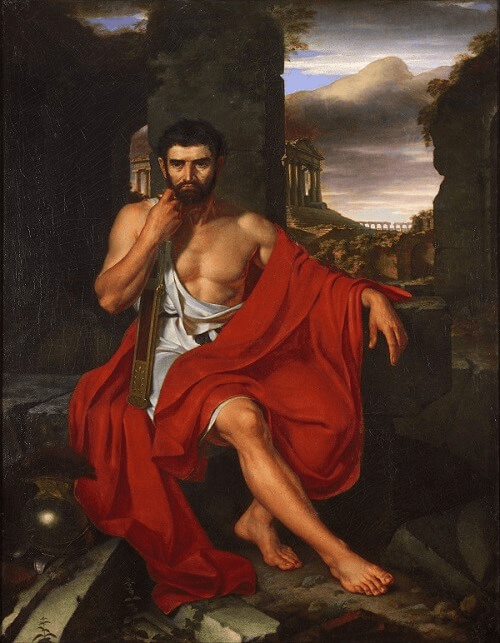
As for Sulla, he became “Dictator,” which meant sole and supreme ruler of all the Roman possessions. He ruled Rome for four years, and he died quietly in his bed, having spent the last year of his life tenderly raising his cabbages, as was the custom of so many Romans who had spent a lifetime killing their fellowmen.
But conditions did not grow better. On the contrary, they grew worse. Another general, Gnaeus Pompeius, or Pompey, a close friend of Sulla, went east to renew the war against the ever troublesome Mithridates. He drove that energetic potentate into the mountains where Mithridates took poison and killed himself, well knowing what fate awaited him as a Roman captive. Next, he re-established the authority of Rome over Syria, destroyed Jerusalem, roamed through western Asia, trying to revive the myth of Alexander the Great, and at last (in the year 62) returned to Rome with a dozen shiploads of defeated Kings and Princes and Generals, all of whom were forced to march in the triumphal procession of this enormously popular Roman who presented his city with the sum of forty million dollars in plunder.

It was necessary that the government of Rome be placed in the hands of a strong ruler. Only a few months before, the town had almost fallen into the hands of a good-for-nothing young aristocrat by the name of Catiline, who had gambled away his money and hoped to reimburse himself for his losses by a little plundering. Cicero, a public-spirited lawyer, had discovered the plot, had warned the Senate, and had forced Catiline to flee. But there were other young men with similar ambitions and it was no time for idle talk.

Pompey organized a triumvirate which was to take charge of affairs. He became the leader of this Vigilante Committee. Gaius Julius Caesar, who had made a reputation for himself as governor of Spain, was the second in command. The third was an indifferent sort of person by the name of Crassus. He had been elected because he was incredibly rich, having been a successful contractor of war supplies. Crassus soon went upon an expedition against the Parthians and was killed.

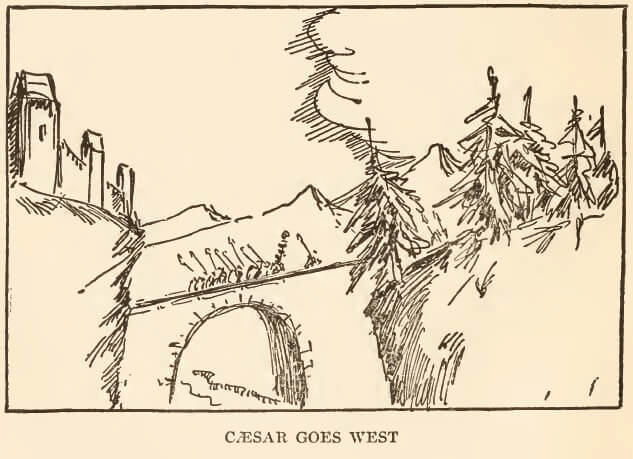
As for Caesar, who was by far the ablest of the three, he decided that he needed a little more military glory to become a popular hero. He crossed the Alps and conquered that part of the world which is now called France. Then he hammered a solid wooden bridge across the Rhine and invaded the land of the wild Teutons. Finally, he took ship and visited England. Heaven knows where he might have ended if he had not been forced to return to Italy. Pompey, so he was informed, had been appointed dictator for life. This of course meant that Caesar was to be placed on the list of the “retired officers,” and the idea did not appeal to him. He remembered that he had begun life as a follower of Marius. He decided to teach the Senators and their “dictator” another lesson. He crossed the Rubicon River which separated the province of Cis-alpine Gaul from Italy. Everywhere he was received as the “friend of the people.” Without difficulty Caesar entered Rome and Pompey fled to Greece. Caesar followed him and defeated his followers near Pharsalus. Pompey sailed across the Mediterranean and escaped to Egypt. When he landed he was murdered by order of young king Ptolemy. A few days later Caesar arrived. He found himself caught in a trap. Both the Egyptians and the Roman garrison which had remained faithful to Pompey, attacked his camp.

Fortune was with Caesar. He succeeded in setting fire to the Egyptian fleet. Incidentally the sparks of the burning vessels fell on the roof of the famous library of Alexandria (which was just off the water front,) and destroyed it. Next, he attacked the Egyptian army, drove the soldiers into the Nile, drowned Ptolemy, and established a new government under Cleopatra, the sister of the late king. Just then word reached him that Pharnaces, the son and heir of Mithridates, had gone on the war-path. Caesar marched northward, defeated Pharnaces in a war which lasted five days, sent word of his victory to Rome in the famous sentence “veni, vidi, vici,” which is Latin for “I came, I saw, I conquered,” and returned to Egypt where he fell desperately in love with Cleopatra, who followed him to Rome when he returned to take charge of the government, in the year 46. He marched at the head of not less than four different victory-parades, having won four different campaigns.

Then Caesar appeared in the Senate to report upon his adventures, and the grateful Senate made him “dictator” for ten years. It was a fatal step.

The new dictator made serious attempts to reform the Roman state. He made it possible for freemen to become members of the Senate. He conferred the rights of citizenship upon distant communities as had been done in the early days of Roman history. He permitted “foreigners” to exercise influence upon the government. He reformed the administration of the distant provinces which certain aristocratic families had come to regard as their private possessions. In short, he did many things for the good of the majority of the people but which made him thoroughly unpopular with the most powerful men in the state. Half a hundred young aristocrats formed a plot “to save the Republic.” On the Ides of March (the fifteenth of March according to that new calendar which Caesar had brought with him from Egypt) Caesar was murdered when he entered the Senate. Once more Rome was without a master.

There were two men who tried to continue the tradition of Caesar’s glory. One was Antony, his former secretary. The other was Octavian, Caesar’s grand-nephew and heir to his estate. Octavian remained in Rome, but Antony went to Egypt to be near Cleopatra with whom he too had fallen in love, as seems to have been the habit of Roman generals.

A war broke out between the two. In the battle of Actium, Octavian defeated Antony. Antony killed himself and Cleopatra was left alone to face the enemy. She tried very hard to make Octavian her third Roman conquest. When she saw that she could make no impression upon this very proud aristocrat, she killed herself, and Egypt became a Roman province.

As for Octavian, he was a very wise young man and he did not repeat the mistake of his famous uncle. He knew how people will shy at words. He was very modest in his demands when he returned to Rome. He did not want to be a “dictator.” He would be entirely satisfied with the title of “the Honorable.” But when the Senate, a few years later, addressed him as Augustus—the Illustrious—he did not object and a few years later the person in the street called him Caesar, or Kaiser, while the soldiers, accustomed to regard Octavian as their Commander-in-chief referred to him as the Chief, the Imperator or Emperor. The Republic had become an Empire, but the average Roman was hardly aware of the fact.

In 14 A.D. his position as the Absolute Ruler of the Roman people had become so well established that he was made an object of that divine worship which hitherto had been reserved for the gods. And his successors were true “Emperors”—the absolute rulers of the greatest empire the world had ever seen.

If the truth be told, the average citizen was sick and tired of anarchy and disorder. They did not care who ruled them provided the new master gave them a chance to live quietly and without the noise of eternal street riots. Octavian assured his subjects forty years of peace. Octavian had no desire to extend the frontiers of his domains, In the year 9 A.D. he had contemplated an invasion of the northwestern wilderness which was inhabited by the Teutons. But Varrus, his general, had been killed with all his men in the Teutoburg Woods, and after that the Romans made no further attempts to civilize these wild people.

The Roman people concentrated their efforts upon the gigantic problem of internal reform. But it was too late to do much good. Two centuries of revolution and foreign war had repeatedly killed the best people among the younger generations. It had ruined the class of the free farmers. It had introduced slave labor, against which no freeman could hope to compete. It had turned the cities into beehives inhabited by pauperized and unhealthy mobs of runaway peasants. It had created a large bureaucracy—petty officials who were underpaid and who were forced to take graft in order to buy bread and clothing for their families. Worst of all, it had accustomed people to violence, to bloodshed, to a barbarous pleasure in the pain and suffering of others.

Outwardly, the Roman state during the first century of our era was a magnificent political structure, so large that Alexander’s empire became one of its minor provinces. Underneath this glory there lived millions upon millions of poor and tired human beings, toiling like ants who have built a nest underneath a heavy stone. They worked for the benefit of someone else. They shared their food with the animals of the fields. They lived in stables. They died without hope.

It was the seven hundred and fifty-third year since the founding of Rome. Gaius Julius Caesar Octavianus Augustus was living in the palace of the Palatine Hill, busily engaged upon the task of ruling his empire.

In a little village of distant Syria, Mary, the wife of Joseph the Carpenter, was tending her little boy, born in a stable of Bethlehem.

This is a strange world.

Before long, the palace and the stable were to meet in open combat.

And the stable was to emerge victorious.
The Roman Empire Part I

When the Roman armies returned from these many victorious campaigns, they were received with great jubilation. Alas and alack! this sudden glory did not make the country any happier. On the contrary. The endless campaigns had ruined the farmers who had been obliged to do the hard work of Empire making. It had placed too much power in the hands of the successful generals (and their private friends) who had used the war as an excuse for wholesale robbery.

The old Roman Republic had been proud of the simplicity which had characterized the lives of her famous men. The new Republic felt ashamed of the shabby coats and the high principles which had been fashionable in the days of its grandfathers. It became a land of rich people ruled by rich people for the benefit of rich people. As such it was doomed to disastrous failure, as I shall now tell you.

Within less than a century and a half. Rome had become the mistress of practically all the land around the Mediterranean. In those early days of history, a prisoner of war lost their freedom and became a slave. The Roman regarded war as a very serious business and he showed no mercy to a conquered foe. After the fall of Carthage, the Carthaginian women and children were sold into bondage together with their own slaves. And a like fate awaited the obstinate inhabitants of Greece and Macedonia and Spain and Syria when they dared to revolt against the Roman power.

Two thousand years ago a slave was considered merely a piece of machinery. Nowadays a rich person invests their money in factories. The rich people of Rome (senators, generals and war profiteers) invested theirs in land and in slaves. The land they bought or took in the newly-acquired provinces. The slaves they bought in open market wherever they happened to be cheapest. During most of the third and second centuries before Christ there was a plentiful supply, and as a result the landowners worked their slaves until they dropped dead in their tracks, when they bought new ones at the nearest bargain-counter of Corinthian or Carthaginian captives.

And now behold the fate of the freeborn farmer!

He had done his duty toward Rome and he had fought her battles without complaint. But when he came home after ten, fifteen or twenty years, his lands were covered with weeds and his family had been ruined. But he was a strong man and willing to begin life anew. He sowed and planted and waited for the harvest. He carried his grain to the market together with his cattle and his poultry, to find that the large landowners who worked their estates with slaves could underbid him all along the line. For a couple of years, he tried to hold his own. Then he gave up in despair. He left the country and he went to the nearest city. In the city he was as hungry as he had been before on the land. But he shared his misery with thousands of other disinherited beings. They crouched together in filthy hovels in the suburbs of the large cities. They were apt to get sick and die from terrible epidemics. They were all profoundly discontented. They had fought for their country and this was their reward. They were always willing to listen to those plausible spell-binders who gather around a public grievance like so many hungry vultures, and soon they became a grave menace to the safety of the state.

But the class of the newly-rich shrugged its shoulders. “We have our army and our policemen,” they argued, “they will keep the mob in order.” And they hid themselves behind the high walls of their pleasant villas and cultivated their gardens and read the poems of a certain Homer which a Greek slave had just translated into very pleasing Latin hexameters.

In a few families however the old tradition of unselfish service to the Commonwealth continued. Cornelia, the daughter of Scipio Africanus, had been married to a Roman by the name of Gracchus. She had two sons, Tiberius and Gaius. When the boys grew up they entered politics and tried to bring about certain much-needed reforms. A census had shown that most of the land of the Italian peninsula was owned by two thousand noble families. Tiberius Gracchus, having been elected a Tribune, tried to help the freemen. He revived two ancient laws which restricted the number of acres which a single owner might possess. In this way he hoped to revive the valuable old class of small and independent freeholders. The newly-rich called him a robber and an enemy of the state. There were street riots. A party of thugs was hired to kill the popular Tribune. Tiberius Gracchus was attacked when he entered the assembly and was beaten to death. Ten years later his brother Gaius tried the experiment of reforming a nation against the expressed wishes of a strong privileged class. He passed a “poor law” which was meant to help the destitute farmers. Eventually it made the greater part of the Roman citizens into professional beggars.

He established colonies of destitute people in distant parts of the empire, but these settlements failed to attract the right sort of people. Before Gaius Gracchus could do more harm he too was murdered and his followers were either killed or exiled. The first two reformers had been gentlemen. The two who came after were of a very different stamp. They were professional soldiers. One was called Marius. The name of the other was Sulla. Both enjoyed a large personal following.

Sulla was the leader of the landowners. Marius, the victor in a great battle at the foot of the Alps when the Teutons and the Cimbri had been annihilated, was the popular hero of the disinherited freemen.

Now it happened in the year 88 B.C. that the Senate of Rome was greatly disturbed by rumors that came from Asia. Mithridates, king of a country along the shores of the Black Sea, and a Greek on his mother’s side, had seen the possibility of establishing a second Alexandrian Empire. He began his campaign for world-domination with the murder of all Roman citizens who happened to be in Asia Minor, men, women and children. Such an act, of course, meant war. The Senate equipped an army to march against the King of Pontus and punish him for his crime. But who was to be commander-in-chief? “Sulla,” said the Senate, “because he is Consul.” “Marius,” said the mob, “because he has been Consul five times and because he is the champion of our rights.”

Possession is nine points of the law. Sulla happened to be in actual command of the army. He went west to defeat Mithridates. Marius fled to Africa. There he waited until he heard that Sulla had crossed into Asia. He then returned to Italy, gathered a motley crew of malcontents, marched on Rome and entered the city with his professional highwaymen, spent five days and five nights, slaughtering the enemies of the Senatorial party, got himself elected Consul and promptly died from the excitement of the last fortnight.

There followed four years of disorder. Then Sulla, having defeated Mithridates, announced that he was ready to return to Rome and settle a few old scores of his own. He was as good as his word. For weeks his soldiers were busy executing those of their fellow citizens who were suspected of democratic sympathies. One day they got hold of a young fellow who had been often seen in the company of Marius. They were going to hang him when someone interfered. “The boy is too young,” he said, and they let him go. His name was Julius Caesar. You shall meet him again in the next lesson.

The Rise of Rome

The Roman Empire was an accident. No one planned it. It “happened.” No famous general or statesman or cutthroat ever got up and said “Friends, Romans, Citizens, we must found an Empire. Follow me and together we shall conquer all the land from the Gates of Hercules to Mount Taurus.”

Rome produced famous generals and equally distinguished statesmen and cutthroats, and Roman armies fought all over the world. But the Roman empire-making was done without a preconceived plan. The average Roman was a very matter-of-fact citizen. He disliked theories about government. When someone began to recite “eastward the course of Roman Empire, etc., etc.,” he hastily left the forum. He just continued to take more and more land because circumstances forced him to do so. He was not driven by ambition or by greed. Both by nature and inclination he was a farmer and wanted to stay at home. But when he was attacked he was obliged to defend himself and when the enemy happened to cross the sea to ask for aid in a distant country then the patient Roman marched many dreary miles to defeat this dangerous foe and when this had been accomplished, he stayed behind to administer his newly conquered provinces lest they fall into the hands of wandering Barbarians and become themselves a menace to Roman safety. It sounds rather complicated and yet to the contemporaries it was so very simple, as you shall see in a moment.

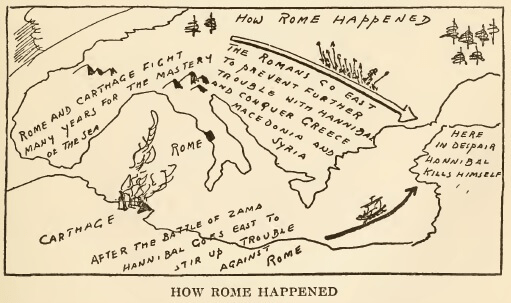
In the year 203 B.C. Scipio had crossed the African Sea and had carried the war into Africa. Carthage had called Hannibal back. Badly supported by his mercenaries, Hannibal had been defeated near Zama. The Romans had asked for his surrender and Hannibal had fled to get aid from the kings of Macedonia and Syria, as I told you in my last chapter.

The rulers of these two countries (remnants of the Empire of Alexander the Great) just then were contemplating an expedition against Egypt. They hoped to divide the rich Nile valley between themselves. The king of Egypt had heard of this and he had asked Rome to come to his support. The stage was set for a number of highly interesting plots and counter-plots. But the Romans, with their lack of imagination, rang the curtain down before the play had been fairly started. Their legions completely defeated the heavy Greek phalanx which was still used by the Macedonians as their battle formation. That happened in the year 197 B.C. at the battle in the plains of Cynoscephalae, or “Dogs’ Heads,” in central Thessaly.

The Romans then marched southward to Attica and informed the Greeks that they had come to “deliver the Hellenes from the Macedonian yoke.” The Greeks, having learned nothing in their years of semi-slavery, used their new freedom in a most unfortunate way. All the little city-states once more began to quarrel with each other as they had done in the good old days. The Romans, who had little understanding and less love for these silly bickerings of a race which they rather despised, showed great forbearance. But tiring of these endless dissensions they lost patience, invaded Greece, burned down Corinth (to “encourage the other Greeks”) and sent a Roman governor to Athens to rule this turbulent province. In this way, Macedonia and Greece became buffer states which protected Rome’s eastern frontier.

Meanwhile right across the Hellespont lay the Kingdom of Syria, and Antiochus III, who ruled that vast land, had shown great eagerness when his distinguished guest, General Hannibal, explained to him how easy it would be to invade Italy and sack the city of Rome.

Lucius Scipio, a brother of Scipio the African fighter who had defeated Hannibal and his Carthaginians at Zama, was sent to Asia Minor. He destroyed the armies of the Syrian king near Magnesia (in the year 190 B.C.) Shortly afterwards, Antiochus was lynched by his own people. Asia Minor became a Roman protectorate and the small City-Republic of Rome was mistress of most of the lands which bordered upon the Mediterranean.

Rome and Carthage Part II

This short account of the early history of Rome shows you the enormous difference between the Roman ideal of a healthy state, and that of the ancient world which was embodied in the town of Carthage. The Romans counted upon the cheerful and hearty co-operation between a number of “equal citizens.” The Carthaginians, following the example of Egypt and western Asia, insisted upon the unreasoning (and therefore unwilling) obedience of “Subjects” and when these failed they hired professional soldiers to do their fighting for them.

You will now understand why Carthage was bound to fear such a clever and powerful enemy and why the plutocracy of Carthage was only too willing to pick a quarrel that they might destroy the dangerous rival before it was too late.

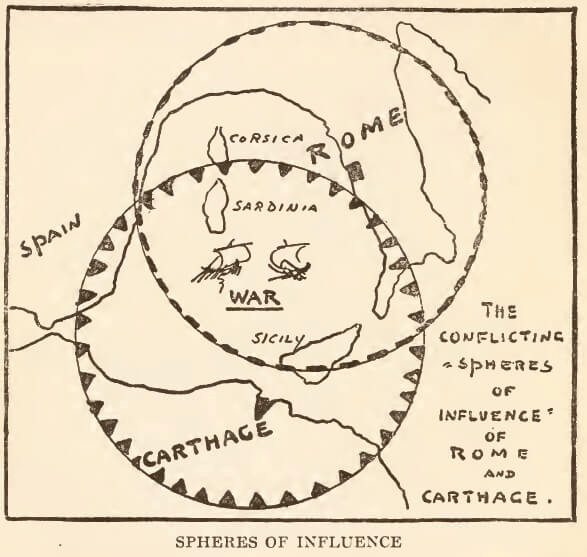
But the Carthaginians, being good business men, knew that it never pays to rush matters. They proposed to the Romans that their respective cities draw two circles on the map and that each town claim one of these circles as her own “sphere of influence” and promise to keep out of the other fellow’s circle. The agreement was promptly made and was broken just as promptly when both sides thought it wise to send their armies to Sicily where a rich soil and a bad government invited foreign interference.

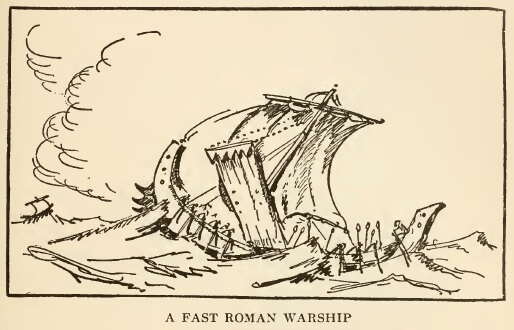
The war which followed (the so-called first Punic War) lasted twenty-four years. It was fought out on the high seas and in the beginning it seemed that the experienced Carthaginian navy would defeat the newly created Roman fleet. Following their ancient tactics, the Carthaginian ships would either ram the enemy vessels or by a bold attack from the side they would break their oars and would then kill the sailors of the helpless vessel with their arrows and with fire balls. But Roman engineers invented a new craft which carried a boarding bridge across which the Roman infantrymen stormed the hostile ship. Then there was a sudden end to Carthaginian victories. At the battle of Mylae their fleet was badly defeated. Carthage was obliged to sue for peace, and Sicily became part of the Roman domains.

Twenty-three years later new trouble arose. Rome (in quest of copper) had taken the island of Sardinia. Carthage (in quest of silver) thereupon occupied all of southern Spain. This made Carthage a direct neighbor of the Romans. The latter did not like this at all and they ordered their troops to cross the Pyrenees and watch the Carthaginian army of occupation.

The stage was set for the second outbreak between the two rivals. Once more a Greek colony was the pretext for a war. The Carthaginians were besieging Saguntum on the east coast of Spain. The Saguntians appealed to Rome and Rome, as usual, was willing to help. The Senate promised the help of the Latin armies, but the preparation for this expedition took some time, and meanwhile Saguntum had been taken and had been destroyed. This had been done in direct opposition to the will of Rome. The Senate decided upon war. One Roman army was to cross the African sea and make a landing on Carthaginian soil. A second division was to keep the Carthaginian armies occupied in Spain to prevent them from rushing to the aid of the home town. It was an excellent plan and everybody expected a great victory. But the gods had decided otherwise.

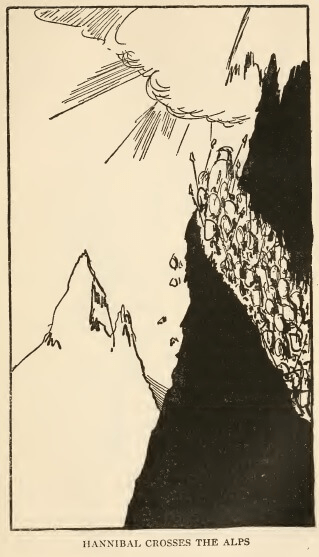
It was the fall of the year 218 before the birth of Christ and the Roman army which was to attack the Carthaginians in Spain had left Italy. People were eagerly waiting for news of an easy and complete victory when a terrible rumor began to spread through the plain of the Po. Wild mountaineers, their lips trembling with fear, told of hundreds of thousands of brown men accompanied by strange beasts “each one as big as a house,” who had suddenly emerged from the clouds of snow which surrounded the old Graian pass through which Hercules, thousands of years before, had driven the oxen of Geryon on his way from Spain to Greece. Soon an endless stream of bedraggled refugees appeared before the gates of Rome, with more complete details. Hannibal, the son of Hamilcar, with fifty thousand soldiers, nine thousand horsemen and thirty-seven fighting elephants, had crossed the Pyrenees. He had defeated the Roman army of Scipio on the banks of the Rhone and he had guided his army safely across the mountain passes of the Alps although it was October and the roads were thickly covered with snow and ice. Then he had joined forces with the Gauls and together they had defeated a second Roman army just before they crossed the Trebia and laid siege to Placentia, the northern terminus of the road which connected Rome with the province of the Alpine districts.

The Senate, surprised but calm and energetic as usual, hushed up the news of these many defeats and sent two fresh armies to stop the invader. Hannibal managed to surprise these troops on a narrow road along the shores of the Trasimene Lake and there he killed all the Roman officers and most of their men. This time there was a panic among the people of Rome, but the Senate kept its nerve. A third army was organized and the command was given to Quintus Fabius Maximus with full power to act “as was necessary to save the state.”

Fabius knew that he must be very careful lest all be lost. His raw and untrained men, the last available soldiers, were no match for Hannibal’s veterans. He refused to accept battle but forever he followed Hannibal, destroyed everything eatable, destroyed the roads, attacked small detachments and generally weakened the morale of the Carthaginian troops by a most distressing and annoying form of guerilla warfare.

Such methods however did not satisfy the fearsome crowds who had found safety behind the walls of Rome. They wanted “action.” Something must be done and must be done quickly. A popular hero by the name of Varro, the sort of man who went about the city telling everybody how much better he could do things than slow old Fabius, the “Delayer,” was made commander-in-chief by popular acclamation. At the battle of Cannae (216) he suffered the most terrible defeat of Roman history. More than seventy thousand men were killed. Hannibal was master of all Italy.

He marched from one end of the peninsula to the other, proclaiming himself the “deliverer from the yoke of Rome” and asking the different provinces to join him in warfare upon the mother city. Then once more the wisdom of Rome bore noble fruit. With the exceptions of Capua and Syracuse, all Roman cities remained loyal. Hannibal, the deliverer, found himself opposed by the people whose friend he pretended to be. He was far away from home and did not like the situation. He sent messengers to Carthage to ask for fresh supplies and new men. Alas, Carthage could not send him either.

The Romans with their boarding-bridges, were the masters of the sea. Hannibal must help himself as best he could. He continued to defeat the Roman armies that were sent out against him, but his own numbers were decreasing rapidly and the Italian peasants held aloof from this self-appointed “deliverer.”

After many years of uninterrupted victories, Hannibal found himself besieged in the country which he had just conquered. For a moment, the luck seemed to turn. Hasdrubal, his brother, had defeated the Roman armies in Spain. He had crossed the Alps to come to Hannibal’s assistance. He sent messengers to the south to tell of his arrival and ask the other army to meet him in the plain of the Tiber. Unfortunately, the messengers fell into the hands of the Romans and Hannibal waited in vain for further news until his brother’s head, neatly packed in a basket, came rolling into his camp and told him of the fate of the last of the Carthaginian troops.

With Hasdrubal out of the way, young Publius Scipio easily reconquered Spain and four years later the Romans were ready for a final attack upon Carthage. Hannibal was called back. He crossed the African Sea and tried to organize the defenses of his home-city. In the year 202 at the battle of Zama, the Carthaginians were defeated. Hannibal fled to Tyre. From there he went to Asia Minor to stir up the Syrians and the Macedonians against Rome. He accomplished very little but his activities among these Asiatic powers gave the Romans an excuse to carry their warfare into the territory of the east and annex the greater part of the Aegean world.

Driven from one city to another, a fugitive without a home, Hannibal at last knew that the end of his ambitious dream had come. His beloved city of Carthage had been ruined by the war. She had been forced to sign a terrible peace. Her navy had been sunk. She had been forbidden to make war without Roman permission. She had been condemned to pay the Romans millions of dollars for endless years to come. Life offered no hope of a better future. In the year 190 B.C. Hannibal took poison and killed himself.

Forty years later, the Romans forced their last war upon Carthage. Three long years the inhabitants of the old Phoenician colony held out against the power of the new republic. Hunger forced them to surrender. The few men and women who had survived the siege were sold as slaves. The city was set on fire. For two whole weeks the store-houses and the palaces and the great arsenal burned. Then a terrible curse was pronounced upon the blackened ruins and the Roman legions returned to Italy to enjoy their victory.

For the next thousand years, the Mediterranean remained a European sea. But as soon as the Roman Empire had been destroyed, Asia made another attempt to dominate this great inland sea, as you will learn when I tell you about Mohammed.

Rome and Carthage Part I

The little Phoenician trading post of Kart-hadshat stood on a low hill which overlooked the African Sea, a stretch of water ninety miles wide which separates Africa from Europe. It was an ideal spot for a commercial center. Almost too ideal. It grew too fast and became too rich. When in the sixth century before our era, Nebuchadnezzar of Babylon destroyed Tyre, Kart-hadshat, now called Carthage, broke off all further relations with the Mother Country and became an independent state—the great western advance-post of the Semitic races.

Unfortunately the city had inherited many of the traits which for a thousand years had been characteristic of the Phoenicians. It was a vast business-house, protected by a strong navy, indifferent to most of the finer aspects of life. The city and the surrounding country and the distant colonies were all ruled by a small but exceedingly powerful group of rich men, The Greek word for rich is “ploutos” and the Greeks called such a government by “rich people” a “Plutocracy.” Carthage was a plutocracy and the real power of the state lay in the hands of a dozen big ship-owners and mine-owners and merchants who met in the back room of an office and regarded their common Fatherland as a business enterprise which ought to yield them a decent profit. They were however wide awake and full of energy and worked very hard.

As the years went by the influence of Carthage upon her neighbors increased until the greater part of the African coast, Spain and certain regions of France were Carthaginian possessions, and paid tribute, taxes and dividends to the mighty city on the African Sea.

Of course, such a “plutocracy” was forever at the mercy of the crowd. As long as there was plenty of work and wages were high, the majority of the citizens were quite contented, allowed their “betters” to rule them and asked no embarrassing questions. But when no ships left the harbor, when no ore was brought to the smelting-ovens, when dockworkers and stevedores were thrown out of employment, then there were grumblings and there was a demand that the popular assembly be called together as in the olden days when Carthage had been a self-governing republic.

To prevent such an occurrence the plutocracy was obliged to keep the business of the town going at full speed. They had managed to do this very successfully for almost five hundred years when they were greatly disturbed by certain rumors which reached them from the western coast of Italy. It was said that a little village on the banks of the Tiber had suddenly risen to great power and was making itself the acknowledged leader of all the Latin tribes who inhabited central Italy. It was also said that this village, which by the way was called Rome, intended to build ships and go after the commerce of Sicily and the southern coast of France.

Carthage could not possibly tolerate such competition. The young rival must be destroyed lest the Carthaginian rulers lose their prestige as the absolute rulers of the western Mediterranean. The rumors were duly investigated and in a general way these were the facts that came to light.

The west coast of Italy had long been neglected by civilization. Whereas in Greece all the good harbors faced eastward and enjoyed a full view of the busy islands of the Aegean, the west coast of Italy contemplated nothing more exciting than the desolate waves of the Mediterranean. The country was poor. It was therefore rarely visited by foreign merchants and the natives were allowed to live in undisturbed possession of their hills and their marshy plains.

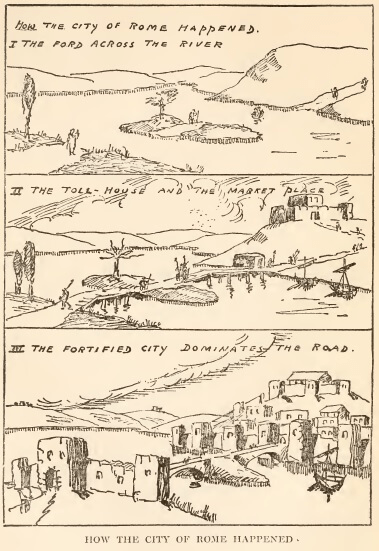
The first serious invasion of this land came from the north. At an unknown date certain Indo-European tribes had managed to find their way through the passes of the Alps and had pushed southward until they had filled the heel and the toe of the famous Italian boot with their villages and their flocks. Of these early conquerors we know nothing. No Homer sang their glory. Their own accounts of the foundation of Rome (written eight hundred years later when the little city had become the center of an Empire) are fairy stories and do not belong in a history. Romulus and Remus jumping across each other’s walls (I always forget who jumped across whose wall) make entertaining reading, but the foundation of the City of Rome was a much more prosaic affair. Rome began as a thousand American cities have done, by being a convenient place for barter and horse-trading. It lay in the heart of the plains of central Italy The Tiber provided direct access to the sea. The land-road from north to south found here a convenient ford which could be used all the year around. And seven little hills along the banks of the river offered the inhabitants a safe shelter against their enemies who lived in the mountains and those who lived beyond the horizon of the nearby sea.

The mountaineers were called the Sabines. They were a rough crowd with an unholy desire for easy plunder. But they were very backward. They used stone axes and wooden shields and were no match for the Romans with their steel swords. The sea-people on the other hand were dangerous foes. They were called the Etruscans and they were (and still are) one of the great mysteries of history. Nobody knew (or knows) whence they came; who they were; what had driven them away from their original homes. We have found the remains of their cities and their cemeteries and their waterworks all along the Italian coast. We are familiar with their inscriptions. But as no one has ever been able to decipher the Etruscan alphabet, these written messages are, so far, merely annoying and not at all useful.

Our best guess is that the Etruscans came originally from Asia Minor and that a great war or a pestilence in that country had forced them to go away and seek a new home elsewhere. Whatever the reason for their coming, the Etruscans played a great role in history. They carried the pollen of the ancient civilization from the east to the west and they taught the Romans who, as we know, came from the north, the first principles of architecture and street-building and fighting and art and cookery and medicine and astronomy.

But just as the Greeks had not loved their Aegean teachers, in this same way did the Romans hate their Etruscan masters. They got rid of them as soon as they could and the opportunity offered itself when Greek merchants discovered the commercial possibilities of Italy and when the first Greek vessels reached Rome. The Greeks came to trade, but they stayed to instruct. They found the tribes who inhabited the Roman country-side (and who were called the Latins) quite willing to learn such things as might be of practical use. At once they understood the great benefit that could be derived from a written alphabet and they copied that of the Greeks. They also understood the commercial advantages of a well-regulated system of coins and measures and weights. Eventually the Romans swallowed Greek civilization hook, line and sinker.

They even welcomed the gods of the Greeks to their country. Zeus was taken to Rome where he became known as Jupiter and the other divinities followed him. The Roman gods however never were quite like their cheerful cousins who had accompanied the Greeks on their road through life and through history. The Roman gods were State Functionaries. Each one managed his own department with great prudence and a deep sense of justice, but in turn he was exact in demanding the obedience of his worshippers. This obedience the Romans rendered with scrupulous care. But they never established the cordial personal relations and that charming friendship which had existed between the old Hellenes and the mighty residents of the high Olympian peak.

The Romans did not imitate the Greek form of government, but being of the same Indo-European stock as the people of Hellas, the early history of Rome resembles that of Athens and the other Greek cities. They did not find it difficult to get rid of their kings, the descendants of the ancient tribal chieftains. But once the kings had been driven from the city, the Romans were forced to bridle the power of the nobles, and it took many centuries before they managed to establish a system which gave every free citizen of Rome a chance to take a personal interest in the affairs of their town.

Thereafter the Romans enjoyed one great advantage over the Greeks. They managed the affairs of their country without making too many speeches. They were less imaginative than the Greeks and they preferred an ounce of action to a pound of words. They understood the tendency of the multitude (the “plebe,” as the assemblage of free citizens was called) only too well to waste valuable time upon mere talk. They therefore placed the actual business of running the city into the hands of two “consuls” who were assisted by a council of Elders, called the Senate (because the word “senex” means an old man). As a matter of custom and practical advantage the senators were elected from the nobility. But their power had been strictly defined.

Rome at one time had passed through the same sort of struggle between the poor and the rich which had forced Athens to adopt the laws of Draco and Solon. In Rome this conflict had occurred in the fifth century B. C. As a result, the freemen had obtained a written code of laws which protected them against the despotism of the aristocratic judges by the institution of the “Tribune.” These Tribunes were city-magistrates, elected by the freemen. They had the right to protect any citizen against those actions of the government officials which were thought to be unjust. A consul had the right to condemn a person to death, but if the case had not been absolutely proved the Tribune could interfere and save the poor person’s life.

But when I use the word Rome, I seem to refer to a little city of a few thousand inhabitants. And the real strength of Rome lay in the country districts outside her walls. And it was in the government of these outlying provinces that Rome at an early age showed her wonderful gift as a colonizing power.

In very early times Rome had been the only strongly fortified city in central Italy, but it had always offered a hospitable refuge to other Latin tribes who happened to be in danger of attack. The Latin neighbors had recognized the advantages of a close union with such a powerful friend and they had tried to find a basis for some sort of defensive and offensive alliance. Other nations, Egyptians, Babylonians, Phoenicians, even Greeks, would have insisted upon a treaty of submission on the part of the “barbarians,” The Romans did nothing of the sort. They gave the “outsider” a chance to become partners in a common “res publica”—or common-wealth.

“You want to join us,” they said. “Very well, go ahead and join. We shall treat you as if you were full-fledged citizens of Rome. In return for this privilege we expect you to fight for our city, the mother of us all, whenever it shall be necessary.”

The “outsider” appreciated this generosity and he showed their gratitude by their unswerving loyalty.

Whenever a Greek city had been attacked, the foreign residents had moved out as quickly as they could. Why defend something which meant nothing to them but a temporary boarding house in which they were tolerated as long as they paid their bills? But when the enemy was before the gates of Rome, all the Latins rushed to her defense. It was their Mother who was in danger. It was their true “home” even if they lived a hundred miles away and had never seen the walls of the sacred Hills.

No defeat and no disaster could change this sentiment. In the beginning of the fourth century B.C. the wild Gauls forced their way into Italy. They had defeated the Roman army near the River Allia and had marched upon the city. They had taken Rome and then they expected that the people would come and sue for peace. They waited, but nothing happened. After a short time, the Gauls found themselves surrounded by a hostile population which made it impossible for them to obtain supplies. After seven months, hunger forced them to withdraw. The policy of Rome to treat the “foreigner” on equal terms had proved a great success and Rome stood stronger than ever before.

Alexander the Great

When the Achaeans had left their homes along the banks of the Danube to look for new pastures, they had spent some time among the mountains of Macedonia. Ever since, the Greeks had maintained certain more or less formal relations with the people of this northern country. The Macedonians from their side had kept themselves well-informed about conditions in Greece.

Now it happened, just when Sparta and Athens had finished their disastrous war for the leadership of Hellas, that Macedonia was ruled by an extraordinarily clever man by the name of Philip. He admired the Greek spirit in letters and art but he despised the Greek lack of self-control in political affairs. It irritated him to see a perfectly good people waste its men and money upon fruitless quarrels. So he settled the difficulty by making himself the master of all Greece and then he asked his new subjects to join him on a voyage which he meant to pay to Persia in return for the visit which Xerxes had paid the Greeks one hundred and fifty years before.

Unfortunately, Philip was murdered before he could start upon this well-prepared expedition. The task of avenging the destruction of Athens was left to Philip’s son Alexander, the beloved pupil of Aristotle, wisest of all Greek teachers.

Alexander bade farewell to Europe in the spring of the year 334 B.C. Seven years later he reached India. In the meantime, he had destroyed Phoenicia, the old rival of the Greek merchants. He had conquered Egypt and had been worshipped by the people of the Nile valley as the son and heir of the Pharaohs. He had defeated the last Persian king—he had overthrown the Persian empire he had given orders to rebuild Babylon—he had led his troops into the heart of the Himalayan mountains and had made the entire world a Macedonian province and dependency. Then he stopped and announced even more ambitious plans.

The newly formed Empire must be brought under the influence of the Greek mind. The people must be taught the Greek language—they must live in cities built after a Greek model. The Alexandrian soldier now turned schoolmaster. The military camps of yesterday became the peaceful centers of the newly imported Greek civilization. Higher and higher did the flood of Greek manners and Greek customs rise, when suddenly Alexander was stricken with a fever and died in the old palace of King Hammurabi of Babylon in the year 323.

Then the waters receded. But they left behind the fertile clay of a higher civilization and Alexander, with all his childish ambitions and his silly vanities, had performed a most valuable service. His Empire did not long survive him. A number of ambitious generals divided the territory among themselves. But they too remained faithful to the dream of a great world brotherhood of Greek and Asiatic ideas and knowledge.

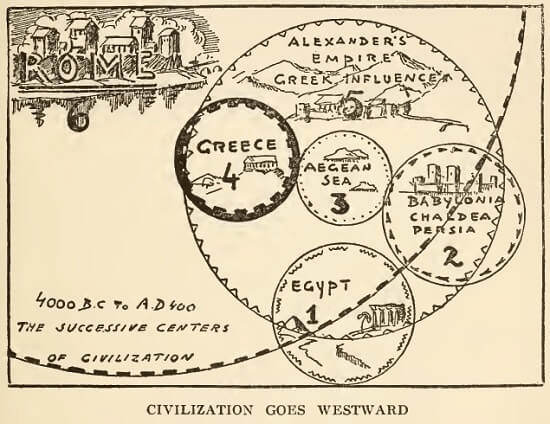
They maintained their independence until the Romans added western Asia and Egypt to their other domains. The strange inheritance of this Hellenistic civilization (part Greek, part Persian, part Egyptian and Babylonian) fell to the Roman conquerors. During the following centuries, it got such a firm hold upon the Roman world, that we feel its influence in our own lives this very day.

Athens vs. Sparta

Athens and Sparta were both Greek cities and their people spoke a common language. In every other respect they were different. Athens rose high from the plain. It was a city exposed to the fresh breezes from the sea, willing to look at the world with the eyes of a happy child. Sparta, on the other hand, was built at the bottom of a deep valley, and used the surrounding mountains as a barrier against foreign thought. Athens was a city of busy trade. Sparta was an armed camp where people were soldiers for the sake of being soldiers. The people of Athens loved to sit in the sun and discuss poetry or listen to the wise words of a philosopher. The Spartans, on the other hand, never wrote a single line that was considered literature, but they knew how to fight, they liked to fight, and they sacrificed all human emotions to their ideal of military preparedness.

No wonder that these somber Spartans viewed the success of Athens with malicious hate. The energy which the defense of the common home had developed in Athens was now used for purposes of a more peaceful nature. The Acropolis was rebuilt and was made into a marble shrine to the goddess Athena. Pericles, the leader of the Athenian democracy, sent far and wide to find famous sculptors and painters and scientists to make the city more beautiful and the young Athenians more worthy of their home. At the same time, he kept a watchful eye on Sparta and built high walls which connected Athens with the sea and made her the strongest fortress of that day.

An insignificant quarrel between two little Greek cities led to the final conflict. For thirty years the war between Athens and Sparta continued. It ended in a terrible disaster for Athens.

During the third year of the war the plague had entered the city. More than half of the people and Pericles, the great leader, had been killed. The plague was followed by a period of bad and untrustworthy leadership. A brilliant young fellow by the name of Alcibiades had gained the favor of the popular assembly. He suggested a raid upon the Spartan colony of Syracuse in Sicily. An expedition was equipped and everything was ready. But Alcibiades got mixed up in a street brawl and was forced to flee. The general who succeeded him was a bungler. First he lost his ships and then he lost his army, and the few surviving Athenians were thrown into the stone-quarries of Syracuse, where they died from hunger and thirst.

The expedition had killed all the young men of Athens. The city was doomed. After a long siege the town surrendered in April of the year 404. The high walls were demolished. The navy was taken away by the Spartans. Athens ceased to exist as the center of the great colonial empire which it had conquered during the days of its prosperity. But that wonderful desire to learn and to know and to investigate which had distinguished her free citizens during the days of greatness and prosperity did not perish with the walls and the ships. It continued to live. It became even more brilliant.

Athens no longer shaped the destinies of the land of Greece. But now, as the home of the first great university the city began to influence the minds of intelligent people far beyond the narrow frontiers of Hellas.

Engaging Children’s Books, Fun Facts and Delicious Recipes

Children’s Bible books

  • For older kids
    • THE CHILDREN’S SIX MINUTES by Bruce S. Wright: The Children’s Six Minutes by Bruce S. Wright features a collection of themes exploring growth, kindness, faith, and life’s lessons through various engaging stories and reflections.
    • The Wonder Book of Bible Stories: “The Wonder Book of Bible Stories” by Logan Marshall shares simplified biblical narratives for children, conveying essential moral lessons through engaging tales from the Bible.

Children’s books

  • For younger kids
    • McGuffey Eclectic Primer: textbook focused on early literacy, teaching reading and writing through simple lessons and moral stories for young children.
    • McGuffey’s First Eclectic Reader: educational textbook for young readers, combining phonics, sight words, moral lessons, and simple narratives to enhance literacy skills.
    • MCGUFFEY’S SECOND ECLECTIC READER: educational book for children, promoting literacy and moral values through engaging prose, poetry, and vocabulary exercises.
    • The Real Mother Goose: a collection of nursery rhymes, reflecting childhood’s whimsical essence through well-known verses and engaging illustrations.
    • THE GREAT BIG TREASURY OF BEATRIX POTTER: The Great Big Treasury of Beatrix Potter features beloved stories like The Tale of Peter Rabbit and The Tale of Jemima Puddle-Duck, celebrating whimsical animal adventures.
    • The Tale of Solomon Owl is a whimsical children’s book by Arthur Scott Bailey, exploring themes of friendship and adventure through Solomon Owl’s humorous encounters with forest animals.
    • THE TALE OF JOLLY ROBIN: follows a young bird’s adventures as he learns life skills, values friendship, and explores youthful curiosity through humorous encounters in the wild.
    • Peter and Polly Series: The content describes a series of stories for 1st graders featuring Peter and Polly, exploring seasonal adventures, imaginative play, nature, family, and interactions with pets and animals.
    • The Adventures of Old Mr. Toad: recounts Old Mr. Toad’s humorous nature-filled journeys, emphasizing lessons on friendship, humility, and personal growth amidst various animal encounters.
    • The Wonderful Wizard of Oz: follows Dorothy’s adventures in Oz as she seeks to return home, meeting memorable friends while exploring themes of courage, friendship, and self-discovery.
  • For older kids
    • Stories of Don Quixote Written Anew for Children retells key adventures from Cervantes’ novel, preserving its spirit while engagingly presenting them for young readers in a cohesive narrative.
    • Heidi by Johanna Spyri follows a young girl adapting to life in the Swiss Alps with her grandfather, highlighting themes of family, love, and the power of nature.
    • Swiss Family Robinson by Johann David Wyss: is a beloved adventure novel by Johann David Wyss about a Swiss family stranded on a deserted island, relying on their creativity and teamwork to survive and build a new life.
    • Rebecca Of Sunnybrook Farm: follows the spirited Rebecca Randall as she navigates life with her aunts in Riverboro, experiencing adventure, growth, and identity exploration.

Children’s history book

  • For younger kids
    • Great Stories for Little Americans: introduces young readers to American history through engaging tales, fostering national pride and knowledge of heritage via accessible storytelling.
    • The Bird-woman of the Lewis and Clark Expedition: A Supplementary Reader for First and Second Grades- tells Sacajawea’s vital role in guiding the explorers, emphasizing her contributions and experiences during this historic journey.
    • The Story of Mankind: chronicles human history from prehistory to the modern era, highlighting key events, cultures, and figures that shaped civilization.
    • A First Book in American History: A first book in American history: with special reference to the lives and deeds of great Americans. This book chronicles pivotal figures in American history, from Columbus and John Smith to Franklin and Lincoln, highlighting their contributions and the nation’s expansion.
  • For older kids

Poem and stories

  • THE PLYMOUTH HARVEST by Governor Bradford
  • The Real Mother Goose Poems Book: a collection of nursery rhymes, reflecting childhood’s whimsical essence through well-known verses and engaging illustrations.
  • Top Poems for Children by Famous Authors: A list of children’s poems organized by author, with future additions anticipated, includes works by notable poets and authors. [Coming soon]
  • Poems and stories by Bell: Bell, a young poet, shares her love for God through inspiring poems and stories centered on nature, love, and faith, aiming to bless and bring joy to readers.
  • Explore Heartfelt Poems and Stories for Inspiration: Poems and stories to warm your heart.
  • Heartfelt Tales of My Beloved Pets: The author shares stories of various animals that have impacted their life, encouraging love for pets and providing comforting Bible verses for grieving pet owners.

Children bible study

The Persian Wars

The Greeks had learned the art of trading from the Aegeans who had been the pupils of the Phoenicians. They had founded colonies after the Phoenician pattern. They had even improved upon the Phoenician methods by a more general use of money in dealing with foreign customers. In the sixth century before our era they had established themselves firmly along the coast of Asia Minor and they were taking away trade from the Phoenicians at a fast rate. This the Phoenicians of course did not like but they were not strong enough to risk a war with their Greek competitors. They sat and waited nor did they wait in vain.

In a former chapter, I have told you how a humble tribe of Persian shepherds had suddenly gone upon the warpath and had conquered the greater part of western Asia. The Persians were too civilized to plunder their new subjects. They contented themselves with a yearly tribute. When they reached the coast of Asia Minor they insisted that the Greek colonies of Lydia recognize the Persian Kings as their overlords and pay them a stipulated tribute. The Greek colonies objected. The Persians insisted. Then the Greek colonies appealed to the home-country and the stage was set for a quarrel.

For if the truth be told, the Persian Kings regarded the Greek city-states as very dangerous political institutions and bad examples for all other people who were supposed to be the patient slaves of the mighty Persian Kings.

Of course, the Greeks enjoyed a certain degree of safety because their country lay hidden beyond the deep waters of the Aegean. But here their old enemies, the Phoenicians, stepped forward with offers of help and advice to the Persians. If the Persian King would provide the soldiers, the Phoenicians would guarantee to deliver the necessary ships to carry them to Europe. It was the year 492 before the birth of Christ, and Asia made ready to destroy the rising power of Europe.

As a final warning the King of Persia sent messengers to the Greeks asking for “earth and water” as a token of their submission. The Greeks promptly threw the messengers into the nearest well where they would find both “earth and water” in large abundance and thereafter of course peace was impossible.

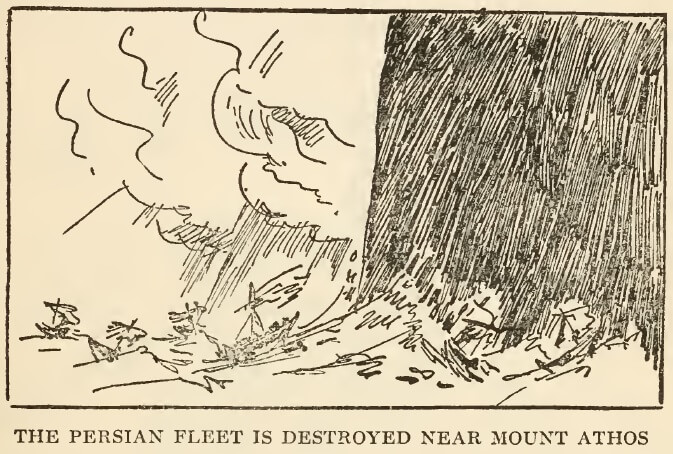
But the gods of High Olympus watched over their children and when the Phoenician fleet carrying the Persian troops was near Mount Athos, the Storm-god blew his cheeks until he almost burst the veins of his brow, and the fleet was destroyed by a terrible hurricane and the Persians were all drowned.

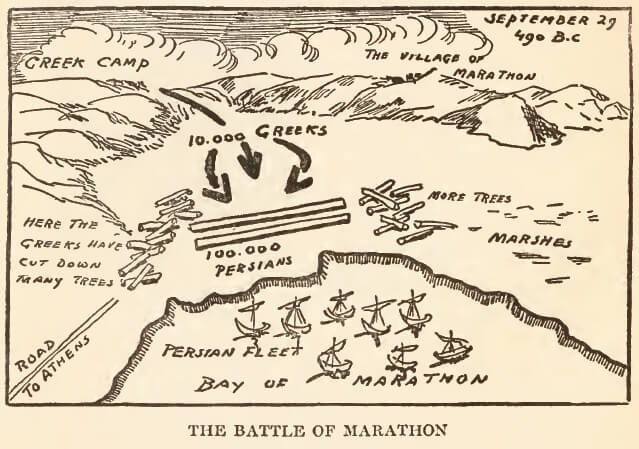
Two years later they returned. This time they sailed straight across the Aegean Sea and landed near the village of Marathon. As soon as the Athenians heard this they sent their army of ten thousand men to guard the hills that surrounded the Marathonian plain. At the same time, they dispatched a fast runner to Sparta to ask for help. But Sparta was envious of the fame of Athens and refused to come to her assistance. The other Greek cities followed her example with the exception of tiny Plataea which sent a thousand men. On the twelfth of September of the year 490, Miltiades, the Athenian commander, threw this little army against the hordes of the Persians. The Greeks broke through the Persian barrage of arrows and their spears caused terrible havoc among the disorganized Asiatic troops who had never been called upon to resist such an enemy.

That night the people of Athens watched the sky grow red with the flames of burning ships. Anxiously they waited for news. At last a little cloud of dust appeared upon the road that led to the North. It was Pheidippides, the runner. He stumbled and gasped for his end was near. Only a few days before had he returned from his errand to Sparta. He had hastened to join Miltiades. That morning he had taken part in the attack and later he had volunteered to carry the news of victory to his beloved city. The people saw him fall and they rushed forward to support him. “We have won,” he whispered and then he died, a glorious death which made him envied of all men.

As for the Persians, they tried, after this defeat, to land near Athens but they found the coast guarded and disappeared, and once more the land of Hellas was at peace.

Eight years they waited and during this time the Greeks were not idle. They knew that a final attack was to be expected but they did not agree upon the best way to avert the danger. Some people wanted to increase the army. Others said that a strong fleet was necessary for success. The two parties led by Aristides (for the army) and Themistocles (the leader of the bigger-navy men) fought each other bitterly and nothing was done until Aristides was exiled. Then Themistocles had his chance and he built all the ships he could and turned the Piraeus into a strong naval base.

In the year 481 B.C. a tremendous Persian army appeared in Thessaly, a province of northern Greece. In this hour of danger, Sparta, the great military city of Greece, was elected commander-in-chief. But the Spartans cared little what happened to northern Greece provided their own country was not invaded. They neglected to fortify the passes that led into Greece.

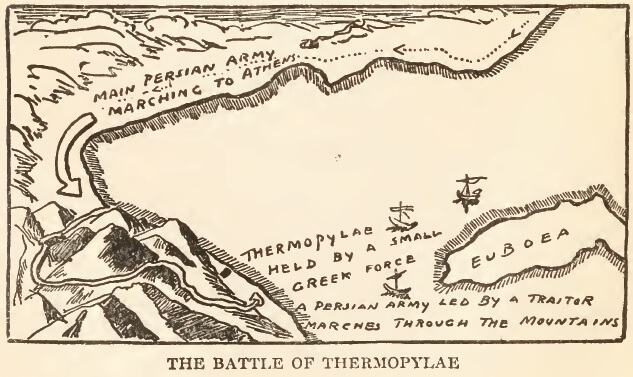
A small detachment of Spartans under Leonidas had been told to guard the narrow road between the high mountains and the sea which connected Thessaly with the southern provinces. Leonidas obeyed his orders. He fought and held the pass with unequalled bravery. But a traitor by the name of Ephialtes who knew the little byways of Malis guided a regiment of Persians through the hills and made it possible for them to attack Leonidas in the rear. Near the Warm Wells—the Thermopylae—a terrible battle was fought.

When night came Leonidas and his faithful soldiers lay dead under the corpses of their enemies.

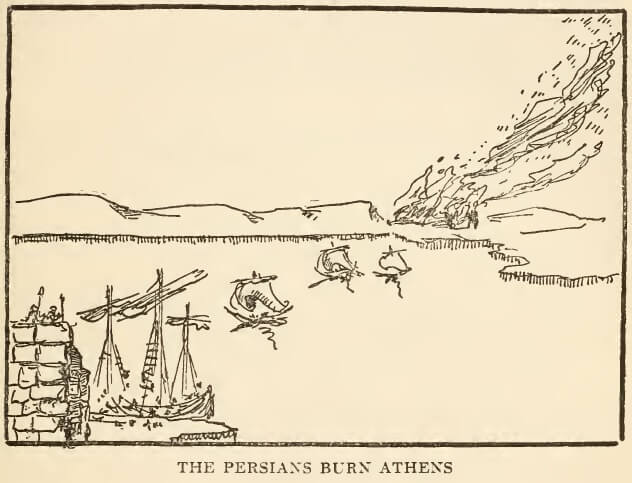
But the pass had been lost and the greater part of Greece fell into the hands of the Persians. They marched upon Athens, threw the garrison from the rocks of the Acropolis and burned the city.

The people fled to the Island of Salamis. All seemed lost. But on the 20th of September of the year 480 Themistocles forced the Persian fleet to give battle within the narrow straits which separated the Island of Salamis from the mainland and within a few hours he destroyed three quarters of the Persian ships.

In this way the victory of Thermopylae came to naught. The Persian leader Xerxes was forced to retire. The next year, so he decreed, would bring a final decision. He took his troops to the Greek region of Thessaly and there he waited for spring.

But this time the Spartans understood the seriousness of the hour. They left the safe shelter of the wall which they had built across the isthmus of Corinth and under the leadership of Pausanias they marched against Mardonius the Persian general. The united Greeks (some one hundred thousand men from a dozen different cities) attacked the three hundred thousand men of the enemy near Plataea. Once more the heavy Greek infantry broke through the Persian barrage of arrows. The Persians were defeated, as they had been at Marathon, and this time they left for good. By a strange coincidence, the same day that the Greek armies won their victory near Plataea, the Athenian ships destroyed the enemy’s fleet near Cape Mycale in Asia Minor.

Thus did the first encounter between Asia and Europe end. Athens had covered herself with glory and Sparta had fought bravely and well. If these two cities had been able to come to an agreement, if they had been willing to forget their little jealousies, they might have become the leaders of a strong and united Hellas.

But alas, they allowed the hour of victory and enthusiasm to slip by, and the same opportunity never returned.

The Ancient Greek Theater

The Greek Theater

At a very early stage of their history the Greeks had begun to collect the poems, which had been written in honor of their brave ancestors who had driven the Pelasgians out of Hellas and had destroyed the power of Troy. These poems were recited in public and everybody came to listen to them. But the theater, the form of entertainment which has become almost a necessary part of our own lives, did not grow out of these recited heroic tales. It had such a curious origin that I must tell you something about it in a separate chapter

The Greeks had always been fond of parades. Every year they held solemn processions in honor of Dionysus the god of the wine. As everybody in Greece drank wine (the Greeks thought water only useful for the purpose of swimming and sailing) this particular Divinity was as popular as a god of the Soda-Fountain would be in our own land.

And because the Wine-god was supposed to live in the vineyards, amidst a merry mob of Satyrs (strange creatures who were half-man and half-goat), the crowd that joined the procession used to wear goat-skins and to hee-haw like real billy-goats. The Greek word for goat is “tragos” and the Greek word for singer is “oidos.” The singer who meh-mehed like a goat therefore was called a “tragos-oidos” or goat singer, and it is this strange name which developed into the modern word “Tragedy,” which means in the theatrical sense a piece with an unhappy ending, just as Comedy (which really means the singing of something “comos” or gay) is the name given to a play which ends happily.

But how, you will ask, did this noisy chorus of masqueraders, stamping around like wild goats, ever develop into the noble tragedies which have filled the theaters of the world for almost two thousand years?

The connecting link between the goat-singer and Hamlet is really very simple as I shall show you in a moment.

The singing chorus was very amusing in the beginning and attracted large crowds of spectators who stood along the side of the road and laughed. But soon this business of tree-hawing grew tiresome and the Greeks thought dullness an evil only comparable to ugliness or sickness. They asked for something more entertaining. Then an inventive young poet from the village of Icaria in Attica hit upon a new idea which proved a tremendous success. He made one of the members of the goat-chorus step forward and engage in conversation with the leader of the musicians who marched at the head of the parade playing upon their pipes of Pan. This individual was allowed to step out of line. He waved his arms and gesticulated while he spoke (that is to say he “acted” while the others merely stood by and sang) and he asked a lot of questions, which the bandmaster answered according to the roll of papyrus upon which the poet had written down these answers before the show began.

This rough and ready conversation—the dialogue—which told the story of Dionysus or one of the other gods, became at once popular with the crowd. Henceforth every Dionysian procession had an “acted scene” and very soon the “acting” was considered more important than the procession and the meh-mehing.

Aeschylus, the most successful of all “tragedians” who wrote no less than eighty plays during his long life (from 526 to 455) made a bold step forward when he introduced two “actors” instead of one. A generation later Sophocles increased the number of actors to three. When Euripides began to write his terrible tragedies in the middle of the fifth century, B.C., he was allowed as many actors as he liked and when Aristophanes wrote those famous comedies in which he poked fun at everybody and everything, including the gods of Mount Olympus, the chorus had been reduced to the role of mere bystanders who were lined up behind the principal performers and who sang “this is a terrible world” while the hero in the foreground committed a crime against the will of the gods.

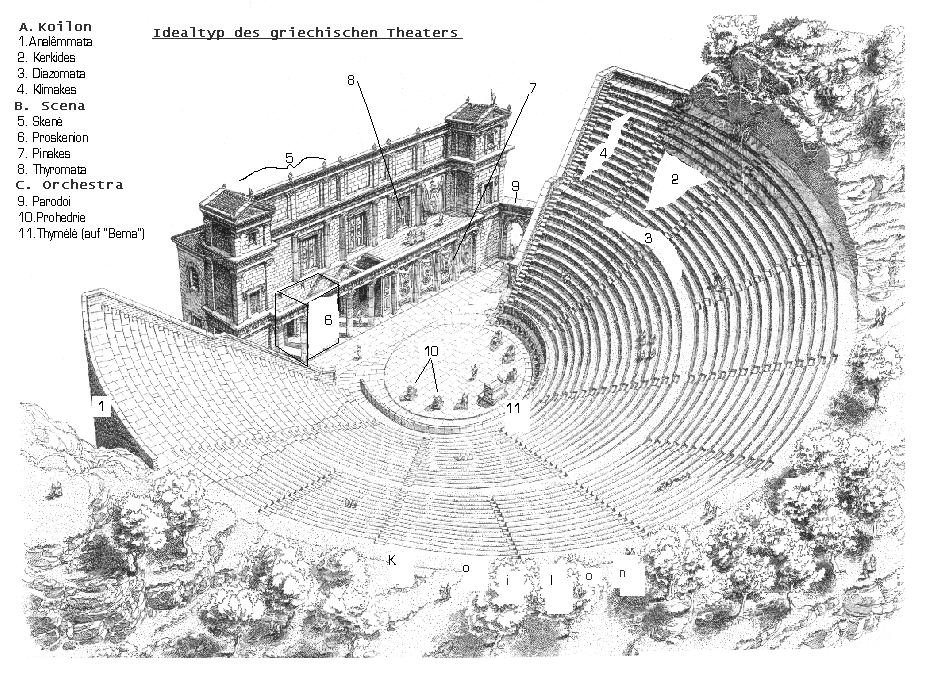
This new form of dramatic entertainment demanded a proper setting, and soon every Greek city owned a theater, cut out of the rock of a nearby hill. The spectators sat upon wooden benches and faced a wide circle (our present orchestra where you pay three dollars and thirty cents for a seat). Upon this half-circle, which was the stage, the actors and the chorus took their stand. Behind them there was a tent where they made up with large clay masks which hid their faces and which showed the spectators whether the actors were supposed to be happy and smiling or unhappy and weeping. The Greek word for tent is “skene” and that is the reason why we talk of the “scenery” of the stage.

When once the tragedy had become part of Greek life, the people took it very seriously and never went to the theater to give their minds a vacation. A new play became as important an event as an election and a successful playwright was received with greater honors than those bestowed upon a general who had just returned from a famous victory.