A place to grow your relationship with God

Archive for the ‘MCGUFFEY’S SECOND ECLECTIC READER’ Category

McGuffey’s Second Eclectic Reader: The Little Star

Lesson 4: The Little Star

Words:

  • above
  • world
  • dark
  • oft
  • never
  • spark
  • dew
  • till
  • diamond
  • twinkle
  • blazing

Lesson:

  1. Twinkle, twinkle, little star;

How I wonder what you are,

Up above the world so high,

Like a diamond in the sky!

  1. When the blazing sun is set,

And the grass with dew is wet,

Then you show your little light;

Twinkle, twinkle, all the night.

  1. Then, if I wore in the dark,

I would thank you for your spark.

I could not see which way to go,

If you did not twinkle so.

  1. And when I am sound asleep,

Oft you through my window peep;

For you never shut your eye,

Till the sun is in the sky.

MCGUFFEY’S SECOND ECLECTIC READER

“McGuffey’s Second Eclectic Reader” by William Holmes McGuffey is an educational reader designed for children, likely written in the mid-19th century. The book serves as a reading and moral instruction tool, using various prose and poetry selections to engage young readers and help them develop literacy skills alongside positive moral values. The beginning of this reader sets a historical context, highlighting the pedagogical approach of the time. It introduces the reader to the types of lessons that will follow, such as “Evening at Home,” which portrays a warm family atmosphere, and “Bubbles,” where children engage in play. It emphasizes moral lessons conveyed through relatable stories, guiding children to understand values like kindness, curiosity, and responsibility. Each lesson is accompanied by vocabulary exercises, fostering vocabulary building and comprehension while providing teachers with a resource to implement reading effectively in their classrooms.

McGuffey’s Second Eclectic Reader by William Holmes McGuffey Lesson 41: The Fishhawk

Words:

  • rough
  • often
  • beneath
  • fiercely
  • seaside
  • twenty
  • timidly
  • compels
  • robber
  • breast
  • spots
  • mode
  • osprey
  • hooked

Lesson:

1. The fishhawk, or osprey, is not so large as the eagle; but he has, like the eagle, a hooked bill and sharp claws.
2. His color is a dark brown, with black and white spots, and his length is from twenty to twenty-two inches. His breast is mostly white. His tail and wings are long.
3. The fishhawk is often found sitting upon a tree over a pond, or lake, or river. He is also found by the seaside.
4. He watches the fish as they swim in the water beneath him; then he darts down suddenly and catches one of them.
5. When he catches a fish in his sharp, rough claws, he carries it off to eat, and, as he flies away with it for his dinner, an eagle sometimes meets him.
6. The eagle flies at him fiercely with his sharp bill and claws, and compels the hawk to drop the fish.
7. Then the eagle catches the fish as it falls, before it reaches the ground, and carries it off.
8. The poor fishhawk, with a loud cry, timidly flies away. He must go again to the water and catch another fish for his dinner.
9. Thus you see, that the eagle is a robber. He robs fishhawks, whose only mode of getting a living is by catching fish.

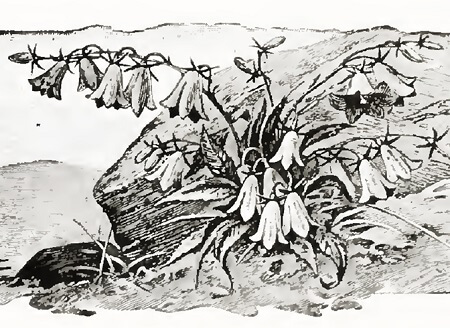
McGuffey’s Second Eclectic Reader by William Holmes McGuffey Lesson 40: The Little Harebell

Words:

  • fair
  • lady
  • drear
  • dreary
  • clinging
  • harebell
  • fled
  • ne’er (another way of saying never)
  • despair
  • nodding
  • blooming

Lesson:
‘Tell me, little harebell,
Are you lonely here.
Blooming in the shadow
On this rock so drear?’
‘Clinging to this bit of earth,
As if in mid-air,
With your sweet face turned to me,
Looking strangely fair?’
‘Lady’ said the harebell,
Nodding low its head,
‘Though this spot seem dreary,
Thought the sunlight’s fled.

‘Know that I’m not lonely

That I ne’er despair.

God is in the shadow

God is everywhere.’

McGuffey’s Second Eclectic Reader by William Holmes McGuffey Lesson 39: The Bear and the Children

Words:

  • smelt
  • hide
  • crept
  • laid
  • floor
  • inn
  • bear
  • fur
  • youngest
  • danced
  • joyfully
  • marched
  • soldiers
  • badly
  • running
  • eldest

Lesson:
1. In the parlor of an inn in a small town, sat a man who had been going about with a bear. He was waiting for his supper, and the bear was tied up in the yard.

2. Up in the attic, three little children were playing together. The eldest might have been six years old; the youngest, not more than two.

3. Stump! stump! stump! Someone was coming up the stairs.

4. The door flew open suddenly, and there stood the great, shaggy bear. He had got tired of waiting, and had found his way to the stairs.

5. The children were badly frightened. Each one crept into a corner, but the bear found them all out, and smelt their clothes, but did not hurt them.


6. ‘This must be a great dog,’ they said, and they began to pat him.

7. Then the bear lay down on the floor, and the youngest boy climbed on his back, hid his head in the shaggy fur, and played at ‘hide and seek.’

8. The eldest boy took his drum and began to strike it, when the bear rose on his hind legs and danced. At that the children gave a merry shout.

9. The two younger boys took their wooden guns, and gave the bear one. Away they all marched around the room, keeping step.

10. Now the frightened mother of the children came to the door. But the youngest boy shouted, joyfully. ‘See, we are playing soldiers!’

11. Then the bear’s master came running up, and took the bear away.

McGuffey’s Second Eclectic Reader by William Holmes McGuffey: The New Scales

Lesson 38: The New Scales

Words:

  • Herbert
  • orange
  • find
  • post
  • inches
  • thread
  • beam
  • thick
  • pine
  • next
  • groove
  • scales
  • hole
  • peel
  • gimlet
  • ribbon

Lesson:

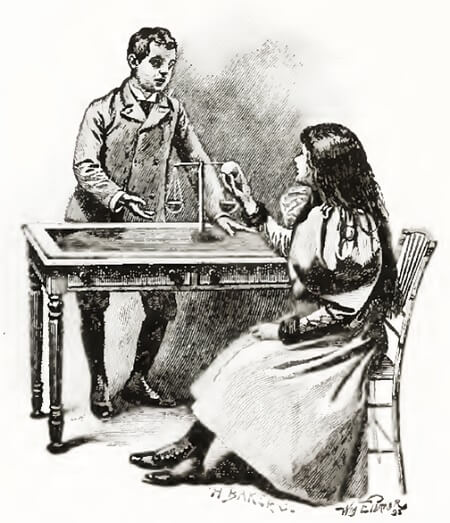
  1. ‘Herbert, will you please peel my orange?’ said Lucy. Herbert was reading his new book, but he put it down at once, and took the orange from his little sister.
  2. ‘Shall I make a pair of scales, Lucy, for you to use when you play store?’
  3. ‘Oh yes! but how can you do that’!’
  4. ‘I’ll show you. First, we must take the peel off in two little cups, one just as large as the other. While I do this, see if you can find me two nice sticks about ten inches long.’
  5. Lucy ran out to the woodhouse to find the sticks.–‘ Will these do?’
  6. ‘No, they are too hard. Find some pine sticks if you can.’
  7. ‘Here are some.’
  8. ‘These will do nicely. Now I must make a scale beam and a post. Can you find me a little block for a post, Lucy’!’
  9. ‘Will a ribbon block do, Herbert?’
  10. ‘Yes, if it is not too thick.’
  11. ‘Here is one an inch thick.’
  12. ‘That will be just right. Now get the little gimlet.’
  13. Herbert worked away until he had made the beam and the post. Then he made a hole in the middle of the block, and put the post in. Next, he put the beam into a little groove at the top of the post, so that it would balance nicely.
  14. ‘Now, Lucy, we must have a needle and some thread. We must put four threads to each cup; then we will tie the threads to the ends of the beam.
  15. ‘There, Lucy, what do you think of that?’
  16. ‘Why, Herbert, that is just as nice as the real scales in father’s store; and you may have all my orange for making them.’

McGuffey’s First Second Reader by William Holmes McGuffey Lesson 37: The Kitchen Clock

Words:

  • talkative
  • improve
  • obliging
  • written
  • tick-tock
  • clock
  • truthful
  • itself
  • kitchen
  • fear
  • reaches
  • most

Lesson:

  1. Listen to the kitchen clock! To itself it ever talks, From its place it never walks; ‘Tick-tock-tick-tock:’ Tell me what it says.
  2. ‘I’m a very patient clock, Never moved by hope or fear, Though I’ve stood for many a year; Tick-tock-tick-tock:’ That is what it says.
  3. ‘I’m a very truthful clock: People say about the place, Truth is written on my face; Tick-tock-tick-tock:’ That is what it says.
  4. ‘I’m a most obliging clock; If you wish to hear me strike, You may do it when you like; Tick-tock-tick-tock:’ That is what it says.
  5. ‘I’m a very friendly clock; For this truth to all I tell, Life is short, improve it well; Tick-tock-tick-tock:’ That is what it says.
  6. What a talkative old clock! Let us see what it will do When the hour hand reaches two; ‘Ding-ding–tick-tock:’ That is what it says.

MCGUFFEY’S SECOND ECLECTIC READER: BUBBLES.

Words:

  • beautiful
  • porch
  • rainbow
  • burst
  • bubbling
  • same
  • biggest
  • sneeze
  • colors
  • main
  • soap
  • wash
  • red
  • many

Lesson:

  1. The boys have come out on the porch to blow bubbles. The old cat is asleep on the mat by the door.
  2. ‘Ha! ha!’ laughs Robert, as a bubble comes down softly on the old cat’s back, and does not burst.
  3. Willie tries to make his bubble do the same. This time it comes down on the cat’s face, and makes her sneeze.
  4. ‘She would rather wash her face without soap,’ says Harry. ‘Now let us see who can make the biggest bubble.’
  5. ‘Mine is the biggest,’ says Robert. ‘See how high it floats in the air! I can see—ah! it has burst.’
  6. ‘I can see the house and the trees and the sky in mine,’ says Willie; ‘and such beautiful colors.’
  7. ‘How many, Willie?’
  8. ‘Red, one; blue, two; there—they are all out. Let us try again.’
  9. ‘I know how many colors there are,’ says Harry. ‘Just as many as there are in the rainbow.’
  10. ‘Do you know how many that is?’

MCGUFFEY’S SECOND ECLECTIC READER: Evening at Home

Words:

  • newspaper
  • cold
  • order
  • seem
  • through
  • stockings
  • chat
  • story
  • light
  • Harry
  • branches
  • kiss
  • burns
  • Mrs.
  • events
  • another
  • Mr.
  • stool
  • lamp
  • mends

Lesson:

  1. It is winter. The cold wind whistles through the branches of the trees.
  2. Mr. Brown has done his day’s work, and his children, Harry and Kate, have come home from school. They learned their lessons well today, and both feel happy.
  3. Tea is over. Mrs. Brown has put the little sitting room in order. The fire burns brightly. One lamp gives light enough for all. On the stool is a basket of fine apples. They seem to say, ‘Won’t you have one?’
  4. Harry and Kate read a story in a new book. The father reads his newspaper, and the mother mends Harry’s stockings.
  5. By and by, they will tell one another what they have been reading about, and will have a chat over the events of the day.
  6. Harry and Kate’s bedtime will come first. I think I see them kiss their dear father and mother a sweet good night.
  7. Do you not wish that every boy and girl could have a home like this?