A place to grow your relationship with God

Archive for the ‘McGuffey’s Third Eclectic Reader’ Category

McGuffey’s Third Eclectic Reader Lesson 60: The Contented Boy

Lesson:

Mr. Lenox was one morning riding by himself. He got off from his horse to look at something on the roadside. The horse broke away from him, and ran off. Mr. Lenox ran after him, but soon found that he could not catch him.

A little boy at work in a field near the road, heard the horse. As soon as he saw him running from his master, the boy ran very quickly to the middle of the road, and, catching the horse by the bridle, stopped him till Mr. Lenox came up.

Mr. Lenox. Thank you, my good boy, you have caught my horse very nicely. What shall I give you for your trouble?

Boy. I want nothing, sir.

Mr. L. You want nothing? So much the better for you. Few men can say as much. But what were you doing in the field?

B. I was rooting up weeds, and tending the sheep that were feeding on turnips.

Mr. L. Do you like to work?

B. Yes, sir, very well, this fine weather.

Mr. L. But would you not rather play?

B. This is not hard work. It is almost as good as play.

Mr. L. Who set you to work?

B. My father, sir.

Mr. L. What is your name?

B. Peter Hurdle, sir.

Mr. L. How old are you?

B. Eight years old, next June.

Mr. L. How long have you been here?

B. Ever since six o’clock this morning.

Mr. L. Are you not hungry?

B. Yes, sir, but I shall go to dinner soon.

Mr. L. If you had a dime now, what would you do with it?

B. I don’t know, sir. I never had so much.

Mr. L. Have you no playthings?

B. Playthings? What are they?

Mr. L. Such things as ninepins, marbles, tops, and wooden horses.

B. No, sir. Tom and I play at football in winter, and I have a jumping rope. I had a hoop, but it is broken.

Mr. L. Do you want nothing else?

B. I have hardly time to play with what I have. I have to drive the cows, and to run on errands, and to ride the horses to the fields, and that is as good as play.

Mr. L. You could get apples and cakes, if you had money, you know.

B. I can have apples at home. As for cake, I do not want that. My mother makes me a pie now and then, which is as good.

Mr. L. Would you not like a knife to cut sticks?

B. I have one. Here it is. Brother Tom gave it to me.

Mr. L. Your shoes are full of holes. Don’t you want a new pair?

B. I have a better pair for Sundays.

Mr. L. But these let in water.

B. I do not mind that, sir.

Mr. L. Your hat is all torn, too.

B. I have a better one at home.

Mr. L. What do you do when it rains?

B. If it rains very hard when I am in the field, I get under a tree for shelter.

Mr. L. What do you do, if you are hungry before it is time to go home?

B. I sometimes eat a raw turnip.

Mr. L. But if there is none?

B. Then I do as well as I can without. I work on, and never think of it.

Mr. L. Why, my little fellow, I am glad to see that you are so contented. Were you ever at school?

B. No, sir. But father means to send me next winter.

Mr. L. You will want books then.

B. Yes, sir; each boy has a Spelling Book, a Reader, and a Testament.

Mr. L. Then I will give them to you. Tell your father so, and that it is because you are an obliging, contented little boy.

B. I will, sir. Thank you.

Mr. L. Goodbye, Peter.

B. Good morning, sir.

Dr. John Aiken

DEFINITIONS

Rooting: Pulling up by the roots.

Tending: Watching, attending.

Turnip: A vegetable.

Weather: State of the atmosphere.

Errands: Messages.

Raw: Not cooked.

Testament: The last twenty-seven books of the Bible.

McGuffey’s Third Eclectic Reader Lesson 59: Persevere

Lesson:

  1. The fisher who draws in his net too soon,

Won’t have any fish to sell;

The child who shuts up his book too soon,

Won’t learn any lessons well.

  1. If you would have your learning stay,

Be patient,—don’t learn too fast:

The man who travels a mile each day,

May get around the world at last.

McGuffey’s Third Eclectic Reader Lesson 58: John Carpenter

Lesson:

  1. John Carpenter did not like to buy toys that somebody else had made. He liked the fun of making them himself. The thought that they were his own work delighted him.
  2. Tom Austin, one of his playmates, thought a toy was worth nothing unless it cost a great deal of money. He never tried to make anything, but bought all his toys.
  3. ‘Come and look at my horse,’ said he, one day. ‘It cost a dollar, and it is such a beauty! Come and see it.’
  4. John was soon admiring his friend’s horse; and he was examining it carefully, to see how it was made. The same evening he began to make one for himself.
  5. He went into the wood shed, and picked out two pieces of wood—one for the head of his horse, the other for the body. It took him two or three days to shape them to his satisfaction.
  6. His father gave him a bit of red leather for a bridle, and a few brass nails, and his mother found a bit of old fur with which he made a mane and tail for his horse.
  7. But what about the wheels? This puzzled him. At last he thought he would go to a turner’s shop, and see if he could not get some round pieces of wood which might suit his purpose.
  8. He found a large number of such pieces among the shavings on the floor, and asked permission to take a few of them. The turner asked him what he wanted them for, and he told him about his horse.
  9. ‘Oh,’ said the man, laughing, ‘if you wish it, I will make some wheels for your horse. But mind, when it is finished, you must let me see it.’
  10. John promised to do so, and he soon ran home with the wheels in his pocket. The next evening, he went to the turner’s shop with his horse all complete, and was told that he was an ingenious little fellow.
  11. Proud of this compliment, he ran to his friend Tom, crying, ‘Now then, Tom, here is my horse,—look!’
  12. ‘Well, that is a funny horse,’ said Tom; ‘where did you buy it?’ ‘I didn’t buy it,’ replied John; ‘I made it.’
  13. ‘You made it yourself! Oh, well, it’s a good horse for you to make. But it is not so good as mine. Mine cost a dollar, and yours didn’t cost anything.’
  14. ‘It was real fun to make it, though,’ said John, and away he ran with his horse rolling after him.
  15. Do you want to know what became of John? Well, I will tell you. He studied hard in school, and was called the best scholar in his class. When he left school, he went to work in a machine shop. He is now a master workman, and will soon have a shop of his own.

DEFINITIONS

  1. Admiring: Looking at with pleasure.
  2. Examining: Looking at every point.
  3. Leather: The skin of an animal prepared for use.
  4. Puzzled: Perplexed, caused trouble.
  5. Turner: One who shapes wooden or metal articles by means of a lathe.
  6. Shavings: The thin ribbons of wood which a carpenter makes in planing.
  7. Permission: Privilege, consent.
  8. Complete: Finished.
  9. Ingenious: Skillful.
  10. Compliment: Praise, approbation.

McGuffey’s Third Eclectic Reader Lesson 57: Which Loved Best?

Lesson:

  1. ‘I love you, mother,’ said little John;

Then, forgetting work, his cap went on,

And he was off to the garden swing,

Leaving his mother the wood to bring.

  1. ‘I love you, mother,’ said rosy Nell;

‘I love you better than tongue can tell;’

Then she teased and pouted full half the day,

Till her mother rejoiced when she went to play.

  1. ‘I love you, mother,’ said little Fan;

‘Today I’ll help you all I can;

How glad I am that school doesn’t keep!’

So she rocked the baby till it fell asleep.

  1. Then, stepping softly, she took the broom,

And swept the floor, and dusted the room;

Busy and happy all day was she,

Helpful and cheerful as child could be.

  1. ‘I love you, mother,’ again they said—

Three little children going to bed;

How do you think that mother guessed

Which of them really loved her best?

Joy Allison.

McGuffey’s Third Eclectic Reader Lesson 56: When to Say No

Lesson:

  1. Though ‘No’ is a very little word, it is not always easy to say it; and the not doing so, often causes trouble.
  2. When we are asked to stay away from school, and spend in idleness or mischief the time which ought to be spent in study, we should at once say ‘No.’
  3. When we are urged to loiter on our way to school, and thus be late, and interrupt our teacher and the school, we should say ‘No.’ When some schoolmate wishes us to whisper or play in the schoolroom, we should say ‘No.’
  4. When we are tempted to use angry or wicked words, we should remember that the eye of God is always upon us, and should say ‘No.’
  5. When we have done anything wrong, and are tempted to conceal it by falsehood, we should say ‘No, we cannot tell a lie; it is wicked and cowardly.’
  6. If we are asked to do anything which we know to be wrong, we should not fear to say ‘No.’
  7. If we thus learn to say ‘No,’ we shall avoid much trouble, and be always safe.

DEFINITIONS

  1. Causes: Makes.
  2. Idleness: A doing nothing, laziness.
  3. Urged: Asked repeatedly.
  4. Loiter: Linger, delay.
  5. Interrupt: Disturb, hinder.
  6. Tempted: Led by evil circumstances.
  7. Conceal: Hide.
  8. Falsehood: Untruth.

McGuffey’s Third Eclectic Reader Lesson 55: Don’t Kill the Birds

Lesson:

  1. Don’t kill the birds! the little birds,

That sing about your door

Soon as the joyous Spring has come,

And chilling storms are o’er.

  1. The little birds! how sweet they sing!

Oh, let them joyous live;

And do not seek to take the life

Which you can never give.

  1. Don’t kill the birds! the pretty birds,

That play among the trees;

For earth would be a cheerless place,

If it were not for these.

  1. The little birds! how fond they play!

Do not disturb their sport;

But let them warble forth their songs,

Till winter cuts them short.

  1. Don’t kill the birds! the happy birds,

That bless the field and grove;

So innocent to look upon,

They claim our warmest love.

  1. The happy birds, the tuneful birds,

How pleasant’t is to see!

No spot can be a cheerless place

Where’er their presence be.

DEFINITIONS

  1. Disturb: Interfere with.
  2. Warble: To trill, to carol.
  3. Innocent: Pure, harmless.
  4. Tuneful: Musical, melodious.
  5. Presence: State of being at hand, existence.

McGuffey’s Third Eclectic Reader Lesson 54: The Waves

Lesson:
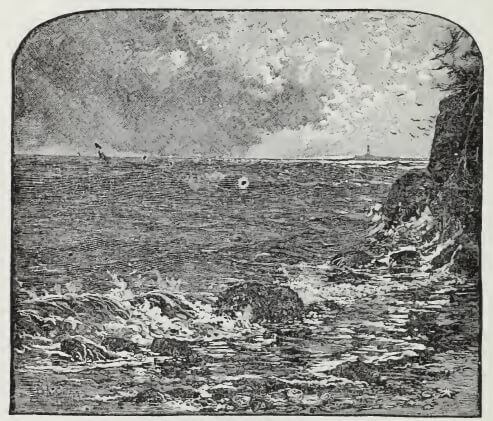
1. ‘Where are we to go?’ said the little waves to the great, deep sea. ‘Go, my darlings, to the yellow sands: you will find work to do there.’

2. ‘I want to play,’ said one little wave; ‘I want to see who can jump the highest.’ ‘No; come on, come on,’ said an earnest wave; ‘mother must be right. I want to work.’

3. ‘Oh, I dare not go,’ said another; ‘look at those great, black rocks close to the sands; I dare not go there, for they will tear me to pieces.’

4. ‘Take my hand, sister,’ said the earnest wave; ‘let us go on together. How glorious it is to do some work.’

5. ‘Shall we ever go back to mother?’ ‘Yes, when our work is done.’

6. So one and all hurried on. Even the little wave that wanted to play, pressed on, and thought that work might be fun after all. The timid ones did not like to be left behind, and they became earnest as they got nearer the sands.

7. After all, it was fun, pressing on one after another— jumping, laughing, running on to the broad, shining sands.

8. First, they came in their course to a great sand castle. Splash, splash! they all went over it, and down it came. ‘Oh, what fun!’ they cried.

9. ‘Mother told me to bring these seaweeds; I will find a pretty place for them,’ said one—and she ran a long way over the sands, and left them among the pebbles. The pebbles cried, ‘We are glad you are come. We wanted washing.’

10. ‘Mother sent these shells; I don’t know where to put them,’ said a little fretful wave. ‘Lay them one by one on the sand, and do not break them,’ said the eldest wave.

11. And the little one went about its work, and learned to be quiet and gentle, for fear of breaking the shells.

12. ‘Where is my work?’ said a great, full-grown wave. ‘this is mere play. The little ones can do this and laugh over it. Mother said there was work for me.’ And he came down upon some large rocks.

13. Over the rocks and into a pool he went, and he heard the fishes say, ‘The sea is coming. Thank you, great sea; you always send a big wave when a storm is nigh. Thank you, kind wave; we are all ready for you now.’

14. Then the waves all went back over the wet sands, slowly and carelessly, for they were tired.

15. ‘All my shells are safe,’ said one.

16. And, ‘My seaweeds are left behind,’ said another.

17. ‘I washed all of the pebbles,’ said a third.

18. ‘And I—I only broke on a rock, and splashed into a pool,’ said the one that was so eager to work. ‘I have done no good, mother—no work at all.’

19. ‘Hush!’ said the sea. And they heard a child that was walking on the shore, say, ‘O mother, the sea has been here! Look, how nice and clean the sand is, and how clear the water is in that pool.’

20. Then the sea, said, ‘Hark!’ and far away they heard the deep moaning of the coming storm.

21. ‘Come, my darlings,’ said she; ‘you have done your work, now let the storm do its work.’

DEFINITIONS

6. Pressed: Pushed, followed closely.

6. Timid: Wanting courage, not bold.

10. Fretful: Cross, peevish.

10. Eldest: First, foremost.

20. Moaning: Making a low, dull sound, muttering.

McGuffey’s Third Eclectic Reader Lesson 53: The Old Clock

Lesson:

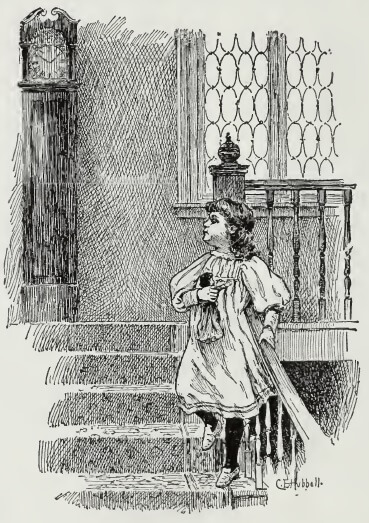
  1. In the old, old hall the old clock stands,

And round and round move the steady hands;

With its tick, tick, tick, both night and day,

While seconds and minutes pass away.

  1. At the old, old clock oft wonders Nell,

For she can’t make out what it has to tell;

She has ne’er yet read, in prose or rhyme,

That it marks the silent course of time.

  1. When I was a child, as Nell is now,

And long ere Time had wrinkled my brow,

The old, old clock both by night and day

Said,—’Tick, tick, tick!’ Time passes away.

DEFINITIONS

  1. Prose: The common language of people in talking or writing.
  2. Rhyme: Verse, poetry.
  3. Wrinkled: Having creases or folds in the skin.
  4. Brow: The forehead.

McGuffey’s Third Eclectic Reader Lesson 52: True Courage

Lesson:

One cold winter’s day, three boys were passing by a schoolhouse. The oldest was a bad boy, always in trouble himself, and trying to get others into trouble.

The youngest, whose name was George, was a very good boy. George wished to do right, but was very much wanting in courage. The other boys were named Henry and James. As they walked along, they talked as follows:

Henry. What fun it would be to throw a snowball against the schoolroom door, and make the teacher and scholars all jump!

James. You would jump, if you should. If the teacher did not catch you and whip you, he would tell your father, and you would get a whipping then; and that would make you jump higher than the scholars, I think.

Henry. Why, we would get so far off, before the teacher could come to the door, that he could not tell who we are. Here is a snowball just as hard as ice, and George would as soon throw it against the door as not.

James. Give it to him, and see. He would not dare to throw it.

Henry. Do you think George is a coward? You do not know him as well as I do. Here, George, take this snowball, and show James that you are not such a coward as he thinks you are.

George. I am not afraid to throw it; but I do not want to. I do not see that it will do any good, or that there will be any fun in it.

James. There! I told you he would not dare to throw it.

Henry. Why, George, are you turning coward? I thought you did not fear anything. Come, save your credit, and throw it. I know you are not afraid.

George. Well, I am not afraid to throw. Give me the snowball. I would as soon throw it as not.

Whack! went the snowball against the door; and the boys took to their heels. Henry was laughing as heartily as he could, to think what a fool he had made of George. George had a whipping for his folly, as he ought to have had. He was such a coward, that he was afraid of being called a coward. He did not dare refuse to do as Henry told him, for fear that he would be laughed at.

If he had been really a brave boy, he would have said, ‘Henry, do you suppose that I am so foolish as to throw that snowball, just because you want to have me? You may throw your own snowballs, if you please!’

Henry would, perhaps, have laughed at him, and called him a coward. But George would have said, ‘Do you think that I care for your laughing? I do not think it right to throw the snowball. I will not do that which I think to be wrong, if the whole town should join with you in laughing.’

This would have been real courage. Henry would have seen, at once, that it would do no good to laugh at a boy who had so bold a heart. You must have this fearless spirit, or you will get into trouble, and will be, and ought to be, disliked by all.

DEFINITIONS

Scholars: Children at school.

Whipping: Punishment.

Dare: Have courage.

Credit: Reputation.

Heartily: Freely, merrily.

Refuse: Decline.

Fearless: Bold, brave.

Disliked: Not loved.

McGuffey’s Third Eclectic Reader Lesson 51: Spring

Lesson:

  1. The alder by the river

Shakes out her powdery curls;

The willow buds in silver

For little boys and girls.

  1. The little birds fly over,

And oh, how sweet they sing!

To tell the happy children

That once again ‘t is Spring.

  1. The gay green grass comes creeping

So soft beneath their feet;

The frogs begin to ripple

A music clear and sweet.

  1. And buttercups are coming,

And scarlet columbine,

And in the sunny meadows

The dandelions shine.

  1. And just as many daisies

As their soft hands can hold,

The little ones may gather,

All fair in white and gold.

  1. Here blows the warm red clover,

There peeps the violet blue;

Oh, happy little children!

God made them all for you.

Celia Thaxter.

DEFINITIONS

  1. Alder: A tree which grows in moist land.
  2. Ripple: To cause little waves of sound.