A place to grow your relationship with God

Archive for the ‘McGuffey’s Third Eclectic Reader’ Category

McGuffey’s Third Eclectic Reader Lesson 50: The Alarm Clock
Lesson:

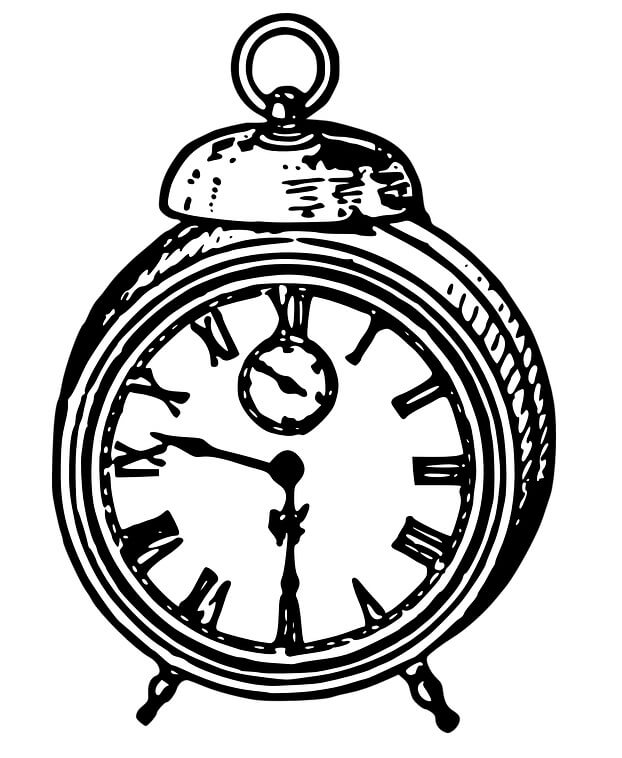
  1. A lady, who found it not easy to wake in the morning as early as she wished, bought an alarm clock. These clocks are so made as to strike with a loud whirring noise at any hour the owner pleases to set them.
  2. The lady placed her clock at the head of the bed, and at the right time she found herself roused by the long, rattling sound.
  3. She arose at once, and felt better all day for her early rising. This lasted for some weeks. The alarm clock faithfully did its duty, and was plainly heard so long as it was obeyed.
  4. But, after a time, the lady grew tired of early rising. When she was waked by the noise, she merely turned over in bed, and slept again.
  5. In a few days, the clock ceased to rouse her from her sleep. It spoke just as loudly as ever; but she did not hear it, because she had been in the habit of not obeying it.
  6. Finding that she might as well be without it, she resolved that when she heard the sound she would jump up.
  7. Just so it is with conscience. If we will obey its voice, even in the most trifling things, we can always hear it, clear and strong.
  8. But if we allow ourselves to do what we have some fears may not be quite right, we shall grow more and more sleepy, until the voice of conscience has no longer power to wake as.

DEFINITIONS

  1. Alarm: A sudden sound calculated to awaken persons from sleep.
  2. Whirring: Buzzing.
  3. Roused: Waked.
  4. Rattling: Giving quick, sharp noises in rapid succession.
  5. Faithfully: In an exact and proper manner.
  6. Duty: The right conduct or action.
  7. Merely: Simply.
  8. Conscience: That within us which tells us what is right and what is wrong, reason.
  9. Trifling: Of little importance or value.
  10. Allow: Permit, suffer.

McGuffey’s Third Eclectic Reader Lesson 49: Deeds of Kindness

Lesson:

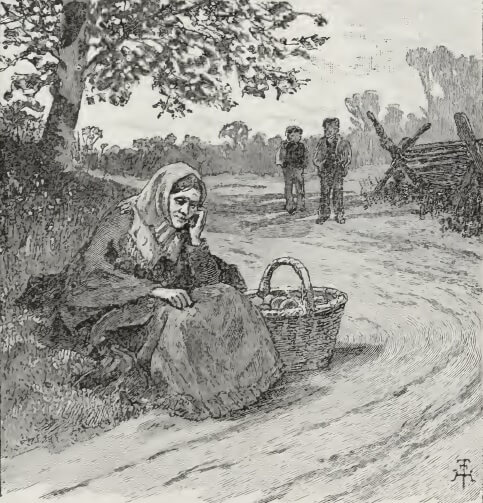
  1. One day, as two little boys were walking along the road, they overtook a woman carrying a large basket of apples.
  2. The boys thought the woman looked very pale and tired; so they said, ‘Are you going to town? If you are, we will carry your basket.’
  3. ‘Thank you,’ replied the woman, ‘you are very kind: you see I am weak and ill.’ Then she told them that she was a widow, and had a lame son to support.
  4. She lived in a cottage three miles away, and was now going to market to sell the apples which grew on the only tree in her little garden. She wanted the money to pay her rent.
  5. ‘We are going the same way you are,’ said the boys. ‘Let us have the basket;’ and they took hold of it, one on each side, and trudged along with merry hearts.
  6. The poor widow looked glad, and said that she hoped their mother would not be angry with them. ‘Oh, no,’ they replied; ‘our mother has taught us to be kind to everybody, and to be useful in any way that we can.’
  7. She then offered to give them a few of the ripest apples for their trouble. ‘No, thank you,’ said they; ‘we do not want any pay for what we have done.’
  8. When the widow got home, she told her lame son what had happened on the road, and they were both made happier that day by the kindness of the two boys.
  9. The other day, I saw a little girl stop and pick up a piece of orange peel, which she threw into the gutter. ‘I wish the boys would not throw orange peel on the sidewalk,’ said she. ‘Someone may tread upon it, and fall.’
  10. ‘That is right, my dear,’ I said. ‘It is a little thing for you to do what you have done, but it shows that you have a thoughtful mind and a feeling heart.’
  11. Perhaps some may say that these are little things. So they are; but we must not wait for occasions to do great things. We must begin with little labors of love.

DEFINITIONS

  1. Widow: A woman whose husband is dead.
  2. Trudged: Walked.
  3. Gutter: The lower ground or channel along the side of a road.
  4. Tread: Step.
  5. Occasions: Chances, opportunities.

McGuffey’s Third Eclectic Reader Lesson 48: Who Made the Stars?

Lesson:

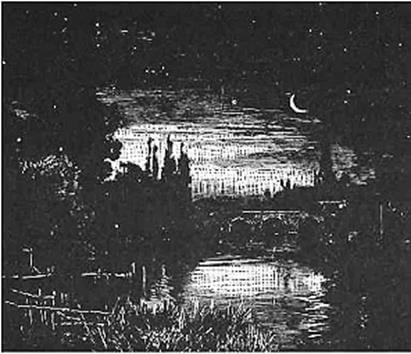
  1. ‘Mother, who made the stars, which light

The beautiful blue sky?

Who made the moon, so clear and bright,

That rises up so high?’

  1. ”Twas God, my child, the Glorious One,

He formed them by his power;

He made alike the brilliant sun,

And every leaf and flower.

  1. ‘He made your little feet to walk;

Your sparkling eyes to see;

Your busy, prattling tongue to talk,

And limbs so light and free.

  1. ‘He paints each fragrant flower that blows,

With loveliness and bloom;

He gives the violet and the rose

Their beauty and perfume.

  1. ‘Our various wants his hands supply;

He guides us every hour;

We’re kept beneath his watchful eye,

And guarded by his power.

  1. ‘Then let your little heart, my love,

Its grateful homage pay

To that kind Friend, who, from above,

Thus guides you every day.

  1. ‘In all the changing scenes of time,

On Him our hopes depend;

In every age, in every clime,

Our Father and our Friend.’

DEFINITIONS

  1. Glorious: Excellent, exalted.
  2. Prattling: Talking lightly like a child.
  3. Blows: Blossoms.
  4. Perfume: Delightful odor.
  5. Various: Many and different.
  6. Homage: Respect.
  7. Scenes: Events.
  8. Clime: Climate, region.

McGuffey’s Third Eclectic Reader Lesson 47: The Money Amy Didn’t Earn

Lesson:

  1. Amy was a dear little girl, but she was too apt to waste time in getting ready to do her tasks, instead of doing them at once as she ought.
  2. In the village in which she lived, Mr. Thornton kept a store where he sold fruit of all kinds, including berries in their season. One day he said to Amy, whose parents were quite poor, ‘Would you like to earn some money?’
  3. ‘Oh, yes,’ replied she, ‘for I want some new shoes, and papa has no money to buy them with.’
  4. ‘Well, Amy,’ said Mr. Thornton, ‘I noticed some fine, ripe blackberries in Mr. Green’s pasture today, and he said that anybody was welcome to them. I will pay you thirteen cents a quart for all you will pick for me.’
  5. Amy was delighted at the thought of earning some money; so she ran home to get a basket, intending to go immediately to pick the berries.
  6. Then she thought she would like to know how much money she would get if she picked five quarts. With the help of her slate and pencil, she found out that she would get sixty-five cents.
  7. ‘But supposing I should pick a dozen quarts,’ thought she, ‘how much should I earn then?’ ‘Dear me,’ she said, after figuring a while, ‘I should earn a dollar and fifty-six cents.’
  8. Amy then found out what Mr. Thornton would pay her for fifty, a hundred, and two hundred quarts. It took her some time to do this, and then it was so near dinner time that she had to stay at home until afternoon.
  9. As soon as dinner was over, she took her basket and hurried to the pasture. Some boys had been there before dinner, and all the ripe berries were picked. She could not find enough to fill a quart measure.
  10. As Amy went home, she thought of what her teacher had often told her—’Do your task at once; then think about it,’ for ‘one doer is worth a hundred dreamers.’

DEFINITIONS

  1. Tasks: Work which one has to do.
  2. Season: Proper time of the year.
  3. Quart: One-fourth of a gallon.
  4. Figuring: Computing, calculating.
  5. Hurried: Went rapidly.
  6. Measure: Vessel or container.

McGuffey’s Third Eclectic Reader: Lesson 46: Harry and the Guidepost

Lesson:

  1. The night was dark, the sun was hid

Beneath the mountain gray,

And not a single star appeared

To shoot a silver ray.

  1. Across the heath the owlet flew,

And screamed along the blast;

And onward, with a quickened step,

Benighted Harry passed.

  1. Now, in thickest darkness plunged,

He groped his way to find;

And now, he thought he saw beyond,

A form of horrid kind.

  1. In deadly white it upward rose,

Of cloak and mantle bare,

And held its naked arms across,

To catch him by the hair.

  1. Poor Harry felt his blood run cold,

At what before him stood;

But then, thought he, no harm, I’m sure,

Can happen to the good.

  1. So, calling all his courage up,

He to the monster went;

And eager through the dismal gloom

His piercing eyes he bent.

  1. And when he came well-nigh the ghost

That gave him such affright,

He clapped his hands upon his side,

And loudly laughed outright.

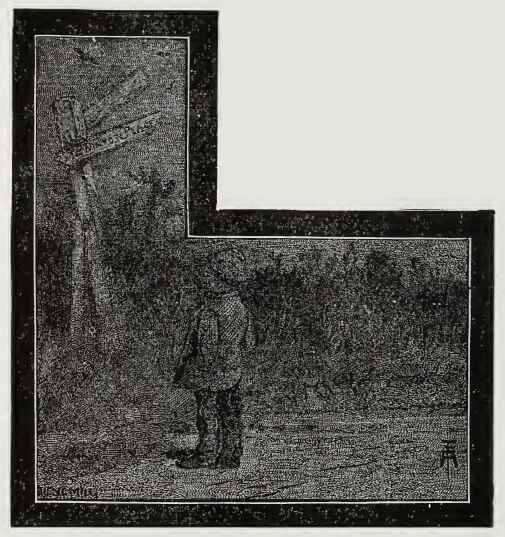
  1. For ‘t was a friendly guidepost stood,

His wandering steps to guide;

And thus he found that to the good,

No evil could betide.

  1. Ah well, thought he, one thing I’ve learned,

Nor shall I soon forget;

Whatever frightens me again,

I’ll march straight up to it.

  1. And when I hear an idle tale,

Of monster or of ghost,

I’ll tell of this, my lonely walk,

And one tall, white guidepost.

DEFINITIONS

  1. Heath: A place overgrown with shrubs.
  2. Benighted: Overtaken by the night.
  3. Groped: Felt his way in the dark.
  4. Horrid: Hideous, frightful.
  5. Monster: A thing of unnatural size and shape.
  6. Dismal: Dark, cheerless.
  7. Piercing: Sharp, penetrating.
  8. Ghost: A frightful object in white, an apparition.
  9. Guidepost: A post and sign set up at the forks of a road to direct travelers.
  10. Betide: Befall, happen.
  11. Idle: Of no account, foolish.

McGuffey’s Third Eclectic Reader Lesson 45: The Mountain Sister

Lesson:

  1. The home of little Jeannette is far away, high up among the mountains. Let us call her our mountain sister.
  2. There are many things you would like to hear about her, but I can only tell you now how she goes with her father and brother, in the autumn, to help gather nuts for the long winter.
  3. A little way down the mountain side is a chestnut wood. Did you ever see a chestnut tree? In the spring its branches are covered with bunches of creamy flowers, like long tassels. All the hot summer these are turning into sweet nuts, wrapped safely in large, prickly, green balls.
  4. But when the frost of autumn comes, these prickly balls turn brown, and crack open. Then you may see inside one, two, three, and even four, sweet, brown nuts.
  5. When her father says, one night at supper time, ‘I think there will be a frost tonight,’ Jeannette knows very well what to do. She dances away early in the evening to her little bed, made in a box built up against the wall.
  6. Soon she falls asleep to dream about the chestnut wood, and the little brook that springs from rock to rock down under the tall, dark trees. She wakes with the first daylight, and is out of bed in a minute, when she hears her father’s cheerful call, ‘Come, children; it is time to be off.’
  7. Their dinner is ready in a large basket. The donkey stands before the door with great bags for the nuts hanging at each side. They go merrily over the crisp, white frost to the chestnut trees. How the frost has opened the burs! It has done half their work for them already.
  8. How they laugh and sing, and shout to each other as they fill their baskets! The sun looks down through the yellow leaves; the rocks give them mossy seats; the birds and squirrels wonder what these strange people are doing in their woods.
  9. Jeannette really helps, though she is only a little girl; and her father says at night, that his Jane is a dear, good child. This makes her very happy. She thinks about it at night, when she says her prayers. Then she goes to sleep to dream of the merry autumn days.
  10. Such is our little mountain sister, and here is a picture of her far-away home. The mountain life is ever a fresh and happy one.

DEFINITIONS

  1. Chestnut: A tree valuable for its timber and its fruit.
  2. Tassels: Hanging ornaments, such as are used on curtains.
  3. Wrapped: Completely covered up, enclosed.
  4. Prickly: Cornered with sharp points.
  5. Crisp: Brittle, sparkling.
  6. Burs: The rough covering of seeds or nuts.

McGuffey’s Third Eclectic Reader Lesson 44: The Seven Sticks

Lesson:

  1. A man had seven sons, who were always quarreling. They left their studies and work, to quarrel among themselves. Some bad men were looking forward to the death of their father, to cheat them out of their property by making them quarrel about it.
  2. The good old man, one day, called his sons around him. He laid before them seven sticks, which were bound together. He said, ‘I will pay a hundred dollars to the one who can break this bundle.’
  3. Each one strained every nerve to break the bundle. After a long but vain trial, they all said that it could not be done.
  4. ‘And yet, my boys,’ said the father, ‘nothing is easier to do.’ He then untied the bundle, and broke the sticks, one by one, with perfect ease.
  5. ‘Ah!’ said his sons, ‘it is easy enough to do it so; anybody could do it in that way.’
  6. Their father replied, ‘As it is with these sticks, so is it with you, my sons. So long as you hold fast together and aid each other, you will prosper, and none can injure you.
  7. ‘But if the bond of union be broken, it will happen to you just as it has to these sticks, which lie here broken on the ground.’

Home, city, country, all are prosperous found,

When by the powerful link of union bound.

DEFINITIONS

  1. Cheat: Deceive, wrong.
  2. Property: That which one owns – whether land, goods, or money.
  3. Bundle: A number of things bound together.
  4. Nerve: Sinew, muscle.
  5. Prosper: Succeed, do well.
  6. Union: The state of being joined or united.

McGuffey’s Third Eclectic Reader Lesson 43: Speak Gently

Lesson:

  1. Speak gently; it is better far

To rule by love than fear:

Speak gently; let no harsh words mar

The good we might do here.

  1. Speak gently to the little child;

Its love be sure to gain;

Teach it in accents soft and mild;

It may not long remain.

  1. Speak gently to the aged one;

Grieve not the careworn heart:

The sands of life are nearly run;

Let such in peace depart.

  1. Speak gently, kindly, to the poor;

Let no harsh tone be heard;

They have enough they must endure,

Without an unkind word.

  1. Speak gently to the erring; know

They must have toiled in vain;

Perhaps unkindness made them so;

Oh, win them back again.

  1. Speak gently: ’tis a little thing

Dropped in the heart’s deep well;

The good, the joy, which it may bring,

Eternity shall tell.

George Washington Langford.

McGuffey’s Third Eclectic Reader Lesson 37: Bats

Words:

  • immediately
  • encountered
  • character
  • prepared
  • squeal
  • policy
  • snapped
  • prowling
  • shunned
  • double
  • quills
  • insect
  • terribly
  • devour
  • crevices
  • escape
  • framework
  • nightmare
  • disgusting
  • quadruped

Lesson:

  1. Bats are very strange little animals, having hair like mice, and wings like birds. During the day, they live in crevices of rocks, in caves, and in other dark places.
  2. At night, they go forth in search of food; and, no doubt, you have seen them flying about, catching such insects as happen to be out rather late at night.
  3. The wings of a bat have no quills. They are only thin pieces of skin stretched upon a framework of bones. Besides this, it may be said that while he is a quadruped, he can rise into the air and fly from place to place like a bird.
  4. There is a funny fable about the bat, founded upon this double character of beast and bird, which I will tell you.
  5. An owl was once prowling about, when he came across a bat. So he caught him in his claws, and was about to devour him. Upon this, the bat began to squeal terribly; and he said to the owl, ‘Pray, what do you take me for, that you use me thus?’
  6. ‘Why, you are a bird, to be sure,’ said the owl, ‘and I am fond of birds. I love dearly to break their little bones.’
  7. ‘Well,’ said the bat, ‘I thought there was some mistake. I am no bird. Don’t you see, Mr. Owl, that I have no feathers, and that I am covered with hair like a mouse?’
  8. ‘Sure enough,’ said the owl, in great surprise; ‘I see it now. Really, I took you for a bird, but it appears you are only a kind of mouse. I ate a mouse last night, and it gave me the nightmare. I can’t bear mice! Bah! it makes me sick to think of it.’ So the owl let the bat go.
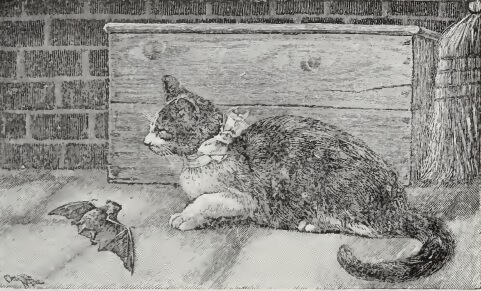
  9. The very next night, the bat encountered another danger. He was snapped up by puss, who took him for a mouse, and immediately prepared to eat him.
  10. ‘I beg you to stop one moment,’ said the bat. ‘Pray, Miss Puss, what do you suppose I am?’ ‘A mouse, to be sure!’ said the cat. ‘Not at all,’ said the bat, spreading his long wings.
  11. ‘Sure enough,’ said the cat: ‘you seem to be a bird, though your feathers are not very fine. I eat birds sometimes, but I am tired of them just now, having lately devoured four young robins; so you may go. But, bird or mouse, it will be your best policy to keep out of my way hereafter.’
  12. The meaning of this fable is, that a person playing a double part may sometimes escape danger; but he is always, like the bat, a creature that is disgusting to everybody, and shunned by all.

S. G. Goodrich—Adapted.

McGuffey’s Third Eclectic Reader Lesson 42: Beware of the First Drink

Lesson:

  1. ‘Uncle Philip, as the day is fine, will you take a walk with us this morning?’
  2. ‘Yes, boys. Let me get my hat and cane, and we will take a ramble. I will tell you a story as we go. Do you know poor old Tom Smith?’
  3. ‘Know him! Why, Uncle Philip, everybody knows him. He is such a shocking drunkard, and swears so horribly.’
  4. ‘Well, I have known him ever since we were boys together. There was not a more decent, well-behaved boy among us. After he left school, his father died, and he was put into a store in the city. There, he fell into bad company.
  5. ‘Instead of spending his evenings in reading, he would go to the theater and to balls. He soon learned to play cards, and of course to play for money. He lost more than he could pay.
  6. ‘He wrote to his poor mother, and told her his losses. She sent him money to pay his debts, and told him to come home.
  7. ‘He did come home. After all, he might still have been useful and happy, for his friends were willing to forgive the past. For a time, things went on well. He married a lovely woman, gave up his bad habits, and was doing well.
  8. ‘But one thing, boys, ruined him forever. In the city, he had learned to take strong drink, and he said to me once, that when a man begins to drink, he never knows where it will end. ‘Therefore,’ said Tom, ‘beware of the first drink!’
  9. ‘It was not long before he began to follow his old habit. He knew the danger, but it seemed as if he could not resist his desire to drink. His poor mother soon died of grief and shame. His lovely wife followed her to the grave.
  10. ‘He lost the respect of all, went on from bad to worse, and has long been a perfect sot. Last night, I had a letter from the city, stating that Tom Smith had been found guilty of stealing, and sent to the state prison for ten years.
  11. ‘There I suppose he will die, for he is now old. It is dreadful to think to what an end he has come. I could not but think, as I read the letter, of what he said to me years ago, ‘Beware of the first drink!’
  12. ‘Ah, my dear boys, when old Uncle Philip is gone, remember that he told you the story of Tom Smith, and said to you, ‘Beware of the first drink!’ The man who does this will never be a drunkard.’

DEFINITIONS

  1. Horribly: In a dreadful manner, terribly.
  2. Decent: Modest, respectable.
  3. Resist: Withstand, overcome.
  4. Sot: A habitual drunkard.
  5. Guilty: Justly chargeable with a crime.