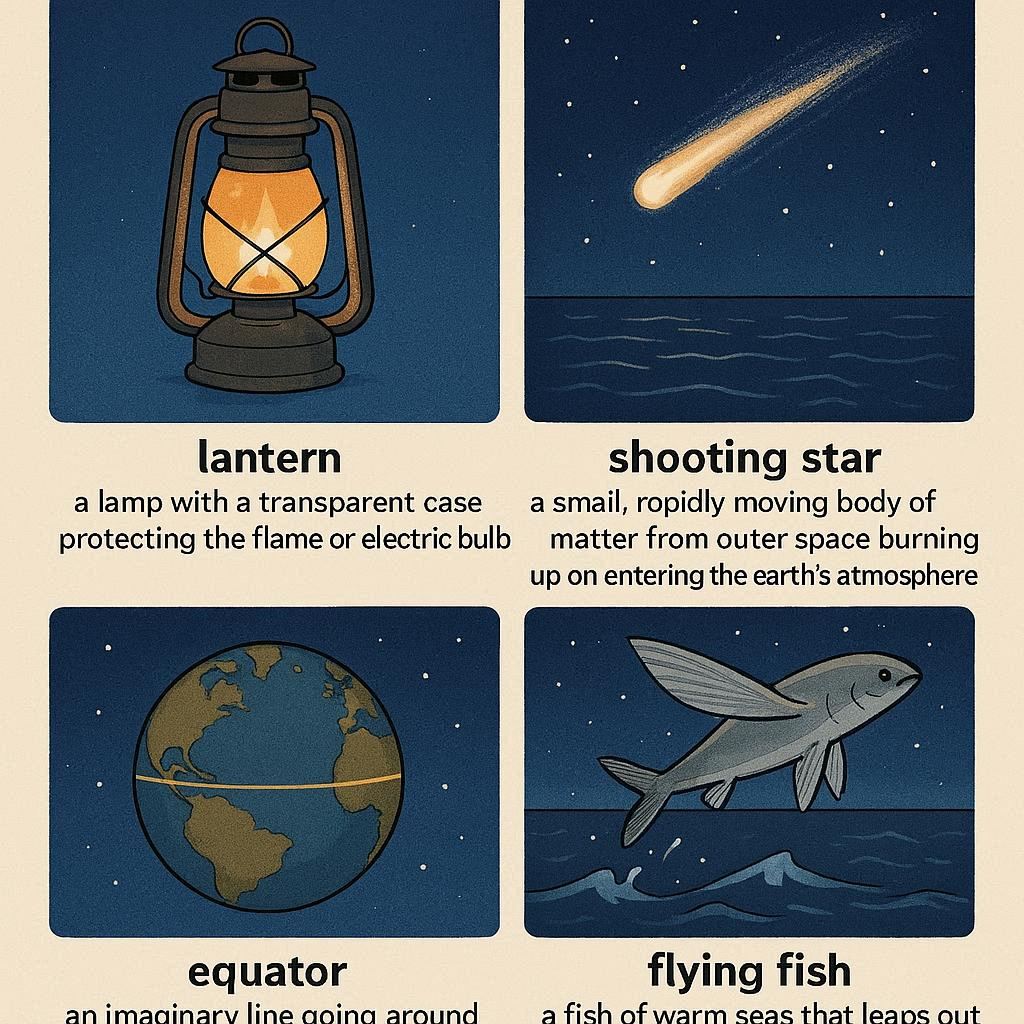
Lantern: A lamp with a transparent case protecting the flame or electric bulb Shooting Star: A small, rapidly moving body of matter from outer space burning up on entering the earth’s atmosphere Equator: An imaginary line going around the middle of the Earth. Flying Fish: A fish of warm seas that leaps out of the water and uses its winglike fins to glide over the surface for some distance. Porpoise: A small toothed whale Stowaway: A person who sneaks on a vessel, such as a ship or plane, to travel without noticed or paying the fare.
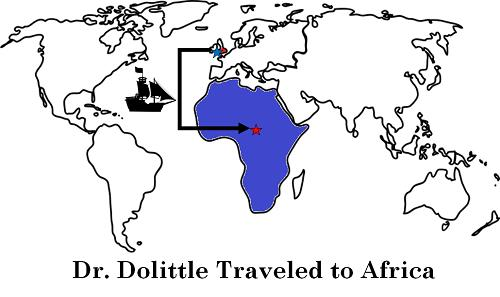
“The Story of Doctor Dolittle” by Hugh Lofting is a children’s novel published in 1920. When a kindly physician learns to speak with animals, he abandons his failing medical practice to become a veterinarian. His new calling leads him on an extraordinary voyage to Africa to cure a monkey epidemic. Along the way, he faces shipwrecks, imprisonment, pirates, and exotic creatures—including the rare pushmi-pullyu. This tale of adventure and animal communication became the first in a beloved series, though it has sparked controversy for its colonial-era themes.
Warning to Parents: Chapters 11 and 12 of the original Dr. Dolittle contain objectionable content. These chapters were modernized by Under the Home, but the Gutenberg link on the textbook page leads to an original copy of Dr. Dolittle with the objectionable content.
VI Polynesia and the King VII The Bridge of Apes VIII The Leader of the Lions IX The Monkeys’ Council X The Rarest Animal of All XI The Black Prince XII Medicine and Magic XIII Red Sails and Blue Wings XIV The Rats’ Warning XV The Barbary Dragon XVI Too-Too, the Listener XVII The Ocean Gossips XVIII Smells XIX The Rock XX The Fisherman’s Town XXI Home Again
Now for six whole weeks they went sailing on and on, over the rolling sea, following the swallow who flew before the ship to show them the way. At night she carried a tiny lantern, so they should not miss her in the dark; and the people on the other ships that passed said that the light must be a shooting star.
As they sailed further and further into the South, it got warmer and warmer. Polynesia, Chee-Chee and the crocodile enjoyed the hot sun no end. They ran about laughing and looking over the side of the ship to see if they could see Africa yet.
But the pig and the dog and the owl, Too-Too, could do nothing in such weather, but sat at the end of the ship in the shade of a big barrel, with their tongues hanging out, drinking lemonade.
Dab-Dab, the duck, used to keep herself cool by jumping into the sea and swimming behind the ship. And every once in a while, when the top of her head got too hot, she would dive under the ship and come up on the other side. In this way, too, she used to catch herrings on Tuesdays and Fridays-when everybody on the boat ate fish to make the beef last longer.
When they got near to the Equator they saw some flying-fishes coming towards them. And the fishes asked the parrot if this was Doctor Dolittle’s ship. When she told them it was, they said they were glad, because the monkeys in Africa were getting worried that he would never come. Polynesia asked them how many miles they had yet to go; and the flying-fishes said it was only fifty-five miles now to the coast of Africa.
And another time a whole school of porpoises came dancing through the waves; and they too asked Polynesia if this was the ship of the famous doctor. And when they heard that it was, they asked the parrot if the Doctor wanted anything for his journey.
And Polynesia said, “Yes. We have run short of onions.”
“There is an island not far from here,” said the porpoises, “where the wild onions grow tall and strong. Keep straight on-we will get some and catch up to you.”
So the porpoises dashed away through the sea. And very soon the parrot saw them again, coming up behind, dragging the onions through the waves in big nets made of seaweed.
The next evening, as the sun was going down, the Doctor said,
“Get me the telescope, Chee-Chee. Our journey is nearly ended. Very soon we should be able to see the shores of Africa.”
And about half an hour later, sure enough, they thought they could see something in front that might be land. But it began to get darker and darker and they couldn’t be sure.
Then a great storm came up, with thunder and lightning. The wind howled; the rain came down in torrents; and the waves got so high they splashed right over the boat.
Presently there was a big BANG! The ship stopped and rolled over on its side.
“What’s happened?” asked the Doctor, coming up from downstairs.
“I’m not sure,” said the parrot; “but I think we’re ship-wrecked. Tell the duck to get out and see.”
So Dab-Dab dived right under the waves. And when she came up she said they had struck a rock; there was a big hole in the bottom of the ship; the water was coming in; and they were sinking fast.
“We must have run into Africa,” said the Doctor. “Dear me, dear me!-Well-we must all swim to land.”
But Chee-Chee and Gub-Gub did not know how to swim.
“Get the rope!” said Polynesia. “I told you it would come in handy. Where’s that duck? Come here, Dab-Dab. Take this end of the rope, fly to the shore and tie it to a palm-tree; and we’ll hold the other end on the ship here. Then those that can’t swim must climb along the rope till they reach the land. That’s what you call a ‘life-line.'”
So they all got safely to the shore-some swimming, some flying; and those that climbed along the rope brought the Doctor’s trunk and hand-bag with them.
But the ship was no good anymore-with the big hole in the bottom; and presently the rough sea beat it to pieces on the rocks and the timbers floated away.
Then they all took shelter in a nice dry cave they found, high up in the cliffs, till the storm was over.
When the sun came out next morning they went down to the sandy beach to dry themselves.
“Dear old Africa!” sighed Polynesia. “It’s good to get back. Just think-it’ll be a hundred and sixty-nine years tomorrow since I was here! And it hasn’t changed a bit!-Same old palm-trees; same old red earth; same old black ants! There’s no place like home!”
And the others noticed she had tears in her eyes-she was so pleased to see her country once again.
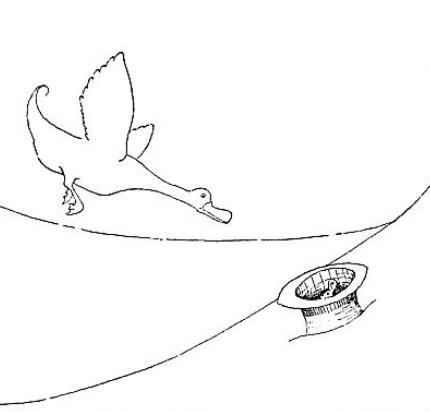
Then the Doctor missed his high hat; for it had been blown into the sea during the storm. So Dab-Dab went out to look for it. And presently she saw it, a long way off, floating on the water like a toy-boat.
When she flew down to get it, she found one of the white mice, very frightened, sitting inside it.
“What are you doing here?” asked the duck. “You were told to stay behind in Puddleby.”
“I didn’t want to be left behind,” said the mouse. “I wanted to see what Africa was like-I have relatives there. So I hid in the baggage and was brought on to the ship with the hard-tack. When the ship sank I was terribly frightened-because I cannot swim far. I swam as long as I could, but I soon got all exhausted and thought I was going to sink. And then, just at that moment, the old man’s hat came floating by; and I got into it because I did not want to be drowned.”
So the duck took up the hat with the mouse in it and brought it to the Doctor on the shore. And they all gathered round to have a look.
“That’s what you call a ‘stowaway,'” said the parrot.
Presently, when they were looking for a place in the trunk where the white mouse could travel comfortably, the monkey, Chee-Chee, suddenly said,
“Sh! I hear footsteps in the jungle!”
They all stopped talking and listened. And soon a black man came down out of the woods and asked them what they were doing there.
“My name is John Dolittle-M.D.,” said the Doctor. “I have been asked to come to Africa to cure the monkeys who are sick.”
“You must all come before the King,” said the black man.
“What king?” said the Doctor, who didn’t want to waste any time.
“The King of the Jolliginki,” the man answered. “All these lands belong to him; and all strangers must be brought before him. Follow me.”
So, they gathered up their baggage and went off, following the man through the jungle.
In this third chapter of the Second Book we come to the results of the Redeemer’s work enjoyed, but in connection with conflict, as is seen in the last of the three sections (the constellation of Andromeda, the chained woman), which leads up to the last chapter of the book, and ends it in triumph over every enemy.
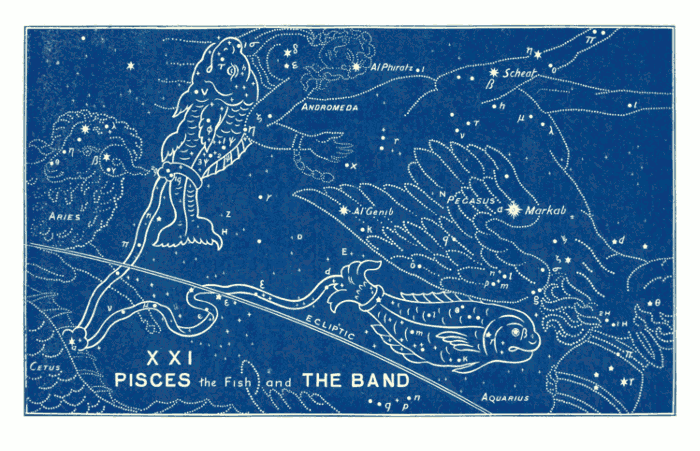
Plate 21: PISCES (the Fish) and the Band
The Sign is pictured as two large fishes bound together by a Band, the ends of which are fastened separately to their tails. One fish is represented with its head pointing upwards towards the North Polar Star, the other is shown at right angles, swimming along the line of the ecliptic, or path of the sun.
The ancient Egyptian name, as shown on the Denderah Zodiac, is Pi-cot Orion, or Pisces Hori, which means the fishes of Him that cometh.
The Hebrew name is Dagim, the Fishes, which is closely connected with multitudes, as in Gen. xlviii. 26, where Jacob blesses Joseph’s sons, and says, “Let them grow into a multitude in the midst of the earth.” The margin says, “Let them grow as fishes do increase.” It refers to the fulfilment of Gen. i. 28, “Be fruitful and multiply.” The multitude of Abraham’s seed is prominent in the pronouncement of the blessings, where God compared his future posterity to the stars of the sky, and the sand upon the sea shore. “A very great multitude of fish,” as in Ezek. xlvii. 9.
The Syriac name is Nuno, the fish, lengthened out (as in posterity).
The sign, then, speaks of the multitudes who should enjoy the blessings of the Redeemer’s work.
And here we must maintain that “the Church,” which is “the Body of Christ,” was a subject that was never revealed to man until it was made known to the Apostle Paul by a special revelation. The Holy Spirit declares (Rom. xvi. 25) that it “was kept secret since the world began.” In Eph. iii. 9 he declares that it “from the beginning of the world hath been hid in God”; and in Col. i. 26, that it “hath been hid from ages and from generations, but now is made manifest to His saints.” In each scripture which speaks of it as “now made manifest,” or “now made known,” it is distinctly stated that it was “a mystery,” i.e., a secret, and had, up to that moment, been hidden from mankind, hidden “in God.” How, then, we ask, can “the Church,” which was a subsequent revelation, be read into the previous prophecies, whether written in the Old Testament Scriptures, or made known in the Heavens? If the Church was revealed in prophecy, then it could not have been said to be hidden or kept secret. If the first revelation of it was made known to Paul, as he distinctly affirms it was, then it could not have been revealed before. Unless we see this very clearly, we cannot “rightly divide the word of truth” (2 Tim. ii. 15). And if we do not rightly divide the word of truth, in its subjects, and times, and dispensations, we must inevitably be landed in confusion and darkness, interpreting of the Church, scriptures which belong only to Israel.
The Church, or Body of Christ, is totally distinct from every class of persons who are made the subject of prophecy. Not that the Church of God was an after-thought. No, it was a Divine secret, kept as only God Himself could keep it. The Bible therefore would have been complete (so far as the Old Testament prophecies are concerned) if the Epistles (which belong only to the Church) were taken out. The Old Testament would then give us the kingdom prophesied; the Gospels and Acts, the King and the kingdom offered and rejected; then the Apocalypse would follow, showing how that promised kingdom will yet be set up with Divine judgment, power, and glory.
If these Signs and these star-pictures be the results of inspired patriarchs, then this Sign of Pisces can refer to “His seed,” prophesied of in Isa. liii.: “He shall see His seed.” It must refer to
“The nation whose God is the Lord,
And the people whom He hath chosen for His own inheritance.”
(Ps. xxxiii. 12.)
“Such as be blessed of Him shall inherit the earth.”
(Ps. xxxvii. 22.)
“The Lord shall increase you more and more,
You and your children,
Ye are blessed of the Lord.”
(Ps. cxv. 14, 15.)
“Their seed shall be known among the Gentiles.
And their offspring among the people;
All that see them shall acknowledge them,
That they are the seed which the Lord hath blessed.”
(Isa. lxi. 9.)
“They are the seed of the blessed of the Lord,
And their offspring with them.”
(Isa. lxv. 23.)
The prophecy of this Sign was afterwards written in the words of Isa. xxvi. 15—the song which shall yet be sung in the land of Judah:
“Thou hast increased the nation, O Lord,
Thou hast increased the nation.”
And in Isa. ix. 3 (r.v.), speaking of the glorious time when the government shall be upon the shoulder of the coming King:
“Thou hast multiplied the nation,
Thou hast increased their joy.”
Of that longed-for day Jeremiah sings (xxx. 19):
“I will multiply them
And they shall not be few;
I will also glorify them,
And they shall not be small.”
Ezekiel also is inspired to say:
“I will multiply men upon you,
All the house of Israel, even all of it:
And the cities shall be inhabited,
And the wastes shall be builded;
And I will multiply upon you man and beast,
And they shall increase and bring fruit.”
(Ezek. xxxvi. 10, 11.)
“Moreover I will make a covenant of peace with them;
It shall be an everlasting covenant with them!
And I will place them, and multiply them,
And will set My sanctuary in the midst of them for evermore.”
(Ezek. xxxvii. 26.)
Indeed, this Sign of Pisces has always been interpreted of Israel. Both Jews and Gentiles have agreed in this. Abarbanel, a Jewish commentator, writing on Daniel, affirms that the Sign Pisces always refers to the people of Israel. He gives five reasons for this belief and also affirms that a conjunction of the planets Jupiter and Saturn always betokens a crisis in the affairs of Israel. Because such a conjunction took place in his day (about 1480 a.d.) he looked for the coming of Messiah.
Certain it is, that when the sun is in Pisces all the constellations which are considered noxious, are seen above the horizon. What is true in astronomical observation is true also in historical fact. When God’s favour is shown to Israel, “the Jew’s enemy” puts forth his malignant powers. When they increased and multiplied in Egypt, he endeavored to compass the destruction of the nation by destroying the male children; but their great Deliverer remembered His covenant, defeated the designs of the enemy, and brought the counsel of the heathen to nought. So it was in Persia; and so, it will yet be again when the hour of Israel’s final deliverance has come.
There can be no doubt that we have in this Sign the foreshowing of the multiplication and blessing of the children of promise, and a token of their coming deliverance from all the power of the enemy.
But why two fishes? and why is one horizontal and the other perpendicular? The answer is that not only in Israel, but in the seed of Seth and Shem there were always those who looked for a heavenly portion and were “partakers of a heavenly calling.” In Heb. xi. we are distinctly told that Abraham “looked for a city which hath foundations, whose builder and maker is God” (v. 10). They were “strangers and pilgrims on the earth” (v. 13). Strangers are those without a home, and pilgrims are those who are journeying home: “they seek a country” (v. 14). They desired “a better country, that is, an HEAVENLY: wherefore God is not ashamed to be called their God; for He hath prepared for them a city” (v. 16). It is clear, therefore, that what are called the “Old Testament Saints” were “partakers of THE HEAVENLY CALLING” (Heb. iii. 1), which included a heavenly portion and a heavenly home; and all through the ages there have been “partakers of the heavenly calling.” This is quite distinct from the calling of the Church, which is from both Jews and Gentiles to form “one body,” a “new man” in Christ (Eph. ii. 15). It must be distinct, for it is expressly stated at the end of that chapter (Heb. xi. 40) that God has “provided (marg. forseen) some better thing for us.” How can this be a “better thing,” if it is the same thing? There must be two separate things if one is “better” than the other! Our calling in Christ is the “better thing.” The Old Testament saints had, and will have, a good thing. They will have a heavenly blessing, and a heavenly portion, for God has “prepared for them a city,” and we see that prepared city, even “the holy city, new Jerusalem, coming down from God out of Heaven, prepared as a bride adorned for her husband” (Rev. xxi. 2). This is the “heavenly” portion of the Old Testament saints, the Bride of Christ. The Church will have a still “better” portion, for “they without us should not be made perfect” (Heb. xi. 40).
The fish, shooting upwards to the Polar Star, exquisitely pictures this “heavenly calling”; while the other fish, keeping on the horizontal line, answers to those who were content with an earthly portion.
But both alike were divinely called, and chosen, and upheld. The names of two of the stars in the sign (not identified) are Okda (Hebrew), the united, and Al Samaca (Arabic), the upheld. These again speak of the redeemed seed, of whom, and to whom, Jehovah speaks in that coming day of glory in Isa. xli. 8-10 (r.v.):—
“But thou, Israel, My servant,
Jacob, whom I have chosen,
The seed of Abraham My friend;
Thou whom I have taken hold of from the ends of the earth,
And called thee from the corners thereof,
And said unto thee, Thou art My servant;
I have chosen thee, and not cast thee away;
Fear thou not, for I am with thee;
Be not dismayed, for I am thy God!
I will strengthen thee;
Yea, I will help thee;
Yea, I will UPHOLD thee with the right hand of My righteousness.”
This is the teaching of the Sign; and the first constellation takes up this thought and emphasizes it.
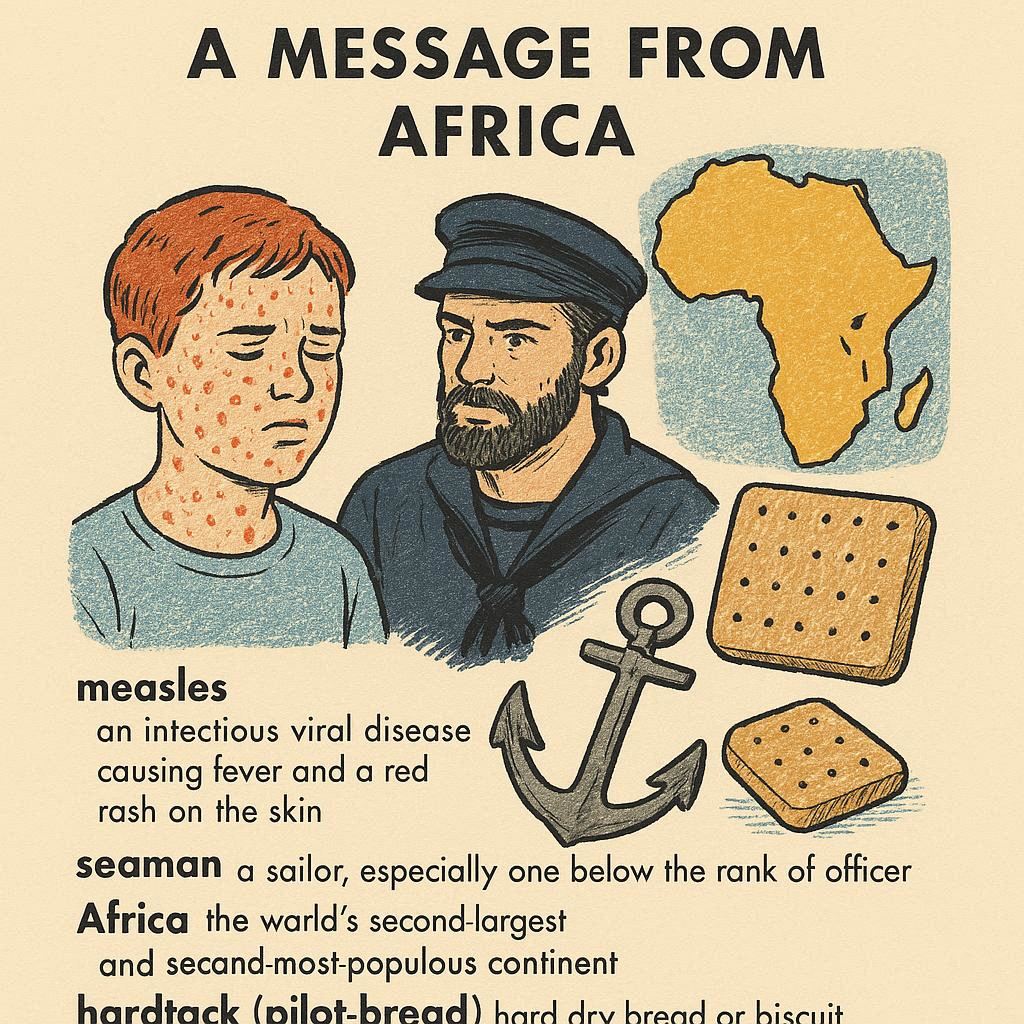
Measles: An infectious viral disease-causing fever and a red rash on the skin Seaman: A sailor, especially one below the rank of officer. Africa: The world’s second largest and second-most-populous continent Hardtack (pilot-bread): Hard dry bread or biscuit, especially as rations for sailors Anchor: A heavy object attached to a rope or chain and used to hold a ship in place to the sea bottom.
That winter was a very cold one. And one night in December, when they were all sitting round the warm fire in the kitchen, and the Doctor was reading aloud to them out of books he had written himself in animal-language, the owl, Too-Too, suddenly said,
“Sh! What’s that noise outside?”
They all listened; and presently they heard the sound of someone running. Then the door flew open and the monkey, Chee-Chee, ran in, badly out of breath.
“Doctor!” he cried, “I’ve just had a message from a cousin of mine in Africa. There is a terrible sickness among the monkeys out there. They are all catching it-and they are dying in hundreds. They have heard of you, and beg you to come to Africa to stop the sickness.”
“Who brought the message?” asked the Doctor, taking off his spectacles and laying down his book.
“A swallow,” said Chee-Chee. “She is outside on the rain-butt.”
“Bring her in by the fire,” said the Doctor. “She must be perished with the cold. The swallows flew South six weeks ago!”
So the swallow was brought in, all huddled and shivering; and although she was a little afraid at first, she soon got warmed up and sat on the edge of the mantelpiece and began to talk.
When she had finished the Doctor said,
“I would gladly go to Africa-especially in this bitter weather. But I’m afraid we haven’t money enough to buy the tickets. Get me the money-box, Chee-Chee.”
So the monkey climbed up and got it off the top shelf of the dresser.
There was nothing in it-not a single penny!
“I felt sure there was twopence left,” said the Doctor.
“There was” said the owl. “But you spent it on a rattle for that badger’s baby when he was teething.”
“Did I?” said the Doctor-“dear me, dear me! What a nuisance money is, to be sure! Well, never mind. Perhaps if I go down to the seaside I shall be able to borrow a boat that will take us to Africa. I knew a seaman once who brought his baby to me with measles. Maybe he’ll lend us his boat-the baby got well.”
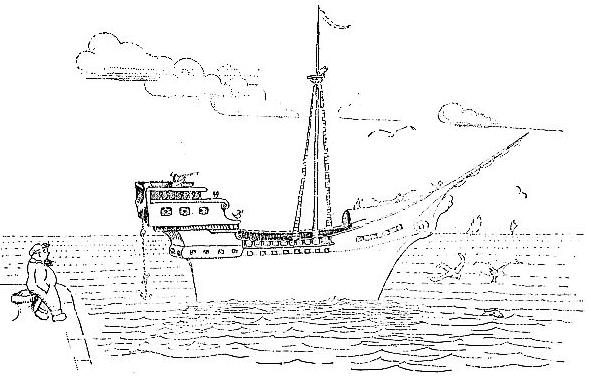
So early the next morning the Doctor went down to the sea-shore. And when he came back he told the animals it was all right-the sailor was going to lend them the boat.
Then the crocodile and the monkey and the parrot were very glad and began to sing, because they were going back to Africa, their real home. And the Doctor said,
“I shall only be able to take you three-with Jip the dog, Dab-Dab the duck, Gub-Gub the pig and the owl, Too-Too. The rest of the animals, like the dormice and the water-voles and the bats, they will have to go back and live in the fields where they were born till we come home again. But as most of them sleep through the Winter, they won’t mind that-and besides, it wouldn’t be good for them to go to Africa.”
So then the parrot, who had been on long sea-voyages before, began telling the Doctor all the things he would have to take with him on the ship.
“You must have plenty of pilot-bread,” she said-“‘hardtack’ they call it. And you must have beef in cans-and an anchor.”
“I expect the ship will have its own anchor,” said the Doctor.
“Well, make sure,” said Polynesia. “Because it’s very important. You can’t stop if you haven’t got an anchor. And you’ll need a bell.”
“What’s that for?” asked the Doctor.
“To tell the time by,” said the parrot. “You go and ring it every half-hour and then you know what time it is. And bring a whole lot of rope-it always comes in handy on voyages.”
Then they began to wonder where they were going to get the money from to buy all the things they needed.
“Oh, bother it! Money again,” cried the Doctor. “Goodness! I shall be glad to get to Africa where we don’t have to have any! I’ll go and ask the grocer if he will wait for his money till I get back-No, I’ll send the sailor to ask him.”
So the sailor went to see the grocer. And presently he came back with all the things they wanted.
Then the animals packed up; and after they had turned off the water so the pipes wouldn’t freeze, and put up the shutters, they closed the house and gave the key to the old horse who lived in the stable. And when they had seen that there was plenty of hay in the loft to last the horse through the Winter, they carried all their luggage down to the seashore and got on to the boat.
The Cat’s-meat-Man was there to see them off; and he brought a large suet-pudding as a present for the Doctor because, he said he had been told, you couldn’t get suet-puddings in foreign parts.
As soon as they were on the ship, Gub-Gub, the pig, asked where the beds were, for it was four o’clock in the afternoon and he wanted his nap. So Polynesia took him downstairs into the inside of the ship and showed him the beds, set all on top of one another like book-shelves against a wall.
“Why, that’s not a bed!” cried Gub-Gub. “That’s a shelf!”
“Beds are always like that on ships,” said the parrot. “It isn’t a shelf. Climb up into it and go to sleep. That’s what you call ‘a bunk.'”
“I don’t think I’ll go to bed yet,” said Gub-Gub. “I’m too excited. I want to go upstairs again and see them start.”
“Well, this is your first trip,” said Polynesia. “You will get used to the life after a while.” And she went back up the stairs of the ship, humming this song to herself,
I’ve seen the Black Sea and the Red Sea;
I rounded the Isle of Wight;
I discovered the Yellow River,
And the Orange too-by night.
Now Greenland drops behind again,
And I sail the ocean Blue.
I’m tired of all these colors, Jane,
So I’m coming back to you.
They were just going to start on their journey, when the Doctor said he would have to go back and ask the sailor the way to Africa.
But the swallow said she had been to that country many times and would show them how to get there.
So, the Doctor told Chee-Chee to pull up the anchor and the voyage began.
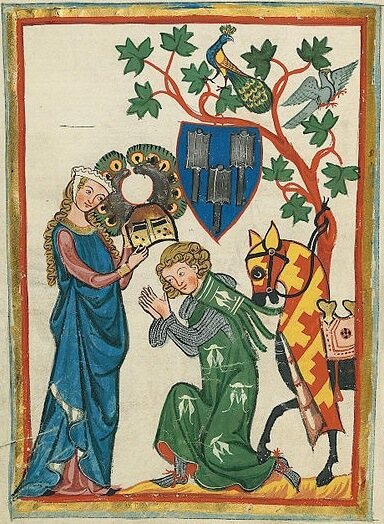
It was quite natural that the professional fighting-men of the Middle Ages should try to establish some sort of organization for their mutual benefit and protection. Out of this need for close organization, Knighthood or Chivalry was born.
We know very little about the origins of Knighthood. But as the system developed, it gave the world something which it needed very badly—a definite rule of conduct which softened the barbarous customs of that day and made life more livable than it had been during the five hundred years of the Dark Ages. It was not an easy task to civilize the rough frontiersmen who had spent most of their time fighting Muslims and Huns and Norsemen. Often, they were guilty of backsliding and having vowed all sorts of oaths about mercy and charity in the morning, they would murder all their prisoners before evening. But progress is ever the result of slow and ceaseless labor, and finally the most unscrupulous of knights was forced to obey the rules of his “class” or suffer the consequences.
These rules were different in the various parts of Europe, but they all made much of “service” and “loyalty to duty.” The Middle Ages regarded service as something very noble and beautiful. It was no disgrace to be a servant, provided you were a good servant and did not slacken on the job. As for loyalty, at a time when life depended upon the faithful performance of many unpleasant duties, it was the chief virtue of the fighting man.
A young knight therefore was asked to swear that he would be faithful as a servant to God and as a servant to his King. Furthermore, he promised to be generous to those whose need was greater than his own. He pledged his word that he would be humble in his personal behavior and would never boast of his own accomplishments and that he would be a friend of all those who suffered, (with the exception of the Muslims, whom he was expected to kill on sight).
Around these vows, which were merely the Ten Commandments expressed in terms which the people of the Middle Ages could understand, there developed a complicated system of manners and outward behavior. The knights tried to model their own lives after the example of those heroes of Arthur’s Round Table and Charlemagne’s court of whom the troubadours had told them and of whom you may read in many delightful books which are enumerated at the end of this volume. They hoped that they might prove as brave as Lancelot and as faithful as Roland. They carried themselves with dignity and they spoke careful and gracious words that they might be known as True Knights, however humble the cut of their coat or the size of their purse.
In this way the order of Knighthood became a school of those good manners which are the oil of the social machinery. Chivalry came to mean courtesy and the feudal castle showed the rest of the world what clothes to wear, how to eat, how to ask a lady for a dance and the thousand and one little things of every-day behavior which help to make life interesting and agreeable.
Like all human institutions, Knighthood was doomed to perish as soon as it had outlived its usefulness.
The crusades, about which one of the next chapters tells, were followed by a great revival of trade. Cities grew overnight. The townspeople became rich, hired good school teachers and soon were the equals of the knights. The invention of gunpowder deprived the heavily armed “Chevalier” of his former advantage and the use of mercenaries made it impossible to conduct a battle with the delicate niceties of a chess tournament. The knight became superfluous. Soon he became a ridiculous figure, with his devotion to ideals that had no longer any practical value. It was said that the literary character of the noble Don Quixote de la Mancha represented the last of the true knights. In the story, after his death, his trusted sword and his armor were sold to pay his debts.
But somehow or other that sword seems to have fallen into the hands of a number of real men in history. General George Washington carried it during the hopeless days of Valley Forge amid the American Revolution. It was the only defense of British Army officer Major-General Charles George Gordon, when he had refused to desert the people who had been entrusted to his care, and stayed to meet his death in the besieged fortress of Khartoum in Sudan.
And I am not quite sure but that it proved of invaluable strength in winning the Great War.
Marbles have been found in archaeological sites worldwide, including the Indus Valley (Cira 2500 BC), ancient Egypt, Mesopotamia, Greece, and Rome, indicating their long- standing presence as a source of play.
Early marbles were made from stone, clay, nut, and fruit pits, polish or fired to create small spheres.
Roman children often played game with nuts, and references to this game appear in literature such as Ovid’s poem ‘nux”. Bas-reliefs from Roman times Depict children engaged in marbles game, and Early glass marbles have been found in Europe, though some may have originated as jewelry.
Medieval and Early Modern Europe
During the Middle Ages, marbles became popular in Europe. In Germany around 1503, authorities regulated marble games to specific areas, and marbles produced from marble, alabaster, agate, and limestone were polished for play.
Germany later became the center of marble craftsmanship, with water-powered stone mills turning raw marble and alabaster into perfectly shaped spheres by the 17th century Glass marbles emerged in Venice, Italy, and by the mid-19th century, German glassmakers invented marble scissors, allowing precise cutting of molten glass into uniform spheres.
Introduction to America and Industrialization
Marbles were brought to the United States by early settlers, and the first American mass-produced clay marbles were made by Samuel C. Dyke in Akron, Ohio, in the 1880s.
In the early 1900s, Martin Frederick Christensen invented machinery to produce glass marbles efficiently in Akron, marking the beginning of largescale U.S. glass marble production. His machinery could produce up to 10,000 marbles per day, creating more uniform and affordable marbles
The Akro Agate Company, founded in 1911 in West Virginia, quickly became a dominant manufacturer, controlling much of the U.S. market by the 1920s.
Golden Age and Global Expansion
The 1920s and 1930s are known as the “Golden Age of Marbles,” with marble games thriving as a popular children’s pastime. Companies like Peltier Glass, Christensen Agate, and Akro Agate produced colorful, decorative, and collectible marbles, including picture marbles showcasing comic-strip characters.
Post World 2, inexpensive Japanese cat’s eye marbles flooded Global markets, overtaking American production.
Modern Marbles and Collecting
Today, marbles are both games and collectibles, with art glass marbles created by artisans worldwide Machine-made marbles continue to be produced predominantly in Mexico and China for global distribution.
The British and World Marbles Championship in Tinsley Green, England, is still held annually since 1932, highlighting the enduring legacy of marble games.
Things to do with Marbles
Here are 25 Games with marbles that you can play. There are others game with Marbles like Chinese checkers
Classic Marbles [1]
Bullseye Marbles[2]
Mini Marble Golf [3]
Booby Trap [4]
Off The Wall [5]
What Decade? [6]
Color Match [7]
Bounce Eye [8]
The Conqueror [9]
Marble Obstacle Racing[10]
Marble Tilt [11]
Eggs in a Basket [12]
Thin Ice [13]
Marble Box [14]
Marble Skee Ball [15]
Marble Racetrack [16]
Pool Noodle Marble Race [17]
Newton’s Cradle [18]
Marble Cup [19]
Valentins Marble [20]
Guess How Many [21]
Marble Roll [22]
Pacman Marble [23]
Marble Painting [24]
Floating Marbles [25]
Clay marbles painted
Easy Homemade Marbles:
You can make homemade marbles using 2 cups of flour, 1 cup of salt, and 1 cup of water, adjusting slightly for texture as needed. Basic Ingredients and Ratio For a standard salt dough or homemade clay to form marbles:
Ingredients for a large batch (for large groups)
Oven
Wax paper
Baking sheet,
2 1 teaspoons [To form the shooter]
2 1/4 teaspoons [ To form the small Marbles]
2 cups Flour
1 cup Salt
1 cup Water
Paints [for decoration]
Glitter [for decoration]
Ingredients for a small batch (for 1 person)
Oven
Wax paper
Baking sheet,
2 1 teaspoons [To form the shooter]
2 1/4 teaspoons [To form the small Marbles]
1/2 cup Flour
1/4 cup Salt
1/4 cup Water
Paints [for decoration]
Glitter [for decoration]
What to do
Cover: your workspace with wax paper.
Combine Dry Ingredients: In a mixing bowl, mix the flour and salt thoroughly.
Add Water: Gradually: Slowly pour in the water while stirring. Mix until a rough dough begins to form
Knead the Dough: Place the dough on a lightly floured surface and knead for 5–10 minutes until it is smooth and pliable.
If the dough: feels dry, add a tablespoon of water at a time; if too sticky, sprinkle in a little flour
Form Marbles: Take small portions and roll them between your palms to form round marbles.
To Ensure: they are smooth and even get two 1/4 teaspoons, put the small ball in them, and push them together. Then roll the ball around one more time in the palm of your hand. Do the same thing with two 1/2 teaspoons to make the shooter.
Drying/Curing: You can either air dry the marbles for 24–48 hours or bake them in a low oven at around 200°F (93°C) for 2–3 hours, turning occasionally to prevent cracking
Time to decoration: Decoration it will what you like .
Tips for Best Results
Use all-purpose flour for optimal texture; avoid self-rising flour.
Kneading well ensures a smooth, workable dough that holds its shape.
For firmer marbles, slightly increase the flour; for softer or more pliable dough, increase water slightly.
Store leftover dough in an airtight container in the fridge for a few days.
Optionally, you can paint or glaze baked marbles once fully hardened for decoration
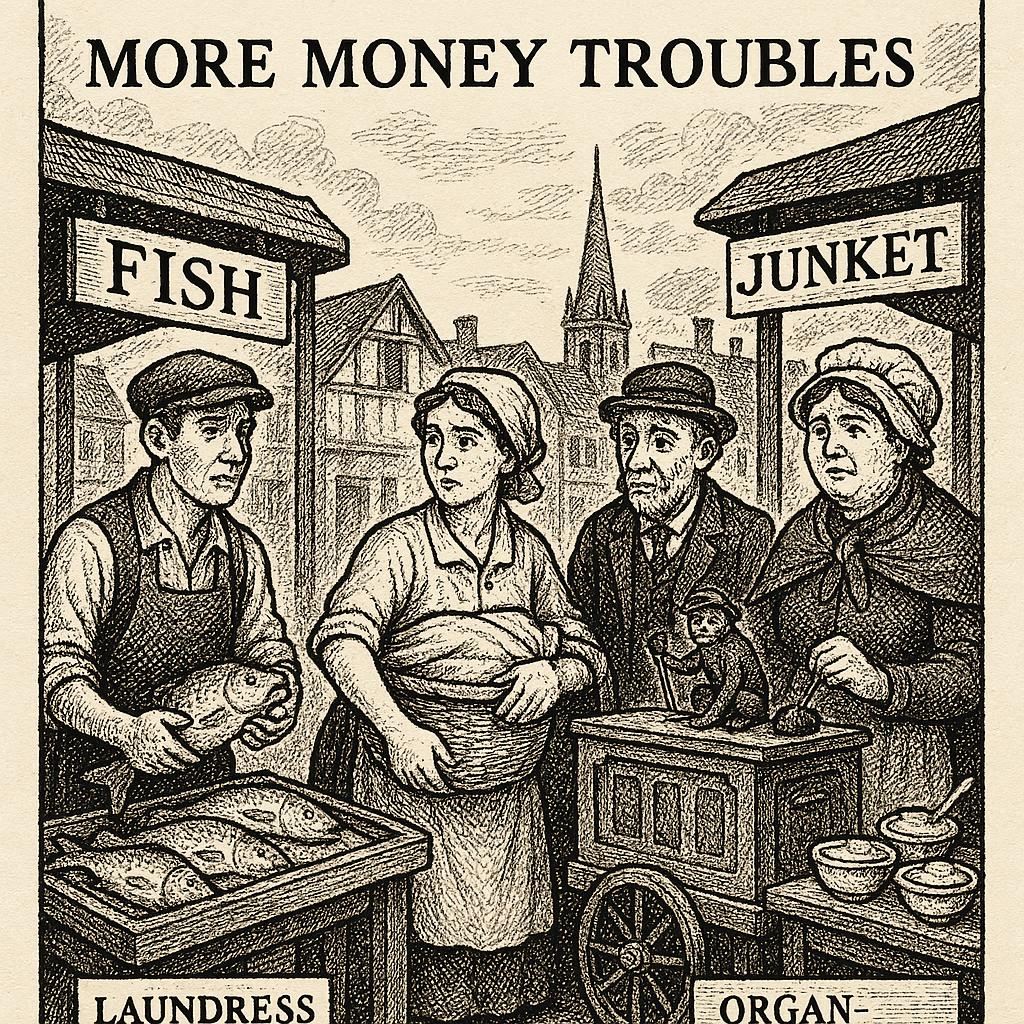
Stall: A stand or booth for the sale of goods. Laundress: A woman who washes laundry for a living. Fishmonger: A person who sells fish for a living. Junket: A dish of sweetened and flavored curds of milk, often served with fruit. Organ-grinder: A street musician who plays a type of organ.



 articlesforchristians