Nuts are actually a type of fruit, defined as dry, single-seeded fruits with high oil content, usually encased in a leathery or hard outer shell. In botanical terms, a true nut has a single seed, a hard shell, and a protective husk—like chestnuts, hazelnuts, pecans, and walnuts. Peanuts and almonds, however, aren’t true nuts; peanuts are legumes, and almonds are surrounded by a fleshy coating similar to a plum. True nut or not, these tasty fruits are enjoyed by people all over the world.
Facts about nuts:
Types of nuts include hazelnuts, birch nuts, chestnuts, acorns, and hickory nuts.
Peanuts are not nuts. They are legumes, like peas and beans.
Coconuts, almonds, macadamia, pistachio, pecan, walnuts, and cashews are also not true nuts.
Acorns
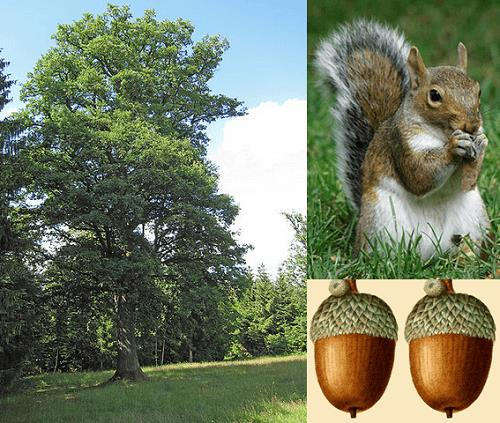
Acorns are the nuts that come from oak trees (Quercus spp.) and were once a staple food for many indigenous peoples of North America. They were especially important in California, where multiple oak species grow in the same areas.
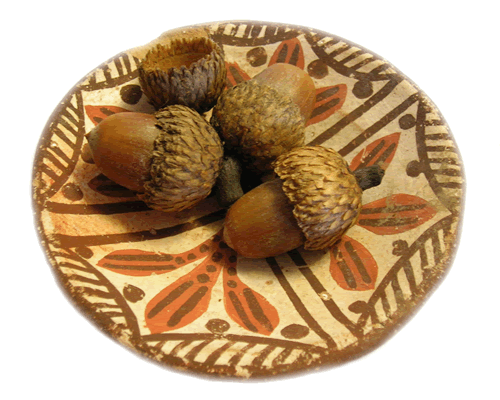
Acorns were a great food source for Native Americans because they could be stored for many years. Photo by Teresa Prendusi.
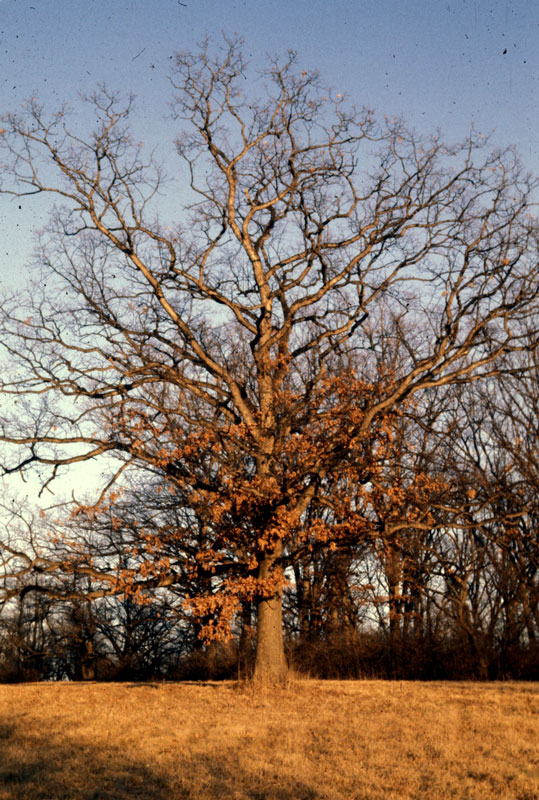
White Oak (Quercus alba). Photo by Larry Stritch.
These hard-shelled fruits were an important food source because if properly treated in the sun, they could be stored for several years and used when needed. Acorns were stored in caches or on tall poles to protect them from being eaten by squirrels. When prepared for use in foods the ground acorn flower was rinsed in a stream to remove bitter tasting tannins.
Native American tribes used fire to promote the production of acorns within oak groves.
Ground fires were used to kill the larvae of acorn moths and acorn weevils that can prove disastrous to the acorn crop.
Burning occurred during the dormancy period in the soil, and the fires released nutrients bound in dead leaves and other plant debris into the soil.
Most North American oaks tolerate light fires, especially when consistent burning has eliminated woody fuel accumulation around their trunks.
Black Walnuts
Black Walnuts (Juglans nigra) are native to North America. The nuts are primarily used in ice cream and candy.
Walnut trees are notorious for inhibiting growth of other plants around them. They produce chemicals in their leaves that are leached out by rain and soak into ground around the trunk.
Farmers planted these trees around farm animals to keep the flies away because they erroneously believed that the trees contained insecticides.
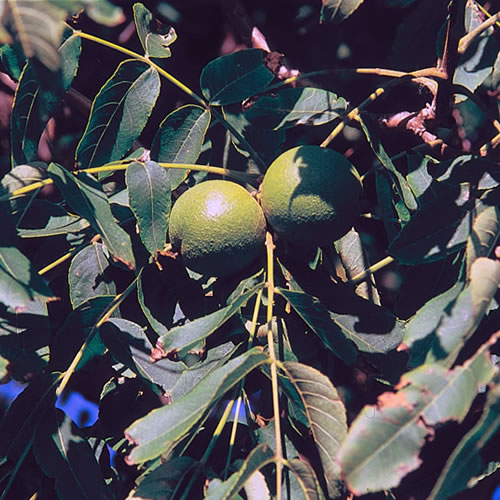
Black walnuts (Juglans nigra) have a strong taste and a very hard shell.
Pecans
Pecans (Carya illinoinensis) are a valuable nut species native to the American Southeast. Today, they’re widely cultivated across the southeastern United States and play a big role in the region’s cuisine.
In the past, native peoples and early American settlers enjoyed pecans because they were easy to find along major waterways and much simpler to shell than other North American nuts.
Pecan (Carya illinoinensis). Photo by Jerry A. Payne, USDA Agricultural Research Service, Bugwood.org.
Facts about Trees for Kids: Trees are perennial plants with a central trunk, branches, and leaves. They generate oxygen, support diverse ecosystems, reproduce through seeds, and come in numerous species. There are over three trillion trees globally. Click on the link for more facts.
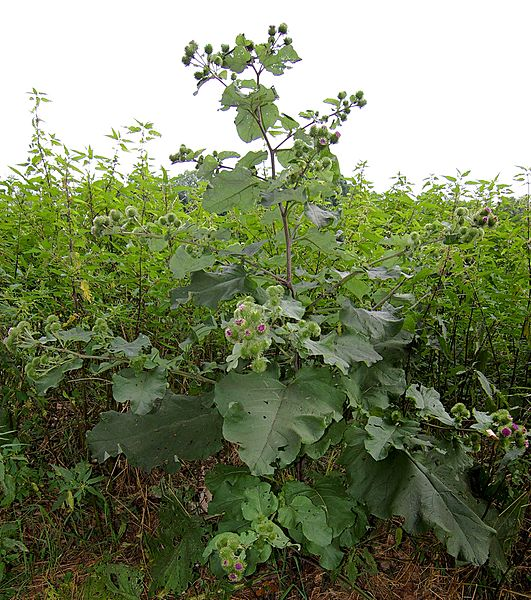
Burdock Facts for Kids: Burdock, a two-year plant from the Asteraceae family, thrives worldwide and aids bee survival with its blooms, while its sticky seeds facilitate dispersal.
Arctium, better known as burdock, is a group of plants that live for two years and are part of the Asteraceae family, which also includes daisies. Originally native to Europe and Asia, burdock has spread across the globe and can now be found in various regions worldwide.
One fascinating thing about burdock is how its seeds cling to surfaces. This impressive sticking ability helps the plant disperse its seeds and even inspired the creation of hook-and-loop fasteners, like Velcro!
About Burdock Plants
Burdock plants have dark green leaves that can grow up to 70 centimeters (about 27 inches) long. The leaves are usually big, rough, and oval-shaped. The ones closer to the ground are often heart-shaped and feel fuzzy on the underside. The stems that hold the leaves are usually hollow.
Burdock plants typically bloom from July to October. Their flowers are very important for honeybees. In August, when other flowers like clover start to fade, burdock flowers provide lots of pollen and nectar for bees. This helps bees get ready for winter before other plants like goldenrod start to bloom.
Burdock’s sticky burrs are great for spreading its seeds. They easily attach to animal fur or people’s clothes, helping the seeds travel to new places.
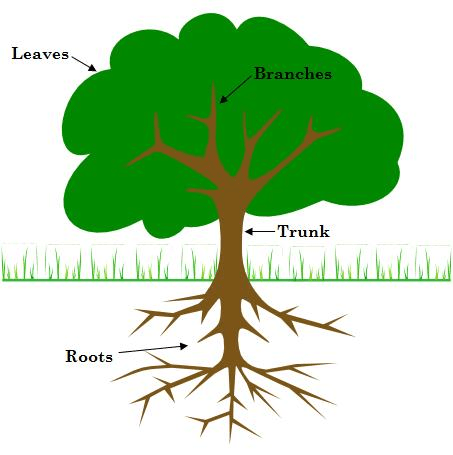
Trees are plants. Trees often have a central wood trunk supporting branches and leaves
Facts about trees:
Trees are some of the oldest living things on Earth.
God made plants on day third day. This was before animals and after the creation of light and the atmosphere. (Click here to read more about the week of Creation)
All sorts of living things thrive in trees, including insects, lichens, birds, and squirrels.
Trees are a Perennial plant (that means it is a plant that persists for several years, usually with new herbaceous growth from a part that survives from growing season to growing season)
There are several parts that make up a tree.
The main parts of a tree include roots, trunk, branches and leaves.
The roots of a tree are underground. They help support the tree and feed it nutrients, like water.
The trunk of the tree starts at the ground and rises upward. The trunk transport nutrients from the roots to the rest of the tree. It also helps the branches and leaves overtop other plants and get as much sunlight as possible.
The branches extend out from the trunk in all directions. Leaves and stems grow from the branches covering as much area as possible that contains sunlight.
The leaves are used to create energy from sunlight, a process known as photosynthesis.
How trees reproduce (make a new tree).
Trees reproduce by pollination, which can occur through insects, wind, or animals.
Trees produce seeds that can grow into a separate adult tree if the conditions are right.
Trees have various ways to spread their seeds. Wind carries winged and plumed seeds, while animals help disperse seeds found in edible fruits. Some seeds rely on gravity, simply dropping to the ground.
Trees are useful in many ways.
Trees generate oxygen, a vital resource for the survival of humans and animals. Take a moment to breathe deeply and be thankful for the oxygen produced by trees.
Trees are the primary source of lumber used by humans to build things, like a home or wooden boat. Trees are also used to create decorative art and furniture, like a table or statue.
The wood for trees can also be used as fuel for a fire, both for warmth and cooking.
Trees are also the source of food, like fruit and nuts. The sap from some trees is used to create syrups.
Trees don’t belong to any official taxonomic group. The term “tree” is simply used to describe various plant species that share certain physical traits.
Several popular species of trees include the red maple tree, the oak tree, the magnolia tree, the sugar maple tree, the sweetgum tree, the cherry blossom tree, the palm tree, the sequoia tree, the dogwood tree and the pine tree.
It’s a widespread misunderstanding that pumpkins are vegetables, and there’s actually a good explanation for it.
In many cuisines worldwide, pumpkins are treated as vegetables and included in savory dishes since they aren’t as overly sweet as other fruits.
Since they grow from flowers and contain seeds, they are classified as fruits botanically, regardless of what culinary experts might claim.
Pumpkins grow from tiny fruits attached to flowers which grow off long vines.
Pumpkin plants have really long vines
Not all pumpkins are orange!
Have you ever seen a pumpkin in a color other than orange, like green or blue? And if you have, have you ever wondered why they aren’t more common?
The color of a pumpkin is determined by its genetic makeup. Through natural or artificial cross-breeding and hybridization, pumpkins can come in a variety of colors, including red, white, orange, yellow, or bluish-grey, often with mottled or speckled stripes.
It’s not easy to come across these exotic colors in most markets since they’re rare and highly sought after. If you do spot them, make sure to get your parents’ permission before buying, as they can be quite pricey.
Almost all parts of a pumpkin are edible
People eat pumpkin shells, seeds, flesh, and flowers. Pumpkin pie, pumpkin soup, and pumpkin muffins are popular items made from pumpkin.
Pumpkins are native to North America
Recent studies suggest that pumpkins first originated in North America, particularly in northeastern Mexico and the southern United States, with the oldest pumpkin seeds discovered in Mexico.
Many people carve pumpkins into Jack-O-Lanterns for Halloween.
Carving pumpkins on Halloween was an old Irish tradition.
Have you ever thought of jack-o-lanterns being made from anything other than pumpkins? Hard to imagine, right? Surprisingly, carving pumpkins is a fairly recent tradition. According to an old Irish folk tale, Stingy Jack was a cunning man who tried to trick the Devil for his own benefit. After his death, he was denied entry to both heaven and hell, leaving him to wander the earth and haunt people. To keep Jack away, the Irish began carving demonic faces into turnips. When they immigrated to America, they switched to pumpkins, which were native, larger, and easier to carve.
Some people compete to grow ‘Giant Pumpkins.’ The largest Giants can weigh more than 2000 pounds, close to what a small car weighs.
Other people build machines to throw pumpkins in pumpkin chunking contests. The team with the machine that throws the pumpkin farthest wins.






 articlesforchristians