Nannie Helen Burroughs: A Voice of Strength, Education, and Empowerment
Black History Month invites us to honor the women and men whose courage and brilliance reshaped the possibilities for future generations. Among these trailblazers stands Nannie Helen Burroughs—an educator, activist, and visionary who believed deeply in the power of faith, discipline, and education to transform lives. Her legacy continues to inspire students, teachers, and leaders across the world.
Nannie Helen Burroughs was born on May 2, 1879, in Orange, Virginia, to formerly enslaved parents. After her father died, she and her mother moved to Washington, D.C., where Nannie attended the prestigious M Street High School, known for its rigorous academics and distinguished Black faculty.
Even as a young girl, Burroughs displayed:
A fierce love for learning
A strong Christian faith
A determination to uplift Black women and girls
Despite her academic excellence, she was denied a teaching job in the D.C. public schools—likely because she was dark‑skinned and from a working‑class background. Instead of allowing rejection to define her, she used it as fuel for her mission.
Middle Life: Building Institutions and Empowering Women
Burroughs’ life took a defining turn when she became active in the National Baptist Convention (NBC). Her powerful speaking ability and organizational skill quickly made her a national figure.
A School Built on Faith and Purpose
In 1909, she founded the National Training School for Women and Girls in Washington, D.C., with almost no money—just vision, prayer, and community support. The school offered:
Academic education
Vocational training
Christian character development
Its motto captured Burroughs’ philosophy: “We specialize in the wholly impossible.”
The school trained thousands of young women in:
Business
Domestic science
Missionary work
Leadership and public service
Burroughs believed that Black women deserved not only opportunity but excellence, dignity, and self‑sufficiency.
A National Leader
Throughout her life, she served as:
A prominent leader in the Women’s Auxiliary of the National Baptist Convention
A civil rights advocate
A writer and speaker who addressed racial injustice, women’s rights, and Christian responsibility
Her voice was bold, uncompromising, and rooted in Scripture and moral conviction.
Later Life: A Legacy of Service and Strength
Burroughs continued leading her school and serving in national organizations well into her later years. She remained a powerful advocate for education, racial uplift, and women’s leadership.
Death and Burial
Nannie Helen Burroughs died on May 20, 1961, in Washington, D.C.
She is buried at Lincoln Memorial Cemetery in Suitland, Maryland.
Her school—later renamed the Nannie Helen Burroughs School—continues to honor her mission of faith‑centered education and empowerment.
A Legacy That Still Teaches
Nannie Helen Burroughs’ life reminds us that:
Education is a tool of liberation
Faith can fuel extraordinary achievement
One determined woman can build institutions that outlive her
During Black History Month, remembering Burroughs invites us to reflect on the power of vision, perseverance, and service. Her work continues to shape classrooms, churches, and communities, proving that her motto was more than words—it was a way of life.
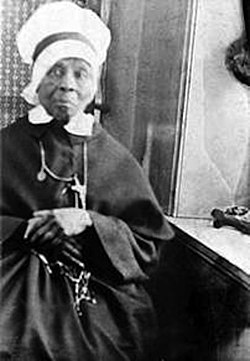
Mother Mary Lange: A Pioneer of Faith, Education, and Courage
Mother Mary Lange stands as one of the most remarkable women in American Catholic history. As the foundress of the Oblate Sisters of Providence—the first sustained religious order for women of African descent in the United States—she transformed education, faith formation, and community life for generations of Black children. Her legacy continues to shine as a beacon of perseverance, compassion, and holy determination.
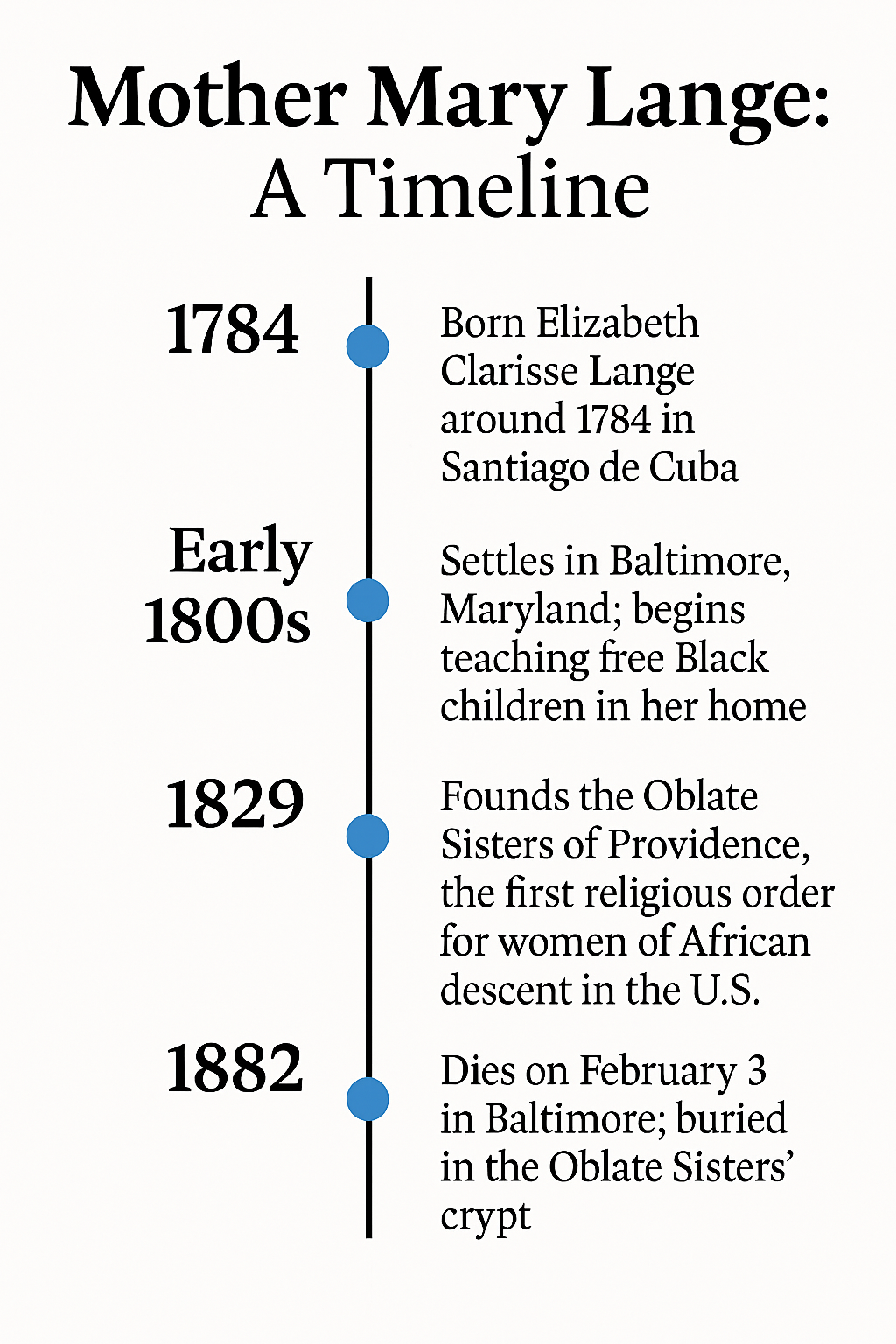
Mother Mary Lange was born Elizabeth Clarisse Lange around 1784 in Santiago de Cuba, though her family roots traced back to Haiti. She grew up in a well‑educated, French‑speaking, Catholic household. Political unrest in the Caribbean led many families of African descent to flee, and Elizabeth eventually migrated to the United States, settling in Baltimore, Maryland, in the early 1800s.
In Baltimore, she encountered a large community of free Black children who had no access to formal education. Elizabeth saw their need—and she also saw their dignity. With a deep sense of mission, she began teaching children in her home, using her own resources. This quiet act of courage planted the seeds of a lifelong ministry.
Middle Life: Founding the Oblate Sisters of Providence
Elizabeth’s work caught the attention of Father James Hector Joubert, a Sulpician priest who recognized her gifts and encouraged her to form a religious community dedicated to educating Black children.
In 1829, Elizabeth Lange, along with three other women, professed vows and founded the Oblate Sisters of Providence. She took the name Mother Mary Lange, becoming the first superior of the order.
A Ministry of Education and Service
Under her leadership, the Oblate Sisters:
Opened St. Frances Academy, one of the first Catholic schools for Black children in the United States
Cared for orphans and the poor
Taught domestic skills, literacy, and faith
Served during cholera outbreaks, tending to the sick when others were afraid
Mother Lange was known for her humility, strength, and unwavering trust in God. Despite racism, financial hardship, and social barriers, she built an institution that endured—and still thrives today.
End of Life: A Legacy Rooted in Faith
Mother Mary Lange spent her later years continuing to guide her community, pray, and serve quietly behind the scenes. Her life was marked by deep devotion and a steadfast belief that God had called her to uplift His children.
Death
Mother Mary Lange died on February 3, 1882, in Baltimore, Maryland, the city where she had poured out her life in service.
Burial
She is buried in the crypt of the Oblate Sisters of Providence Motherhouse in Baltimore. Her resting place has become a site of prayer and pilgrimage for those inspired by her holiness and courage.
A Legacy That Continues to Inspire
Today, Mother Mary Lange is recognized as a woman of heroic virtue, and her cause for canonization is underway in the Catholic Church. Schools, ministries, and communities across the country bear her name, honoring her commitment to education, dignity, and faith.
During Black History Month, remembering Mother Mary Lange invites us to celebrate:
The power of education
The strength of Black women in shaping American religious life
The courage to serve even when the world resists
The enduring impact of faith lived boldly
Her life reminds us that one person, rooted in love and conviction, can change the course of history.
Maya Angelou (April 4,1928-May 28, 2014) is an American author, poet, playwright, editor, actress, director, and teacher. She is best known for the first installment of her autobiography, I Know Why the Caged Bird Sings (1970). This work tells the story of a black girl growing up during the Great Depression. Angelou continued to chronicle her life in Gather Together in My Name (1974), Singin’ and Swingin’ and Getting Merry Like Christmas (1976), The Heart of a Woman (1981), and All God’s Children Need Traveling Shoes (1986). Like much of her other writing, Angelou’s autobiographical works are realistic and exuberant.
She has written several collections of poetry, including Just Give Me a Cool Drink of Water ‘fore I Düle (1971) and Oh Pray My Wings Are Gonna Fit Me Well (1975). She has also performed in several stage productions.
Maya Angelou was born Marguerite Johnson in St. Louis, Missouri. Her brother nicknamed her “Maya” as a child, combining “My” or “Mya Sister” with her first husband’s last name to form her famous name. The younger of two children of Bailey Johnson, a doorman and navy dietitian, and Vivian Baxter Johnson, a nurse and card dealer, she spent her early years in her maternal grandparents’ home. When she was three and her brother four, their parents’ troubled marriage ended, and their father sent them alone by train to Stamps, Arkansas, to live with their paternal grandmother, Annie Henderson. Remarkably, despite the economic struggles African Americans faced at the time, Annie prospered during the Great Depression and World War II, thanks to her general store selling essential goods and her wise, honest investments. When Angelou was seven and her brother eight, their father suddenly showed up in Stamps and took them back to their mother in St. Louis. At eight, while living with her mother, Angelou was sexually abused by her mother’s boyfriend, Freeman. She confided in her brother, who told the family. Freeman was convicted but spent only a day in jail. Four days after his release, he was killed, likely by Angelou’s uncles. Believing her words had caused his death, she stopped speaking for nearly five years, convinced her voice could kill. During this silence, as noted by biographer Marcia Ann Gillespie and others, Angelou developed an exceptional memory, a passion for literature, and a keen ability to listen and observe.
After Freeman’s death, eight-year-old Angelou and her nine-year-old brother were sent back to live with their grandmother. She attended the Lafayette County Training School in Stamps, a Rosenwald School. Angelou credited a family friend and teacher, Mrs. Bertha Flowers, with helping her find her voice again, challenging her by saying, “You do not love poetry, not until you speak it.” Flowers introduced her to influential writers like Charles Dickens, William Shakespeare, Edgar Allan Poe, Georgia Douglas Johnson, and James Weldon Johnson, as well as notable Black female artists such as Frances Harper, Anne Spencer, and Jessie Fauset, all of whom shaped her life and career.
When Angelou was 14 and her brother 15, they moved back in with their mother, who had relocated to Oakland, California. During World War II, she attended the California Labor School, and at 16, became San Francisco’s first Black female streetcar conductor. She was drawn to the role, captivated by the operators’ sharp uniforms—complete with money-changing belts, cap bibs, and perfect tailoring—so much so that her mother called it her “dream job.” Her mother urged her to go for it, but reminded her she’d have to show up early and work harder than the rest. In 2014, she was honored with a lifetime achievement award from the Conference of Minority Transportation Officials during a session called “Women Who Move the Nation.”
Three weeks after completing school, at the age of 17, she gave birth to her son, Clyde (who later changed his name to Guy Johnson).
Career
Adulthood and early career: 1951–1961
In 1951, Angelou married Tosh Angelos, a Greek electrician, former sailor, and aspiring musician, despite widespread disapproval of interracial relationships and her mother’s objections. During this time, she took modern dance classes and met dancers and choreographers Alvin Ailey and Ruth Beckford. She and Ailey teamed up as “Al and Rita,” performing modern dance at fraternal Black organizations around San Francisco, though they never found much success. Angelou, along with her husband and son, later moved to New York City so she could study African dance with Trinidadian dancer Pearl Primus, but they returned to San Francisco a year later.
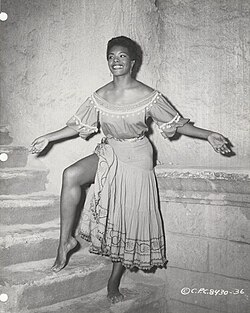
Publicity photo for Calypso Heat Wave, 1957
After her marriage ended in 1954, Angelou began dancing professionally in San Francisco clubs, including The Purple Onion, where she performed calypso music. Until then, she had gone by “Marguerite Johnson” or “Rita,” but, encouraged by her managers and supporters, she adopted the distinctive stage name “Maya Angelou,” a nod to her nickname and former married surname. The name captured the spirit of her calypso performances. In 1954 and 1955, she toured Europe with the opera Porgy and Bess, starting her habit of learning the language of each country she visited, eventually becoming proficient in several. In 1957, capitalizing on calypso’s popularity, she recorded her debut album *Miss Calypso*, later reissued on CD in 1996. That same year, she appeared in an off-Broadway revue that inspired the film *Calypso Heat Wave*, in which she sang and performed her own songs.
In 1959, Angelou met novelist John Oliver Killens, who encouraged her to move to New York and focus on her writing. There, she joined the Harlem Writers Guild and connected with prominent African American authors like John Henrik Clarke, Rosa Guy, Paule Marshall, and Julian Mayfield, eventually seeing her first work published. In 1960, after meeting and hearing civil rights leader Martin Luther King Jr. speak, she teamed up with Killens to organize the legendary Cabaret for Freedom in support of the Southern Christian Leadership Conference (SCLC), later becoming its Northern Coordinator. Scholar Lyman B. Hagen described her work as a fundraiser and organizer as both successful and highly effective. Around this time, she also began her pro-Castro and anti-apartheid activism, joining the Fair Play for Cuba Committee and even cheering for Fidel Castro when he arrived at Harlem’s Hotel Theresa during the United Nations 15th General Assembly on September 19, 1960.
Personal life
Evidence suggests that Angelou was partly descended from the Mende people of West Africa through her maternal line. In 2008, DNA testing showed that 45 percent of her ancestry came from Central African peoples of the Congo-Angola region, while 55 percent was from West Africans. A PBS documentary that same year revealed that her maternal great-grandmother, Mary Lee, freed after the Civil War, became pregnant by her former white owner, John Savin. Savin coerced Lee into falsely naming another man as the father of her child. Although Savin was indicted for forcing her to commit perjury, and it was confirmed he was the father, a jury acquitted him. Lee was sent to the Clinton County poorhouse in Missouri with her daughter, Marguerite Baxter, who later became Angelou’s grandmother. Angelou described Lee as “that poor little black girl, physically and mentally bruised.”
The details of Maya Angelou’s life, as told in her seven autobiographies and various interviews, speeches, and articles, were often inconsistent. Critic Mary Jane Lupton noted that Angelou spoke about her life eloquently but informally, without a strict timeline. For instance, though she was married at least twice, she never specified how many times, not wanting to seem frivolous. Her accounts and biographer Gillespie record her marriage to Tosh Angelos in 1951, her marriage to Paul du Feu in 1973 or 1974, and her relationship with Vusumzi Make beginning in 1961, though they never formally married. Angelou worked a variety of jobs, including in the sex trade as a prostitute and madam for lesbians, which she described in her second autobiography, *Gather Together in My Name*. In a 1995 interview, she said:
I wrote about my experiences because I thought too many people tell young folks, “I never did anything wrong. Who, Moi? – never I. I have no skeletons in my closet. In fact, I have no closet.” They lie like that and then young people find themselves in situations and they think, “Damn I must be a pretty bad guy. My mom or dad never did anything wrong.” They can’t forgive themselves and go on with their lives.
Angelou had one son, Guy, whose birth she recounted in her first autobiography, along with a grandson, two great-grandchildren, and, as Gillespie noted, a wide circle of friends and extended family. Her mother, Vivian Baxter, passed away in 1991, and her brother, Bailey Johnson Jr., died in 2000 after a series of strokes; both played significant roles in her life and writings. In 1981, her grandson’s mother disappeared with him, and it took four years to locate him.
Although Angelou never earned a university degree, Gillespie noted that she preferred to be addressed as “Dr. Angelou” by those outside her family and close friends. She owned two homes in Winston-Salem, North Carolina, and a stately brownstone in Harlem purchased in 2004, which housed her ever-growing library of books, decades’ worth of collected artwork, and well-stocked kitchens. According to The Guardian’s Gary Younge, her Harlem home featured African wall hangings and a collection of paintings, including portraits of jazz trumpeters, a watercolor of Rosa Parks, and a Faith Ringgold piece titled *Maya’s Quilt of Life*.
Gillespie recalled that she hosted several celebrations each year at her main home in Winston-Salem, and her legendary kitchen skills ranged from haute cuisine to comforting home-style dishes. The Winston-Salem Journal noted that an invitation to her Thanksgiving dinners, Christmas tree decorating parties, or birthday gatherings was one of the most sought-after in town. The New York Times reported that during her time in New York City, she often held elaborate New Year’s Day parties. She brought together her love for cooking and writing in her 2004 book *Hallelujah! The Welcome Table*, featuring 73 recipes—many passed down from her grandmother and mother—paired with 28 vignettes. In 2010, she released her second cookbook, *Great Food, All Day Long: Cook Splendidly, Eat Smart*, which emphasized weight loss and portion control.
Starting with *I Know Why the Caged Bird Sings*, Angelou followed the same “writing ritual” for years. She’d wake up early, head to a hotel room with the walls stripped of pictures, and write on legal pads while lying on the bed. Her only companions were a bottle of sherry, a deck of cards for solitaire, Roget’s Thesaurus, and the Bible. By early afternoon, she’d leave, having written 10–12 pages, later pared down to three or four in the evening. She used this routine to “enchant” herself, as she put it in a 1989 BBC interview, to relive the agony, anguish, and Sturm und Drang of her past. Even for painful memories, like her rape in *Caged Bird*, she sought to tell “the human truth.” Playing cards helped her slip into that state of enchantment and tap into her memories. “It may take an hour to get into it,” she said, “but once I’m in it—ha! It’s so delicious!” For her, the process wasn’t cathartic; the relief came from simply telling the truth.
Death
Maya Angelou passed away on the morning of May 28, 2014, at the age of 86. Though she had been in poor health and had recently canceled appearances, she was working on another autobiography about her experiences with national and world leaders. At her memorial service at Wake Forest University, her son, Guy Johnson, shared that despite constant pain from her dancing career and respiratory issues, she managed to write four books in her last decade. He noted, “She left this mortal plane with no loss of acuity and no loss in comprehension.”
Artists, entertainers, and world leaders paid tribute to Angelou, including President Obama, whose sister was named after her, and Bill Clinton. Harold Augenbraum of the National Book Foundation praised her legacy as one that writers and readers everywhere can admire and strive for. In the week following her death, *I Know Why the Caged Bird Sings* soared to the top spot on Amazon.com’s bestseller list.
On May 29, 2014, Mount Zion Baptist Church in Winston-Salem, where Angelou had been a member for 30 years, hosted a public memorial in her honor. A private service followed on June 7 at Wait Chapel on Wake Forest University’s campus, broadcast live on local TV in the Winston-Salem/Triad area and streamed on the university’s website, featuring speeches from her son, Oprah Winfrey, Michelle Obama, and Bill Clinton. On June 15, another memorial took place at Glide Memorial Church in San Francisco, where she had also been a longtime member, with remarks from Rev. Cecil Williams, Mayor Lee, and former mayor Willie Brown.
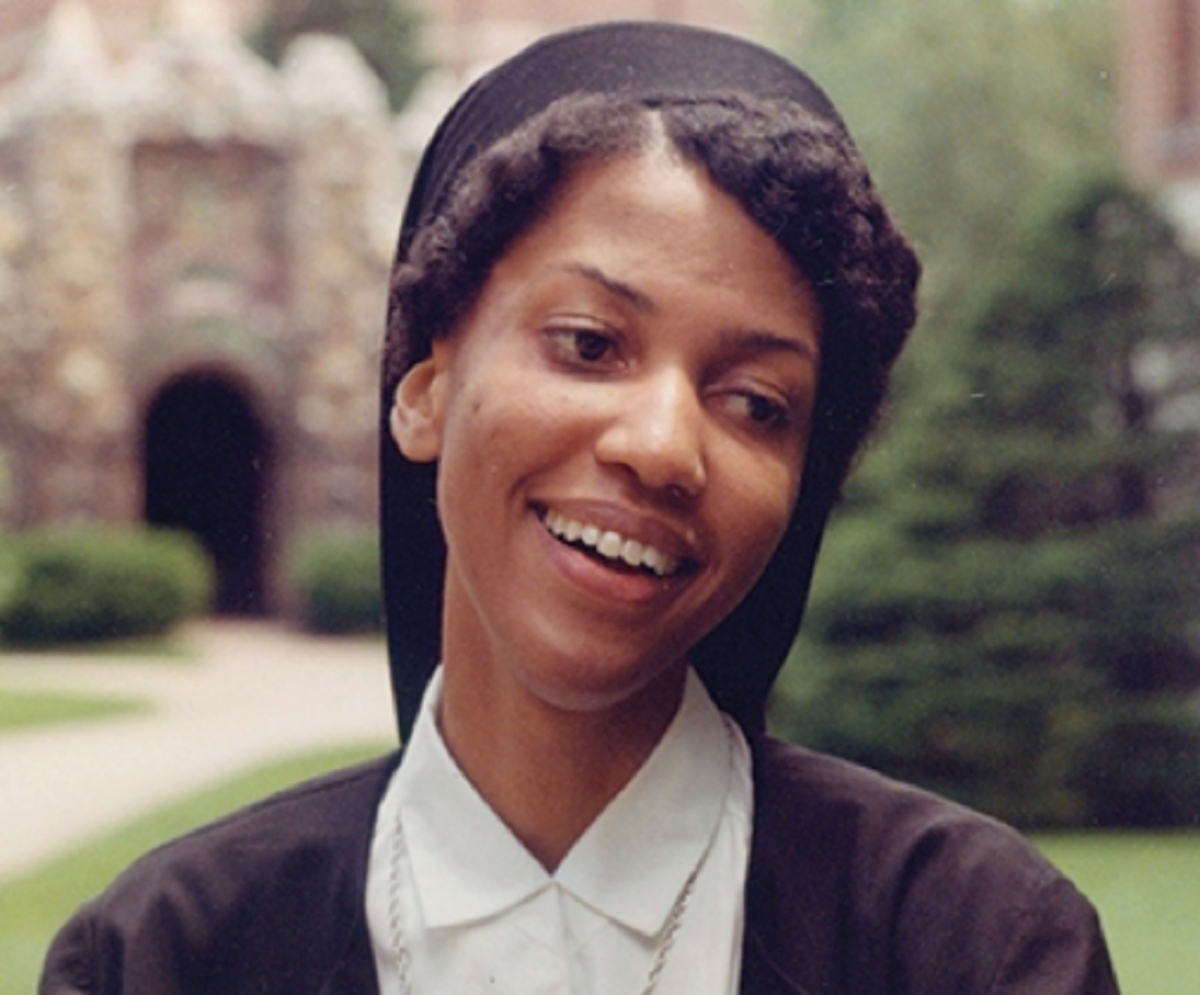
Mary Thea Bowman, FSPA (born Bertha Elizabeth Bowman; December 29, 1937 – March 30, 1990) was a Black Catholic religious sister, teacher, musician, liturgist and scholar who contributed to the ministry of the Catholic Church toward African Americans.
She became an evangelist among her people, assisted in the production of an African-American Catholic hymnal, and was a popular speaker on faith and spirituality in her final years, in addition to recording music. She also helped found the National Black Sisters’ Conference to provide support for African-American women in Catholic religious life. She died of cancer in 1990.
In 2018, the Diocese of Jackson opened her cause for sainthood, and she was designated a Servant of God.
Life
Early life
Born in Yazoo City, Mississippi, in 1937, Sis Mary Thea Bowman came from a family with a remarkable history. Her grandfather, Edward Bowman, had been born into slavery, while her father, Theon Edward Bowman, became a physician and her mother, Mary Esther Coleman, worked as a teacher. Raised in the Methodist tradition, she converted to Catholicism at the age of nine with her parents’ blessing. She attended Holy Child Jesus School in Canton, Mississippi, where she met her classmate, Flonzie Brown Wright.
At just 15, she became the first African-American to join the Franciscan Sisters of Perpetual Adoration in La Crosse, Wisconsin, defying her parents’ wishes. Bowman also played a role in the civil rights movement.
As part of her religious training, Bowman attended Viterbo University, run by her congregation, earning a B.A. in English in 1965. She later studied at The Catholic University of America in Washington, D.C., where she earned an M.A. in English in 1969 and a Ph.D. in English in 1972, completing her doctoral thesis on Thomas More, titled *The Relationship of Pathos and Style in A Dyalogue of Comforte Agaynste Tribulacyon: A Rhetorical Study*.
While working on her master’s at CUA, Bowman helped found the National Black Sisters’ Conference, launched in Pittsburgh in 1968 after Martin Luther King Jr.’s assassination. She stayed involved with the group for the rest of her life.
Educator
Bowman began her teaching career at an elementary school in La Crosse, Wisconsin, before moving on to Holy Child Jesus Catholic School, her alma mater. She later taught at her other alma maters, Viterbo College in La Crosse and the Catholic University of America in Washington, D.C., as well as Xavier University of Louisiana in New Orleans.
In his book *Eleven Modern Mystics*, meditation teacher Victor M. Parachin highlights Bowman’s influence on Catholic liturgical music, noting how she provided an intellectual, spiritual, historical, and cultural foundation for creating and validating a unique worship style for Black Catholics. As Bowman explained, “When we understand our history and culture, we can develop the rituals, music, and devotional expressions that truly fulfill us in the Church.”
In 1987, Bowman played a key role in publishing *Lead Me, Guide Me: The African American Catholic Hymnal*, the first Catholic hymnal created for the Black community. The project was coordinated by James P. Lyke, Auxiliary Bishop of Cleveland and an African American himself, who said it grew from the needs and hopes of Black Catholics. Bowman helped choose the hymns and contributed her essay, “The Gift of African American Sacred Song,” in which she called Black sacred song “soulful” and described it as holistic, participatory, genuine, spirit-filled, and life-giving.
Evangelist
After spending 16 years in education, Bowman was invited by the Bishop of Jackson to serve as a consultant for intercultural awareness. She became more deeply involved in ministry to African-Americans, giving inspiring talks to Black congregations. Her “ministry of joy” reached people as far away as Nigeria and Kenya, as well as Canada, the Virgin Islands, Hawaii, New York, and California. She encouraged Catholics to embrace their differences, preserve their cultures, and express the joy of being united in Christ. In his book Hope Sings, So Beautiful: Graced Encounters Across the Color Line, Christopher Pramuk wrote: “Arguably no person in recent memory did more to resist and transform the sad legacy of segregation and racism in the Catholic Church than Thea Bowman … who inspired millions with her singing and message of God’s love for all races and faiths. Sister Thea awakened a sense of fellowship in people both within and well beyond the Catholic world, first and foremost through her charismatic presence.”
In 1984, Bowman was diagnosed with breast cancer and began treatment, yet she kept up a busy speaking schedule. As her illness advanced, her fame continued to grow, taking her on trips abroad to places like West Africa and Lourdes, France. She also appeared on national news programs and was featured in a documentary about her life following a terminal diagnosis.
During an appearance on the show 60 Minutes with Mike Wallace, she prodded him into saying “Black is beautiful.”
In 1989, just before her passing, she was honored with an honorary doctorate from Boston College in Massachusetts, recognizing her contributions to the service of the Church.
Death
A few months before she passed away from cancer in 1989, Bowman addressed American Catholic bishops from her wheelchair, moving them deeply and earning their applause. When she finished, they stood together, linking arms, and joined her in singing the spiritual “We Shall Overcome.” That same year, Harry Belafonte met her in Mississippi with hopes of making a film about her life starring Whoopi Goldberg, though the project never came to fruition.
Just days before her passing, the University of Notre Dame announced it would honor Bowman with the 1990 Laetare Medal. The award was given posthumously during their 1990 commencement. She passed away on March 30, 1990, at the age of 52, in Canton, Mississippi, and was laid to rest with her parents in Memphis, Tennessee.
Legacy
The 25th anniversary of Bowman’s passing inspired many tributes. Her 1988 albums, *Songs of My People* and *’Round the Glory Manger*, originally released on stereo audiocassette by the Daughters of St. Paul, were reissued in 2020 for the 30th anniversary of her death under the title *Songs of My People: The Complete Collection*.
Thea Bowman AHANA and Intercultural Center
Boston College instituted the Thea Bowman AHANA and Intercultural Center (African, Hispanic, Asian, Native American).
Sister Thea Bowman Foundation
Shortly before her passing, the Sister Thea Bowman Black Catholic Educational Foundation was created to raise scholarship funds nationwide for underserved students of color seeking post-secondary education but lacking the means to attend—an effort Bowman saw as vital to uplifting Black communities. She first envisioned the foundation in 1984 and expressed its mission to students: “Walk with us. Don’t walk behind us and don’t walk in front of us; walk with us.” In 1989, founder Mary Lou Jennings brought this vision to life under Bowman’s guidance, and by 2015, it had helped more than 150 African American students earn college degrees.
Cause for canonization
In mid-2018, the Diocese of Jackson began the process for Bowman’s canonization, granting her the title “Servant of God,” the first of four steps toward being officially recognized as a saint by the Church. Later that year, during the U.S. Conference of Catholic Bishops’ Fall General Assembly, the Committee on Canonical Affairs and Church Governance gave unanimous support to moving her cause forward at the diocesan level.
As of February 9, 2026, they have spent the last 7 years gathering information and are now ready to give the information to the Pope.
The canonization process involves several key steps:
Step 1: Servant of God
Waiting Period: After a person’s death, there is typically a five-year waiting period before the canonization process can begin. This allows for an objective assessment of the individual’s life and reputation for holiness. The pope can waive this waiting period.
Initiation: The bishop of the diocese where the person died can initiate the cause for canonization by petitioning the Holy See. The individual is then referred to as a “Servant of God.”
Step 2: Venerable
Investigation: A diocesan tribunal is formed to investigate the life and virtues of the Servant of God. This includes gathering testimonies and examining writings to confirm the individual’s heroic virtues or martyrdom.
Presentation to the Pope: The findings are sent to the Congregation for the Causes of Saints in Rome. If the investigation is favorable, the pope may declare the individual “Venerable,” recognizing their heroic virtues.
Step 3: Blessed
Miracle Requirement: To be beatified and declared “Blessed,” a miracle attributed to the intercession of the Venerable must be verified. This miracle must be rigorously investigated and confirmed.
Beatification: Once the miracle is validated, the pope beatifies the individual, allowing for limited public veneration, typically within the diocese or religious order associated with the Blessed.
Step 4: Saint
Second Miracle: For canonization, a second miracle must be attributed to the intercession of the Blessed. This miracle must also undergo a thorough investigation.
Canonization: After the second miracle is confirmed, the pope canonizes the individual, officially declaring them a saint and allowing for universal veneration within the Church.
Additional Notes
Martyrs: If the individual is a martyr, they may be beatified without the need for a miracle, as their martyrdom is considered sufficient proof of holiness. However, a miracle is still required for canonization.
Role of the Congregation for the Causes of Saints: This body oversees the canonization process, ensuring that all investigations and verifications are conducted according to Church law.
These steps illustrate the thorough and careful process the Catholic Church follows to recognize individuals as saints, ensuring that only those with a proven reputation for holiness are canonized.
Alice Marie Coachman Davis (November 9, 1923 – July 14, 2014) was an American track and field star who excelled in the high jump and made history as the first Black woman to win an Olympic gold medal.
Biography
Early life and education
Alice Coachman was born on November 9, 1923, in Albany, Georgia, the fifth of Fred and Evelyn Coachman’s ten children. She faced significant barriers to athletic training and participation in organized sports due to the color of her skin and the fact that she was a female athlete during a time when women in sports faced strong opposition. Making the most of what she had, she trained by running barefoot along dirt roads near her home and practiced her jumping with homemade equipment.
Coachman went to Monroe Street Elementary School, where her 5th grade teacher, Cora Bailey, and her aunt, Carrie Spry, encouraged her even though her parents had doubts. When she started at Madison High School in 1938, she joined the track team and trained with Harry E. Lash to hone her athletic skills. Within a year, she caught the eye of the Tuskegee Institute in Tuskegee, Alabama.
In 1939, at just 16, she entered Tuskegee Preparatory School on a scholarship that required her to work while studying and training. Her duties included cleaning and maintaining sports facilities and repairing uniforms. She graduated from the Tuskegee Institute in 1946 with a degree in dressmaking, then went on to Albany State College the next year. There, she earned a B.S. in Home Economics with a minor in science in 1949, before becoming a teacher and track-and-field instructor.
Athletic career
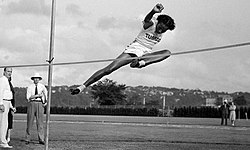
Before enrolling at Tuskegee Preparatory School, Coachman competed in the Amateur Athletic Union’s (AAU) Women’s National Championships, where she broke both the college and national high jump records while jumping barefoot. Her unique style combined elements of straight jumping and the western roll technique.
Alice Coachman high jumper at the NCAA track and field championships, 1939
From 1939 to 1948, Coachman dominated the AAU outdoor high jump championships, winning ten straight national titles and earning the nickname “Tuskegee Flash.” While at Tuskegee Institute, she also claimed national championships in the 50-meter dash, 100-meter dash, and as part of the 400-meter relay team. Over nine years, she racked up 26 national titles—second only to her Polish-American rival Stella Walsh—and even won three conference championships as a guard on the women’s basketball team. Unfortunately, her prime years coincided with the canceled 1940 and 1944 Olympic Games due to World War II. As sportswriter Eric Williams put it, had she competed in those Olympics, she might be remembered as the greatest female athlete of all time.
Coachman got her big break on the world stage at the 1948 Olympic Games in London. She made the US Olympic team with a high jump of 5 feet 4 inches (1.63 m), breaking a 16-year-old record by three-quarters of an inch (19 mm). In the finals, she cleared 1.68 m (5 ft 6 in) on her first attempt. Her closest competitor, Great Britain’s Dorothy Tyler, matched the height but only on her second try. Coachman ended up being the only American woman to win an Olympic gold in athletics that year, with King George VI presenting her medal.
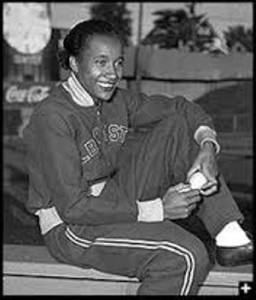
When Coachman returned to the United States after the Olympics, she quickly rose to celebrity status. She met President Harry Truman and former First Lady Eleanor Roosevelt, was celebrated with parades from Atlanta to Albany, and even enjoyed a party hosted by Count Basie. In 1952, she made history as the first African-American woman to endorse an international product, becoming a spokesperson for the Coca-Cola Company and appearing on billboards alongside 1936 Olympic champion Jesse Owens. Back in her hometown, both Alice Avenue and Coachman Elementary School were named in her honor.
Later life
Alice Coachman Elementary School
Coachman’s athletic career wrapped up when she was just 24, after which she devoted herself to education and the Job Corps. She passed away in Albany, Georgia, on July 14, 2014, from cardiac arrest following ongoing respiratory issues. A few months earlier, she had suffered a stroke and received care at a nursing home. She had two children with her first husband, N. F. Davis, before their marriage ended in divorce, and her second husband, Frank Davis, died before her.
Legacy
Coachman was inducted into the USA Track and Field Hall of Fame in 1975 and the Georgia Sports Hall of Fame in 1979. She was celebrated as one of the 100 greatest Olympians during the 1996 Summer Olympics in Atlanta. In 1998, she became an honorary member of Alpha Kappa Alpha sorority, and in 2002, she was recognized as a Women’s History Month Honoree by the National Women’s History Project. She was later inducted into the United States Olympic Hall of Fame in 2004.
Coachman has been celebrated for paving the way for future African American track stars like Evelyn Ashford, Florence Griffith Joyner, and Jackie Joyner-Kersee. Since her remarkable Olympic performance, Black women have often made up the majority of the U.S. women’s Olympic track and field team. Reflecting on her impact, she said, “I think I opened the gate for all of them. Whether they believe that or not, they should appreciate someone from the Black community who was able to accomplish these things.”
Sojourner Truth, born Isabella Baumfree around 1797, was an American abolitionist and advocate for African American civil rights, women’s rights, and temperance. She was born into slavery in Swartekill, New York, but escaped to freedom with her infant daughter in 1826. In 1828, she went to court to reclaim her son and became the first Black woman to win such a case against a white man. Truth passed away on November 26, 1883.
In 1843, she took the name Sojourner Truth after feeling called by God to leave the city and travel the countryside, “testifying to the hope that was in her.” Her most famous speech was given on the spot in 1851 at the Ohio Women’s Convention in Akron. During the Civil War, it became widely known as “Ain’t I a Woman?”, a reworked version of her speech published in 1863 in a stereotypical Black dialect common in the South at the time. In reality, Sojourner Truth’s first language was Dutch.
Sojourner Truth examining the Bible with Abraham Lincoln, Civil War-era print
During the Civil War, Truth helped recruit Black men for the Union army. Afterward, she pushed for land grants from the federal government for formerly enslaved people, an effort tied to the promise of “forty acres and a mule,” but without success. She kept advocating for both women and African Americans until her death. As her biographer Nell Irvin Painter noted, “At a time when most Americans thought of slaves as male and women as white, Truth embodied a fact that still bears repeating: Among the Blacks are women; among the women, there are Blacks.”
Early years
House of Col. Johannes Hardenbergh
Sojourner Truth believed she was born sometime between 1797 and 1800. She was one of about a dozen children of James and Elizabeth Bomefree (later also spelled Baumfree). Her father, captured from what is now Ghana, was nicknamed “Bomefree” (which was thought to be Dutch for “tree”) for his tall height, while her mother, “Mau-Mau Bet,” was the daughter of enslaved people taken from the Guinea region. Colonel Hardenbergh purchased James and Elizabeth from slave traders and kept their family on his estate in a hilly area called Swartekill, just north of modern Rifton in Esopus, New York, about 95 miles north of New York City. As an infant, Truth’s five-year-old brother and three-year-old sister were sold to another estate. Her family often remembered those lost to slavery, and her mother taught her children to pray. Dutch was her first language, and she spoke with a Dutch accent throughout her life. After Hardenbergh’s death, his son Charles inherited the estate and continued to hold slaves there.
When Charles Hardenbergh died in 1806, nine-year-old Truth, known then as Belle, was sold at an auction along with a flock of sheep for $100 (~$2,010 in 2024) to John Neely near Kingston, New York. Until then, she spoke only Dutch, and when she learned English, it was with a Dutch accent rather than a stereotypical dialect. She later described Neely as cruel, recalling how he beat her daily, once even with a bundle of rods. In 1808, Neely sold her for $105 (~$2,067 in 2024) to tavern keeper Martinus Schryver of Port Ewen, New York, who kept her for 18 months before selling her in 1810 to John Dumont of West Park, New York.
Dumont repeatedly assaulted her, and there was significant tension between Truth and Dumont’s wife, Elizabeth Waring Dumont, who harassed her and made life harder. Around 1815, Truth met and fell in love with Robert, a slave from a nearby farm. His owner, Charles Catton Jr., a landscape painter, forbade the relationship because he didn’t want his slaves having children with people he didn’t own, as he wouldn’t own the children. One day, Robert sneaked over to see Truth, but when Catton and his son caught him, they brutally beat him until Dumont stepped in. Truth never saw Robert again, and he died a few years later, an event that haunted her for life. She later married an older enslaved man named Thomas, with whom she had five children: James, her firstborn who died young; Diana (1815), the child of John Dumont’s assault; and Peter (1821), Elizabeth (1825), and Sophia (c. 1826), all born after she and Thomas came together.
Freedom
In 1799, New York began passing laws to abolish slavery, though the process wasn’t finished until July 4, 1827. Dumont had promised to free Truth a year before the official emancipation if she “did well and was faithful.” But he went back on his word, saying a hand injury had made her less productive. Angry but determined, she kept working, spinning 100 pounds (45 kg) of wool to fulfill her sense of duty to him.
In late 1826, Truth gained her freedom, taking her infant daughter, Sophia, with her. Sadly, she had to leave her other children behind, as the emancipation order didn’t free them until they had worked as bound servants into their twenties. Reflecting on her escape, she said, “I didn’t run off, thinking that was wrong, but I walked away, believing it was the right thing to do.”
She eventually arrived at the home of Isaac and Maria Van Wagenen in New Paltz, where they welcomed her and her baby. Isaac offered to pay $20 for her services for the rest of the year, until the state’s emancipation took effect, and Dumont agreed. She stayed with them until the New York State Emancipation Act passed a year later.
When Truth found out that her five-year-old son Peter had been sold by Dumont and then illegally resold to someone in Alabama, she sought help from the Van Wagenens and took the matter to the New York Supreme Court. Using the name Isabella van Wagenen, she sued Peter’s new owner, Solomon Gedney. After months of legal battles in 1828, she regained custody of her son, who had suffered abuse. This made her one of the first Black women to win a court case against a white man. The lawsuit’s court documents were later rediscovered around 2022 by the staff at the New York State Archives.
In 1827, she converted to Christianity and helped establish the Methodist Church in Kingston, New York. Two years later, she moved to New York City and became a member of the John Street Methodist Church, also known as the Zion African Methodist Episcopal Church.
In 1833, she began working for Robert Matthews, known as the Prophet Matthias, who led a sect identifying with Judaism. She served as a housekeeper in their communal settlement and joined the group. In 1834, Matthews and Truth were accused of murdering Elijah Pierson but were acquitted due to lack of evidence, with Truth presenting letters that vouched for her reliability as a servant. The trial then shifted to allegations that Matthews had beaten his daughter, for which he was found guilty and sentenced to three months in jail plus thirty days for contempt of court. This led Truth to leave the sect in 1835, after which she lived in New York City until 1843.
In 1839, Truth’s son Peter joined the crew of a whaling ship called the Zone of Nantucket. Between 1840 and 1841, she got three letters from him, though in his third he mentioned sending five. Peter also said he hadn’t received any of her replies. When the ship came back to port in 1842, Peter wasn’t among the crew, and Truth never heard from him again.
The result of freedom
The year 1843 was a turning point for her. On June 1, Pentecost Sunday, she changed her name to Sojourner Truth. She chose the name because she heard the Spirit of God calling on her to preach the truth. She told her friends: “The Spirit calls me, and I must go”, and left to make her way traveling and preaching about the abolition of slavery. Taking along only a few possessions in a pillowcase, she traveled north, working her way up through the Connecticut River Valley, towards Massachusetts.
During that period, Truth started going to Millerite Adventist camp meetings. The Millerites, followers of William Miller from New York, believed Jesus would return in 1843–1844 to bring about the end of the world. Truth’s preaching and singing were well-loved in the community, and she often attracted large audiences. But when the predicted second coming didn’t happen, she, like many others, stepped back from her Millerite friends for a while.
In 1844, she became part of the Northampton Association of Education and Industry in Florence, Massachusetts. Founded by abolitionists, the group promoted women’s rights, religious tolerance, and pacifism. Over its four-and-a-half-year span, it had 240 members in total, but never more than 120 at once. Members lived on 470 acres, raising livestock and operating a sawmill, a gristmill, and a silk factory. Truth worked and lived there, managing the laundry and supervising both men and women. During her time in the community, she met William Lloyd Garrison, Frederick Douglass, and David Ruggles. Inspired by those around her, she gave her first anti-slavery speech that same year.
In 1845, she became part of George Benson’s household, who was William Lloyd Garrison’s brother-in-law. A year later, the Northampton Association of Education and Industry dissolved due to financial struggles. In 1849, she visited John Dumont before his move out west.
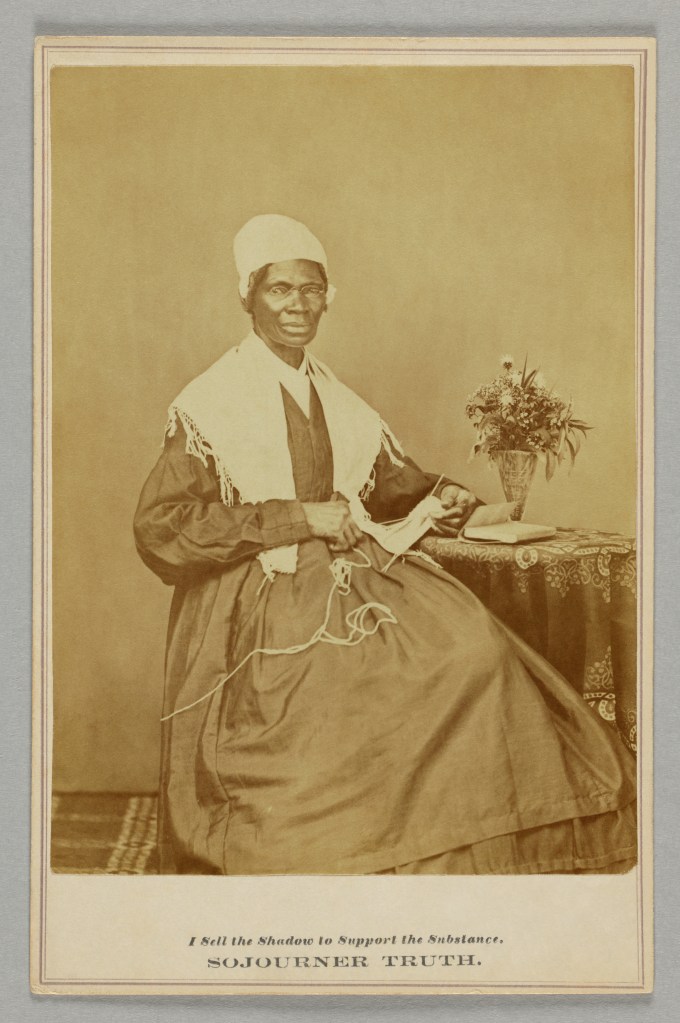
Truth began dictating her memoirs to her friend Olive Gilbert, and in 1850, William Lloyd Garrison privately published them as *The Narrative of Sojourner Truth: A Northern Slave*. That same year, she bought a home in Florence for $300 and spoke at the first National Women’s Rights Convention in Worcester, Massachusetts. In 1854, using proceeds from the book and cartes-de-visite captioned “I sell the shadow to support the substance,” she paid off the mortgage held by her friend and fellow community member, Samuel L. Hill.
“Ain’t I a Woman?”
In 1851, Truth teamed up with abolitionist and speaker George Thompson for a lecture tour across central and western New York. That May, she attended the Ohio Women’s Rights Convention in Akron, where she gave her now-famous impromptu speech, later called “Ain’t I a Woman?”. In it, she called for equal rights for all women, speaking from her experience as a former enslaved woman and blending the fight for abolition with women’s rights, using her strength as a laborer to support her case.
On a mission
Truth devoted her life to pushing for a fairer society for African Americans and women, championing causes like abolition, voting rights, and property rights. She was at the forefront of tackling overlapping social justice struggles. Historian Martha Jones noted that when Black women like Truth spoke about rights, they blended their ideas with challenges to slavery and racism. Truth shared her own experiences, hinting that the women’s movement could take a different path—one that stood for the broader interests of all humanity.
Illness and death
Truth’s grave at Oak Hill Cemetery
In her final years, Truth was cared for by two of her daughters. Just days before her death, a reporter from the Grand Rapids Eagle visited to interview her. Her face was thin and drawn, and she seemed to be in great pain. Still, her eyes shone brightly and her mind remained sharp, though speaking was difficult for her.
Truth passed away early in the morning on November 26, 1883, at her home in Battle Creek. Her funeral took place two days later at the Congregational-Presbyterian Church, led by Reverend Reed Stuart. Prominent citizens served as pallbearers, and nearly a thousand people attended the service. She was laid to rest in Oak Hill Cemetery.
In Washington, D.C., Frederick Douglass delivered a eulogy for her, praising her as venerable in age, insightful about human nature, remarkably independent and boldly self-assured, and deeply committed to the welfare of her race. For the past forty years, she had earned the respect and admiration of social reformers everywhere.
Louisa Alcott was a wild little girl. When she was very little, she would run away from home. She liked to play with beggar children.
One day she wandered so far away from her home, she could not find the way back again. It was growing dark. The little girl’s feet were tired. She sat down on a doorstep. A big dog was lying on the step. He wagged his tail. That was his way of saying, “I am glad to see you.”
Little Louisa grew sleepy. She laid her head on the curly head of the big dog. Then she fell asleep.
Louisa’s father and mother could not find her. They sent out the town crier to look for her.
The town crier went along the street. As he went, he rang his bell. Every now and then he would tell that a little girl was lost. At last, the man with the bell came to the place where Louisa was asleep. He rang his bell. That waked her up. She heard him call out in a loud voice,
“Lost, lost! a little girl six years old. She wore a pink frock, a white hat, and new green shoes.”
When the crier had said that, he heard a small voice coming out of the darkness. It said, “Why, dat’s me.” The crier went to the voice, and found Louisa sitting by the big dog on the doorstep. The next day she was tied to the sofa to punish her for running away.
She and her sisters learned to sew well. Louisa set up as a doll’s dressmaker. She was then twelve years old. She hung out a little sign. She put some pretty dresses in the window to show how well she could do.
Other girls liked the little dresses that she made. They came to her to get dresses made for their dolls. They liked the little doll’s hats she made better than all. Louisa chased the chickens to get soft feathers for these hats.
She turned the old fairy tales into little plays. The children played these plays in the barn.
One of these plays was Jack and the Beanstalk. A squash vine was put up in the barn. This was the beanstalk. When it was cut down, the boy who played giant would come tumbling out of the hayloft.
Louisa found it hard to be good and obedient. She wrote some verses about being good. She was fourteen years old when she wrote them. Here they are:
A little kingdom I possess
Where thoughts and feelings dwell,
And very hard I find the task
Of governing it well.
For passion tempts and troubles me,
A wayward will misleads,
And selfishness its shadow casts
On all my words and deeds.
I do not ask for any crown
But that which all may win,
Nor seek to conquer any world
Except the one within.
The Alcott family were very poor. Louisa made up her mind to do something to make money when she got big. She did not like being so very poor.
One day she was sitting on a cartwheel thinking. She was thinking how poor her father was. There was a crow up in the air over her head. The crow was cawing. There was nobody to tell her thoughts to but the crow. She shook her fist at the big bird, and said,
“I will do something by and by. Don’t care what. I’ll teach, sew, act, write, do anything to help the family. And I’ll be rich and famous before I die. See if I don’t.”
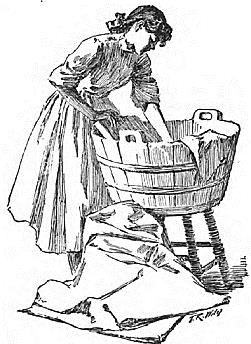
The crow did not make any answer. But Louisa kept thinking about the work she was going to do. The other children got work to do that made money. But Louisa was left at home to do housework. She had to do the washing. She made a little song about it. Here are some of the verses of this song:
Queen of my tub, I merrily sing,
While the white foam rises high,
And sturdily wash and rinse and wring,
And fasten the clothes to dry;
Then out in the free fresh air they swing,
Under the sunny sky.
I am glad a task to me is given,
To labor at day by day;
For it brings me health and strength and hope,
And I cheerfully learn to say,
“Head you may think, Heart you may feel,
But Hand you shall work always.”
Louisa grew to be a woman at last. She went to nurse soldiers in the war. She wrote books. When she wrote the book called “Little Women,” all the young people were delighted. What she had said to the crow came true at last. She became famous. She had money enough to make the family comfortable.
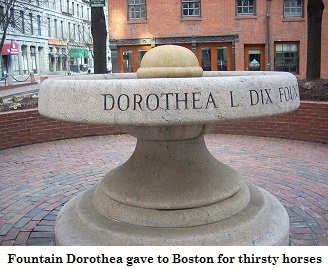
Little Dorothy Dix was poor. Her father did not know how to make a living. Her mother did not know how to bring up her children.
The father moved from place to place. Sometimes he printed little tracts to do good. But he let his own children grow up poor and wretched.
Dorothy wanted to learn. She wanted to become a teacher. She wanted to get money to send her little brothers to school.
Dorothy was a girl of strong will and temper. When she was twelve years old, she left her wretched home. She went to her grandmother. Her grandmother Dix lived in a large house in Boston. She sent Dorothy to school.
Dorothy learned fast. But she wanted to make money. She wanted to help her brothers. When she was fourteen, she taught a school. She tried to make herself look like a woman. She made her dresses longer.
She soon went back to her grandmother. She went to school again. Then she taught school. She soon had a school in her grandmother’s house. It was a very good school. Many girls were sent to her school. Miss Dix was often ill. But when she was well enough, she worked away. She was able to send her brothers to school until they grew up.
Besides helping her brothers, she wanted to help other poor children. She started a school for poor children in her grandmother’s barn.
After a while she left off teaching. She was not well. She had made all the money she needed.
But she was not idle. She went one day to teach some poor women in an almshouse. Then she went to see the place where the crazy people were kept. These insane people had no fire in the coldest weather.
Miss Dix tried to get the managers to put up a stove in the room. But they would not do it. Then she went to the court. She told the judge about it. The judge said that the insane people ought to have a fire. He made the managers put up a stove in the place where they were kept.
Then Miss Dix went to other towns. She wanted to see how the insane people were treated. Some of them were shut up in dark, damp cells. One young man was chained up with an iron collar about his neck.
Miss Dix got new laws made about the insane. She persuaded the States to build large houses for keeping the insane. She spent most of her life at this work. The Civil War broke out. There were many sick and wounded soldiers to be taken care of.
All of the nurses in the hospitals were put under Miss Dix. She worked at this as long as the war lasted. Then she spent the rest of her life doing all that she could for insane people.
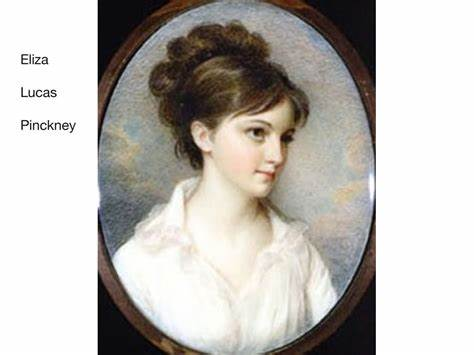
You have read how Thomas Smith first raised rice in Carolina. After his death, there lived in South Carolina a wise young woman. She showed the people how to raise another plant. Her name was Eliza Lucas.
The father of Miss Lucas did not live in Carolina. He was governor of one of the islands of the West Indies. Miss Lucas was fond of trying new things. She often got seeds from her father. These she planted in South Carolina.
Her father sent her some seeds of the indigo plant. She sowed some of these in March. But there came a frost. The indigo plant cannot stand frost. Her plants all died.
But Miss Lucas did not give up. She sowed some more seeds in April. These grew very well until a cutworm found them. The worm wished to try new things, too. So, he ate off the indigo plants.
But Miss Lucas was one of the people who try, try again. She had lost her indigo plants twice. Once more she sowed some of the seed. This time the plants grew very well.
Miss Lucas wrote to her father about it. He sent her a man who knew how to get the indigo out of the plant.
The man tried not to show Miss Lucas how to make the indigo. He did not wish the people in South Carolina to learn how to make it. He was afraid his own people would not get so much for their indigo.
So, he would not explain just how it ought to be done. He spoiled the indigo on purpose.
But Miss Lucas watched him closely. She found out how the indigo ought to be made. Some of her father’s land in South Carolina was now planted with the indigo plants.
Then Miss Lucas was married. She became Mrs. Pinckney. Her father gave her all the indigo growing on his land in South Carolina. It was all saved for seed. Some of the seed Mrs. Pinckney gave to her friends. Some of it her husband sowed. It all grew, and was made into that blue dye that we call indigo. When it is used in washing clothes, it is called bluing.
In a few years, more than a million pounds of indigo were made in South Carolina every year. Many people got rich by it. And it was all because Miss Lucas did not give up.





 articlesforchristians