A place to grow your relationship with God

Posts tagged ‘1’

1st grade week 18 out of 36

Subscribe to continue reading

Subscribe to get access to the rest of this post and other subscriber-only content.

Should We Call God by His Hebrew Name?

It has been making the rounds for quite some time that we need to call God and Jesus by the Hebrew names. Some say that this may not apply to everybody. Others declare that you are worshiping an idol by not calling God by His Hebrew name. I am addressing those that make this a salvation issue.
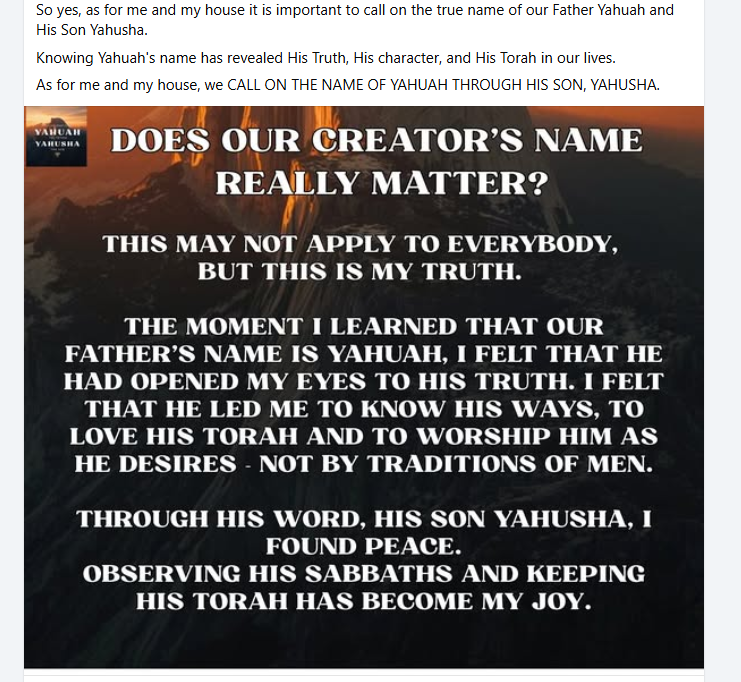
Now I want you to think about this carefully. Yes, we are supposed to worship God as he desires and not by the traditions of men. However, I want you to answer two very important questions.

  1. Who created the languages?
  2. Who knows man’s heart?

The answer to question can be found in Genesis 11:9. Therefore, is the name of it called Babel; because the Lord did there confound the language of all the earth: and from thence did the Lord scatter them abroad upon the face of all the earth. God created the languages when he confounded the language of all the earth. Therefore, isn’t logical that since he created the languages that he also understands the languages. I am not getting into the argument that says the words were mistranslated (that is for linguistics to figure out). God knows that those that speak English use the words that are English. Learning the Bible is hard enough without having to learn a new language just to pray. Remember that on the Day of Pentecost, God poured out His Spirit.

  • Acts 2:4-11 And they were all filled with the Holy Ghost, and began to speak with other tongues, as the Spirit gave them utterance. And there were dwelling at Jerusalem Jews, devout men, out of every nation under heaven. Now when this was noised abroad, the multitude came together, and were confounded, because that every man heard them speak in his own language. And they were all amazed and marvelled, saying one to another, Behold, are not all these which speak Galilaeans? And how hear we every man in our own tongue, wherein we were born? Parthians, and Medes, and Elamites, and the dwellers in Mesopotamia, and in Judaea, and Cappadocia, in Pontus, and Asia, Phrygia, and Pamphylia, in Egypt, and in the parts of Libya about Cyrene, and strangers of Rome, Jews and proselytes, Cretes and Arabians, we do hear them speak in our tongues the wonderful works of God.

Notice how that God started the church by translating the wonderful works of God into many different languages.

The answer to question can be found in 1 Samuel 16:7 But the Lord said unto Samuel, Look not on his countenance, or on the height of his stature; because I have refused him: for the Lord seeth not as man seeth; for man looketh on the outward appearance, but the Lord looketh on the heart. If what is in your heart is correct, then your actions will be correct. Thankfully God is all knowing. He knows what you are trying to say. He knows the intent of your heart.

Now if you have a heart’s desire to learn Hebrew, by all means learn it, but don’t make others feel bad by acting like they are dishonoring God by not learning Hebrew. I would rather that people pray in whatever language that they know and seek God with all their heart, soul, and mind than get discouraged by not knowing how to pray in Hebrew.

It is good to learn Hebrew and Greek for studying the Bible, but when it is time to witness to others, even God on the Day of Pentecost translated it into their language. He started the church by translating what needed to be translated and it wasn’t just Hebrew that he translated the words into.

1st grade week 14 out of 36

Subscribe to continue reading

Subscribe to get access to the rest of this post and other subscriber-only content.

Adding Columns of Numbers

Teach children to add columns of numbers.
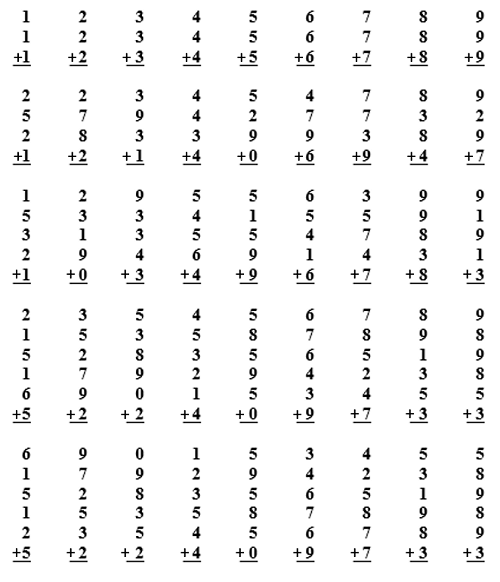
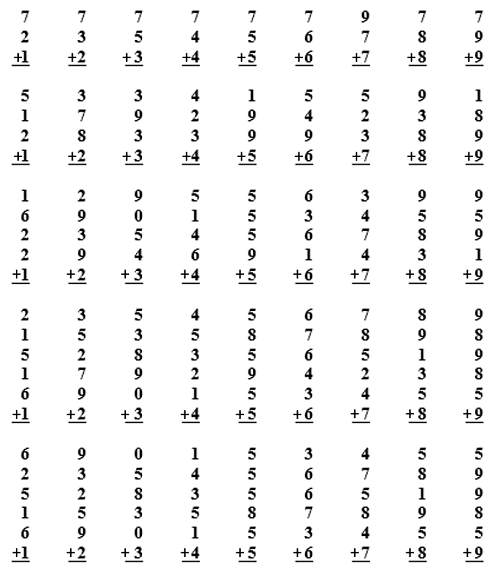
  • Direct children to mentally add the columns below, speaking aloud the results only of each operation.
  • Have children add columns from bottom to top for additional practice.
  • Exercise : Add the columns aloud from top to bottom and bottom to top. For example, for the first problem top to bottom, students say ‘2, 3.’

STEP 2

  • Exercise : Add the columns aloud from top to bottom and bottom to top. For example, for the first problem top to bottom, students say ‘9, 10.’
  • Direct children to mentally add the columns below, speaking aloud the results only of each operation.
  • Have children add columns from bottom to top for additional practice.
  • Exercise : Add the columns aloud from top to bottom and bottom to top. For example, for the first problem top to bottom, students say ‘2, 3.’
  • Exercise : Add the columns aloud from top to bottom and bottom to top. For example, for the first problem top to bottom, students say ‘9, 10.’
  • Exercise : Add the columns aloud from top to bottom and bottom to top. For example, for the first problem top to bottom, students say ‘4, 6.’

Kindergarten Week 5 out of 36

Subscribe to continue reading

Subscribe to get access to the rest of this post and other subscriber-only content.

Kindergarten week 1 of 36

Print out this page. As you do the assignments, write down the day that you completed each assignment. This will be your attendance record. Science and Social Studies are only done 3 days a week.

Monday

  • Math
  • Science
    • God Made Me Cut & Paste Printables
      • Choose the page that you want your child to do.
      • Review the parts of the body with your child.
      • Have the child cut and paste the correct body parts
      • Review the scripture.
  • Social Studies
    • Would you like to take a 100 day adventure of American history? Travel through books from the time when Squanto was a boy and the time shortly before the Pilgrims arrived through the late 1800’s and the turn of the century!  Click on the link to download a list of books recommended for use during the 100 days as well as coordinating notebook pages!
      • Preparing to journey with us on a 100 day adventure of American history? Travel through books with us from the time when Squanto was a boy and the time shortly before the Pilgrims arrived through the late 1800’s and the turn of the century!
      • On the 3rd page of the link is a list of books recommended for use during the 100 days. However, please feel free to substitute as needed.
      • All books should be read to the child.
    • On the 4th page starts the day-by-day lesson plan. You will be doing about 3 days per week.
  • Reading/ Language (Phonics or Sight word instruction)
    • Reading lesson 1
    • Phonics
      • Lesson 1: Let’s remember the alphabet and the letter sounds.
      • Poetry reading
        • The Poetry of Mother Goose     
        • Lesson 1: Rain
          • Look at the poem picture.
          • Read or listen to the poem.
          • Read the title of the poem and the poem.
          • Complete page 5 of ‘Poetry Coloring Pages for Kindergarten.’ (see the list of materials for the link.)
          • Act Out the Poem
            • If you have an umbrella, pretend it is raining and take shelter beneath it.
            • Pretend to splash through puddles.
  • Art
    • Read or listen to the Poem
      • Draw the Green Grass and Blue Sky

Tuesday

  • Math
    • Calendar math
    • Mix the colors. Make sure to click on any tube that you don’t need to put back its paint when you aren’t using it.
    • Counting 1-10 Song | Number Songs for Children | Count to 10
    • You are on day 2, count to two. Remember to have your child count out loud and hold up 2 fingers.
    • Tracing the number 2 (two) (printable)
  • Science
  • Social Studies
  • Reading/ Language
    • Reading Lesson 1
      • step 2
    • Phonics
    • Poetry
      • The Clock
        • Recite the Title and the Poem
        • After reading or listening to the poem, retell the poem in your own words.
        • Complete page 6 of ‘Poetry Coloring Pages for Kindergarten.’
        • Act Out the Poem
          • Take extra care washing your face and hands and brushing your teeth before you go to bed tonight.
          • Look for opportunities to help others during the week.
  • Music

Thursday

  • Math: day 4
  • Reading/Language
    • Reading Lesson 1
      • review steps 1-3
      • Do the trace work or copy work page that corresponds to lesson 1. (see materials for the link to the workbook)
    • Phonics
    • Poetry
      • The Old Woman Under a Hill
        • read or listen to the poem.
        • Retell the poem in your own words.
        • Color the picture on page 8.
        • Act Out the Poem
          • Make your own house under a hill.
          • Make a house in a hill out of blankets, tables, chairs, or other furniture.
          • Go in your house and practice reciting the poem.
  • Bible (get a Children’s Story Bible or use this)
    • Creation: (Genesis 1)
    • Bible Truths: God created everything and it was good!
    • Focus Verse(s): Genesis 1:1 – In the beginning, God created the heavens and the earth.
    • Scripture Booklet
    • Read the story of Creation
    • Make the scripture booklet
    • Pray, thanking God for His goodness, power, and love!

Friday

  • Math: lesson 5
  • Reading/ Language
    • Reading
      • Step 5
    • Phonics
    • Poetry
      • Oh, Dear!
        • Read or listen to the poem.
        • Retell the poem in you own words.
        • Color the picture on page 9.
  • Finish any unfinished work or review any difficult subjects.