A place to grow your relationship with God

Posts tagged ‘abraham’

Biblical Parallels: Abraham, Isaac, and Christ’s Sacrifice

THE PARALLELS BETWEEN ABRAHAM AND ISAAC’S STORY AND CHRIST’S DEATH

Abraham and Isaac’s StoryChrist’s Crucifixion Account
Mount Moriah in Jerusalem
Gen. 22:2 And he said, Take now thy son, thine only son Isaac, whom thou lovest, and get thee into the land of Moriah; and offer him there for a burnt offering upon one of the mountains which I will tell thee of.
Crucified near Mount Moriah in Jerusalem: Golgotha and Mount Moriah aren’t the exact same spot, but they’re pretty close to each other. Mount Moriah is traditionally linked to the site of the Jewish Temple, where sacrifices took place. The whole area, including Golgotha, holds deep meaning in God’s redemptive story. According to Jewish tradition, Mount Moriah was home to the Holy of Holies, where God’s presence dwelled in the temple (2 Chronicles 3:1). Both places clearly reflect the strong connection between sacrifice and atonement.
Abraham was the fatherGod is Jesus’ Father: John 3:16 For God so loved the world, that he gave his only begotten Son, that whosoever believeth in him should not perish, but have everlasting life.
Isaac was the covenant sonChrist is the only begotten Son of God
Two unnamed men were there: Gen 22:3 And Abraham rose up early in the morning, and saddled his ass, and took two of his young men with him, and Isaac his son, and clave the wood for the burnt offering, and rose up, and went unto the place of which God had told him.May represent the two unnamed men crucified on Golgotha: John 19:18 Where they crucified him, and two other with him, on either side one, and Jesus in the midst.
Saw the mount on the third day: Gen 22:4 Then on the third day Abraham lifted up his eyes, and saw the place afar off.Jesus was raised from the grave on the third day: 1 Corinthians 15:4 And that he was buried, and that he rose again the third day according to the scriptures:
The wood was laid on Isaac: Gen 22:6 And Abraham took the wood of the burnt offering, and laid it upon Isaac his son; and he took the fire in his hand, and a knife; and they went both of them together.The cross was laid on Christ: John 19:17 And he bearing his cross went forth into a place called the place of a skull, which is called in the Hebrew Golgotha:
Isaac got up off the altar Gen 22:13 And Abraham lifted up his eyes, and looked, and behold behind him a ram caught in a thicket by his horns: and Abraham went and took the ram, and offered him up for a burnt offering in the stead of his son.Christ arose from the grave: 1 Cor. 15:3-6 For I delivered unto you first of all that which I also received, how that Christ died for our sins according to the scriptures; And that he was buried, and that he rose again the third day according to the scriptures: And that he was seen of Cephas, then of the twelve: After that, he was seen of above five hundred brethren at once; of whom the greater part remain unto this present, but some are fallen asleep.
A ram replaced Isaac Gen 22:13 And Abraham lifted up his eyes, and looked, and behold behind him a ram caught in a thicket by his horns: and Abraham went and took the ram, and offered him up for a burnt offering in the stead of his son.Christ was sacrificed in our place: Hebrews 10:9-12 Then said he, Lo, I come to do thy will, O God. He taketh away the first, that he may establish the second. By the which will we are sanctified through the offering of the body of Jesus Christ once for all. And every priest standeth daily ministering and offering oftentimes the same sacrifices, which can never take away sins: But this man, after he had offered one sacrifice for sins for ever, sat down on the right hand of God;
God will provide a lamb: Gen 22:8 And Abraham said, My son, God will provide himself a lamb for a burnt offering: so they went both of them together.Christ is the “lamb of God”: John 1:29  The next day John seeth Jesus coming unto him, and saith, Behold the Lamb of God, which taketh away the sin of the world.


Abraham takes Isaac to the same land where, years earlier, he had met the king-priest Melchizedek (Gen. 14). When Isaac asks, “Where is the lamb?” Abraham assures him that God will “provide Himself a lamb.” Yet, it’s a ram—not a lamb—that takes Isaac’s place. Upon the ram’s appearance, Abraham names the place Jehovah-Jireh, meaning “the Lord will see to it.” Moses writes, “In the mount of the Lord it shall be seen” (Gen. 22:14). So, what will be seen there? I believe, through the revelation of the Holy Spirit, Abraham glimpsed something not recorded in the story—he knew a lamb would one day appear on that mountain to bring redemption. That lamb is Christ, the One Jesus referred to when He said, “Abraham rejoiced to see my day; and he saw it” (John 8:56).
The Story of Lot: Choices That Lead to Sin

Lot and his flocks became a burden for Abram and his flocks, putting strain on the land. Abram allowed Lot to choose his path, and Lot decided to head south, toward the southern end of the Dead Sea. This region was home to five cities.

  • Sodom,
  • Gomorrah
  • Admah
  • Zebolim
  • Zoar

 Genesis 13:5-9 And Lot also, which went with Abram, had flocks, and herds, and tents. And the land was not able to bear them, that they might dwell together: for their substance was great, so that they could not dwell together. And there was a strife between the herdmen of Abram’s cattle and the herdmen of Lot’s cattle: and the Canaanite and the Perizzite dwelled then in the land. And Abram said unto Lot, Let there be no strife, I pray thee, between me and thee, and between my herdmen and thy herdmen; for we be brethren. Is not the whole land before thee? separate thyself, I pray thee, from me: if thou wilt take the left hand, then I will go to the right; or if thou depart to the right hand, then I will go to the left.

Lot gazed toward Sodom, one of the largest and most corrupt cities of that time. It’s unclear he fully understood just how wicked it truly was.

There is a parallel between the actions of Lot and how people get involved in sin today. Just look at the chart below.

LotPeople Today
First, Lot looked toward Sodom. Gen. 13:10 And Lot lifted up his eyes, and beheld all the plain of Jordan, that it was well watered every where, before the Lord destroyed Sodom and Gomorrah, even as the garden of the Lord, like the land of Egypt, as thou comest unto Zoar.Bondage to sin often begins with what we see. The lust of the eyes can and will get you into a lot of trouble. 1 John 2:16 “For all that is in the world, the lust of the flesh, and the lust of the eyes, and the pride of life, is not of the Father, but is of the world.”
Second, Lot pitched his tent toward Sodom. Gen 13:12 Abram dwelled in the land of Canaan, and Lot dwelled in the cities of the plain, and pitched his tent toward Sodom.Slowly, we move toward the wrong things we see.
Third, Lot dwelt in Sodom. Gen 19:1-2 And there came two angels to Sodom at even; and Lot sat in the gate of Sodom: and Lot seeing them rose up to meet them; and he bowed himself with his face toward the ground; And he said, Behold now, my lords, turn in, I pray you, into your servant’s house, and tarry all night, and wash your feet, and ye shall rise up early, and go on your ways. And they said, Nay; but we will abide in the street all night.Then, we are living in the midst of the bondage to sin.
Fourth, Lot was sitting at the gate of Sodom Gen 19:1 And there came two angels to Sodom at even; and Lot sat in the gate of Sodom: and Lot seeing them rose up to meet them;Finally, we often remember the better days of our past.

If you have been looking towards sin with lust, now is the time to stop before you get in too deep.

If you are already there, help is just a prayer away. Now is the time to repent and turn from the wickedness.


La Promesa de Dios a Abraham: El Nacimiento de las Naciones

La época de los patriarcas

  • Abraham
    • Así como en los días de Noé, Dios miró sobre la tierra y encontró a un hombre con quien podría hacer un pacto. Este hombre había venido de Ur de los Caldeos con su padre, Taré. El nombre del hombre era Abram. El Señor le dijo a Abram que dejara su país, su parentela y la casa de su padre para viajar a una tierra que Dios le mostraría. El Señor prometió: “Haré de ti una gran nación, y te bendeciré, y haré grande tu nombre; y serás una bendición; y bendeciré a los que te bendigan, y maldeciré a los que te maldigan: y en ti serán benditas todas las familias de la tierra” (Génesis 12:2-3).
    • Abram obedeció al Señor y dejó su hogar en Jarán cuando tenía setenta y cinco años. Llevó a su esposa, Sarai, y a su sobrino, Lot, y viajaron a la tierra de Canaán. Cuando el Señor llamó a Abram, él no tenía hijos. Parte de la promesa de Dios era que haría de Abram una gran nación. Esta promesa se cumplió posteriormente, como se ve en Deuteronomio 4:6; 1 Reyes 3:8-9; y Josué 21:43-45.
  • Las Naciones Árabes
    • Sin embargo, los días pasaron sin ninguna señal física de que Dios estuviera cumpliendo Su promesa. Finalmente, como suelen hacer los seres humanos, Abram y Sarai decidieron tomar el asunto en sus propias manos. Sarai, que tenía una sierva egipcia llamada Agar, le dijo a Abram: “He aquí, ahora, el SEÑOR me ha impedido tener hijos; te ruego que te acerques a mi sierva, puede ser que yo tenga hijos por ella” (Génesis 16:2). Abram actuó según el consejo de su esposa, que era una costumbre de la época, y de esta unión nació Ismael.
    • By trying to help God out because they could see no visible sign of His promise coming to pass, Abram and Sarai brought many sorrows to their family, Ishmael and their son, Isaac, would have conflicts. The seeds were sown for conflict between the Arabs and the Jews, nations who sprang from these two men.
  • El Pacto de Dios con Abraham
    • Cuando Abram tenía noventa y nueve años, el Señor se le apareció y le dijo: “Yo soy el Dios Todopoderoso; anda delante de mí y sé perfecto. Y haré mi pacto entre mí y ti, y te multiplicaré en gran manera” (Génesis 17:1-2). Mientras Abram se postraba sobre su rostro ante Dios, el Señor continuó hablándole. Dios renovó Su promesa de hacerlo padre de muchas naciones y cambió su nombre a Abraham. Abram significa “padre exaltado”; Abraham significa “padre de una multitud”. También cambió el nombre de Sarai a Sarah. Sarai significa “princesa”; Sarah significa “mi princesa”. Luego, Dios dio una señal de Su pacto. Dijo: “Este es mi pacto, el cual guardaréis entre mí y vosotros y tu descendencia después de ti: todo varón entre vosotros será circuncidado. Y circuncidaréis la carne de vuestro prepucio, y será una señal entre mí y vosotros” (Génesis 17:10-11). Abraham tomó a su hijo Ismael con todos los varones de su casa, y todos fueron circuncidados el mismo día en obediencia a la Palabra de Dios.
  • Separación
    • Se desarrolló una disputa entre los pastores del ganado de Abraham y los de Lot. El problema era que tanto Abraham como Lot eran muy ricos, con muchos rebaños, y carpas, y la tierra simplemente no podía soportarlos. Abraham dijo a Lot: “No haya, te ruego, contienda entre tú y yo, entre mis pastores y tus pastores; porque somos hermanos. ¿No está toda la tierra delante de ti? Sepárate, te ruego, de mí: si tú tomas la mano izquierda, entonces yo iré a la derecha; o si tú te apartas a la mano derecha, entonces yo iré a la izquierda” (Génesis 13:8-9)
  • La elección de Lot
    • Abraham fue muy generoso al permitir que su sobrino hiciera la primera elección. Lot observó la llanura bien regada del Jordán y eligió eso para sí mismo. Luego viajó al este, separándose de Abraham y levantando su tienda en dirección a Sodoma. Esto resultó ser un error para Lot, porque la gente de Sodoma era malvada y terribles pecadores a los ojos del Señor (Génesis 13:13). Siempre es peligroso ir en dirección al pecado.
  • Juicio contra el pecado
    • Dios observó la creciente maldad en Sodoma y Gomorra, donde vivía Lot, el sobrino de Abraham, con su familia. El Señor se le apareció a Abraham e le informó que las ciudades serían destruidas. Abraham, sabiendo que sus parientes vivían en la ciudad condenada de Sodoma, buscó al Señor para que perdonara la ciudad. Él accedió a hacerlo, si tan solo se pudieran encontrar diez justos. Pero, tristemente, Sodoma y Gomorra eran tan malvadas que ni siquiera se pudieron localizar diez personas justas (Génesis 18).
  • Ángeles de la Misericordia
    • Los ángeles visitaron a Lot y lo sacaron a él, a su esposa y a sus dos hijas solteras de la ciudad. Dios envió ángeles de misericordia a Sodoma ese día. Las oraciones de Abraham no salvaron las ciudades, pero sí salvaron a Lot. Lot fue bendecido por tener un tío que permaneció cerca del Señor. Pero el grave error de Lot al mudarse a esta ciudad malvada tuvo sus consecuencias. Tuvo que dejar atrás a hijas que se habían casado con hombres de Sodoma. En desobediencia a los mandamientos del ángel, su esposa miró hacia atrás mientras huían y se convirtió en una estatua de sal. Sin embargo, Lot y sus dos hijas solteras huyeron por sus vidas.
    • Debido a la gran maldad de estas ciudades, Dios las destruyó con fuego y azufre. Hoy en día, han sido borradas de la faz de la tierra. Algunos estudiantes de la Biblia creen que la destrucción de estas ciudades pudo haber estado conectada con la formación del Mar Muerto.
    • El juicio de Dios sobre Sodoma y Gomorra permanece eternamente como una solemne advertencia para cualquier persona que violaría la Palabra de Dios. “Y convirtiendo las ciudades de Sodoma y Gomorra en cenizas, las condenó con una destrucción, haciéndolas un ejemplo para aquellos que después vivirían impíamente” (1 Pedro 2:6).
    • Como señaló un autor, “Las enseñanzas de Cristo no son muy diferentes de un río que fluye durante mucho tiempo de manera suave y silenciosa entre sus márgenes y luego de repente toma la tremenda caída de la catarata. En la proclamación de Jesús sobre la venida de Su reino tenemos la nota de catarata de Su predicación. Los mismos labios que pronunciaron las Bienaventuranzas y hablaron las tranquilas parábolas del crecimiento y desarrollo hablan de la venida de Su reino y del gran y terrible día del Señor.” ¡El juicio se acerca! ¡Es hora de prepararse!
  • Isaac, el hijo prometido
    • Finalmente, en el tiempo de Dios, Sara concibió y dio a luz a un hijo. Abraham nombró al niño Isaac y lo circuncidó cuando tenía ocho días. Abraham tenía cien años cuando nació Isaac. Dios había cumplido Su promesa, pero aún no había terminado de probar la fe de Abraham.
  • La fe de Abraham puesta a prueba
    • Dios dijo a Abraham: “Toma ahora a tu hijo, tu único hijo Isaac, a quien amas, y ve a la tierra de Moriah; y ofrécele allí como ofrenda quemada sobre uno de los montes que yo te diré” (Génesis 22:2). ¡Qué pensamientos debieron haber pasado por la mente de Abraham! Dios le había prometido un hijo. La promesa había tomado muchos años en cumplirse, y ahora Dios le ordenaba sacrificar a ese hijo. Sin embargo, Abraham era un hombre de gran fe en Dios. Sabía que Isaac era el hijo prometido que Dios le había dado. Creía que a través de Isaac, Dios levantaría una multitud de descendencia, como Él había prometido. Sabía que, incluso si ofrecía a Isaac a Dios, Dios era capaz de resucitarlo de entre los muertos para cumplir Su Palabra.
    • Como dice Hebreos 11:17-19: “Por la fe Abraham, cuando fue probado, ofreció a Isaac; y el que había recibido las promesas ofreció a su único hijo, de quien se había dicho: ‘En Isaac será llamada tu descendencia’; considerando que Dios era poderoso para levantarle incluso de entre los muertos; de donde también le recibió en figura.”
  • La obediencia de Abraham
    • “Y Abraham se levantó de madrugada, y empacó su asno, y tomó consigo dos de sus jóvenes, y a Isaac su hijo, y cortó la leña para el holocausto, y se levantó, y fue al lugar del cual Dios le había dicho” (Génesis 22:3). En el tercer día de su viaje, Abraham vio de lejos el monte sobre el cual Dios le había mandado ofrecer a Isaac. Les dijo a los siervos que se quedaran atrás mientras él e Isaac iban a adorar.
    • La fe de Abraham queda clara en la declaración que hizo a sus siervos: “Yo y el muchacho iremos allá a adorar, y volveremos a vosotros” (Génesis 22:5). Él creía que Dios tenía un propósito divino en la tarea que le había sido pedida.
  • La fe continua de Abraham
    • Mientras Abraham e Isaac viajaban hacia su destino, Isaac notó que tenían todo menos el sacrificio. Preguntó: “He aquí el fuego y la leña: ¿pero dónde está el cordero para el holocausto?” Abraham respondió con una afirmación de significativa eternidad: “Hijo mío, Dios se proveerá de un cordero para el holocausto” (Génesis 22:7-8).
    • Después de que habían preparado el altar, Abraham ató a su hijo y lo colocó sobre el altar. Entonces Abraham extendió su mano con el cuchillo para sacrificar a su hijo. En ese momento, el ángel del Señor llamó: “¡Abraham, Abraham!” “Aquí estoy,” respondió él. “No pongas tu mano sobre el muchacho,” dijo el ángel, “ni le hagas nada: porque ahora sé que temes a Dios, ya que no has reservado a tu hijo, tu único hijo, de mí” (Génesis 22:12). La fe de Abraham había sido probada por lo que más amaba, y salió victorioso de la prueba. Después de que Abraham oyó la voz del ángel, se volvió y vio un carnero atrapado por sus cuernos en la maleza cercana. Dios había provisto un sacrificio. La declaración de Abraham fue profética en el sentido de que muchos años después, Jesucristo, que era Dios manifestado en carne, vino como el Cordero de Dios para quitar el pecado del mundo (Juan 1:29; 1 Timoteo 3:16). ¡Qué cosa maravillosa es la fe!
    • En la historia de nuestro país, los hombres viajaban a caballo y tenían que cruzar ríos crecidos por las lluvias. Si miraban las aguas turbulentas a su alrededor, se mareaban y podían caer de la silla y ser arrastrados. Pero si fijaban su mirada en la otra orilla, un árbol, una gran roca o una colina, se levantaban a salvo.
    • De manera similar, en las tormentas de la vida, la fe es el equilibrio que da calma y victoria. Es importante fijar nuestra mirada, no en la escena cambiante a nuestro alrededor, sino en la Roca sólida, Jesucristo.

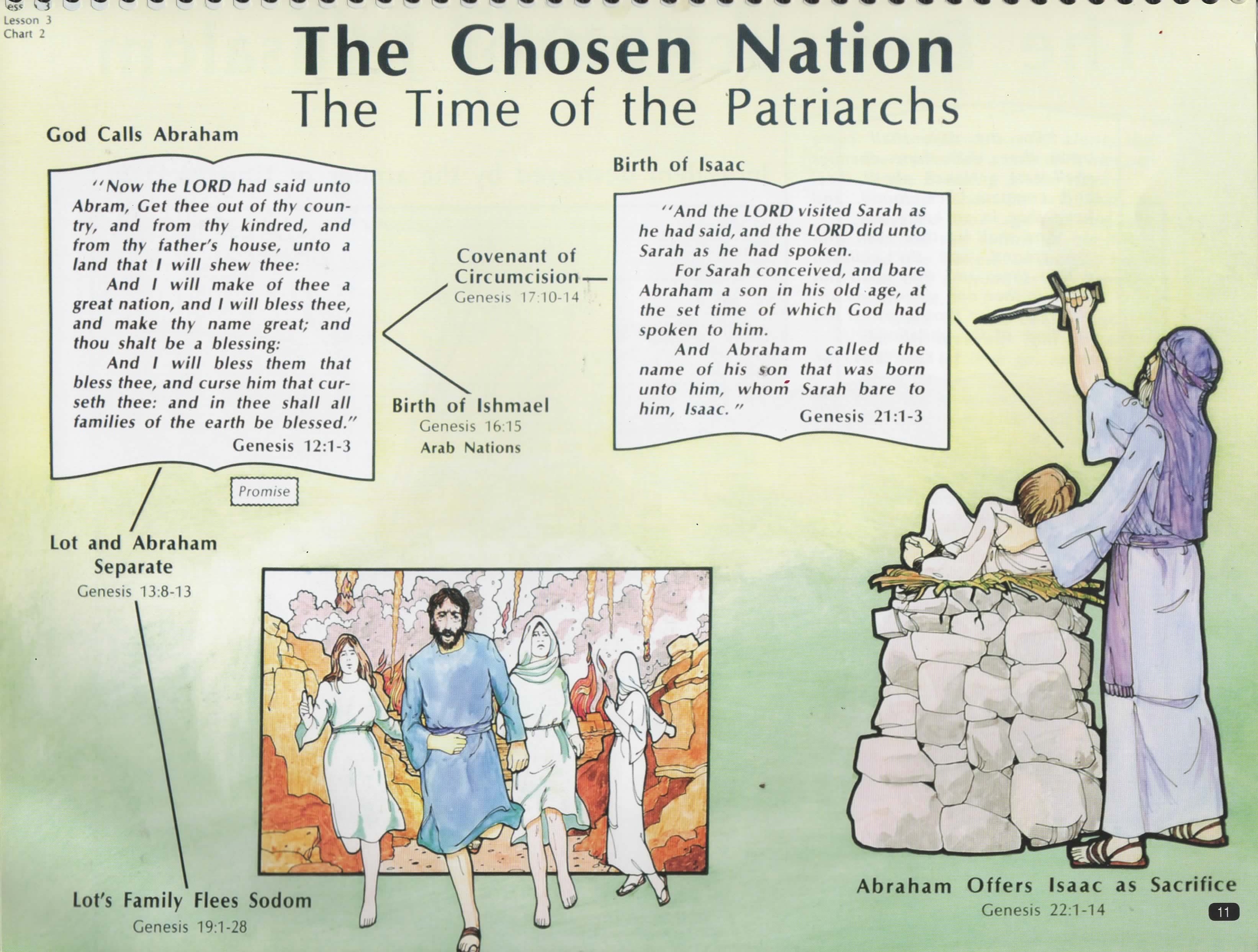
God’s Promise to Abraham: The Birth of Nations

The Time of the Patriarchs

a chart about the Patriarchs
  • Abraham
    • As in the days of Noah, God looked upon the earth and found a man with whom He could make a covenant. This man had come from Ur of the Chaldees with his father, Terah. The man’s name was Abram. The Lord told Abram to leave his country; his kindred, and his father’s house to journey to a land that God would show him. The Lord promised, “I will make of thee a great nation, and I will bless thee, and make thy name great and thou shalt be a blessing; and I will bless them that bless thee, and curse him that curseth thee: and in thee shall all families of the earth be blessed” (Genesis 12:2-3).
    • Abram obeyed the Lord and left his home in Haran when he was seventy-five years old. He took his wife, Sarai, and his nephew, Lot, and they traveled to the land of Canaan. When the Lord called Abram, he had no children. Part of God’s promise was that He would make of Abram a great nation. This promise was subsequently fulfilled, as seen in Deuteronomy 4:6; 1 Kings 3:8-9; and Joshua 21:43-45.
  • The Arab Nations
    • The days passed, however, without any physical sign that God was keeping His promise. Finally, as human beings often do, Abram and Sarai decided to take matters into their own hands. Sarai, who had an Egyptian handmaid named Hagar, said unto Abram, “Behold now, the LORD hath restrained me from bearing I pray thee, go in unto my maid, it may be that I may obtain children by her (Genesis 16:2). Abram acted on his wife’s counsel, which was according to the custom of the time and Ishmael was born of this union.
    • By trying to help God out because they could see no visible sign of His promise coming to pass, Abram and Sarai brought many sorrows to their family, Ishmael and their son, Isaac, would have conflicts. The seeds were sown for conflict between the Arabs and the Jews, nations who sprang from these two men.
  • God’s Covenant with Abraham
    • When Abram was ninety-nine years old, the Lord appeared to him and said, “I am the Almighty God; walk before me, and be thou perfect. And I will make my covenant between me and thee and will multiply thee exceedingly” (Genesis 17:1-2). As Abram fell on his face before God, the Lord continued to talk with him. God renewed His promise to make him the father of many nations and changed his name to Abraham. Abram means “high father: Abraham means “father of a multitude” He also changed Sarai’s name to Sarah. Sarai means “princess”; Sarah means “my princess” Then God gave a token of His covenant. He said. “This is my covenant, which ye shall keep between me and you and thy seed after thee: every man child among you shall be circumcised. And ye shall circumcise the flesh of your foreskin and it shall be a token betwixt me and you” (Genesis 1710-11). Abraham took his son Ishmael with all the male members of his household, and they were all circumcised the same day in obedience to God’s Word.
  • Separation
    • Strife developed between the herdsmen of Abraham’s cattle and those of Lot. The problem was that both Abraham and Lot were very rich, with many flocks herds, and tents, and the land simply was not able to bear them. Abraham said to Lot, “Let there be no strife, I pray thee, between me and thee, and between my herdsmen and thy herdsmen; for we be brethren. Is not the whole land before thee! separate thyself, I pray thee, from me: if thou wilt take the left hand, then i will go to the right; or if thou depart to the right hand, then I will go to the left” (Genesis 13:8-9)
  • Lot’s Choice
    • Abraham was very gracious in allowing his nephew to make the first choice. Lot observed the well-watered plain of Jordan and chose that for himself. He then journeyed east, separating himself from Abraham and pitching his tent in the direction of Sodom. This proved to be a mistake for Lot, for the people of Sodom were wicked and terrible sinners in the Lord’s eyes (Genesis 13:13). It is always dangerous to go in the direction of sin.
  • Judgment against Sin
    • God observed the mounting wickedness in Sodom and Gomorrah, where Abraham’s nephew, Lot, lived with his family. The Lord appeared to Abraham and informed him that the cities would be destroyed. Abraham, knowing that his relatives lived in the doomed city of Sodom, sought the Lord to spare the city. He agreed to do so, if only ten righteous people could be found. But sadly, Sodom and Gomorrah were so wicked that not even ten righteous people could be located (Genesis 18).
  • Angels of Mercy
    • The angels visited Lot and removed him, his wife, and two unmarried daughters from the city. God sent angels of mercy to Sodom that day. The prayers of Abraham did not save the cities, but they did save Lot. Lot was blessed to have an uncle who stayed close to the Lord. But Lot’s grievous error in moving into this wicked city took its toll. He had to leave behind daughters who had married men of Sodom. In disobedience to the angel’s commands his wife looked back as they were fleeing and turned into a pillar of salt. However, Lot and his two unmarried daughters fled for their lives.
    • Because of the great wickedness of these cities, God destroyed them with fire and brimstone. Today, they have been wiped off the face of the earth. Some Bible students believe the destruction of these cities may have been connected with the formation of the Dead Sea.
    • The judgment of God upon Sodom and Gomorrah stands forever as a solemn warning to any who would violate God’s Word. “And turning the cities of Sodom and Gomorrah into ashes condemned them with an overthrow making them an ensample unto those that after should live ungodly” (1 Peter 2:6).
    • As one author noted, “The teachings of Christ are not unlike a river that flows for a long time smoothly and noiselessly between its banks and then suddenly takes the tremendous plunge of the cataract. In the utterance of Jesus about the coming of His kingdom we have the cataract note of His preaching. The same lips which pronounced the Beatitudes and spake the quiet parables of growth and development tell of the coming of His kingdom and the great and terrible day of the Lord.” Judgment is coming! It is time to prepare!
  • Isaac, the Promised Son
    • At last, in God’s time, Sarah conceived and gave birth to a son. Abraham named the child Isaac and circumcised him when he was eight days old. Abraham was one hundred years old when Isaac was born. God had kept His promise, but He was not yet finished trying Abraham’s faith.
  • Abraham’s Faith Tested
    • God said to Abraham, “Take now they son, thine only son Isaac, whom thou lovest, and get thee into the land of Moriah; and offer him there for a burnt offering upon one of the mountains which I will tell thee of (Genesis 22:2). What thoughts must have gone through Abraham’s mind! God had promised him a son. The promise had taken many years to be fulfilled, and now God commanded him to sacrifice that son! Abraham was a man of great faith in God, however. He knew that Isaac was the promised son that God had given him. He believed that through Isaac God would raise up countless offspring as He had promised. He knew that, even if he offered Isaac to God, God was able to raise him up from the dead in order to keep His Word.
    • As Hebrews 11:17-19 says, “By faith Abraham, when he was tried, offered up Isaac: and he that received the promises offered up his only begotten son, of whom it was said, That in Isaac shall thy seed be called: accounting that God was able to raise him up, even from the dead; from whence also he received him in a figure”
  • Abraham’s Obedience
    • “And Abraham rose up early in the morning, and saddled his ass, and took two of his young men with him, and Isaac his son, and clave the wood for the burnt offering, and rose up, and went unto the place of which God had told him” (Genesis 22:3). On the third day of their journey, Abraham saw in the distance the mountain upon which God had commanded that he offer Isaac. He told the servants to stay behind while he and Isaac went to worship.
    • Abraham’s faith is clear in the statement that he made to his servants: “I and the lad will go yonder and worship, and come again to you” (Genesis 22:5). He believed that God had a divine purpose in the task that he hadbeen asked to perform.
  • Abraham’s Continuing Faith
    • As Abraham and Isaac traveled toward their destination, Isaac noticed that they had everything but the sacrifice. He asked, “Behold the fire and the wood: but where is the lamb for a burnt offering!” Abraham responded with statement of eternal significance: “My son, God will provide himself a lamb for a burnt offering” (Genesis 22:7-8).
    • After they had prepared the altar, Abraham bound his son and placed him on the altar. Then Abraham stretched forth his hand with the knife to slay his son. At that moment, the angel of the Lord called, “Abraham, Abraham!” “Here am I,” he answered. “Lay not thine hand upon the lad,” said the angel, “neither do thou anything unto him: for now I know that thou fearest God, seeing thou hast not withheld thy son, thine only son from me” (Genesis 22:12). Abraham’s faith had been tested by what was dear to him, and he came through the trial victoriously. After Abraham heard the voice of the angel, he turned and saw a ram caught by its horns in the thicket nearby. God had provided a sacrifice. Abraham’s statement was prophetic in that many years later Jesus Christ, who was God manifest in the flesh, came as the Lamb of God to take away the sin of the world John 1:29; 1 Timothy 3:16). What a marvelous thing is faith!
    • In the history of our country men traveled by horseback and had to cross rivers swollen by the rains. If they looked at the swirling waters around them, they would become dizzy and possibly fall from the saddle and be swept away. But if they fixed their eye upon the other bank, a tree, a large rock, or a hillside, they would rise safely through.
    • Similarly, in the storms of life, faith is the balance that gives calmness and victory. It is important to fix our eyes, not upon the shifting scene around us, but upon the solid Rock, Jesus Christ.

Understanding Faith: Lessons from Ephesians and Hebrews

Ephesians 2:8-9

For by grace are ye saved through faith; and that not of yourselves: it is the gift of God: Not of works, lest any man should boast. 

  • Hebrews 11:3 Through faith we understand that the worlds were framed by the word of God, so that things which are seen were not made of things which do appear.
    • Our Faith caused us to understand. 
  • Hebrews 11:4 By faith Abel offered unto God a more excellent sacrifice than Cain, by which he obtained witness that he was righteous, God testifying of his gifts: and by it he being dead yet speaketh.
    • Abel’s faith caused him to offer a sacrifice to God. 
  • Hebrews 11:5 By faith Enoch was translated that he should not see death; and was not found, because God had translated him: for before his translation he had this testimony, that he pleased God.
    • Enoch’s faith caused him to walk closely with God. He walked so close that he walked to Heaven with God. (Genesis 5:24)
  • Hebrews 11:6 But without faith it is impossible to please him: for he that cometh to God must believe that he is, and that he is a rewarder of them that diligently seek him.
    • Without faith it is impossible to please God. You must diligently seek God. 
  • Hebrews 11:7 By faith Noah, being warned of God of things not seen as yet, moved with fear, prepared an ark to the saving of his house; by the which he condemned the world, and became heir of the righteousness which is by faith.
    • Noah’s faith caused him to build an ark. 
  • Hebrews 11:8-10 By faith Abraham, when he was called to go out into a place which he should after receive for an inheritance, obeyed; and he went out, not knowing whither he went. By faith he sojourned in the land of promise, as in a strange country, dwelling in tabernacles with Isaac and Jacob, the heirs with him of the same promise: For he looked for a city which hath foundations, whose builder and maker is God.
    • Abraham’s faith caused him to leave the only place he had ever lived and travel to a place that he had never seen before. He did not even know where he was going. 
  • Hebrews 11:11-12 Through faith also Sara herself received strength to conceive seed, and was delivered of a child when she was past age, because she judged him faithful who had promised. Therefore sprang there even of one, and him as good as dead, so many as the stars of the sky in multitude, and as the sand which is by the sea shore innumerable.
    • Sarah’s faith caused her to get pregnant after her body was well past the age of childbearing. She also was able to carry the baby to term and have the baby. 
  • Hebrews 11:13 These all died in faith, not having received the promises, but having seen them afar off, and were persuaded of them, and embraced them, and confessed that they were strangers and pilgrims on the earth.
  • Hebrews 11:17-19 By faith Abraham, when he was tried, offered up Isaac: and he that had received the promises offered up his only begotten son, Of whom it was said, That in Isaac shall thy seed be called: Accounting that God was able to raise him up, even from the dead; from whence also he received him in a figure.
    • Abraham’s faith trusted that God was able to raise Isaac from the dead if there was need. 
  • Hebrews 11:23 By faith Moses, when he was born, was hid three months of his parents, because they saw he was a proper child; and they were not afraid of the king’s commandment.
    • Moses’ parents’ faith caused them to hide Moses for 3 months from the commandment of the king. 
  • Hebrews 11:24-29 By faith Moses, when he was come to years, refused to be called the son of Pharaoh’s daughter; Choosing rather to suffer affliction with the people of God, than to enjoy the pleasures of sin for a season; Esteeming the reproach of Christ greater riches than the treasures in Egypt: for he had respect unto the recompence of the reward. By faith he forsook Egypt, not fearing the wrath of the king: for he endured, as seeing him who is invisible. Through faith he kept the passover, and the sprinkling of blood, lest he that destroyed the firstborn should touch them. By faith they passed through the Red sea as by dry land: which the Egyptians assaying to do were drowned.
    • Moses’ faith caused him to do many things. He rejected being called the son of Pharaoh’s daughter, left Egypt, kept the Passover, and walked through the Red Sea on dry land. 
  • Hebrews 11:31 By faith the harlot Rahab perished not with them that believed not, when she had received the spies with peace.
    • Rahab’s faith caused her to hide the spies. This led to her not being killed with the other people of Jericho. 

Yes salvation is a free gift and not of works. However, it then produces a response. If your faith has not produced a response or caused you to seek a closer relationship with God, you have a problem. Each of these Heros of the Faith were moved to action by their faith. 

Spending time praying and studying His word is how to work on your relationship with God. 

James 2:17-20

17 Even so faith, if it hath not works, is dead, being alone.

18 Yea, a man may say, Thou hast faith, and I have works: shew me thy faith without thy works, and I will shew thee my faith by my works.

19 Thou believest that there is one God; thou doest well: the devils also believe, and tremble.

20 But wilt thou know, O vain man, that faith without works is dead?