A place to grow your relationship with God

Posts tagged ‘Alexander the Great’

How Alexander the Great’s Death Shaped His Empire

Alexander the Great rule over all the land

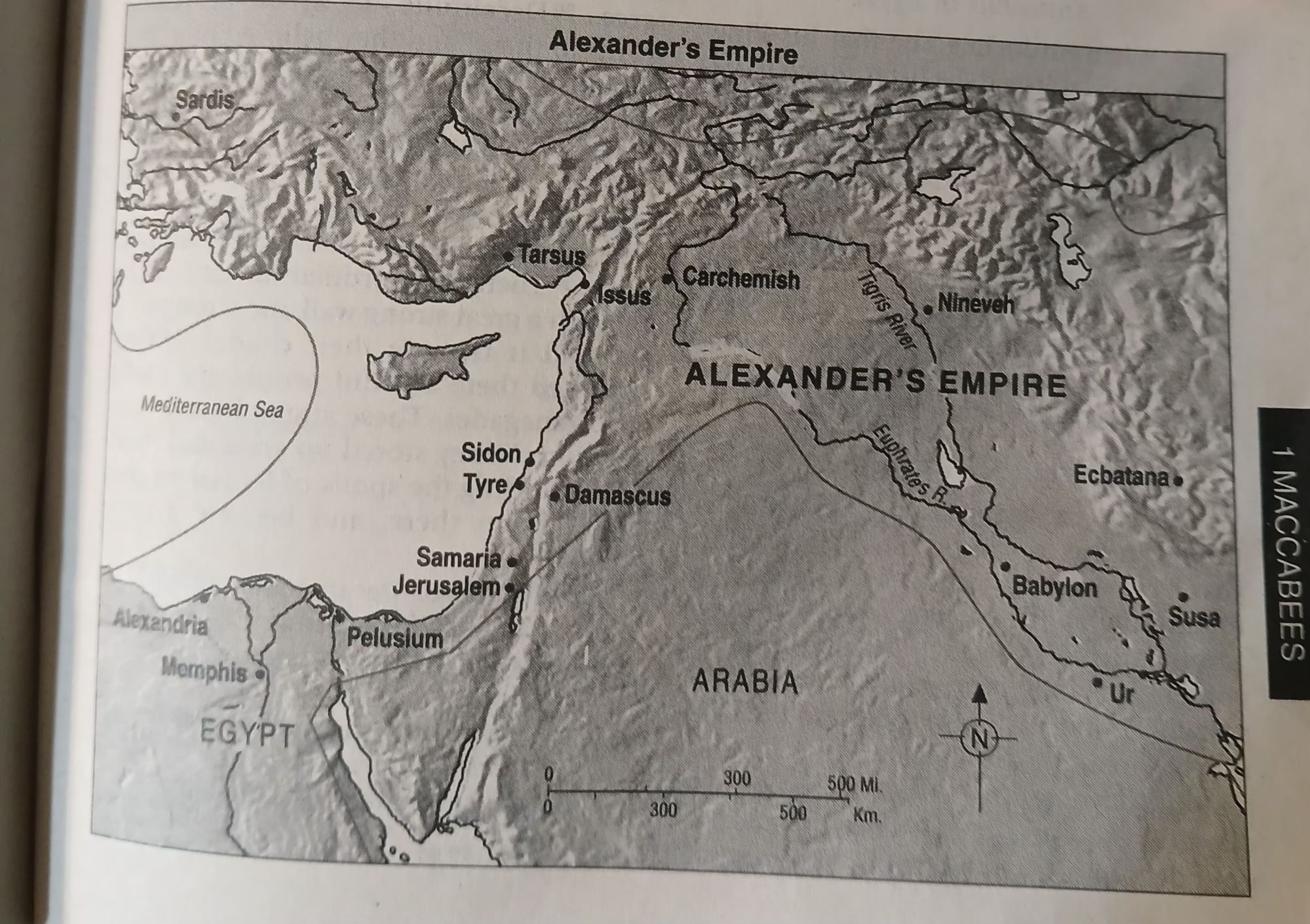
1 Maccabees 1:1-4 After Alexander of Macedon, the son of Philip, had come from the land of Kittim and defeated Darius, the king of the Persians and the Medes, he succeeded him as king, in addition to his position as king of Greece. He engaged in many campaigns, captured strongholds, and executed kings. In his advance to the ends of the earth, he plundered countless nations. When the earth was reduced to silence before him, his heart swelled with pride and arrogance. He recruited a very powerful army, and as provinces, nations, and rulers were conquered by him, they became his tributaries.

After defeating the Persians, Alexander the Great reached the Indian Ocean.
Alexander the Great Dies

1 Maccabees 1:5-9 However, when all this had been accomplished, Alexander became ill, and he realized that his death was imminent. Therefore, he summoned his officers, nobles who had been brought up with him from his youth, and he divided his kingdom among them while he was still alive. Then, in the twelfth year of his reign, Alexander died. After that, his officers assumed power in the kingdom, each in his own territory.  They all put on royal crowns after his death, as did their heirs who succeeded them for many years, inflicting great evils on the world.

  • Twelfth year: 334 B.C.
GeneralThe Region TakenModern Geographical Area
PtolemyEgypt and northern AfricaEgypt, Libya, and Northern Africa
SeleucusAssyria, Mesopotamia and PersiaLebanon, Syria and Iraq, Iran
LysimachusThrace and Asia MinorTurkey and southern Russia
CassanderGreece and MacedoniaGreece, Bulgaria, and Romania

Alexander the Great

When the Achaeans had left their homes along the banks of the Danube to look for new pastures, they had spent some time among the mountains of Macedonia. Ever since, the Greeks had maintained certain more or less formal relations with the people of this northern country. The Macedonians from their side had kept themselves well-informed about conditions in Greece.

Now it happened, just when Sparta and Athens had finished their disastrous war for the leadership of Hellas, that Macedonia was ruled by an extraordinarily clever man by the name of Philip. He admired the Greek spirit in letters and art but he despised the Greek lack of self-control in political affairs. It irritated him to see a perfectly good people waste its men and money upon fruitless quarrels. So he settled the difficulty by making himself the master of all Greece and then he asked his new subjects to join him on a voyage which he meant to pay to Persia in return for the visit which Xerxes had paid the Greeks one hundred and fifty years before.

Unfortunately, Philip was murdered before he could start upon this well-prepared expedition. The task of avenging the destruction of Athens was left to Philip’s son Alexander, the beloved pupil of Aristotle, wisest of all Greek teachers.

Alexander bade farewell to Europe in the spring of the year 334 B.C. Seven years later he reached India. In the meantime, he had destroyed Phoenicia, the old rival of the Greek merchants. He had conquered Egypt and had been worshipped by the people of the Nile valley as the son and heir of the Pharaohs. He had defeated the last Persian king—he had overthrown the Persian empire he had given orders to rebuild Babylon—he had led his troops into the heart of the Himalayan mountains and had made the entire world a Macedonian province and dependency. Then he stopped and announced even more ambitious plans.

The newly formed Empire must be brought under the influence of the Greek mind. The people must be taught the Greek language—they must live in cities built after a Greek model. The Alexandrian soldier now turned schoolmaster. The military camps of yesterday became the peaceful centers of the newly imported Greek civilization. Higher and higher did the flood of Greek manners and Greek customs rise, when suddenly Alexander was stricken with a fever and died in the old palace of King Hammurabi of Babylon in the year 323.

Then the waters receded. But they left behind the fertile clay of a higher civilization and Alexander, with all his childish ambitions and his silly vanities, had performed a most valuable service. His Empire did not long survive him. A number of ambitious generals divided the territory among themselves. But they too remained faithful to the dream of a great world brotherhood of Greek and Asiatic ideas and knowledge.

They maintained their independence until the Romans added western Asia and Egypt to their other domains. The strange inheritance of this Hellenistic civilization (part Greek, part Persian, part Egyptian and Babylonian) fell to the Roman conquerors. During the following centuries, it got such a firm hold upon the Roman world, that we feel its influence in our own lives this very day.