A place to grow your relationship with God

Posts tagged ‘American history’

Franklin, the Printer

When Ben Franklin left his brother, he tried in vain to get a place in one of the other printing offices in Boston. But James Franklin had sent word to the other printers not to take Benjamin into their employ. There was no other town nearer than New York large enough to support a printing office. Franklin, who was now but seventeen years old, sold some of his books, and secretly got aboard a sloop ready to sail to New York. In New York he could find no work but was recommended to try in Philadelphia.

The modes of travel in that time were very rough. The easiest way of getting from Boston to New York was by sailing vessels. To get to Philadelphia, Franklin had first to take a sailboat to Amboy, in New Jersey. On the way, a squall of wind tore the sails and drove the boat to anchor near the Long Island shore, where our runaway boy lay all night in the little hold of the boat, with the waves beating over the deck and the water leaking down on him. When at last he landed at Amboy, he had been thirty hours without anything to eat or any water to drink.

Having but little money in his pocket, he had to walk from Amboy to Burlington; and when, soaked by rain, he stopped at an inn, he cut such a figure that the people came near arresting him for a runaway bond servant, of whom there were many in that time. He thought he might better have stayed at home.

This tired and mud-spattered young fellow got a chance to go from Burlington to Philadelphia in a rowboat by taking his turn at the oars. There were no street lamps in the town of Philadelphia, and the men in the boat passed the town without knowing it. Like forlorn tramps, they landed and made a fire of some fence rails.

When they got back to Philadelphia in the morning, Franklin — who was to become in time the most famous man in that town — walked up the street in his working clothes, which were badly soiled by his rough journey. His spare stockings and shirt were stuffed into his pockets. He bought three large rolls at a baker’s shop. One of these he carried under each arm; the other he munched as he walked.

As he passed along the street, a girl named Deborah Read stood in the door of her lather’s house and laughed at the funny sight of a young fellow with bulging pockets and a roll under each arm. Years afterward this same Deborah was married to Franklin.

Franklin got a place to work with a printer named Keimer. He was now only a poor printer-boy, in leather breeches such as workingmen wore at that time. But, though he looked poor, he was already different from most of the boys in Philadelphia. He was a lover of good books. The child who has learned to read the best books will be an educated citizen, with or without schools. The great difference between people is shown in the way they spend their leisure time. Franklin, when not studying, spent his evenings with a few young people who were also fond of books. Here is the sort of young person that will come to something.
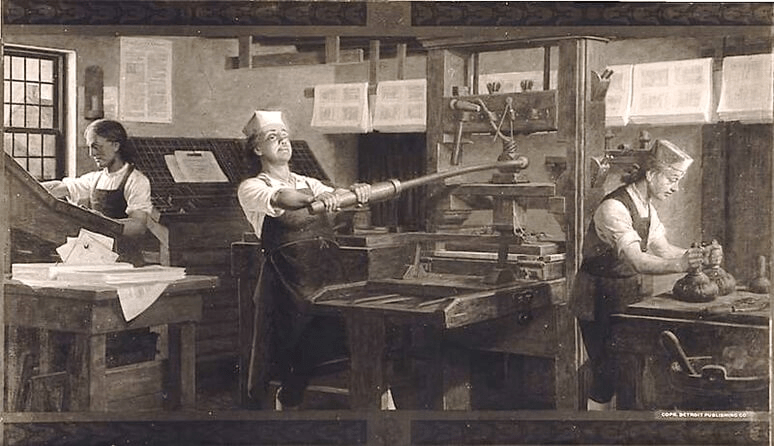
I suppose people began to notice and talk about this studious young workman. One day Keimer, the printer for whom Franklin was at work, saw coming toward his office, Sir William Keith, the governor of the province of Pennsylvania, and another gentleman, both finely dressed after the fashion of the time, in powdered periwigs and silver knee buckles. Keimer was delighted to have such visitors, and he ran down to meet the men. But imagine his disappointment when the governor asked to see Franklin and led away the young printer in leather breeches to talk with him in the tavern.

The governor wanted Franklin to set up a printing office of his own, because both Keimer and the other masterprinter in Philadelphia were poor workmen. But Franklin had no money, and it took a great deal to buy a printing press and types in that day. Franklin told the governor that he did not believe his father would help him to buy an outfit. But the governor wrote a letter himself to Franklin’s father, asking him to start Benjamin in business.

So Franklin went back to Boston in a better plight than that in which he had left. He had on a brand new suit of clothes, he carried a watch, and he had some silver in his pockets. His father and mother were glad to see him once more, but his father told him he was too young to start in business for himself.

Franklin returned to Philadelphia. Governor Keith, who was one of those gentlemen that make many promising speeches, now offered to start Franklin himself. He wanted him to go to London to buy the printing press. He promised to give the young man letters to people in London, and one that would get him the money to buy the press.

But, somehow, every time that Franklin called on the governor for the letters he was told to call again. At last, Franklin went on shipboard, thinking the governor had sent the letters in the ship’s letterbag. Before the ship got to England the bag was opened, and no letters for Franklin were found. A gentleman now told Franklin that Keith made a great many such promises, but he never kept them. Fine clothes do not make a fine gentleman.

So Franklin was left in London without money or friends. But he got work as a printer, and learned some things about the business that he could not learn in America. The English printers drank a great deal of beer. They laughed at Franklin because he did not use beer, and they called him the “Water American.” But Franklin wasn’t a fellow to be afraid of ridicule. The English printers told Franklin that water would make him weak, but they were surprised to find him able to lift more than any of them. Franklin was also a strong swimmer. In London, Franklin kept up his reading. He paid a man who kept a secondhand bookstore for permission to read his books.

Franklin came back to Philadelphia as clerk for a merchant, but the merchant soon died, and Franklin went to work again for his old master, Keimer. He was very useful, for he could make ink and cast type when they were needed, and he also engraved some designs on type metal. Keimer once fell out with Franklin and discharged him, but he begged him to come back when there was some paper money to be printed, which Keimer could not print without Franklin’s help in making the engravings.

Bacon and his Men

In 1676, just a hundred years before the American Revolution, the people of Virginia were very much oppressed by Sir William Berkeley, the governor appointed by the king of England. Their property was taken away by unjust taxes and in other ways. The governor had managed to get all the power into his own hands and those of his friends.

This was the time of King Philip’s War in New England. The news of this war made the American Indians of Virginia uneasy, and at length the Susquehannas and other tribes attacked the frontiers. Governor Berkeley would not do anything to protect the people on the frontier, because he was making a great deal of money out of the trade with friendly Indians. If troops were sent against them, this profitable trade would be stopped.

When many hundreds of people on the frontier had been put to death, some three hundred men formed themselves into a company to fight the Indians. But Berkeley refused to allow anyone to take command of this troop or to let them go against the Indians.

There was a young gentleman named Nathaniel Bacon, who had come from England three years before. He was a member of the governor’s council and an educated man. He begged the governor to let him lead this company of three hundred men against the Indians, but the old governor refused.

Bacon disagreed and wished to fight the Indians. He went to the camp of these men, to see and encourage them. But when they saw him, they set up a cry, “A Bacon! A Bacon! A Bacon!” This was the way of cheering a man at that day and choosing him for a leader.

Bacon knew that the governor might put him to death if he disobeyed orders, but he wished to defend his fellow colonists.

Berkeley gathered his friends and started after Bacon, declaring that he would hang Bacon for going to war without orders. While the old governor was looking for Bacon, the people down by the coast rose in favor of Bacon. The governor had to make peace with them by promising to let them choose a new legislature.

When Bacon got back from the Indian country, the frontier people cheered him as their deliverer. They kept guard night and day over his house. They were afraid the angry governor would send men to kill him.

The people of his county elected Bacon a member of the new Legislature. But they were afraid the governor might harm him. Forty of them with guns went down to Jamestown with him in a sloop. With the help of two boats and a ship, the governor captured Bacon’s sloop, and brought Bacon into Jamestown. But as the angry people were already rising to defend their leader, Berkeley was afraid to hurt him. He made him apologize, and restored him to his place in the Council.

But that night, Bacon was warned that the next day he would be seized again, and that the roads and river were guarded to keep him from getting away. So Bacon took horse suddenly and galloped out of Jamestown in the darkness. The next morning, the governor sent men to search the house where Bacon had stayed. Berkeley’s men stuck their swords through the beds, thinking Bacon hidden there.

But Bacon was already among friends. When the country people heard that Bacon was in danger, they seized their guns and vowed to kill the governor and all his party. Bacon was quickly marching on Jamestown with five hundred angry men at his back. The people refused to help the governor, and Bacon and his men entered Jamestown. It was their turn to guard the roads and keep Berkeley in.

The old governor offered to fight the young captain single-handed, but Bacon told him he would not harm him. Bacon forced the governor to sign a commission appointing Bacon a general. Bacon also made the Legislature pass good laws for the relief of the people. These laws were remembered long after Nathaniel Bacon’s death, and were known as “Bacon’s Laws.”

While this work of doing away with bad laws and making good ones was going on, the Indians attacked at a place only about twenty miles from Jamestown. General Bacon promptly started for the Indian country with his little army. But, just as he was leaving the settlements, he heard that the governor was raising troops to take him when he should get back; so he turned around and marched swiftly back to Jamestown.

The governor had called out the militia, but when they learned that instead of taking them to fight the Indians they were to go against Bacon, they all began to murmur, “Bacon! Bacon! Bacon!” Then they left the field and went home, and the old governor fainted with disappointment. He was forced to flee for safety to the eastern shore of Chesapeake Bay, and the government fell into the hands of General Bacon.

Bacon had an enemy on each side of him. No sooner had Berkeley gone than the Indians again attacked. Bacon once more marched against them and killed many. He and his men lived on horseflesh and chinquapin nuts during this expedition.

When Bacon got back to the settlements and had dismissed all but one hundred and thirty-six of his men, he heard that Governor Berkeley had gathered together seventeen vessels and six hundred sailors and others, and with these had taken possession of Jamestown. Worn out as they were with fatigue and hunger, Bacon persuaded his band to march straight for Jamestown, so as to take Berkeley by surprise.

As the weary and dusty veterans of the Indian war hurried onward to Jamestown, the people cheered the company. The women called after Bacon, “General, if you need help, send for us!” So fast did these men march that they reached the narrow neck of sand that connected Jamestown with the mainland before the governor had heard of their coming. Bacon’s men dug trenches in the night and shut in the governor and his people.

After a while, Bacon got some cannon. He wanted to put them up on his breastworks without losing the life of any of his brave soldiers. So he sent to the plantations nearby and brought to his camp the wives of the chief men in the governor’s party. These ladies he had sit in front of his works until his cannon were in place. He knew that the enemy would not fire on the ladies. When he had finished, he sent the ladies home.

Great numbers of the people now flocked to General Bacon’s standard, and the governor and his followers left Jamestown in their vessels. Knowing that they would try to return, Bacon ordered the town to be burned to the ground. Almost all of the people except those on the eastern shore sided with Bacon, who now did his best to put the government in order. But the hardships he had been through were too much for him. He sickened and died. His friends knew that Berkeley would soon get control again, now that their leader was dead. They knew that his enemies would dig up Bacon’s body and hang it, after the fashion of that time. No one knows where they buried Bacon’s body, but as they put stones in his coffin, they must have sunk it in the river.

Governor Berkeley got back his power and hanged many of Bacon’s friends. But the king of England removed Berkeley in disgrace, and he died of a broken heart. The governors who came after were generally careful not to oppress the people too far. They were afraid another Bacon might rise up against them.

A First Book in American History

A first book in American history: with special reference to the lives and deeds of great Americans. This book chronicles pivotal figures in American history, from Columbus and John Smith to Franklin and Lincoln, highlighting their contributions and the nation’s expansion.

  • The Great Doctor Franklin
  • Young- George Washington
  • Washington in the French War
  • Washington in the Revolution
  • The Victory at Yorktown and Washing
  • Thomas Jefferson
  • Daniel Boone
  • Robert Fulton and the Steamboat
  • William Henry Harrison
  • Andrew Jackson
  • Morse and the Telegraph
  • How the Telegraph became successful
  • Early Life of Abraham Lincoln
  • Lincoln in Public Life
  • Something about the Great Civil War
  • How the United States became larger

Myles Standish and the Indians

The American Indians, recognizing the superior firepower of the Pilgrims, did not attack Plymouth. But they thought that they might get rid of the Pilgrims by witchcraft. So they held a powwow in a big swamp to persuade the spirits to kill or drive away the newcomers. Sometimes the Pilgrims would see some Indians on a hilltop near Plymouth. Perhaps they came to see whether the Plymouth people had all been killed by the spirits.

But in the spring, a chief from a place farther east came to visit the Indians near Plymouth. He had met English fishermen and learned a little English. He was not afraid to visit the Pilgrims. Walking boldly into the little town, he said, “Welcome, Englishmen.” The Pilgrims were surprised to hear two English words from the mouth of an Indian.

They treated this Indian well, and he came again bringing an Indian named Squanto [squon’-to] who could speak more English. Squanto, who had lived at Plymouth, was one of the Indians carried away to Spain and sold into slavery by English explorer Captain Thomas Hunt. From Spain, he had been taken to England and then brought back to America. When he got home to Plymouth, he found that all the people of his village had died from pestilence.

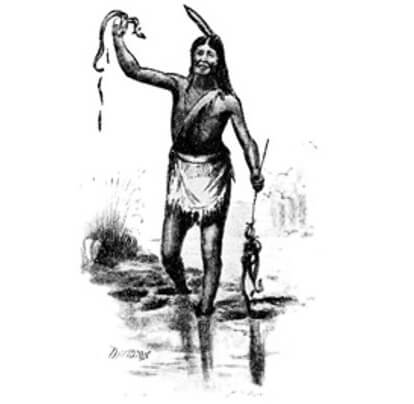
Squanto now came again to the old home of his people at Plymouth and lived with the Pilgrims. He showed the English a way to catch eels by treading them out of the mud with his feet. He knew the woods and waters well, and he showed them how to hunt and fish. He taught them how to plant Indian corn as the Indians did, putting a fish or two in every hill for manure, and then watching the fields for a while to keep the wolves from digging up the buried fish. Without the seed corn and the help of Squanto the whole colony would have starved.

Squanto told the other Indians about the dreadful gunpowder kept in the cellar at Plymouth. He also told them that the horrid pestilence was kept in the same cellar with the powder.

Massasoit [mas-sa-so’-it], the chief of Squanto’s tribe, came to see the Pilgrims, bringing some other Indians with him. They were taken into the largest house in Plymouth and seated on a green mat and some cushions. The Governor of the colony was then brought in while the trumpets were blowing and the drums beating. This parade pleased the Indians. Afterward, the Pilgrims sent Massasoit a red cotton coat and a copper chain, and by degrees a firm friendship was made between him and the Pilgrims.

The Narragansett Indians were enemies of Massasoit. None of their people had died from pestilence, and they were therefore stronger than Massasoit’s tribe. The Narragansetts sent a bundle of arrows to Plymouth tied up in a snake’s skin. Squanto told the English that this meant to say that they would come and make war on Plymouth. The Pilgrims filled the snake’s skin with bullets and sent it back. This was to say, “Shoot your arrows at us and we will kill you with our bullets.” The Narragansetts smartly realized that arrows could not easily defeat bullets. They sent the bullets back to Plymouth, and there was no war.

When the Pilgrims had been settled at Plymouth more than a year, a ship brought them news of the dreadful massacre that had taken place in Virginia. The Pilgrims were afraid something of the kind might happen to them. So Captain Standish trained the Plymouth men, and they kept guard every night. They put cannon on the roof of their meeting house and carried their guns to church.

A company of people from England made a settlement at Weymouth [way’-muth], not very far from Plymouth. They were rude and familiar, and the Indians soon despised them. Some Indian warriors made a plan to kill them all. They intended to kill the Plymouth people at the same time. But Massasoit told the Pilgrims about it and said they must go and kill the leaders before they had a chance to kill the Pilgrims.

Captain Standish was a little man, and one of his enemies once nicknamed him “Captain Shrimp.” However, Captain Standish was also brave. Captain Standish set out for the colony at Weymouth. He took but few men, so that the Indians might not guess what he came for. But they saw that the little captain was very “angry in his heart,” as they said. Seeing how few his men were they tried to frighten him.

One of these Indians named Wittamut sharpened the knife which he wore hanging about his neck. While sharpening it he said to Captain Standish: “This is a good knife. On the handle is the picture of a woman’s face. But I have another knife at home with which I have killed both Frenchmen and Englishmen. That knife has a man’s face on it. After a while these two will get married.”

A large Indian named Pecksuot said: “You are a captain, but you are a little man. I am not a chief, but I am strong and brave.”

It was now a question whether Standish would attack the Indians or wait for them to begin. One day when Wittamut, Pecksuot, and two other Indians were in the room with Standish and some of his men, the captain made a signal, and himself snatched the knife that hung on Pecksuot’s neck and stabbed him to death after a terrible struggle. His men killed the other Indians in the same way. After that the English were called “stabbers” in the Indian language.

The Pilgrims were often very near to starvation during the first years after they settled at Plymouth. At one time, they lived on clams and lobsters and such fish as they could catch. Standish made many voyages along the coast, trading with the Indians for furs, which were sent to England and exchanged for whatever the settlers might need.

A few years after the Pilgrims settled Plymouth, additional colonists began to settle near them. In 1630, there came over a large number of people, who founded Boston and other Massachusetts towns. Captain Standish lived to be more than seventy years old and to see many thousands of people in New England. He owned a place at Duxbury, just across the bay from Plymouth. He died there in 1656. The hill which he owned is still called “Captain’s Hill.”

The Louisiana Purchase

Louisiana Purchase

The Louisiana Purchase was a land deal made by U.S. President Thomas Jefferson in 1803. He purchased the Louisiana Territory from France, led by Napoleon Bonaparte, for 15 million USD. Initially, the delegates sent to France were authorized to spend up to 10 million USD to acquire New Orleans and possibly the west bank of the Mississippi River. However, the French government offered to sell the entire Louisiana Territory for just 5 million more. Jefferson approved the deal and used his constitutional authority to sign treaties to finalize the purchase.

Napoleon Bonaparte sold the land to fund the Great French War. With the British back in the conflict and France losing the Haitian Revolution, defending Louisiana became impossible. Thomas Jefferson seized the French offer as a chance to expand America, even though it went against his Republican principles of small government—some argue he overstepped his constitutional authority by making the deal on his own.

Louisiana Purchase

A map of the Louisiana Purchase compared to state boundaries in 2025. The Louisiana Purchase is shown in green overtop of what states would be formed from it.

The Lewis and Clark expedition explored the Louisiana Purchase and the Oregon Territory. They started from St. Louis. Their route traced the Missouri River.

Adapted from:  Louisiana Purchase Facts for KidsKiddle Encyclopedia.