The Bird-woman of the Lewis and Clark Expedition: A Supplementary Reader for First and Second Grades
by Katherine Chandler
“The Bird-Woman of the Lewis and Clark Expedition” by Katherine Chandler is a historical account written in the early 20th century. This book serves as a supplementary reader designed for first and second-grade students, recounting the journey of the Lewis and Clark Expedition with a focus on Sacajawea, an indigenous woman who played a crucial role in guiding the explorers through uncharted territory. The narrative is based on true events documented in the Lewis and Clark Journals, making it both educational and engaging for young readers. The story follows Sacajawea from her early life with the Snake Indians to her joining the expedition alongside Meriwether Lewis and William Clark. After being taken from her tribe, she marries a French trapper and eventually becomes an essential member of the expedition as they journey across the American wilderness. Sacajawea’s knowledge of the land and her ability to communicate with different tribes help the party navigate challenges and establish favorable relations with various Indigenous peoples they encounter. Her contributions range from logistical support to practical survival skills, such as finding food sources and medicine for her fellow travelers. Through her story, readers gain insight into the trials faced by the expedition and the significant impact of Sacajawea, often referred to as the “Bird-Woman,” on their successful journey.
Captain Clark had his black man, York, with him. The Indians were always surprised to see the black man. They thought he was stranger than the white men. One Mandan chief said, “This is a white man painted black.” He wet his finger and tried to wash the black off York’s skin. The black would not come off. Then York took off his hat. The chief had not seen such hair before. Then the chief said, “You are not like a white man. You are a black man.” The Indians told each other of this black man. They came from far to see him. York helped make them friends with the whites. The captains named a river for York. The river had only a little water in it. They named it York’s Dry River.
Vocabulary Words
basket
laugh
weeks
born
sugar
SACAJAWEA’S BABY.
At Fort Mandan, Sacajawea’s baby boy was born. He was only eight weeks old when the white men began to go to the far West. Sacajawea made a basket of skins for her baby. She put it on her back. The baby could sleep in the basket as Sacajawea walked. The soldiers liked the baby. They gave it sugar. They made it playthings of wood. They danced to make it laugh. Indian babies do not laugh much and they do not cry much. Once in the West the baby was ill. Then the soldiers camped for some days. They were very still. Captain Lewis gave the baby medicine. This made the baby well again. Then the men laughed. They said, “Let us sing and dance for the baby.” The baby laughed as it looked at the men.
Vocabulary words
April
party
shot
broke
shoot
warm
The warm April sun broke up the ice in the Missouri River. Then the party got into their boats and rowed on up the river. From this time on, Sacajawea and her baby were a help to the soldiers. When the Indians saw a woman and a baby with the men, they knew it was not a war party. Indians would not take a woman and baby to war. Only men go to war. The Indians did not shoot at the men. They came up to see what they wanted. If Sacajawea had not been there, they would have shot the white men. The Indians thought that all strangers wanted war. They thought this until the strangers showed that they were friends.
Sacajawea belonged in the West. Her tribe was called the Snake Indians. They lived in the Rocky Mountains. Sacajawea lived in the Mountains until she was twelve years old. Then her tribe went to war with the Mandans from the East. One day Sacajawea and some other girls were getting roots. They were down by a stream. Some Mandans came upon them. The girls ran fast to get away.
Sacajawea ran into the stream. An Indian caught her. He took her up on his horse. He carried her away to the East, to the country of the Mandans. There she married the Frenchman. There the Americans found her. She was glad when her husband said he would go West with Lewis and Clark. She thought she would see her own tribe again.
Vocabulary words
animals
country
friends
medicine
ready
chiefs
frozen
plants
wrote
fort
sweat house
AT FORT MANDAN
The soldiers called their winter camp Fort Mandan. They had a hard winter there. It was so cold that many men were ill. They had no time to be ill. They had to work to be ready to go West when Spring opened. The captains wrote in their books about the Indians and animals and plants they had seen. They made maps of the country they had come through. They had long talks with the Indian chiefs. They made friends with the Indians by giving them medicine. An Indian boy had his feet frozen near the soldiers’ camp. The captains kept him until his feet were well again. His people all came and thanked the captains.
The Indians told each other about the white men’s medicine. They said, “The white men’s medicine is better than our sweat-house.” So they came for miles to the white camp to get the medicine. They gave the captains food. They wanted to be friends with them.
Vocabulary Words
arrows
dinner
hunted
money
beads
fiddle
knives
pieces
blankets
gallons
medals
stove
The soldiers hunted animals for food and for their skins. One soldier cut an old stove into pieces. The Indians wanted these pieces to make arrows and knives. They would give eight gallons of corn for one piece. The Indians did not know what money was. The captains did not carry money with them. They took flags and medals, knives and blankets, looking-glasses and beads, and many other things. With these they could get food from the Indians. On Christmas Day, 1804, the soldiers put the American flag up over the fort. They told the Indians not to come to see them on that day. They said it was the best day of their year. It was a cold day, with much ice and snow. They had a good dinner and after dinner the soldiers danced. On New Year’s Day, 1805, they fired off all their guns. The captains let the soldiers go to the Mandan camp. They took their fiddle and danced for the Indians. One soldier danced on his hands with his head down. The Indians liked this dancing very much. They gave the soldiers some corn and some skins.
Do you not think Columbus must have felt very fine as he sailed out of Cadiz Harbor on his second voyage to the West? It was just about a year before, you know, that his feeble fleet of three little ships sailed from Palos port. His hundred sailors hated to go; his friends were few; everybody else said he was crazy; his success was very doubtful. Now, as he stood on the high quarter-deck of his big flag-ship, the Maria Galante, he was a great man. By appointment of his king and queen he was “Admiral of the Ocean Seas” and “Viceroy of the Indies.” He had servants, to do as he directed; he had supreme command over the seventeen ships of his fleet, large and small; fifteen hundred men joyfully crowded his decks, while thousands left at home wished that they might go with him, too. He had soldiers and sailors, horsemen and footmen; his ships were filled with all the things necessary for trading with the Indians and the great merchants of Cathay, and for building the homes of those who wished to live in the lands beyond the sea.
Everything looked so well and everybody was so full of hope and expectation that the Admiral felt that now his fondest dreams were coming to pass and that he was a great man indeed.
This was to be a hunt for gold. And so sure of success was Columbus that he promised the king and queen of Spain, out of the money he should make on this voyage, to, himself pay for the fitting out of a great army of fifty thousand foot soldiers and four thousand horsemen to drive away the pagan Turks who had captured and held possession of the city of Jerusalem and the sepulcher of Christ. For this had been the chief desire, for years and years, of the Christian people of Europe. To accomplish it many brave knights and warriors had fought and failed. But now Columbus was certain he could do it.
So, out into the western ocean sailed the great expedition of the Admiral. He sailed first to the Canary Isles, where he took aboard wood and water and many cattle, sheep and swine. Then, on the seventeenth of October, he steered straight out into the broad Atlantic, and on Sunday, the third of November, he saw the hill-tops of one of the West India Islands that he named Dominica. You can find it on your map of the West Indies.
For days he sailed on, passing island after island, landing on some and giving them names. Some of them were inhabited, some of them were not; some were very large, some were very small. But none of them helped him in any way to find Cathay, so at last he steered toward Hayti (or Hispaniola, as he called it) and the little ship-built fortress of La Navidad, where his forty comrades had been left.
On the twenty-seventh of November, the fleet of the Admiral cast anchor off the solitary fort. It was night. No light was to be seen on the shore; through the darkness nothing could be made out that looked like the walls of the fort. Columbus fired a cannon; then he fired another. The echoes were the only answer. They must be sound sleepers in our fortress there, said the Admiral. At last, over the water he heard the sound of oars—or was it the dip of a paddle? A voice called for the Admiral; but it was not a Spanish voice. The interpreter—who was the only one left of those ten stolen Indians carried by Columbus to Spain—came to the Admiral’s side; by the light of the ship’s lantern they could make out the figure of an Indian in his canoe. He brought presents from his chief. But where are my men at the fort? asked the Admiral. And then the whole sad story was told.
The fort of La Navidad was destroyed; the Spaniards were all dead; the first attempt of Spain to start a colony in the new world was a terrible failure. And for it the Spaniards themselves were to blame.
After Columbus had left them, the forty men in the fort did not do as he told them or as they had solemnly promised. They were lazy; they were rough; they treated the Indians badly; they quarreled among themselves; some of them ran off to live in the woods. Then sickness came; there were two “sides,” each one jealous of the other; the Indians became enemies. A fiery war-chief from the hills, whose name was Caonabo, led the Indians against the white men. The fort and village were surprised, surrounded and destroyed. And the little band of “conquerors”—as the Spaniards loved to call themselves—was itself conquered and killed.
It was a terrible disappointment to Columbus. The men in whom he had trusted had proved false. The gold he had told them to get together they had not even found. His plans had all gone wrong.
But Columbus was not the man to stay defeated. His fort was destroyed, his men were killed, his settlement was a failure. It can’t be helped now, he said. I will try again.
This time he would not only build a fort, he would build a city. He had men and material enough to do this and to do it well. So he set to work.
But the place where he had built from the wreck of the unlucky Santa Maria his unlucky fort of La Navidad did not suit him. It was low, damp and unhealthy. He must find a better place. After looking about for some time he finally selected a place on the northern side of the island. You can find it if you look at the map of Hayti in the West Indies; it is near to Cape Isabella.
He found here a good harbor for ships, a good place on the rocks for a fort, and good land for gardens. Here Columbus laid out his new town, and called it after his friend the queen of Spain, the city of Isabella.
He marked out a central spot for his park or square; around this ran a street, and along this street he built large stone buildings for a storehouse, a church and a house for himself, as governor of the colony. On the side streets were built the houses for the people who were to live in the new town, while on a rocky point with its queer little round tower looking out to sea stood the stone fort to protect the little city. It was the first settlement made by white men in all the great new world of America.
You must know that there are some very wise and very bright people who do not agree to this. They say that nearly five hundred years before Columbus landed, a Norwegian prince or viking, whose name was Leif Ericsson, had built on the banks of the beautiful Charles River, some twelve miles from Boston, a city which he called Norumbega.
But this has not really been proved. It is almost all the fancy of a wise man who has studied it out for himself, and says he believes there was such a city. But he does not really know it as we know of the city of Isabella, and so we must still say that Christopher Columbus really discovered America and built the first fort and the first city on its shores—although he thought he was doing all this in Asia, on the shores of China or Japan.
When Columbus had his people nearly settled in their new city of Isabella, he remembered that the main thing he was sent to do was to get together as much gold as possible. His men were already grumbling. They had come over the sea, they said, not to dig cellars and build huts, but to find gold—gold that should make them rich and great and happy.
So Columbus set to work gold-hunting. At first things seemed to promise success. The Indians told big stories of gold to be found in the mountains of Hayti; the men sent to the mountains discovered signs of gold, and at once Columbus sent home joyful tidings to the king and queen of Spain.
Then he and his men hunted everywhere for the glittering yellow metal. They fished for it in the streams; they dug for it in the earth; they drove the Indians to hunt for it also until the poor redmen learned to hate the very sound of the word gold, and believed that this was all the white men lived for, cared for or worked for; holding up a piece of this hated gold the Indians would say, one to another: “Behold the Christian’s god!” And so it came about that the poor worried natives, who were not used to such hard work, took the easiest way out of it all, and told the Spaniards the biggest kind of lies as to where gold might be found—always away off somewhere else—if only the white men would go there to look for it.
On the thirteenth of January, 1494, Columbus sent back to Spain twelve of his seventeen ships. He did not send back in them to the king, and queen, the gold he had promised. He sent back the letters that promised gold; he sent back as prisoners for punishment some of the most discontented and quarrelsome of his colonists; and, worst of all, he sent to the king and queen a note asking, them to permit him to send to Spain all the Indians he could catch, to be sold as slaves. He said that by doing this they could make “good Christians” of the Indians, while the money that came from selling the natives would buy cattle for the colony and leave some money for the royal money-chests.
It is not pleasant to think this of so great a man as Columbus. But it is true, and he is really the man who, started the slave-trade in America. Of course things were very different in his time from what they are to-day, and people did not think so badly of this horrible business. But some good men did, and spoke out boldly against it. What they said was not of much use, however, and slavery was started in the new world. And from that act of Columbus came much sorrow and trouble for the land he found. Even the great war between the northern and southern sections of our own United States, upon one side or the other of which your fathers, or your grandfathers perhaps, fought with gun and sword, was brought about by this act of the great Admiral Columbus hundreds of years before.
So the twelve ships sailed back to Spain, and Columbus, with his five remaining ships, his soldiers and his colonists, remained in the new city of Isabella to keep up the hunt for gold or to become farmers in the new world.
Great men of one kind are known only in new countries like ours. These men discover new regions. They know how to manage the Indians. They show other people how to live in a wild country.
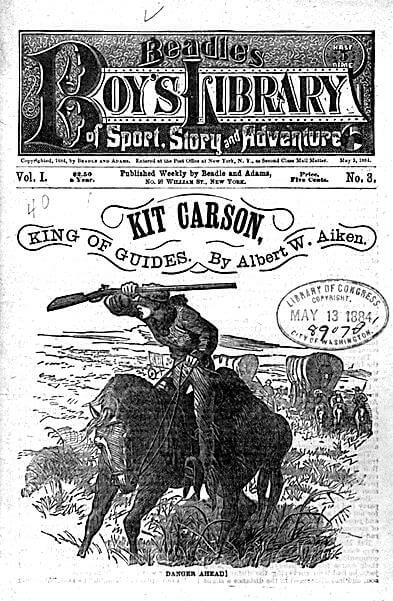
One of the most famous of such men was Kit Carson. He knew all about the wild animals. He was a great hunter. He learned the languages of the Indians. The Indians liked him. He was a great guide. He showed soldiers and settlers how to travel where they wished to go.
Once he was marching through the wild country with other men. Evening came. He left the others, and went to shoot something to eat. It was the only way to get meat for supper. When he had gone about a mile, he saw the tracks of some elks. He followed these tracks. He came in sight of the elks. They were eating grass on a hill, as cows do.
Kit Carson crept up behind some bushes. But elks are very timid animals. Before the hunter got very near, they began to run away. So Carson fired at one of them as it was running. The elk fell dead.
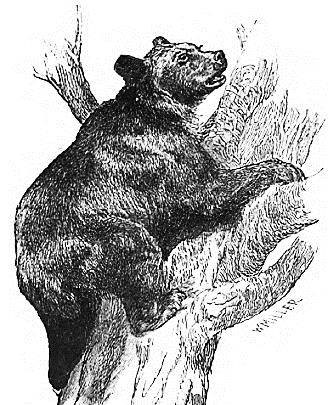
But just at that moment he heard a roar. He turned to see what made this ugly noise. Two huge bears were running toward him. They wanted some meat for supper, too.
Kit Carson’s gun was empty. He threw it down. Then he ran as fast as he could. He wanted to find a tree.
Just as the bears were about to seize him, he got to a tree. He caught hold of a limb. He swung himself up into the tree. The bears just missed getting him.
But bears know how to climb trees. Carson knew that they would soon be after him. He pulled out his knife, and began to cut off a limb. He wanted to make a club.
A bear is much larger and stronger than a man. He cannot be killed with a club. But every bear has one tender spot. It is his nose. He does not like to be hit on the nose. A sharp blow on the nose hurts him a great deal.
Kit Carson got his club cut just in time. The bears were coming after him. Kit got up into the very top of the tree. He drew up his feet, and made himself as small as he could.
When the bears came near, one of them reached for Kit. Whack! went the stick on the end of his nose. The bear drew back, and whined with pain.
First one bear tried to get him, and then the other. But whichever one tried, Kit was ready. The bear was sure to get his nose hurt.
The bears grew tired, and rested awhile. But they kept up their screeching and roaring. When their noses felt better, they tried again. And then they tried again. But every time they came away with sore noses. At last, they both tried at once. But Carson pounded faster than ever. One of the bears cried like a baby. The tears ran out of his eyes. It hurt his feelings to have his nose treated in this rude way.
After a long time, one of the bears got tired. He went away. After awhile, the other went away too. Kit Carson stayed in the tree a long time. Then he came down. The first thing he did was to get his gun. He loaded it. But the bears did not come back. They were too busy rubbing noses.
Longfellow was a noble boy. He always wanted to do right. He could not bear to see one person do any wrong to another.
He was very tenderhearted. One day he took a gun and went shooting. He killed a robin. Then he felt sorry for the robin He came home with tears in his eyes. He was so grieved, that he never went shooting again.
He liked to read Irving’s “Sketch Book.” Its strange stories about Sleepy Hollow and Rip Van Winkle pleased his fancy.
When he was thirteen he wrote a poem. It was about Lovewell’s fight with the Indians. He sent his verses to a newspaper. He wondered if the editor would print them. He could not think of anything else. He walked up and down in front of the printing office. He thought that his poem might be in the printer’s hands.
When the paper came out, there was his poem. It was signed “Henry.” Longfellow read it. He thought it a good poem.
But a judge who did not know whose poem it was talked about it that evening. He said to young Longfellow, “Did you see that poem in the paper? It was stiff. And all taken from other poets, too.”
This made Henry Longfellow feel bad. But he kept on trying. After many years, he became a famous poet.
For more than fifty years, young people have liked to read his poem called “A Psalm of Life.” Here are three stanzas of it:
After they got the seal, Doctor Kane and his men traveled on. Sometimes they were on the ice. Sometimes they were in the boats. The men were so weak, that they could hardly row the boats. They were so hungry, that they could not sleep well at night.
One day they were rowing, when they heard a sound. It came to them across the water. It did not sound like the cry of sea birds. It sounded like people’s voices.
“Listen!” Doctor Kane said to Petersen.
Petersen spoke the same language as the people of Greenland. He listened. The sound came again. Petersen was so glad, that he could hardly speak. He told Kane in a half whisper, that it was the voice of someone speaking his own language. It was some Greenland men in a boat.
The next day they got to a Greenland town. Then they got into a little ship going to England. They knew that they could get home from England. But the ship stopped at another Greenland town. While they were there, a steamer was seen. It came nearer. They could see the stars and stripes flying from her mast. It was an American steamer sent to find Doctor Kane.
Doctor Kane and his men were full of joy. They pushed their little boat into the water once more. This little boat was called the “Faith.” It had carried Kane and his men hundreds of miles in icy seas.
Once more the men took their oars, and rowed. This time they rowed with all their might. They held up the little flag that they had carried farther north than anybody had ever been before. They rowed straight to the steamer.
In the bow of the boat was a little man with a tattered red shirt. He could see that the captain of the boat was looking at him through a spyglass.
The captain shouted to the little man, “Is that Doctor Kane?”
The little man in the red shirt shouted back, “Yes!”
Doctor Kane and his men had been gone more than two years. People had begun to think that they had all died. This steamer had been sent to find out what had become of them. When the men on the steamer heard that this little man in the red shirt was Doctor Kane himself, they sent up cheer after cheer. In a few minutes more, Doctor Kane and his men were on the steamer. They were now safe among friends. They were sailing away toward their homes.
After two winters of cold and darkness, Doctor Kane made up his mind to leave the ship fast in the ice. He wanted to get to a place in Greenland where there were people living. Then he might find some way of getting home again.
The men started out, drawing the boats on sleds. Whenever they came to open water, they put the boats into the water, and took the sleds in the boats. When they came to the ice again, they had to draw out their boats, and carry them on the sleds. At first, they could travel only about a mile a day.
It was a hard journey. Some of the men were ill. These had to be drawn on the sleds by the rest. They had not enough food. At one time, they rested three days in a kind of cave. Here they found many birds’ eggs. These made very good food for them. At another place, they stayed a week. They stayed just to eat the eggs of the wild birds.
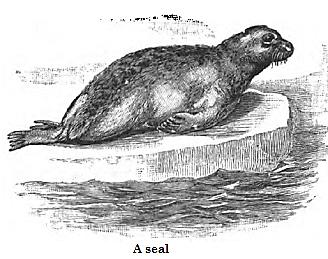
After they left this place, they were hungry. The men grew thinner and thinner. It seemed that they must die for want of food. But one day they saw a large seal. He was floating on a piece of ice. The hungry men thought, “What a fine dinner he would make for us!” If they could get the seal, they would not die of hunger.
Every one of the poor fellows trembled for fear the seal would wake up. A man named Petersen took a gun, and got ready to shoot. The men rowed the boat toward the seal. They rowed slowly and quietly. But the seal waked up. He raised his head. The men thought that he would jump off into the water. Then they might all die for want of food.
Doctor Kane made a motion to Petersen. That was to tell him to shoot quickly. But Petersen did not shoot. He was so much afraid that the seal would get away, that he could not shoot. The seal now raised himself a little more. He was getting ready to jump into the water. Just then Petersen fired. The seal fell dead on the ice.
The men were wild with joy. They rowed the boats with all their might. When they got to the seal, they dragged it farther away from the water. They were so happy, that they danced on the ice. Some of them laughed. Some were so glad, that they cried. Then they took their knives and began to cut up the seal. They had no fire on the ice, and they were too hungry to think of lighting one. So they ate the meat of the seal without waiting to cook it.
Elisha Kent Kane was a doctor in one of the war ships of the United States. He had sailed about the world a great deal. When he heard that ships were to be sent into the icy seas of the north, he asked to be sent along. He went the first time as a doctor. Then he wanted to find out more about the frozen ocean. So he went again as captain of a ship. His ship was called the “Advance.”
Kane sailed into the icy seas. His ship was driven far into the ice by a furious storm. She was crowded by icebergs. At one time, she was lifted clear out of the water. The ship seemed ready to fall over on her side. But the ice let her down again. Then she was squeezed till the men thought that she would be crushed like an eggshell. At last, the storm stopped. Then came the awful cold. The ship was frozen into the ice. The ice never let go of her. She was farther north than any ship had ever been before. But she was so fast in the ice that she never could get away.
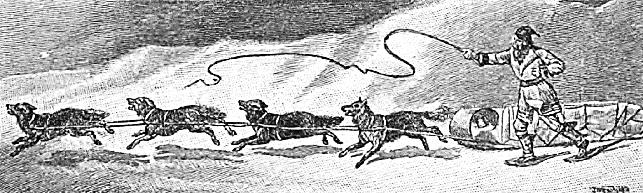
In that part of the world it is night nearly all winter. For months, there was no sun at all. Daylight came again. It was now summer, but it did not get warm. Doctor Kane took sleds, and went about on the ice to see what he could see. The sleds were drawn by large dogs. But nearly all of the dogs died in the long winter night.
Doctor Kane thought that the ice would melt. He wanted to get the ship out. But the ice did not melt at all.
At last, the summer passed away. Another awful winter came. The sun did not rise anymore. It was dark for months and months. The men were ill. Some of them died. They were much discouraged. But Kane kept up his heart, and did the best he could.
At last, the least little streak of light could be seen. It got a little lighter each day. But the sick men down in the cabin of the ship could not see the light.
Doctor Kane said to himself, “If my poor men could see this sunlight, it would cheer them up. It might save their lives.” But they were too ill to get out where they could see the sun. It would be many days before the sun would shine into the cabin of the ship. The men might die before that time.
So Doctor Kane took some looking glasses up to the deck or top of the ship. He fixed one of these so it would catch the light of the sun. Then he fixed another so that the first one would throw the light on this one. The last one would throw the sunlight down into the cabin where the sick men were.
One day the poor fellows were ready to give up. Then the sun fell on the looking glasses, and flashed down into the cabin. It was the first daylight the sick men had seen for months. The long winter night was over. Think how happy they were!
Many years ago, a strange-looking man was sometimes seen in the streets of New York. His cap was made of India rubber. So was his coat. He wore a rubber waistcoat. Even his cravat was of India rubber. He wore rubber shoes in dry weather. People called this man “The India rubber man.”
His name was Charles Goodyear. He was very poor. He was trying to find out how to make India rubber useful.
India rubber trees grow in South America. The juice of these trees is something like milk or cream. By drying this juice, India rubber is made.
The Indians in Brazil have no glass to make bottles with. A long time ago, they learned to make bottles out of rubber. More than a hundred years ago, some of these rubber bottles were brought to this country. The people in this country had never seen India rubber before. They thought the bottles made out of it by the Indians very curious.
In this country, rubber was used only to rub out pencil marks. That is why we call it rubber. People in South America learned to make a kind of heavy shoe out of it. But these shoes were hard to make. They cost a great deal when they were sold in this country.
Goodyear wanted to try his rubber. That is why he wore a rubber coat and a rubber waistcoat and a rubber cravat. That is why he wore a rubber cap and rubber shoes when it was not raining. He made paper out of rubber, and wrote a book on it. He had a doorplate made of it. He even carried a cane made of India rubber. It is no wonder people called him the India rubber man.
He was very poor. Sometimes he had to borrow money to buy rubber with. Sometimes his friends gave him money to keep his family from starving. Sometimes there was no wood and no coal in the house in cold weather.
But Goodyear kept on trying. He thought that he was just going to find out. Years went by, and still he kept on trying.
One day he was mixing some rubber with Sulphur. It slipped out of his hand. It fell on the hot stove. But it did not melt. Goodyear was happy at last. That night it was cold. Goodyear took the burned piece of rubber out of doors, and nailed it to the kitchen door. When morning came, he went and got it. It had not frozen.
He was now sure that he was on the right track. But he had to find out how to mix and heat his rubber and Sulphur. He was too poor to buy rubber to try with. Nobody would lend him anymore money. His family had to live by the help of his friends. He had already sold almost everything that he had. Now he had to sell his children’s schoolbooks to get money to buy rubber with.
At last, his rubber goods were made and sold. Poor men who had to stand in the rain could now keep themselves dry. People could walk in the wet with dry feet. A great many people are alive who would have died if they had not been kept dry by India rubber.
You may count up, if you can, how many useful things are made of rubber. We owe them all to one man. People laughed at Goodyear once. But at last, they praised him. To be “The India rubber man” was something to be proud of.








 articlesforchristians