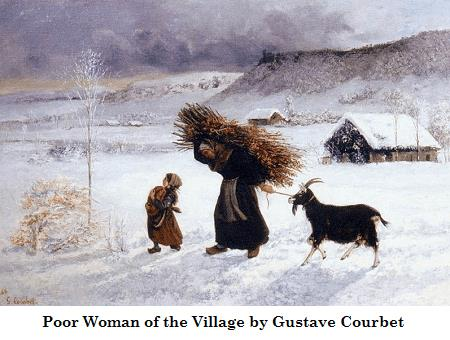
When Daniel Webster was a young lawyer, he was going home one night. There was snow on the ground. It was very cold. It was late, and there was nobody to be seen.
But after a while he saw a poor woman. She was ahead of him. He wondered what had brought her out on so cold a night.
Sometimes she stopped and looked around. Then she would stand and listen. Then she would go on again. Webster kept out of her sight. But he watched her. After looking around, she turned down the street in which Webster lived. She stopped in front of Webster’s house. She looked around and listened.
Webster had put down some loose boards to walk on. They reached from the gate to the door of his house. After standing still a minute, the woman took one of the boards, and went off quickly.
Webster followed her. But he kept out of her sight. She went to a distant part of the town. She went into a poor little house.
Webster went home without saying anything to the woman. He knew that she had stolen the board for firewood.
The next day the poor woman got a present. It was a nice load of wood.
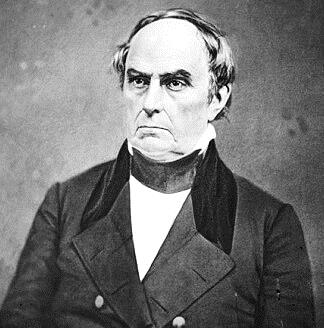
Daniel Webster was a great statesman. As a little boy, he was called “Little Black Dan.” When he grew larger, he was thin and sickly-looking. But he had large, dark eyes. People called him “All Eyes.”
He was very fond of his brother Ezekiel. Ezekiel was a little older than Daniel. Both the boys had fine minds. They wanted to go to college. But their father was poor.
Daniel had not much strength for work on the farm. So little “All Eyes” was sent to school, and then to college. Ezekiel stayed at home, and worked on the farm.
While Daniel was at school, he was unhappy to think that Ezekiel could not go to college also. He went home on a visit. He talked to Ezekiel about going to college. The brothers talked about it all night. The next day Daniel talked to his father about it. The father said he was too poor to send both of his sons to college. He said he would lose all his little property if he tried to send Ezekiel to college. But he said, that, if their mother and sisters were willing to be poor, he would send the other son to college.
So the mother and sisters were asked. It seemed hard to risk the loss of all they had. It seemed hard not to give Ezekiel a chance. They all shed tears over it.
The boys promised to take care of their mother and sisters if the property should be lost. Then they all agreed that Ezekiel should go to college too.
Daniel taught school while he was studying. That helped to pay the expenses. After Daniel was through his studies in college, he taught a school in order to help his brother. When his school closed, he went home. On his way, he went around to the college to see his brother. Finding that Ezekiel needed money, he gave him a hundred dollars. He kept but three dollars to get home with.
The father’s property was not sold. The two boys helped the family. Daniel soon began to make money as a lawyer. He knew that his father was in debt. He went home to see him. He said, “Father, I am going to pay your debts.”
The father said, “You cannot do it, Daniel. You have not money enough.”
“I can do it,” said Daniel; “and I will do it before Monday evening.”
When Monday evening came around, the father’s debts were all paid.
When Daniel became a famous man, it made Ezekiel very happy. But Ezekiel died first. When Daniel Webster made his greatest speech, all the people praised him.
But Webster said, “I wish that my poor brother had lived to this time. It would have made him very happy.”
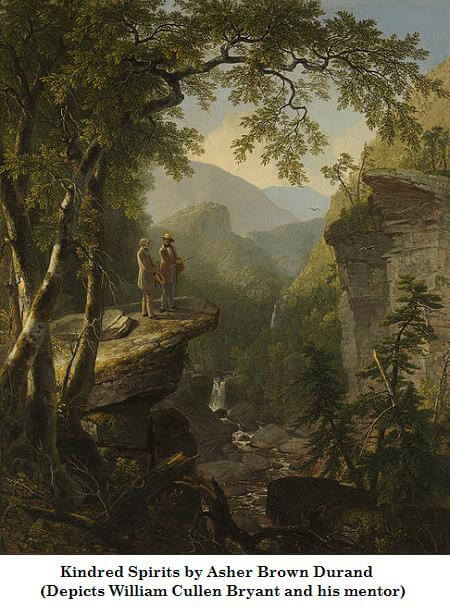
William Cullen Bryant was the first great poet in this country. He was a small man. When he was a baby, his head was too big for his body. His father used to send the baby to be dipped in a cold spring every day. The father thought that putting his head into cold water would keep it from growing.
Bryant knew his letters before he was a year and a half old. He began to write rhymes when he was a very little fellow. He wanted to be a poet. He used to pray that he might be a poet. His father printed some verses of his when he was only ten years old.
Bryant wrote many fine poems. Here are some lines of his about the bird we call a bobolink:
Robert of Lincoln is gaily dressed,
Wearing a bright black wedding coat,
White are his shoulders and white his crest.
Hear him call in his merry note:
Bobolink, bobolink,
Spink, spank, spink;
Look, what a nice new coat is mine,
Sure there was never a bird so fine.
Chee, chee, chee.
Nathaniel Hawthorne was one of our greatest writers of stories. He was a pretty boy with golden curls. He was fond of all the great poets, and he read Shakespeare and Milton and many other poets as soon as he was old enough to understand them.
Hawthorne grew up a very handsome young fellow. One day he was walking in the woods. He met an old gypsy woman. She had never seen anybody so fine-looking.
“Are you a man, or an angel?” she asked him.
Some of Hawthorne’s best books are written for girls and boys. One of these is called “The Wonder Book.” Another of his books for young people is “Tanglewood Tales.”
William H. Prescott wrote beautiful histories. When Prescott was a boy, a schoolmate threw a crust of bread at him. It hit him in the eye. He became almost blind.
He had to do his writing with a machine. This machine was made for the use of the blind. There were no typewriters in those days.
It was hard work to write history without good eyes. But Prescott did not give up. He had a man to read to him. It took him ten years to write his first book.
When Prescott had finished his book, he was afraid to print it. But his father said, “The man who writes a book, and is afraid to print it, is a coward.”
Then Prescott printed his book. Everybody praised it. When you are older, you will like to read his histories.
Doctor Oliver Wendell Holmes, the poet, was a boy full of fancies. He lived in an old house. Soldiers had stayed in the house at the time of the Revolution. The floor of one room was all battered by the butts of the soldiers’ muskets.
Little Oliver Holmes used to think he could hear soldiers in the house. He thought he could hear their spurs rattling in the dark passages. Sometimes he thought he could hear their swords clanking.
The little boy was afraid of a sign that hung over the sidewalk. It was a great, big, wooden hand. It was the sign of a place where gloves were made. This big hand swung in the air. Little Oliver Holmes had to walk under it on his way to school. He thought the great fingers would grab him someday. Then he thought he would never get home again. He even thought that his other pair of shoes would be put away till his little brother grew big enough to wear them.
But the big wooden hand never caught him.
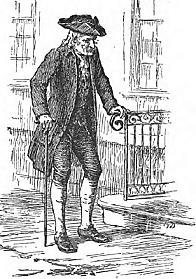
Here are some verses that Doctor Holmes wrote about a very old man:
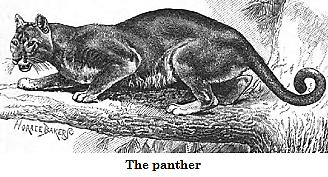
Audubon was traveling in the woods in Mississippi. He found the little cabin of a settler. He stayed there for the night. The settler told him that there was a panther in the swamp near his house. A panther is a very large and fierce animal. It is large enough to kill a man. This was a very bad panther. It had killed some of the settler’s dogs.
Audubon said, “Let us hunt this panther, and kill it.”
So, the settler sent out for his neighbors to come and help kill the panther. Five men came. Audubon and the settler made seven. They were all on horseback.
When they came to the edge of the swamp, each man went a different way. They each took their dogs with them to find the track of the wild beast. All of the hunters carried horns. Whoever should find the track first was to blow his horn to let the others know.
In about two hours after they had started, they heard the sound of a horn. It told them that the track had been found. Every man now went toward the sound of the horn. Soon all the yelping dogs were following the track of the fierce panther. The panther was running into the swamp farther and farther.
I suppose that the panther thought that there were too many dogs and men for him to fight. All the hunters came after the dogs. They held their guns ready to shoot if the panther should make up his mind to fight them.
After a while the sound of the dogs’ voices changed. The hunters knew from this that the panther had stopped running, and gone up into a tree.
At last, the men came to the place where the dogs were. They were all barking round a tree. Far up in the tree was the dangerous beast. The hunters came up carefully. One of them fired. The bullet hit the panther, but did not kill him.
The panther sprang to the ground, and ran off again. The dogs ran after. The men got on their horses, and rode after.
But the horses were tired, and the men had to get down, and follow the dogs on foot.
The hunters now had to wade through little ponds of water. Sometimes they had to climb over fallen trees. Their clothes were badly torn by the bushes. After two hours more, they came to a place where the panther had again gone up into a tree.
This time three of the hunters shot at him. The fierce panther came tumbling to the ground. But he was still able to fight. The men fought the savage beast on all sides. At last, they killed him. Then they gave his skin to the settler. They wanted him to know that his enemy was dead.
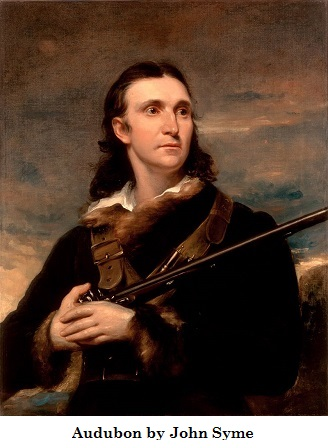
When Audubon was making his great book about birds, he had to live much in the woods. Sometimes he lived among the Indians. He once saw an Indian go into a hollow tree. There was a bear in the tree. The Indian had a knife in his hand. He fought with the bear in the tree, and killed it.
Audubon could shoot very well. A friend of his one day threw up his cap in the air. He told Audubon to shoot at it. When the cap came down, it had a hole in it.
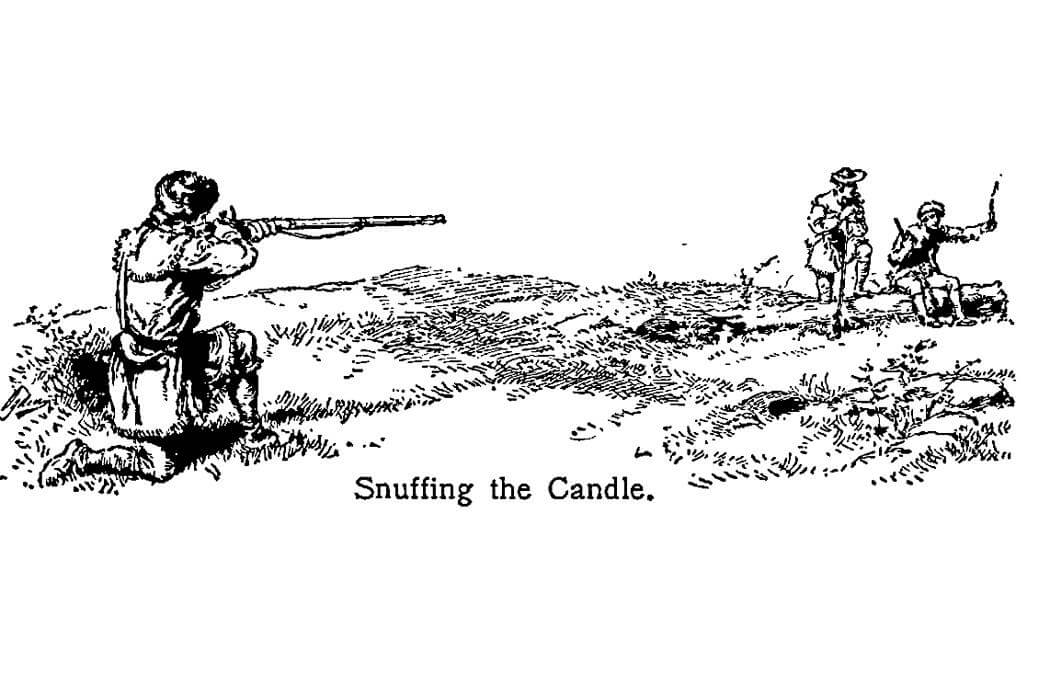
But the hunters who lived in the woods could shoot better. They would light a candle. Then one of the hunters would take his gun, and go a hundred steps away from the candle. He would then shoot at the candle. He would shoot so as to snuff it. He would not put out the candle. He would only cut off a bit of the wick with the bullet. But he would leave the candle burning.
Once Audubon came near being killed by some robbers. He stopped at a cabin where lived an old white woman. He found a young Indian in the house. The Indian had hurt himself with an arrow. He had come to the house to spend the night.
The old woman saw Audubon’s fine gold watch. She asked him to let her look at it. He put it into her hands for a minute. Then the Indian passed by Audubon, and pinched him two or three times. That was to let him know that the woman was bad, and that she might rob him.
Audubon went and lay down with his hand on his gun. After a while two men came in. They were the sons of the old woman. Then the old woman sharpened a large knife. She told the young men to kill the Indian first, and then to kill Audubon and take his watch. She thought that Audubon was asleep. But he drew up his gun ready to fire.
Just then two hunters came to the cabin. Audubon told them what the robbers were going to do. They took the old woman and her sons, and tied their hands and feet. The Indian, though he was in pain from his hurt, danced for joy when he saw that the robbers were caught. The woman and her sons were afterward punished.
John James Audubon knew more about the birds of this country than any man had ever known before. He was born in the State of Louisiana. His father took him to France when he was a boy. He went to school in France.
The little John James was fond of studying about wild animals. But most of all he wished to know about birds. Seeing that the boy liked such things, his father took pains to get birds and flowers for him.
While he was yet a boy at school, he began to gather birds and other animals for himself. He learned to skin and stuff them. But his stuffed birds did not please him. Their feathers did not look bright, like those of live birds. He wanted living birds to study.
His father told him that he could not keep so many birds alive. To please the boy, he got him a book with pictures in it. Looking at these pictures made John James wish to draw. He thought that he could make pictures that would look like the live birds.
But when he tried to paint a picture of a bird, it looked worse than his stuffed birds. The birds he drew were not much like real birds. He called them a “family of cripples.” As often as his birthday came around, he made a bonfire of his bad pictures. Then he would begin over again.
All this time he was learning to draw birds. But he was not willing to make pictures that were not just like the real birds. So when he grew to be a man he went to a great French painter whose name was David. David taught him to draw and paint things as they are.
Then he came back to this country, and lived awhile in Pennsylvania. Here his chief study was the wild creatures of the woods.
He gathered many eggs of birds. He made pictures of these eggs. He did not take birds’ eggs to break up the nests. He was not cruel. He took only what he needed to study.
He would make two little holes in each egg. Then he would shake the egg, or stir it up with a little stick or straw, or a long pin. This would break up the inside of the egg. Then he would blow into one of the holes. That would blow the inside of the egg out through the other hole.
These egg shells he strung together by running strings through the holes. He hung these strings of egg shells all over the walls of his room. On the mantelpiece, he put the stuffed skins of squirrels, raccoons, opossums, and other small animals. On the shelves his friends could see frogs, snakes, and other animals. He married a young lady, and brought her to live in this museum with his dead snakes, frogs, and strings of birds’ eggs. She liked what he did, and was sure that he would come to be a great man.
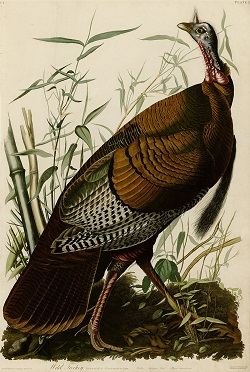
He made up his mind to write a great book about American birds. He meant to tell all about the birds in one book. Then in another book he would print pictures of the birds, just as large as the birds themselves. He meant to have them look just like the birds.
To do this he must travel many thousands of miles. He must live for years, almost all of the time in the woods. He would have to find and shoot the birds, in order to make pictures of them. And he must see how the birds lived, and how they built their nests, so that he could tell all about them. It would take a great deal of work and trouble. But he was not afraid of trouble.
That was many years ago. Much of our country was then covered with great trees. Audubon sometimes went in a boat down a lonesome river. Sometimes he rode on horseback. Often, he had to travel on foot through woods where there were no roads. Many a time he had to sleep out of doors.
He lost his money and became poor. Sometimes he had to paint portraits to get money to live on. Once he turned dancing master for a while. But he did not give up his great idea. He still studied birds, and worked to make his books about American birds. His wife went to teaching to help make a living.
After years of hard work, he made paintings of nearly a thousand birds. That was almost enough for his books. But, while he was traveling, two large rats got into the box in which he kept his pictures. They cut up all his paintings with their teeth, and made a nest of the pieces. This almost broke his heart for a while. For many nights, he could not sleep, because he had lost all his work.
But he did not give up. After some days, he took his gun, and went into the woods. He said to himself, “I will begin over again. I can make better paintings than those that the rats spoiled.” But it took him four long years and a half to find the birds, and make the pictures again.
He was so careful to have his drawings just like the birds, that he would measure them in every way. Thus, he made his pictures just the size of the birds themselves.
At last, the great books were printed. In this country, in France, and in England, people praised the wonderful books. They knew that Audubon was indeed a great man.
During all the early years of the Virginia colony the people were fed and clothed out of a common stock of provisions. They were also obliged to work for this stock. No division was made of the land, nor could the industrious man get any profit by his hard work. The laziest man was as well off as the one who worked hardest, and under this arrangement men neglected their work, and the colony was always poor. The men had been promised that after five years they should have land of their own and be free, but this promise was not kept. In 1614 Sir Thomas Dale gave to some who had been longest in Virginia three acres of ground apiece, and allowed them one month in the year to work on their little patches. For this they must support themselves and give the rest of their work to the common stock. This arrangement made them more industrious. But the cruel military laws put in force by the governor made Virginia very unpopular.
Argall, who came after Dale, governed very badly, and the colony was almost ruined. In 1618 many new emigrants were sent, and Lord De la Warr was again sent as governor, but he died on the way. The “Virginia Company,” of London, which had the government of the colony in November, 1618, granted to Virginia a “Great Charter,” under which the people of the colony were allowed a voice in making their own laws. This was the beginning of free government in America. Under this charter the government of Virginia was put into the hands of a governor, a “council of estate,” and a “general assembly.” The other American colonies afterward took pattern from this threefold government.
The government of the United States by a president, a senate, and a house of representatives shows that the ideas put into the Great Charter have left their mark on the constitution of our country. The governments of all our States also show traces of the same idea. Each State has a governor, a senate, and a house of representatives. So that the plan arranged in 1618 for a few hundred people in Virginia was a tiny stream that has spread out into a great river.
The Great Charter also gave the people of Virginia the right to divide the land into farms, and to own and work ground each for himself. When the new governor, Sir George Yeardley, got to Virginia in the spring of 1619, bringing this good news that the settlers were to live under laws of their own making, and were to enjoy the fruits of their own labors, they thought themselves the happiest people in the world.
About this time it was thought that the colony would be more firmly planted if the colonists had wives. Young women were therefore sent out to be married to the settlers. But, before any man could marry one of these, he was obliged to gain her consent, and to pay the cost of her passage, which was about a hundred and fifty pounds of tobacco. This venture proved very satisfactory to the Virginians, and women were therefore sent for wives from time to time for years afterward. When the colonists had land of their own, they felt themselves at home in America, and no longer thought of going back to England.
Before this there had been a good many small wars and troubles of one kind or other with the American Indians. But, as the American Indians had few firearms, the settlers could easily defend themselves. After 1619 many efforts were made to change and convert the American Indians. Money was given to educate their children, and a college was planned for them. One ambitious American Indian brave, whom the settlers called “Jack of the Feather,” and who was believed to be proof against bullets, was suspected of wishing war. At length he killed a settler, and the settler’s servants, in trying to take him to the governor, shot him. The American Indians did not show any resentment at his death at first, and O-pe-chan’-ka-no, who had become head chief on the death of Powhatan, said that the sky might fall sooner than he would break the peace.
But on the 22nd of March, 1622, while the men of the colony were in the fields, the American Indians suddenly fell on the settlements, killing the colonists mostly with their own axes, hatchets, and hoes. Three hundred and forty-seven men, women, and children were killed in a single day. One American Indian lad, living in a settler’s house, had given warning during the night before, and some of the settlements had time to prepare themselves for defense. From this time on there was almost continual war with the American Indians for many years.
In 1624 the Virginia Company, of London, was dissolved, and the colony was put under the government of the king. But the king, James I, when he put down the company, promised to the colony all the liberties which they then enjoyed. This promise was not well kept by his successors in after-years; the Virginians were often oppressed by the governors sent to them, but the right to pass laws in the General Assembly was never taken away.
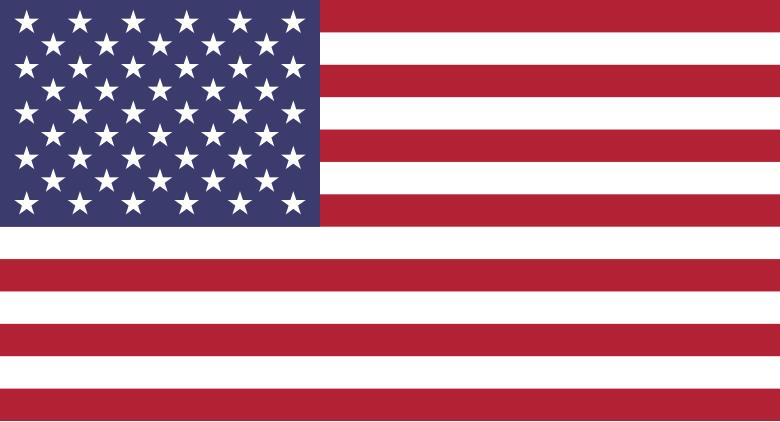
Everybody in the United States has heard the song about the star-spangled banner. Nearly everybody has sung it. It was written by Francis Scott Key.
Key was a young lawyer. In the War of 1812 he fought with the American army. The British landed soldiers in Maryland. At Bladensburg, they fought and beat the Americans. Key was in this battle on the American side.
After the battle the British army took Washington and burned the public buildings. Key had a friend who was taken prisoner by the British. He was on one of the British ships. Key went to the ships with a flag of truce. A flag of truce is a white flag. It is carried in war when one side sends a message to the other.
When Key got to the British ships, they were sailing to Baltimore. They were going to try to take Baltimore. The British commander would not let Key go back. He was afraid that he would let the Americans know where the ships were going.
Key was kept a kind of prisoner while the ships attacked Baltimore. The ships tried to take the city by firing at it from the water. The British army tried to take the city on the land side.
The ships did their worst firing at night. They tried to take the little fort near the city.
Key could see the battle. He watched the little fort. He was afraid that the men in it would give up. He was afraid that the fort would be broken down by the cannon balls.
The British fired bombshells and rockets at the fort. When these burst, they made a light. By this light Key could see that the little fort was still standing. He could see the flag still waving over it. He tells this in his song in these words:
“And the rocket’s red glare, the bombs bursting in air Gave proof through the night that our flag was still there.”
Key did not know whether the fort had been knocked down or not. He could not see whether the flag was still flying or not. He thought that the Americans might have given up. He felt what he wrote in the song:
“Oh! say, does that star-spangled banner yet wave O’er the land of the free, and the home of the brave?”
When the break of day came, Key looked toward the fort. It was still standing. There was a flag flying over it. It grew lighter. He could see that it was the American flag. His feelings are told in two lines of the song:
“Tis the star-spangled banner, oh, long may it wave O’er the land of the free, and the home of the brave!”
Key was full of joy. He took an old letter from his pocket. The back of this letter had no writing on it. Here he wrote the song about the star-spangled banner.
The British commander now let Key go ashore. When he got to Baltimore, he wrote out his song. He gave it to a friend. This friend took it to a printing office. But the printers had all turned soldiers. They had all gone to defend the city.
There was one boy left in the office. He knew how to print. He took the verses and printed them on a broad sheet of paper.
The printed song was soon in the hands of the soldiers around Baltimore. It was sung in the streets. It was sung in the theaters. It traveled all over the country. Everybody learned to sing:
“Then conquer we must, for our cause it is just; And this be our motto–’In God is our trust’– And the star-spangled banner in triumph shall wave O’er the land of the free, and the home of the brave.”
The English were not the only people who had colonies in North America. The Spaniards, who claimed the whole continent, had planted a colony at Saint Au’-gus-tine, in Florida, in 1565, forty-two years before the first English colony Jamestown. Saint Augustine is thus the oldest city in the United States. But the Spaniards were too busy in Mexico and in Central and South America to push their settlements farther to the north, though they were very jealous of the English colonies, and especially of South Carolina and Georgia.
English Privateers Attack St. Augustine
The French laid claim also to a large part of North America. They tried to plant a colony in Canada in 1549, and afterward made some other attempts that failed. Quebec [kwebec’] was founded by a great French explorer, Champlain, in 1608, the very year after the English settled at Jamestown. At Quebec the real settlement of Canada was begun, and it was always the capital of the vast establishments of the French in America.
The French, like the English, were trying to find the Pacific Ocean, and they were much more daring in their explorations than the English colonists, whose chief business was farming. A French explorer named Joliet [zhol-yay] reached the Mississippi in 1673, and another Frenchman, La Salle [lah-sahl], explored the great country west of the Alleghany Mountains, and discovered the Ohio. After many disasters and failures, La Salle succeeded in reaching the mouth of the Mississippi. Father Hennepin, a priest, explored the upper Mississippi. The French then laid claim to all the country west of the Alleghanies. Over the region they established posts and mission-houses, while the English contented themselves with multiplying their farming settlements east of the mountains.
When La Salle reached the mouth of the Mississippi, he took possession of the country in the name of Louis XIV., and called it Louisiana, in honor of that king. The settlement of Louisiana was begun in 1699. The French held the St. Lawrence and the Mississippi, the two great water-ways of North America, and they controlled most of the American Indian tribes by means of missionaries and traders. They endeavored to connect Canada and Louisiana by a chain of fortified posts, and so to hold for France an empire, in the heart of America, larger than France itself.
But the weakness of the French in America lay in the fewness of their people. Canada, the oldest of their colonies, was in a country too cold to be a prosperous farming country in that day. Besides, its growth was checked by the system of lordships with tenants, which some of the English colonies had also tried. But inferior as the French were in numbers, they were strong in their military character; they were almost all soldiers. The English were divided into colonies, and could never be made to act together; but the French, from Canada to the Mississippi, were absolutely subjected to their governors.
The French influenced and leveraged the American Indians to push back against the English colonies. The great business of the French in Canada was the fur trade, and this was pushed with an energy that quite left the English traders behind. The French drew furs from the shores of Lake Superior and from beyond the Mississippi. The French traders gained great influence over the American Indians. The English treated the American Indians as inferiors, the French lived among them on terms of equality. The French also gained control of the American Indian tribes by means of missionary priests, who risked their lives and spent their days in the dirty cabins of the American Indians to convert them to European religions. The powerful Iroquois confederacy, known as the “Five Nations,” and afterward as the “Six Nations,” sided with the English, and hated and killed the French. They lived in what is now the State of New York. But the most of the tribes were managed by the French, who sent missionaries to convert them, ambassadors to flatter them, gunsmiths to mend their arms, and military men to teach them to fortify, and to direct their attacks against the settlements of the English. ‘Engraving of Juan Ponce de León’ The wars between the French colony in Canada and the English colonies in what is now the United States were caused partly by wars between France and England in Europe. But there were also causes enough for enmity in the state of affairs on this side of the ocean. First, there was always a quarrel about territory. The French claimed that part of what is now the State of Maine which lies east of the Kennebec River, while the English claimed to the St. Croix. The French also claimed all the country back of the Alleghanies. With a population not more than one twentieth of that of one of the English colonies, they spread their claim over all the country watered by the lakes and the tributaries of the Mississippi, including more than half of the present United States. Second, both France and England wished to control the fisheries of the eastern coast. Third, both the French and the English endeavored to get the entire control of the fur trade. To do this the French tried to win the Iroquois Confederacy to their interest, while the English sought to take the trade of the Western tribes away from the French. Fourth, the French were Catholics and the English mostly Protestants. In that age men were very bigoted about religion, and hated and feared those who differed from them.
SPANISH DISCOVERIES IN FLORIDA
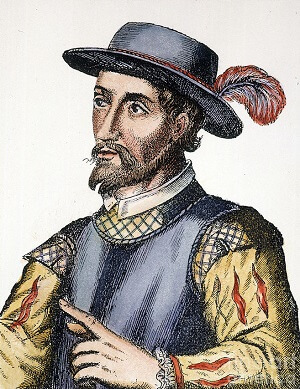
Ponce de Leon [pon’-thay day lay-on; commonly in English, ponss deh lee’-on], an old Spanish explorer, set sail in 1513 from the island of Puerto Rico, to discover a land reported to lie to the northward of Cuba, and which had somehow come to be called Bimini [bee-mcc-nee]. It was said to contain a fountain, by bathing in which an old man would be made young again. On Easter Sunday Ponce discovered the mainland, which he called Florida, from Pascua Florida [pas’-kwah floree’- dah], the Spanish name for Easter Sunday. In 1521 Ponce tried to settle Florida, but his party was attacked and he was mortally wounded by the American Indians. Florida was then believed to be an island. After his death, other Spanish adventurers explored the coast from Labrador southward, and even tried to find goldmines, and plant colonies in the interior of the country. The most famous of these expeditions was that of Hernando de Soto [aer-nan’-do day so’-to], a Spanish explorer, who reached Florida in 1539. He marched through Georgia, Alabama, and Mississippi. He was determined to find some land yielding gold, like Mexico and Peru. But he treated the American Indians cruelly, killing some of them wantonly, and forcing others to serve him as slaves. The American Indians, in turn, attacked him again and again, until his party was sadly reduced. De Soto tried to descend the Mississippi River to the Gulf of Mexico, but at the mouth of the Red River he died of a fever. His body was buried m the Mississippi, to keep the American Indians from disfiguring it in revenge. A few of his followers reached the Gulf and got to the Spanish settlements in Mexico.
When people first came to this country, they had to take up with such houses as they could get. In Virginia and New England, as in New York and Philadelphia, holes were dug in the ground for dwelling places by some of the first settlers. In some places bark wigwams were made, like those of the American Indians. Sometimes a rudimentary cabin was built of round logs, and without a floor. As time advanced, better houses were built. Some of these were of hewed logs, some of planks, split, or sawed out by hand. The richer people built good houses soon after they came. Most of these had in the middle a large room, called “the hall.”
The chimneys were generally very large, with wide fireplaces. Sometimes there were seats inside the fireplace, and children, sitting on these seats in the evening, amused themselves by watching the stars through the top of the chimney. In the early houses most of the windows had paper instead of glass. This paper was oiled, so as to let light come through.
Except in the houses of rich people the furniture was scant and rough. Benches, stools, and tables were home-made. Beds were often filled with mistletoe, the down from cattail flags, or the feathers of wild-pigeons. People who were not rich brought their food to the table in wooden trenchers, or trays, and ate off wooden plates. Some used square blocks of wood instead of plates. Neither rich nor poor, in England or America, had forks when the first colonies were settled. Meat was cut with a knife and eaten from the fingers. On the tables of well-to-do people pewter dishes were much used, and a row of shining pewter in an open cupboard, called a dresser, was a sign of good housekeeping. The richest people had silverware for use on great occasions. They also had stately furniture brought from England. But carpets were hardly ever seen. The floor of the best room was strewed with sand, which was marked off in ornamental figures. There was no wall-paper until long after 1700, but rich cloths and tapestry hung on the walls of the finest houses.
Cooking was done in front of fireplaces in skillets and on griddles that stood upon legs, so that coals could be put under them, and in pots and kettles that hung over the fire on a swinging crane, so that they could be drawn out or pushed back. Sometimes there was an oven, for baking, built in the side of the chimney. Meat was roasted on a spit in front of the fire. The spit was an iron rod thrust through the piece to be roasted, and turned by a crank. A whole pig or fowl was sometimes hung up before the fire and turned about while it roasted. Often pieces of meat were broiled by throwing them on the live coals.
‘Still Life with Mince (Eel) Pie’ by Pieter Claesz
A mug of home-brewed beer, with bread and cheese, or a porridge of peas or beans, boiled with a little meat, constituted the breakfast of the early colonists. Neither tea nor coffee was known in England or this country until long after the first colonies were settled. When tea came in, it became a fashionable drink, and was served to company from pretty little china cups, set on lacquered tables. Mush, made of Indian-corn meal, was eaten for supper.
In proportion to the population, more wine and spirits were consumed at that time than now. The very strong Madeira wine was drunk at genteel tables. Rum, which from its destructive effects was known everywhere by the nickname of “kill-devil,” was much used then. At every social gathering rum was provided. Hard cider was a common drink. There was much drunkenness. Peach-brandy was used in the Middle and Southern colonies, and was very ruinous to health and morals.
People of wealth made great display in their dress. Much lace and many silver buckles and buttons were worn. Workingmen of all sorts wore leather, deerskin, or coarse canvas breeches. The stockings worn by men were long, the breeches were short, and buckled, or otherwise fastened, at the knees.
Our forefathers traveled about in canoes and little sailing-boats called shallops. Most of the canoes would hold about six men, but some were large enough to hold forty or more. For a long time, there were no roads except the trails and bridle paths created by the American Indians, which could only be traveled on foot or on horseback. Goods were carried on packhorses. When roads were made, wagons came into use.
In a life so hard and busy as that of the early settlers, there was little time for education. The schools were few and generally poor. Boys, when taught at all, learned to read, write, and “cast accounts.” Girls were taught even less. Many of the children born when the colonies were new grew up unable to write their names. There were few books at first, and no newspapers until after 1700. There was little to occupy the mind except the Sunday sermon.
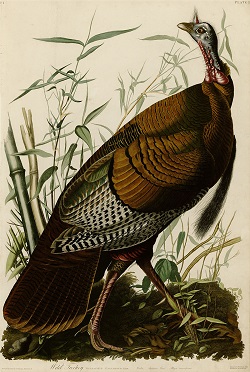
In all the colonies people were very fond of dancing parties. Weddings were times of great excitement and often of much drinking. In some of the colonies wedding festivities were continued for several days. Even funerals were occasions of feasting, and sometimes of excessive drinking In the Middle and Southern colonies the people were fond of horseracing, cock-fighting, and many other cruel sports brought from England. New England people made their militia-trainings the occasions for feasting and amusement, fighting sham battles, and playing many rough, old-fashioned games. Coasting on the snow, skating, and sleighing were first brought into America from Holland by the Dutch settlers in New York. In all the colonies there was a great deal of hunting and fishing. The woods were full of deer and wild turkeys. Flocks of pigeons often darkened the sky, and the rivers were alive with waterfowl and fish.


 ‘Engraving of Juan Ponce de León’
 articlesforchristians