Ancient Greek Life
Greek Life

But how, you will ask, did the ancient Greeks have time to look after their families and their business if they were forever running to the marketplace to discuss affairs of state? In this chapter I shall tell you.
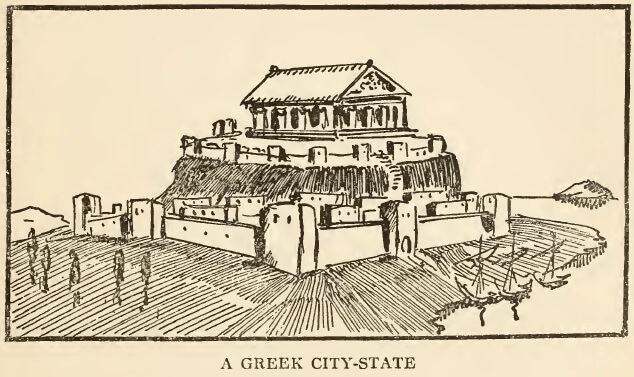
In all matters of government, the Greek democracy recognized only one class of citizens—the freemen. Every Greek city was composed of a small number of free born citizens, a large number of slaves and a sprinkling of foreigners.
The Greek city, therefore, whenever it was not ruled by a king or a tyrant, was run by and for the freemen, and this would not have been possible without a large army of slaves who outnumbered the free citizens at the rate of six or five to one and who performed those tasks to which we modern people must devote most of our time and energy if we wish to provide for our families and pay the rent of our apartments. The slaves did all the cooking and baking and candlestick making of the entire city. They were the tailors and the carpenters and the jewelers and the school-teachers and the bookkeepers and they tended the store and looked after the factory while the master went to the public meeting to discuss questions of war and peace or visited the theater to see the latest play of Aeschylus or hear a discussion of the revolutionary ideas of Euripides, who had dared to express certain doubts upon the omnipotence of the great god Zeus.
Indeed, ancient Athens resembled a modern club. All the freeborn citizens were hereditary members and all the slaves were hereditary servants, and waited upon the needs of their masters.
The slaves also took care of those tasks which nowadays are performed by the business people and the professional people. As for those household duties which take up so much of the time of your parents, the Greeks, who understood the value of leisure, had reduced such duties to the smallest possible minimum by living amidst surroundings of extreme simplicity.
To begin with, their homes were very plain. Even the rich nobles spent their lives in a sort of adobe barn, which lacked all the comforts which a modern workers expects as their natural right. A Greek home consisted of four walls and a roof. There was a door which led into the street but there were no windows. The kitchen, the living rooms and the sleeping quarters were built around an open courtyard in which there was a small fountain, or a statue and a few plants to make it look bright. Within this courtyard the family lived when it did not rain or when it was not too cold. In one corner of the yard the cook (who was a slave) prepared the meal and in another corner, the teacher (who was also a slave) taught the children the alpha beta gamma and the tables of multiplication and in still another corner the lady of the house, who rarely left her domain (since in those ancient times it was not considered good form for a married woman to be seen on the street too often) was repairing her husband’s coat with her seamstresses (who were slaves,) and in the little office, right off the door, the master was inspecting the accounts which the overseer of his farm (who was a slave) had just brought to him.
When dinner was ready the family came together but the meal was a very simple one and did not take much time. The Greeks seem to have regarded eating as an unavoidable evil and not a pastime, which kills many dreary hours and eventually kills many dreary people. They lived on bread and on wine, with a little meat and some green vegetables. They drank water only when nothing else was available because they did not think it very healthy. They loved to call on each other for dinner, but our idea of a festive meal, where everybody is supposed to eat much more than is good for him, would have disgusted them. They came together at the table for the purpose of a good talk and a good glass of wine and water, but as they were moderate people they despised those who drank too much.
The same simplicity which prevailed in the dining room also dominated their choice of clothes. They liked to be clean and well groomed, to have their hair and beards neatly cut, to feel their bodies strong with the exercise and the swimming of the gymnasium, but they never followed the Asiatic fashion which prescribed loud colors and strange patterns. They wore a long white coat and they managed to look as smart as a modern Italian officer in his long blue cape.
They loved to wear ornaments but they thought it very vulgar to display their wealth (or their wives) in public and whenever the women left their home they were as inconspicuous as possible.
In short, the story of Greek life is a story not only of moderation but also of simplicity. “Things,” chairs and tables and books and houses and carriages, are apt to take up a great deal of their owner’s time. In the end they invariably make him their slave and their hours are spent looking after their wants, keeping them polished and brushed and painted. The Greeks, before everything else, wanted to be “free,” both in mind and in body. That they might maintain their liberty, and be truly free in spirit, they reduced their daily needs to the lowest possible point.
 articlesforchristians