It is the figure of a being with two natures. Jamieson, in his Celestial Atlas, 1822, says, “On the authority of the most accomplished Orientalist of our own times, the Arabic and Chaldaic name of this constellation is בזה.” Now this Hebrew word Bezeh (and the Arabic Al Beze) means the despised. It is the very word used of this Divine sufferer in Isa. liii. 3, “He is despised (נִבְזֶה) and rejected of men.”
Plate 3: Centaurus (the Centaur)
The constellation contains thirty-five stars. Two of the 1st magnitude, one of the 2nd, six of the 3rd, nine of the 4th, etc., which, together with the four bright stars in the Cross make a brilliant show in southern latitudes.
The brightest star, α (in the horse’s fore-foot), has come down to us with the ancient name of Toliman, which means the heretofore and hereafter, marking Him as the one “which is, and which was, and which is to come—the Almighty” (Rev. i. 8). Sir John Herschell observed this star to be growing rapidly brighter. It may be, therefore, one of the changeable stars, and its name may be taken as an indication of the fact that it was known to the ancients.
Another name for the constellation was in Hebrew, Asmeath, which means a sin-offering (as in Isa. liii. 10).
The Greek name was Cheiron, which means the pierced, or who pierces. In the Greek fables Cheiron was renowned for his skill in hunting, medicine, music, athletics, and prophecy. All the most distinguished heroes of Greece are described as his pupils. He was supposed to be immortal, but he voluntarily agreed to die; and, wounded by a poisoned arrow (not intended for him) while in conflict with a wild boar, he transferred his immortality to Prometheus; whereupon he was placed amongst the stars.
We can easily see how this fable is the ignorant perversion of the primitive Revelation. The true tradition can be seen dimly through it, and we can discern Him of whom it spoke,—the all-wise, all-powerful Teacher and Prophet, who “went about doing good,” yet “despised and rejected of men,” laying down His life that others might live.
It is one of the lowest of the constellations, i.e. the farthest south from the northern centre. It is situated immediately over the Cross, which bespeaks His own death; He is seen in the act of destroying the enemy.
Thus these star-pictures tell us that it would be as a child that the Promised Seed should come forth and grow and wax strong in spirit and be filled with wisdom (Luke ii. 40); and that as a man having two natures He should suffer and die. Then the third and last section in this first chapter of this First Book goes on to tell of His second coming in glory.
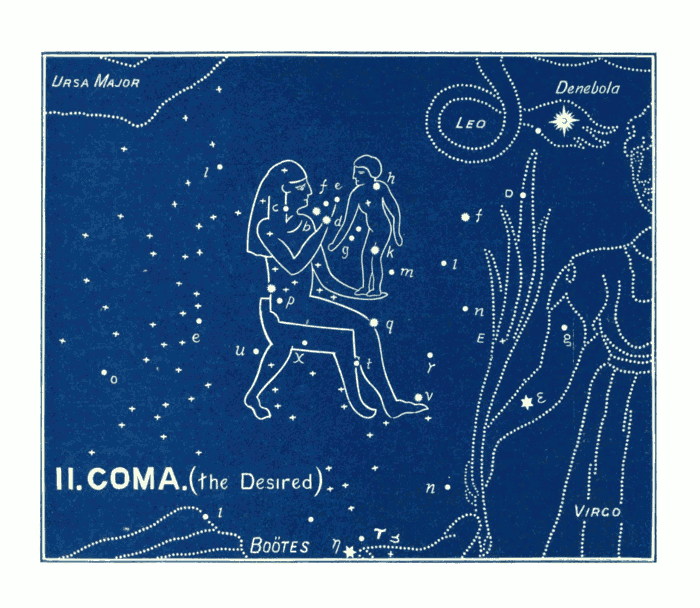
The first constellation in Virgo explains that this coming “Branch” will be a child, and that He should be the “Desire of all nations.”
The ancient name of this constellation is Comah, the desired, or the longed for. We have the word used by the Holy Spirit in this very connection, in Hag. ii. 7: “The DESIRE of all nations shall come.”
Plate 2: Coma (the Desired)
The ancient Zodiacs pictured this constellation as a woman with a child in her arms. Albumazar (or Abu Masher), an Arabian astronomer of the eighth century, says, “There arises in the first Decan, as the Persians, Chaldeans, and Egyptians, and the two Hermes and Ascalius teach, a young woman, whose Persian name denotes a pure virgin, sitting on a throne, nourishing an infant boy (the boy, I say), having a Hebrew name, by some nations called IHESU, with the signification IEZA, which in Greek is called CHRISTOS.”
But this picture is not found in any of the modern maps of the stars. There we find to-day a woman’s wig! It appears that Berenice, the wife of Euergetes (Ptolemy III.), king of Egypt in the third century b.c., when her husband once went on a dangerous expedition, vowed to consecrate her fine head of hair to Venus if he returned in safety. Her hair, which was hung up in the Temple of Venus, was subsequently stolen, and to comfort Berenice, Conon, an astronomer of Alexandria (b.c. 283-222), gave it out that Jupiter had taken it and made it a constellation!
This is a good example of how the meaning of other constellations have been perverted (ignorantly or intentionally). In this case, as in others, the transition from ancient to more modern languages helped to hide the meaning. The Hebrew name was Coma (desired). But the Greeks had a word for hair, Có-me. This again is transferred to the Latin coma, and thus “Coma Berenicæ” (the hair of Berenice) comes down to us to-day as the name of this constellation, and gives us a woman’s wig instead of that Blessed One, “the Desire of all Nations.”
In this case, however, we are able to give absolute proof that this is a perversion.
The ancient Egyptian name for this constellation was Shes-nu, the desired son!
The Zodiac in the Temple of Denderah, in Egypt, going back at least 2,000 years b.c., has no trace of any hair, but it has the figure of a woman and child. In our illustration we have given a copy of this very ancient picture, and not the wig of hair!
We have been permitted to trace it from a work on Egyptian Scenery by the late eminent astronomer, Edward J. Cooper, of Markree Castle, co. Sligo, who visited that Temple in the year 1820 with an Italian artist, Signor Bossi. The original drawing from which our tracing is made (and enlarged) was drawn by Signor Bossi on the spot, before it was taken to Paris in 1821. We thus have before us the exact representations of one of these star-pictures at least 4,000 years old.
Even Shakespeare understood the truth about this constellation picture, which has been so long covered by modern inventions. In his Titus Andronicus he speaks of an arrow being shot up to heaven to the “Good boy in Virgo’s lap.”
The constellation itself is very remarkable. Others contain one or two stars of the first or second magnitude, and then a greater or less variety of lesser stars; but this is peculiar from having no one very bright star, but contains so many stars of the 4th and 5th magnitudes. It contains 43 stars altogether, ten being of the 4th magnitude, and the remainder of the 5th, 6th, etc.
It was in all probability the constellation of Coma in which “the Star of Bethlehem” appeared. There was a traditional prophecy, well-known in the East, carefully preserved and handed down, that a new star would appear in this sign when He whom it foretold should be born.
This was, doubtless, referred to in the prophecy of Balaam, which would thus receive a double fulfilment, first of the literal “Star,” and also of the person to whom it referred. The Lord said by Balaam (Num. xxiv. 17),
“There shall come a star out of Jacob,
And a sceptre shall rise out of Israel.”
Thomas Hyde, an eminent Orientalist (1636-1703), writing on the ancient religion of the Persians, quotes from Abulfaragius (an Arab Christian Historian, 1226-1286), who says that Zoroaster, or Zerdusht, the Persian, was a pupil of Daniel the Prophet, and that he predicted to the Magians (who were the astronomers of Persia), that when they should see a new star appear it would notify the birth of a mysterious child, whom they were to adore. It is further stated in the Zend Avesta that this new star was to appear in the sign of the Virgin. Some have supposed that this passage is not genuine. But whether it was interpolated before or after the event, it is equally good evidence for our purpose here. For if it was written before the event, it is evidence of the prophetic announcement; and if it was interpolated after the event it is evidence of the historic fact.
The Book of Job shows us how Astronomy flourished in Idumea; and the Gospel according to Matthew shows that the Persian Magi, as well as others, were looking for “the Desire of all nations.”
New stars have appeared again and again. It was in 125 b.c. that a star, so bright as to be seen in the day-time, suddenly appeared. It was this that caused Hipparchus to draw up his catalogue of stars, which has been handed down to us by Ptolemy (150 a.d.).
This new star would show the latitude, passing at that time immediately overhead at midnight, every twenty-four hours; while the prophecy would give the longitude as the land of Jacob. Having these two factors, it would be only a matter of observation, and easy for the Magi to find the place where it would be vertical, and thus to locate the very spot of the birth of Him of whom it was the sign, for they emphatically called it “His Star.” There is a beautiful tradition which relates how, in their difficulty, on their way from Jerusalem to find the actual spot under the Zenith of this star, these Magi sat down beside David’s “Well of Bethlehem” to refresh themselves. There they saw the star reflected in the clear water of the well. Hence it is written that “when they saw the star they rejoiced with exceeding joy,” for they knew they were at the very spot and place of His appearing whence He was to “come forth.”
There can be little doubt that it was a new star. In the first place a new star is no unusual phenomenon. In the second place the tradition is well supported by ancient Christian writers. One speaks of its “surpassing brightness.” Another (Ignatius, Bp. of Antioch, a.d. 69) says, “At the appearance of the Lord a star shone forth brighter than all the other stars.” Ignatius, doubtless, had this from those who had actually seen it! Prudentius (4th cent. a.d.) says that not even the morning star was so fair. Archbishop Trench, who quotes these authorities, says “This star, I conceive, as so many ancients and moderns have done, to have been a new star in the heavens.”
One step more places this new star in the constellation of Coma, and with new force makes it indeed “His star”—the “Sign” of His “coming forth from Bethlehem.” Will it be “the sign of the Son of Man in heaven” (Matt. xxiv. 30) when He shall “come unto” this world again to complete the wondrous prophecies written of Him in the heavenly and earthly Revelations?
Thus does the constellation of Coma reveal that the coming “Seed of the woman” was to be a child born, a son given.
But He was to be more: He was to be God and man—two natures in one person! This is the lesson of the next picture.
The First Book is occupied with the PERSON of the Coming One. It covers the whole ground, and includes the conflict and the victory of the Promised Seed, but with special emphasis on His Coming. The book opens with the promise of His coming, and it closes with the Dragon cast down from heaven.
Chapter I. The Sign VIRGO.
The Promised Seed of the Woman.
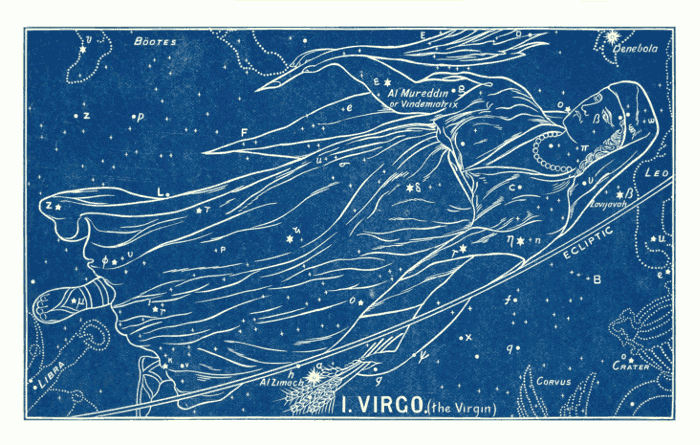
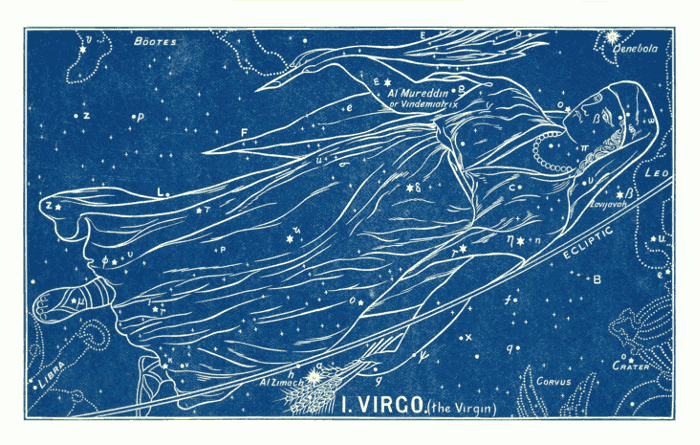
Plate 1: Virgo (the Virgin)
Here is the commencement of all prophecy in Gen. iii. 15, spoken to the serpent:—“I will put enmity between thee and the woman, and between thy seed and her seed: it shall bruise thy head, and thou shalt bruise His heel.” This is the prophetic announcement which the Revelation in the heavens and in the Book is designed to unfold and develope. It lies at the root of all the ancient traditions and mythologies, which are simply the perversion and corruption of primitive truth.
Virgo is represented as a woman with a branch in her right hand, and some ears of corn in her left hand. Thus giving a two-fold testimony of the Coming One.
The name of this sign in the Hebrew is Bethulah, which means a virgin, and in the Arabic a branch. The two words are connected, as in Latin—Virgo, which means a virgin; and virga, which means a branch (Vulg. Isa. xi. 1). Another name is Sunbul, Arabic, an ear of corn.
In Gen. iii. 15 she is presented only as a woman; but in later prophecies her nationality is defined as being of the stock of Israel, the seed of Abraham, the line of David; and, further, she is to be a virgin. There are two prominent prophecies of her and her seed: one is connected with the first coming in incarnation, Isa. vii. 14 (quoted in Matt. i. 23.)
“Behold, a virgin shall conceive and bear a son,
And shall call his name Immanuel.”
The other is connected with His second coming, leaping over the sufferings and this present interval of His rejection, and looking forward to His coming in glory and judgment, Isa. ix. 6, 7 (quoted in Luke ii. 11 and i. 32, 33)—
“For unto us a child is born,
Unto us a son is given;
And the government shall be upon His shoulder;
And His name shall be called Wonderful, Counsellor,
The Mighty God, The Everlasting Father, The Prince of Peace.
Of the increase of His government there shall be no end.
Upon the throne of David, and upon His kingdom,
To order it, and to establish it
With judgment and with justice
From henceforth even for ever.
The zeal of the LORD of hosts will perform this.”
It is difficult to separate the Virgin and her Seed in the prophecy, and so, here, we have first the sign Virgo, where the name points to her as the prominent subject; while in the first of the three constellations of this sign, where the woman appears again, the name Coma points to the child as the great subject.
Virgo contains 110 stars, viz., one of the 1st magnitude, six of the 3rd, ten of the 4th, etc.
Aratus thus sings of them:—
“Beneath Boötes feet the Virgin seek,
Who carries in her hand a glittering spike….
Over her shoulder there revolves a star
In the right wing, superlatively bright;
It rolls beneath the tail, and may compare
With the bright stars that deck the Greater Bear.
Upon her shoulder one bright star is borne,
One clasps the circling girdle of her loins,
One at her bending knee; and in her hand
Glitters that bright and golden Ear of Corn.
Thus, the brightest star in Virgo (α) has an ancient name, handed down to us in all the star-maps, in which the Hebrew word (צֶמֶח) Tsemech is preserved. It is called in Arabic Al Zimach, which means the branch. This star is in the ear of corn which she holds in her left hand. Hence the star has a modern Latin name, which has almost superseded the ancient one, Spica, which means, an ear of corn. But this hides the great truth revealed by its name Al Zimach. It foretold the coming of Him who should bear this name. The same Divine inspiration has, in the written Word, four times connected it with Him. There are twenty Hebrew words translated “Branch,” but only one of them (Tsemech) is used exclusively of the Messiah, and this word only four times. Each of these further connects Him with one special account of Him, given in the Gospels.
(1.) Jer. xxiii. 5, 6—
“Behold, the days come, saith the LORD,
That I will raise unto David a righteous BRANCH
(i.e., a Son),
And a KING shall reign and prosper.”
The account of His coming as King is written in the Gospel according to Matthew, where Jehovah says to Israel, “Behold thy KING.” (Zech. ix. 9; Matt. xxi. 9.)
(2.) Zech. iii. 8.—“Behold I will bring forth my SERVANT the BRANCH.” In the Gospel according to Mark we find the record of Jehovah’s servant and His service, and we hear Jehovah’s voice saying, “Behold my SERVANT.” (Isa. xlii. 1.)
(3.) Zech. vi. 12.—“Thus speaketh the Lord of hosts, saying, Behold the MAN whose name is the [pg 033]BRANCH.” In the Gospel according to Luke we behold Him, presented in “the MAN Christ Jesus.”
(4.) Isa. iv. 2.—“In that day shall the BRANCH of JEHOVAH be beautiful and glorious.” So that this Branch, this Son, is Jehovah Himself; and as we read the record of John we hear the voice from heaven saying, “Behold your GOD.” (Isa. xl. 9.)
This is the Branch foretold by the star Al Zimach in the ear of corn.
The star β is called Zavijaveh, which means the gloriously beautiful, as in Isa. iv. 2. The star ε, in the arm bearing the branch, is called Al Mureddin, which means who shall come down (as in Ps. lxxii. 8), or who shall have dominion. It is also known as Vindemiatrix, a Chaldee word which means the son, or branch, who cometh.
Other names of stars in the sign, not identified, are—
Subilah, who carries. (Isa. xlvi. 4.)
Al Azal, the Branch. (As in Isa. xviii. 5.)
Subilon, a spike of corn. (As in Isa. xvii. 5.)
The Greeks, ignorant of the Divine origin and teaching of the sign, represented Virgo as Ceres, with ears of corn in her hand.
In the Zodiac in the Temple of Denderah, in Egypt, about 2000 b.c. (now in Paris), she is likewise represented with a branch in her hand, but ignorantly explained by a false religion to represent Isis! Her name is called Aspolia, which means ears of corn, or the seed, which shows that though the woman is seen, it is her Seed who is the great subject of the prophecy.
Passing to the three constellations anciently assigned to the sign Virgo, we come to what may be compared to three sections of the chapter, each giving some further detail as to the interpretation of its teaching.
For more than two thousand five hundred years the world was without a written revelation from God. The question is, Did God leave Himself without a witness? The question is answered very positively by the written Word that He did not. In Rom. i. 19 it is declared that, “that which may be known of God is manifest in them; for God hath showed it unto them. For the invisible things of Him from the creation of the world are clearly seen, being understood by the things that are made, even His eternal power and Godhead; so that they are without excuse.” But how was God known? How were His “invisible things,” i.e., His plans, His purposes, and His counsels, known since the creation of the world? We are told by the Holy Spirit in Rom. x. 18. Having stated in v. 17 that “Faith cometh by hearing and hearing by the Word (ῥήμα, the thing spoken, sayings) of God,” He asks, “But I say, Have they not heard? Yes, verily.” And we may ask, How have they heard? The answer follows—“Their sound went into all the earth (γή) and their words (ῥήματα, their teaching, message, instruction) unto the ends of the world (οἰκουμένη).” What words? What instruction? Whose message? Whose teaching? There is only one answer, and that is, THE HEAVENS! This is settled by the fact that the passage is quoted from Ps. xix., the first part of which is occupied with the Revelation of God written in the Heavens, and the latter part with the Revelation of God written in the Word.
This is the simple explanation of this beautiful Psalm. This is why its two subjects are brought together. It has often perplexed many why there should be that abrupt departure in verse 7—“The law of the Lord is perfect, converting the soul.” The fact is, there is nothing abrupt in it, and it is no departure. It is simply the transition to the second of the two great Revelations which are thus placed in juxtaposition. The first is the Revelation of the Creator, El, אֵל, in His works, while the second is the Revelation of the Covenant Jehovah, יְהוָה, in His Word. And it is noteworthy that while in the first half of the Psalm, El is named only once, in the latter half Jehovah is named seven times, the last being threefold (Jehovah, Rock, and Redeemer), concluding the Psalm.
Let us then turn to Ps. xix., and note first—
The Structure of the Psalm as a whole.
A | 1-4-. The Heavens.
B | -4-6. “In them” (בָּהֶם) the Sun.
A | 7-10. The Scriptures.
B | 11-14. “In them” (בָּהֶם) Thy Servant.
In the Key to the Psalms, p. 17, it is pointed out that the terms employed in A and B are astronomical, while in A and B they are literary. Thus, the two parts are significantly connected and united.
Ewald and others imagine that this Psalm is made up of two fragments of separate Psalms composed at different periods and brought together by a later editor!
But this is disproved not only by what has been said concerning the structure of the Psalm as a whole, and the interlacing of the astronomical and the literary terms in the two parts, but it is also shown by more minute details.
Each half consists of two portions which correspond the one to the other, A answering to A, and B to B. Moreover, each half, as well as each corresponding member, consists of the same number of lines; those in the first half being, by the cæsura, short, while those in the last half are long (or double).
A | 1-4-. Eight lines
B | -4-6. Six lines
A | 7-10. Eight lines
B | 11-14. Six lines
If we confine ourselves to the first half of the Psalm (A and B, verses 1-6), with which we are now alone concerned, we see a still more minute proof of Divine order and perfection.
The Structure of A and B.
A & B | C | 1. The heavens.
| D | 2. Their testimony: incessant. (Pos.)
| E | 3. Their words inaudible. (Neg.)
| D | 4-. Their testimony: universal. (Pos.)
| C | -4-6. The heavens.
Here we have an introversion, in which the extremes (C and C) are occupied with the heavens; while the means (D, E and D) are occupied with their testimony.
The following is the full expansion of the above, with original emendations which preserve the order of the Hebrew words and thus indicate the nature of the structure:—
C | a | The heavens
b | are telling
c | the glory of God:
c | and the work of his hands
b | is setting forth
a | the firmament.
D | d | Day after day
e | uttereth speech,
d | And night after night
e | sheweth knowledge.
E | f | There is no speech (what is articulate)
g | and there are no words (what is audible);
g | and without being audible,
f | is their voice (what is articulate).
D | h | Into all the earth (as created)
i | is their line gone forth;
h | And into the ends of the world (as inhabited)
i | Their sayings.
C | j | For the sun He hath set a tent (an abode) in them;
k | l | and he as a bridegroom (comparison)
m | is going forth from his canopy, (motion: its rising)
l | he rejoiceth as a mighty one (comparison)
m | to run his course. (Motion: its rapid course.)
k | n | from the end of the heavens (egress)
o | is his going forth (egress)
o | and his revolution (regress)
n | unto their ends (regress):
j | and there is nothing hid from his heat (i.e., from him)
Surely there is something more referred to here than a mere wonder excited by the works of the Creator! When we read the whole passage and mark its structure, and note the words employed, we are emphatically told that the heavens contain a revelation from God; they prophesy, they show knowledge, they tell of God’s glory, and set forth His purposes and counsels.
It is a remarkable fact that it is in the Book of Job, which is generally allowed to be the oldest book in the Bible, if not in the world, that we have references to this Stellar Revelation. This would be at least 2,000 years before Christ. In that book the signs of the Zodiac and the names of several stars and constellations are mentioned, as being ancient and well-known.
In Isa. xl. 26 (r.v.) we read:—
“Lift up your eyes on high,
And see who hath created these,
That bringeth out their host by number:
He calleth them all by name;
By the greatness of His might,
And for that He is strong in power,
Not one is lacking.”
We have the same evidence in Psalm cxlvii. 4. (r.v.)
“He telleth the number of the stars;
He giveth them all their names.”
Here is a distinct and Divine declaration that the great Creator both numbered as well as named the stars of Heaven.
The question is, Has he revealed any of these names? Have any of them been handed down to us?
The answer is Yes; and that in the Bible itself we have the names (so ancient that their meaning is a little obscure) of Ash (עָשׁ, a name still connected with the Great Bear), Cesil (כְּסִיל), and Cimah (כִּימָה).
They occur in Job ix. 9: “Which maketh Arcturus (r.v. the Bear), Orion, and Pleiades, and the chambers of the south.” (Marg., Heb., Ash, Cesil, and Cimah.)
Job xxxviii. 31, 32: “Canst thou bind the sweet influences (r.v. cluster) of the Pleiades (marg., the [pg 008]seven stars, Heb. Cimah), or loose the bands of Orion (marg. Heb. Cesil)? Canst thou bring forth Mazzaroth (marg., the twelve signs. r.v., ‘the twelve signs’: and marg., the signs of the Zodiac) in his season? or canst thou guide Arcturus with his sons (r.v., the Bear with her train; and marg., Heb., sons).”
Isa. xiii. 10: … “The stars of heaven and the constellations thereof.” …
Amos v. 8: “Seek him that maketh the seven stars (r.v., the Pleiades) and Orion.”
Then we have the term “Mazzaroth,” Job xxxviii. 32, and “Mazzaloth,” 2 Kings xxiii. 5. The former in both versions is referred to the Twelve Signs of the Zodiac, while the latter is rendered “planets,” and in margin, the twelve signs or constellations.
Others are referred to by name. The sign of “Gemini,” or the Twins, is given as the name of a ship: Acts xxviii. 11, Διόσκουροι, (i.e. Castor & Pollux).
Most commentators agree that the constellation of “Draco,” or the Dragon (between the Great and Little Bear), is referred to in Job xxvi. 13: “By His Spirit He hath garnished the heavens; His hand hath formed the crooked serpent (r.v. swift. Marg. fleeing or gliding. See Is. xxvii. 1; xliii. 14).” This word “garnished” is peculiar. The r.v. puts in the margin, beauty. In Ps. xvi. 6, it is rendered goodly. “I have a goodly heritage.” In Dan. iv. 2, it is rendered, “I thought [pg 009]it good to show,” referring to “the signs and wonders” with which God had visited Nebuchadnezzar. It appears from this that God “thought it good to show” by these signs written in the heavens the wonders of His purposes and counsels, and it was by His Spirit that He made it known; it was His hand that coiled (חוּל) the crooked serpent among the stars of heaven.
Thus we see that the Scriptures are not silent as to the great antiquity of the signs and constellations.
If we turn to history and tradition, we are at once met with the fact that the Twelve Signs are the same, both as to the meaning of their names and as to their order in all the ancient nations of the world. The Chinese, Chaldean, and Egyptian records go back to more than 2,000 years b.c. Indeed, the Zodiacs in the Temples of Denderah and Esnéh, in Egypt, are doubtless copies of Zodiacs still more ancient, which, from internal evidence, must be placed nearly 4,000 b.c., when the summer solstice was in Leo.
Josephus hands down to us what he gives as the traditions of his own nation, corroborated by his reference to eight ancient Gentile authorities, whose works are lost. He says that they all assert that “God gave the antediluvians such long life that they might perfect those things which they had invented in astronomy.” Cassini commences his History of Astronomy by saying “It is impossible to doubt that astronomy was invented from the beginning of the world; history, profane as well as sacred, testifies to this truth.” Nouet, a French astronomer, infers that the Egyptian Astronomy must have arisen 5,400 b.c.!
Ancient Persian and Arabian traditions ascribe its invention to Adam, Seth, and Enoch. Josephus asserts that it originated in the family of Seth; and he says that the children of Seth, and especially Adam, Seth, and Enoch, that their revelation might not be lost as to the two coming judgments of Water and Fire, made two pillars (one of brick, the other of stone), describing the whole of the predictions of the stars upon them, and in case the brick pillar should be destroyed by the flood, the stone would preserve the revelation (Book i. chs. 1-3).
This is what is doubtless meant by Gen. xi. 4, “And they said, Go to, let us build us a city and a tower whose top may reach unto heaven.” The words “may reach” are in italics. There is nothing in the verse which relates to the height of this tower. It merely says וְרֹאשׁוֹ בַשָּׁמַיִם, and his top with the heavens, i.e. with the pictures and the stars, just as we find them in the ancient temples of Denderah and Esnéh in Egypt. This tower, with its planisphere and pictures of the signs and constellations, was to be erected like those temples were afterwards, in order to preserve the revelation, “lest we be scattered abroad upon the face of the whole earth.”
This is corroborated by Lieut.-Gen. Chesney, well known for his learned researches and excavations among the ruins of Babylon, who, after describing his various discoveries, says, “About five miles S.W. of Hillah, the most remarkable of all the ruins, the Birs Nimroud of the Arabs, rises to a height of 153 feet above the plain from a base covering a square of 400 feet, or almost four acres. It was constructed of kiln-dried bricks in seven stages to correspond with the planets to which they were dedicated: the lowermost black, the colour of Saturn; the next orange, for Jupiter; the third red, for Mars; and so on. These stages were surmounted by a lofty tower on the summit of which, we are told, were the signs of the Zodiac and other astronomical figures; thus having (as it should have been translated) a representation of the heavens, instead of ‘a top which reached unto heaven.’ ”
This Biblical evidence carries us at once right back to the Flood, or about 2,500 years b.c.
This tower or temple, or both, was also called “The Seven Spheres,” according to some; and “The Seven Lights,” according to others. It is thus clear that the popular idea of its height and purpose must be abandoned, and its astronomical reference to revelation must be admitted. The tower was an attempt to preserve and hand down the antediluvian traditions; their sin was in keeping together instead of scattering themselves over the earth.
Another important statement is made by Dr. Budge, of the British Museum. He says, “It must never be forgotten that the Babylonians were a nation of star-gazers, and that they kept a body of men to do nothing else but report eclipses, appearances of the moon, sun-spots, etc., etc.”
“Astronomy, mixed with astrology, occupied a large number of tablets in the Babylonian libraries, and Isaiah, xlvii. 13, refers to this when he says to Babylon, ‘Thou art wearied in the multitude of thy counsels. Let now thy astrologers (marg. viewers of the heavens), the star-gazers, the monthly prognosticators stand up.’ The largest astrological work of the Babylonians contained seventy tablets, and was compiled by the command of Sargon of Agade thirty-eight hundred years before Christ! It was called the ‘Illumination of Bel.’ ”
“Their observations were made in towers called ‘ziggurats’ ” (p. 106).
“They built observatories in all the great cities, and reports like the above [which Dr. Budge gives in full] were regularly sent to the King” (p. 110).
“They were able to calculate eclipses, and had long lists of them.” “They found out that the sun was spotted, and they knew of comets.” “They were the inventors of the Zodiac” (?). There are fragments of two (ancient Babylonian) planispheres in the British Museum with figures and calculations inscribed upon them. “The months were called after the signs of the Zodiac” (p. 109).
We may form some idea of what this “representation of the heavens” was from the fifth “Creation Tablet,” now in the British Museum. It reads as follows:—
“Anu [the Creator] made excellent the mansions [i.e.the celestial houses] of the great gods [twelve] in number [i.e.the twelve signs or mansions of the sun].
The stars he placed in them. The lumasi [i.e.groups of stars or figures] he fixed.
He arranged the year according to the bounds [i.e.the twelve signs] which he defined.
For each of the twelve months three rows of stars [i.e.constellations] he fixed.
From the day when the year issues forth unto the close, he marked the mansions [i.e.the Zodiacal Signs] of the wandering stars [i.e.planets] to know their courses that they might not err or deflect at all.”
Coming down to less ancient records: Eudoxos, an astronomer of Cnidus (403 to 350 b.c.), wrote a work on Astronomy which he called Phainomena. Antigonus Gonatas, King of Macedonia (273-239 b.c.), requested the Poet Aratus to put the work of Eudoxus into the form of a poem, which he did about the year 270 b.c. Aratus called his work Diosemeia (the Divine Signs). He was a native of Tarsus, and it is interesting for us to note that his poem was known to, and, indeed, must have been read by, the Apostle Paul, for he quotes it in his address at Athens on Mars’ Hill. He says (Acts xvii. 28), “For in Him we live, and move, and have our being; as certain also of your own poets have said, For we are also his offspring.” Several translations of this poem have been made, both by Cicero and others, into Latin, and in recent times into English by E. Poste, J. Lamb, and others. The following is the opening from the translation of Robert Brown, jun.:—
“From Zeus we lead the strain; he whom mankind
Ne’er leave unhymned: of Zeus all public ways,
All haunts of men, are full; and full the sea,
And harbours; and of Zeus all stand in need.
We are his offspring: and he, ever good and mild to man,
Gives favouring signs, and rouses us to toil.
Calling to mind life’s wants: when clods are best
For plough and mattock: when the time is ripe
For planting vines and sowing seeds, he tells,
Since he himself hath fixed in heaven these Signs,
The stars dividing: and throughout the year
Stars he provides to indicate to man
The seasons’ course, that all things duly grow,” etc., etc.
Then Aratus proceeds to describe and explain all the Signs and Constellations as the Greeks in his day understood, or rather misunderstood, them, after their true meaning and testimony had been forgotten.
Moreover, Aratus describes them, not as they were seen in his day, but as they were seen some 4,000 years before. The stars were not seen from Tarsus as he describes them, and he must therefore have written from a then ancient Zodiac. For notwithstanding that we speak of “fixed stars,” there is a constant, though slow, change taking place amongst them. There is also another change taking place owing to the slow recession of the pole of the heavens (about 50″ in the year); so that while Alpha in the constellation of Draco was the Polar Star when the Zodiac was first formed, the Polar Star is now Alpha in what is called Ursa Minor. This change alone carries us back at least 5,000 years. The same movement which has changed the relative position of these two stars has also caused the constellation of the Southern Cross to become invisible in northern latitudes. When the constellations were formed the Southern Cross was visible in N. latitude 40°, and was included in their number. But, though known by tradition, it had not been seen in that latitude for some twenty centuries, [pg 015]until the Cape of Good Hope had been discovered. Then was seen again The Southern Cross depicted by the Patriarchs. Here is another indisputable proof as to the antiquity of the formation of the Zodiac.
Ptolemy (150 a.d.) transmits them from Hïpparchus (130 b.c.) “as of unquestioned authority, unknown origin, and unsearchable antiquity.”
Sir William Drummond says that “the traditions of the Chaldean Astronomy seem the fragments of a mighty system fallen into ruins.”
The word Zodiac itself is from the Greek Ζωδιακός, which is not from Ζάω, to live, but from a primitive root through the Hebrew Sodi, which in Sanscrit means a way. Its etymology has no connection with living creatures, but denotes a way, or step, and is used of the way or path in which the sun appears to move amongst the stars in the course of the year.
To an observer on the earth the whole firmament, together with the sun, appears to revolve in a circle once in twenty-four hours. But the time occupied by the stars in going round, differs from the time occupied by the sun. This difference amounts to about one-twelfth part of the whole circle in each month, so that when the circle of the heavens is divided up into twelve parts, the sun appears to move each month through one of them. This path which the sun thus makes amongst the stars is called the Ecliptic.
Each of these twelve parts (consisting each of about 30 degrees) is distinguished, not by numbers or by letters, but by pictures and names, and this, as we have seen, from the very earliest times. They are preserved to the present day in our almanacs, and we are taught their order in the familiar rhymes:—
“The Ram, the Bull, the heavenly Twins,
And next the Crab, the Lion shines,
The Virgin and the Scales;
The Scorpion, Archer, and Sea-Goat,
The Man that carries the Water-pot,
And Fish with glittering scales.”
These signs have always and everywhere been preserved in this order, and have begun with Aries. They have been known amongst all nations, and in all ages, thus proving their common origin from one source.
The figures themselves are perfectly arbitrary. There is nothing in the groups of stars to even suggest the figures. This is the first thing which is noticed by every one who looks at the constellations. Take for example the sign of Virgo, and look at the stars. There is nothing whatever to suggest a human form; still less is there anything to show whether that form is a man or a woman. And so with all the others.
The picture, therefore, is the original, and must have been drawn around or connected with certain stars, simply in order that it might be identified and associated with them; and that it might thus be remembered and handed down to posterity.
There can be no doubt, as the learned Authoress of Mazzaroth conclusively proves, that these signs were afterwards identified with the twelve sons of Jacob. Joseph sees the sun and moon and eleven stars bowing down to him, he himself being the twelfth (Gen. xxxvii. 9). The blessing of Jacob (Gen. xlix.) and the blessing of Moses (Deut. xxxiii.) both bear witness to the existence of these signs in their day. And it is more than probable that each of the Twelve Tribes bore one of them on its standard. We read in Num. ii. 2, “Every man of the children of Israel shall pitch by his own Standard, with the Ensign of their father’s house” (r.v. “with the ensigns of their fathers’ houses”). This “Standard” was the Degel (דֶגֶל) on which the “Sign” (אוֹת, Oth) was depicted. Hence it was called the “En-sign.” Ancient Jewish authorities declare that each tribe had one of the signs as its own, [pg 018]and it is highly probable, even from Scripture, that four of the tribes carried its “Sign”; and that these four were placed at the four sides of the camp.
If the Lion were appropriated to Judah, then the other three would be thus fixed, and would be the same four that equally divide the Zodiac at its four cardinal points. According to Num. ii. the camp was thus formed:—
In the North, from North-West to North-East:
Asher (Sagittarius).
Dan, The Scorpion (Scorpio).
Nephtali (Capricornus).
In the East, from North-East to South-East:
Issachar (Cancer).
Judah, The Lion (Leo).
Zebulon (Virgo).
In the South, from South-East to South-West:
Simeon (Pisces).
Reuben, The Man (Aquarius).
Gad (Aries).
In the West, from South-West to North-West:
Ephraim and Manasseh, The Bull (the two horns of Taurus).
Benjamin (Gemini).
In the Center:
Levi, The Scales (Libra).
If the reader compares the above with the blessings of Israel and Moses, and compares the meanings and descriptions given below with those blessings, the connection will be clearly seen. Levi, for example, had no standard, and he needed none, for he kept “the balance of the Sanctuary,” and had the charge of that brazen altar on which the atoning blood outweighed the nation’s sins.
The four great signs which thus marked the four sides of the camp, and the four quarters of the Zodiac, are the same four which form the Cherubim (the Eagle, the Scorpion’s enemy, being substituted for the Scorpion). The Cherubim thus form a compendious expression of the hope of Creation, which, from the very first, has been bound up with the Coming One, who alone should cause its groanings to cease.
But this brings us to the Signs themselves and their interpretation.
These pictures were designed to preserve, expound, and perpetuate the one first great promise and prophecy of Gen. iii. 15, that all hope for Man, all hope for Creation, was bound up in a coming Redeemer; One who should be born of a woman; who should first suffer, and afterwards gloriously triumph; One who should first be wounded by that great enemy who was the cause of all sin and sorrow and death, but who should finally crush the head of “that Old Serpent the Devil.”
These ancient star-pictures reveal this Coming One. They set forth “the sufferings of Christ and the glory that should follow.” Altogether there are forty-eight of them, made up of twelve Signs, each sign containing three Constellations.
These may be divided into three great books, each book containing four chapters (or Signs); and each chapter containing three sections (or Constellations).
Each book (like the four Gospels) sets forth its peculiar aspect of the Coming One; beginning with the promise of His coming, and ending with the destruction of the enemy.
But where are we to begin to read this wondrous Heavenly Scroll? A circle has proverbially neither beginning nor end. In what order then are we to consider these signs? In the heavens they form a never-ending circle. Where is the beginning and where is the end of this circle through which the sun is constantly moving? Where are we to break into this circle? and say, This is the commencement. It is clear that unless we can determine this original starting point we can never read this wondrous book aright.
As I have said, the popular beginning to-day is with Aries, the Ram. But comparing this Revelation with that which was afterwards written “in the Volume of the Book,” Virgo is the only point where we can intelligently begin, and Leo is the only point where we can logically conclude. Is not this what is spoken of as the unknown and insoluble mystery—“The riddle of the Sphinx”? The word “Sphinx” is from σφίγγω, to bind closely together. It was therefore designed to show where the two ends of the Zodiac were to be joined together, and where the great circle of the heavens begins and ends.
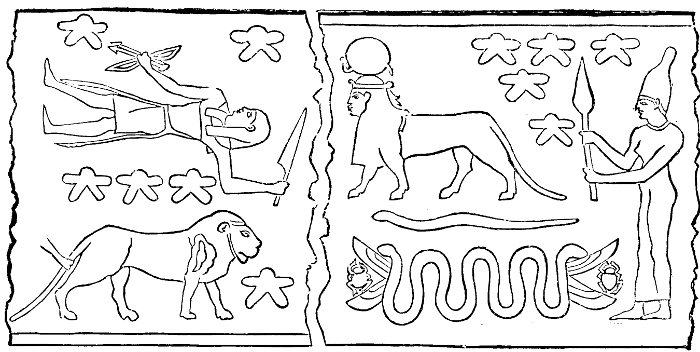
Signs of Leo and Virgo, from the ceiling of the Portico of the Temple of Esneh, showing the Sphinx between, uniting the beginning and end of the Zodiac.
The Sphinx is a figure with the head of a woman and the body of a lion! What is this but a never-ceasing monitor, telling us to begin with Virgo and to end with Leo! In the Zodiac in the Temple of Esnéh, in Egypt, a Sphinx is actually placed between the Signs of Virgo and Leo, as shown in the illustration on the preceding page. It is a tracing from the drawing of Signor Bossi, executed on the spot, under the direction of the late Mr. Edward J. Cooper, in 1820.
Beginning, then, with Virgo, let us now spread out the contents of this Heavenly Volume, so that the eye can take them in at a glance. Of course we are greatly hindered in this, in having to use the modern Latin names which the Constellations bear to-day. Some of these names are mistakes, others are gross perversions of the truth, as proved by the pictures themselves, which are far more ancient, and have come down to us from primitive times.
After the Revelation came to be written down in the Scriptures, there was not the same need for the preservation of the Heavenly Volume. And after the nations had lost the original meaning of the pictures, they invented a meaning out of the vain imagination of the thoughts of their hearts. The Greek Mythology is an interpretation of (only some of) the signs and constellations after their true meaning had been forgotten. It is popularly believed that Bible truth is an evolution from, or development of, the ancient religions of the world. But the fact is that they themselves are a corruption and perversion of primitive truth!
We will now give the contents of this Heavenly Volume of Divine Revelation, and afterwards proceed to develope it, explain it in detail, and compare it with the same truth which was afterwards written down in the Scriptures.
The First Book. THE REDEEMER. (His First Coming.) “The Sufferings of Christ.”
CHAPTER I. The Prophecy of the Promised Seed of the Woman.
VIRGO (The Virgin. A woman bearing a branch in her right hand and an ear of corn in her left). The Promised Seed of the woman.
§ 1. Coma (The Desired. The woman and child). The Desired of all nations.
§ 2. Centaurus (The Centaur with two natures, holding a spear piercing a victim). The despised sin offering.
§ 3. Boötes (a man walking bearing a branch called Arcturus, meaning the same). He cometh.
CHAPTER II. The Redeemer’s Atoning Work.
LIBRA (The Scales). The price deficient balanced by the price which covers.
§ 1. CRUX, The Cross endured.
§ 2. LUPUS, or VICTIMA, The Victim slain.
§ 3. CORONA, The Crown bestowed.
CHAPTER III. The Redeemer’s Conflict.
SCORPIO (The Scorpion) seeking to wound, but itself trodden under foot.
§ 1. Serpens (The Serpent struggling with the man).
§ 2. O-phi-u-chus (The man grasping the serpent). The struggle with the enemy.
§ 3. Hercules (The mighty man. A man kneeling on one knee, humbled in the conflict, but holding aloft the tokens of victory, with his foot on the head of the Dragon). The mighty Vanquisher seeming to sink in the conflict.
CHAPTER IV. The Redeemer’s Triumph.
SAGITTARIUS (The Archer). The Two-natured Conqueror going forth “Conquering and to conquer.”
§ 1. Lyra (The Harp). Praise prepared for the Conqueror.
§ 2. Ara (The Altar). Consuming fire prepared for His enemies.
§ 3. Draco (The Dragon). The Old Serpent—the Devil, cast down from heaven.
The Second Book. THE REDEEMED. The Result of the Redeemer’s Sufferings.
CHAPTER I. Their Blessings Procured.
CAPRICORNUS (The fish-goat). The goat of Atonement slain for the Redeemed.[pg 025]
§ 1. Sagitta (The Arrow). The arrow of God sent forth.
§ 2. Aquila (The Eagle). The smitten One falling.
§ 3. Delphinus (The Dolphin). The dead One rising again.
CHAPTER II. Their Blessings Ensured.
AQUARIUS (The Water-Bearer): The living waters of blessing poured forth for the Redeemed.
§ 1. Piscis Australis (The Southern Fish). The blessings bestowed.
§ 2. Pegasus (The Winged Horse). The blessings quickly coming.
§ 3. Cygnus (The Swan). The Blesser surely returning.
CHAPTER III. Their Blessings in Abeyance.
PISCES (The Fishes). The Redeemed blessed though bound.
§ 1. The Band—bound, but binding their great enemy Cetus, the sea monster.
§ 2. Andromeda (The Chained Woman). The Redeemed in their bondage and affliction.
§ 3. Cepheus (The King). Their Redeemer coming to rule.
CHAPTER IV. Their Blessings Consummated and Enjoyed.
ARIES (The Ram or Lamb). The Lamb that was slain, prepared for the victory.
§ 1. Cassiopeia (The Enthroned Woman). The captive delivered, and preparing for her husband, the Redeemer.
§ 2. Cetus (The Sea Monster). The great enemy bound.
§ 3. Perseus (The Breaker). Delivering His redeemed.
The Third Book. THE REDEEMER. (His Second Coming.) “The glory that should follow.”
CHAPTER I. Messiah, the coming Judge of all the Earth.
TAURUS (The Bull). Messiah coming to rule.
§ 1. Orion, Light breaking forth in the person of the Redeemer.
§ 2. Eridanus (The River of the Judge). Wrath breaking forth for His enemies.
§ 3. Auriga (The Shepherd). Safety for the Redeemed in the day of that wrath.
CHAPTER II. Messiah’s Reign as Prince of Peace.
GEMINI (The Twins). The twofold nature of the King.
§ 1. Lepus (The Hare), or THE ENEMY trodden under foot.
§ 2. Canis Major (The Dog), or Sirius, the coming glorious Prince of Princes.
§ 3. Canis Minor (The Second Dog), or Procyon, the exalted Redeemer.
CHAPTER III. Messiah’s Redeemed Possessions.
CANCER (The Crab). The possessions held fast.
§ 1. Ursa Minor (The Lesser Bear). The lesser sheepfold.
§ 2. Ursa Major (The Great Bear). The fold and the flock.
§ 3. Argo (The Ship). The redeemed pilgrims safe at home.
CHAPTER IV. Messiah’s Consummated Triumph.
LEO (The Lion). The Lion of the Tribe of Judah aroused for the rending of the Enemy.
§ 1. Hydra (The Serpent). That old Serpent—the Devil, destroyed.
§ 2. Crater (The Cup). The cup of Divine wrath poured out upon him.
§ 3. Corvus (The Crow, or Raven). Birds of prey devouring him.
Such are the contents of this wondrous book that is written in the heavens. Thus has God been speaking and emphasizing and developing His first great prophetic promise of Gen. iii. 15.
Though for more than 2,500 years His people had not this Revelation written in a book as we now have it in the Bible, they were not left in ignorance and darkness as to God’s purposes and counsels; nor were they without hope as to ultimate deliverance from all evil and from the Evil One.
Adam, who first heard that wondrous promise, repeated it, and gave it to his posterity as a most precious heritage—the ground of all their faith, the substance of all their hope, the object of all their desire. Seth and Enoch took it up. Enoch, we know, prophesied of the Lord’s coming, saying, “Behold the Lord cometh with ten thousands of His saints to execute judgment upon all” (Jude 14). How could these “holy prophets, since the world began,” have recorded their prophecies better, or more effectually, or more truthfully and powerfully, than in these star-pictures and their interpretation? This becomes a certainty when we remember the words of the Holy Spirit by Zacharias (Luke i. 67-70):—
“Blessed be the Lord God of Israel;
For He hath visited and redeemed His people,
And hath raised up a horn of salvation for us
In the house of His servant David;
As He spake by the mouth of HIS HOLY PROPHETS
WHICH HAVE BEEN SINCE THE WORLD BEGAN.”
The same truth is revealed through Peter, in Acts iii. 20, 21:—“He shall send Jesus Christ, which before was preached unto you; whom the heaven must receive until the times of restitution of all things, which God hath spoken by the mouth of all HIS HOLY PROPHETS SINCE THE WORLD BEGAN.”
These words have new meaning for us, if we see the things which were spoken “since the world began,” thus written in the heavens, which utter speech (i.e. prophecy), and show forth this knowledge day after day and night after night, the heritage of all the earth, and their words reaching unto the ends of the world.
This Revelation, coinciding as it does in all its facts and truths with that afterwards recorded “in the Volume of the Book,” must have had the same Divine origin, must have been made known by the inspiration of the same Holy Spirit.
We now proceed to compare the two, and we shall see how they agree at every point, proving that the source and origin of this Divine Revelation is one and the same.
Some years ago it was my privilege to enjoy the acquaintance of Miss Frances Rolleston, of Keswick, and to carry on a correspondence with her with respect to her work, Mazzaroth: or, the Constellations. She was the first to create an interest in this important subject. Since then Dr. Seiss, of Philadelphia, has endeavoured to popularize her work on the other side of the Atlantic; and brief references have been made to the subject in such books as Moses and Geology, by Dr. Kinns, and in Primeval Man; but it was felt, for many reasons, that it was desirable to make another effort to set forth, in a more complete form, the witness of the stars to prophetic truth, so necessary in these last days.
To the late Miss Rolleston, however, belongs the honour of collecting a mass of information bearing on this subject; but, published as it was, chiefly in the form of notes, unarranged and unindexed, it was suited only for, but was most valuable to, the student. She it was who performed the drudgery of collecting the facts presented by Albumazer, the Arab astronomer to the Caliphs of Grenada, 850 a.d.; and the Tables drawn up by Ulugh Beigh, the Tartar prince and astronomer, about 1450 a.d., who gives the Arabian Astronomy as it had come down from the earliest times.
Modern astronomers have preserved, and still have in common use, the ancient names of over a hundred of the principal stars which have been handed down; but now these names are used merely as a convenience, and without any reference to their significance.
This work is an attempt to popularize this ancient information, and to use it in the interests of truth.
For the ancient astronomical facts and the names, with their signification, I am, from the very nature of the case, indebted, of course, to all who have preserved, collected, and handed them down; but for their interpretation I am alone responsible.
It is for the readers to judge how far my conclusions are borne out by the evidence; and how far the foundation of our hopes of coming glory are strengthened by the prophecies which have been written in the stars of heaven, as well as in the Scriptures of truth.
For the illustrations I am greatly indebted to Jamieson’s Celestial Atlas, 1820; Flammarion’s L’Étoiles; Sir John W. Lubbock’s Stars in Six Maps, 1883; and to the late Mr. Edward J. Cooper’s Egyptian Scenery, 1820. For the general presentation and arrangement of the Constellations I am responsible, while for the drawings my thanks are due to my friend Miss Amy Manson.
It is the possession of “that blessed hope” of Christ’s speedy return from Heaven which will give true interest in the great subject of this book.
No one can dispute the antiquity of the Signs of the Zodiac, or of the Constellations. No one can question the accuracy of the ancient star-names which have come down to us, for they are still preserved in every good celestial atlas. And we hope that no one will be able to resist the cumulative evidence that, apart from God’s grace in Christ there is no hope for sinners now: and apart from God’s glory, as it will be manifested in the return of Christ from Heaven, there is no hope for the Church, no hope for Israel, no hope for the world, no hope for a groaning creation. In spite of all the vaunted promises of a religious World, and of a worldly Church, to remove the effects of the curse by a Social Gospel of Sanitation, we are more and more shut up to the prophecy of Gen. iii. 15, which we wait and long to see fulfilled in Christ as our only hope. This is beautifully expressed by the late Dr. William Leask:—
And is there none before? No perfect peace
Unbroken by the storms and cares of life,
Until the time of waiting for Him cease,
By His appearing to destroy the strife?
No, none before.
Do we not hear that through the flag of grace
By faithful messengers of God unfurled,
All men will be converted, and the place
Of man’s rebellion be a holy world?
Yes, so we hear.
Is it not true that to the Church is given
The holy honour of dispelling night,
And bringing back the human race to heaven,
By kindling everywhere the Gospel light?
It is not true.
Is this the hope—that Christ the Lord will come,
In all the glory of His royal right,
Redeemer and Avenger, taking home
His saints, and crushing the usurper’s might?
This is the hope.
May the God of all grace accept and bless this effort to show forth His glory, and use it to strengthen His people in waiting for His Son from Heaven, even Jesus which delivered us from the wrath to come.



 articlesforchristians