A place to grow your relationship with God

Posts tagged ‘Bible teaching notes’

Leadership Lessons from Nehemiah: Building Resilience

Nehemiah 1:3-4 NKJV
And they said to me, “The survivors who are left from the captivity in the province are here in great distress and reproach. The wall of Jerusalem is also broken down, and its gates are burned with fire.” So it was, when I heard these words that I sat down and wept, and mourned for many days; I was fasting and praying before the God of heaven.

  • Author
    • It is believed that the books of Ezra and Nehemiah were originally one
      volume
    • Many attribute the books of 1 and 2 Chronicles, Ezra, and Nehemiah to Ezra
    • Most however believe that Nehemiah (the Lord Comforts) was the author of the book of Nehemiah
  • Date
    • Approximately 423 B.C.
  • Theme
    • Godly leadership and victory through the face of opposition
  • Purpose
    • The book of Nehemiah continues the history of the Jews returning to Jerusalem. Nehemiah gives up his job as cupbearer to the king to return to Jerusalem to rebuild the wall. The book of Nehemiah describes his compassion for the Jewish people, his prayer and intercession and his courage to fulfill the will of God.
  • Content
    • Nehemiah rebuilding the walls (Nehemiah 1:1-7:3)
      • Nehemiah 2:17-18 (NKJV) Then I said to them, “You see the distress that we are in, how Jerusalem lies ]waste, and its gates are burned with fire. Come and let us build the wall of Jerusalem, that we may no longer be a reproach.” 18 And I told them of the hand of my God which had been good upon me, and also of the king’s words that he had spoken to me. So they said, “Let us rise up and build.” Then they set their hands to this good work.
    • The Opposition
      • Nehemiah 2:19-20 (NKJV) But when Sanballat the Horonite, Tobiah the Ammonite official, and Geshem the Arab heard of it, they laughed at us and despised us, and said, “What is this thing that you are doing? Will you rebel against the king?” So I answered them, and said to them, “The God of heaven Himself will prosper us; therefore we His servants will arise and build, but you have no heritage or right or memorial in Jerusalem.”
      • Nehemiah 4:1-3 (NKJV) But it so happened, when Sanballat heard that we were rebuilding the wall, that he was furious and very indignant, and mocked the Jews. And he spoke before his brethren and the army of Samaria, and said, “What are these feeble Jews doing? Will they fortify themselves? Will they offer sacrifices? Will they complete it in a day? Will they revive the stones from the heaps of rubbish—stones that are burned?” Now Tobiah the Ammonite was beside him, and he said, “Whatever they build, if even a fox goes up on it, he will break down their stone wall.”
      • Nehemiah 6:1-3 (NKJV) Now it happened when Sanballat, Tobiah, Geshem the Arab, and the rest of our enemies heard that I had rebuilt the wall, and that there were no breaks left in it (though at that time I had not hung the doors in the gates), that Sanballat and Geshem sent to me, saying, “Come, let us meet together among the villages in the plain of Ono.” But they thought to do me harm. So I sent messengers to them, saying, “I am doing a great work, so that I cannot come down. Why should the work cease while I leave it and go down to you?”
      • Nehemiah 6:10-13(NKJV) Afterward I came to the house of Shemaiah the son of Delaiah, the son of Mehetabel, who was a secret informer, and he said, “Let us meet together in the house of God, within the temple, and let us close the doors of the temple, for they are coming to kill you; indeed, at night they will come to kill you.” “And I said, “Should such a man as I flee? And who is there such as I who would go into the temple to save his life? I will not go in!” Then I perceived that God had not sent him at all, but that he pronounced this prophecy against me because Tobiah and Sanballat had hired him. For this reason he was hired, that I should be afraid and act that way and sin, so that they might have cause for an evil report, that they might reproach me.
      • Nehemiah 6:15-16 (NKJV) So the wall was finished on the twenty-fifth day of Elul, in fifty-two days. And it happened, when all our enemies heard of it, and all the nations around us saw these things, that they were very disheartened in their own eyes; for they perceived that this work was done by our God.
      • Restoration of the Temple represented
        • Spiritual Authority
      • Restoration of the Walls represented
        • Civil Authority
  • Ezra and the Word (Nehemiah 7:4-10:39)
    • Nehemiah 8:1-3(NKJV) Now all the people gathered together as one man in the open square that was in front of the Water Gate; and they told Ezra the scribe to bring the Book of the Law of Moses, which the LORD had commanded Israel. So Ezra the priest brought the Law before the assembly of men and women and all who could hear with understanding on the first day of the seventh month. Then he read from it in the open square that was in front of the Water Gate from morning until midday, before the men and women and those who could understand; and the ears of all the people were attentive to the Book of the Law.
    • Nehemiah 8:10(NKJV) Then he said to them, “Go your way, eat the fat, drink the sweet, and send portions to those for whom nothing is prepared; for this day is holy to our Lord. Do not sorrow, for the joy of the LORD is your strength.”
  • Nehemiah’s Reforms (Nehemiah 11:1-13:31
    • Those living within the walls of the city (Nehemiah chapter 11)
      • Nehemiah 11:1 Now the leaders of the people dwelt at Jerusalem; the rest of the people cast lots to bring one out of ten to dwell in Jerusalem, the holy city, and nine-tenths were to dwell in other cities.  And the people blessed all the men who willingly offered themselves to dwell at Jerusalem.
      • Priests and Levites (Nehemiah chapter 12)
        • Nehemiah 12:1-9 Now these are the priests and the Levites who came up with Zerubbabel the son of Shealtiel, and Jeshua: Seraiah, Jeremiah, Ezra, Amariah, Malluch, Hattush,  Shechaniah, Rehum, Meremoth, Iddo,  Ginnethoi, Abijah, Mijamin, Maadiah, Bilgah, Shemaiah, Joiarib, Jedaiah, Sallu, Amok, Hilkiah, and Jedaiah. These were the heads of the priests and their brethren in the days of Jeshua. Moreover, the Levites were Jeshua, Binnui, Kadmiel, Sherebiah, Judah, and Mattaniah who led the thanksgiving psalms, he and his brethren. Also Bakbukiah and Unni, stood across from them in their duties.
      • The Sabbath
        • Nehemiah 13:17-22 Then I contended with the nobles of Judah, and said to them, “What evil thing is this that you do, by which you profane the Sabbath day? 18 Did not your fathers do thus, and did not our God bring all this disaster on us and on this city? Yet you bring added wrath on Israel by profaning the Sabbath.” So it was, at the gates of Jerusalem, as it began to be dark before the Sabbath, that I commanded the gates to be shut, and charged that they must not be opened till after the Sabbath. Then I posted some of my servants at the gates, so that no burdens would be brought in on the Sabbath day. Now the merchants and sellers of all kinds of wares lodged outside Jerusalem once or twice. Then I warned them, and said to them, “Why do you spend the night around the wall? If you do so again, I will lay hands on you!” From that time on they came no more on the Sabbath.  And I commanded the Levites that they should cleanse themselves, and that they should go and guard the gates, to sanctify the Sabbath day.
      • Unlawful mirage relationships
        • Nehemiah 13:23-29 In those days I also saw Jews who had married women of Ashdod, Ammon, and Moab. And half of their children spoke the language of Ashdod, and could not speak the language of Judah, but spoke according to the language of one or the other people.  So, I contended with them and cursed them, struck some of them and pulled out their hair, and made them swear by God, saying, “You shall not give your daughters as wives to their sons, nor take their daughters for your sons or yourselves.  Did not Solomon king of Israel sin by these things? Yet among many nations there was no king like him, who was beloved of his God; and God made him king over all Israel. Nevertheless, pagan women caused even him to sin. Should we then hear of your doing all this great evil, transgressing against our God by marrying pagan women?” And one of the sons of Joiada, the son of Eliashib the high priest, was a son-in-law of Sanballat the Horonite; therefore I drove him from me. Remember them, O my God, because they have defiled the priesthood and the covenant of the priesthood and the Levites.
  • Christ in the Book of Nehemiah
    • Christ as our protector and refuge
    • Christ as our victor through opposition
      • 1 Corinthians 15:57-58 (NKJV) But thanks be to God, who gives us the victory through our Lord Jesus Christ. Therefore, my beloved brethren, be steadfast, immovable, always abounding in the work of the Lord, knowing that your labor is not in vain in the Lord.

Ezra’s Journey: Rebuilding the Temple in Jerusalem


Ezra 1:5
Then the heads of the fathers’ houses of Judah and Benjamin, and the priests and the Levites, with all whose spirits God had moved, arose to go up and build the house of the LORD which is in Jerusalem.

  • Author
    • Ezra (the Lord has helped) the priest who led the second of three groups
      returning from Babylon to Jerusalem
    • It is also believed that Ezra wrote 1 & 2 Chronicles, Nehemiah, (Psalm 119)
  • Date
    • 538-457 B.C.
  • Theme
    • Exiles returning to Jerusalem and the rebuilding of the temple
      • Jeremiah 29:10 For thus says the LORD: After seventy years are completed at Babylon, I will visit you and perform My good word toward you, and cause you to return to this place.
      • Jeremiah 29:11 (NKJV) For I know the thoughts that I think toward you, says the LORD, thoughts of peace and not of evil, to give you a future and a hope.
      • Jeremiah 29:11 (NIV) For I know the plans I have for you,” declares the LORD, “plans to prosper you and not to harm you, plans to give you hope and a future.
  • Purpose
    • The book of Ezra describes the efforts of the exiles returning to Jerusalem to rebuild the temple. Jeshua is the high priest and Zerubbabel is the governor. Ezra returned to teach the law to the people in Jerusalem.
      • Ezra 7:10(NKJV) For Ezra had prepared his heart to seek the Law of the LORD, and to do it, and to teach statutes and ordinances in Israel.
    • The book of Ezra shows God’s faithfulness to His word. Ezra like the book of Daniel is partly written in Aramaic
  • Content
    • The first exiles return to the land of Judah (Ezra 1:1-2:70)
      • Ezra 1:5(NKJV) Then the heads of the fathers’ houses of Judah and Benjamin, and the priests and the Levites, with all whose spirits God had moved, arose to go up and build the house of the LORD which is in Jerusalem.
      • Ezra 2:1(NKJV) Now these are the people of the province who came back from the captivity, of those who had been carried away, whom Nebuchadnezzar the king of Babylon had carried away to Babylon, and who returned to Jerusalem and Judah, everyone to his own city.
      • 3 primary groups of those returning to Jerusalem
        • 1 group around 538 B.C. under the leadership of Zerubbabel
        • 2nd group around 458 B.C. under the leadership of Ezra
        • 3rd group around 445 B.C. under the leadership of Nehemiah
      • The return to Jerusalem was on a volunteer basis. Many Jews chose to remain in Babylon.
    • The rebuilding of the temple (Ezra 3:1-6:22)
      • Ezra 3:1(NKJV) And when the seventh month had come, and the children of Israel were in the cities, the people gathered together as one man to Jerusalem.
      • Ezra 3:2(NKJV) Then Jeshua the son of Jozadak and his brethren the priests, and Zerubbabel the son of Shealtiel and his brethren, arose and built the altar of the God of Israel, to offer burnt offerings on it, as it is written in the Law of Moses the man of God.
      • Ezra 3:6(NKJV) From the first day of the seventh month they began to offer burnt offerings to the LORD, although the foundation of the temple of the LORD had not been laid.
      • In 539 B.C. the begin rebuilding the temple. They were delayed for eighteen years by opposition from the north. In 521 B.C. after receiving a decree from Darius king of Persia they completed and dedicated the temple in 515 B.C.
        • Ezra 6:14-16(NKJV) So the elders of the Jews built, and they prospered through the prophesying of Haggai the prophet and Zechariah the son of Iddo. And they built and finished it, according to the commandment of the God of Israel, and according to the command of Cyrus, Darius, and Artaxerxes king of Persia. Now the temple was finished on the third day of the month of Adar, which was in the sixth year of the reign of King Darius. Then the children of Israel, the priests and the Levites and the rest of the descendants of the captivity, celebrated the dedication of this house of God with joy.
    • Ezra’s ministry (Ezra 7:1-10:44)
      • Ezra 7:6-10(NKJV) this Ezra came up from Babylon; and he was a skilled scribe in the Law of Moses, which the LORD God of Israel had given. The king granted him all his request, according to the hand of the LORD his God upon him. Some of the children of Israel, the priests, the Levites, the singers, the gatekeepers, and the Nethinim came up to Jerusalem in the seventh year of King Artaxerxes. And Ezra came to Jerusalem in the fifth month, which was in the seventh year of the king. On the first day of the first month he began his journey from Babylon, and on the first day of the fifth month he came to Jerusalem, according to the good hand of his God upon him. For Ezra had prepared his heart to seek the Law of the LORD, and to do it, and to teach statutes and ordinances in Israel.
      • Ezra 9:8 (NKJV) And now for a little while grace has been shown from the LORD our God, to leave us a remnant to escape, and to give us a peg in His holy place, that our God may enlighten our eyes and give us a measure of revival in our bondage.
    • Ezra 9:9(NKJV) For we were slaves. Yet our God did not forsake us in our bondage; but He extended mercy to us in the sight of the kings of Persia, to revive us, to repair the house of our God, to rebuild its ruins, and to give us a wall in Judah and Jerusalem.
  • Christ in the Book of Ezra
    • Ezra the scribe as a type of Christ being the Word
    • Ezra the priest as type of Christ the great High Priest
    • Christ being the fulfillment of God’s Promise seed

Understanding the Tabernacle’s Spiritual Significance

The Tabernacle-Man’s Approach to God

A picture showing the various parts of the Tabernacle


When the Lord gave Moses the plan of the Tabernacle on Mt. Sinai, He admonished Moses to follow His specifications in its construction to the letter (Exodus 25:1-9). The Tabernacle was more than just a place to worship while in the wilderness. Its design and layout was a shadow of the redemptive work of Jesus, as well as a pattern of the salvation experienced in the present church age.

  1. The Court of the Tabernacle
    • The court of the Tabernacle was approximately 150 feet long and 75 feet wide. It had one gate on the east side. Four doorposts supported hangings of four colors of cloth: purple, scarlet, blue, and white. There was only one entrance into the courtyard. Likewise, there is also only one way of salvation-through Jesus Christ (John 10:9).
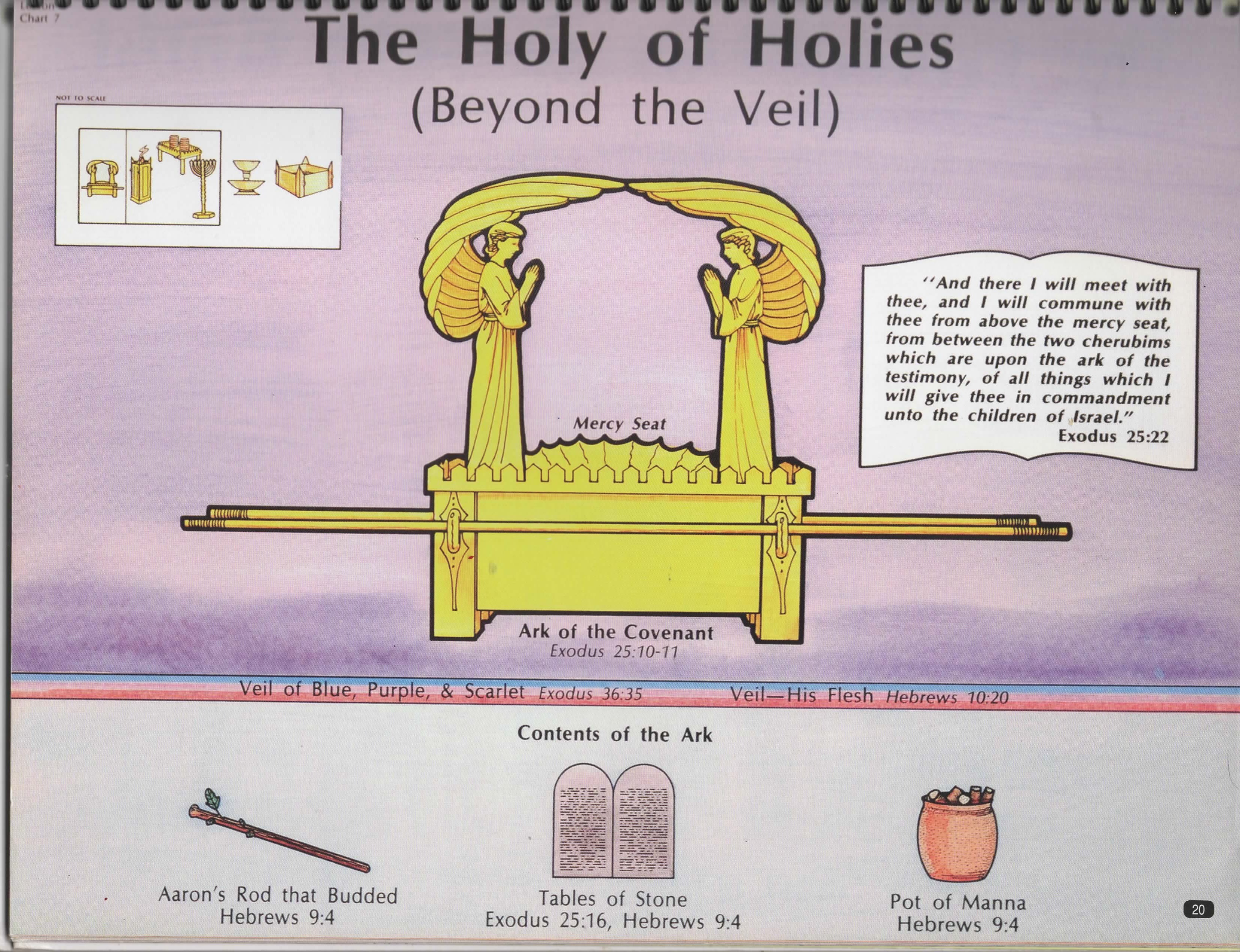
    • Inside the courtyard was the brazen altar, the brazen laver, and the Tabernacle itself. The Tabernacle was approximately 15 feet high, 15 feet wide, and 45 feet long. It consisted of the Holy Place and the Holy of Holies. These two rooms were separated by a veil of blue, purple, and scarlet. In the Holy Place was the golden candlestick, the table of showbread, and the altar of incense. In the Holy of Holies was the ark of the covenant. There abode the Spirit of God between two golden cherubims located on the lid of the ark, which was called the mercy seat.
      Of course. God is omnipresent, or present everywhere, but He manifested His glory there to show His covenant relationship with Israel. God has always desired to dwell with His people, but sin has always separated humanity from God. From the Day of Pentecost, fifty days after the death of Christ, God has dwelt in the hearts of His people in a new and wonderful way. “Know ye not that ye are the temple of God, and that the Spirit of God dwelleth in you?” (I Corinthians 3:16).
  2. The Altar of Sacrifice
    • The priest approached the Tabernacle first by way of the brazen altar, and there he offered the sacrifice for sin. The brazen altar was approximately seven and a half feet square and four and a half feet high. It was made of acacia wood overlaid with brass. It was a place of death and shedding of blood. It represents the death of Jesus, which purchased our salvation. It also points to repentance, which is our identification with the death of Jesus and our personal death to sin and self-will. Everyone must approach God through repentance. Jesus said, “Except ye repent, ye shall all likewise perish’ (Luke 13:3).
    • The altar was a prominent feature of the Tabernacle and its worship. It was placed immediately in front of the gate of the court of the Tabernacle. It was the first object that met the eye of the worshiper as he came into the court to present his sacrifice unto the Lord. The altar was not hidden in some remote place in the court, removed from the gaze of the people, nor did it stand inside the Tabernacle where only a few could approach it. It was placed where all could see it and where all could approach it. Only the priests could see the golden lampstand, the table of showbread, and the altar of incense, which were inside the Tabernacle itself. No one but the high priest was permitted to enter the Holy of Holies and he did so only on the Day of Atonement. By contrast, the altar was plainly visible from without. In fact, no one could enter into the Holy Place except by passing this sacred emblem where the sacrificial blood of the animals was offered. The altar teaches that not one will enter heaven except by the blood of Jesus, who stands as an altar of sacrifice for all who would approach God (John 14:6).
The Altar of Sacrifice
  • It was not merely the altar that gave the worshiper access to the Holy Place, by the putting away of his sins, for there had to be a sacrifice upon the altar. The relationship of the brazen altar to every other part of the Tabernacle service and its furniture was like that of the root to a tree, the heart to the body, and the foundation to a building. Everything inside and even the brazen laver in front of the door of the Tabernacle depended upon the work done at the altar.
  • Without the brazen altar, all else, no matter how magnificent, was useless. Everyone had to come to God by the way of the altar.
  • All the priests, their garments, the sacred vessels, and everything else were unfit for service until the blood shed at the brazen altar touched and sanctified them.
  • Here is the story of the Cross of Christ, Calvary. There is no pardon, no righteousness, no peace, no grace, no blessings, and no salvation without the sacrifice of the Cross. The altar represents the shedding of blood and the death of Jesus. And without the shedding of blood there is no remission of sins (Hebrews 9:27).
  • The fire upon the altar was never to go out (Leviticus 6:13). There is no hour, day or night, that a transgressor cannot find the atonement of Calvary.

3. The Laver of Water

The Laver of Water
  • The laver points to the cleansing from sin we have in Jesus – the initial washing at water
    baptism, which is for the remission of sins and the continual cleansing we have thereafter
    • Exo 30:21 So they shall wash their hands and their feet, that they die not: and it shall be a
      statute for ever to them, even to him and to his seed throughout their generations.
  • In the New Testament
    • Acts 2:38 Then Peter said unto them, Repent, and be baptized every one of you in the name
      of Jesus Christ for the remission of sins, and ye shall receive the gift of the Holy
      Ghost.
    • 1 John 1:7 But if we walk in the light, as he is in the light, we have fellowship one with
      another, and the blood of Jesus Christ his Son cleanseth us from all sin.
  • When we are baptized, God washes away our sins
    • Acts 22:16 And now why tarriest thou? arise, and be baptized, and wash away thy sins,
      calling on the name of the Lord.
  • Without believeth, we are not saved. This belief is demonstrated by baptism.
    • Mark 16:16 He that believeth and is baptized shall be saved; but he that believeth not shall
      be damned.
    • 1 Pet 3:21 The like figure whereunto even baptism doth also now save us (not the putting
      away of the filth of the flesh, but the answer of a good conscience toward God,) by
      the resurrection of Jesus Christ:
  • In the New Testament experience of salvation, repentance comes first, which is a death with
    Christ, a death to sin.
  • Then comes water baptism, which is a washing and burial with Christ.
    • Rom 6:3-4 Know ye not, that so many of us as were baptized into Jesus Christ were
      baptized into his death? 4 Therefore we are buried with him by baptism into death:
      that like as Christ was raised up from the dead by the glory of the Father, even so we
      also, should walk in newness of life.

4. The Holy Place

The Holy Place
  • The Holy Place was the golden candlestick (lampstand), the altar of incense, and the table of
    showbread show bread (sh½”brud”) n. The 12 loaves of blessed unleavened bread placed
    every Sabbath in the sanctuary of the Tabernacle as an offering by the Hebrew priests of
    ancient Israel.
  • These pieces of furniture point to Jesus and to our life in Christ through the indwelling of
    the Holy Spirit.
  • 1. THE GOLDEN CANDLESTICK
    • The candlestick was of pure gold and provided the only light in the Tabernacle. Just as
      Jesus is the light to the world
      • John 8:12 Then spake Jesus again unto them, saying, I am the light of the world: he that
        followeth me shall not walk in darkness, but shall have the light of life.
  • 2. THE TABLE OF SHOWBREAD
    • The showbread provided sustenance for the priest and also points to Jesus who is the Bread
      of Life and to His Word, which is food for the soul.
    • Just as the table exhibited the bread, so the Christian life shows forth Jesus to a dying world
      • John 6:51 I am the living bread which came down from heaven: if any man cat of this
        bread, he shall live for ever: and the bread that I will give is my flesh, which I will
        give for the life of the world.
  • 3. THE ALTAR OF INCENSE
    • The Altar of incense represents prayers to God each morning and evening.
      • We also should pray each morning and evening
    • God hears the prayers of a righteous person
      • 1 Pet 2:9 But ye are a chosen generation, a royal priesthood, an holy nation, a peculiar
        people; that ye should show forth the praises of him who hath called you out of
        darkness into his marvellous light:
      • James 5:16… The effectual fervent prayer of a righteous man availeth much.
        • fer vent (für”v…nt) adj. 1. Having or showing great emotion or zeal; ardent: fervent
          protests; a fervent admirer. 2. Extremely hot; glowing

4. The Holy of Holies (Beyond the Veil)

EPSON MFP image
  • The Holy of Holies represents God himself
  • By His mercy He saved us
    • Titus 3:5 Not by works of righteousness which we have done, but according to his mercy
      he saved us, by the washing of regeneration, and renewing of the Holy Ghost;

Understanding the Law: From Sinai to Christ

Israel at Sinai (The Time of the Law)

  • Moses brought Israel from the Red Sea into the wilderness of Sinai. When they came to Marah, they found bitter water, unsuitable for drinking. When the people murmured against Moses, God showed him a tree. When Moses cut it down and cast it into the water, the water became sweet. Sometimes life may be bitter, but Jesus is the Tree that can sweeten every life.
  • After three months on their journey from Egypt, they arrived at Mt. Sinai. The people remained there for a period of one year. What took place at Sinai marked the beginning of Israel’s national history. The covenant that God made with Abraham and confirmed to Isaac and Jacob became a national covenant.
  • At Mt. Sinai, God gave Moses the law, which included the Ten Commandments as well as other moral, ceremonial, and civil laws. God intended for Israel to live by the law until Jesus came in the fullness of time. “The law was our schoolmaster to bring us unto Christ, that we might be justified by faith” (Galatians 3:24). The law pointed out sin and the shortcomings of all human efforts to live holy without God’s indwelling Spirit. God also gave Moses the plan of the Tabernacle, which was the physical dwelling place of God’s Spirit in the midst of the people of Israel.

From the Tabernacle to the Cross (Read Hebrews Chapter 9)

  • The mission and the object of the law was the Cross of Christ.
  • The things shown to Moses point to the One who was to come, Jesus
    • Gal 3:24 Wherefore the law was our schoolmaster to bring us unto Christ, that we might be
      justified by faith.
  • Jesus was literally God tabernacled in flesh, God coming into this world to be our Savior
    • Mat 1:21 And she shall bring forth a son, and thou shalt call his name JESUS: for he shall
      save his people from their sins.
    • Mat 1:23 Behold, a virgin shall be with child, and shall bring forth a son, and they shall
      call his name Emmanuel, which being interpreted is, God with us.
    • Col 1:14-15 In whom we have redemption through his blood, even the forgiveness of sins: Who is the image of the invisible God, the firstborn of every creature:
    • 1 Tim 3:16 And without controversy great is the mystery of godliness: God was manifest in
      the flesh, justified in the Spirit, seen of angels, preached unto the Gentiles, believed on in the world, received up into glory.
    • Isa 53:1-10 Who hath believed our report? and to whom is the arm of the LORD revealed?
      2 For he shall grow up before him as a tender plant, and as a root out of a dry ground: he hath no form nor comeliness; and when we shall see him, there is no beauty that we should desire him. 3 He is despised and rejected of men; a man of sorrows, and acquainted with grief: and we hid as it were our faces from him; he was despised, and we esteemed him not. 4 Surely he hath borne our griefs, and carried our sorrows: yet we did esteem him stricken, smitten of God, and afflicted. 5 But he was wounded for our transgressions, he was bruised for our iniquities: the
      chastisement of our peace was upon him; and with his stripes we are healed. 6 All we like sheep have gone astray: we have turned every one to his own way; and the LORD hath laid on him the iniquity of us all. 7 He was oppressed, and he was afflicted, yet he opened not his mouth: he is brought as a lamb to the slaughter, and as a sheep before her shearers is dumb, so he openeth not his mouth. 8 He was taken from prison and from judgment: and who shall declare his generation? for he was cut off out of the land of the living: for the transgression of my people was he stricken. 9 And he made his grave with the wicked, and with the rich in his death; because he had done no violence, neither was any deceit in his mouth. 10 Yet it pleased the
      LORD to bruise him; he hath put him to grief: when thou shalt make his soul an offering for sin, he shall see his seed, he shall prolong his days, and the pleasure of the LORD shall prosper in his hand.

Understanding the Exodus: God’s Plan of Redemption

The Exodus-The Plan of Redemption

  • Nearly four centuries passed after the Israelites came to Egypt in the days of Joseph. “And the children of Israel were fruitful and increased abundantly, and multiplied and waxed exceeding mighty; and the land was filled with them. Now there arose up a new king over Egypt, which knew not Joseph” (Exodus 1:7-8). The new king set harsh taskmasters over the Israelites and set them at hard labor in the fields and in constructing cities and walls. This story is rich in typology, for the deliverance of Israel from bondage illustrates God’s plan of redemption for fallen humanity. I Corinthians 10:1-11 teaches that we can use the flight from Egypt as an example for us today.
  • Forty Years in Egypt
    • The Birth of Moses
      • Pharaoh became fearful that the Hebrews would rise up and overthrow the Egyptians, so he commanded the midwives to kill every newborn male Hebrew at the time of birth.
      • “But the midwives feared God, and did not as the king of Egypt commanded them, but saved the men children alive” (Exodus 1:17).
      • Then Pharaoh commanded all his people to destroy the baby boys by throwing them into a river (Exodus 1:22). After Moses was born, he was hid three months by his parents, Jochebed and Amram. When they could no longer hide him in their home, his mother made an ark of bulrushes and waterproofed it with slime and pitch. She hid him each day in the reeds along the river. His sister, Miriam, watched the baby Moses from the shore.
      • One day while on her way to wash herself at the river, Pharaoh’s daughter chanced to find the ark there among the reeds. She had the ark brought to her, and when she opened it, Moses wept and Pharaoh’s daughter had compassion on the small baby. She determined to take the child and bring him up in the palace. Miriam offered to contact a Hebrew woman to nurse the child for the daughter of Pharaoh. “And Pharaoh’s daughter said unto her, Take this child away, and nurse it for me, and I will give thee thy wages. And the woman took the child, and nursed it” (Exodus 2:9). The woman, who was Jochebed, took the child to her home, nursed him, and received wages for nursing her own baby. “And the child grew, and she brought him [Moses] unto Pharaoh’s daughter, and he became her son” (Exodus 2:10). The same river that could have been the means of destruction of Moses became his salvation, just as Jesus becomes our Savior instead of our Judge if we follow His plan of salvation for us.
    • Moses’ Choice
      • When Moses was grown, he went out one day among his brethren and saw an Egyptian beating a Hebrew. He killed the Egyptian and hid him in the sand. The next day he saw two Hebrews fighting and attempted to separate them. One of them said, “Who made thee a prince and a judge over us? intendest thou to kill me, as thou killedst the Egyptian?” (Exodus 2:14). Because Moses had acted out of God’s will, his efforts to lead were rejected by the people. He was unprepared at this stage for the task that he would later perform. (See also Hebrews 11:23-29.)
  • Forty Years in Midian
    • Moses realized that his deed was known, and fearing revenge by Pharaoh, he fled to the land of Midian. There he met and married Zipporah, a daughter of the Midianite priest Jethro.
    • Moses’ Call
      • One day as Moses was tending sheep, he beheld a bush burning. Upon closer examination, he was amazed when he saw it was not consumed with the fire. God called to him out of the midst of the bush, giving him his call for his life’s work. God told Moses that He had heard the cries of the people and that He would use him to deliver them from bondage and lead them to their promised land.
    • God Proves Himself to Moses
      • Moses expressed doubts that he could do the job, so God had him to cast down the rod he held in his hand. When he did so, the rod changed into a serpent. God had him pick it up by the tail, and it turned back into the rod. God then told Moses to put his hand into his bosom. Moses obeyed, and when he took his hand out it was white with leprosy. Then Moses was told to thrust his hand back into his garment. When he removed his hand, this time it was healed. Thus he was shown that God could make him victorious over everything that would confront him. Likewise God’s people today can totally trust in the Lord, knowing that He will bring triumph over the devil, the world, and the flesh.
  • Moses the Deliverer
    • Moses Before Pharaoh-Ten Plagues
      • Moses obeyed the Lord, returned to Egypt, went to Pharaoh, and told him that God had said, “Let my people go.” Pharaoh desired to keep the Hebrews in bondage and rebelled against God’s will. Disaster came to Egypt in the form of ten plagues from God. Significantly, God used the things the Egyptians worshiped-frogs, cattle, the sun, and the Nile river-to demonstrate His great power. After each of the first nine plagues, Pharaoh agreed to let the Israelites go, but in each instance, he later had a change of heart. His deceit set the stage for the most dreadul plague yet to come.
    • Passover-Deliverance by the Blood
      • The Lord told Moses to speak to the congregation and tell them to take a male lamb of the first year without blemish for each household. He instructed them to kill the lamb and to apply its blood to the two doorposts and the lintel of each house. They were then to roast the lamb and eat it that night, along with unleavened bread and bitter herbs. They were to eat in haste with shoes on their feet, belts on their waist, and a staff in their hand, because it was time to leave Egypt. At midnight the Lord passed through the land of Egypt and killed the firstborn of every household that did not have blood upon the doorpost. When he saw blood on the doorpost, He passed by that house and the inhabitants inside were safe.
      • Salvation in this age is dependent upon the blood of the Lamb, Jesus Christ. “For even Christ our passover is sacrificed for us” (1 Corinthians 5:7). The blood of Jesus must be applied through obedience to the gospel. If the Lord did not find blood applied to the doorpost, instant death resulted. The blood of the innocent lamb is symbolic of the blood of the Lamb of God that delivers from spiritual bondage.
    • Deliverance through the Red Sea
      • Pharaoh at last agreed to let the Hebrews go. The Lord led them out of Egypt with a pillar of fire by night and a pillar of cloud by day (Exodus 13:21). After the people left Egypt, Pharaoh changed his mind again and sent his army after the Israelites. God led the Israelites to the Red Sea. When the people saw Pharaoh’s chariots closing in on them, they cried out against Moses. Moses told the people, “Fear ye not, stand still, and see the salvation of the LORD which he will shew to you to day: for the Egyptians whom ye have seen to day, ye shall see them again no more for ever’ (Exodus 14:13). Moses lifted his rod, and the Lord caused the sea to go back by a strong east wind all that night (Exodus 14:7-21). The people miraculously crossed over upon dry ground with the waters as a great wall on either side. In every situation the Lord will always make a way of escape for His people. (See I Corinthians 10:13.) The Egyptians were in pursuit, but as soon as the Israelites got across, the Lord had Moses to stretch out his hand over the sea. The waters fell on the Egyptians and they were all drowned. “And Israel saw the Egyptians dead upon the sea shore” (Exodus 14:30). Salvation is the whole process by which Christ rescues a person from sin and makes him a child of God.
  • Jesus Christ rescues from sin and death; He restores the soul, and He puts a new song into the heart.
  • In typology, Egypt represents bondage, or sin. The Red Sea is a type of baptism for “all our fathers.. baptized unto Moses in the cloud and in the sea” (I Corinthians 10:1-2). A future lesson will show that entering the promised land is a type of receiving God’s promise. There were battles to be fought, giants to face, and walls to bring down. Thus we see God’s plan of salvation: repentance (leaving Egypt), baptism (crossing the Red Sea), and moving into the promise of God (the Holy Spirit).

The Journey of Joseph: From Betrayal to Leadership

Joseph
God reaffirmed His covenant with Jacob (Israel), and Jacob fathered twelve sons (Genesis 35:22-26). One of Jacob’s sons, Joseph, was chosen by God to be a preserver of the family of Jacob (Genesis 45:5).

  • Joseph Sold into Egypt
    • Joseph was sensitive to the Lord and a person of high moral character. His brothers became jealous of him when they saw that their father loved him above the other sons. Later, Joseph had some dreams which suggested that his brothers and mother and father would bow down to him. Predictably, their hatred for him increased.
    • One day, when Jacob sent Joseph to check on his brothers, they saw an opportunity to rid themselves of him forever. After casting him into a pit, they sold him to some Midianite merchants for twenty pieces of silver. The Midianites took him into Egypt, where they sold him to Potiphar, who was one of Pharaoh’s officers and a captain of the guard.
  • Jacob Deceived
    • After having disposed of Joseph, his brothers took a goat and killed it, dipping Joseph’s coat in the blood. They brought the coat to their father and asked, “Is this thy son’s coat?” “It is my son’s coat,” Jacob declared. “An evil beast hath devoured him. Joseph is without doubt rent in pieces. In his despair, Jacob refused to be comforted and mourned with tears for Joseph (Genesis 37:31-35).
    • Meanwhile, Joseph, being the conscientious, godly man that he was did his very best as a servant to Potiphar. He had every reason for bitterness and an excuse to be sullen. Instead he served his master diligently. Potiphar saw that God was with him and that everything Joseph did prospered. Finally, Potiphar made Joseph the overseer of all that he had. Potiphar concerned himself only with the food that was set before him to eat Joseph took care of everything.
  • Joseph’s Temptation
    • Joseph’s trials were not over, however. Potiphar’s wife became infatuated with Joseph and daily tempted him to commit immorality with her. He steadfastly refused her advances, until one day, as he fled from her presence. she grasped part of his clothing. Seeing that she was rebuffed, she contrived to blame Joseph with trying to assault her, using his clothing as proof. Potiphar, his wrath kindled, put Joseph in the prison where the king’s prisoners were kept.
  • Joseph in Prison
    • Even in the prison, Joseph kept the right attitude. He refused to be bitter and looked for opportunities to serve God. The keeper of the prison committed to Joseph’s hand all the prisoners and the complete management of the prison. Even in prison, God blessed Joseph and prepared the way for the fulfillment of His plan.
    • In the prison were two men who had served Pharaoh as the chief of the butlers and the chief of the bakers. They both had dreams, which Joseph Interpreted. True to Joseph’s interpretation, the butler was restored to his office, while the baker was hanged.
  • Joseph’s Elevation under Pharaoh
    • At the end of two years, Pharaoh had a dream that which none of his men could interpret. Then the butler remembered Joseph and suggested to Pharaoh that Joseph might be able to interpret Pharaoh’s dream. Pharaoh called for Joseph, who told him the significance of his dream: Egypt would experience seven years of plenty followed by seven years of famine.
    • Pharaoh promoted Joseph to the position of second most powerful ruler in all of Egypt and gave to this thirty-year-old Hebrew the responsibility of storing up food during the seven years of plenty in preparation for the drastic famine that was to follow (Genesis 41:46).
  • Joseph’s Brothers Come to Egypt
    • When the famine came to Egypt, it also affected the land of Canaan, where Joseph’s family still lived. When Jacob heard that Egypt had grain, he sent his sons-all except the youngest son, Benjamin-to buy some. The person in charge of selling grain was Joseph, and just as he had dreamed many years previously, his brothers came before him bowing down to the earth!
    • Recognizing them, Joseph disguised himself and spoke roughly, trying to find out if his father was still alive and attempting to devise a plan to bring his father to Egypt. He accused his brothers of being spies. When they denied the charges and said that they were all the sons of one man, Joseph took one of them, Simeon, and bound him until the others could return with their youngest brother, Benjamin, as proof of their innocence.
    • Jacob was greatly troubled and refused to send Benjamin for fear that he too would never return. But when the famine grew worse, the family had no choice but to comply with Joseph’s instructions. Judah took personal responsibility for Benjamin, and the brothers traveled to Egypt once again.
    • This time, Joseph devised a plan to keep Benjamin, which involved secretly returning the brothers’ money in the mouth of their sacks and putting his personal silver cup in the sack of Benjamin. When the brothers were stopped by Joseph’s servant and returned to him, Joseph could no longer refrain from revealing to them exactly who he was. He wept aloud, and said, “I am Joseph; doth my father yet live?”
  • Joseph Forgives His Brothers
    • His brothers, troubled and surprised, could not answer. Then Joseph, who had every reason to be bitter, harsh, and unforgiving, said, “Now therefore be not grieved, nor angry with yourselves, that ye sold me hither: for God did send me before you to preserve life” (Genesis 45:5).
    • Long before the New Testament was ever written, Joseph had learned one of the most valuable lessons that we can ever learn: “And we know that all things work together for good to them that love God, to them who are the called according to his purpose’ (Romans 8:28). As he was to say later, “Ye thought evil against me; but God meant it unto good, to bring to pass, as it is this day, to save much people alive’ (Genesis 50:20).
  • Jacob and His Family Settle in Goshen
    • Joseph supplied his brothers with wagons and equipment. They returned to Canaan and brought their father, Jacob, back to Egypt to settle in the land of Goshen, the choice land of all Egypt. Here they enjoyed many years of blessings, peace, and plenty while Joseph was alive.
  • Israel in Egyptian Bondage
    • After Joseph’s death, a new king arose in Egypt who did not know Joseph. This pharaoh began to be fearful of the Israelites, for they were numerous and strong. He was afraid that they would side with his enemies to help them overthrow Egypt in war. In his fear, the new pharaoh set taskmasters over the Israelites and made slaves of them. But the more the Egyptians afflicted the Israelites (Hebrews), the more the Israelites multiplied and grew. God was preparing them for the great exodus from Egypt back to their promised land of Canaan.

The Story of Jacob and Esau: A Biblical Analysis

Jacob and Esau
It was through Isaac that God had promised to raise up descendants to Abraham, Isaac’s wife, Rebekah, had two sons, Esau and Jacob. Like Cain and Abel, these two sons were quite different. The Lord had said to Rebekah, “Two nations are in thy womb, and two manner of people shall be separated from thy bowels; and the one people shall be stronger than the other people and the elder shall serve the younger” (Genesis 25:23).
Esau the elder son was a cunning hunter, a man of the field, while Jacob was a man of the plains who lived in tents.

Esau Sells His Birthright

  • Jacob, the younger of the two, was making stew one day when Esau came in from the field. Esau was hungry and said. “Feed me, I pray thee with that same red pottage for I am faint” (Genesis 25:30). Esau appears to have been a who was concerned with fleshly, physical things. He was guided by his senses. When he was hungry satisfying his appetite was the most important thing in the world to him.
  • Jacob, on the other hand, had an appreciation for spiritual things, although he was by no means perfect. In response to Esau’s request, Jacob demanded, “Sell me this day thy birthright” (Genesis 25:31).The birthright was the privilege given to the oldest son. It gave him preferred treatment in the family, including first claim on the inheritance. Esau was so oriented to the present, rather than the future, that he answered, “Behold, I am at the point to die and what profit shall this birthright do to me?” (Genesis 25:32).
  • “Swear to me this day.” Jacob insisted, and Esau sold his birthright to Jacob for bread and stew of lentils. Then Esau arose and went his way, having sold out a most valuable blessing for a temporary, fleshly satisfaction (Genesis 25:33-34).
  • How sad it is that when confronted with a choice of preparing for the future eternity or receiving a small measure of satisfaction right now, many will choose the present. Such people are looking at things that are seen and not things that are eternal (II Corinthians 4:18).

Jacob Steals the Blessing

  • The dramatic scene of Jacob gaining Esau’s birthright was not their last encounter over family blessings. When Isaac was old and his vision dim so that he could not see, he called Esau, his favorite of the two boys, and asked Esau to go into the field with his bow and arrows for some venison. Isaac enjoyed the meat and wanted to eat some prior to bestowing upon Esau the blessing due to the firstborn.
  • Rebekah heard Isaac’s instructions to Esau, and she instructed Jacob, who was her favorite son, to bring her two kids of the goats. She prepared the meat that Isaac liked and disguised Jacob by putting the goat skins on Jacob’s hands and neck and giving him Esau’s clothing to wear.
  • Then, pretending to be Esau, Jacob went into his blind father and presented Isaac with the meat. Isaac was surprised that Esau had returned so soon with the meat, and he was a bit skeptical. He called Jacob near in order to feel of him and said, “The voice is Jacob’s voice, but the hands are the hands of Esau” (Genesis 27:22). But Isaac was unable to distinguish that it was Jacob, and he gave Jacob Esau’s blessing.
  • Shortly thereafter, just as Jacob had left his father, Esau came in. Isaac was very disturbed that he had been deceived. Esau cried with a bitter cry, but the blessing could not be removed from Jacob. Esau hated Jacob and planned to kill him in revenge. Rebekah heard of his plans and urged Jacob to flee to Haran, where her brother, Laban, lived.

Jacob’s Encounter with God (Genesis 28:10-22)

  • As Jacob traveled, he came to a place called Luz, where he prepared to stay the night. While he slept, he dreamed of a ladder set up on the earth with its top reaching heaven. The angels of God were going up and down on the ladder. Above the ladder stood the Lord, who said, “I am the LORD God of Abraham thy father, and the God of Isaac: the land whereon thou liest, to thee will I give it, and to thy seed; and thy seed shall be as the dust of the earth, and thou shalt spread abroad to the west, and to the east, and to the north, and to the south: and in thee and in thy seed shall all the families of the earth be blessed” (Genesis 28:13-14).
  • Jacob awoke and said, “Surely the LORD is in this place; and I knew it not. Being afraid, he continued, “How dreadful is this place! this is none other but the house of God, and this is the gate of heaven” (Genesis 28:16-17).

Jacob Remembers the House of the Lord

  • Early in the morning, Jacob rose and set up a pillar from the stones he had used for pillows. He poured oil on the pillar and called the name of the place Bethel, which means “house of God.” Jacob vowed, “If God will be with me, and will keep me in this way that I go, and will give me bread to eat, and raiment to put on, so that I come again to my father’s house in peace; then shall the LORD be my God: and this stone, which I have set for a pillar, shall be God’s house and of all that thou shalt give me I will surely give the tenth unto thee” (Genesis 28:20-22).
  • Thus, God renewed with Jacob the covenant that He had made with his father, Isaac, and his grandfather, Abraham.

Jacob Wrestles with the Angel of the Lord

  • Twenty years later, after Jacob had spent time with his Uncle Laban and had begun his family, he was on his way back to see his aged father. He heard that Esau was coming to meet him, and fear rose up in his heart as he remembered his brother’s pledge to kill him. Sending his family on, Jacob stayed behind. An angel of the Lord wrestled with him until daybreak. When the angel saw that Jacob was not going to release him, he touched the hollow of Jacob’s thigh, permanently shrinking the sinew and causing him to limp. The angel said, “Let me go, for the day breaketh.” Jacob answered, “I will not let thee go, except thou bless me.” The angel asked, “What is thy name?” “Jacob” “Thy name shall be called no more Jacob,” said the angel, “but Israel: for as a prince hast thou power with God and with men, and hast prevailed” (Genesis 32:24-28).
  • Because of his persistence, Jacob received the blessing that he desired and left that place a different man. His former name, Jacob, meant “supplanter” and had the connotation of trickery and deceit. His new name, Israel, meant “he who strives with God.” There was also a physical difference: every time he took a step, the limp reminded him of his encounter with the angel of the Lord.
  • Certainly, when a person comes into the presence of God and determines to receive God’s best, a miraculous change takes place. He is never the same!

Lessons from the Kings of Judah found in 2 Chronicles: Obedience and Forgiveness

  • Author
    • Ezra – according to some Jewish traditions or possible a contemporary of Ezra
  • Date
    • 971-538 BC
      • Chapters 1-9
        • a 40-year period from 971 BC to 931 BC
        • This is Solomon’s Reign
      • Chapters 10-35
        • a 393-year period from 931 BC -538 BC
        • 20 different kings
      • Chapters 35-36
        • The fall of Judah
        • Coves captivity and return
          • political
        • Destruction and the temple (586 BC)
          • Religious
  • Theme
    • “Divine Editorial” on Spiritual Characteristics of the Davidic Dynasty
    • Temple: spiritual significance past to future
    • God’s ongoing offer of forgiveness
  • Purpose
    • obedience brings blessings
    • disobedience means the blessing are withdrawn
    • Key verses
      • 2 Chronicles 7:14 If my people, which are called by my name, shall humble themselves, and pray, and seek my face, and turn from their wicked ways; then will I hear from heaven, and will forgive their sin, and will heal their land.
      • 2 Chronicles 16:9 For the eyes of the Lord run to and fro throughout the whole earth, to shew himself strong in the behalf of them whose heart is perfect toward him. Herein thou hast done foolishly: therefore from henceforth thou shalt have wars.
    • Key Chapter
  • Content
    • Solomon’s Reign
      • Chapters 1-9
      • The kingdom splits into after King Solomon’s death
    • Judah’s Kings
      • Chapters 10-36
      • 8 good kings
      • part of the house of David
      • the messianic line is preserved
    • Temple Restorers
      • Asa
        • 2 Chronicles 14:2-4: And Asa did that which was good and right in the eyes of the Lord his God: For he took away the altars of the strange gods, and the high places, and brake down the images, and cut down the groves: And commanded Judah to seek the Lord God of their fathers, and to do the law and the commandment.
      • Jehoshaphat 
        • 2 Chronicles 17:1-9: And Jehoshaphat his son reigned in his stead, and strengthened himself against Israel. And he placed forces in all the fenced cities of Judah, and set garrisons in the land of Judah, and in the cities of Ephraim, which Asa his father had taken. And the Lord was with Jehoshaphat, because he walked in the first ways of his father David, and sought not unto Baalim; But sought to the Lord God of his father, and walked in his commandments, and not after the doings of Israel. Therefore the Lord stablished the kingdom in his hand; and all Judah brought to Jehoshaphat presents; and he had riches and honour in abundance. And his heart was lifted up in the ways of the Lord: moreover he took away the high places and groves out of Judah. Also in the third year of his reign he sent to his princes, even to Benhail, and to Obadiah, and to Zechariah, and to Nethaneel, and to Michaiah, to teach in the cities of Judah. And with them he sent Levites, even Shemaiah, and Nethaniah, and Zebadiah, and Asahel, and Shemiramoth, and Jehonathan, and Adonijah, and Tobijah, and Tobadonijah, Levites; and with them Elishama and Jehoram, priests. And they taught in Judah, and had the book of the law of the Lord with them, and went about throughout all the cities of Judah, and taught the people.
      • Joash
        • 2 Chronicles 24:1-4: Joash was seven years old when he began to reign, and he reigned forty years in Jerusalem. His mother’s name also was Zibiah of Beersheba. And Joash did that which was right in the sight of the Lord all the days of Jehoiada the priest. And Jehoiada took for him two wives; and he begat sons and daughters. And it came to pass after this, that Joash was minded to repair the house of the Lord.
      • Hezekiah
      • Josiah
  • Christ in book of Chronicles
    • Temple
      • Matthew 12:6: But I say unto you, That in this place is one greater than the temple.
      • John 2: 19:  Jesus answered and said unto them, Destroy this temple, and in three days I will raise it up.
      • Revelations 21:22: And I saw no temple therein: for the Lord God Almighty and the Lamb are the temple of it.

The Davidic Covenant: Significance in 1st Chronicles and Beyond

  • Author
    • Ezra – according to some Jewish traditions or possible a contemporary of Ezra
  • Date
    • covers the same time period of Jewish History as 1st and 2nd Samuel and 1st and 2nd Kings
  • Theme
    • written to the remnants that returned from Babylonian Captivity to encourage and remind them that they are the covenant people of God.
    • Written to remind the people of their Spiritual heritage and identity
    • It retraces the whole of Israel’s history up to the return of the remnant.
  • Purpose
    • Davidic Covenant
      • David’s eternal throne which points to the Messiah (Jesus)
  • Content
    • Royal line of David
      • Chapters 1-9
    • Reign of David
      • Chapters 10-29
    • Key chapter: chapter 17
    • Key verse: 17:11-14
      • And it shall come to pass, when thy days be expired that thou must go to be with thy fathers, that I will raise up thy seed after thee, which shall be of thy sons; and I will establish his kingdom. He shall build me an house, and I will stablish his throne for ever. I will be his father, and he shall be my son: and I will not take my mercy away from him, as I took it from him that was before thee: But I will settle him in mine house and in my kingdom for ever: and his throne shall be established for evermore.
  • Emphasis is on:
    • God’s grace and forgiveness
    • to encourage the remnant
    • temple preparation and worship
    • priestly perspective – Levites
  • Christ in book of Chronicles
    • David’s throne would be eternal leading to the Messiah
    • Judah’s genealogy is the preamble to Christ’s genealogy found in Matthew chapter 1 and Luke chapter 3

The Importance of 1st and 2nd Chronicles in Biblical History

Intro:

  • 1st and 2nd Chronicles
    • originally one book in the Hebrew Bible.
    • The title of the book is Words of the Days
      • Accounts or events
    • equivalent meaning today
      • The Events of the Times
  • 3rd Century
    • Became a divided book with the Greek translation (Septuagint)
    • Title: Of Things Omitted
      • refers to things omitted in Samuel and Kings
    • Some copies titled it Concerning the Kings of Judah
  • 385-405 AD
    • Translated to Latin (Latin Vulgate)
      • The Latin Vulgate is a late-fourth-century Latin translation of the Bible, produced primarily under the labor and scholarship of Jerome (circa 347–420 AD). Its name comes from the Latin word “vulgata,” meaning “common version,” reflecting its purpose to provide a uniform, accessible text for believers throughout the Roman Empire. Over time, the Vulgate became a foundational text, shaping Christian theology, liturgy, and scholarship across centuries.
    • Jerome intitles is “Chronicles”
      • meaning the Chronicles of the whole of Sacred History
      • 1st and 2nd Chronicles cover the same period of History as 1st and 2nd Samuel and 1st and 2nd Kings

Why have another account?

  • A different prospective
1st and 2nd Samuel and 1st and 2nd KingsChronicles
Prophetic PerspectivePriestly Perspective
Political HistoryReligious History
Wars ProminentTemple Prominent
Record of Both NationsRecord of Judah
Continuing History of NationContinuity of David
Man’s FailureGod’s Faithfulness
  • A different People
    • written to the remnant that returned from exile
      • Judah had been exiled to Babylon for 70 years
      • Temple destroyed in 586 BC
  • 1st Chronicles
    • Chapters 1-9: David’s genealogy from Adam to David
    • Chapters 10-29: 33 years of David’s rule over the United Kingdom of Israel (the whole 12 tribes)
  • 2nd Chronicles
    • Chapters 1-9: covers 40 years from 971 BC to 931 BC
    • Chapters 10-36: covers 393 years from 931-538 BC
  • Political Captivity
    • Babylon takes over as the ruling power
  • Religious Captivity
    • the temple is destroyed
  • Genealogy
    • Chronicles was last in the order Hebrew Bible
    • 1st Chronicles chapters 1-9 is the preamble to the genealogy of Christ in Matthew chapter 1 and Luke chapter 3