A place to grow your relationship with God

Posts tagged ‘birds’

The Tale of Solomon Owl Chapter II A NEWCOMER

Chapter II A NEWCOMER

Upon his arrival, as a stranger, in Pleasant Valley, Solomon Owl looked about carefully for a place to live. What he wanted especially was a good, dark hole, for he thought that sunshine was very dismal.

Though he was willing to bestir himself enough to suit anybody, when it came to hunting, Solomon Owl did not like to work. He was no busy nest-builder, like Rusty Wren. In his search for a house he looked several times at the home of old Mr. Crow. If it had suited him better, Solomon would not have hesitated to take it for his own. But in the end he decided that it was altogether too light to please him.

That was lucky for old Mr. Crow. And the black rascal knew it, too. He had noticed that Solomon Owl was hanging about the neighborhood. And several times he caught Solomon examining his nest.

But Mr. Crow did not have to worry long. For as it happened, Solomon Owl at last found exactly what he wanted. In an old, hollow hemlock, he came across a cozy, dark cavity. As soon as he saw it he knew that it was the very thing! So he moved in at once. And except for the time that he spent in the meadow–which was considerably later–he lived there for a good many years.

Once Fatty Coon thought that he would drive Solomon out of his snug house and live in it himself. But he soon changed his mind—after one attempt to oust Solomon.

Solomon Owl–so Fatty discovered–had sharp, strong claws and a sharp, strong beak as well, which curled over his face in a cruel hook.

It was really a good thing for Solomon Owl–the fight he had with Fatty Coon. For afterward his neighbors seldom troubled him–except when Jasper Jay brought a crowd of his noisy friends to tease Solomon, or Reddy Woodpecker annoyed him by rapping on his door when he was asleep.

But those rowdies always took good care to skip out of Solomon’s reach. And when Jasper Jay met Solomon alone in the woods at dawn or dusk he was most polite to the solemn old chap. Then it was “Howdy-do, Mr. Owl!” and “I hope you’re well to-day!” And when Solomon Owl turned his great, round, black eyes on Jasper, that bold fellow always felt quite uneasy; and he was glad when Solomon Owl looked away.

If Solomon Owl chanced to hoot on those occasions, Jasper Jay would jump almost out of his bright blue coat. Then Solomon’s deep laughter would echo mockingly through the woods.

You see, though not nearly so wise as he appeared, Solomon Owl knew well enough how to frighten some people.
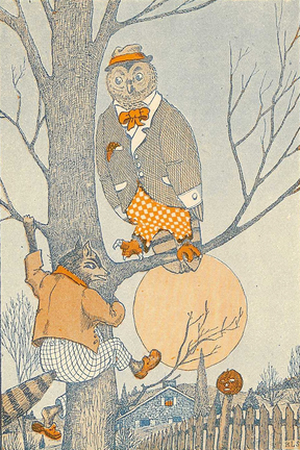
The Tale of Solomon Owl by Arthur Scott Bailey

THE TALE OF SOLOMON OWL

BY

ARTHUR SCOTT BAILEY

“The Tale of Solomon Owl” by Arthur Scott Bailey is a children’s book written in the early 20th century. This delightful tale is playful and imaginative, focusing on the life of Solomon Owl and his interactions with other forest animals in Pleasant Valley. The book explores themes of friendship, cleverness, and the humorous adventures of various animal characters. In the story, Solomon Owl is portrayed as both wise and somewhat foolish, and he becomes embroiled in different situations involving other animals like Mr. Frog, Fatty Coon, and Reddy Woodpecker. Throughout the chapters, Solomon navigates encounters that reveal his character traits, such as his penchant for hooting and his amusing attempts to catch food. As various events unfold, including Solomon’s encounters with mischief and misunderstandings in the animal community, readers get a charming glimpse into a whimsical animal world filled with laughter and lessons. The narrative carries a lighthearted tone, making it enjoyable for children while imparting moral lessons about caution, wisdom, and friendship. 

Contents:

The Tale of Solomon Owl Chapter 1 SCARING JOHNNIE GREEN

Chapter I

When Johnnie Green was younger, it always scared him to hear Solomon Owl’s deep-toned voice calling in the woods after dark.

“Whoo-whoo-whoo, whoo-whoo, to-whoo-ah!” That weird cry was enough to send Johnnie Green hurrying into the farmhouse, though sometimes he paused in the doorway to listen–especially if Solomon Owl happened to be laughing. His “haw-haw-hoo-hoo,” booming across the meadow on a crisp fall evening, when the big yellow moon hung over the fields of corn-shocks and pumpkins, sounded almost as if Solomon were laughing at the little boy he had frightened. There was certainly a mocking, jeering note in his laughter.

Of course, as he grew older, Johnnie Green no longer shivered on hearing Solomon’s rolling call. When Solomon laughed, Johnnie Green would laugh, too. But Solomon Owl never knew that, for often he was half a mile from the farm buildings.

A “hoot owl,” Johnnie Green termed him. And anyone who heard Solomon hooting of an evening, or just before sunrise, would have agreed that it was a good name for him. But he was really a barred owl, for he had bars of white across his feathers.

If you had happened to catch Solomon Owl resting among the thick hemlocks near the foot of Blue Mountain, where he lived, you would have thought that he looked strangely like a human being. He had no “horns,” or ear-tufts, such as some of the other owls wore; and his great pale face, with its black eyes, made him seem very wise and solemn.

In spite of the mild, questioning look upon his face whenever anyone surprised him in the daytime, Solomon Owl was the noisiest of all the different families of owls in Pleasant Valley. There were the barn owls, the long-eared owls, the short-eared owls, the saw-whet owls, the screech owls–but there! there’s no use of naming them all. There wasn’t one of them that could equal Solomon Owl’s laughing and hooting and shrieking and wailing–at night.

During the day, however, Solomon Owl seldom had anything to say — or if he had, he was quiet about it. One reason for his silence then was that he generally slept when the sun was shining. And when most people were sleeping, Solomon Owl was as wide awake as he could be.

He was a night-prowler–if ever there was one. And he could see a mouse on the darkest night, even if it stirred ever so slightly.

That was unfortunate for the mice. But luckily for them, Solomon Owl couldn’t be in more than one place at a time. Otherwise, there wouldn’t have been a mouse left in Pleasant Valley–if he could have had his way.

And though he didn’t help the mice, he helped Farmer Green by catching them. If he did take a fat pullet once in a while, it is certain that he more than paid for it.

So, on the whole, Farmer Green did not object to Solomon Owl’s living in the wood-lot. And for a long time Solomon raised no objection to Farmer Green’s living near Swift River.

But later Solomon Owl claimed that it would be a good thing for the forest folk if they could get rid of the whole Green family–and the hired man, too.

McGuffey’s Third Eclectic Reader Lesson 16: Bird Friends

Words:

  • wife
  • greet
  • beard
  • worms
  • prayers
  • faith
  • grove
  • crusts
  • church
  • furnished

Lesson:

  1. I once knew a man who was rich in his love for birds, and in their love for him. He lived in the midst of a grove full of all kinds of trees. He had no wife or children in his home.
  2. He was an old man with gray beard, blue and kind eyes, and a voice that the birds loved; and this was the way he made them his friends.
  3. While he was at work with a rake on his nice walks in the grove, the birds came close to him to pick up the worms in the fresh earth he dug up. At first, they kept a rod or two from him, but they soon found he was a kind man, and would not hurt them, but liked to have them near him.
  4. They knew this by his kind eyes and voice, which tell what is in the heart. So, day by day their faith in his love grew in them.
  5. They came close to the rake. They would hop on top of it to be first at the worm. They would turn up their eyes into his when he spoke to them, as if they said, ‘He is a kind man; he loves us; we need not fear him.’
  6. All the birds of the grove were soon his fast friends. They were on the watch for him, and would fly down from the green tree tops to greet him with their chirp.
  7. When he had no work on the walks to do with his rake or his hoe, he took crusts of bread with him, and dropped the crumbs on the ground. Down they would dart on his head and feet to catch them as they fell from his hand.
  8. He showed me how they loved him. He put a crust of bread in his mouth, with one end of it out of his lips. Down they came like bees at a flower, and flew off with it crumb by crumb.
  9. When they thought he slept too long in the morning, they would fly in and sit on the bedpost, and call him up with their chirp.
  10. They went with him to church, and while he said his prayers and sang his hymns in it, they sat in the trees, and sang their praises to the same good God who cares for them as he does for us.
  11. Thus, the love and trust of birds were a joy to him all his life long; and such love and trust no boy or girl can fail to win with the same kind heart, voice, and eye that he had.

Adapted from Elihu Burritt.