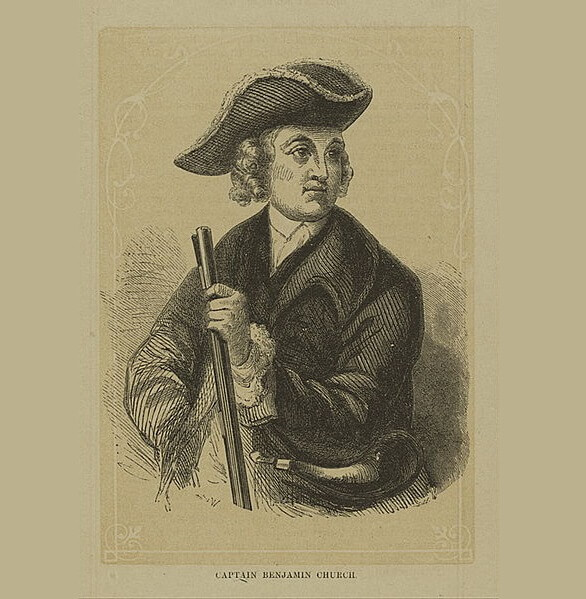
The colonists had not learned how to fight the Wampanoag and Narragansett Indians, who moved swiftly from place to place, and hid themselves in the darkest swamps. But at last the man was found who could battle with the American Indians in their own way. This was Captain Benjamin Church.
Church could not only fight the Indians, but he knew how to make them his friends. The Sakonet tribe, not far from his home, was under control of a woman chief. Her name was Awashonks. She and Benjamin Church were good friends, and after the war broke out Church tried to go to see her. Some of the Indians of her tribe who were friendly to Philip attacked Church and his men, so that they had to hide behind a fence till a boat came and took them away.
Later in the war, Church sent word to Awashonks that he would meet her and four other Indians at a certain place. But the rulers of Plymouth Colony thought it too dangerous for Church to go to see the woman chief. They would not give him any men for such an expedition.
However, Church went on his own account, with one colonist and three Indians. He took some tobacco and a bottle of rum as presents suited to the taste of this Indian queen. Church ventured ashore, leaving his canoe to stand off at a safe distance, so that if he should be killed the men in the canoe might carry the news to the other colonists. Awashonks and the four Indians met him and thanked him for venturing among them. But soon a great number of warriors, frightfully painted and armed, rose up out of the tall grass and surrounded Captain Church. The captain knew that if he showed himself frightened he would be killed.
“Have you not met me to talk about peace?” he said to Awashonks.
“Yes,” said Awashonks.
“When people meet to talk of peace they lay down their arms,” said Captain Church.
The Indians now began to look surly and to mutter something.
“If you will put aside your guns, that will do,” said Church.
The Indian warriors laid down their guns and squatted on the grass. But during the discussion, some of them grew angry. One fellow with a wooden tomahawk wished to kill Church, but the others pushed him away. The captain succeeded in making peace with this tribe, who agreed to take the side of the English against Philip and the Wampanoags.
Awashonks held a war dance after this, and Church attended. The Indians lighted a great bonfire and moved about it in rings. One of the braves stepped inside the circle and called out the name of one of the tribe fighting on Philip’s side against the colonists. Then he pulled a firebrand out of the fire to represent that tribe, and he made a show of fighting with the firebrand. Every time the name of a tribe was called, a firebrand was drawn out and attacked in this way.
After this ceremony, Church could call on as many of these Indians as he wished to help him against Philip. With small bands of these Indians and a few colonists, Captain Church scoured the woods, capturing a great many enemy prisoners.
At last so many of Philip’s Indians were taken, that Philip himself was fleeing from swamp to swamp to avoid falling into the hands of the colonists. But he grew fiercer as he grew more desperate. He killed one of his men for telling him that he ought to make peace with the colonists. The brother of this man whom he killed ran away from Philip, and came into the settlement to tell the colonists where to find that chief.
Captain Church had just come from chasing Philip to make a short visit to his wife. The poor woman had been so anxious for her husband’s safety that she fainted when she saw him. By the time she had recovered, the Indian deserter came to tell Church where Philip could be found, and the captain galloped off at once.
Church placed his men near the swamp in which Philip was hidden. The Indians took the alarm and fled. In running away, Philip ran straight toward Church’s hidden men and was shot by the very Indian whose brother he had killed. His head was cut off and stuck up over a gatepost at Plymouth. Such was the savage custom of the colonists in that day.
Philip’s chief captain, Annawon, got away with a considerable number of Indians. Church and half a dozen of his Indian scouts captured an old man and a young woman who belonged to Annawon’s party. They made these two walk ahead of them carrying baskets, while Church and his men crept behind them. In this way, they got down a steep bank right into the camp of Annawon, whose party was much stronger than Church’s. But Church seized the guns of the Indians, which were stacked together.
“I am taken,” cried Annawon.
Annawon later came with a bundle in his arms. “You have killed Philip and conquered his country. I and my company are the last. This war is ended by you, and therefore these things are yours.”
He opened the bundle, which contained Philip’s belts of wampum and the red blanket in which Philip dressed on great occasions.
 articlesforchristians