A place to grow your relationship with God

Posts tagged ‘Children’s bible’

The House Built Upon the Sand

THE HOUSE BUILT UPON THE SAND

What a foolish man the builder of the house shown in our picture must have been! Of course, when the wind blew and the waves dashed against his house, it would fall. Look how the sea has washed the foundation away, and how the roof is falling in! And the people; see how they are fleeing to save their lives! And all this calamity because he built his house upon the sand. But the other house, shown in the distance: how firmly that stands! What a bold front it offers to the waves, and how safely it resists the fury of the storm. Its foundations are sure, because they rest upon the solid rock.

THE HOUSE BUILT UPON THE SAND

Jesus had been teaching the people. He had taught them many wonderful truths, which you will find written in the fifth, sixth, and seventh chapters of Matthew; and in closing He said, “Whosoever heareth these sayings of mine, and doeth them, I will liken him unto a wise man who built his house upon a rock. And the rain descended, and the floods came, and the winds blew, and beat upon that house; and it fell not, for it was founded upon a rock. And everyone that heareth these sayings of mine, and doeth them not, shall be likened unto a foolish man which built his house upon the sand. And the rain descended, and the floods came, and the winds blew, and beat upon that house, and it fell, and great was the fall of it.” The lesson Jesus sought to impress upon the people by this parable was, that it is not enough simply to hear what He says. Many will do that; but it is only those who remember Christ’s commandments and keep them, whose work will stand when the time of trial comes.

Mother Stories from the New Testament

“Mother Stories from the New Testament” by Anonymous is an early 20th-century collection of religious tales created mainly for children. It’s meant to help mothers and caregivers share the teachings and stories of the New Testament in a way that’s easy to understand and engaging for young readers. The book gathers some of the most notable New Testament stories, highlighting moral lessons and the values of faith, compassion, and kindness. It features accounts like the visit of the wise men, Jesus’ parables, his healing miracles, and his warm interactions with children. Each story comes with illustrations that add to the reading experience and help convey the messages of love and redemption at the heart of the Christian faith. This approachable format both teaches children about the New Testament and encourages the core values of Christianity in a relatable way.

Content:

The Wonderful Draught of Fishes

THE WONDERFUL DRAUGHT OF FISHES

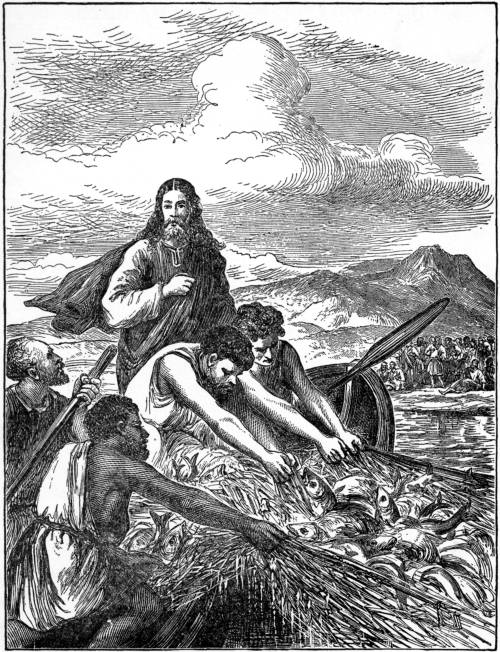
One day, as the crowds pressed round Him to hear the Word of God, Jesus came to the Lake of Gennesaret and saw two boats drawn up on the shore. Now one of these belonged to a man named Simon Peter, who was at the water’s edge washing his nets. Jesus entered into this boat and asked Simon to push it off from the land a little. Then He sat down and taught the people from the boat. And when He had done speaking to them, He said to Simon, “Launch out into the deep, and let down your nets for a draught of fishes.” Simon, answering Him, said, “Master, we have toiled all through the night and have taken nothing, but as you wish it I will let down the net again.” And they let down the net into the sea, but it enclosed so great a multitude of fishes that they could not draw them up, and the net brake. Then Simon beckoned to his partners, James and John, who were in the other boat, that they should come and help them. And they came and filled both boats with the fishes, so that they began to sink.

THE WONDERFUL DRAUGHT OF FISHES

When Simon Peter saw it he fell down before Jesus, saying, “Depart from me, for I am a sinful man, O Lord.” For he and all that were with him were astonished at the marvelous draught of fishes which they had taken. And Jesus said unto Simon, “Fear not, Simon Peter; from henceforth thou shalt be a fisher of men.” Meaning that he was to go about winning souls for God, instead of being a fisherman.

And when they had brought their boats to land, they forsook all they had and followed Christ.

Jesus in the Temple

JESUS IN THE TEMPLE

When Jesus was twelve years of age, His parents took Him with them to Jerusalem to the feast of the Passover. Great numbers journeyed from different parts to keep this feast; and travelled in companies or caravans, the women and old men riding on asses or mules, and the rest going on foot. Thus Joseph and Mary, with Jesus, left Nazareth, and with many others journeyed to Jerusalem, where they kept the Passover.

When the feast was ended, as they returned homewards, Joseph and Mary discovered that Jesus was missing; but supposing Him to have been somewhere among the company, they continued their first day’s short journey. When, however, evening came, and the caravan halted, and Jesus was nowhere to be found, His parents sorrowfully returned to Jerusalem seeking Him. At last, on the third day, they went to the Temple, and found Jesus sitting in the midst of the aged and learned Jewish doctors, both hearing them and asking them questions. “And all that heard Him were astonished at His understanding and answers.”

His parents were amazed when they saw Jesus in such company. But Mary, while she rejoiced at finding Him, gently said, “Son, why hast Thou thus dealt with us? Behold Thy father and I have sought Thee sorrowing.” Jesus replied, “How is it that ye sought Me? Wist ye not that I must be about My Father’s business?”

“SON, WHY HAST THOU THUS DEALT WITH US?”

Jesus was the Son of God, and doing God’s work was being about His Father’s business. Years afterwards He said, “I came not to do Mine own will, but the will of Him that sent Me.”

The Wise Men’s Visit

THE WISE MEN’S VISIT

The birth of Jesus Christ was announced by two remarkable events: the coming of wise men from the East, and the appearance of angels to some shepherds at Bethlehem.

The wise men were probably astronomers; and in watching the stars they had seen one that had led them to leave their own country, and take a long journey to Jerusalem. Most likely they rode on camels, and their journey was a tedious one. But at last they reached Jerusalem, where they inquired saying, “Where is He that is born King of the Jews? for we have seen His star in the East and are come to worship Him.” Tidings of these inquiries were brought to King Herod, and when he heard them he was much troubled. He was a wicked king; and feared that if another king had been born, he would grow up and take the crown away. Herod was also cruel and treacherous, and while pretending to act rightly, often did many evil things. And now he intended to destroy the infant King, who might one day take his sceptre away.

So, he first sent for the learned men of the Jews, the chief priests and scribes, and demanded of them where Christ should be born; and when they had replied that it was to be in Bethlehem, he secretly called the wise men before him and inquired of them what time the star appeared. After getting the information he needed, he dismissed the wise men, bidding them to go to Bethlehem “and search diligently for the young child; and when ye have found Him,” said Herod, “bring me word again, that I may come and worship Him also.”

THE WISE MEN BEFORE THE KING

So the wise men left King Herod and Jerusalem, and journeyed onward towards Bethlehem; and the star which they had seen in the East went before them, till it came and stood over where the young child lay. And when they saw the star they rejoiced with exceeding great joy, for they knew they had found Him whom they had come so far to seek.

But the wise men did not bring Herod word where Jesus was; and he was so angry that shortly afterwards he sent his soldiers and slew all the children under two years of age that were in Bethlehem and its neighborhood. He thought by so doing to kill Jesus among them, but God prevented him from doing so.

Joshua’s Exhortation

JOSHUA’S EXHORTATION

Exhortation seems a hard word, but it simply means to strongly urge to good deeds, and this is what our artist shows Joshua to be doing.

Joshua is now an old man, and the Israelites are settled peaceably in Canaan. He has called them before him, with their elders, and heads, and judges, and officers. He tells them that he is old and about to die, and reminds them of the land that has already been conquered and divided among them, and of that which still remains to be conquered; urging them to be “very courageous to keep and to do all that is written in the book of the law of Moses, that they turn not aside therefrom to the right hand or to the left.” He bids them take good heed therefore unto themselves, that they love the Lord their God; and warns them that if they go back and do wickedly, the anger of the Lord will be kindled against them, and they will perish quickly from off the good land which God has given them.

In his address, Joshua said, “Ye know in all your hearts and in all your souls, that not one good thing hath failed of all the good things which the Lord your God spake concerning you; all are come to pass unto you, and not one thing hath failed thereof.” How faithful is God! He never fails in His promises: and we are told He is unchangeable, so that whatever He promises now He will fulfil, and whatever warnings He gives will surely come to pass. How good is it to have this holy and wise God for our Father, and to know that He promises abundantly to bless all those that trust in the Saviour, Jesus Christ. But let us take heed of the warnings against sin given in God’s Holy Word.

JOSHUA EXHORTING THE PEOPLE

The Cities of Refuge

THE CITIES OF REFUGE

Revenge is contrary to the teaching of Jesus Christ, “If thine enemy hunger, feed him,” says the Saviour; but among the Israelites and other eastern nations a different practice prevailed. If one slew another, the kinsman of him that was slain felt bound to avenge his relative, and to slay him that had done the deed. Sometimes people were killed by accident, when it was clearly unjust that he who had unwittingly killed another should be slain. To guard against the innocent thus suffering, God commanded that “cities of refuge” should be appointed, to which the slayer might flee, “which killeth any person at unawares.”

These cities were six in number: Kedesh, Shechem, and Kirjath-arba, on the west of Jordan; and Bezer, Ramoth, and Golan, on the east of that river. They were so arranged that a few hours’ rapid flight would bring the slayer from any part of the land to one of the cities of refuge. Jewish writers say that the roads leading to these cities were always kept in good repair, and that guide-posts were placed at every cross road with “Refuge! Refuge!” written upon them. But the man that wilfully killed another was not sheltered. He was given up to the avenger to be slain.

In our picture we see the slayer running to the city gate; the avenger close behind, shooting arrows at him. He has thus far escaped, and two or three more steps will place him in safety. But, once within the city, he must not quit its refuge until the death of the high priest. If he do so and the avenger find him he may be slain. But upon the death of the high priest he will be allowed to return home, to dwell in peace again.

FLEEING TO THE CITY OF REFUGE

The Altar on Mount Ebal

THE ALTAR ON MOUNT EBAL

Before Moses died he called the Israelites together, and urged them to faithfully serve God; also directing that when they entered Canaan, they were to build an altar of rough stones, covered with plaster, on Mount Ebal, and to write the words of God’s law upon this altar. Then six of the tribes were to stand on Mount Gerizim, and six on Mount Ebal, and, in the hearing of all the people, the blessings for obedience and the cursings for disobedience were to be proclaimed.

Mounts Ebal and Gerizim are two rugged mountains that face each other in Samaria. When the Israelites advanced thus far, they remembered the words of Moses. Joshua built the altar as directed, on which he offered sacrifices to God, and wrote a copy of the law upon it. All Israel stood, “half of them over against Mount Gerizim, and half of them over against Mount Ebal,” and Joshua read all the words of the law, “the blessings and cursings, according to all that is written in the book of the law.” Then the loud voices of the Levites were heard from the mountain sides, declaring, in the hearing of all the people, the blessings for obedience and the curses for disobedience, as God had commanded.

THE ALTAR ON MOUNT EBAL

Achan’s Sin

ACHAN’S SIN

God commanded the Israelites to destroy Jericho; and all the gold, silver, and other riches found there were to be devoted to the Lord. If any disobeyed this command then a curse was to rest upon all, and they were not to prosper.

The Israelites were to conquer the Canaanites, and drive them out of the land. So Joshua prepared to attack a city named Ai. Three thousand of his men went to capture it, but the inhabitants came out and drove them back, killing some of them. Joshua was greatly grieved. He knew that unless God made the Israelites victorious, the Canaanites would be able to overcome them, and God had appeared to fail them this time. Oh! he was sorry. But he told God the trouble, and God showed him the cause of it.

One of the Israelites, named Achan, saw among the spoil of Jericho, a handsome garment, some silver, and a bar of gold, and coveted them. He stole these things and hid them away in his tent, thinking that no one saw him; but God knew it all. Achan’s sin was the cause of Israel’s defeat! God showed Joshua how the man who had done the wickedness was to be discovered. Each tribe was to be brought before God, then each family of the tribe He chose, then each household of the family taken, and lastly each man of the family chosen. Finally, Achan was pointed out by God. Joshua bade him confess what he had done, and he said that he had taken the Babylonish garment and the gold and silver.

Messengers were sent to his tent, who brought what Achan had hidden; and he, with his sons and daughters, his cattle, and all that he had, and the garment, silver, and gold, were taken to a valley near by, where the people stoned them, and burned them with fire; and then raised over all a great heap of stones, which remained as a memorial to warn others against sinning as Achan had done.

Achan Confessing His sin

How Jericho was Captured

HOW JERICHO WAS CAPTURED

When men in olden times attacked a city, they tried to batter down the walls with heavy beams of wood, having heads of iron, called battering rams; but God did not instruct the Israelites thus to capture Jericho. They were to remember that it was not by their own power they could conquer the Canaanites, but only as God gave them the victory over their enemies. So God commanded Joshua to lay siege to Jericho in a very strange way. He said that seven priests, each having a trumpet, were to go before the ark. In front of them the armed men of Israel were to march; and behind the ark the people were to follow. In this way they were to go round the city once each day for six days, the priests blowing their trumpets each time. The seventh day they were to go in the same manner round the city seven times; and God said that when the priests blew their trumpets the seventh time, the people were to give a great shout, and the walls of the city would fall down.

Joshua and the people did as God commanded. They marched round the city carrying the ark, the priests blowing their trumpets; and on the seventh day they marched round seven times. The last time, when the priests blew their trumpets, the people shouted with a great shout, and the walls of the city fell down flat. Then the Israelites went up and took possession of it.

Thus God delivered Jericho into the hands of His people. All the inhabitants were killed except Rahab and her relatives. These were spared because Rahab had been kind to the spies whom Joshua had sent.

The Fall of Jericho