A place to grow your relationship with God

Posts tagged ‘Children’s bible stories’

The House Built Upon the Sand

THE HOUSE BUILT UPON THE SAND

What a foolish man the builder of the house shown in our picture must have been! Of course, when the wind blew and the waves dashed against his house, it would fall. Look how the sea has washed the foundation away, and how the roof is falling in! And the people; see how they are fleeing to save their lives! And all this calamity because he built his house upon the sand. But the other house, shown in the distance: how firmly that stands! What a bold front it offers to the waves, and how safely it resists the fury of the storm. Its foundations are sure, because they rest upon the solid rock.

THE HOUSE BUILT UPON THE SAND

Jesus had been teaching the people. He had taught them many wonderful truths, which you will find written in the fifth, sixth, and seventh chapters of Matthew; and in closing He said, “Whosoever heareth these sayings of mine, and doeth them, I will liken him unto a wise man who built his house upon a rock. And the rain descended, and the floods came, and the winds blew, and beat upon that house; and it fell not, for it was founded upon a rock. And everyone that heareth these sayings of mine, and doeth them not, shall be likened unto a foolish man which built his house upon the sand. And the rain descended, and the floods came, and the winds blew, and beat upon that house, and it fell, and great was the fall of it.” The lesson Jesus sought to impress upon the people by this parable was, that it is not enough simply to hear what He says. Many will do that; but it is only those who remember Christ’s commandments and keep them, whose work will stand when the time of trial comes.

Mother Stories from the New Testament

“Mother Stories from the New Testament” by Anonymous is an early 20th-century collection of religious tales created mainly for children. It’s meant to help mothers and caregivers share the teachings and stories of the New Testament in a way that’s easy to understand and engaging for young readers. The book gathers some of the most notable New Testament stories, highlighting moral lessons and the values of faith, compassion, and kindness. It features accounts like the visit of the wise men, Jesus’ parables, his healing miracles, and his warm interactions with children. Each story comes with illustrations that add to the reading experience and help convey the messages of love and redemption at the heart of the Christian faith. This approachable format both teaches children about the New Testament and encourages the core values of Christianity in a relatable way.

Content:

  • The Good Samaritan
  • Importunity Rewarded
  • The Unmerciful Servant
  • The Good Shepherd
  • The Lost Piece of Money
  • The Prodigal Son
  • Peter’s Wife’s Mother Cured
  • The Unjust Steward
  • The Rich Man and the Beggar
  • “Avenge Me of My Adversary”
  • The Pharisee and the Tax-Gatherer
  • The Laborers in the Vineyard
  • The Barren Fig Tree
  • The Wicked Husbandman
  • Without the Wedding Garment
  • The Foolish Virgins
  • The Parable of the Talents
  • Man with the Withered Hand
  • Jesus Ascends to Heaven
  • The Philippian Jailer
  • Timothy and His Mother Eunice
  • Christ Blessing the Children

The Wise Men’s Visit

THE WISE MEN’S VISIT

The birth of Jesus Christ was announced by two remarkable events: the coming of wise men from the East, and the appearance of angels to some shepherds at Bethlehem.

The wise men were probably astronomers; and in watching the stars they had seen one that had led them to leave their own country, and take a long journey to Jerusalem. Most likely they rode on camels, and their journey was a tedious one. But at last they reached Jerusalem, where they inquired saying, “Where is He that is born King of the Jews? for we have seen His star in the East and are come to worship Him.” Tidings of these inquiries were brought to King Herod, and when he heard them he was much troubled. He was a wicked king; and feared that if another king had been born, he would grow up and take the crown away. Herod was also cruel and treacherous, and while pretending to act rightly, often did many evil things. And now he intended to destroy the infant King, who might one day take his sceptre away.

So, he first sent for the learned men of the Jews, the chief priests and scribes, and demanded of them where Christ should be born; and when they had replied that it was to be in Bethlehem, he secretly called the wise men before him and inquired of them what time the star appeared. After getting the information he needed, he dismissed the wise men, bidding them to go to Bethlehem “and search diligently for the young child; and when ye have found Him,” said Herod, “bring me word again, that I may come and worship Him also.”

THE WISE MEN BEFORE THE KING

So the wise men left King Herod and Jerusalem, and journeyed onward towards Bethlehem; and the star which they had seen in the East went before them, till it came and stood over where the young child lay. And when they saw the star they rejoiced with exceeding great joy, for they knew they had found Him whom they had come so far to seek.

But the wise men did not bring Herod word where Jesus was; and he was so angry that shortly afterwards he sent his soldiers and slew all the children under two years of age that were in Bethlehem and its neighborhood. He thought by so doing to kill Jesus among them, but God prevented him from doing so.

Death of Eli and his sons

DEATH OF ELI AND HIS SONS

In the morning Samuel feared to tell Eli what the Lord had shown him; but Eli bade him do so, saying to Samuel, “God do so to thee, and more also, if thou hide any thing from me of all that He said unto thee.” So Samuel told Eli all God had said, keeping nothing back, and Eli answered, “It is the Lord: let Him do what seemeth Him good.”

Afterwards there was war between the Israelites and the Philistines, and both sides prepared for battle. They fought; the Israelites were defeated, and many of them slain. Then they sent to Shiloh and fetched the ark of the covenant out of the Tabernacle, carrying it to the camp, and thinking that if the ark were with them they would overcome their enemies. But the ark only signified God’s presence in their midst; it was not God Himself, to give them victory. It was very sinful of them thus to use what God had made so holy; and God suffered them again to be defeated. The ark was taken by the Philistines, and many of the Israelites were slain.

Eli, who was then ninety-eight years old, and nearly blind, sat by the wayside, trembling for the safety of the ark, and waiting for messengers to bring news of the battle. Presently a messenger came who told him the Israelites had fled before the Philistines, that his two sons Hophni and Phinehas were slain, and that the ark of God had been taken. When he heard that the ark had been taken, he fell backward from off his seat and died. Thus God’s judgment upon Eli and his sons came to pass. In our picture we see the messenger, who has just come from the field of battle, telling Eli the sad tidings that caused his death.

Eli and Samuel

ELI AND SAMUEL

Elkanah went up to Shiloh yearly to offer sacrifice: and when Samuel was old enough, Hannah went with her husband and took her little boy with her. They came to Eli the high priest, and Hannah said: “Oh, my Lord, I am the woman that stood by thee here praying. For this child I prayed; and the Lord hath given me my petition. Therefore also have I given him to the Lord.” Then she left Samuel with Eli.

Samuel assisted Eli in the Tabernacle service, and wore a linen ephod like a priest. His mother came yearly to see him, when she accompanied Elkanah to the sacrifice at Shiloh, and each time brought with her a little coat, which she had made for her son. Eli was an old man, who had two wicked sons. These he had not restrained as he should have done. So God was displeased with him and them on account of their sins.

One night, while the lamp in the Tabernacle was burning, and Eli was resting, Samuel was sleeping. A voice came to him calling, “Samuel!” He rose, and ran to Eli saying, “Here am I.” But Eli had not called, so Samuel lay down again. A second time the same voice called, “Samuel!” He went to Eli and said, “Here am I; for thou didst call me.” But Eli replied, “I called not, my son; lie down again.” The call was repeated a third time; then Eli told Samuel it was the Lord who called him; and bade him answer if the voice came again, “Speak, Lord, for thy servant heareth.” Again, God called, and Samuel answered as Eli had commanded him. Then God told Samuel what terrible things should befall Eli and his sons through their wickedness.

Hannah Praying Before the Lord

HANNAH PRAYING BEFORE THE LORD

The Tabernacle, which had been set up by the Israelites in the wilderness, was after the conquest of Canaan erected at Shiloh, a city about ten miles south of Shechem. There it remained for more than three hundred years. No Temple was at Jerusalem in those days, so the Jewish priests offered sacrifices to God in the Tabernacle at Shiloh.

One day, Hannah, the wife of a priest named Elkanah, came to the Tabernacle to worship. She was grieved because she had no children; and especially sad because she had no son. So she knelt down and prayed to God, and asked God to remember her sorrow and to give her a son; promising that if God granted her request, she would give that son to Him all the days of his life.

As Hannah prayed, Eli, the high priest, saw her. She did not speak aloud, but prayed in her heart; her lips moved, but no voice was heard; so Eli thought that a drunken woman had come before the Lord. He reproved her saying, “How long wilt thou be drunken? Put away thy wine from thee.” But Hannah had not drunk wine. She answered Eli, “No, my lord, I am a woman of a sorrowful spirit. I have drunk neither wine nor strong drink, but have poured out my soul before the Lord.” Then Eli bade her “Go in peace, and the God of Israel grant thee thy petition that thou hast asked of Him.”

Hannah left the Tabernacle. Her face was no longer sad. She believed God had heard her prayer; and He had done so. In due time a son was given her, whom she named Samuel. Samuel means Heard of God, which name Hannah gave him in remembrance of God’s goodness in hearing her prayer.

HANNAH PRAYING BEFORE THE LORD

Boaz and Ruth

BOAZ AND RUTH

When Naomi returned to Bethlehem she was poor. The poor were allowed at harvest time to follow the reapers; gleaning or gathering up the stray ears of corn. One day, Ruth obtained permission from her mother-in-law to go gleaning, and went to glean in the field of a rich man named Boaz, who happened to be a kinsman, or relative of Elimelech. But Ruth did not know of this relationship.

Boaz saw Ruth gleaning, and asked one of his servants who she was. The servant replied, “It is the Moabitish damsel that came back with Naomi out of the country of Moab.” Then Boaz spoke kindly to Ruth, telling her not to go to any other field to glean, but to stay with his maidens and glean in his field. She fell on her face before him and bowed herself to the ground, and asked, “Why have I found grace in thine eyes, that thou shouldest take knowledge of me, seeing I am a stranger?” Boaz was pleased with her because of her kindness to Naomi, so he replied, “It hath fully been showed me all that thou hast done unto thy mother-in-law since the death of thine husband.” He also bade her to eat and drink with his servants, and told his reapers to let some handfuls of grain fall on purpose for her. So Ruth gleaned that day quite a large quantity of barley, which she took home to Naomi. Then she learned that Boaz was her kinsman.

She continued gleaning until the end of harvest; and afterwards became the wife of Boaz and grandmother of Jesse, the father of David. Jesus Christ descended from David; so, we see what high honour was bestowed upon Ruth for her kindness to her mother-in-law.

BOAZ SHOWING KINDNESS TO RUTH

Ruth and Naomi

RUTH AND NAOMI

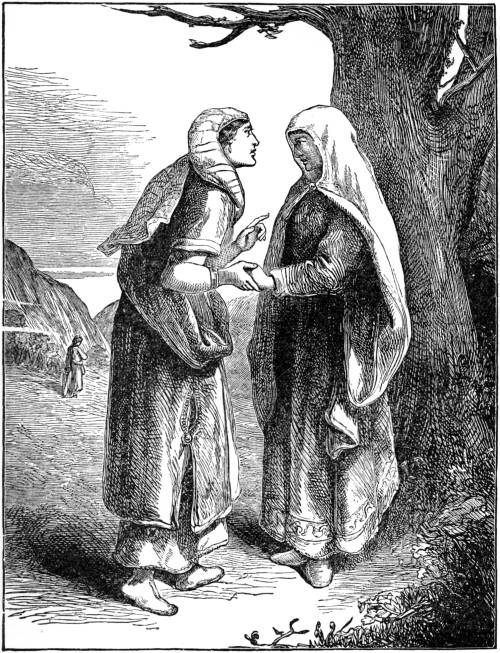
Naomi was the wife of a Jew named Elimelech, who left his own city of Bethlehem to go into the land of Moab, because there was a famine in Canaan. Some time afterwards he died, leaving Naomi a widow with two sons, all dwellers in a strange land. Her sons married two young women belonging to Moab, whose names were Orpah and Ruth. After living there about ten years Naomi’s sons died also, leaving Orpah and Ruth widows, along with their widowed mother-in-law. Then Naomi determined to return to her own land. Orpah and Ruth accompanied Naomi some distance on her journey; then she bade them to leave her, telling each to go back to her mother’s house in Moab, while she would pursue her way alone to the land of Judah. They were unwilling to do so, saying they would go with her to her land and people; but she urged them to depart, assuring them that they would gain nothing by leaving their own country to accompany her, and that they had better return to their own homes. Then the story informs us—you will find it in the Bible, in the Book of Ruth—that Orpah kissed her mother-in-law and departed; but Ruth clave unto her, saying, “Whither thou goest, I will go; and where thou lodgest, I will lodge; thy people shall be my people, and thy God my God; where thou diest, will I die, and there will I be buried: the Lord do so to me and more also, if ought but death part thee and me.”

So, Ruth refused to leave her mother-in-law, and journeyed with her until they reached Canaan. Then they both dwelt in the city of Bethlehem, in the land of Judah, where we shall meet with them again.

RUTH AND NAOMI

The Death of Samson

THE DEATH OF SAMSON

Samson’s birth was foretold by an angel. He was to grow up a Nazarite, forbidden to drink strong drink, neither was his head to be shaved. His strength was very great; but his marriage was sinful, and his doings with the idolatrous Philistines terrible. Though an Israelite and a judge, I fear much he sinned greatly against God. On one occasion he went to Gaza, a city of the Philistines. The inhabitants tried to take him, but he arose at midnight and carried away the gates of their city. In our picture though he looks so strong, yet we see chains on his legs, and he is blind! How came he to lose his sight and be made a prisoner? I think it was owing to his sin and folly.

He became acquainted with a wicked woman, who enticed him to tell her in what his great strength lay. Three times he told her falsely, but at last he said that if the flowing locks of his hair were removed his strength would depart. While he slept these locks were cut off, then the Philistines burst in upon him, and when he arose to resist them, he found that his strength was gone. Then his eyes were cruelly put out, and he was bound with fetters of brass.

Our artist shows him blind, brought out to make sport at the Philistines’ feast. He is very sorrowful, and, I think, angry. He asks the lad beside him to place his hands upon the pillars supporting the house; then, his great strength returning, he bows himself with all his might; the pillars break, the house falls, and Samson, with very many of the Philistines, is crushed amid the ruins. Was not this a terrible end to what might have been a noble life?

SAMSON MAKING SPORT FOR THE PHILISTINES

The Defeat of the Midianites

THE DEFEAT OF THE MIDIANITES

Large numbers of the Israelites gathered around Gideon, prepared to fight against the Midianites, who were encamped in a valley, “like grasshoppers for multitude.” How Gideon’s host was reduced till only three hundred men remained, and the wonderful dream he heard related, when he and his servant went down as spies into the enemy’s camp, are recorded in the seventh chapter of Judges. It was not by their own bravery or power that the Israelites were to overcome their enemies. God was to give them the victory: and He chose Gideon and three hundred men to overcome the great and mighty host of the Midianites.

Gideon divided his three hundred men into three companies, and put a trumpet in every man’s hand, and gave to each a pitcher with a lamp inside. Then he said, “Look on me, and do likewise: when I blow with a trumpet, I and all that are with me, then blow ye the trumpets also on every side of the camp, and say, ‘The sword of the Lord and of Gideon.'” Gideon and the hundred men of his company approached the enemy’s camp by night, and the other two companies drew nigh also, so that the Midianites where surrounded. Then all blew their trumpets, broke their pitchers, held up their lamps (torches), and cried out as they had been commanded.

The Midianites heard the trumpets’ blast and the cry, and saw the lights. They were thrown into confusion, and one fought against another; then they fled, and were pursued by the Israelites, great numbers of whom gathered together and followed after their flying enemies. Thus the Midianites were overcome, and Israel had peace during the lifetime of Gideon.

THE SWORD OF THE LORD, AND OF GIDEON