A place to grow your relationship with God

Posts tagged ‘Children’s bible’

THE STORY OF THE FISHERMEN

THE STORY OF THE FISHERMEN

When Jesus began to teach the people by the river Jordan, a few young men came to him as followers, or disciples. Some of these men were Andrew and John, Peter and Philip and Nathanael. While Jesus was teaching near Jerusalem and in Samaria, these men stayed with Jesus; but when he came to Galilee, they went to their homes and work, for most of them were fishermen from the Sea of Galilee.

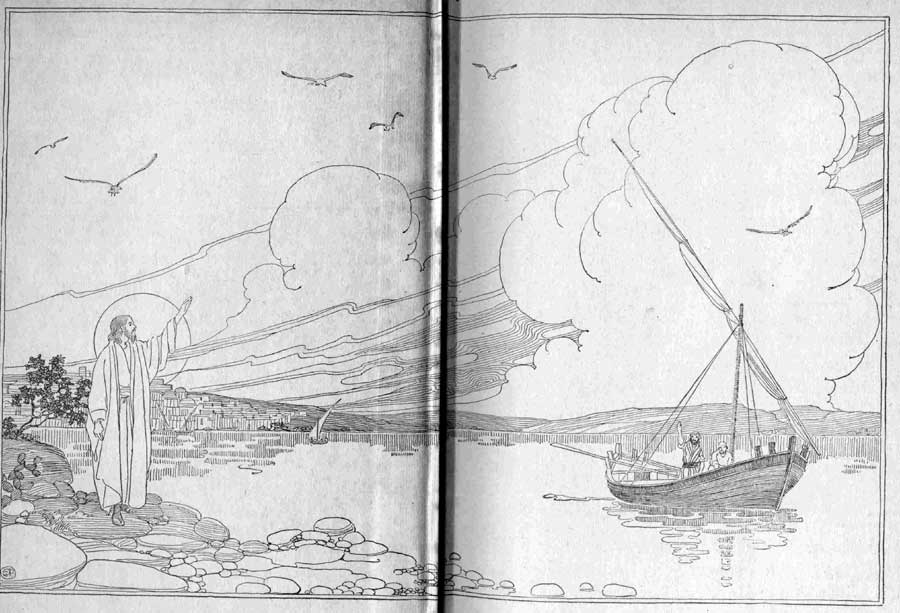
One morning, soon after Jesus came to Capernaum, he went out of the city, by the sea, followed by a great throng of people, who had come together to see him and to hear him. On the shore were lying two fishing boats, one of which belonged to Simon and Andrew, the other to James and John and their father Zebedee. The men themselves were not in the boats, but were washing their nets near by.

Jesus stepped into the boat that belonged to Simon Peter and his brother Andrew, and asked them to push it out a little into the lake, so that he could talk to the people from it without being crowded too closely. They pushed it out, and then Jesus sat in the boat, and spoke to the people, as they stood upon the beach. After he had finished speaking to the people, and had sent them away, he said to Simon Peter:

“Put out into the deep water and let down your nets to catch some fish.”

The net caught so many fishes they could not pull it up

“Master,” said Simon, “we have been fishing all night, and have caught nothing; but if it is your will, I will let down the net again.”

They did as Jesus bade them; and now the net caught so many fishes that Simon and Andrew could not pull it up, and it was in danger of breaking. They made signs to the two brothers, James and John, who were in the other boat, for them to come and help them. They came, and lifted the net, and poured out the fish. There were so many of them that both the boats were filled, and began to sink.

When Simon Peter saw this, he was struck with wonder, and felt that it was by the power of God. He fell down at the feet of Jesus, saying: “Oh Lord, I am full of sin, and am not worthy of all this! Leave me, O Lord.”

But Jesus said to Simon, and to the others, “Fear not; but follow me, and I will make you from this time fishers of men.”

From that time these four men, Simon and Andrew, James and John, gave up their nets and their work, and became disciples of Jesus.

On the Sabbath, after this, Jesus and his disciples went together to the synagogue, and spoke to the people. They listened to him and were surprised at his teaching; for while the scribes always repeated what other scribes had said before, Jesus never spoke of what the men of old time had taught, but spoke in his own name, and by his own power, saying, “I say unto you,” as one who had the right to speak. Men felt that Jesus was speaking to them as the voice of God.

On one Sabbath, while Jesus was preaching, a man came into the synagogue who had in him an evil spirit; for sometimes evil spirits came into men, and lived in them and spoke out from them. The evil spirit in this man cried out, saying:

“Let us alone, thou Jesus of Nazareth! What have we to do with thee? Hast thou come to destroy us? I know thee; and I know who thou art, the Holy one of God!”

Then Jesus spoke to the evil spirit in the man:

“Be still; and come out of this man!”

Then the evil spirit threw the man down, and seemed as if he would tear him apart; but he left the man lying on the ground, without harm.

Then wonder fell upon all the people. They were filled with fear, and said: “What mighty word is this? This man speaks even to the evil spirits, and they obey him!”

After the meeting in the synagogue, Jesus went into the house where Simon Peter lived. There he saw lying upon a bed the mother of Simon’s wife, who was very ill with a burning fever. He stood over her, and touched her hand. At once the fever left her; she rose up from her bed and waited upon them.

At sunset, the Sabbath day was over; and then they brought to Jesus from all parts of the city those that were sick, and some that had evil spirits in them. Jesus laid his hands upon the sick, and they became well; he drove out the evil spirits by a word, and would not allow them to speak.
THE STORY OF THE STRANGER AT THE WELL

THE STORY OF THE STRANGER AT THE WELL

While Jesus was teaching in Jerusalem and in the country places near it, John the Baptist was still preaching and baptizing. But already the people were leaving John and going to hear Jesus. Some of the followers of John the Baptist were not pleased as they saw that fewer people came to their master, and that the crowds were seeking Jesus. But John said to them: “I told you that I am not the Christ, but that I am sent before him. Jesus is the Christ, the king. He must grow greater, while I must grow less; and I am glad that it is so.”

Soon after this, Herod Antipas, the king of the province or land of Galilee, put John in prison. Herod had taken for his wife a woman named Herodias, who had left her husband to live with Herod, which was very wicked. John sent word to Herod, that it was not right for him to have this woman as his wife. These words of John made Herodias very angry. She hated John, and tried to kill him. Herod himself did not hate John so greatly, for he knew that John had spoken the truth. But he was weak, and yielded to his wife Herodias. To please her, he sent John the Baptist to a lonely prison among the mountains east of the Dead Sea; for the land in that region, as well as Galilee, was under Herod’s rule. There in prison Herod hoped to keep John safe from the hate of his wife Herodias.

Soon after John the Baptist was thrown into prison, Jesus left the country near Jerusalem with his disciples, and went toward Galilee, the province in the north. Between Judea in the south and Galilee in the north, lay the land of Samaria, where the Samaritans lived, who hated the Jews. They worshipped the Lord as the Jews worshipped him, but they had their own Temple and their own priests. And they had their own Bible, which was only the five books of Moses; for they would not read the other books of the old Testament. The Jews and the Samaritans would scarcely ever speak to each other, so great was the hate between them.

When Jews went from Galilee to Jerusalem, or from Jerusalem to Galilee, they would not pass through Samaria, but went down the mountains to the river Jordan, and walked beside the river, in order to go around Samaria. But Jesus, when he would go from Jerusalem to Galilee, walked over the mountains straight through Samaria. One morning while he was on his journey, he stopped to rest beside an old well at the foot of Mount Gerizim, not far from the city of Shechem, but nearer to a little village that was called Sychar. This well had been dug by Jacob, the great father or ancestor of the Israelites, many hundreds of years before. It was an old well then in the days of Jesus; and it is much older now; for the same well may be seen in that place still. Even now travelers may have a drink from Jacob’s well.

It was early in the morning, about sunrise, when Jesus was sitting by Jacob’s well. He was very tired, for he had walked a long journey; he was hungry, and his disciples had gone to the village near at hand to buy food. He was thirsty, too; and as he looked into the well he could see the water a hundred feet below, but he had no rope with which to let down a cup or a jar to draw up some water to drink.

Just at this moment a Samaritan woman came to the well, with her water-jar upon her head, and her rope in her hand. Jesus looked at her, and in one glance read her soul, and saw all her life.

He knew that Jews did not often speak to Samaritans, but he said to her:

“Please to give me a drink?”

The woman saw from his looks and his dress that he was a Jew, and she said to him:

“How is it that you, who are a Jew, ask drink of me, a Samaritan woman?”

Jesus answered her:

“If you knew what God’s free gift is, and if you knew who it is that says to you, ‘Give me a drink,’ you would ask him to give you living water, and he would give it to you.”

There was something in the words and the looks of Jesus which made the woman feel that he was not a common man. She said to him: “Sir, you have nothing to draw water with, and the well is deep. Where can you get that living water? Are you greater than our father Jacob, who drank from this well, and who gave it to us?”

“Whoever drinks of this water,” said Jesus, “shall thirst again, but whoever drinks of the water that I shall give him, shall never thirst; but the water that I shall give him shall be in him a well of water springing up unto everlasting life.”

“Sir,” said the woman, “give me some of this water of yours, so that I will not thirst any more, nor come all the way to this well.”

Jesus looked at the woman, and said to her, “Go home, and bring your husband, and come here.”

“I have no husband,” answered the woman.

“Yes,” said Jesus, “you have spoken the truth. You have no husband. But you have had five husbands, and the man whom you now have is not your husband.”

The woman was filled with wonder as she heard this. She saw that here was a man who knew what others could not know. She felt that God had spoken to him, and she said:

“Sir, I see that you are a prophet of God. Tell me whether our people or the Jews are right. Our fathers have worshipped on this mountain. The Jews say that Jerusalem is the place where men should go to worship. Now, which of these is the right place?”

“Woman, believe me,” said Jesus, “there is coming a time when men shall worship God in other places besides on this mountain and in Jerusalem. The time is near; it has even now come, when the true worshippers everywhere shall pray to God in spirit and in truth; for God himself is a Spirit.”

The woman said: “I know that the Anointed one is coming, the Christ. When he comes, he will teach us all things.”

Jesus said to her:

“I that speak to you now am he, the Christ!”

Just at this time the disciples of Jesus came back from the village. They wondered to see Jesus talking with this Samaritan woman, but they said nothing.

The woman had come to draw water, but in her interest in this wonderful stranger, she forgot her errand. Leaving her water-jar, she ran back to her village, and said to the people:

“Come, see a man who told me everything that I have done in all my life! Is not this man the Christ whom we are looking for?”

Soon the woman came back to the well with many of her people. They asked Jesus to come to their town, and to stay there and teach them. He went with them, and stayed there two days, teaching the people, who were Samaritans. And many of the people in that place believed in Jesus, and said:

“We have heard for ourselves; now we know that this is indeed the Saviour of the world.”

THE STORY OF THE WATER THAT WAS TURNED INTO WINE

THE STORY OF THE WATER THAT WAS TURNED INTO WINE

A few days after Jesus met his followers or disciples at the river Jordan, he came with these men to a town in Galilee called Cana, to be present at a wedding. In those lands a feast was always held at a wedding, and often the friends of those who were married stayed several days, eating and drinking together.

The mother of Jesus was at this wedding as a friend of the family; for Nazareth, where she lived, was quite near to Cana. Before the wedding feast was over, all the wine had been used, and there was no more for the guests to drink. The mother of Jesus knew that her son had power to do whatever he chose; and she said to him; “They have no wine.”

Jesus said to her: “O woman, what have I to do with thee? My hour is not yet come.”

But his mother knew that Jesus would in some way help the people in their need, and she said to the servants who were waiting at the table:

“Whatever he tells you to do, be sure to do it.”

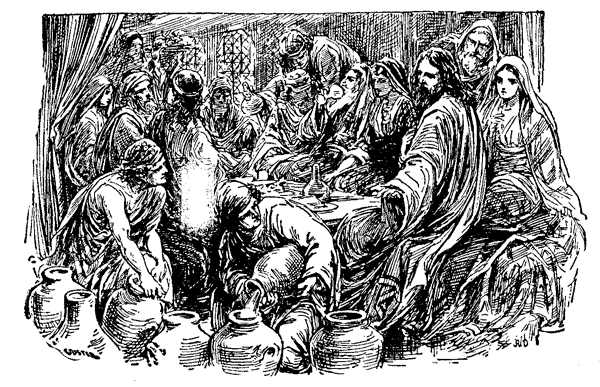
In the dining hall were standing six large stone jars, each about as large as a barrel, holding twenty-five gallons. These jars held water for washing, as the Jews washed their hands before every meal, and washed their feet as often as they came from walking in the street, since they wore no shoes, but only sandals. Jesus said to the servants:

“Fill the jars with water.”

“Fill the jars with water”

The servants obeyed Jesus, and filled the jars up to the brim. Then Jesus spoke to them again, and said:

“Now draw out some of the water, and take it to the ruler of the feast.”

They drew out water from the jars, and saw that it had been turned into wine. The ruler did not know from what place the wine had come; but he said to the young man who had just been married, the bridegroom:

“At a feast everybody gives his best wine at the beginning, and afterward, when his guests have drunk freely, he brings on wine that is not so good; but you have kept the good wine until now.”

This was the first time that Jesus used the power that God had given him, to do what no other man could do. Such works as these were called “miracles”; and Jesus did them as signs of his power as the Son of God. When the disciples saw this miracle, they believed in Jesus more fully than before.

After this Jesus went with his mother and his younger brothers to a place called Capernaum, on the shore of the Sea of Galilee. But they stayed there only a few days, for the feast of the Passover was near, and Jesus went up to Jerusalem to attend it. You remember that the feast of the Passover was held every year, to keep in mind how God had led the people of Israel out of Egypt long before.

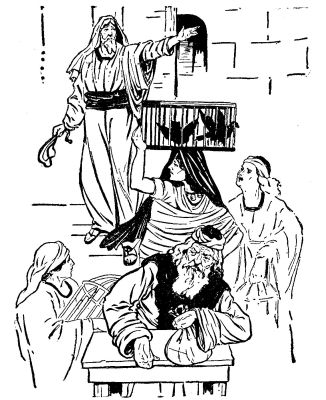
When Jesus came to Jerusalem, he found in the courts of the Temple men who were selling oxen and sheep and doves for the sacrifices, and other men sitting at tables changing the money of Jews who came from other lands into the money of Judea. All this made the courts around the Temple seem like a market, and not a place for the worship of God.

“Take these things away”

Jesus picked up some cord and made from it a little whip. With it he began to drive out of the Temple all the buyers and sellers. He was but one, and they were many; but such power was in his look, that they ran before him. He drove the men and the sheep and the oxen; he overturned the tables and threw on the floor the money, and to those who were selling the doves he said: “Take these things away; make not my Father’s house a house for selling and buying!”

The acts of Jesus were not pleasing to the rulers of the Jews, for many of them were making money by this selling of sacrifices and changing of money. Some of the rulers came to Jesus and said to him: “What right have you to come here and do such things as these? What sign can you show that God has given to you power to rule in this place?”

Jesus said to them: “I will give you a sign. Destroy this house of God, and in three days I will raise it up.”

Then said the Jews, “It has taken forty-six years to build this Temple, and it is not finished yet. Will you raise it up in three days?”

But Jesus did not mean that Temple on Mount Moriah. He was speaking of himself, for in him God was dwelling as in a temple, and he meant that when they should put him to death, he would rise again in three days. Afterward, when Jesus had died and risen again, his followers, the disciples, thought of what he had said, and understood these words.

THE STORY OF THE CHILD IN THE TEMPLE

THE STORY OF THE CHILD IN THE TEMPLE

Jesus was brought to Nazareth when he was a little child not more than three years old; there he grew up as a boy and a young man, and there he lived until he was thirty years of age. We should like to know many things about his boyhood, but the Bible tells us very little. As Joseph was a working man, it is likely that he lived in a house with only one room, with no floor except the earth, no window except a hole in the wall, no pictures upon the walls, and neither bedstead, nor chair, nor looking-glass. They sat upon the floor or upon cushions; they slept upon rolls of matting, and their meals were taken from a low table not much larger than a stool.

Jesus may have learned to read at the village school, which was generally held in the house used for worship, called the “synagogue.” The lessons were from rolls on which were written parts of the Old Testament; but Jesus never had a Bible of his own. From a child he went with Joseph to the worship in the synagogue twice every week. There they sat on the floor and heard the Old Testament read and explained, while Mary and the younger sisters of Jesus listened from a gallery behind a lattice-screen. The Jewish boys of that time were taught to know almost the whole of the Old Testament by heart.

It was the custom of the Jews from all parts of the land to go up to Jerusalem to worship at least once every year, at the feast of the Passover, which was held in the spring. Some families also stayed to the feast of Pentecost, which was fifty days after Passover; and some went again in the fall to the feast of Tabernacles, when for a week all the families slept out of doors, under roofs made of green twigs and bushes.

When Jesus was a boy twelve years old, he was taken up to the feast of the Passover, and there for the first time he saw the holy city Jerusalem, and the Temple of the Lord on Mount Moriah. Young as he was, his soul was stirred, as he walked among the courts of the Temple and saw the altar with its smoking sacrifice, the priests in their white robes, and the Levites with their silver trumpets. Though a boy, Jesus began to feel that he was the Son of God, and that this was his Father’s house.

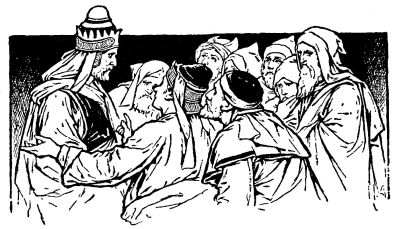
Sitting in a company of the doctors of the law

His heart was so filled with the worship of the Temple, with the words of the scribes or teachers whom he heard in the courts, and with his own thoughts, that when it was time to go home to Nazareth, he stayed behind, held fast by his love for the house of the Lord. The company of people who were traveling together was large, and at first he was not missed. But when night came and the boy Jesus could not be found, his mother was alarmed. The next day Joseph and Mary left their company and hastened back to Jerusalem. They did not at first think to go to the Temple. They sought him among their friends and kindred who were living in the city, but could not find him.

On the third day, they went up to the Temple with heavy hearts, still looking for their boy. And there they found him sitting in a company of the doctors of the law, listening to their words and asking them questions. Everybody who stood near was surprised to find how deep was the knowledge of this boy in the word of the Lord.

His mother spoke to him a little sharply, for she felt that her son had not been thoughtful of his duty. She said: “Child, why have you treated us in this way? Do you not know that your father and I have been looking for you with troubled hearts?”

“Why did you seek for me,” said Jesus. “Did you not know that I must be in my Father’s house?”

They did not understand these words; but Mary thought often about them afterward; for she felt her son was no common child, and that his words had a deep meaning. Though Jesus was wise beyond his years, he obeyed Joseph and his mother in all things. He went with them to Nazareth, and lived contented with the plain life of their country home.

As the years went on, Jesus grew from a boy to a young man. He grew, too, in knowledge, and in wisdom, and in the favor of God. He won the love of all who knew him, for there was something in his nature that drew all hearts, both young and old.

Jesus learned the trade of a carpenter with Joseph; and when Joseph died, while Jesus was still a young man, Jesus worked as a carpenter and helped his mother take care of the family. And so in the carpenter shop, and the quiet life of a country village, and the worship of the synagogue, the years passed until Jesus was thirty years of age.

THE STORY OF THE STAR AND THE WISE MEN

THE STORY OF THE STAR AND THE WISE MEN

For some time after Jesus was born, Joseph and Mary stayed with him in Bethlehem. The little baby was not kept long in the stable sleeping in a manger; for after a few days they found room in a house; and there another visit was made to Jesus by strange men from a land far away.

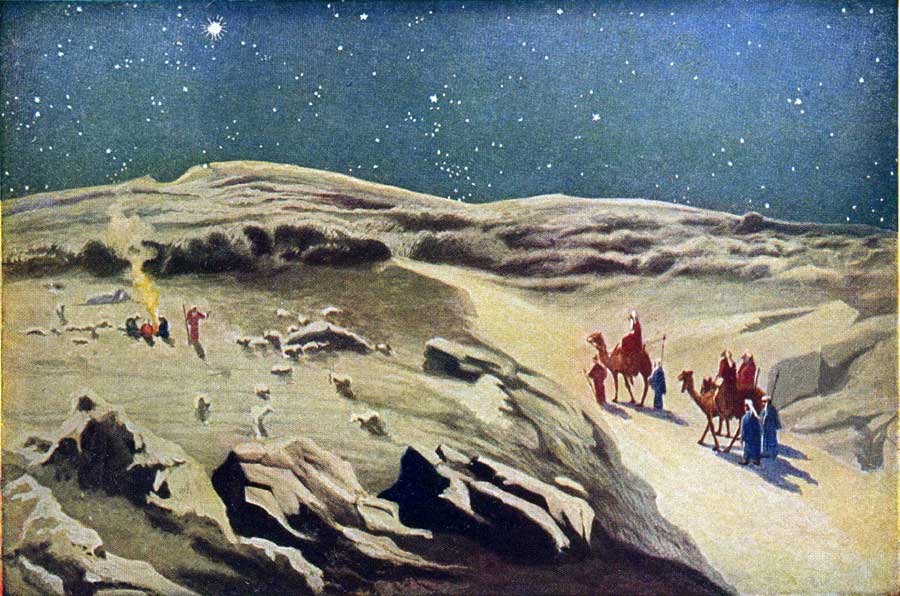
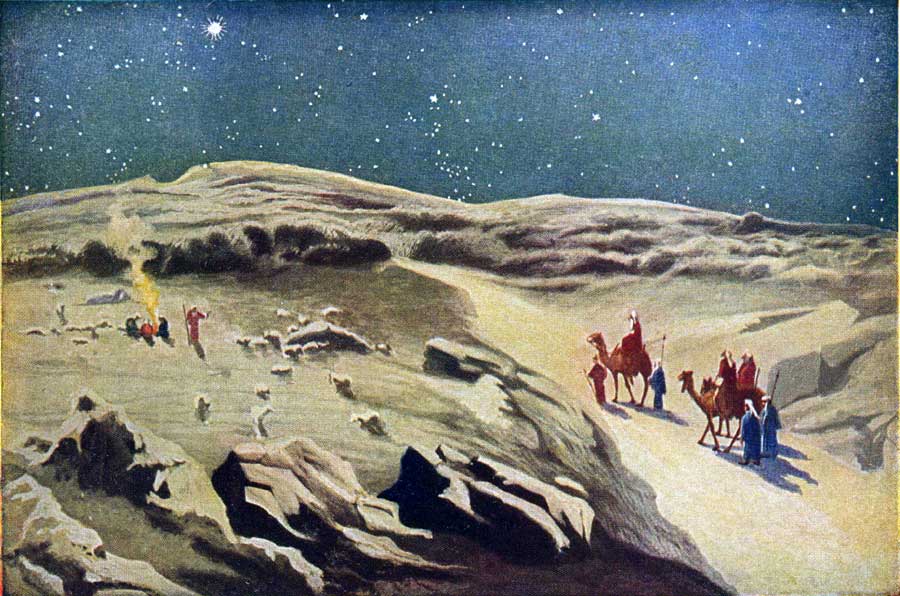
In a country east of Judea, and many miles distant, were living some very wise men who studied the stars. One night they saw a strange star shining in the sky, and in some way they learned that the coming of this star meant that a king was soon to be born in the land of Judea. These men felt a call of God to go to Judea, far to the west of their own home, and there to see this new-born king. They took a long journey, with camels and horses, and at last they came to, the land of Judea, just at the time when Jesus was born at Bethlehem. As soon as they were in Judea, they supposed that every one would know all about the king, and they said:

“Where is he that is born king of the Jews? In the east we have seen his star, and we have come to worship him.”

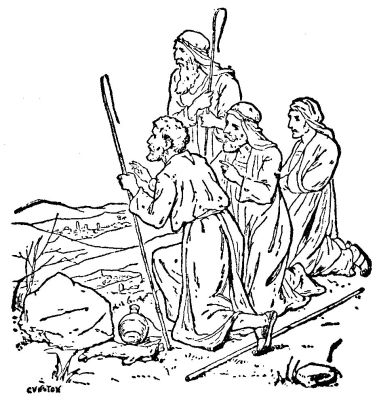
THE SHEPHERDS IN THE FIELD—And there were in the same country shepherds abiding in the field, keeping watch over their flock by night…. And the angel said unto them, ‘Fear not: for, behold, I bring you good tidings of great joy, which shall be to all people. For unto you is born this day in the city of David a Saviour, which is Christ the Lord.’—(Luke 2: 8-10-11.)

But no one of whom they asked had ever seen this king, or had heard of him. The news of their coming was sent to Herod the king, who was now a very old man. He ruled the land of Judea, as you know, under the emperor at Rome, Augustus Cæsar. Herod was a very wicked man, and when he heard of some one born to be a king, he feared that he might lose his own kingdom. He made up his mind to kill this new king.

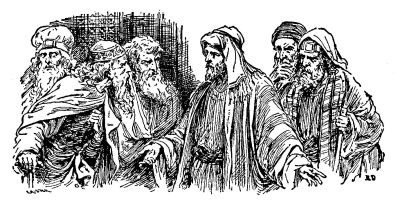
He sent for the priests and scribes, the men who studied and taught the books of the Old Testament, and asked them about this Christ for whom all the people were looking. He said: “Can you tell me where Christ, the king of Israel, is to be born?” They looked at the books of the prophets, and then they said: “He is to be born in Bethlehem of Judea; for thus it is written by the prophet, ‘And thou Bethlehem in the land of Judah are not the least among the princes of Judah; for out of thee shall come forth one who shall rule my people Israel.'”

Then Herod sent for the wise men from the east, and met them alone, and found from them at what time the star was first seen. Then he said to them:

“Go to Bethlehem; and there search carefully for the little child; and when you have found him, bring me word again, so that I also may come and worship him.”

The wise men went their way

Then the wise men went on their way toward Bethlehem; and suddenly they saw the star again shining upon the road before them. At this they were glad, and followed the star until it led them to the very house where the little child was. They came in, and there they saw the little one, with Mary, its mother. They knew at once that this was the king; and they fell down on their faces and worshipped him as the Lord. Then they brought out gifts of gold and precious perfumes, frankincense and myrrh, which were used in offering sacrifices; and they gave them as presents to the royal child.

That night God sent a dream to the wise men, telling them not to go back to Herod, but to go home at once to their own land by another way. They obeyed the Lord, and found another road to their own country without passing through Jerusalem where Herod was living. So Herod could not learn from those men who the child was that was born to be a king.

And very soon after these wise men had gone away, the Lord sent another dream to Joseph, the husband of Mary. He saw an angel, who spoke to him, saying:

“Rise up quickly; take the little child and his mother, and go down to the land of Egypt, for Herod will try to find the child to kill him.”

Then at once Joseph rose up in the night, without waiting even for the morning. He took his wife and her baby, and quietly and quickly went with them down to Egypt, which was on the southwest of Judea. There they all stayed in safety, as long as the wicked king Herod lived, which was not many months.

King Herod waited for the wise men to come back to him from their visit to Bethlehem; but he soon found that they had gone to their home without bringing to him any word. Then Herod was very angry. He sent out his soldiers to Bethlehem. They came, and by the cruel king’s command they seized all the little children in Bethlehem who were three years old, or younger, and killed them all. What a cry went up to God from the mothers in Bethlehem, as their children were torn from their arms and slain!

He took his wife and baby and went down to Egypt

But all this time, the child Jesus whom they were seeking was safe with his mother in the land of Egypt.

Soon after this king Herod died, a very old man, cruel to the last. Then the angel of the Lord came again and spoke to Joseph in a dream, saying: “You may now take the young child back to his own land, for the king who sought to kill him is dead.”

Then Joseph took his wife and the little child Jesus, and started to go again to the land of Judea. Perhaps it was his thought to go again to Bethlehem, the city of David, and there bring up the child. But he heard that in that part of the land Archelaus, a son of Herod, was now ruling, and who was as wicked and cruel as his father.

He feared to go under Archelaus’ rule, and instead took his wife and the child to Nazareth, which had been his own home and that of Mary his wife before the child was born. Nazareth was in the part of the land called Galilee, which at that time was ruled by another son of king Herod, a king named Herod Antipas. He was not a good man, but was not so cruel nor bloody as his wicked father had been.

So again Joseph the carpenter and Mary his wife were living in Nazareth. And there they stayed for many years while Jesus was growing up. Jesus was not the only child in their house, and he had many other playmates among the boys of Nazareth.

THE STORY OF JESUS, THE BABE OF BETHLEHEM

THE STORY OF JESUS, THE BABE OF BETHLEHEM

Soon after the time when John the Baptist was born, Joseph the carpenter of Nazareth had a dream. In his dream he saw an angel from the Lord standing beside him. The angel said to him:

“Joseph, sprung from the line of king David, I have come to tell you, that Mary, the young woman whom you are to marry, will have a son, sent by the Lord God. You shall call his name Jesus, which means ‘salvation,’ because he shall save his people from their sins.”

God’s people had had several kings. Some of them had been selfish and cruel, but Jesus was to be a new kind of king, one who would save, not destroy men.

Soon after Joseph and Mary were married in Nazareth, a command went forth from the emperor Augustus Cæsar through all the lands of the Roman empire, for all the people to go to the cities and towns from which their families had come, and there to have their names written down upon a list, for the emperor wished a list to be made of all the people under his rule. As both Joseph and Mary had come from the family of David the king, they went together from Nazareth to Bethlehem, there to have their names written upon the list. For you remember that Bethlehem in Judea, six miles south of Jerusalem, was the place where David was born, and where his father’s family had lived for many years.

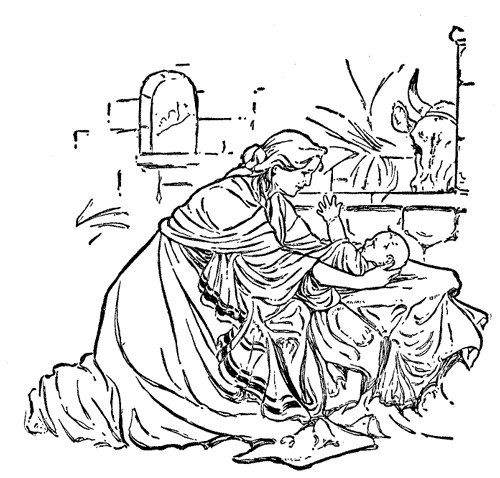
It was a long journey from Nazareth to Bethlehem; down the mountains to the river Jordan, then following the Jordan almost to its end, and then climbing the mountains of Judah to the town of Bethlehem. When Joseph and Mary came to Bethlehem they found the city full of people who, like themselves, had come to have their names enrolled or written upon the list. The inn or hotel was full, and there was no room for them; for no one but themselves knew that this young woman was soon to be the mother of the Lord of all the earth. The best that they could do was to go to a stable where the cattle were kept. There the little baby was born, and was laid in a manger, where the cattle were fed.

On that night, some shepherds were tending their sheep in a field near Bethlehem. Suddenly, a great light shone upon them, and they saw an angel of the Lord standing before them. They were filled with fear, as they saw how glorious the angel was. But the angel said to them:

“Be not afraid; for behold I bring you news of great joy, which shall be to all the people; for there is born to you this day in Bethlehem, the city of David, a Saviour who is Christ the Lord, the anointed king. You may see him there; and you may know him by this sign: He is a new-born baby, lying in a manger, at the inn.”

They were filled with fear

And then they saw that the air around and the sky above them were filled with angels, praising God and singing:

“Glory to God in the highest. And on earth peace among men in whom God is well pleased.”

While they looked with wonder, and listened, the angels went out of sight as suddenly as they had come. Then the shepherds said one to another:

“Let us go at once to Bethlehem, and see this wonderful thing that has come to pass, and which the Lord has made known to us.”

The baby in the manger

Then as quickly as they could go to Bethlehem, they went, and found Joseph, the carpenter of Nazareth, and his young wife Mary, and the little baby lying in the manger. They told Mary and Joseph, and others also, how they had seen the angels, and what they had heard about this baby. All who heard their story wondered at it; Mary, the mother of the child, said nothing. She thought over all these things, and silently kept them in her heart. After their visit, the shepherds went back to their flocks, praising God for the good news that he had sent to them.

When the little one was eight days old, they gave him a name; and the name given was “Jesus,” a word which means “salvation,” as the angel had told both Mary and Joseph that he should be named. So the very name of this child told what he should do for men; for he was to bring salvation to the world.

THE STORY OF THE ANGEL BY THE ALTAR

THE STORY OF THE ANGEL BY THE ALTAR

At the time when the story of the New Testament begins, the land of Israel, called also the land of Judea, was ruled by a king named Herod. He was the first of several Herods, who at different times ruled either the whole of the land, or parts of it. But Herod was not the highest ruler. Many years before this time, the Romans, who came from the city of Rome in Italy, had won all the lands around the Great Sea, the sea which we call the Mediterranean; and above king Herod of Judea was the great king of Rome, ruling over all the lands, and over the land of Judea among them. So Herod, though king of Judea, obeyed his overlord, the emperor at Rome. At the time when this story begins, the emperor at Rome was named Augustus Cæsar.

At this time, the land where the Jews lived was full of people. Jerusalem was its largest city, and in Jerusalem was standing the Temple of the Lord, which king Herod had lately built anew, taking the place of the old Temple built very many years before, which had long needed repair. There were also many other large cities besides Jerusalem. In the south was Hebron among the mountains; on the shore of the Great Sea were Gaza, and Joppa, and Cæsarea; in the middle of the land were Shechem and Samaria; and in the north were Nazareth, and Cana; down by the shore of the Sea of Galilee were Tiberias, and Capernaum, and Bethsaida. Far up in the north, at the foot of snowy Mount Hermon, was another Cæsarea; but so that it might not be confused with Cæsarea upon the seacoast this city was called Cæsarea-Philippi, or “Philip’s Cæsarea,” from the name of one of Herod’s sons.

One day, an old priest named Zacharias was leading the service of worship in the Temple. He was standing in front of the golden altar of incense, in the Holy Place, and was holding in his hand a censer, or cup, full of burning coals and incense; while all the people were worshipping in the court of the Temple, outside the court of the Priests, where the great altar of burnt-offering stood.

Suddenly, Zacharias saw an angel from the Lord, standing on the right side of the altar of incense. He felt a great fear when he saw this strange being with shining face; but the angel said to him:

“Do not be afraid, Zacharias”

“Do not be afraid, Zacharias; for I have come from the Lord to bring good news. Your wife Elizabeth shall have a son, and you shall name him John. You shall be made glad, for your son John shall bring joy and gladness to many. He shall be great in the sight of the Lord; and he shall never taste wine nor strong drink as long as he lives; but he shall be filled with God’s Holy Spirit. He shall lead many of the people of Israel to the Lord, for he shall go before the Lord in the power of Elijah the prophet, as was promised by Malachi, the last of the old prophets. He shall turn the hearts of the fathers to the children, and those who are disobeying the Lord to do his will.”

As Zacharias heard these words, he was filled with wonder, and could hardly believe them true. He was now an old man, and his wife Elizabeth was also old; so that they could not expect to have a child. He said to the angel:

“How shall I know that your words are true, for I am an old man, and my wife is old?”

“I am Gabriel, who stands in the presence of God,” said the angel. “And I was sent from the Lord to speak to you, and to bring you this good news. But because you did not believe my words, you shall become dumb, and shall not be able to speak, until this which I have said comes to pass.”

All this time the people outside in the court were wondering why the priest stayed so long in the Temple. When at last he came out, they found that he could not speak a word; but he made signs to them, to tell them that he had seen a vision in the Temple.

After the days of his service were over, Zacharias went to his own home, which was near Hebron, a city of the priests, among the mountains in the south of Judea. When his wife Elizabeth found that God was soon to give her a child, she was very happy, and praised the Lord.

About six months after Zacharias saw the vision in the Temple, the same angel Gabriel was sent from the Lord to a city in the part of the land called Galilee, which was in the north. The city to which the angel was sent was Nazareth. There the angel found a young girl named Mary, who was a cousin to Elizabeth. Mary was soon to be married to a good man who had sprung from the line of king David, though he was not himself a king, nor a rich man. He was a carpenter, living in Nazareth, and his name was Joseph. The angel came into the room where Mary was, and said to her: “Hail, woman favored by the Lord; the Lord is with you!”

Mary was surprised at the angel’s words, and wondered what they could mean. Then the angel spoke again, and said: “Do not be afraid, Mary. The Lord has given to you his favor, and has chosen you to be the mother of a son whose name shall be Jesus, which means ‘salvation,’ because he shall save his people from their sins. He shall be great, and shall be called the Son of God; and the Lord shall give to him the throne of his father David. He shall be a king, and shall reign over the people of God forever; and of his kingdom there shall be no end.”

But Mary could not see how all this was to come to pass. And the angel said to her:

“The Holy Spirit shall come upon you, and the power of the Most High God shall be over you; and the child which you shall have shall be called holy, the Son of God.”

Then the angel told Mary that her cousin Elizabeth was soon to have a child, through the power of the Lord. And when Mary heard all this, she said: “I am the servant of the Lord, to do his will. Let it be to me as you have said.”

When the angel had given his message and had gone away, Mary rose up in haste and made a journey to the home of Zacharias and Elizabeth. When Elizabeth saw Mary, she was filled with the Spirit of the Lord, and said:

“Blessed are you among women, and blessed among men shall be your son! And why is it that the mother of my Lord comes to visit me? Blessed is the woman who believed that the promise of the Lord to her shall be made true!”

Then Mary was filled with the Spirit of the Lord, and broke out into a song of praise. She stayed with Elizabeth for nearly three months, and then went again to her own home at Nazareth.

As the angel had said, to the aged woman Elizabeth was given a son. They were going to name him Zacharias, after his father. But his mother said: “No, his name shall be John.”

“Why,” they said, “none of your family have ever been named John!”

They asked his father Zacharias, by signs, what name he wished to be given to the child. He asked for something to write upon; and when they brought it, he wrote, “His name is John.” Then all at once, the power to hear and to speak came back to Zacharias. He spoke, praising and blessing God; and he sang a song of thanks to God, in which he said:

“You O child, shall be called a prophet of the Most High; to go before the Lord, and to make ready his ways.”

When John was growing up, they sent him out into the desert on the south of the land, and there he stayed until the time came for him to preach to the people; for this child became the great prophet John the Baptist.

THE STORY OF THE SERMON ON THE MOUNT

THE STORY OF THE SERMON ON THE MOUNT

Among the Jews there was one class of men hated and despised by the people more than any other. That was “the publicans.” These were the men who took from the people the tax which the Roman rulers had laid upon the land. Many of these publicans were selfish, grasping, and cruel. They robbed the people, taking more than was right. Some of them were honest men, dealing fairly, and taking no more for the tax than was needful; but because so many were wicked, all the publicans were hated alike; and they were called “sinners” by the people.

One day, when Jesus was going out of Capernaum, to the seaside, followed by a great crowd of people, he passed a publican, or tax-gatherer, who was seated at his table taking money from the people who came to pay their taxes. This man was named Matthew, or Levi; for many Jews had two names. Jesus could look into the hearts of men, and he saw that Matthew was one who might help him as one of his disciples. He looked upon Matthew, and said:

“Follow me!”

At once, the publican rose up from his table, and left it to go with Jesus. All the people wondered, as they saw one of the hated publicans among the disciples, with Peter, and John, and the rest. But Jesus believed that there is good in all kinds of people. Most of the men who followed him were poor fishermen. None of them, so far as we know, was rich. And when he called Matthew he saw a man with a true and loving heart, whose rising up to follow Jesus just as soon as he was called showed what a brave and faithful friend he would be. The first of the four books about Jesus bears Matthew’s name.

A little while after Jesus called him, Matthew made a great feast for Jesus at his house; and to the feast he invited many publicans, and others whom the Jews called sinners. The Pharisees saw Jesus sitting among these people, and they said with scorn to his disciples:

“Why does your Master sit at the table with publicans and sinners?”

Jesus heard of what these men had said, and he said:

“Those that are well do not need a doctor to cure them, but those that are sick do need one. I go to these people because they know that they are sinners and need to be saved. I came not to call those who think themselves to be good, but those who wish to be made better.”

One evening Jesus went alone to a mountain not far from Capernaum. A crowd of people and his disciples followed him; but Jesus left them all, and went up to the top of the mountain, where he could be alone. There he stayed all night, praying to God, his Father and our Father. In the morning, out of all his followers, he chose twelve men who should walk with him and listen to his words, so that they might be able to teach others in turn. Some of these men he had called before; but now he called them again, and others with them. They were called “The Twelve,” or “the disciples”; and after Jesus went to heaven, they were called “The Apostles,” a word which means “those who were sent out,” because Jesus sent them out to preach the gospel to the world.

“I came not to call those who think themselves to be good”

The names of the twelve disciples, or apostles, were these: Simon Peter and his brother Andrew; James and John, the two sons of Zebedee; Philip of Bethsaida, and Nathanael, who was also called Bartholomew, a name which means “the son of Tholmai”; Thomas, who was also called Didymus, a name which means “a twin,” and Matthew the publican, or tax-gatherer; another James, the son of Alpheus, who was called “James the Less,” to keep his name apart from the first James, the brother of John; and Lebbeus, who was also called Thaddeus. Lebbeus was also called Judas, but he was a different man from another Judas, whose name is always given last. The eleventh name was another Simon, who was called “the Cananean” or “Simon Zelotes”; and the last name was Judas Iscariot, who was afterward the traitor. We know very little about most of these men, but some of them in later days did a great work. Simon Peter was a leader among them, but most of them were common sort of men of whom the best we know is that they loved Jesus and followed him to the end. Some died for him, and some served him in distant and dangerous places.

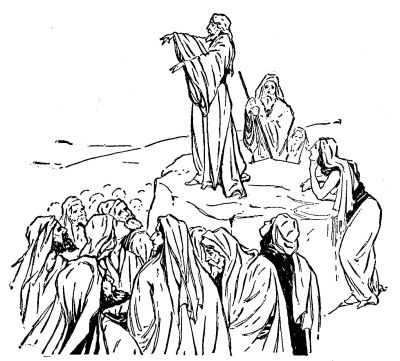
Then, on the mountain, he preached

Before all the people who had come to hear him, Jesus called these twelve men to stand by his side. Then, on the mountain, he preached to these disciples and to the great company of people. The disciples stood beside him, and the great crowd of people stood in front, while Jesus spoke. What he said on that day is called “The Sermon on the Mount.” Matthew wrote it down, and you can read it in his gospel, in the fifth, sixth, and seventh chapters. Jesus began with these words to his disciples:

“Blessed are the poor in spirit: for theirs is the kingdom of heaven.

“Blessed are they that mourn: for they shall be comforted.

“Blessed are the meek: for they shall inherit the earth.

“Blessed are they which do hunger and thirst after righteousness: for they shall be filled.

“Blessed are the merciful: for they shall obtain mercy.

“Blessed are the pure in heart: for they shall see God.

“Blessed are the peacemakers: for they shall be called the children of God.

“Blessed are they which are persecuted for righteousness’ sake: for theirs is the kingdom of heaven.

“Blessed are ye when men shall revile you, and persecute you, and shall say all manner of evil against you falsely, for my sake.

“Rejoice, and be exceedingly glad: for great is your reward in heaven: for so persecuted they the prophets which were before you.

“Ye are the salt of the earth: but if the salt have lost his savor, wherewith shall it be salted? it is thenceforth good for nothing, but to be cast out, and to be trodden under foot of men.

“Ye are the light of the world. A city that is set on an hill cannot be hid. Neither do men light a candle, and put it under a bushel, but on a candlestick; and it giveth light unto all that are in the house. Let your light so shine before men, that they may see your good works, and glorify your Father which is in heaven.”

It was in this Sermon on the Mount that Jesus told the people how they should pray, and he gave them the prayer which we all know as the Lord’s Prayer.

And this was the end of the Sermon:

“Therefore, whosoever heareth these sayings of mine, and doeth them, I will liken him unto a wise man, which built his house upon a rock:

“And the rain descended, and the floods came, and the winds blew, and beat upon that house; and it fell not; for it was founded upon a rock.

“And every one that heareth these sayings of mine, and doeth them not, shall be likened unto a foolish man, which built his house upon the sand:

“And the rain descended, and the floods came, and the winds blew, and beat upon that house; and it fell: and great was the fall of it.”

THE STORY OF DANIEL IN THE LIONS’ DEN

THE STORY OF DANIEL IN THE LIONS’ DEN

The lands which had been the Babylonian or Chaldean empire, now became the empire of Persia; and over these Darius was the king. King Darius gave to Daniel, who was now a very old man, a high place in honor and in power. Among all the rulers over the land, Daniel stood first, for the king saw that he was wise and able to rule. This made the other princes and rulers very jealous, and they tried to find something evil in Daniel, so that they could speak to the king against him.

These men saw that three times every day Daniel went to his room and opened the window that was toward the city of Jerusalem, and looking toward Jerusalem, made his prayer to God. Jerusalem was at that time in ruins, and the Temple was no longer standing; but Daniel prayed three times each day with his face toward the place where the house of God had once stood, although it was many hundreds of miles away.

These nobles thought that in Daniel’s prayers they could find a chance to do him harm, and perhaps cause him to be put to death. They came to King Darius, and said to him:

“All the rulers have agreed together to have a law made that for thirty days no one shall ask anything of any god or of any man, except from you, O king; and that if any one shall pray to any god, or shall ask anything from any man during the thirty days, except from you, O king, he shall be thrown into the den where the lions are kept. Now, O king, make the law, and sign the writing, so that it cannot be changed, for no law among the Medes and the Persians can be altered.”

The king was not a wise man; and being foolish and vain, he was pleased with this law which would set him even above the gods. So without asking Daniel’s advice, he signed the writing; and the law was made, and the word was sent out through the kingdom, that for thirty days no one should pray to any god.

Daniel knew that the law had been made, but every day he went to his room three times, and opened the window that looked toward Jerusalem, and offered his prayers to the Lord, just as he had prayed in other times. These rulers were watching near by, and they saw Daniel kneeling in prayer to God. Then they came to the king, and said:

“O King Darius, have you not made a law, that if any one in thirty days offers a prayer, he shall be thrown into the den of lions?”

“It is true,” said the king. “The law has been made, and it must stand.”

They said to the king: “There is one man who does not obey the law which you have made. It is that Daniel, one of the captive Jews. Every day Daniel prays to his God three times, just as he did before you signed the writing of the law.”

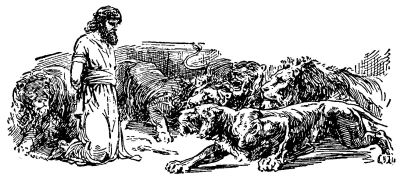
Thrown into the den of lions

Then the king was very sorry for what he had done, for he loved Daniel, and knew that no one could take his place in the kingdom. All day, until the sun went down, he tried in vain to find some way to save Daniel’s life; but when evening came, these men again told him of the law that he had made, and said to him that it must be kept. Very unwillingly the king sent for Daniel, and gave an order that he should be thrown into the den of lions. He said to Daniel: “Perhaps your God, whom you serve so faithfully, will save you from the lions.”

They led Daniel to the mouth of the pit where the lions were kept, and they threw him in; and over the mouth they placed a stone; and the king sealed it with his own seal, and with the seals of his nobles; so that no one might take away the stone and let Daniel out of the den.

Then the king went again to his palace; but that night he was so sad that he could not eat, nor did he listen to music as he was used to listen. He could not sleep, for all through the night he was thinking of Daniel. Very early in the morning he rose up from his bed and went in haste to the den of lions. He broke the seal and took away the stone, and in a voice full of sorrow he called out, scarcely hoping to have an answer:

“O Daniel, servant of the living God, has your God been able to save you from the lions?”

And out of the darkness in the den came the voice of Daniel, saying:

“O king, may you live forever! My God has sent his angel and has shut the mouths of the lions. They have not hurt me, because my God saw that I had done no wrong. And I have done no wrong toward you, O king!”

DANIEL’S ANSWER TO THE KING—Then said Daniel unto the King, O King, live forever. My God hath sent his angel, and hath shut the lions’ mouths, that they have not hurt me.—(Daniel 6: 21-22.)

Then the king was glad. He gave to his servants orders to take Daniel out of the den. Daniel was brought out safe and without harm, because he had trusted fully in the Lord God. Then by the king’s command, they brought those men who had spoken against Daniel, and with them their wives and their children, for the king was exceedingly angry with them. They were all thrown into the den, and the hungry lions leaped upon them, and tore them in pieces, so soon as they fell upon the floor of the den.

After this king Darius wrote to all the lands and the peoples in the many kingdoms under his rule:

“May peace be given to you all abundantly! I make a law that everywhere among my kingdoms men fear and worship the Lord God of Daniel; for he is the living God, above all other gods, who only can save men.”

And Daniel stood beside king Darius until the end of his reign, and afterward while Cyrus the Persian was king over all the lands.

THE STORY OF THE FIERY FURNACE

THE STORY OF THE FIERY FURNACE

There was in the land of Judah a wicked king-named Jehoiakim, son of the good Josiah. While Jehoiakim was ruling over the land of Judah, Nebuchadnezzar, a great conqueror of the nations, came from Babylon with his army of Chaldean soldiers. He took the city of Jerusalem, and made Jehoiakim promise to submit to him as his master. And when he went back to his own land he took with him all the gold and silver that he could find in the Temple; and he carried away as captives very many of the princes and nobles, the best people in the land of Judah.

When these Jews were brought to the land of Chaldea or Babylon, King Nebuchadnezzar gave orders to the prince, who had charge of his palace, to choose among these Jewish captives some young men who were of noble rank, and beautiful in their looks, and also quick and bright in their minds; young men who would be able to learn readily. These young men were to be placed under the care of wise men, who should teach them all that they knew, and fit them to stand before the king of Babylon, so that they might be his helpers to carry out his orders; and the king wished them to be wise, so that they might give him advice in ruling his people.

Among the young men thus chosen were four Jews, men who had been brought from Judah. By order of the king the names of these men were changed. One of them, named Daniel, was to be called Belteshazzer; the other three young men were called Shadrach, Meshach and Abed-nego. They were taught in all the knowledge of the Chaldeans; and after three years of training they were taken into the king’s palace.

King Nebuchadnezzar was pleased with them, more than with any others who stood before him. He found them wise and faithful in the work given to them, and able to rule over men under them. And these four men came to the highest places in the kingdom of the Chaldeans.

At one time King Nebuchadnezzar caused a great image to be made, and to be covered with gold. This image he set up, as an idol to be worshipped, on the plain of Dura, near the city of Babylon. When it was finished, it stood upon its base or foundation almost a hundred feet high; so that upon the plain it could be seen far away. Then the king sent out a command for all the princes, and rulers, and nobles in the land, to come to a great gathering, when the image was to be set apart for worship.

The great men of the kingdom came from far and near and stood around the image. Among them, by command of the king, were Daniel’s three friends, the young Jews, Shadrach, Meshach, and Abed-nego. For some reason, Daniel himself was not there. He may have been busy with the work of the kingdom in some other place.

At one moment in the service before the image, all the trumpets sounded, the drums were beaten, and music was made upon musical instruments of all kinds, as a signal for all the people to kneel down and worship the great golden image. But while the people were kneeling, there were three men who stood up, and would not bow down. These were the three young Jews, Shadrach, Meshach, and Abed-nego. They knelt down before the Lord God only.

Many of the nobles had been jealous of these young men, because they had been lifted to high places in the rule of the kingdom; and these men who hated Daniel and his friends, were glad to find that these three men had not obeyed the command of King Nebuchadnezzar. The king had said that if any one did not worship the golden image he should be thrown into a furnace of fire. These men who hated the Jews came to the king and said:

“O king, may you live forever! You gave orders that when the music sounded, everyone should bow down and worship the golden image; and that if any man did not worship, he should be thrown into a furnace of fire. There are some Jews, whom you have made rulers in the land, who have not done as you commanded. Their names are Shadrach, Meshach and Abed-nego. They do not serve your gods, nor worship the golden image that you have set up.”

Nebuchadnezzar was fitted with rage

Then Nebuchadnezzar was filled with rage and fury at knowing that any one should dare to disobey his words. He sent for these three men and said to them:

“O Shadrach, Meshach, and Abed-nego, was it by purpose that you did not fall down and worship the image of gold? The music shall sound once more, and if you then will worship the image, it will be well. But if you will not, then you shall be thrown into the furnace of fire, to die.”

These three young men were not afraid of the king. They said:

“O King Nebuchadnezzar, we are ready to answer you at once. The God whom we serve is able to save us from the fiery furnace, and we know that he will save us. But if it is God’s will that we should die, even then you may understand, O king, that we will not serve your gods, nor worship the golden image.”

This answer made the king more furious than before. He said to his servants:

“Make a fire in the furnace hotter than ever it has been before, as hot as fire can be made; and throw these three men into it.”

Then the soldiers of the king’s army seized the three young Jews, as they stood in their loose robes, with their turbans on their heads. They tied them with ropes, and dragged them to the mouth of the furnace, and threw them into the fire. The flames rushed from the opened door with such fury that they burned even to death the soldiers who were holding these men; and the men themselves fell down bound into the middle of the fiery furnace.

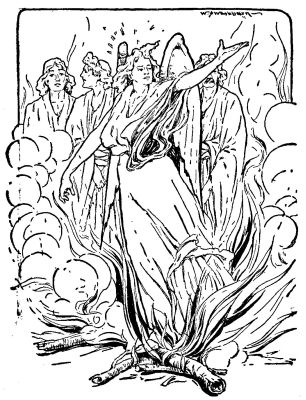
But an angel befriended them and they were unhurt.

An angel befriended them

King Nebuchadnezzar stood in front of the furnace and looked into the open door. As he looked, he was filled with wonder at what he saw; and he said to the nobles around him:

“Did we not throw three men bound into the fire? How is it then that I see four men loose walking in the furnace; and the fourth man looks as though he were a son of the gods?”

And the nobles who stood by could scarcely speak, so great was their surprise.

“It is true, O king,” at last they said to Nebuchadnezzar, “that we cast these men into the flames, expecting them to be burned up; and we cannot understand how it happens that they have not been destroyed.”

The king came near to the door of the furnace, as the fire became lower; and he called out to the three men within it:

“Shadrach, Meshach, and Abed-nego, ye who serve the Most High God, come out of the fire, and come to me.”

They came out and stood before the king, in the sight of all the princes, and nobles, and rulers; and every one could see that they were alive.

Their garments had not been scorched, nor their hair singed, nor was there even the smell of fire upon them.

Then King Nebuchadnezzar said before all his rulers:

“Blessed be the God of Shadrach, Meshach, and Abed-nego, who has sent his angel, and has saved the lives of these men who trusted in him. I make a law that no man in all my kingdoms shall say a word against their God, for there is no other god who can save in this manner those who worship him. And if any man speaks a word against their God, the Most High God, that man shall be cut in pieces, and his house shall be torn down.”

After King Nebuchadnezzar died, his kingdom became weak, and the city of Babylon was taken by the Medes and Persians, under Cyrus, a great warrior.