A place to grow your relationship with God

Posts tagged ‘Children’s Literature’

Swiss Family Robinson Chapter 46

Chapter 46

Whilst we continued to talk and to admire the beauty of the stars, they at length began to fade away before the first light of morning. Ernest returned to us, and we awoke Jack, who had slept uninterruptedly, and was quite unconscious where he was. We returned to the pass, which now, by the light of day, seemed to us in a more hopeless state than in the dusk of evening. I was struck with consternation: it appeared to me that we were entirely enclosed at this side; and I shuddered to think of crossing the island again, to pass round at the other end, of the risk we should run of meeting wild beasts, and of the painful and perilous passage along the coral reefs. At that moment I would gladly have consented to open a passage through the grotto, at the hazard of any visitors, in order to get through myself, that I might relieve the anxious feelings of my dear wife and boy. The thoughts of their agony unnerved me, and took away all courage for the commencement of a labour which seemed impossible, our only utensils being a small saw, and a little dibble for taking up plants, which Ernest had been unwilling to leave behind us. The path by which Jack and I had passed was covered with rocks and masses of soil, which obstructed even the course of the stream; we could not discover the place we had forded, the river had opened itself a wider course, far beyond its former one.

“It is impossible,” said Fritz, gazing on the ruins, “that we can remove all these immense stones without proper tools; but, perhaps, with a little courage, we may cross over them, the rivulet being widened cannot be very deep. At all events, it cannot be worse than the coral reefs.”

“Let us try; but I fear it will be impossible, at least for him,” said I, pointing to Jack.

Him, indeed, papa, and why not?” said the bold fellow; “he is perhaps as strong, and more active, than some of them; ask Fritz what he thinks of his workman. Shall I go the first to show you the way?”

And he was advancing boldly, but I checked him, and said, that before we undertook to scale these masses of rock, absolutely bare, where we had nothing to support us, or to hold by, it would be as well to examine if, by descending lower, we could not find a less dangerous road. We descended to the narrow pass, and found our drawbridge, plantation, all our fortification that my boys were so proud of, and where, at Fritz’s request, I had even planted a small cannon, all, all destroyed; the cannon swallowed up with the rest. My boys deplored their disappointment; but I showed them how useless such a defence must ever be. Nature had provided us with a better fortification than we could construct, as we just now bitterly experienced.

We had descended several yards lower with incredible difficulty, plunged in a wet, heavy soil, and obliged to step across immense stones, when Fritz, who went first, cried out, joyfully

“The roof, papa! the roof of our chalet! it is quite whole; it will be a bridge for us if we can only get to it.”

“What roof? What chalet?” said I, in astonishment.

“The roof of our little hermitage,” said he, “which we had covered so well with stones, like the Swiss chalets.”

I then recollected that I had made this little hut, after the fashion of the Swiss chalet, of bark, with a roof nearly flat and covered with stones, to secure it against the winds. It was this circumstance, and its situation, that had saved it in the storm. I had placed it opposite the cascade, that we might see the fall in all its beauty, and, consequently, a little on one side of the passage filled up by the fall of the rocks. Some fragments reached the roof of the hut, and we certainly could not have entered it; but the chalet was supported by this means, and the roof was still standing and perfectly secure. We contrived to slide along the rock which sustained it; Jack was the first to stand on the roof and sing victory. It was very easy to descend on the other side, holding by the poles and pieces of bark, and we soon found ourselves safe in our own island. Ernest had lost his gun in the passage: not being willing to resign his bag of curiosities, he had dropped the gun into the abyss.

“You may take the gun I left in the canoe,” said Fritz; “but, another time, throw away your stones, and keep your gun you will find it a good friend in need.”

“Let us embark in our canoe,” cried Jack. “The sea! the sea! Long live the waves! they are not so hard as the stones.”

I was very glad to have the opportunity of conveying my canoe back to the port of Tent House; our important occupations had prevented me till now, and everything favoured the plan: the sea was calm, the wind favourable, and we should arrive at home sooner, and with less fatigue, than by land. We skirted the great Bay to the Cabbage-palm Wood. I had moored the canoe so firmly to one of the palms, that I felt secure of it being there. We arrived at the place, and no canoe was there! The mark of the cord which fastened it was still to be seen round the tree, but the canoe had entirely disappeared. Struck with astonishment, we looked at each other with terror, and without being able to articulate a word. What was become of it?

“Some animal, the jackals; a monkey, perhaps, might have detached it,” said Jack; “but they could not have eaten the canoe.” And we could not find a trace of it, any more than of the gun Fritz had left in it.

This extraordinary circumstance gave me a great deal of thought. Natives, surely, had landed on our island, and carried off our canoe. We could no longer doubt it when we discovered on the sands the print of naked feet! It is easy to believe how uneasy and agitated I was. I hastened to take the road to Tent House, from which we were now more than three leagues distant. I forbade my sons to mention this event, or our suspicions, to their mother, as I knew it would rob her of all peace of mind. I tried to console myself. It was possible that chance had conducted them to the Bay, that they had seen our pretty canoe, and that, satisfied with their prize, and seeing no inhabitants, they might not return. Perhaps, on the contrary, these islanders might prove kind and humane, and become our friends. There was no trace of their proceedings further than the shore.

We called at The Farm, on purpose to examine. All appeared in order; and certainly, if they had reached here, there was much to tempt them: our cotton mattresses, our osier seats, and some household utensils that my wife had left here. Our geese and fowls did not appear to have been alarmed, but were pecking about as usual for worms and insects. I began to hope that we might get off with the loss of our canoe, a loss which might be repaired. We were a sufficient number, being well armed, not to be afraid of a few natives, even if they penetrated further into the island, and showed hostile intentions. I exhorted my sons to do nothing to irritate them; on the contrary, to meet them with kindness and attention, and to commit no violence against them unless called on to defend their lives. I also recommended them to select from the wrecked chest, some articles likely to please the natives, and to carry them always about with them. “And I beseech you, once more,” added I, “not to alarm your mother.” They promised me; and we continued our road unmolested to Falcon’s Nest. Jack preceded us, delighted, he said, to see our castle again, which he hoped the natives had not carried away. Suddenly, we saw him return, running, with terror painted on his countenance.

“They are there!” said he; “they have taken possession of it; our dwelling is full of them. Oh! how frightful they are! What a blessing mamma is not there; she would have died of fright to see them enter.”

I confess I was much agitated; but, not wishing to expose my children to danger before I had done all in my power to prevent it, I ordered them to remain behind till I called them. I broke a branch from a tree hastily, which I held in one hand, and in the other some long nails, which I found by chance in the bottom of my pocket; and I advanced thus to my Tree-Castle. I expected to have found the door of my staircase torn open and broken, and our new guests ascending and descending; but I saw at once it was closed as I had left it; being of bark, it was not easily distinguished. How had these natives reached the dwelling, forty feet from the ground? I had placed planks before the great opening; they were no longer there; the greater part of them had been hurled down to the ground, and I heard such a noise in our house, that I could not doubt Jack’s report. I advanced timidly, holding up in the air the branch and my offerings, when I discovered, all at once, that I was offering them to a troop of monkeys, lodged in the fortress, which they were amusing themselves by destroying. We had numbers of them in the island; some large and mischievous, against whom we had some difficulty in defending ourselves when crossing the woods, where they principally dwelt. The frequent report of fire-arms round our dwelling had kept them aloof till now, when, emboldened by our absence, and enticed by the figs on our tree, they had come in crowds. These vexatious animals had got through the roof, and, once in, had thrown down the planks that covered the opening; they made the most frightful grimaces, throwing down everything they could seize.

Although this devastation caused me much vexation, I could not help laughing at their antics, and at the humble and submissive manner in which I had advanced to pay homage to them. I called my sons, who laughed heartily, and rallied “the prince of the monkeys” without mercy, for not knowing his own subjects. Fritz wished much to discharge his gun amongst them, but I forbade him. I was too anxious to reach Tent House, to be able to turn my thoughts on these depredators just now.

We continued our journey but I pause here; my heart is oppressed. My feelings when I reached home require another chapter to describe them, and I must summon courage for the task.
Peter and Polly: The Tent Store

Peter and Polly had not really waited very long when Tim came past. He saw the tents in Peter’s yard. They were quite near the road.

“What are you doing?” he called. “Are you playing something? I wish to play, too.”

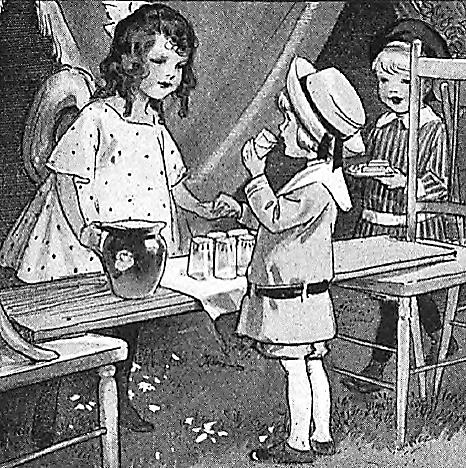
“We have a store,” said Polly. “We are selling lemonade and sandwiches. Do you wish to buy?”

“Yes,” said Tim. “I do. I have some money. My mother just gave it to me. I was going to the store for candy. I will buy a glass of lemonade.”

“Have you two cents?” asked Polly. “It will be two cents.”

“Here it is, Polly. And I have more than that. I will buy some sandwiches. How much are they, Peter?”

“I will sell you all there are on this plate for two cents, Tim,” said Peter.

“Oh Peter!” cried Polly. “You must not do that. You do not charge enough. Sell him four for two cents. They are big ones, anyway.”

“I wish that I could play with you,” said Tim. “I could help sell things.”

“Come into my tent then,” said Peter. “You may play with us.”

In just a few minutes Tim’s father drove up the road.

“Father, father!” called Tim. “Here is a store. You must stop and buy something.”

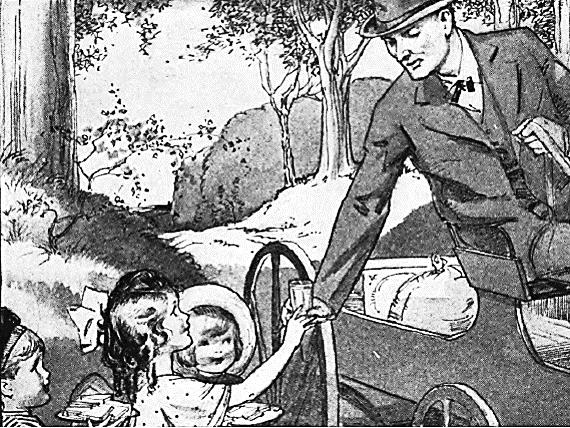
“Whoa,” said his father to the horse. “What have you to sell? Why, it looks like lemonade. That is just what I need. Give me a glass. Yes, that is good. Give me another glass, Polly. Now, how much do I owe you?”

“Two cents for each glass, please. That will be four cents.”

“That is very cheap,” said Tim’s father. “At the circus, we have to pay ten cents a glass. And, at the fair, it costs five cents. I think that I will pay you ten cents for the two glasses.”

“Thank you very much,” said Polly. “I hope you will come again.”

“Now, father, you must buy something to eat,” said Tim. “That is what Peter and I are selling.”

“Very well,” said his father. “I believe that I am hungry. And supper time is a long way off. How much are the sandwiches?”

“I will give you all there are on that plate for five cents,” said Peter.

“No, you will not, Peter,” said Tim. “I had just four for two cents. So that is all you can have, father.”

“That will be quite enough,” said his father. “Give me four of those big ones, and you may have this five-cent piece. Here comes your grandmother, Polly. Perhaps she will be a good customer.”

Polly’s grandmother lives down the road just a little way. She is Mr. Howe’s mother.

“Oh grandmother, will you buy something from us?” called the children.

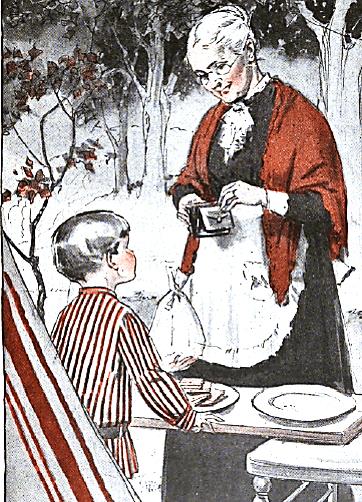
“That is just what I came for,” said grandmother. “I heard you were keeping a store.”

“How did you hear it, grandmother?” asked Peter.

“A little bird told me, Peter. Haven’t you any cookies to sell? I must have cookies for supper. Oh, yes, I see them. Run into the house, Peter. Get a paper bag for them.”

Polly counted the cookies for Peter. He could not count very well. There were just one dozen.

“I will give you ten cents for those cookies,” said grandmother. “And now, Polly, I will drink a glass of your good lemonade. Here are three cents for it. Goodbye.”

“Let’s drink up the rest,” said Polly. “I am thirsty. Besides we have enough money. We can eat up the rest of the sandwiches, too. I have thought of something to do tomorrow.”

“Let’s have another store,” said Peter.

“No,” said Polly. “We will have a circus. Tim’s father made me think of it. He said something about lemonade at the circus.”

“How can we?” asked Tim.

“I will think and tell you tomorrow morning,” said Polly. “You come down early. Now let’s carry the things back into the house.”

Peter and Polly: Clotheshorse Tents

Mother,” said Polly, “can you make us a tent?”

“A tent?” asked mother. “What for?”

“To play in, mother. Some of the other children have tents. I should like one.”

“Perhaps they bought theirs, Polly.”

“Yes, they did, mother. But I thought that maybe you could make one. You do make us things.”

“Perhaps I can, Polly. Let me see. Yes, I think of a way. Come and help me.”

Mother went out into the back kitchen. She had some clotheshorses there.

She said, “Take hold of the end of this clotheshorse, Polly. We will carry it out of doors. It is quite heavy. But you can do it. Now here is a good place. We will stand it up. Let us go for the other.”

“They are just the shape of some tents,” said Polly. “How did you think of them, mother? But they are not quite right. They have no roofs.”

“That is so, Polly. We will find something for roofs.”

The two clotheshorses were set up side by side. Some old blankets and shawls were spread over them.

“Oh, goody, goody!” shouted Polly. “Now we have our tents. They are good ones, too. Thank you, mother.”

“What shall we play?” asked Peter.

“Come into my tent, Peter. We will sit down. Guess what I thought of playing.”

“Is it soldiers?” asked Peter. “Soldiers sleep in tents.”

“No, but soldiers would be a good game. We can play that sometime. Guess again.”

“Hunters,” said Peter. “When father goes hunting and fishing, he has a tent.”

“No, but that would be a good game. I shall remember that one.”

.”You tell, then,” said Peter. “I cannot spend anymore time guessing.”

“We will get mother to let us have something to eat. We will have a tent picnic.”

“That is a good game, Polly. What can we have to eat? And can we have something to drink?”

“We can have bread and sugar, and bread and jelly. And maybe we can have cookies. Perhaps mother will make us some lemonade. It is quite a hot day.”

“Let us ask her now,” said Peter, “I am very hungry.”

“Oh, oh, oh!” cried Polly. “I have thought of something better. Let us have lemonade to sell. We can charge two cents a glass. Perhaps somebody will buy.”

“I should rather have the picnic,” said Peter. “I told you that I am very hungry.”

“But you like to keep store, Peter. You will like to play this.”

“All right,” said Peter. “Let us ask mother.”

Mother said, “Yes.” She went into the kitchen to make lemonade and sandwiches.

“May we take the four wooden chairs that are in the back kitchen, mother?” asked Polly. “We will put boards across them. They will be our counters.”

Mother said, “Yes,” again. So Peter and Polly made a counter in front of Peter’s tent. Then, with the two other chairs, they made a counter in front of Polly’s tent.

Mother gave them some clean glasses. She said, “You can use each glass only once. It is not right to let anyone drink out of a used glass. Polly, you may sell the lemonade.”

“Then Peter may sell the sandwiches,” said Polly. “He likes those best, so he will be glad. See, Peter! You have three plates full of sandwiches. Do not eat them all.”

“No,” said Peter. “I will leave a few to sell.” And he sat down on the grass behind his counter.

After a few minutes he said, “I am getting tired of waiting for someone to buy. I am going to begin to eat my things up now.”

Swiss Family Robinson Chapters 44 & 45

Chapter 44 & 45

Fritz struck his forehead, and, seizing Ernest by the arm “Brother,” said he, “what fools we have been!”

Ernest inquired what folly they had been guilty of.

“Why did we not,” said Fritz, “when we were working within our grotto, attempt to make the opening on the other side? We should not have had much difficulty, I am persuaded, and if our tools had not been sufficient, a little powder would have opened us a door on the other side. Only consider, father, the convenience of bringing the cart loaded with the trees we wanted through our grotto, and to be able to go a-hunting without having I don’t know how many miles to go.”

“Well, we can still do that,” said Ernest, in his usual calm, grave manner; “if we do not find another passage, we will make one through the Grotto Ernestine, with mamma’s permission, as it is her property.”

This idea of my son appeared good. It was quite certain, from our experience at Tent House and in the grotto, that the cavity in the rocks was of very great extent, and it did not appear difficult to pierce through to the other side; but some other chain of rocks, some gigantic tree, some hill, at the end of our tunnel, might render all our labour useless. I proposed that we should defer our work till we had examined the nature of the ground on the other side; my sons agreed, and we proceeded with renewed courage, when we were suddenly checked by the sight of the sea beating against a perpendicular rock of terrific height, which terminated our island on this side, and did not give us a chance of going on. I saw the rock did not extend far; but how to get round it, I could not devise. I did not conceive we could get the pinnace round, as the coast seemed surrounded by reefs; masses of rock stood up in the sea, and the breakers showed that more were hidden. After much consideration and many plans, Ernest proposed that we should swim out to the uncovered rocks, and endeavour to pass round. Fritz objected, on account of his arms and ammunition; but Ernest suggested that the powder should be secured in the pockets of his clothes, which he might carry on his head, holding his gun above the water.

With some difficulty we arranged our incumbrances, and succeeded in reaching the range of outer rocks, without swimming, as the water was not above our shoulders. We rested here awhile, and, putting on some of our clothes, we commenced our walk over sharp stones, which wounded our feet. In many places, where the rocks lay low, we were up to the waist in the water. Ernest, the proposer of the plan, encouraged us, and led the way for some time; but at last he fell behind, and remained so long, that I became alarmed, and calling aloud, for I had lost sight of him, he answered me, and at last I discovered him stretched on the rock, endeavouring to separate a piece from it with his knife.

“Father,” said he, “I am now certain that this bed of rocks, over which we are walking, and which we fancied was formed of stone or flints, is nothing but the work of those remarkable zoophytes, called coral insects, which form coral and many other extraordinary things; they can even make whole islands. Look at these little points and hollows, and these stars of every colour and every form; I would give all the world to have a specimen of each kind.”

He succeeded in breaking off a piece, which was of a deep orange-colour inside; he collected also, and deposited in his bag, some other pieces, of various forms and colours. These greatly enriched his collection; and, idle as he was, he did not complain of any difficulty in obtaining them. He had given his gun to Jack, who complained much of the ruggedness of our road. Our march was truly painful, and I repented more than once of having yielded to the idea; besides the misery of walking along these shelly rocks, which presented points like the sharp teeth of a saw, tearing our shoes and even our skin, the sea, in some of the lower places, was so high as to bar our passage, and we were obliged, in the interval between two waves, to rush across, with the water to our chins. We had some difficulty to avoid being carried away. I trembled especially for Jack; though small and light, he preferred facing the wave to avoiding it. I was several times obliged to catch hold of him, and narrowly escaped destruction along with him. Happily, our march was not above half a mile, and we gained the shore at last without any serious accident, but much fatigued and foot-sore; and we made a resolution never more to cross the coral reefs.

The island was much narrower here, and instead of the wide plain, crossed by a river, divided by delightful woods, giving an idea of paradise on earth; we were journeying through a contracted valley, lying between the rocky wall which divided the island, and a chain of sandy hills, which hid the sea and sheltered the valley from the wind. Fritz and I ascended one of these hills. Any navigators, sailing along these shores, would pronounce the island inaccessible and entirely barren. This is not the fact; the grass is very thick, and the trees of noble growth; we found many unknown to us, some loaded with fruit. I should never finish, if I were to try and name all the plants found in this shady valley, which might be called the botanic garden of Nature. Ernest was in ecstasies; he wished to carry away everything, but he did not know how to dispose of them.

“Ah!” said he, “if only our grotto were open to this side!”

At this moment Fritz came running out of breath, crying out, “The bread-fruit tree! I have found the bread-fruit tree! Here is the fruit, excellent, delicious bread. Taste it, father; here, Ernest; here, Jack;” and he gave us each a part of an oval fruit, about the size of an ordinary melon, which really seemed very good and nourishing.

“There are many of these trees,” continued he, “loaded with fruit. Would that we had our grotto opened, that we might collect a store of them, now that they are ripe.”

My boys pointed out to me exactly the situation of the grotto, judging from the rock above, and longed for their tools, that they might commence the opening directly. We proceeded to make our way through a border of trees and bushes, that separated us from the rock, that we might examine it, and judge of the difficulties of our undertaking. Jack preceded us, as usual, after giving Ernest his gun; Fritz followed him, and suddenly turning to me, said,

“I believe kind Nature has saved us much trouble; the rock appears to be divided from top to bottom; at the foot I see a sort of cave, or grotto, already made.”

44

“We saw at the entrance of the
cave two large brown bears.”

There was a gentle stream, gushing from a perpendicular rock; then forming a graceful bend, it took its course towards the great bay, and fell in a cascade into the sea. We remained some time here to fill our gourds, drinking moderately, and taking a bath, which refreshed us all greatly.

The evening was approaching, and we began to fear we should not reach home before night. I had warned my wife that there was a possibility that we might be delayed, though I could not then anticipate the cause of our delay. We endeavoured, however, by walking as quickly as we could, and resting no more, to reach our farm at any rate. We followed the course of the river, on the opposite shore of which rose a wide plain, where we saw the herd of buffaloes quietly grazing, ruminating, and drinking, without paying the slightest attention to us. We thought we distinguished some other quadrupeds amongst them, which Fritz was certain were zebras or donkeys; but certainly not his dear gazelle, for which he had incessantly looked round. Jack was in despair that the river separated us from the buffaloes, so that he could not cast his lasso round the legs of one of them, as he had promised Ernest. He even wished to swim across the stream, to have a hunt; but I forbade him, encouraging him to hope that perhaps a single buffalo might cross to our side, and throw itself in the way of his lasso. I was far from wishing such a thing myself, for we had no time to lose, nor any means to secure and lead it home, should we succeed in capturing one, not having any cords with us; and moreover, intending to return from the bay in the canoe.

When we arrived at the bay, the night, which comes on rapidly in equinoctial countries, had almost closed. We were scarcely able to see, without terror, the changes that the late storm had occasioned; the narrow pass which led from the other side of the island, between the river and a deep stream that flowed from the rocks, was entirely obstructed with rocks and earth fallen upon it; and to render our passage practicable, it was necessary to undertake a labour that the darkness now prevented, and which would at any time be attended by danger. We were obliged then to spend the night in the open air, and separated from our dear and anxious friends at Tent House. Fortunately, Fritz had collected a store of bread-fruit for his mother, with which he had filled his own pockets and those of his brothers. These, with water from the river, formed our supper; for we had nothing but the bone of our leg of mutton left. We turned back a little way, to establish ourselves under a clump of trees, where we were in greater safety; we loaded our muskets, we kindled a large fire of dry branches, and recommending ourselves to the protection of God, we lay ourselves down on the soft moss to wait for the first rays of light.

With the exception of Jack, who from the first slept as if he had been in his bed, we none of us could rest. The night was beautiful; a multitude of stars shone over our heads in the ethereal vault. Ernest was never tired of gazing on them. After some questions and suppositions on the plurality of worlds, their courses and their distances, he quitted us to wander on the borders of the river, which reflected them in all their brilliancy. From this night his passion for astronomy commenced, a passion which he carried beyond all others. This became his favourite and continual study, nor did he fall far short of Duval, whose history he had read. Whilst he was engaged in contemplation, Fritz and I conversed on our projects for tunnelling to the grotto, and on the utility of such a passage, as this side of the island was quite lost to us, from the difficulty in reaching it. “And yet,” said I, “it is to this difficulty we owe the safety we have enjoyed. Who can say that the bears and the buffaloes may not find the way through the grotto? I confess I am not desirous of their visits, nor even of those of the donkeys. Who knows but they might persuade your favourite Lightfoot to return and live amongst them? Liberty has many charms. Till now, we have been very happy on our side of the island, without the productions of this. My dear boy, there is a proverb, ‘Let well alone,’ Let us not have too much ambition, it has ruined greater states than ours.”

Fritz seemed grieved to give up his plan, and suggested that he could forge some strong bars of iron to place before the opening, which could be removed at will.

“But,” said I, “they will not prevent the snakes from passing underneath. I have noticed some with terror, as they are animals I have a great antipathy to; and if your mother saw one crawl into her grotto, she would never enter it again; even if she did not die of fright.”

“Well, we must give it up,” said Fritz; “but it is a pity. Do you think, father, there are more bears in the island than those we killed?”

“In all probability,” said I; “it is scarcely to be supposed that there should only be two. I cannot well account for their being here. They can swim very well, and perhaps the abundance of fruit in this part of the island may have attracted them.” I then gave my son a short account of their manners and habits, from the best works on the history of these animals.

Heidi Chapter 12 – Part 2

The House Is Haunted   continued…

When the doctor laughed, Mr. Sesemann continued: “I call that sympathy; I wish my friend Miss Rottenmeier could hear you. She is convinced that an old Sesemann is wandering about, expiating some dreadful deed.”

“How did she make his acquaintance?” asked the doctor, much amused.

Mr. Sesemann then explained the circumstances. He said that the matter was either a bad joke which an acquaintance of the servants was playing in his absence, or it was a gang of thieves, who, after intimidating the people, would surely rob his house by and by.

With these explanations they entered the room where the two servants had watched before. A few bottles of wine stood on the table and two bright candelabra shed a brilliant light. Two revolvers were ready for emergencies.

They left the door only partly open, for too much light might drive the ghost away. Then, sitting down comfortably, the two men passed their time by chatting, taking a sip now and then.

“The ghost seems to have spied us and probably won’t come to-day,” said the doctor.

“We must have patience. It is supposed to come at one,” replied his friend.

So they talked till one o’clock. Everything was quiet, and not a sound came from the street. Suddenly the doctor raised his finger.

“Sh! Sesemann, don’t you hear something?”

While they both listened, the bar was unfastened, the key was turned, and the door flew open. Mr. Sesemann seized his revolver.

“You are not afraid, I hope?” said the doctor, getting up.

“Better be cautious!” whispered Mr. Sesemann, seizing the candelabrum in the other hand. The doctor followed with his revolver and the light, and so they went out into the hall.

On the threshhold stood a motionless white form, lighted up by the moon.

“Who is there?” thundered the doctor, approaching the figure. It turned and uttered a low shriek. There stood Heidi, with bare feet and in her white night-gown, looking bewildered at the bright light and the weapons. She was shaking with fear, while the two men were looking at her in amazement.

“Sesemann, this seems to be your little water carrier,” said the doctor.

“Child, what does this mean?” asked Mr. Sesemann. “What did you want to do? Why have you come down here?”

Pale from fright, Heidi said: “I do not know.”

The doctor came forward now. “Sesemann, this case belongs to my field. Please go and sit down while I take her to bed.”

Putting his revolver aside, he led the trembling child up-stairs.

“Don’t be afraid; just be quiet! Everything is all right; don’t be frightened.”

When they had arrived in Heidi’s room, the doctor put the little girl to bed, covering her up carefully. Drawing a chair near the couch, he waited till Heidi had calmed down and had stopped trembling. Then taking her hand in his, he said kindly: “Now everything is all right again. Tell me where you wanted to go?”

“I did not want to go anywhere,” Heidi assured him; “I did not go myself, only I was there all of a sudden.”

“Really! Tell me, what did you dream?”

“Oh, I have the same dream every night. I always think I am with my grandfather again and can hear the fir-trees roar. I always think how beautiful the stars must be, and then I open the door of the hut, and oh, it is so wonderful! But when I wake up I am always in Frankfurt.” Heidi had to fight the sobs that were rising in her throat.

“Does your back or your head hurt you, child?”

“No, but I feel as if a big stone was pressing me here.”

“As if you had eaten something that disagreed with you?”

“Oh no, but as if I wanted to cry hard.”

“So, and then you cry out, don’t you?”

“Oh no, I must never do that, for Miss Rottenmeier has forbidden it.”

“Then you swallow it down? Yes? Do you like to be here?”

“Oh yes,” was the faint, uncertain reply.

“Where did you live with your grandfather?”

“Up on the Alp.”

“But wasn’t it a little lonely there?”

“Oh no, it was so beautiful!”—But Heidi could say no more. The recollection, the excitement of the night and all the restrained sorrow overpowered the child. The tears rushed violently from her eyes and she broke out into loud sobs.

The doctor rose, and soothing her, said: “It won’t hurt to cry; you’ll go to sleep afterward, and when you wake up everything will come right.” Then he left the room.

Joining his anxious friend down-stairs, he said: “Sesemann, the little girl is a sleep-walker, and has unconsciously scared your whole household. Besides, she is so home-sick that her little body has wasted away. We shall have to act quickly. The only remedy for her is to be restored to her native mountain air. This is my prescription, and she must go tomorrow.”

“What, sick, a sleep-walker, and wasted away in my house! Nobody even suspected it! You think I should send this child back in this condition, when she has come in good health? No, doctor, ask everything but that. Take her in hand and prescribe for her, but let her get well before I send her back.”

“Sesemann,” the doctor replied seriously, “just think what you are doing. We cannot cure her with powders and pills. The child has not a strong constitution, and if you keep her here, she might never get well again. If you restore her to the bracing mountain air to which she is accustomed, she probably will get perfectly well again.”

When Mr. Sesemann heard this he said, “If that is your advice, we must act at once; this is the only way then.” With these words Mr. Sesemann took his friend’s arm and walked about with him to talk the matter over. When everything was settled, the doctor took his leave, for the morning had already come and the sun was shining in through the door.

Peter and Polly: The Doll Family

The Doll Family

See what I have, Peter,” said Polly.

“What are they, Polly?”

“They are acorns. They came from oak trees. Here are some oak leaves.”

“I never saw any acorns before. They look like nuts. What are they good for?”

“To play with, Peter. I will show you how, soon. And they are good for squirrels.”

“Squirrels get all the nuts,” said Peter. “Tim and I cannot find anymore beechnuts. We know where they are, too. Those old squirrels have them.”

“What if they have?” asked Polly. “You cannot have everything that there is to eat.”

“Are acorns good to eat, Polly?”

“These are not very good,” said Polly. “But the squirrels like them. One of the big boys gave me these. He got them up on the hill. He says many oak trees grow there. He gave me these oak leaves, too. Aren’t they pretty?”

“Yes,” said Peter. “They are not like elm leaves. They are not like maple leaves. And they are not like beech leaves.”

“See what a dark red they are, Peter. I wish that we had some oak trees here.”

“So do I,” said Peter. “Let’s plant an acorn. Maybe it will grow. How do you play with acorns?”

“I shall have a dolls’ party,” said Polly. “We can have it on the front steps. Let us bring out the family.”

Polly and Peter had a large family. It was made up of Mr. and Mrs. Rag Doll and eight children. Mother and grandmother had given the dolls to them.

Polly had other beautiful dolls. One was two feet tall. But she liked the family best. She could play harder with them.

Mrs. Rag Doll sat on one step with four children. Mr. Rag Doll sat on the step above with four children.

Polly always played Mrs. Rag Doll. Peter always played Mr. Rag Doll.

MRS. RAG DOLL: “Can’t you keep your children still? They are all jumping around.”

MR. RAG DOLL: “No, I cannot. Why don’t you keep yours still?”

MRS. RAG DOLL: “They would be still, if your children would stop kicking them.”

MR. RAG DOLL: “It is time for them to have their tea, anyway. Where are those new cups?”

Polly put an acorn in its cup in the lap of each doll. She set cups without the acorns on the step beside each doll.

Then Mrs. Rag Doll said, “Now they each have a cup of tea. They each have a plate of cake, too. Perhaps they will behave.”

The children did not behave. Just as soon as they had finished eating, they began to push and pinch one another.

The boys threw their cups and saucers on the grass. Then the girls threw their plates on the grass. Their mother and their father were ashamed of them.

MRS. RAG DOLL: “What shall we do with these naughty children I They have not been so bad for a long time.”

MR. RAG DOLL: “They have not been to a party for a long time. They have forgotten how to behave. I think they have broken all the dishes.”

MRS. RAG DOLL: “Oh, dear! How dreadful. I shall take them straight home. I shall put them to bed.”

MR. RAG DOLL: “I will help you. They ought to be punished. Maybe I shall spank them.”

“No, you will not, Peter. Mother does not spank us,” said Polly.

“She does not send us to bed in the afternoon, either, Polly,” said Peter.

“That is so,” said Polly. “Then I shall not do it.”

MR. RAG DOLL: “Perhaps they are not feeling well. Sometimes I am cross when I do not feel well.”

MRS. RAG DOLL: “Perhaps that is so. I will hold my four in my arms and comfort them. Then they will feel better.”

MR. RAG DOLL: “I will hold my four in my arms and comfort them. Then they will get well.”

So Polly and Peter gathered their large family up in their arms. They carried them into the house and upstairs to the playroom.

There they sat down to comfort their naughty dolls.

Swiss Family Robinson Chapter 43

Chapter 43

The next and following days were spent in removing our furniture and property, particularly our poultry, which had multiplied greatly. We also constructed a poultry-yard, at a sufficient distance from our house to save our sleep from disturbance, and still so near that we could easily tend them. We made it as a continuation of the colonnade, and on the same plan, but enclosed in the front by a sort of wire trellis-work, which Fritz and Jack made wonderfully well. Fritz, who had a turn for architecture and mechanics, gave me some good hints, especially one, which we put into execution. This was to carry the water from the basin of the fountain through the poultry-yard, which enabled us also to have a little pond for our ducks. The pigeons had their abode above the hen-roosts, in some pretty baskets, which Ernest and Francis made, similar to those made by the natives of the Friendly Isles, of which they had seen engravings in Cook’s Voyages. When all was finished, my wife was delighted to think that even in the rainy season she could attend to her feathered family and collect their eggs.

“What a difference,” said she, admiring the elegance of our buildings, “what a difference between this Tent House and the original dwelling that suggested the name to us, and which was our only shelter four years ago. What a surprising progress luxury has made with us in that time! Do you remember, my dear, the barrel which served us for a table, and the oyster-shells for spoons, the tent where we slept, crowded together on dried leaves, and without undressing, and the river half a mile off, where we were obliged to go to drink if we were thirsty? Compared to what we were then, we are now great lords

“Kings, you mean, mamma,” said Jack, “for all this island is ours, and it is quite like a kingdom.”

“And how many millions of subjects does Prince Jack reckon in the kingdom of his august father?” said I.

Prince Jack declared he had not yet counted the parrots, kangaroos, agoutis, and monkeys. The laughter of his brothers stopped him. I then agreed with my wife that our luxuries had increased; but I explained to her that this was the result of our industry. All civilized nations have commenced as we did; necessity has developed the intellect which God has given to man alone, and by degrees the arts have progressed, and knowledge has extended more perhaps than is conducive to happiness. What appeared luxury to us now was still simplicity compared with the luxury of towns, or even villages, among civilized nations. My wife declared she had everything she wished for, and should not know what more to ask for, as we now had only to rest and enjoy our happiness.

I declared against spending our time in rest and indolence, as the sure means of ending our pleasure; and I well knew my dear wife was, like myself, an enemy to idleness; but she dreaded any more laborious undertakings.

“But, mamma,” said Fritz, “you must let me make a mill under the cascade; it will be so useful when our corn grows, and even now for the maize. I also think of making an oven in the kitchen, which will be very useful for you to bake your bread in.”

“These would indeed be useful labours,” said the good mother, smiling; “but can you accomplish them?”

“I hope so,” said Fritz, “with the help of God and that of my dear brothers.”

Ernest promised his best aid, in return for his brother’s kind services in forming his grotto, only requesting occasional leisure for his natural history collections. His mother did not see the utility of these collections, but, willing to indulge her kind and attentive Ernest, she offered, till she could walk well, to assist him in arranging and labelling his plants, which were yet in disorder, and he gratefully consented. In procuring her some paper for the purpose, of which I had brought a large quantity from the vessel, I brought out an unopened packet, amongst which was a piece of some fabric, neither paper nor stuff apparently. We examined it together, and at length remembered it was a piece of stuff made at Otaheite, which our captain had bought of a native at an island where we had touched on our voyage. Fritz appearing much interested in examining this cloth, Ernest said gravely, “I can teach you how to make it;” and immediately bringing Cook’s Voyages, where a detailed description is given, he proceeded to read it. Fritz was disappointed to find it could only be made of the bark of three trees of these our island produced only one. These trees were the mulberry-tree, the bread fruit, and the wild fig. We had the last in abundance, but of the two former we had not yet discovered a single plant.

Fritz was not, however, discouraged. “They ought to be here,” said he, “since they are found in all the South-Sea Islands. Perhaps we may find them on the other side of the rocks, where I saw some superb unknown trees from the height where we discovered the grotto; and who knows but I may find my pretty gazelle there again. The rogue can leap better than I can over those rocks. I had a great wish to descend them, but found it impossible; some are very high and perpendicular; others have overhanging summits; I might, however, get round as you did by the pass, between the torrent and the rocks at the Great Bay.”

Jack offered to be his guide, even with his eyes shut, into that rich country where he conquered and captured his buffalo; and Ernest begged to be of the party. As this was an expedition I had long projected, I agreed to accompany them next day, their mother being content to have Francis left with her as a protector. I cautioned Fritz not to fire off his gun when we approached the buffaloes, as any show of hostility might render them furious; otherwise the animals, unaccustomed to man, have no fear of him, and will not harm him. “In general,” added I, “I cannot sufficiently recommend to you to be careful of your powder; we have not more than will last us a year, and there may be a necessity to have recourse to it for our defence.”

“I have a plan for making it,” said Fritz, who never saw a difficulty in anything. “I know it is composed of charcoal, saltpetre, and sulphur and we ought to find all these materials in the island. It is only necessary to combine them, and to form it into little round grains. This is my only difficulty; but I will consider it over; and I have my mill to think on first. I have a confused recollection of a powder manufactory at Berne: there was some machinery which went by water; this machinery moved some hammers, which pounded and mixed the ingredients was not this the case, father?”

“Something like it,” said I; “but we have many things to do before making powder. First, we must go to sleep; we must set out before daybreak, if we intend to return to-morrow evening.” We did indeed rise before the sun, which would not rise for us. The sky was very cloudy, and shortly we had an abundant and incessant rain, which obliged us to defer our journey, and put us all in bad humour, but my wife, who was not sorry to keep us with her, and who declared this gracious rain would water her garden, and bring it forward. Fritz was the first who consoled himself; he thought on nothing but building mills, and manufacturing gunpowder. He begged me to draw him a mill; this was very easy, so far as regards the exterior, that is, the wheel, and the waterfall that sets it in motion; but the interior, the disposition of the wheels, the stones to bruise the grain, the sieve, or bolter, to separate the flour from the bran; all this complicated machinery was difficult to explain; but he comprehended all, adding his usual expression, “I will try, and I shall succeed.” Not to lose any time, and to profit by this rainy day, he began by making sieves of different materials, which he fastened to a circle of pliant wood, and tried by passing through them the flour of the cassava; he made some with sailcloth, others with the hair of the donkey, which is very long and strong, and some of the fibres of bark. His mother admired his work, which he continued to improve more and more; she assured him the sieve would be sufficient for her; it was useless to have the trouble of building a mill.

“But how shall we bruise the grain, mamma?” said he; “it would be tedious and hard work.”

“And you think there will be no hard work in building your mill?” said Jack. “I am curious to see how you will contrive to form that huge stone, which is called the millstone.”

“You shall see,” said Fritz; “only find me the stone, and it shall soon be done. Do you think, father, that of our rock would be suitable?”

I told him I thought it would be hard enough, but it would be difficult to cut from the rock a piece large enough for the purpose. He made his usual reply, “I will try. Ernest and Jack will assist me; and perhaps you, papa.”

I declared my willingness, but named him the master-mason; we must only be his workmen. Francis was impatient to see the mill in operation. “Oh!” said Jack, “you shall soon have that pleasure. It is a mere trifle; we only want stone, wood, tools, and science.”

At the word “science,” Ernest, who was reading in a corner, without listening to us, raised his head suddenly, saying, “What science are you in need of?”

“Of one you know nothing of, Mr. Philosopher,” said Jack. “Come, tell us, do you know how to build a mill?”

“A mill?” answered Ernest; “of what description? There are many sorts. I was just looking in my dictionary for it. There are corn-mills, and powder-mills, oil-mills, wind-mills, water-mills, hand-mills, and saw-mills; which do you want?”

Fritz would have liked them all.

“You remind me,” said I, “that we brought from the vessel a hand-mill and a saw-mill, taken to pieces, to be sure, but numbered and labelled, so that they could be easily united: they should be in the magazine, where you found the anvil and iron bars; I had forgotten them.”

“Let us go and examine them,” said Fritz, lighting his lantern; “I shall get some ideas from them.”

“Rather,” said his mother, “they will spare you the trouble of thinking and labouring.”

I sent them all four to seek these treasures, which, heaped in an obscure corner of the store-room, had escaped my recollection. When we were alone, I seriously besought my wife not to oppose any occupations our children might plan, however they might seem beyond their power; the great point being, to keep them continually occupied, so that no evil or dangerous fancies might fill their minds. “Let them,” I said, “cut stone, fell trees, or dig fountains, and bless God that their thoughts are so innocently directed.” She understood me, and promised not to discourage them, only fearing the excessive fatigue of these undertakings.

Swiss Family Robinson Chapter 42

Chapter 42

In a few days we completed the Grotto Ernestine. It contained some stalactites; but not so many as our former grotto. We found, however, a beautiful block of salt, which resembled white marble, of which Ernest formed a sort of altar, supported by four pillars, on which he placed a pretty vase of citron-wood, which he had turned himself, and in which he arranged some of the beautiful erica which had been the cause of his discovering the grotto. It was one of those occasions when his feelings overcame his natural indolence, when he became for a time the most active of the four, and brought forward all his resources, which were many. This indolence was merely physical; when not excited by any sudden circumstance, or by some fancy which soon assumed the character of a passion, he loved ease, and to enjoy life tranquilly in study. He improved his mind continually, as well by his excellent memory, as by natural talent and application. He reflected, made experiments, and was always successful. He had at last succeeded in making his mother a very pretty bonnet. He had also composed some verses, which were intended to celebrate her visit to Tent House; and this joyful day being at last fixed, the boys all went over, the evening before, to make their preparations. The flowers that the storm had spared were gathered to ornament the fountains, the altar, and the table, on which was placed an excellent cold dinner, entirely prepared by themselves. Fritz supplied and roasted the game, a fine bustard, the flesh of which resembles a turkey, and a brace of partridges. Ernest brought pines, melons, and figs; Jack should have supplied the fish, but was able only to procure oysters, crabs, and turtles’ eggs. Francis had the charge of the dessert, which consisted of a dish of strawberries, honeycomb, and the cream of the cocoa-nut. I had contributed a bottle of Canary wine, that we might drink mamma’s health. All was arranged on a table in the middle of the Franciade, and my sons returned to accompany the expedition next day.

The morning was beautiful, and the sun shone brightly on our emigration. My wife was anxious to set out, expecting she should have to return to her aerial dwelling. Though her leg and foot were better, she still walked feebly, and she begged us to harness the cow and ass to the cart, and to lead them as gently as possible.

“I will only go a little way the first day,” said she, “for I am not strong enough to visit Tent House yet.”

We felt quite convinced she would change her opinion when once in her litter. I wished to carry her down the staircase; but she declined, and descended very well with the help of my arm. When the door was opened, and she found herself once more in the open air, surrounded by her children, she thanked God, with tears of gratitude, for her recovery, and all his mercies to us. Then the pretty osier carriage arrived. They had harnessed the cow and young bull to it; Francis answering for the docility of Valiant, provided he guided him himself. Accordingly, he was mounted before, his cane in his hand, and his bow and quiver on his back, very proud to be mamma’s charioteer. My other three boys mounted on their animals, were ready before, to form the advanced guard, while I proposed to follow, and watch over the whole. My wife was moved even to tears, and could not cease admiring her new carriage, which Fritz and Jack presented to her as their own work. Francis, however, boasted that he had carded the cotton for the soft cushion on which she was to sit, and I, that I had made it. I then lifted her in, and as soon as she was seated Ernest came to put her new bonnet on her head, which greatly delighted her; it was of fine straw, and so thick and firm that it might even defend her from the rain. But what pleased her most was, that it was the shape worn by the Swiss peasants in the Canton of Vaud, where my dear wife had resided some time in her youth. She thanked all her dear children, and felt so easy and comfortable in her new conveyance, that we arrived at Family Bridge without her feeling the least fatigue. Here we stopped.

“Would you like to cross here, my dear?” said I; “and as we are very near, look in at your convenient Tent House, where you will have no staircase to ascend. And we should like to know, too, if you approve of our management of your garden,”

“As you please,” said she; “in fact, I am so comfortable in my carriage, that if it were necessary, I could make the tour of the island. I should like to see my house again; but it will be so very hot at this season, that we must not stay long.”

“But you must dine there, my dear mother,” said Fritz; “it is too late to return to dinner at Falcon’s Nest; consider, too, the fatigue it would occasion you.”

“I would be very glad, indeed, my dear,” said she; “but what are we to dine on? We have prepared no provision, and I fear we shall all be hungry.”

“What matter,” said Jack, “provided you dine with us? You must take your chance. I will go and get some oysters, that we may not die with hunger;” and off he galloped on his buffalo. Fritz followed him, on some pretence, on Lightfoot. Mamma wished she had brought a vessel to carry some water from the river, for she knew we could get none at Tent House. Francis reminded her we could milk the cow, and she was satisfied, and enjoyed her journey much. At last we arrived before the colonnade. My wife was dumb with wonder for some moments.

“Where am I, and what do I see?” said she, when she could speak.

“You see the Franciade, mamma,” said her little boy; “this beautiful colonnade was my invention, to protect you from the heat; stay, read what is written above: Francis to his dear mother. May this colonnade, which is called the Franciade, be to her a temple of happiness. Now mamma, lean on me, and come and see my brothers’ gifts much better than mine;” and he led her to Jack’s pavilion, who was standing by the fountain. He held a shell in his hand, which he filled with water, and drank, saying, “To the health of the Queen of the Island; may she have no more accidents, and live as long as her children! Long live Queen Elizabeth, and may she come every day to Jackia, to drink her son Jack’s health.”

I supported my wife, and was almost as much affected as herself. She wept and trembled with joy and surprise. Jack and Ernest then joined their hands, and carried her to the other pavilion, where Fritz was waiting to receive her, and the same scene of tenderness ensued. “Accept this pavilion, dear mother,” said he; “and may Fritzia ever make you think on Fritz.”

The delighted mother embraced them all, and observing Ernest’s name was not commemorated by any trophy, thanked him again for her beautiful bonnet. She then drank some of the delicious water of the fountain, and returned to seat herself at the repast, which was another surprise for her. We all made an excellent dinner; and at the dessert, I handed my Canary wine round in shells; and then Ernest rose and sung us very prettily, to a familiar air, some little verses he had composed:

On this festive happy day,
Let us pour our grateful lay;
Since Heaven has hush’d our mother’s pain,
And given her to her sons again.
Then from this quiet, lovely home
Never, never, may we roam.
All we love around us smile:
Joyful is our desert isle.

When o’er our mother’s couch we bent,
Fervent prayers to Heaven we sent,
And God has spared that mother dear,
To bless her happy children here.
Then from this quiet, lovely home,
Never, never, may we roam;
All we love around us smile,
Joyful is our desert isle.

We all joined in the chorus, and none of us thought of the ship, of Europe, or of anything that was passing in the world. The island was our universe, and Tent House was a palace we would not have exchanged for any the world contained. This was one of those happy days that God grants us sometimes on earth, to give us an idea of the bliss of Heaven; and most fervently did we thank Him, at the end of our repast, for all his mercies and blessings to us.

After dinner, I told my wife she must not think of returning to Falcon’s Nest, with all its risks of storms and the winding staircase, and she could not better recompense her sons for their labours than by living among them. She was of the same opinion, and was very glad to be so near her kitchen and her stores, and to be able to walk alone with the assistance of a stick in the colonnade, which she could do already; but she made me promise to leave Falcon’s Nest as it was. It would be a pretty place to walk to, and besides, this castle in the air was her own invention. We agreed that this very evening she should take possession of her own pretty room, with the good felt carpet, on which she could walk without fear; and that the next day, I should go with my elder sons and the animals to bring the cart, such utensils as we needed, and above all, the poultry. Our dogs always followed their masters, as well as the monkey and jackal, and they were so domesticated, we had no trouble with them.

I then prevailed on my wife to go into her room and rest for an hour, after which we were to visit the garden. She complied, and after her repose found her four sons ready to carry her in her litter as in a sedan-chair. They took care to bring her straight to the grotto, where I was waiting for her. This was a new surprise for the good mother. She could not sufficiently express her astonishment and delight, when Jack and Francis, taking their flageolets, accompanied their brothers, who sung the following verse, which Ernest had added to his former attempt.

Dear mother, let this gift be mine,
Accept the Grotto Ernestine.
May all your hours be doubly blest
Within this tranquil place of rest.
Then from this quiet, lovely home
Never, never may we roam;
All we love around us smile.
Joyful is our desert isle!

What cause had we to rejoice in our children! we could not but shed tears to witness their affection and perfect happiness.

Below the vase of flowers, on the block of salt, Ernest had written:

Ernest, assisted by his brother Fritz,
Has prepared this grotto,
As a retreat for his beloved mother,
When she visits her garden.

Ernest then conducted his mother to one of the benches, which he had covered with soft moss, as a seat for her, and there she rested at her ease to hear the history of the discovery of the grotto. It was now my turn to offer my present; the garden, the embankment, the pond, and the arbour. She walked, supported by my arm, to view her little empire, and her delight was extreme; the pond, which enabled her to water her vegetables, particularly pleased her, as well as her shady arbour, under which she found all her gardening tools, ornamented with flowers, and augmented by two lightwatering-pans, constructed by Jack and Francis, from two gourds. They had canes for spouts, with the gourd bottles at the end, pierced with holes, through which the water came in the manner of a watering-pan. The embankment was also a great surprise; she proposed to place plants of pines and melon on it, and I agreed to it. Truly did she rejoice at the appearance of the vegetables, which promised us some excellent European provision, a great comfort to her. After expressing her grateful feelings, she returned to the grotto, and seating herself in her sedan-chair, returned to Tent House, to enjoy the repose she needed, after such a day of excitement. We did not, however, lie down before we had together thanked God for the manifold blessings he had given us, and for the pleasure of that day.

“If I had been in Europe,” said my dear wife, “on the festival of my recovery, I should have received a bouquet of flowers, a ribbon, or some trinket; here I have had presented a carriage, a colonnade, pavilions, ornamental fountains, a large grotto, a garden, a pond, an arbour, and a straw bonnet!”

Swiss Family Robinson Chapter 41

Chapter 41

One day, having gone over with my younger sons to weed the garden, and survey our possessions, I perceived that the roof of the gallery wanted a little repair, and called Jack to raise for me the rope ladder which I had brought from Falcon’s Nest, and which had been very useful while we were constructing the roof; but we sought for it everywhere; it could not be found; and as we were quite free from robbers in our island, I could only accuse my elder sons, who had doubtless carried it off to ascend some tall cocoa-nut tree. Obliged to be content, we walked into the garden by the foot of the rocks. Since our arrival, I had been somewhat uneasy at hearing a dull, continued noise, which appeared to proceed from this side. The forge we had passed, now extinguished, and our workmen were absent. Passing along, close to the rocks, the noise became more distinct, and I was truly alarmed. Could it be an earthquake? Or perhaps it announced some volcanic explosion. I stopped before that part of the rock where the noise was loudest; the surface was firm and level; but from time to time, blows and falling stones seemed to strike our ears. I was uncertain what to do; curiosity prompted me to stay, but a sort of terror urged me to remove my child and myself. However, Jack, always daring, was unwilling to go till he had discovered the cause of the phenomenon. “If Francis were here,” said he, “he would fancy it was the wicked gnomes, working underground, and he would be in a fine fright. For my part, I believe it is only people come to collect the salt in the rock.”

“People!” said I; “you don’t know what you are saying, Jack; I could excuse Francis and his gnomes, it would be at least a poetic fancy, but yours is quite absurd. Where are the people to come from?”

“But what else can it be?” said he. “Hark! you may hear them strike the rock.”

“Be certain, however,” said I, “there are no people.” At that moment, I distinctly heard human voices, speaking, laughing, and apparently clapping their hands. I could not distinguish any words; I was struck with a mortal terror; but Jack, whom nothing could alarm, clapped his hands also, with joy, that he had guessed right. “What did I say, papa? Was I not right? Are there not people within the rock? friends, I hope.” He was approaching the rock, when it appeared to me to be shaking; a stone soon fell down, then another. I seized hold of Jack, to drag him away, lest he should be crushed by the fragments of rock. At that moment another stone fell, and we saw two heads appear through the opening, the heads of Fritz and Ernest. Judge of our surprise and joy! Jack was soon through the opening, and assisting his brothers to enlarge it. As soon as I could enter, I stepped in, and found myself in a real grotto, of a round form, with a vaulted roof, divided by a narrow crevice, which admitted the light and air. It was, however, better lighted by two large gourd lamps. I saw my long ladder of ropes suspended from the opening at the top, and thus comprehended how my sons had penetrated into this recess, which it was impossible to suspect the existence of from the outside. But how had they discovered it? and what were they making of it? These were my two questions. Ernest replied at once to the last. “I wished,” said he, “to make a resting-place for my mother, when she came to her garden. My brothers have each built some place for her, and called it by their name. I had a desire that some place in our island might be dedicated to Ernest, and I now present you the Grotto Ernestine.”

“And after all,” said Jack, “it will make a pretty dwelling for the first of us that marries.”

“Silence, little giddy-pate,” said I; “where do you expect to find a wife in this island? Do you think you shall discover one among the rocks, as your brothers have discovered the grotto? But tell me, Fritz, what directed you here.”

“Our good star, father,” said he. “Ernest and I were walking round these rocks, and talking of his wish for a resting-place for my mother on her way to the garden. He projected a tent; but the path was too narrow to admit it; and the rock, heated by the sun, was like a stove. We were considering what we should do, when I saw on the summit of the rock a very beautiful little unknown quadruped. From its form I should have taken it for a young chamois, if I had been in Switzerland; but Ernest reminded me that the chamois was peculiar to cold countries, and he thought it was a gazelle or antelope; probably the gazelle of Guinea or Java, called by naturalists the chevrotain. You may suppose I tried to climb the rock on which this little animal remained standing, with one foot raised, and its pretty head turning first to one side and then to the other; but it was useless to attempt it here, where the rock was smooth and perpendicular; besides, I should have put the gazelle to flight, as it is a timid and wild animal. I then remembered there was a place near Tent House where a considerable break occurred in the chain of rocks, and we found that, with a little difficulty, the rock might be scaled by ascending this ravine. Ernest laughed at me, and asked me if I expected the antelope would wait patiently till I got to it? No matter, I determined to try, and I told him to remain; but he soon determined to accompany me, for he fancied that in the fissure of a rock he saw a flower of a beautiful rose-colour, which was unknown to him. My learned botanist thought it must be an erica, or heath, and wished to ascertain the fact. One helping the other, we soon got through all difficulties, and arrived at the summit; and here we were amply repaid by the beautiful prospect on every side. We will talk of that afterwards, father; I have formed some idea of the country which these rocks separate us from. But to return to our grotto.

I went along, first looking for my pretty gazelle, which I saw licking a piece of rock, where doubtless she found some salt. I was hardly a hundred yards from her, my gun ready, when I was suddenly stopped by a crevice, which I could not cross, though the opening was not very wide. The pretty quadruped was on the rock opposite to me; but of what use would it have been to shoot it, when I could not secure it. I was obliged to defer it till a better opportunity offered, and turned to examine the opening, which appeared deep; still I could see that the bottom of the cavity was white, like that of our former grotto. I called Ernest, who was behind me, with his plants and stones, to impart to him an idea that suddenly struck me. It was, to make this the retreat for my mother. I told him that I believed the floor of the cave was nearly on a level with the path that led to the garden, and we had only to make an opening in the form of a natural grotto, and it would be exactly what he wished. Ernest was much pleased with the idea, and said he could easily ascertain the level by means of a weight attached to a string; but though he was startled at the difficulty of descending to our labour every day, and returning in the evening, he would not agree to my wish of beginning at the outside of the rock, as we had done in our former grotto, He had several reasons for wishing to work from within. ‘In the first place,’ said he, ’it will be so much cooler this summer weather; we should be soon unable to go on labouring before the burning rock; then our path is so narrow, that we should not know how to dispose of the rubbish; in the interior, it will serve us to make a bench round the grotto; besides, I should have such pleasure in completing it secretly, and unsuspected, without any assistance or advice except yours, my dear Fritz, which I accept with all my heart; so pray find out some means of descending and ascending readily.’

“I immediately recollected your rope ladder, father; it was forty feet long, and we could easily fasten it to the point of the rock. Ernest was delighted and sanguine. We returned with all speed. We took first a roll of cord and some candles; then the rope ladder, which we rolled up as well as we could, but had great difficulty in conveying it up the rock; once or twice, when the ascent was very difficult, we were obliged to fasten a cord to it, and draw it up after us; but determination, courage, and perseverance overcame all obstacles. We arrived at the opening, and, on sounding it, we were glad to find our ladder would be long enough to reach the bottom. We then measured the outside of the rock, and ascertained that the floor of the grotto was near the same level as the ground outside.

“We remembered your lessons, father, and made some experiments to discover if it contained mephitic air. (Hi, it’s me again. I don’t know what mephitic air is. Do you? But next we’ll read that they lit candles which didn’t go out. Fire needs oxygen to burn, so it seems they are testing to see if the air was okay to breathe. You won’t get all the words, but follow the story.) We first lighted some candles, which were not extinguished; we then kindled a large heap of sticks and dried grass, which-burned well, the smoke passing through the opening like a chimney. Having no uneasiness about this, we deferred our commencement till the next day. Then we lighted the forge, and pointed some iron bars we found in the magazine; these were to be our tools to break open the rock. We secured, also, your chisel, as well as some hammers, and all our tools were thrown down below; we then arranged two gourds to serve us for lamps; and when all was ready, and our ladder firmly fixed, we descended ourselves; and we have nothing more to tell you, except that we were very glad when we heard your voices outside, at the very time when our work was drawing to an end. We were sure, when we distinguished your voices so clearly, that we must be near the external air; we redoubled our efforts, and here we are. Now tell us, father, are you pleased with our idea? and will you forgive us for making a mystery of it?”

I assured them of my forgiveness, and my cordial approbation of their manly and useful enterprise; and made Ernest happy by declaring that it should always be called the Grotto Ernestine.

“Thanks to you all, my dear children,” said I; “your dear mamma will now prefer Tent House to Falcon’s Nest, and will have no occasion to risk breaking a limb in descending the winding staircase. I will assist you to enlarge the opening, and as we will leave it all the simplicity of a natural grotto, it will soon be ready.”

We all set to work; Jack carried away the loosened stones and rubbish, and formed benches on each side the grotto. With what had fallen outside, he also made two seats in the front of the rock, and before evening all was complete. Fritz ascended to unfasten the ladder, and to convey it by an easier road to Tent House; he then rejoined us, and we returned to our castle in the air, which was henceforward only to be looked on as a pleasure-house. We resolved, however, to establish here, as we had done at our farm, a colony of our cattle, which increased daily: we had now a number of young cows, which were most useful for our support. We wished, however, for a female buffalo, as the milk of that animal makes excellent cheese. Conversing on our future plans, we soon reached home, and found all well.

Heidi Chapter 12 part 1

The House Is Haunted

For several days Miss Rottenmeier had been wandering silently about the house. When she went from room to room or along the corridors, she would often glance back as if she were afraid that somebody was following her. If she had to go to the upper floor, where the gorgeous guest-rooms were, or to the lower story, where the big ball-room was situated, she always told Tinette to come with her. The strange thing was, that none of the servants dared to go anywhere alone and always found an excuse to ask each other’s company, which requests were always granted. The cook, who had been in the house for many years, would often shake her head and mutter: “That I should live to see this!”

Something strange and weird was happening in the house. Every morning, when the servants came down-stairs, they found the front door wide open. At first everybody had thought that the house must have been robbed, but nothing was missing. Every morning it was the same, despite the double locks that were put on the door. At last John and Sebastian, taking courage, prepared themselves to watch through a night to see who was the ghost. Armed and provided with some strengthening liquor, they repaired to a room down-stairs. First they talked, but soon, getting sleepy, they leaned silently back in their chairs. When the clock from the old church tower struck one, Sebastian awoke and roused his comrade, which was no easy matter. At last, however, John was wide awake, and together they went out into the hall. The same moment a strong wind put out the light that John held in his hand. Rushing back, he nearly upset Sebastian, who stood behind him, and pulling the butler back into the room, he locked the door in furious haste. When the light was lit again, Sebastian noticed that John was deadly pale and trembling like an aspen leaf. Sebastian, not having seen anything, asked anxiously: “What is the matter? What did you see?”

“The door was open and a white form was on the stairs; it went up and was gone in a moment,” gasped John. Cold shivers ran down the butler’s back. They sat without moving till the morning came, and then, shutting the door, they went upstairs to report to the housekeeper what they had seen. The lady, who was waiting eagerly, heard the tale and immediately sat down to write to Mr. Sesemann. She told him that fright had paralyzed her fingers and that terrible things were happening in the house. Then followed a tale of the appearance of the ghost. Mr. Sesemann replied that he could not leave his business, and advised Miss Rottenmeier to ask his mother to come to stay with them, for Mrs. Sesemann would easily despatch the ghost. Miss Rottenmeier was offended with the tone of the letter, which did not seem to take her account seriously. Mrs. Sesemann also replied that she could not come, so the housekeeper decided to tell the children all about it. Clara, at the uncanny tale, immediately exclaimed that she would not stay alone another moment and that she wished her father to come home. The housekeeper arranged to sleep with the frightened child, while Heidi, who did not know what ghosts were, was perfectly unmoved. Another letter was despatched to Mr. Sesemann, telling him that the excitement might have serious effects on his daughter’s delicate constitution, and mentioning several misfortunes that might probably happen if he did not relieve the household from this terror.

This brought Mr. Sesemann. Going to his daughter’s room after his arrival, he was overjoyed to see her as well as ever. Clara was also delighted to see her father.

“What new tricks has the ghost played on you, Miss Rottenmeier?” asked Mr. Sesemann with a twinkle in his eye.

“It is no joke, Mr. Sesemann,” replied the lady seriously. “I am sure you will not laugh tomorrow. Those strange events indicate that something secret and horrible has happened in this house in days gone by.”

“Is that so? this is new to me,” remarked Mr. Sesemann. “But will you please not suspect my venerable ancestors? Please call Sebastian; I want to speak to him alone.”

Mr. Sesemann knew that the two were not on good terms, so he said to the butler:

“Come here, Sebastian, and tell me honestly, if you have played the ghost for Miss Rottenmeier’s pastime?”

“No, upon my word, master; you must not think that,” replied Sebastian frankly. “I do not like it quite myself.”

“Well, I’ll show you and John what ghosts look like by day. You ought to be ashamed of yourselves, strong young men like you! Now go at once to my old friend, Dr. Classen, and tell him to come to me at nine o’clock to-night. Tell him that I came from Paris especially to consult him, and that I want him to sit up all night with me. Do you understand me, Sebastian?”

“Yes indeed! I shall do as you say, Mr. Sesemann.” Mr. Sesemann then went up to Clara’s room to quiet and comfort her.

Punctually at nine o’clock the doctor arrived. Though his hair was grey, his face was still fresh, and his eyes were lively and kind. When he saw his friend, he laughed aloud and said: “Well, well, you look pretty healthy for one who needs to be watched all night.”

“Have patience, my old friend,” replied Mr. Sesemann. “I am afraid the person we have to sit up for will look worse, but first we must catch him.”

“What? Then somebody is sick in this house? What do you mean?”

“Far worse, doctor, far worse. A ghost is in the house. My house is haunted.”

When the doctor laughed, Mr. Sesemann continued: “I call that sympathy; I wish my friend Miss Rottenmeier could hear you. She is convinced that an old Sesemann is wandering about, expiating some dreadful deed.”