A place to grow your relationship with God

Posts tagged ‘chilren’s history book’

Great Stories for Little Americans: How Benny West Learned to be a Painter

In old times there lived in Pennsylvania a little fellow whose name was Benjamin West. He lived in a long stone house.

He had never seen a picture. The country was new, and there were not many pictures in it. Benny’s father was a Friend or Quaker. The Friends of that day did not think that pictures were useful things to make or to have. Before he was seven years old, this little boy began to draw pictures. One day he was watching the cradle of his sister’s child. The baby smiled. Benny was so pleased with her beauty, that he made a picture of her in red and black ink. The picture of the baby pleased his mother when she saw it. That was very pleasant to the boy.
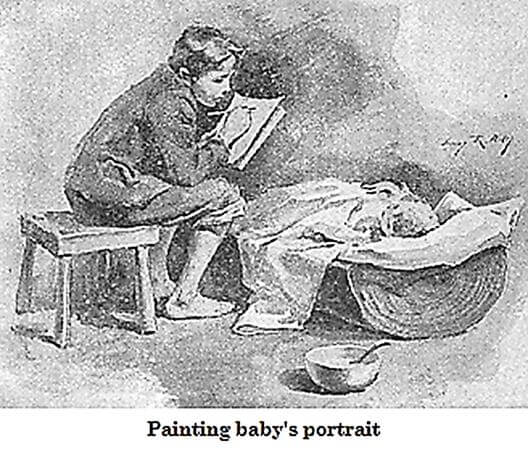
He made other pictures. At school, he used to draw with a pen before he could write. He made pictures of birds and of animals. Sometimes he would draw flowers.

He liked to draw so well, that sometimes he forgot to do his work. His father sent him to work in the field one day. The father went out to see how well he was doing his work. Benny was nowhere to be found. At last, his father saw him sitting under a large pokeweed. He was making pictures. He had squeezed the juice out of some pokeberries. The juice of pokeberries is deep red. With this, the boy had made his pictures. When the father looked at them, he was surprised. There were portraits of every member of the family. His father knew every picture.

Up to this time Benny had no paints nor any brushes. The Indians had not all gone away from that neighborhood. The Indians paint their faces with red and yellow colors. These colors they make themselves. Sometimes they prepare them from the juice of some plant. Sometimes they get them by finding red or yellow earth. Some of the Indians can make rough pictures with these colors.

The Indians near the house of Benny’s father must have liked the boy. They showed him how to make red and yellow colors for himself. He got some of his mother’s indigo to make blue. He now had red, yellow, and blue. By mixing these three, the other colors that he wanted could be made.
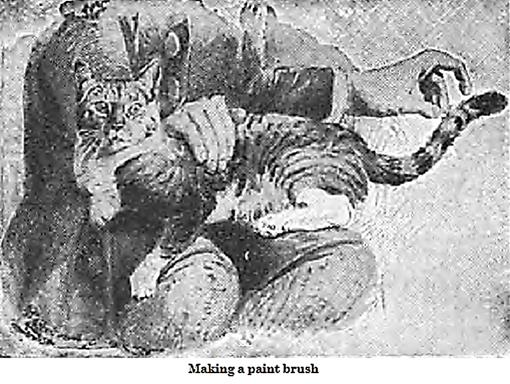
But he had no brush to paint with. He took some long hairs from the cat’s tail. Of these he made his brushes. He used so many of the cat’s hairs, that her tail began to look bare. Everybody in the house began to wonder what was the matter with pussy’s tail. At last, Benny told where he got his brushes.

A cousin of Benny’s came from the city on a visit. He saw some of the boy’s drawings. When he went home, he sent Benny a box of paints. With the paints were some brushes. And there was some canvas such as pictures are painted on. And that was not all. There were in the box six beautiful engravings.

The little painter now felt himself rich. He was so happy that he could hardly sleep at all. At night, he put the box that held his treasures on a chair by his bed. As soon as daylight came, he carried the precious box to the garret. The garret of the long stone house was his studio. Here he worked away all day long. He did not go to school at all. Perhaps he forgot that there was any school. Perhaps the little artist could not tear himself away from his work.

But the schoolmaster missed him. He came to ask if Benny was ill. The mother was vexed when she found that he had stayed away from school. She went to look for the naughty boy. After a while she found the little truant. He was hard at work in his garret. She saw what he had been doing. He had not copied any of his new engravings. He had made up a new picture by taking one person out of one engraving, and another out of another. He had copied these so that they made a picture that he had thought of for himself.

His mother could not find it in her heart to punish him. She was too much pleased with the picture he was making. This picture was not finished. But his mother would not let him finish it. She was afraid he would spoil it if he did anything more on it.

The good people called Friends did not like the making of pictures, as I said. But they thought that Benny West had a talent that he ought to use. So he went to Philadelphia to study his art. After a while he sailed away to Italy to see the pictures that great artists had painted.

At last, he settled in England. The King of England was at that time the king of this country too. The king liked West’s pictures. West became the king’s painter. He came to be the most famous painter in England.

He liked to remember his boyish work. He liked to remember the time when he was a little Quaker boy making his paints of poke juice and Indian colors.
Great Stories for Little Americans: George Washington and His Hatchet

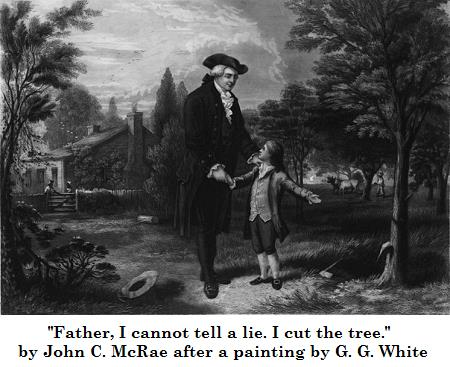
It was Arbor Day in the Mossy Hill School, Johnny Littlejohn had to speak a piece that had something to do with trees. He thought it would be a good plan to say something about the little cherry tree that Washington spoiled with his hatchet, when he was a little boy. This is what he said:

He had a hatchet–little George–

A hatchet bright and new,

And sharp enough to cut a stick–

A little stick–in two.

He hacked and whacked and whacked and hacked,

This sturdy little man;

He hacked a log and hacked a fence,

As roundabout he ran.

He hacked his father’s cherry tree

And made an ugly spot;

The bark was soft, the hatchet sharp,

And little George forgot.

You know the rest. The father frowned

And asked the reason why;

You know the good old story runs

He could not tell a lie.

The boy that chopped that cherry tree

Soon grew to be a youth;

At work and books he hacked away,

And still he told the truth:

The youth became a famous man,

Above six feet in height,

And when he had good work to do

He hacked with all his might.

He fought the armies that the king

Had sent across the sea;

He battled up and down the land

To set his country free.

For seven long years he, hacked and whacked

With all his might and main

Until the British sailed away

And did not come again.

Great Stories for Little Americans: Daniel Boone’s Daughter and Her Friends

Daniel Boone and his brother picked out a good place in Kentucky to settle. Then they went home to North Carolina. They took with them such things as were curious and valuable. These were the skins of animals they had killed, and no doubt some of the heads and tails.


Boone was restless. He had seen Kentucky and he did not wish to settle down to the life of North Carolina.

In two years Boone sold his farm in North Carolina and set out for Kentucky. He took with him his wife and children and two brothers. Some of their neighbors went with them. They traveled by pack train. All their goods were packed on horses.

When they reached the place on the Kentucky River that Boone had chosen for a home they built a fort of log houses. These cabins all stood round a square. The backs of the houses were outward. There was no door or window in the back of a house. The outer walls were thus shut up. They made the place a fort. The houses at the four corners were a little taller and stronger than the others. There were gates leading into the fort. These gates were kept shut at night.

In the evening the people danced and amused themselves in the square. Indians could not creep up and attack them.

When the men went out to feed the horses and cows they carried their guns. They walked softly and turned their eyes quickly from point to point to see if Indians were hiding near. They held their guns so they could shoot quickly.

The women and children had to stay very near the fort so they could run in if an Indian came in sight.

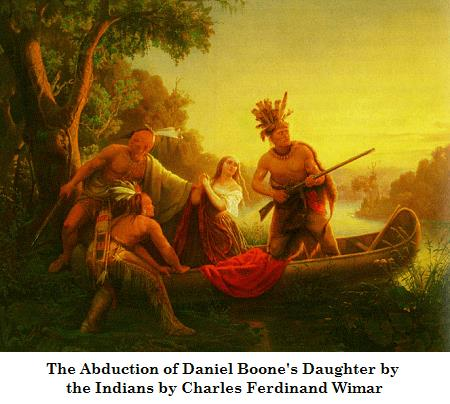
Daniel Boone had a daughter named Jemima. She was about fourteen years old. She had two friends named Frances and Betsey Calloway. Frances Galloway was about the same age as Jemima.

One summer afternoon these three girls went out of the fort. They went to the river and got into a canoe. It was not far from the fort. They felt safe. They laughed and talked and splashed the water with their paddles.

The current carried them slowly near the other shore. They could still see the fort. They did not think of danger. Trees and bushes grew thick down to the edge of the river. Five strong Indians were hiding in the bushes.

One Indian crept carefully through the bushes. He made no more noise than a snake. When he got to the edge of the water he put out his long arm and caught hold of the rope that hung down from the canoe. In a moment, he had turned the boat around and drawn it out of sight from the fort. The girls screamed when they saw the Indian. Their friends heard them but could not cross the river to help them. The girls had taken the only canoe.

Boone and Calloway were both gone from the fort. They got home too late to start that day. No sleep came to their eyes while they waited for light to travel by.

As soon as there was a glimmer of light they and a party of their friends set out. It was in July and they could start early. They crossed the river and easily found the Indians’ tracks where they started. The brush was broken down there.

The Indians were cunning. They did not keep close together after they set out. Each Indian walked by himself through the tall canes. Three of the Indians took the captives.

Boone and his friends tried in vain to follow them. Sometimes they would find a track but it would soon be lost in the thick canes. Boone’s party gave up trying to find their path. They noticed which way the Indians were going. Then they walked as fast as they could the same way for thirty miles. They thought the Indians would grow careless about their tracks after traveling so far. They turned so as to cross the path they thought the Indians had taken. They looked carefully at the ground and at the bushes to see if anyone had gone by.

Before long they found the Indians’ tracks in a buffalo path. Buffaloes and other animals go often to lick salt from the rocks round salt springs. They beat down the brush and make great roads. These roads run to the salt springs. The hunters call them streets.

The Indians took one of these roads after they got far from the fort. They could travel more easily in it. They did not take pains to hide their tracks.

As fast as their feet could carry them, Boone and his friends traveled along the trail. When they had gone about ten miles they saw the Indians.

The Indians had stopped to rest and to eat. It was very warm and they had put off their moccasins and laid down their arms. They were kindling a fire to cook by.

In a moment, the Indians saw the white men. Boone and Galloway were afraid the Indians would kill the girls. Four of the white men shot at the Indians. Then all rushed at them. The Indians ran away as fast as they could. They did not stop to pick up their guns or knives or hatchets. They had no time to put on their moccasins. The poor worn-out girls were soon safe in their fathers’ arms. Back to Boonesborough they went, not minding their tired feet. When they got to the fort there was great joy to see them alive. I do not believe they ever played in the water again.

Great Stories for Little Americans:  Daniel Boone and His Grapevine Swing

Daniel Boone was the first settler of Kentucky. He knew all about living in the woods. He knew how to hunt the wild animals. He knew how to fight Indians, and how to get away from them.


Nearly all the men that came with him to Kentucky the first time were killed. One was eaten by wolves. Some of them were killed by Indians. Some of them went into the woods and never came back. Nobody knows what killed them.

Only Boone and his brother were left alive. They needed some powder and some bullets. They wanted some horses. Boone’s brother went back across the mountains to get these things. Boone stayed in his little cabin all alone.

Once a mother bear tried to kill him. He fired his gun at her, but the bullet did not kill her. The bear ran at him. He held his long knife out in his hand. The bear ran against it and was killed.

He made long journeys alone in the woods. One day he looked back through the trees and saw four Indians. They were following Boone’s tracks. They did not see him. He turned this way and that. But the Indians still followed his tracks.

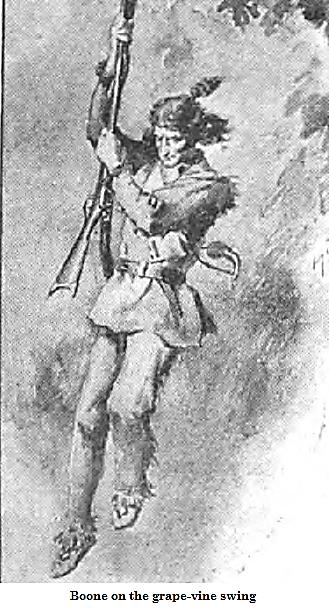
He went over a little hill. Here he found a wild grapevine. It was a very long vine, reaching to the top of a high tree. There are many such vines in the Southern woods. Children cut such vines off near the roots. Then they use them for swings.

Boone had swung on grapevines when he was a boy. He now thought of a way to break his tracks. He cut the wild grapevine off near the root. Then he took hold of it. He sprang out into the air with all his might. The great swing carried him far out as it swung. Then he let go. He fell to the ground, and then he ran away in a different direction from that in which he had been going.

When the Indians came to the place, they could not find his tracks. They could not tell which way he had gone. He got to his cabin in safety.

Boone had now been alone for many months. His brother did not get back at the time he had set for coming. Boone thought that his brother might have been killed. Boone had not tasted anything but meat since he left home. He had to get his food by shooting animals in the woods. By this time, he had hardly any powder or bullets left.

One evening he sat by his cabin. He heard someone coming. He thought that it might be Indians. He heard the steps of horses. He looked through the trees. He saw his brother riding on one horse, and leading another. The other horse was loaded with powder and bullets and clothes, and other things that Boone needed.

Great Stories for Little Americans: Israel Putnam and the Wolf

Israel Putnam was a brave soldier. He fought many battles against the Indians. After that he became a general in the Revolution. But this is a story of his battle with a wolf. It took place when he was a young man, before he was a soldier.

Putnam lived in Connecticut. In the woods, there were still a few wolves. One old wolf came to Putnam’s neighborhood every winter. She always brought a family of young wolves with her.

The hunters would always kill the young wolves. But they could not find the old mother wolf. She knew how to keep out of the way.

The farmers tried to catch her in their traps. But she was too cunning. She had had one good lesson when she was young. She had put the toes of one foot into a steel trap. The trap had snipped them off. After that she was more careful.

One winter night she went out to get some meat. She came to Putnam’s flock of sheep and goats. She killed some of them. She found it great fun.

There were no dogs about. The poor sheep had nobody to protect them. So, the old wolf kept on killing. One sheep was enough for her supper. But she killed the rest just for sport. She killed seventy sheep and goats that night.

Putnam and his friends set out to find the old sheep killer. There were six men of them. They agreed that two of them should hunt for her at a time. Then another two should begin as soon as the first two should stop. So, she would be hunted day and night.

The hunters found her track in the snow. There could be no mistake about it. The track made by one of her feet was shorter than those made by the other feet. That was because one of her feet had been caught in a trap.

The hunters found that the old wolf had gone a long way off. Perhaps she felt guilty. She must have thought that she would be hunted. She had trotted away for a whole night.

Then she turned and went back again. She was getting hungry by this time. She wanted some more sheep.

The men followed her tracks back again. The dogs drove her into a hole. It was not far from Putnam’s house.

All the farmers came to help catch her. They sent the dogs into the cave where the wolf was. But the wolf bit the dogs, and drove them out again.

Then the men put a pile of straw in the mouth of the cave. They set the straw on fire. It filled the cave with smoke. But Mrs. Wolf did not come out.

Then they burned brimstone in the cave. It must have made the wolf sneeze. But the cave was deep. She went as far in as she could, and stayed there. She thought that the smell of brimstone was not so bad as the dogs and men who wanted to kill her.

Putnam wanted to send his worker into the cave to drive out the wolf. But the worker thought that he would rather stay out.

Then Putnam said that he would go in himself. He tied a rope to his legs. Then he got some pieces of birchbark. He set fire to these. He knew that wild animals do not like to face a fire.

He got down on his hands and knees. He held the blazing bark in his hand. He crawled through the small hole into the cave. There was not room for him to stand up.

At first the cave went downward into the ground. Then it was level a little way. Then it went upward. At the very back of this part of the cave was the wolf. Putnam crawled up until he could see the wolf’s eyes.

When the wolf saw the fire, she gave a sudden growl. Putnam jerked the rope that was tied to his leg. The men outside thought that the wolf had caught him. They pulled on the other end of the rope.

The men pulled as fast as they could. When they had drawn Putnam out, his clothes were torn. He was badly scratched by the rocks.

He now got his gun. He held it in one hand. He held the burning birchbark in the other. He crawled into the cave again.

When the wolf saw him coming again, she was very angry. She snapped her teeth. She got ready to spring on him. She meant to kill him as she had killed his sheep. Putnam fired at her head. As soon as his gun went off, he jerked the rope. His friends pulled him out.

He waited awhile for the smoke of his gun to clear up. Then he went in once more. He wanted to see if the wolf was dead.

He found her lying down. He tapped her nose with his birchbark. She did not move. He took hold of her. Then he jerked the rope.

This time the men saw him come out, bringing the dead wolf. Now the sheep would have some peace.

Great Stories for Little Americans: A Great Good Man

Some men are great soldiers. Some are great lawmakers. Some men write great books. Some men make great inventions. Some men are great speakers.


Now you are going to read about a man that was great in none of these things. He was not a soldier. He was not a great speaker. He was never rich. He was a poor schoolteacher. He never held any office.

And yet he was a great man. He was great for his goodness.

He was born in France. But most of his life was passed in Philadelphia before the Revolution.

He was twenty-five years old when he became a schoolteacher. He thought that he could do more good in teaching than in any other way.

Schoolmasters in his time were not like our teachers. Children were treated like little animals. In old times the schoolmaster was a little king. He walked and talked as if he knew everything. He wanted all the children to be afraid of him.

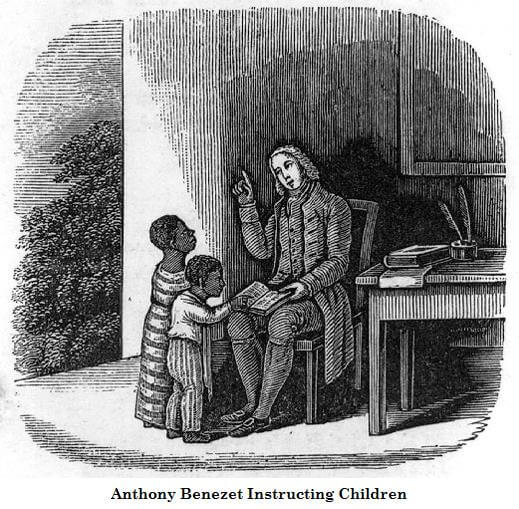
But Anthony Benezet was not that kind of man. He was very gentle. He treated the children kindlier than their fathers and mothers did. Nobody in this country had ever seen a teacher like him.

He built a playroom for the children of his school. He used to take them to this room during school time for a little amusement. He managed each child as he found best. Some he could persuade to be good. Some he shamed into being good. But this was very different from the cruel beatings that other teachers of that time gave their pupils.

Of course, the children came to love him very much. After they grew to be men and women, they kept their love for the good little schoolmaster. As long as they lived they listened to his advice.

There were no good schoolbooks in his time. He wrote some little books to make learning easier to his pupils. He taught them many things not in their books. He taught them to be kind to brutes, and gentle with one another. He taught them to be noble. He made them despise every kind of meanness.

He was a great teacher. That is better than being a great soldier.

Benezet was a good man in many ways. He was the friend of all poor people. Once he found a poor man suffering with cold for want of a coat. He took off his own coat in the street and put it on the poor man, and then went home in his shirtsleeves.

In those days, black people were stolen from Africa to be sold into America. Benezet wrote books against this wrong. He sent these books over all the world. He also tried to persuade the Europeans of his own country to be honest and kind with the Indians. Great men in other countries were pleased with his books. They wrote him letters. When any of them came to this country, they went to see him. They wanted to see a man that was good to everybody. His house was a plain one. But great men liked to sit at the table of the good schoolmaster.

There was war between the English and French at that time. Canada belonged to the French. The United States belonged to the English. There was a country called Acadia. It was a part of what is now Nova Scotia. The people of Acadia were French.

The English forced the Acadians from their homes. They sent them to various places. Many families were divided. The poor Acadians lost their homes and all that they had.

Many hundreds of these people were sent to Philadelphia. Benezet became their friend. As he was born in France, he could speak their language. He got a large house built for some of them to stay in. He got food and clothing for them. He helped them to get work, and did them good in many other ways.

One day, Benezet’s wife came to him with a troubled face. She said, “There have been thieves in the house. Two of my blankets have been stolen.”

“Never mind, my dear,” said Benezet, “I gave them to some of the poor Acadians.”

One old Acadian was afraid of Benezet. He did not see why Benezet should take so much trouble for other people. He thought that Benezet was only trying to get a chance to sell the Acadians for slaves. When Benezet heard this, he had a good laugh.

Many years after this the Revolution broke out. It brought trouble to many people. Benezet helped as many as he could.

After a while the British army took Philadelphia. They sent their soldiers to stay in the houses of the people. The people had to take care of the soldiers. This was very hard for the poor people.

One day, Benezet saw a poor woman. Her face showed that she was in trouble.

“Friend, what is the matter?” Benezet said to her. She told him that six soldiers of the British army had been sent to stay in her house. She was a washerwoman. But while the soldiers filled up the house she could not do any washing. She and her children were in want.

Benezet went right away to see the general that was in command of the soldiers. The good man was in such a hurry that he forgot to get a pass. The soldiers at the general’s door would not let him go in.

At last, someone told the general that a strange-looking fellow wanted to see him.

“Let him come up,” said the general.

The odd little man came in. He told the general all about the troubles of the poor washerwoman. The general sent word that the soldiers must not stay any longer in her house.

The general liked the kind little man. He told him to come to see him again. He told the soldiers at his door to let Benezet come in whenever he wished to.

Soon after the Revolution was over, Benezet was taken ill. When the people of Philadelphia heard that he was ill, they gathered in crowds about his house. Everybody loved him. Everybody wanted to know whether he was better or not. At last, the doctors said he could not get well. Then the people wished to see the good man once more. The doors were opened. The rooms and halls of his house were filled with people coming to say goodbye to Benezet, and going away again.

When he was buried, it seemed as if all Philadelphia had come to his funeral. The rich and the poor, the black and the white, crowded the streets. The city had never seen so great a funeral.

In the company was an American general. He said, “I would rather be Anthony Benezet in that coffin than General Washington in all his glory.”

Great Stories for Little Americans: John Stark and the Abenaki Indians

John Stark was a famous general in the Revolution. But this story is not about the Revolution. It is about Stark before he became a soldier.


When he was a young man, Stark went into the woods. His brother and two other young men were with him. They lived in a camp. It was far away from any houses.

The young men set traps for animals in many places. They wanted to catch the animals that have fur on them. They wanted to get the skins to sell.

The Abenaki Indians were at war with the European settlers. One day the young men saw the tracks of the Indians. Then they knew that it was not safe for them to stay in the woods any longer. They began to get ready to go home.

John Stark went out to bring in the traps set for animals. The Indians found him, and made him a prisoner. They asked him where his friends were.

Stark did not wish his friends to be taken. So he pointed the wrong way. He took the Indians a long way from the other young men.

But John Stark’s friends did not know that he was a prisoner. When he did not come back, they thought that he had lost his way. They fired their guns to let him know where they were.

When the Indians heard the guns, they knew where the other hunters were. They went down to the river, and waited for them. When one of the men came down, they caught him.

Then John Stark’s brother and the other man came down the river in a boat. The Indians told Stark to call them. They wanted them to come over where the Indians were. Then they could take them.

John knew that if he did not do what the Indians told him to, they might kill him. But he wished to save his brother. He called to his brother to row for the other shore.

When they turned toward the other shore, the Indians fired at them. But Stark knocked up two of their guns. They did not hit his brother or friend. Then some of the other Indians fired. Stark knocked up their guns also. But the man that was with his brother was killed.

John now called to his brother, “Run! for all the Indians’ guns are empty.”

His brother got away. The Indians were very angry with John. They did not kill him. But they gave him a good beating. These Indians were from Canada. They took their prisoners to their own village. When they were coming home, they shouted to let the people know that they had prisoners.

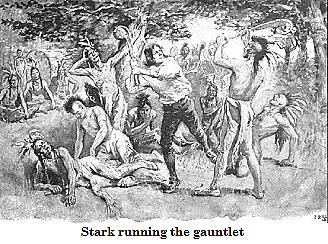
The young Indian warriors stood in two rows in the village. Each prisoner had to run between these two rows of Indians. As he passed, every one of the Indians hit him as hard as he could with a stick, or a club, or a stone.

The young man who was with Stark was badly hurt in running between these lines. But John Stark knew the Indians. He knew that they liked a brave man.

When it came his turn to run, he snatched a club from one of the Indians. With this club, he fought his way down the lines. He hit hard, now on this side, and now on that. The young Indians got out of his way. The old Indians who were looking on sat and laughed at the others. They said that Stark was a brave man.

One day the Indians gave him a hoe and told him to hoe corn. He knew that the Indian warriors would not work. They think it a shame for a man to work. They think that work is for slaves and women. So Stark pretended that he did not know how to hoe. He dug up the corn instead of the weeds. Then he threw the hoe into the river. He said, “That is work for slaves and women.”

Then the Indians were pleased with him. They called him the young chief.

After a while the European settlers paid the Indians a hundred and three dollars to let Stark go home. They charged more for him than for the other man, because they thought that he must be a young chief. Stark went hunting again. He had to get some furs to pay back the money the men had paid the Indians for him. He took good care that the Indians should not catch him again.

He afterwards became an effective fighter against the Indians. He had learned their ways while he was among them. He knew better how to fight them than almost anybody else.

In the Revolution he was a general. He fought the British at Bennington, and won a great victory.

Great Stories for Little Americans: FRANKLIN’S WHISTLE.

FRANKLIN’S WHISTLE.

When Franklin was an old man, he wrote a cu-ri-ous letter. In that letter he told a story. It was about some-thing that happened to him when he was a boy.

Here is the story put into verses, so that you will re-member it better. Some day you can read the story as Franklin told it himself. You will hear people say, “He paid too much for the whistle.” The saying came from this story.

TOO MUCH FOR THE WHISTLE

     As Ben with pennies in his pocket
       Went strolling down the street,
     “Toot-toot! toot-toot!” there came a whistle
       From a boy he chanced to meet,

     Whistling fit to burst his buttons,
       Blowing hard and stepping high.
     Then Benny said, “I’ll buy your whistle;”
       But “Toot! toot-toot!” was the reply.

     But Benny counted out his pennies,
       The whistling boy began to smile;
     With one last toot he gave the whistle
       To Ben, and took his penny pile.

     Now homeward goes the whistling Benny,
       As proud as any foolish boy,
     And in his pockets not a penny,
       But in his mouth a noisy toy.

     “Ah, Benny, Benny!” cries his mother,
       “I cannot stand your ugly noise.”
     “Stop, Benny, Benny!” says his father,
       “I cannot talk, you drown my voice.”

     At last the whistling boy re-mem-bers
       How much his money might have bought
     “Too many pennies for a whistle,”
       Is little Benny’s ugly thought.

     Too many pennies for a whistle
       Is what we all pay, you and I,
     Just for a little foolish pleasure
       Pay a price that’s quite too high.

Great Stories for Little Americans: FRANKLIN AND THE KITE.

When Franklin wanted to know whether the ants could talk or not, he asked the ants, and they told him. When he wanted to know some-thing else, he asked the sunshine about it, as you have read in another story. That is the way that Franklin came to know so many things. He knew how to ask questions of every-thing.

Once he asked the light-ning a question. And the light-ning gave him an answer.

Before the time of Franklin, people did not know what light-ning was. They did not know what made the thunder. Franklin thought much about it. At last he proved what it was. He asked the lightning a question, and made it tell what it was. To tell you this story, I shall have to use one big word. Maybe it is too big for some of my little friends that will read this book. Let us divide it into parts. Then you will not be afraid of it. The big word is e-lec-tric-i-ty.

Those of you who live in towns have seen the streets lighted by e-lec-tric-i-ty. But in Franklin’s time there were no such lights. People knew very little about this strange thing with a big name.

But Franklin found out many things about it that nobody had ever known before. He began to think that the little sparks he got from e-lec-tric-i-ty were small flashes of lightning. He thought that the little cracking sound of these sparks was a kind of baby thunder.

So he thought that he would try to catch a little bit of lightning. Perhaps he could put it into one of the little bottles used to hold e-lec-tric-i-ty. Then if it behaved like e-lec-tric-i-ty, he would know what it was. But catching lightning is not easy. How do you think he did it?

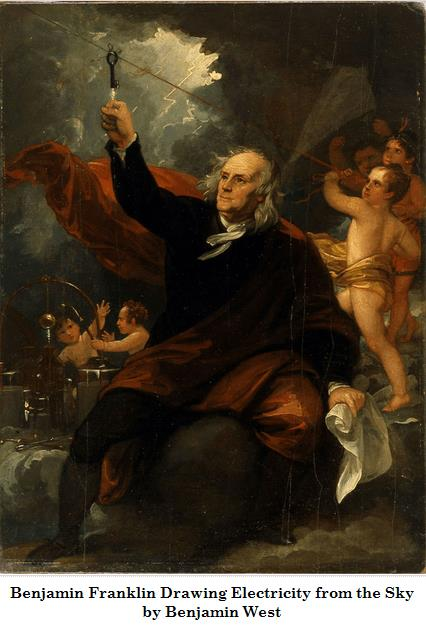
First he made a kite. It was not a kite just like a boy’s kite. He wanted a kite that would fly when it rained. Rain would spoil a paper kite in a minute. So Franklin used a silk hand-ker-chief to cover his kite, instead of paper.

He put a little sharp-pointed wire at the top of his kite. This was a kind of lightning rod to draw the lightning into the kite. His kite string was a common hemp string. To this he tied a key, because lightning will follow metal. The end of the string that he held in his hand was a silk ribbon, which was tied to the hemp string of the kite. E-lec-tric-ity will not follow silk.

One night when there was a storm coming, he went out with his son. They stood under a cow shed, and he sent his kite up in the air.

After a while he held his knuckle to the key. A tiny spark flashed between the key and his knuckle. It was a little flash of lightning.

Then he took his little bottle fixed to hold e-lec-tric-i-ty. He filled it with the e-lec-tric-i-ty that came from the key. He carried home a bottle of lightning. So he found out what made it thunder and lighten.

After that he used to bring the lightning into his house on rods and wires. He made the lightning ring bells and do many other strange things.

Note: This story may be more myth than fact. In 2006, Mythbusters episode “Franklin’s Kite” attempted to recreate the kite experiment as described in this story. Their findings indicated that had Franklin successfully undertaken the experiment, he would have died.

Great Stories for Little Americans: FRANKLIN ASKS THE SUNSHINE SOMETHING.

One day Franklin was eating dinner at the house of a friend. The lady of the house, when she poured out the coffee, found that it was not hot.

She said, “I am sorry that the coffee is cold. It is because the servant forgot to scour the coffee-pot. Coffee gets cold more quickly when the coffee-pot is not bright.”

This set Franklin to thinking. He thought that a black or dull thing would cool more quickly than a white or bright one. That made him think that a black thing would take in heat more quickly than a white one.

He wanted to find out if this were true or not. There was no-body who knew, so there was no-body to ask. But Franklin thought that he would ask the sunshine. Maybe the sunshine would tell him whether a black thing would heat more quickly than a white thing.

But how could he ask the sunshine?

There was snow on the ground. Franklin spread a white cloth on the snow. Then he spread a black cloth on the snow near the white one. When he came to look at them, he saw that the snow under the black cloth melted away much sooner than that under the white cloth.

That is the way that the sunshine told him that black would take in heat more quickly than white. After he had found this out, many people got white hats to wear in the summer time. A white hat is cooler than a black one.

Some time when there is snow on the ground, you can take a white and a black cloth and ask the sunshine the same question.