Posts tagged ‘chilren’s history book’
Great Stories for Little Americans: Benjamin Franklin – His Own Teacher

Few people ever knew so many things as Benjamin Franklin. Men said, “How did he ever learn so many things?” For he had been a poor boy who had to work for a living. He could not go to school at all after he was ten years old.
His father made soap and candles. Little Ben Franklin had to cut wicks for the candles. He also filled the candle molds. And he sold soap and candles, and ran on errands. But when he was not at work he spent his time in reading good books. What little money he got he used to buy books with.
He read the old story of “Pilgrim’s Progress,” and liked it so well that he bought all the other stories by the same man. But as he wanted more books, and had not money to buy them, he sold all of these books. The next he bought were some little history books. These were made to sell very cheap, and they were sold by peddlers. He managed to buy forty or fifty of these little books of history.
Another way that he had of learning was by seeing things with his own eyes. His father took him to see carpenters at work with their saws and planes. He also saw masons laying bricks. And he went to see men making brass and copper kettles. And he saw a man with a turning lathe making the round legs of chairs. Other men were at work making knives. Some things people learn out of books, and some things they have to see for themselves.
As he was fond of books, Ben’s father thought that it would be a good plan to send him to learn to print them. So the boy went to work in his brother’s printing office. Here he passed his spare time in reading. He borrowed some books out of the stores where books were sold. He would sit up a great part of the night sometimes to read one of these books. He wished to return it when the bookstore opened in the morning. One man who had many books lent to Ben such of his books as he wanted.
It was part of the bargain that Ben’s brother should pay his board. The boy offered to board himself if his brother would give him half what it cost to pay for his board.
His brother was glad to do this, and Ben saved part of the money and bought books with it. He was a healthy boy, and it did not hurt him to live mostly on bread and butter. Sometimes he bought a little pie or a handful of raisins.
Long before he was a man, people said, “How much the boy knows!” This was because–
He did not waste his time.
He read good books.
He saw things for himself.
Great Stories for Little Americans: The Story of a Wise Woman
You have read how Thomas Smith first raised rice in Carolina. After his death, there lived in South Carolina a wise young woman. She showed the people how to raise another plant. Her name was Eliza Lucas.
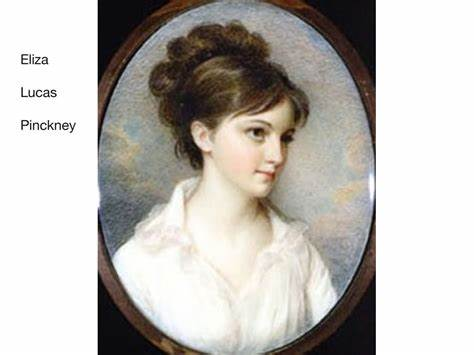
The father of Miss Lucas did not live in Carolina. He was governor of one of the islands of the West Indies. Miss Lucas was fond of trying new things. She often got seeds from her father. These she planted in South Carolina.
Her father sent her some seeds of the indigo plant. She sowed some of these in March. But there came a frost. The indigo plant cannot stand frost. Her plants all died.
But Miss Lucas did not give up. She sowed some more seeds in April. These grew very well until a cutworm found them. The worm wished to try new things, too. So, he ate off the indigo plants.
But Miss Lucas was one of the people who try, try again. She had lost her indigo plants twice. Once more she sowed some of the seed. This time the plants grew very well.
Miss Lucas wrote to her father about it. He sent her a man who knew how to get the indigo out of the plant.
The man tried not to show Miss Lucas how to make the indigo. He did not wish the people in South Carolina to learn how to make it. He was afraid his own people would not get so much for their indigo.
So, he would not explain just how it ought to be done. He spoiled the indigo on purpose.
But Miss Lucas watched him closely. She found out how the indigo ought to be made. Some of her father’s land in South Carolina was now planted with the indigo plants.
Then Miss Lucas was married. She became Mrs. Pinckney. Her father gave her all the indigo growing on his land in South Carolina. It was all saved for seed. Some of the seed Mrs. Pinckney gave to her friends. Some of it her husband sowed. It all grew, and was made into that blue dye that we call indigo. When it is used in washing clothes, it is called bluing.
In a few years, more than a million pounds of indigo were made in South Carolina every year. Many people got rich by it. And it was all because Miss Lucas did not give up.
Chapter 4: William Penn and the Lenape Indians
The King of England gave all the land in Pennsylvania to William Penn. The King made Penn a kind of king over Pennsylvania. Penn could make the laws of this new country. But he let the people make their own laws.

Penn wanted to be friendly with the Lenape (also called Delaware) Indians living in Pennsylvania. He paid them for all the land his people wanted to live on. Before he went to Pennsylvania he wrote a letter to the Indians. He told them in this letter that he would not let any of his people do any harm to the Indians. He said he would punish anybody that did any wrong to an Indian. This letter was read to the Indians in their own language.
Soon after this Penn got into a ship and sailed from England. He sailed to Pennsylvania. When he came there, he sent word to the tribes of Indians to come to meet him.
The Indians met under a great elm tree on the bank of the river. Indians like to hold their solemn meetings out of doors. They sit on the ground. They say that the earth is the Indian’s mother.
When Penn came to the place of meeting, he found the woods full of Indians. As far as he could see, there were crowds of Indians. Penn’s friends were few. They had no guns.
Penn had a bright blue sash round his waist. One of the Indian chiefs, who was the great chief, put on a kind of cap or crown. In the middle of this was a small horn. The head chief wore this only at such great meetings as this one.
When the great chief had put on his horn, all the other chiefs and great men of the Indians put down their guns. Then they sat down in front of Penn in the form of a half-moon. Then the great chief told Penn that the Indians were ready to hear what he had to say.
Penn had a large paper in which he had written all the things that he and his friends had promised to the Indians. He had written all the promises that the Indians were to make to the European settlers. This was to make them friends. When Penn had read this to them, it was explained to them in their own language. Penn told them that they might stay in the country that they had sold to the settlers. The land would belong to both the Indians and the settlers.
Then Penn laid the large paper down on the ground. That was to show them, he said, that the ground was to belong to the Indians and the settlers together.
He said that there might be quarrels between some of the settlers and some of the Indians. But they would settle any quarrels without fighting. Whenever there should be a quarrel, the Indians were to pick out six Indians. The settlers should also pick out six of their men. These were to meet, and settle the quarrel.
Penn said, “I will not call you my children, because fathers sometimes whip their children. I will not call you brothers, because brothers sometimes fall out. But I will call you the same person as the settlers. We are the two parts of the same body.”
The Indians could not write. But they had their way of putting down things that they wished to have remembered. They gave Penn a belt of shell beads. These beads are called wampum. Some wampum is white. Some is purple.
They made this belt for Penn of white beads. In the middle of the belt they made a picture of purple beads. It is a picture of a white man and an Indian. They have hold of each other’s hands. When they gave this belt to Penn, they said, “We will live with William Penn and his children as long as the sun and moon shall last.”
Penn took up the great paper from the ground. He handed it to the great chief that wore the horn on his head. He told the Indians to keep it and hand it to their children’s children, that they might know what he had said. Then he gave them many presents of such things as they liked. They gave Penn a name in their own language. They named him “Onas.” That was their word for a feather. As the European settlers used a pen made out of a quill or feather, they called a pen “onas.” That is why they called William Penn “Brother Onas.”
Penn sometimes went to see the Indians. He talked to them, and gave them friendly advice. Once he saw some of them jumping. They were trying to see who could jump the farthest.
Penn had been a very active boy. He knew how to jump very well. He went to the place where the Indians were jumping. He jumped farther than any of them.
When the great governor took part in their sport, the Indians were pleased. They loved Brother Onas more than ever.
UTH Note: Unfortunately, those that came after Penn were not as kind as Penn. Forty years after Penn died, the Lenape Indians were relocated from their land to Ohio. Additional relocations followed, scattering the tribe across several states.
Chapter 3: Indian Pictures
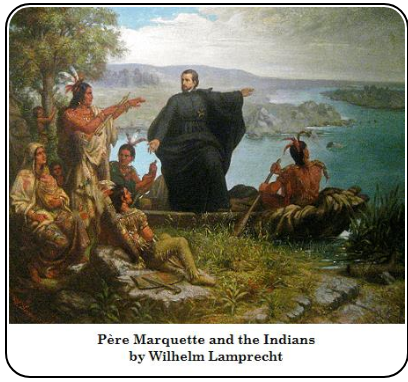
When Marquette and his men left the Illinois, they went on down the river. The friendly Illinois had told them that the Indians they would see were bad, and that they would kill anyone who came into their country.
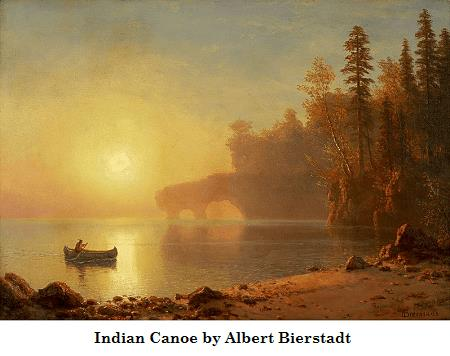
The Frenchmen had heard before this that there were demons and monsters in the river. One day they saw some high rocks with pictures painted on them. The ugly pictures made them think of these monsters. They were painted in red, black, and green colors. They were pictures of two Indian demons or gods.
Each one of these monsters was about the size of a calf. They had horns as long as those of a deer. Their eyes were red. Their faces were like a man’s, but they were ugly and frightful. They had beards like a tiger’s. Their bodies were covered with scales like those on a fish. Their long tails were wound round their bodies, and over their heads, and down between their legs. The end of each tail was like that of a fish.
The Indians prayed to these ugly gods when they passed in their canoes. Even Marquette and his men were a little frightened when they saw such pictures in a place so lonely. The Frenchmen went down the river about twelve hundred miles. Sometimes the Indians tried to kill them, but by showing the peace pipe they made friends. At last, they turned back. Joliet went to Canada. Marquette preached to the Indians in the West till he died.
MARQUETTE IN IOWA
MARQUETTE IN IOWA
The first white men to go into the middle of our country were French-men. The French had settled in Can-a-da. They sent mis-sion-a-ries to preach to the Indians in the West. They also sent traders to buy furs from the Indians.
The French-men heard the Indians talk about a great river in the West. But no French-man had ever gone far enough to see the Mis-sis-sip-pi.
Mar-quette was a priest. Jo-li-et was a trader. These two men were sent to find the great river that the Indians talked about.
They trav-eled in two birch canoes. They took five men to paddle the canoes. They took some smoked meat to eat on the way. They also took some Indian corn. They had trinkets to trade to the Indians. Hatchets, and beads, and bits of cloth were the money they used to pay the Indians for what they wanted.
The friendly Indians in Wis-con-sin tried to per-suade them not to go. They told them that the Indians on the great river would kill them.
The friendly Indians also told them that there was a demon in one part of the river. They said that this demon roared so loud that he could be heard a long way off. They said that the demon would draw the trav-el-ers down into the water. Then they told about great monsters that ate up men and their canoes.
But Mar-quette and the men with him thought they would risk the journey. They would not turn back for fear of the demon or the monsters.
The two little canoes went down the Wis-con-sin River. After some days they came to the Mis-sis-sip-pi. More than a hundred years before, the Spaniards had seen the lower part of this river. But no white man had ever seen this part of the great river. Mar-quette did not know that any white man had ever seen any part of the Mis-sis-sip-pi.
The two little canoes now turned their bows down the river. Some-times they saw great herds of buf-fa-loes. Some of these came to the bank of the river to look at the men in the canoes. They had long, shaggy manes, which hung down over their eyes.
For two weeks the trav-el-ers paddled down the river. In all this time they did not see any Indians. After they had gone hundreds of miles in this way, they came to a place where they saw tracks in the mud. It was in what is now the State of I-o-wa.
Mar-quette and Jo-li-et left the men in their canoes, and followed the tracks. After walking two hours, they came to an Indian village. The Frenchmen came near enough to hear the Indians talking. The Indians did not see them.
Jo-li-et and Mar-quette did not know whether the Indians would kill them or not. They said a short prayer. Then they stood out in full view, and gave a loud shout.
The Indians came out of their tents like bees. They stared at the strangers. Then four Indians came toward them. These Indians carried a peace pipe. They held this up toward the sun. This meant that they were friendly.
The Indians now offered the peace pipe to the French-men. The French-men took it, and smoked with the Indians. This was the Indian way of saying, “We are friends.”
Mar-quette asked the Indians what tribe they belonged to. They told him that they were of the tribe called the Il-li-nois.
They took Jo-li-et and Mar-quette into their village. They came to the door of a large wig-wam. A chief stood in the door. He shaded his eyes with both hands, as if the sun were shining in his face. Then he made a little speech.
He said, “French-men, how bright the sun shines when you come to see us! We are all waiting for you. You shall now come into our houses in peace.”
The Il-li-nois Indians made a feast for their new friends. First they had mush of corn meal, with fat meat in it. One of the Indians fed the Frenchmen as though they were babies. He put mush into their mouths with a large spoon.
Then came some fish. The Indian that fed the vis-it-ors picked out the bones with his fingers. Then he put the pieces of fish into their mouths. After they had some roasted dog. The French-men did not like this. Last, they were fed with buf-fa-lo meat.
The next morning six hundred Indians went to the canoes to tell the Frenchmen good-by. They gave Mar-quette a young Indian slave. And they gave him a peace pipe to carry with him.
Vocabulary
- Iowa: A state in the middle of the United States.
- French / Frenchmen: People from the European country of France.
- Priest: An ordained minister of certain churches.
- Fur Trader: A person who obtains and sells animals furs.
- Canoe: A narrow boat propelled by paddles.
- Trinket: A small ornament or item of jewelry that is of little value.
- Buffalo: A stout, shaggy wild ox.
- Tribe: A distinctive close-knit group of people.
- Wigwam: A dome-shaped hut or tent made of wooden poles and animal skins, bark, or other natural materials.
- Chief: A leader or ruler of a people or clan.
The First Governor in Boston
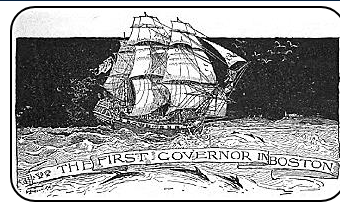
Before the white people came, there were no houses in this country but the little huts of the In-di-ans. The In-di-an houses were made of bark, or mats, or skins, spread over poles.
Some people came to one part of the country. Others started set-tle-ments in other places. When more people came, some of these set-tle-ments grew into towns. The woods were cut down. Farms were planted. Roads were made. But it took many years for the country to fill with people.
The first white people that came to live in the woods where Boston is now, settled there a long time ago. They had a gov-ern-or over them. He was a good man, and did much for the people. His name was John Win-throp.
The first thing the people had to do was to cut down the trees. After that they could plant corn. But at first they could not raise any-thing to eat. They had brought flour and oat-meal from England. But they found that it was not enough to last till they could raise corn on their new ground.
Win-throp sent a ship to get more food for them. The ship was gone a long time. The people ate up all their food. They were hungry. They went to the sea-shore, and found clams and mussels. They were glad to get these to eat.
At last they set a day for every-body to fast and pray for food. The gov-ern-or had a little flour left. Nearly all of this was made into bread, and put into the oven to bake. He did not know when he would get any more.
Soon after this a poor man came along. His flour was all gone. His bread had all been eaten up. His family were hungry. The gov-ern-or gave the poor man the very last flour that he had in the barrel.
Just then a ship was seen. It sailed up toward Boston. It was loaded with food for all the people.
The time for the fast day came. But there was now plenty of food. The fast day was turned into a thanks-giving day.
One day a man sent a very cross letter to Gov-ern-or Win-throp. Win-throp sent it back to him. He said, “I cannot keep a letter that might make me angry.” Then the man that had written the cross letter wrote to Win-throp, “By con-quer-ing yourself, you have con-quered me.”
Vocabulary:
- Governor: A leader or person in authority.
- Europe: A continent that encompasses numerous countries including France, Spain, England, and Germany.
- Europeans: People from the continent of Europe.
- Settlement: A wild place with no people where people establish a new community.
- Settler: A person who moves to a wild area that has no people.
- Boston: A large city in the northeastern United States.
- Clam: A small water creature with a soft, boneless body that lives in a shell with two halves.
- Mussel: Like a clam, but with a long, narrow brown or purplish shell.
- Cross: Angry.
- Conquer: To take control over a place or people.
 articlesforchristians