A place to grow your relationship with God

Posts tagged ‘curriculum’

Understanding Groundhog Day: History and Traditions

Groundhog Day comes from a tradition brought to America by people from Germany and Great Britain. They believed it was a time to predict the weather for the next six weeks. According to legend, the groundhog, or woodchuck, wakes from its long winter sleep on February 2 and pokes its head out of its burrow. If the sun is shining and it sees its shadow, it gets scared and retreats underground, meaning six more weeks of winter. But if it’s cloudy and there’s no shadow, it stays outside, signaling that spring is on its way. Science, however, hasn’t confirmed this belief.

In the United States as Ground-hog Day is more whimsical. On this day, everyone listens for reports of Punxsutawney Phil, the nation’s “official” groundhog.

Source: World Book Encyclopedia 1990

Weekly Recap of Articles for Christians Jan 25th to Jan 31st

Bible

Education

Cooking/ House Keeping

Estudio Bíblico en Español

Witness of the Star: ANDROMEDA (The Chained Woman)

2. ANDROMEDA (The Chained Woman)

The Redeemed in their Bondage and Affliction.

This is a peculiar picture to set in the heavens. A woman with chains fastened to her feet and arms, in misery and trouble; and bound, helpless, to the sky. Yet this is the ancient foreshowing of the truth.

In the Denderah Zodiac her name is Set, which means setset up as a queen. In Hebrew it is Sirrathe chained, and Perseathe stretched out.

Plate 22: ANDROMEDA (the Chained Woman)

There are 63 stars in this constellation, three of which are of the 2nd magnitude, two of the 3rd, twelve of the 4th, etc.

The brightest star, α (in the head), is called Al Phiratz (Arabic), the broken down. The star β (in the body) is called Mirach (Hebrew), the weak. The star γ (in the left foot) is called Al Maach, or Al Amak (Arabic), struck down.

The names of other stars, not identified, are Adhilthe afflictedMizarthe weakAl Mara (Arabic), the afflicted. Aratus speaks of Desma, which means the bound, and says—

“Her feet point to her bridegroom

Perseus, on whose shoulder they rest.”

Thus, with one voice, the stars of Andromeda speak to us of the captive daughter of Zion. And her coming Deliverer thus addresses her:—

“O thou afflicted, tossed with tempest, and not comforted,

Behold, … in righteousness shalt thou be established:

Thou shalt be far from oppression; for thou shalt not fear:

And from terror; for it shall not come nigh thee.”

(Isa. liv. 11-14.)

“Hear now this, thou afflicted….

Awake, awake; put on thy strength, O Zion;

Put on thy beautiful garments, O Jerusalem….

Shake thyself from the dust;

Arise, and sit down, O Jerusalem:

Loose thyself from the bands of thy neck, O captive daughter of Zion.

For thus saith the Lord, Ye have sold yourselves for nought;

And ye shall be redeemed without money.”

(Isa. li. 21-lii. 3.)

“The virgin daughter of My people is broken with a great breach, with a very grievous blow” (Jer. xiv. 17).

The picture which sets forth her deliverance is reserved for the next chapter (or Sign), where it comes in its proper place and order. We are first shown her glorious Deliverer; for we never, in the heavens or in the Word, have a reference to the sufferings without an immediate reference to the glory.

Chapter 6: Polynesia and the King Vocabulary words

Vocabulary

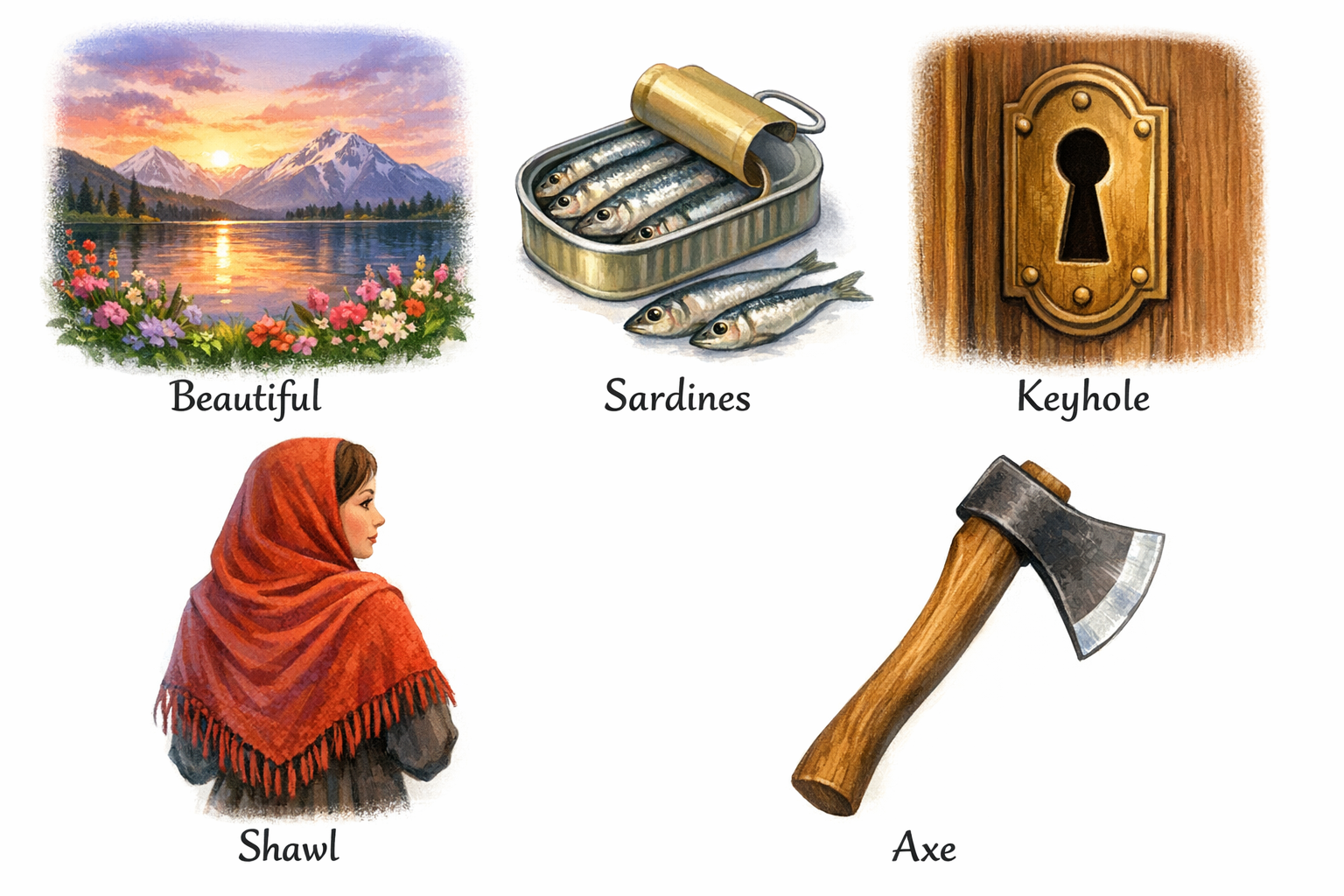
Dungeon: A strong underground prison cell, especially in a castle.
Invisible: Unable to be seen.
Latch-key: A key of an outer door of a house.
Ruse: A trick.
Mimic: To imitate the appearance, words, or actions of something or someone else.

Math: US Money – The Five-Dollar Bill

Directions

Gather one five-dollar bill and five one-dollar bills per child. Children might create their own pretend paper money with paper, pens, and crayons or markers.

Have children complete the steps below.

Have children practice until they perfectly master each task.

STEP 1 – WHAT IS A FIVE-DOLLAR BILL?

Children identify the five-dollar bill.

  • Direct the children to examine the front and back of the five-dollar bill. Ask the children to verbally describe what they see.
  • Have children hold up the five-dollar bill and recite, ‘1 five-dollar bill is worth 5 one-dollar bills.’

STEP 2 – COMBINE AND SEPARATE

Children combine and separate groups of one-dollar bills and a five-dollar bill.

  • Ask children to group five one-dollar bills together.
  • Tell children to move 1 five-dollar bill next to the 5 one-dollar bills. Have them recite, ‘1 five-dollar bill is worth 5 one-dollar bills.’

STEP 3 – PLAY STORE

  • Give each child 5 one-dollar bills and 1 five-dollar bill. Say to children, ‘A game costs 8 dollars. Show me which bills you must give to the cashier to purchase the game.’
  • Give each child 5 one-dollar bills and 1 five-dollar bill. Say to children, ‘A vase costs 6 dollars. Show me which bills you must give to the cashier to purchase the vase.’
  • Give each child 5 one-dollar bills and 1 five-dollar bill. Say to children, ‘A statue costs 9 dollars. Show me which bills you must give to the cashier to purchase the statue.’

1st grade week 24 out of 36

Subscribe to continue reading

Subscribe to get access to the rest of this post and other subscriber-only content.

A Song from the Suds by Louisa May Alcott

A Song from the Suds
by: Louisa May Alcott

Queen of my tub, I merrily sing,
While the white foam rises high,
And sturdily wash and rinse and wring,
And fasten the clothes to dry.
Then out in the free fresh air they swing,
Under the sunny sky.

I wish we could wash from our hearts and souls
The stains of the week away,
And let water and air by their magic make
Ourselves as pure as they.
Then on the earth there would be indeed,
A glorious washing day!

Along the path of a useful life,
Will heartsease ever bloom.
The busy mind has no time to think
Of sorrow or care or gloom.
And anxious thoughts may be swept away,
As we bravely wield a broom.

I am glad a task to me is given,
To labor at day by day,
For it brings me health and strength and hope,
And I cheerfully learn to say,
“Head, you may think, Heart, you may feel,
But, Hand, you shall work alway!”

The Story of Doctor Dolittle Chapter 6: Polynesia and the King

Chapter 6: Polynesia and the King

When they had gone a little way through the thick forest, they came to a wide, clear space; and they saw the King’s palace which was made of mud.

This was where the King lived with his Queen, Ermintrude, and their son, Prince Bumpo. The Prince was away fishing for salmon in the river. But the King and Queen were sitting under an umbrella before the palace door. And Queen Ermintrude was asleep.

When the Doctor had come up to the palace the King asked him his business; and the Doctor told him why he had come to Africa.

“You may not travel through my lands,” said the King. “Many years ago a white man came to these shores; and I was very kind to him. But after he had dug holes in the ground to get the gold, and killed all the elephants to get their ivory tusks, he went away secretly in his ship- without so much as saying ‘Thank you.’ Never again shall a white man travel through the lands of Jolliginki.”

Then the King turned to some of the black men who were standing near and said, “Take away this medicine-man-with all his animals, and lock them up in my strongest prison.”

So six of the black men led the Doctor and all his pets away and shut them up in a stone dungeon. The dungeon had only one little window, high up in the wall, with bars in it; and the door was strong and thick.

Then they all grew very sad; and Gub-Gub, the pig, began to cry. But Chee-Chee said he would spank him if he didn’t stop that horrible noise; and he kept quiet.

“Are we all here?” asked the Doctor, after he had got used to the dim light.

“Yes, I think so,” said the duck and started to count them.

“Where’s Polynesia?” asked the crocodile. “She isn’t here.”

“Are you sure?” said the Doctor. “Look again. Polynesia! Polynesia! Where are you?”

“I suppose she escaped,” grumbled the crocodile. “Well, that’s just like her! -Sneaked off into the jungle as soon as her friends got into trouble.”

“I’m not that kind of a bird,” said the parrot, climbing out of the pocket in the tail of the Doctor’s coat. “You see, I’m small enough to get through the bars of that window; and I was afraid they would put me in a cage instead. So while the King was busy talking, I hid in the Doctor’s pocket-and here I am! That’s what you call a ‘ruse,'” she said, smoothing down her feathers with her beak.

“Good Gracious!” cried the Doctor. “You’re lucky I didn’t sit on you.”

“Now listen,” said Polynesia, “tonight, as soon as it gets dark, I am going to creep through the bars of that window and fly over to the palace. And then-you’ll see-I’ll soon find a way to make the King let us all out of prison.”

“Oh, what can you do?” said Gub-Gub, turning up his nose and beginning to cry again. “You’re only a bird!”

“Quite true,” said the parrot. “But do not forget that although I am only a bird, I can talk like a man-and I know these people.”

So that night, when the moon was shining through the palm-trees and all the King’s men were asleep, the parrot slipped out through the bars of the prison and flew across to the palace. The pantry window had been broken by a tennis ball the week before; and Polynesia popped in through the hole in the glass.

She heard Prince Bumpo snoring in his bedroom at the back of the palace. Then she tip-toed up the stairs till she came to the King’s bedroom. She opened the door gently and peeped in.

The Queen was away at a dance that night at her cousin’s; but the King was in bed fast asleep.

Polynesia crept in, very softly, and got under the bed.

Then she coughed-just the way Doctor Dolittle used to cough. Polynesia could mimic any one.

The King opened his eyes and said sleepily: “Is that you, Ermintrude?” (He thought it was the Queen come back from the dance.)

Then the parrot coughed again-loud, like a man. And the King sat up, wide awake, and said, “Who’s that?”

“I am Doctor Dolittle,” said the parrot-just the way the Doctor would have said it.

“What are you doing in my bedroom?” cried the King. “How dare you get out of prison! Where are you?-I don’t see you.”

But the parrot just laughed-a long, deep jolly laugh, like the Doctor’s.

“Stop laughing and come here at once, so I can see you,” said the King.

“Foolish King!” answered Polynesia. “Have you forgotten that you are talking to John Dolittle, M.D.-the most wonderful man on earth? Of course you cannot see me. I have made myself invisible. There is nothing I cannot do. Now listen: I have come here tonight to warn you. If you don’t let me and my animals travel through your kingdom, I will make you and all your people sick like the monkeys. For I can make people well, and I can make people ill-just by raising my little finger. Send your soldiers at once to open the dungeon door, or you shall have mumps before the morning sun has risen on the hills of Jolliginki.”

Then the King began to tremble and was very much afraid.

“Doctor,” he cried, “it shall be as you say. Do not raise your little finger, please!” And he jumped out of bed and ran to tell the soldiers to open the prison door.

As soon as he was gone, Polynesia crept downstairs and left the palace by the pantry window.

But the Queen, who was just letting herself in at the backdoor with a latch-key, saw the parrot getting out through the broken glass. And when the King came back to bed she told him what she had seen.

Then the King understood that he had been tricked, and he was dreadfully angry. He hurried back to the prison at once.

But he was too late. The door stood open. The dungeon was empty. The Doctor and all his animals were gone.

Math: US Money – The One-Dollar Bill

Directions
Gather 100 pennies, 20 nickels, 10 dimes, 4 quarters, and 1 one-dollar bill per child. Children might create their own pretend paper money with paper, pens, and crayons or markers.

Have children complete the steps below.

Have children practice until they perfectly master each task.

STEP 1 – WHAT IS A ONE-DOLLAR BILL?

Children identify the one-dollar bill.

  • Direct the children to examine the front and back of the dollar bill. Ask the children to verbally describe what they see.
  • Have children hold up a penny and recite, ‘1 penny is worth 1 cent.’
  • Have children hold up a nickel and recite, ‘1 nickel is worth 5 cents.’
  • Have children hold up a dime and recite, ‘1 dime is worth 10 cents.’
  • Have children hold up a quarter and recite, ‘1 quarter is worth 25 cents.’
  • Have children hold up the 1 dollar bill and recite, ‘1 one-dollar bill is worth 100 cents.’

STEP 2 – COMBINE AND SEPARATE

Children combine and separate groups of pennies, nickels, dimes, quarters, and one-dollar bills.

  • Ask children to group 100 pennies together.
  • Tell children to move 1 one-dollar bill next to the 100 pennies. Have them recite, ‘1 one-dollar bill is worth 100 pennies.’
  • Tell children to remove the pennies and to move 4 quarters next to the dollar. Have them recite, ‘4 quarters are worth 1 dollar.’
  • Tell children to remove the quarters and to move 10 dimes next to the dollar. Have them recite, ’10 dimes are worth 1 dollar.’
  • Tell children to remove the dimes and to move 20 nickels next to the dollar. Have them recite, ’20 nickels are worth 1 dollar.’

STEP 3 – PLAY STORE

Play store with children, where children show the amount of money required to buy pretend items.

  • Give each child 1 dollar, 1 quarter, 1 dime, 1 nickel, and 5 pennies. Say to children, ‘A scissors costs 1 dollar and 42 cents. Show me which bills and coins you must give to the cashier to purchase the scissors.’
  • Give each child 1 dollar, 2 quarters, 1 dime, 1 nickel, and 5 pennies. Say to children, ‘A toy dump truck costs 1 dollar and 63 cents. Show me which bills and coins you must give to the cashier to purchase the truck.’
  • Give each child 1 dollar, 3 quarters, 1 dime, 1 nickel, and 5 pennies. Say to children, ‘A fairy wand costs 1 dollar and 84 cents. Show me which bills and coins you must give to the cashier to purchase the wand.’

Sketch an Oak Tree

Sketch an Oak Tree

Objective:

Reinforce that oak trees grow acorns which are eaten by squirrels.

Materials:

Pencil, crayons or markers, and paper.

Procedure:

  • Examine the pictures of the oak tree, squirrel, and acorns below.
    • There is a video that may help.
  • Sketch an oak tree in the fall.
  • Unlike the green leaves in the picture, color your trees leaves yellow, orange, and red.
  • Draw nuts hanging from the tree branches and nuts on the ground around the tree.
  • Draw some squirrels eating the nuts.