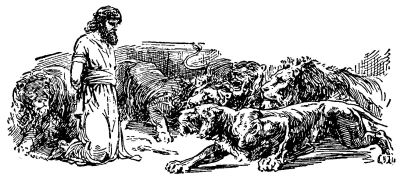
When Darius came to the throne, upon the death of Belshazzar, he set over the kingdom a hundred and twenty princes. Over these he appointed three presidents, of whom Daniel was first. Now the princes and other presidents were jealous of Daniel, and sought to find some fault against him; but could not, as he was a faithful servant of the King. Then they tried to injure him because of his praying to God. So they came to the King, and said, “King Darius live for ever: all the great officers of thy kingdom have consulted together to establish a royal law, that whosoever shall ask a petition of any god or man for thirty days, save of thee, O King, he shall be cast into a den of lions.” The King signed the writing and established the law. But Daniel still knelt and prayed three times a day as before.
His enemies saw him praying, and told the King, urging him to carry out the law. But the King was angry with himself that he had agreed to such a law, and tried to think of some way to save Daniel. Then these men urged that the law could not be altered. So Daniel was cast into the den of lions, and a stone was put over the mouth of the den, which was sealed by the King and the lords. But the King had said to Daniel, “Thy God whom thou servest will deliver thee.”
The King passed the night fasting, and could not sleep. In the morning, very early, he arose and went to the den of lions, and cried with a lamentable voice, “O Daniel, servant of the living God, is thy God able to deliver thee from the lions?” Then Daniel said, “O King, live for ever. My God hath sent His angel and shut the lions’ mouths.”
Brave boys and girls! We all wish to be brave, do we not? Then we must learn to say “No,” when tempted to do wrong.
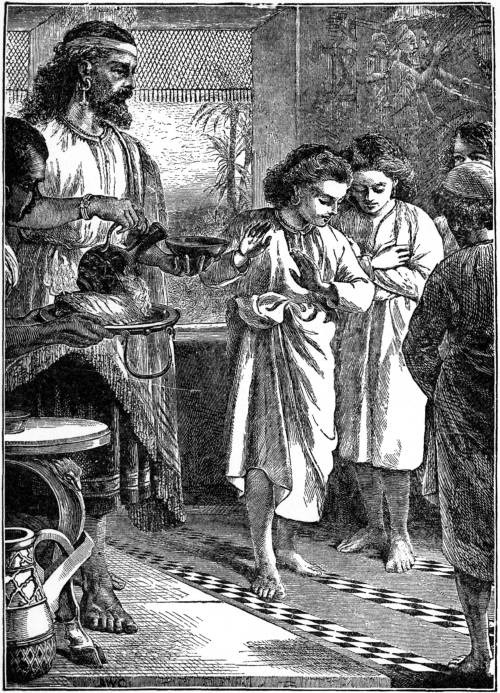
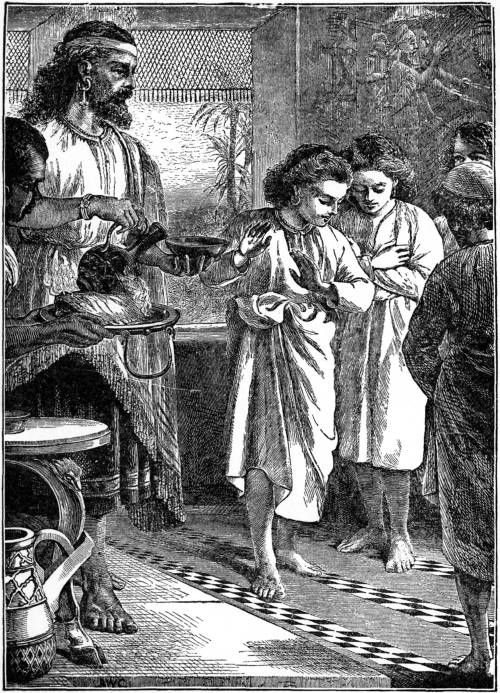
These Hebrew boys were young nobles who had been carried captive from Jerusalem to Babylon; but though in a strange land, subject to the mighty king Nebuchadnezzar, they feared not to refuse his food and wine when they knew that the taking of it would cause them to sin against God. They were well educated Hebrew youths, and the Babylonish king had commanded that they should be taught the learning of the Chaldeans; also, to keep them in health and with beautiful countenances, he had ordered that the meat and wine from his table should be given them. Their names were Daniel, Hananiah, Mishael, and Azariah. Daniel seems to have been their leader. We find “he purposed in his heart that he would not defile himself with the portion of the king’s meat, nor with the wine which he drank.” So he begged the king’s servant the feed him and his three companions on plain food and pure water; but the servant feared to do so, lest the king should find them worse looking than those who ate his meat and drank his wine, and the servant should lose his head in consequence. A trial was made, however, for ten days, at the end of which time they were found to be better looking than the boys fed on rich food and wine. Therefore, the servant let them live plainly according to their request; and at the end of three years, when they stood before the king, we are told that for wisdom and understanding none were found like Daniel, Hananiah, Mishael, and Azariah.
Around 650 BC, King Nebuchadnezzar and the Babylonians laid siege to Jerusalem, plundered Solomon’s temple, and exiled many people to Babylon, which is now modern-day Iraq. The Babylonians had overpowered the provinces of Assyria and unified their empire, spanning much of the Middle East. Educated slaves or those with valuable skills became essential workers in the government’s administrative system.
DATE
The book of Daniel was written during the Babylonian exile of 605BC-536BC.
There are several pieces of evidence that supports this timeframe.
Josephus, the first-century AD Jewish historian, stated that Alexander the Great was shown the prophecies of Daniel in 332BC.
Ezekiel, a contemporary of Daniel’s, mentions Daniel three times (Ez. 14:14, 20: 28:3).
The writer shows an accurate knowledge of sixth-century BC events, as well as knowledge of Chaldean manners, customs, history, and religion that point to an eyewitness account.
The Hebrew and Aramaic languages used by the author are from the Babylonian period.
AUTHOR
The author refers to himself as Daniel throughout the book (7:1, 28; 8:1, 15; 9:2; 10:2).
Jesus also refers to Daniel as the prophet who spoke of “the abomination of desolation” (Mt. 24:15).
Daniel was from the royal family (1:3), probably from Jerusalem. He deported as a teenager in 605BC to Babylon, where he lived over 60 years.
He initially served as a trainee in Nebuchadnezzar’s court but advanced to the highest positions in the administrations of three empires-Babylonian, Mede, and Persian.
LANGUAGES
The book of Daniel is written in two languages: 1:1-2:4a and 8:1-12:13 are in Hebrew.
The rest of the book, 2:4b-7:28 is in Aramaic.
The Aramaic part deals primarily with God’s dealing with the Gentile/pagan nations.
The Hebrew sections deal with the Jews and their relationship with other nations.
FORM
The book of Daniel contains two major divisions.
The first division (chapters 1-6) involves historical narratives illustrating the sovereign rule of God.
The second division (chapes 7-12) involves prophecies illustrating the sovereign rule of God.
THEME
The overall theme of the book of Daniel is to show that the God of Israel, the one true God is sovereign and in control of the destinies of men and nations.
PURPOSE
There are four dimensions to the author’s purpose.
First, Daniel highlights the stark difference between God’s omnipotence and the powerlessness of the Babylonian gods. No matter how much effort the magicians, wise men, and astrologers in the king’s court put in, they could never uncover the truth. False spiritual guides can never match the wisdom and might of God.
Secondly, Daniel shows that God disrupts the plans of the most powerful monarchs but protects those servants who stay loyal to Him.
Third, Daniel reveals that the course of history is determined by a divine plan.
Finally, the Holy Spirit working through Daniel outlines the course of world history as it relates to the people of God.
CONTENT
God’s program for Daniel (Daniel 1:1-21)
The Deportation of Daniel (Daniel 1:1-7)
Daniel 1:4 Children in whom was no blemish, but well favoured, and skilful in all wisdom, and cunning in knowledge, and understanding science, and such as had ability in them to stand in the king’s palace, and whom they might teach the learning and the tongue of the Chaldeans.
The Dedication of Daniel (Daniel 1:8-16)
Daniel 1:8 But Daniel purposed in his heart that he would not defile himself with the portion of the king’s meat, nor with the wine which he drank: therefore he requested of the prince of the eunuchs that he might not defile himself.
The prosperity of Daniel (Daniel 1:17-21)
Daniel 1:19-20 And the king communed with them; and among them all was found none like Daniel, Hananiah, Mishael, and Azariah: therefore stood they before the king. And in all matters of wisdom and understanding, that the king enquired of them, he found them ten times better than all the magicians and astrologers that were in all his realm.
God’s program for the Gentiles (Daniel 2:1-7:28)
The Dream of Nebuchadnezzar (Daniel 2:1-49)
Daniel 2:1 And in the second year of the reign of Nebuchadnezzar, Nebuchadnezzar dreamed dreams, wherewith his spirit was troubled, and his sleep brake from him.
Daniel 2:28-29 But there is a God in heaven that revealeth secrets, and maketh known to the king Nebuchadnezzar what shall be in the latter days. Thy dream, and the visions of thy head upon thy bed, are these; As for thee, O king, thy thoughts came into thy mind upon thy bed, what should come to pass hereafter: and he that revealeth secrets maketh known to thee what shall come to pass.
The image of Nebuchadnezzar (Daniel 3:1-30)
Daniel 3:1-2 Nebuchadnezzar the king made an image of gold, whose height was threescore cubits, and the breadth thereof six cubits: he set it up in the plain of Dura, in the province of Babylon. Then Nebuchadnezzar the king sent to gather together the princes, the governors, and the captains, the judges, the treasurers, the counsellors, the sheriffs, and all the rulers of the provinces, to come to the dedication of the image which Nebuchadnezzar the king had set up.
The humiliation and restoration of Nebuchadnezzar (Daniel 4:1-37)
Daniel 4:24-26 This is the interpretation, O king, and this is the decree of the most High, which is come upon my lord the king: That they shall drive thee from men, and thy dwelling shall be with the beasts of the field, and they shall make thee to eat grass as oxen, and they shall wet thee with the dew of heaven, and seven times shall pass over thee, till thou know that the most High ruleth in the kingdom of men, and giveth it to whomsoever he will. And whereas they commanded to leave the stump of the tree roots; thy kingdom shall be sure unto thee, after that thou shalt have known that the heavens do rule.
Daniel 4:33-34The same hour was the thing fulfilled upon Nebuchadnezzar: and he was driven from men, and did eat grass as oxen, and his body was wet with the dew of heaven, till his hairs were grown like eagles’ feathers, and his nails like birds’ claws. And at the end of the days, I Nebuchadnezzar lifted up mine eyes unto heaven, and mine understanding returned unto me, and I blessed the most High, and I praised and honoured him that liveth for ever, whose dominion is an everlasting dominion, and his kingdom is from generation to generation:
The feast of Belshazzar (Daniel 5:1-31)
Daniel 5:1-2 Belshazzar the king made a great feast to a thousand of his lords, and drank wine before the thousand. Belshazzar, whiles he tasted the wine, commanded to bring the golden and silver vessels which his father Nebuchadnezzar had taken out of the temple which was in Jerusalem; that the king, and his princes, his wives, and his concubines, might drink therein.
Daniel 5:30-31 In that night was Belshazzar the king of the Chaldeans slain. And Darius the Median took the kingdom, being about threescore and two years old.
The deliverance of Daniel (Daniel 6:1-28)
Daniel 6:16-18Then the king commanded, and they brought Daniel, and cast him into the den of lions. Now the king spake and said unto Daniel, Thy God whom thou servest continually, he will deliver thee. And a stone was brought, and laid upon the mouth of the den; and the king sealed it with his own signet, and with the signet of his lords; that the purpose might not be changed concerning Daniel. Then the king went to his palace, and passed the night fasting: neither were instruments of musick brought before him: and his sleep went from him.
Daniel 6:21-23 Then said Daniel unto the king, O king, live for ever. My God hath sent his angel, and hath shut the lions’ mouths, that they have not hurt me: forasmuch as before him innocency was found in me; and also before thee, O king, have I done no hurt. Then was the king exceedingly glad for him, and commanded that they should take Daniel up out of the den. So Daniel was taken up out of the den, and no manner of hurt was found upon him, because he believed in his God.
The Dream of Daniel (Daniel 7:1-28)
Daniel 7:1 In the first year of Belshazzar king of Babylon Daniel had a dream and visions of his head upon his bed: then he wrote the dream, and told the sum of the matters.
Daniel 715-16 I Daniel was grieved in my spirit in the midst of my body, and the visions of my head troubled me. I came near unto one of them that stood by, and asked him the truth of all this. So he told me, and made me know the interpretation of the things.
God’s Program for Israel (Daniel 8:1-12:13)
The vision of the ram and the he goat 8:1-27
Daniel 8:5-6 And as I was considering, behold, an he goat came from the west on the face of the whole earth, and touched not the ground: and the goat had a notable horn between his eyes. And he came to the ram that had two horns, which I had seen standing before the river, and ran unto him in the fury of his power.
The vision of the “70 Weeks” (Daniel 9:1-27)
Daniel 9:24 Seventy weeks are determined upon thy people and upon thy holy city, to finish the transgression, and to make an end of sins, and to make reconciliation for iniquity, and to bring in everlasting righteousness, and to seal up the vision and prophecy, and to anoint the most Holy.
The Final vision (Daniel 10:1-12:13)
The preparation of Daniel (Daniel 10:1-11:1)
Daniel 10:1-3 In the third year of Cyrus king of Persia a thing was revealed unto Daniel, whose name was called Belteshazzar; and the thing was true, but the time appointed was long: and he understood the thing, and had understanding of the vision. In those days I Daniel was mourning three full weeks. I ate no pleasant bread, neither came flesh nor wine in my mouth, neither did I anoint myself at all, till three whole weeks were fulfilled.
Events from Daniel’s time to the tribulation (Daniel 11:2-35)
Daniel 11:2-5 And now will I shew thee the truth. Behold, there shall stand up yet three kings in Persia; and the fourth shall be far richer than they all: and by his strength through his riches he shall stir up all against the realm of Grecia. And a mighty king shall stand up, that shall rule with great dominion, and do according to his will. And when he shall stand up, his kingdom shall be broken, and shall be divided toward the four winds of heaven; and not to his posterity, nor according to his dominion which he ruled: for his kingdom shall be plucked up, even for others beside those. And the king of the south shall be strong, and one of his princes; and he shall be strong above him, and have dominion; his dominion shall be a great dominion.
Events during the tribulation (Daniel 11:36-12:1)
Daniel 11:36-37 And the king shall do according to his will; and he shall exalt himself, and magnify himself above every god, and shall speak marvellous things against the God of gods, and shall prosper till the indignation be accomplished: for that that is determined shall be done. Neither shall he regard the God of his fathers, nor the desire of women, nor regard any god: for he shall magnify himself above all.
Events at the end of the tribulation (Daniel 12:2-3)
Daniel 12:2-3 And at that time shall Michael stand up, the great prince which standeth for the children of thy people: and there shall be a time of trouble, such as never was since there was a nation even to that same time: and at that time thy people shall be delivered, every one that shall be found written in the book. And many of them that sleep in the dust of the earth shall awake, some to everlasting life, and some to shame and everlasting contempt. And they that be wise shall shine as the brightness of the firmament; and they that turn many to righteousness as the stars for ever and ever.
Conclusion (Daniel 12:4-13)
Daniel 12:8-9 And I heard, but I understood not: then said I, O my Lord, what shall be the end of these things? And he said, Go thy way, Daniel: for the words are closed up and sealed till the time of the end.
Jesus in the Book of Daniel
Son of Man
Daniel 3:20-25 And he commanded the most mighty men that were in his army to bind Shadrach, Meshach, and Abednego, and to cast them into the burning fiery furnace. Then these men were bound in their coats, their hosen, and their hats, and their other garments, and were cast into the midst of the burning fiery furnace. Therefore because the king’s commandment was urgent, and the furnace exceeding hot, the flames of the fire slew those men that took up Shadrach, Meshach, and Abednego. And these three men, Shadrach, Meshach, and Abednego, fell down bound into the midst of the burning fiery furnace. Then Nebuchadnezzar the king was astonished, and rose up in haste, and spake, and said unto his counsellors, Did not we cast three men bound into the midst of the fire? They answered and said unto the king, True, O king. He answered and said, Lo, I see four men loose, walking in the midst of the fire, and they have no hurt; and the form of the fourth is like the Son of God.
Daniel 7:14 I saw in the night visions, and, behold, one like the Son of man came with the clouds of heaven, and came to the Ancient of days, and they brought him near before him.
The Stone
The Stone destroys the image in Nebuchadnezzar’s Dream. That Stone is symbolic of Jesus. The Kingdom of Jesus shall stand forever.
Daniel 2:44-45 And in the days of these kings shall the God of heaven set up a kingdom, which shall never be destroyed: and the kingdom shall not be left to other people, but it shall break in pieces and consume all these kingdoms, and it shall stand for ever. Forasmuch as thou sawest that the stone was cut out of the mountain without hands, and that it brake in pieces the iron, the brass, the clay, the silver, and the gold; the great God hath made known to the king what shall come to pass hereafter: and the dream is certain, and the interpretation thereof sure.
Psalms 118:22 The stone which the builders refused is become the head stone of the corner.
Matthew 21:42 Jesus asked them, “Have you never read in the Scriptures: ‘The [very] Stone which the builders rejected and threw away, Has become the chief Cornerstone; This is the Lord’s doing, And it is marvelous and wonderful in our eyes’?
The lands which had been the Babylonian or Chaldean empire, now became the empire of Persia; and over these Darius was the king. King Darius gave to Daniel, who was now a very old man, a high place in honor and in power. Among all the rulers over the land, Daniel stood first, for the king saw that he was wise and able to rule. This made the other princes and rulers very jealous, and they tried to find something evil in Daniel, so that they could speak to the king against him.
These men saw that three times every day Daniel went to his room and opened the window that was toward the city of Jerusalem, and looking toward Jerusalem, made his prayer to God. Jerusalem was at that time in ruins, and the Temple was no longer standing; but Daniel prayed three times each day with his face toward the place where the house of God had once stood, although it was many hundreds of miles away.
These nobles thought that in Daniel’s prayers they could find a chance to do him harm, and perhaps cause him to be put to death. They came to King Darius, and said to him:
“All the rulers have agreed together to have a law made that for thirty days no one shall ask anything of any god or of any man, except from you, O king; and that if any one shall pray to any god, or shall ask anything from any man during the thirty days, except from you, O king, he shall be thrown into the den where the lions are kept. Now, O king, make the law, and sign the writing, so that it cannot be changed, for no law among the Medes and the Persians can be altered.”
The king was not a wise man; and being foolish and vain, he was pleased with this law which would set him even above the gods. So without asking Daniel’s advice, he signed the writing; and the law was made, and the word was sent out through the kingdom, that for thirty days no one should pray to any god.
Daniel knew that the law had been made, but every day he went to his room three times, and opened the window that looked toward Jerusalem, and offered his prayers to the Lord, just as he had prayed in other times. These rulers were watching near by, and they saw Daniel kneeling in prayer to God. Then they came to the king, and said:
“O King Darius, have you not made a law, that if any one in thirty days offers a prayer, he shall be thrown into the den of lions?”
“It is true,” said the king. “The law has been made, and it must stand.”
They said to the king: “There is one man who does not obey the law which you have made. It is that Daniel, one of the captive Jews. Every day Daniel prays to his God three times, just as he did before you signed the writing of the law.”
Thrown into the den of lions
Then the king was very sorry for what he had done, for he loved Daniel, and knew that no one could take his place in the kingdom. All day, until the sun went down, he tried in vain to find some way to save Daniel’s life; but when evening came, these men again told him of the law that he had made, and said to him that it must be kept. Very unwillingly the king sent for Daniel, and gave an order that he should be thrown into the den of lions. He said to Daniel: “Perhaps your God, whom you serve so faithfully, will save you from the lions.”
They led Daniel to the mouth of the pit where the lions were kept, and they threw him in; and over the mouth they placed a stone; and the king sealed it with his own seal, and with the seals of his nobles; so that no one might take away the stone and let Daniel out of the den.
Then the king went again to his palace; but that night he was so sad that he could not eat, nor did he listen to music as he was used to listen. He could not sleep, for all through the night he was thinking of Daniel. Very early in the morning he rose up from his bed and went in haste to the den of lions. He broke the seal and took away the stone, and in a voice full of sorrow he called out, scarcely hoping to have an answer:
“O Daniel, servant of the living God, has your God been able to save you from the lions?”
And out of the darkness in the den came the voice of Daniel, saying:
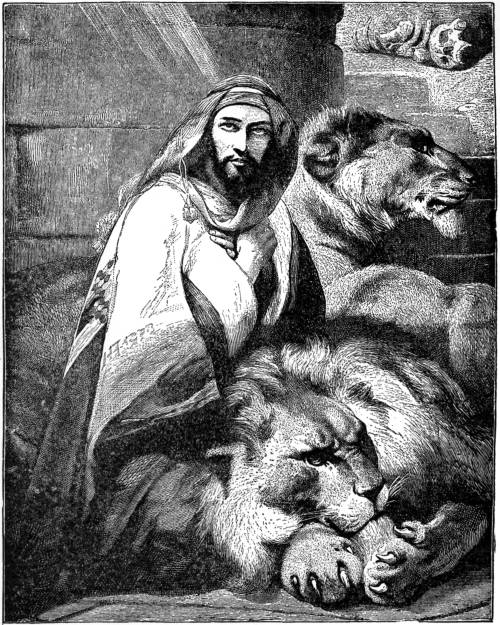
“O king, may you live forever! My God has sent his angel and has shut the mouths of the lions. They have not hurt me, because my God saw that I had done no wrong. And I have done no wrong toward you, O king!”
DANIEL’S ANSWER TO THE KING—Then said Daniel unto the King, O King, live forever. My God hath sent his angel, and hath shut the lions’ mouths, that they have not hurt me.—(Daniel 6: 21-22.)
Then the king was glad. He gave to his servants orders to take Daniel out of the den. Daniel was brought out safe and without harm, because he had trusted fully in the Lord God. Then by the king’s command, they brought those men who had spoken against Daniel, and with them their wives and their children, for the king was exceedingly angry with them. They were all thrown into the den, and the hungry lions leaped upon them, and tore them in pieces, so soon as they fell upon the floor of the den.
After this king Darius wrote to all the lands and the peoples in the many kingdoms under his rule:
“May peace be given to you all abundantly! I make a law that everywhere among my kingdoms men fear and worship the Lord God of Daniel; for he is the living God, above all other gods, who only can save men.”
And Daniel stood beside king Darius until the end of his reign, and afterward while Cyrus the Persian was king over all the lands.