A place to grow your relationship with God

Posts tagged ‘david’

Ehud: A Bible Hero’s Journey

Ehud was born around 1318 BC and around died 1217 BC. He was the second judge of Israel. He rose after Israel had fallen into sin.

Judges 3:12-14

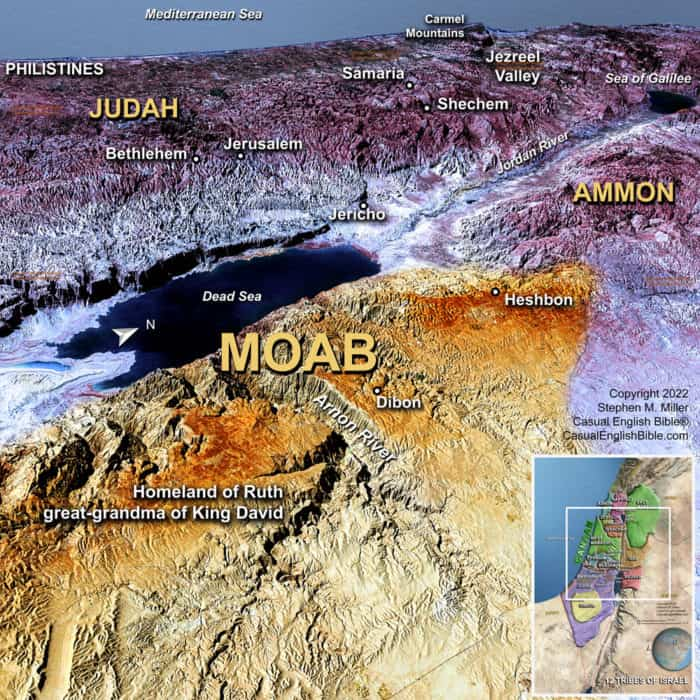
  • Now the Israelites again did evil in the sight of the Lord, and the Lord strengthened Eglon king of Moab against Israel, since they had done what was evil in the sight of the Lord. 
  • And Eglon gathered to him the sons of Ammon and Amalek, and went and struck down Israel [in defeat], and they took possession of the City of Palm Trees (Jericho). 
  • And the Israelites served Eglon king of Moab eighteen years.

Ehud Rescues Israel from Moab
 Judges 3:15

  • But when the Israelites cried out to the Lord [for help], the Lord raised up a man to rescue them, Ehud the son of Gera, a Benjamite, a left-handed man. And the Israelites sent a gift of tribute by him to Eglon king of Moab. 

From this verse we learn a few things about Ehud.

  • Ehud was the son of Gera.
  • Ehud was from the tribe of Benjamin.
  • Ehud was left-handed.

What Ehud did as recorded in Judges 3:16-30

  • Ehud made himself a double-edged sword eighteen inches long.
  • He strapped it to his right thigh under his clothes and brought the tribute to King Eglon of Moab, who was an extremely fat man. 
  • When Ehud had finished presenting the tribute, he dismissed the people who had carried it. 
  • At the carved images near Gilgal he returned and said, “King Eglon, I have a secret message for you.”
    • The king said, “Silence!” and all his attendants left him. 
  • Then Ehud approached him while he was sitting alone in his upstairs room where it was cool. Ehud said, “I have a message from God for you,” and the king stood up from his throne. 
  • Ehud reached with his left hand, took the sword from his right thigh, and plunged it into Eglon’s belly. 
    • Even the handle went in after the blade, and Eglon’s fat closed in over it, so that Ehud did not withdraw the sword from his belly. And the waste came out.
  • Ehud escaped by way of the porch, closing and locking the doors of the upstairs room behind him.
    • Ehud was gone when Eglon’s servants came in. They looked and found the doors of the upstairs room locked and thought he was relieving himself in the cool room. The servants waited until they became embarrassed and saw that he had still not opened the doors of the upstairs room. So, they took the key and opened the doors—and there was their lord lying dead on the floor!
  • Ehud escaped while the servants waited. He passed the Jordan near the carved images and reached Seirah. 
  • After he arrived, he sounded the ram’s horn throughout the hill country of Ephraim. The Israelites came down with him from the hill country, and he became their leader. 
  • He told them, “Follow me, because the Lord has handed over your enemies, the Moabites, to you.” So, they followed him, captured the fords of the Jordan leading to Moab, and did not allow anyone to cross over. 
    • At that time, they struck down about ten thousand Moabites, all stout and able-bodied men. Not one of them escaped.  Moab became subject to Israel that day, and the land had peace for eighty years.
According to Jewish tradition (not all Jewish tradition is good) remember what Jesus said about Jewish traditions:

  • Mark 7:13 You nullify the word of God by your tradition that you have handed down. And you do many other similar things.

However, some of the traditions has more to do with history than the Law of God. This is the tradition that they have about family linage. Also, some parts of this tradition can be proven with scripture. I am adding all of it here because it brings up an interesting thought.

  • Zippor was the father of Balak
    • Numbers 22:2 Now Balak son of Zippor saw all that Israel had done to the Amorites. 
  • Balak was the father of Eglon
  • Eglon was the father of Orpah & Ruth
    • Ruth & Orpah was the daughter-n-law of Naomi
    • Orpah stayed in Moab
    • Ruth went with Naomi
  • Orpah married again and had children
    • Goliath
    • Saph
    • Lahmi
    • Ishbibenob
  • Ruth married Boaz and had a child Obed
    • Ruth 4:21-22
      • Salmon fathered Boaz,
      • Boaz fathered Obed,
      • Obed fathered Jesse,
      • and Jesse fathered David.
  • David killed Goliath
    • 1 Samuel 17: 49-51
      • David put his hand in the bag, took out a stone, slung it, and hit the Philistine on his forehead. The stone sank into his forehead, and he fell facedown to the ground. 
      • David defeated the Philistine with a sling and a stone. David overpowered the Philistine and killed him without having a sword. 
      • David ran and stood over him. He grabbed the Philistine’s sword, pulled it from its sheath, and used it to kill him. Then he cut off his head. When the Philistines saw that their hero was dead, they fled.
    • 1 Samuel 17:54
      • David took Goliath’s head and brought it to Jerusalem, but he put Goliath’s weapons in his own tent.

Notes: If this Goliath was the same Goliath as Orpah’s son, then Goliath had to be at least 120 years old. If the tradition about Orpah having a son named Goliath is true, then 1 of 3 possibilities happened:

  1. The Goliah that David killed was really a descendant of Orpah’s son who was named after Orpah’s son.
  2. Goliah had superhuman abilities because of his father being a fallen angel that allowed him to have incredibly long life.
  3. This Goliath was a totally different Goliath with no direct connection to Orpah.
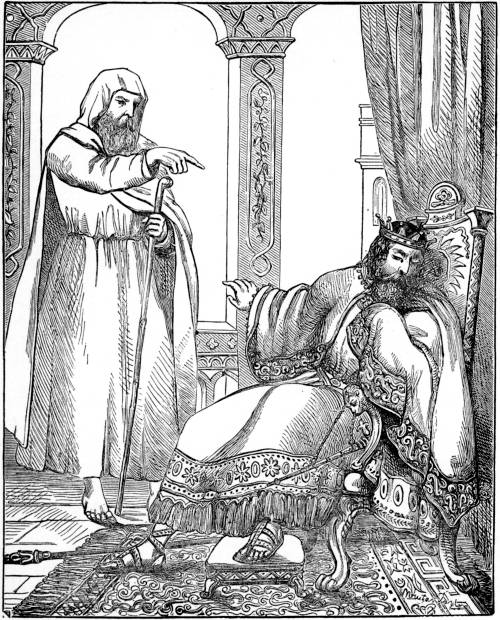
Nathan Reproving the King

NATHAN REPROVING THE KING

David was now King. He had great riches and honour, and a palace had been built for him. He had brought the ark from Kirjath-jearim, and placed it in the tabernacle prepared for it at Jerusalem, and he now reigned over all the people of Israel and Judah. But David did a very wicked thing. He took the wife of Uriah the Hittite for his wife, and caused Uriah to be slain. God was displeased at what he had done, and sent Nathan the prophet to reprove him.

Nathan’s reproof was given by a parable. It was a story of a poor man who had one dear little lamb. It grew up in his house, played with his children, and was very precious to him. But one day a traveller came to a rich neighbour, who possessed great flocks and herds, and this neighbour, instead of killing one of his own lambs and setting it before his guest, sent and took the poor man’s lamb and killed it.

David heard the story, and was very angry. He said the rich man should die, and the lamb taken away should be restored fourfold. Then Nathan, looking at the King, said: “Thou art the man!” He showed David how greatly he had sinned, and told him that trouble and sorrow would come upon him for what he had done. God had given him riches and honour, and all that he could wish for; yet he had taken the one precious thing of Uriah’s, even his wife, and had caused him to be slain. David was sorely grieved when he saw how wickedly he had acted. He confessed his sin to God, and God forgave it; but great trouble came upon the King afterwards through this crime.

“THOU ART THE MAN”

David and Goliath

DAVID AND GOLIATH

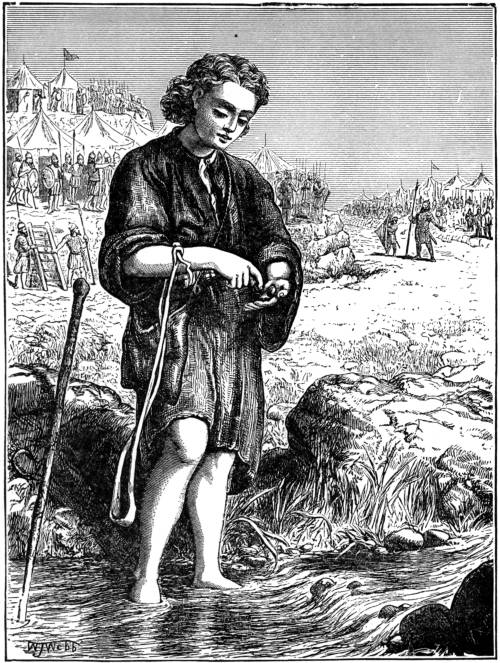
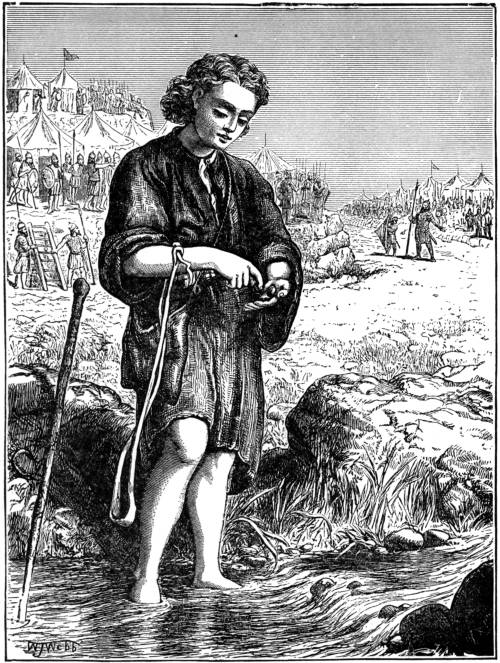
How attentively David looks at the stones in his hand. His sling is on his arm, and his bag by his side. What is he about to do with those stones? And who is that tall man in armour, strutting about with such a long spear in his hand?

Two armies were drawn up in battle array. They were the armies of the Israelites and Philistines. The camp of the Israelites was on one hill, and that of the Philistines was upon another; a valley lying between. For forty days these armies had been facing each other, but yet the battle had been delayed. The Philistines had on their side a giant of great height and strength, encased in armour, who daily came out, challenging the Israelites to send a man from their camp to fight with him. But no man among them dared to go against Goliath, the Philistines’ champion.

Meanwhile Jesse had sent David to the Israelites’ camp to see after his brethren. He heard what the giant said, and offered to go out against him. Saul was informed of David’s offer, and sent for him. Saul told David he was not able to fight the giant, but he boldly replied, “The Lord which delivered me out of the paw of the lion and out of the paw of the bear, He will deliver me out of the hand of this Philistine.” David trusted not in his own power, but in God! Then Saul said, “Go, and the Lord be with thee.”

He went, slung one of the smooth stones he had chosen out of the brook, smote the Philistine in the forehead so that he fell to the earth, and then ran and cut off his head. Thus God enabled this ruddy youth to overcome the giant Philistine, and to slay him with a sling and a stone.

CHOOSING SMOOTH STONES OUT OF THE BROOK

Boaz and Ruth: Family Ties in Biblical History

  1. Naomi lived in Bethlehem with her husband Elimelech and her two Sons Mahlon and Chilion
    • Naomi and Elimelech journey in the Country of Moab because of a famine.
    • Ruth 1:1-2 In the days when the judges governed [Israel], there was a famine in the land [of Canaan]. And a certain man of Bethlehem in Judah went to live temporarily in the country of Moab with his wife and his two sons. The man’s name was Elimelech and his wife’s name was Naomi and his two sons were named Mahlon and Chilion. They were Ephrathites from Bethlehem in Judah. They went to the country of Moab and stayed there.
  2. In the country of Moab their sons got Married.
    • Ruth 1:4 They took wives from the Moabite women; the name of the one was Orpah, and the name of the other was Ruth. They lived there about ten years; 
    • Mahlon married Ruth.
      • Ruth was a Moabitess.
    • Chilion married Orpah.
      • Orpah was a Moabitess.
  3. Elimelech, the husband of Naomi died, and then her sons died.
    • Ruth 1:5 and then both Mahlon and Chilion also died, so the woman [Naomi] was left without her two sons and her husband.
  4. Naomi decided to go back to her home town.
    • Ruth and Orpah wanted to go with her, but Naomi told them to go home and may God find them new husbands.
      • Ruth 1:8-9 But Naomi said to her two daughters-in-law, “Go back, each of you return to your mother’s house. May the Lord show kindness to you as you have shown kindness to the dead and to me. May the Lord grant that you find rest, each one in the home of her husband.” Then she kissed them [goodbye], and they wept aloud. 
    • Orpah went back, but Ruth said, “Your people shall be my people, your God Shall be my God, Where thou diest Will I die.
      • Ruth 1:15-17 Then Naomi said, “Look, your sister-in-law has gone back to her people and to her gods; turn back and follow your sister-in-law.” But Ruth said, “Do not urge me to leave you or to turn back from following you; for where you go, I will go, and where you lodge, I will lodge. Your people will be my people, and your God, my God. Where you die, I will die, and there I will be buried. May the Lord do the same to me [as He has done to you], and more also, if anything but death separates me from you.” 
  5. So Ruth and Naomi went to Bethlehem in the beginning of the barley harvest.
    • There was a law that said any barley that fell from the bundle they should
      leave it for the poor.
  6. Naomi Ruth was poor, so Ruth went to glean (harvest). She went and came and gleaned ears of corns.
    • Ruth 2:2-3 And Ruth the Moabitess said to Naomi, “Please let me go to the field and glean among the ears of grain after one [of the reapers] in whose sight I may find favor.” Naomi said to her, “Go, my daughter.” So Ruth went and picked up the leftover grain in a field after the reapers; and she happened to stop at the plot of land belonging to Boaz, who was of the family of Elimelech. 
      • The field that she went to belong to a man named Boaz,
      • Boaz was a Kinsman of Elimelech.
      • In these days, if a wife husband died the near is hiasman take care of her or, in this case, them.
  7. Boaz was kind to Ruth and said don’t go to another field, and if you wants a drink to drink from the vessels his men drawn.
    •  Ruth 2:8-9 Then Boaz said to Ruth, “Listen carefully, my daughter. Do not go to glean in another field or leave this one, but stay here close by my maids. Watch which field they reap, and follow behind them. I have commanded the servants not to touch you. And when you are thirsty, go to the [water] jars and drink from what the servants draw.” 
      • Ruth was bringing so much that Naomi asked what field she was going to, and she said. Naomi said Boaz was a kinsman.
        • Ruth 2:19-20 Her mother-in-law said to her, “Where did you glean today? Where did you work? Blessed be the man who took notice of you.” So she told her mother-in-law with whom she had worked and said, “The name of the man with whom I worked today is Boaz.” Naomi said to her daughter-in-law, “May he be blessed of the Lord who has not ceased His kindness to the living and to the dead.” Again Naomi said to her, “The man is one of our closest relatives, one who has the right to redeem us.” 
  8. One night, Noami told Ruth to go to the threshing floor. When he[Boaz] lies down to go to him and lay at his feet
    • Boaz said that he was near to her but there was one nearer, he told her to sleep here and in the morning he would ask.
      • Ruth 3:10-13 Then he said, “May you be blessed by the Lord, my daughter. You have made your last kindness better than the first; for you have not gone after young men, whether poor or rich. Now, my daughter, do not be afraid. I will do for you whatever you ask, since all my people in the city know that you are a woman of excellence. It is true that I am your close relative and redeemer; however, there is a relative closer [to you] than I. Spend the night [here], and in the morning if he will redeem you, fine; let him do it. But if he does not wish to redeem you, then, as the Lord lives, I will redeem you. Lie down until the morning.”
    • He did let her go empty handed.
      • He gave her 6 measures of barley.
        • Ruth 3:15 He also said, “Give me the shawl you are wearing and hold it out.” So Ruth held it and he measured out six measures of barley [into it] and placed it on her. And she went into the city. 
    • The other kins man could not redeem Ruth and Naomi.
      • Ruth 5:5-6 Then Boaz said, “The day that you buy the field from Naomi, you must also acquire Ruth the Moabitess, the widow of the deceased, to restore the name of the deceased to his inheritance.” The closest relative (redeemer) said, “I cannot redeem it for myself, because [by marrying a Moabitess] I would jeopardize my own inheritance. Take my right of redemption (purchase) yourself, because I cannot redeem it.”
        • So he said Boaz married Ruth. So he did he took Ruth and she had a son. They named him Obed.
          • Ruth 5:13 So Boaz took Ruth, and she became his wife. And he went in to her, and the Lord enabled her to conceive, and she gave birth to a son. 
          • Ruth 5:17 The neighbor women gave him a name, saying, “A son (grandson) has been born to Naomi.” They named him Obed (worshiper). He is the father of Jesse, the father of David [the ancestor of Jesus Christ].
        • Boaz’s Mother was Rahab, the same one who helped the two spies.
          • Matthew 1:5 Salmon was the father of Boaz by Rahab, Boaz was the father of Obed by Ruth, and Obed the father of Jesse.

ALL About Boaz’s Mother Rahab

  1. Immediately after crossing the Jordan, Joshua sent two spies, Caleb and Pinchas, to the City of Jericho, the ‘Jews’ first point of attack.
    • Disguised, the spies made their way to an inn owned by a woman named Rahab.
      • Joshua 2:1 Joshua the son of Nun sent two men as scouts secretly from Shittim, saying, “Go, view the land, especially Jericho [the walled city].” So they went and came to the house of a prostitute named Rahab, and lodged there. 
  2. Rahab saved the two spies lives by hiding them on her rooftop and covering them with stalks of Flax, which she laid in order on the roof.
    •  Joshua 2:6-7 But [in fact] she had brought the scouts up to the roof and had hidden them under the stalks of flax which she had laid in order on the roof [to dry]. So the [king’s] men pursued them on the road to the Jordan as far as the fords [east of Jericho]; as soon as the pursuers had gone out after them, the gate [of the city] was shut.
  3. After it was safe, she let them down the wall with a red rope. Her house was part of the city wall.
    • Joshua 2:15 Then she let them down by a rope through the window, for her house was built into the city wall, so that she was living on the wall.
  4. Rahab beg them to save her family/household when the day came they took over.
    • Thy spies said unto her if she gather all the family she could in her house when the day came they would be safe, but if one went out (we with not know one family from another). Rahab agreed to this.
    • Joshua 2:12-14 And now, please swear [an oath] to me by the Lord, since I have shown you kindness, that you also will show kindness to my father’s household (family), and give me a pledge of truth and faithfulness, and spare my father and my mother and my brothers and my sisters, along with everyone who belongs to them, and let us all live.” So the men said to her, “Our lives for yours if you do not tell [anyone about] this business of ours; then when the Lord gives us the land we will show you kindness and faithfulness [and keep our agreement with you].”
  5. Now, when the day came, Joshua said unto the the the men that had been spies to go and bring Rahab and her household out.
  6. So the two spies went in and brought out Rahab and her father, her mother, her brethrer, and all that She had. They brought Rahab and her family out of the city.
    • Joshua 6:22-23  But Joshua said to the two men who had spied out the land, “Go into the prostitute’s house and bring the woman and all that she has out of there, as you have sworn to her.” So the young men, the spies, went in and brought out Rahab and her father and her mother and her brothers and everything that she had; they also brought out all her relatives and allowed them to stay outside the camp of Israel [at Gilgal during the time required for ceremonial cleansing].
ParentsRahab & Salmon Boaz & Ruth Obed Jesse
ChildBoazObedJesseDavid

Learning Scriptures Through Music: A Historical Insight

Music has been around and important since basically the beginning of time. The first mention os musical instruments is in Genesis.  Genesis 4:19-21Lamech took for himself two wives; the name of the one was Adah, and the name of the other, Zillah. Adah gave birth to Jabal; he became the father of those [nomadic herdsmen] who live in tents and have cattle and raise livestock. His brother’s name was Jubal; he became the father of all those [musicians] who play the lyre and flute.

Music has been a part of worship for Godly people and pagans for thousands of years. Even in the ancient times people knew that music had power. When Saul, the king of Israel, was tormented by evil spirits they looked to music for help. 1 Samuel 16:14-23 Now the Spirit of the Lord departed from Saul, and an evil spirit from the Lord tormented and terrified him. Saul’s servants said to him, “Behold, an evil spirit from God is tormenting you. Let our lord now command your servants who are here before you to find a man who plays skillfully on the harp; and when the evil spirit from God is on you, he shall play the harp with his hand, and you will be well.” So Saul told his servants, “Find me a man who plays well and bring him to me.” One of the young men said, “Behold, I have seen a son of Jesse the Bethlehemite who is a skillful musician, a brave and competent man, a warrior, discerning (prudent, eloquent) in speech, and a handsome man; and the Lord is with him.” So Saul sent messengers to Jesse and said, “Send me David your son, who is with the flock.” Jesse took a donkey [loaded with] bread and a jug of wine and a young goat, and sent them to Saul with David his son. Then David came to Saul and attended him. Saul loved him greatly and [later] David became his armor bearer. Saul sent word to Jesse, saying, “Please let David be my attendant, for he has found favor in my sight.” So it came about that whenever the [evil] spirit from God was on Saul, David took a harp and played it with his hand; so Saul would be refreshed and be well, and the evil spirit would leave him.

Early in King David’s reign he set up a music ministry. There is a lengthy discussion of who did what in 1 Chronicles chapter 6.  1 Chronicles 6:31-32 Now these are those whom David appointed over the service of song in the house of the Lord after the ark [of the covenant] rested there They ministered with singing before the tabernacle of the Tent of Meeting, until Solomon had built the Lord’s house (temple) in Jerusalem, performing their service in due order. 

It was understood during this time that there is more than one type of music. Some music is bad and some is good. Psalms 69:12 says, “They who sit in the [city’s] gate talk about me and mock me,
And I am the song of the drunkards.” Apparently, a type of bar or drinking music is nothing new. Now look at Psalms 81:1-4 Sing aloud to God our strength; Shout for joy to the God of Jacob (Israel). Raise a song, sound the timbrel, The sweet sounding lyre with the harp. Blow the trumpet at the New Moon, At the full moon, on our feast day. For this is a statute for Israel, An ordinance of the God of Jacob. This indicates that there was music for the feasts of God. I am certain that the music played and the songs sung at God’s feasts was obviously different from the songs sung and the music for the drunkards. In Psalms 119:54 it says, “Your statutes are my songs in the house of my pilgrimage.” Statutes in this verse is another word for commandments.

In the New Testament Paul and Silas prayed and sang praises unto God while in prison. This is just before the prison doors opened.

  • Acts 16:25-26  But about midnight when Paul and Silas were praying and singing hymns of praise to God, and the prisoners were listening to them; suddenly there was a great earthquake, so [powerful] that the very foundations of the prison were shaken and at once all the doors were opened and everyone’s chains were unfastened. 

In Colossians it instructs us to teach and admonish with psalms, hymns, and spiritual songs.

  • Colossians 3:16 Let the [spoken] word of Christ have its home within you [dwelling in your heart and mind—permeating every aspect of your being] as you teach [spiritual things] and admonish and train one another with all wisdom, singing psalms and hymns and spiritual songs with thankfulness in your hearts to God.

Modern research indicates that it is easier to learn information set to music. Throughout history music has been important to the spread of the scriptures. In the time of David, the statutes were song. Paul taught that we should teach and instruct by singing the word of God.

Now more than ever we need to be mindful of what we sing. Music should be used to teach scriptural truths to everyone possible. Our worship services should be filled with music that teaches the Word/ Statutes of God.

THE STORY OF THE CAVE OF ADULLAM

THE STORY OF THE CAVE OF ADULLAM

Now Saul had a son, Jonathan, near David’s own age. He and David became fast friends and loved one another as brothers. Saul the king became very jealous of David because the people praised him after his fight with Goliath. He even threatened to take David’s life. He tried to catch him in his own house, but David’s wife let him down from a window by a rope and he escaped. He met his friend Jonathan, who told him that he should flee. They renewed their promises of friendship, which they kept ever afterward.

From his meeting with Jonathan, David went forth to be a wanderer, having no home as long as Saul lived. He found a great cave, called the cave of Adullam, and hid in it. Soon people heard where he was, and from all parts of the land, especially from his own tribe of Judah, men who were not satisfied with the rule of King Saul gathered around David.

Saul soon heard that David, with a band of men, was hiding among the mountains of Judah, and that among those who aided him were certain priests.

This enraged King Saul, and he ordered his guards to kill all the priests. The guards would not obey him, for they felt that it was a wicked thing to lay hands upon the priests of the Lord.

But he found one man whose name was Doeg, an Edomite, who was willing to obey the king. And Doeg, the Edomite, killed eighty-five men who wore the priestly garments.

All through the land went the news of Saul’s dreadful deed, and everywhere the people began to turn from Saul, and to look toward David as the only hope of the nation.

When Saul died he was followed by David, the shepherd boy, now grown to manhood and greatly loved by the people. He had many battles to fight with the Philistines and was nearly always victorious. He was a warrior king; but he was more than a warrior. He played on his harp and composed many beautiful hymns and songs, which are collected in the book of Psalms. He was a good king and tried to obey God’s command. He had a long reign and his people were happy and prosperous. He had many sons and daughters and beautiful palaces for them to live in.