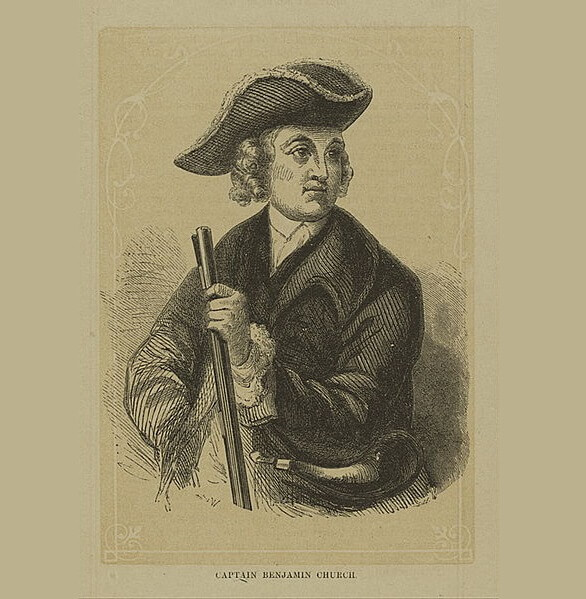
The colonists had not learned how to fight the Wampanoag and Narragansett Indians, who moved swiftly from place to place, and hid themselves in the darkest swamps. But at last the man was found who could battle with the American Indians in their own way. This was Captain Benjamin Church.
Church could not only fight the Indians, but he knew how to make them his friends. The Sakonet tribe, not far from his home, was under control of a woman chief. Her name was Awashonks. She and Benjamin Church were good friends, and after the war broke out Church tried to go to see her. Some of the Indians of her tribe who were friendly to Philip attacked Church and his men, so that they had to hide behind a fence till a boat came and took them away.
Later in the war, Church sent word to Awashonks that he would meet her and four other Indians at a certain place. But the rulers of Plymouth Colony thought it too dangerous for Church to go to see the woman chief. They would not give him any men for such an expedition.
However, Church went on his own account, with one colonist and three Indians. He took some tobacco and a bottle of rum as presents suited to the taste of this Indian queen. Church ventured ashore, leaving his canoe to stand off at a safe distance, so that if he should be killed the men in the canoe might carry the news to the other colonists. Awashonks and the four Indians met him and thanked him for venturing among them. But soon a great number of warriors, frightfully painted and armed, rose up out of the tall grass and surrounded Captain Church. The captain knew that if he showed himself frightened he would be killed.
“Have you not met me to talk about peace?” he said to Awashonks.
“Yes,” said Awashonks.
“When people meet to talk of peace they lay down their arms,” said Captain Church.
The Indians now began to look surly and to mutter something.
“If you will put aside your guns, that will do,” said Church.
The Indian warriors laid down their guns and squatted on the grass. But during the discussion, some of them grew angry. One fellow with a wooden tomahawk wished to kill Church, but the others pushed him away. The captain succeeded in making peace with this tribe, who agreed to take the side of the English against Philip and the Wampanoags.
Awashonks held a war dance after this, and Church attended. The Indians lighted a great bonfire and moved about it in rings. One of the braves stepped inside the circle and called out the name of one of the tribe fighting on Philip’s side against the colonists. Then he pulled a firebrand out of the fire to represent that tribe, and he made a show of fighting with the firebrand. Every time the name of a tribe was called, a firebrand was drawn out and attacked in this way.
After this ceremony, Church could call on as many of these Indians as he wished to help him against Philip. With small bands of these Indians and a few colonists, Captain Church scoured the woods, capturing a great many enemy prisoners.
At last so many of Philip’s Indians were taken, that Philip himself was fleeing from swamp to swamp to avoid falling into the hands of the colonists. But he grew fiercer as he grew more desperate. He killed one of his men for telling him that he ought to make peace with the colonists. The brother of this man whom he killed ran away from Philip, and came into the settlement to tell the colonists where to find that chief.
Captain Church had just come from chasing Philip to make a short visit to his wife. The poor woman had been so anxious for her husband’s safety that she fainted when she saw him. By the time she had recovered, the Indian deserter came to tell Church where Philip could be found, and the captain galloped off at once.
Church placed his men near the swamp in which Philip was hidden. The Indians took the alarm and fled. In running away, Philip ran straight toward Church’s hidden men and was shot by the very Indian whose brother he had killed. His head was cut off and stuck up over a gatepost at Plymouth. Such was the savage custom of the colonists in that day.
Philip’s chief captain, Annawon, got away with a considerable number of Indians. Church and half a dozen of his Indian scouts captured an old man and a young woman who belonged to Annawon’s party. They made these two walk ahead of them carrying baskets, while Church and his men crept behind them. In this way, they got down a steep bank right into the camp of Annawon, whose party was much stronger than Church’s. But Church seized the guns of the Indians, which were stacked together.
“I am taken,” cried Annawon.
Annawon later came with a bundle in his arms. “You have killed Philip and conquered his country. I and my company are the last. This war is ended by you, and therefore these things are yours.”
He opened the bundle, which contained Philip’s belts of wampum and the red blanket in which Philip dressed on great occasions.
When the Pilgrims first came to New England, they found that the nearest tribe of American Indians, the Wam-pa-no’-ags of which Massasoit was chief, had been much reduced in number by a dreadful sickness. The bones of the dead lay bleaching on the ground.
The next neighbors to the Wampanoags were the Narragansetts. The Narragansetts had not been visited by the great sickness but were as numerous and strong as ever. Massasoit was, therefore, very glad to have the English, with their superior guns and long swords, near him, to protect his people from the Narragansetts.
The two sons of Massasoit remained friendly to the settlers for some time after their father’s death. But many things made the Wampanoags discontented. They sold their lands to the colonists for blankets, hatchets, and such like things. The ground was all covered with woods, and, as they only used it for hunting, didn’t perceive what it meant to “sell” the land. But when the Wampanoags realized what selling their land entailed, they wished to be paid more.
Many of this tribe of Indians became Christians through the preaching of John Eliot, who was called “The Apostle to the Indians.” These were called “praying Indians.” They settled in villages, though they continued to dwell in bark-houses, because they found that the easiest way to clean house was to leave the old one and build a new. They no longer followed their chiefs or respected the charms of the medicine men. It made the great men among the Wampanoags angry to see their people leave them.
The young Wampanoag chief, Wamsutta, or King Alexander, began to show ill-feeling toward the colonists. The rulers of Plymouth Colony retaliated with harsh measures against him. They sent some soldiers to detain him and brought him to Plymouth. When the Wampanoag chief saw himself arrested and degraded in this way he felt it bitterly. He was taken sick at Plymouth and died soon after he got home.
The Wampanoags suspected that King Alexander had died of poison given him by the colonists. Sometime afterward the colonists heard that King Alexander’s brother, the new Wampanoag chief, Metacomet, now called King Philip, was sharpening hatchets and knives. The colonists immediately sent for the chief and forced him and his men to give up the seventy guns they had brought with them. They also made Philip promise to send in all the other guns his men had.
When the colonists first came, the Wampanoags had nothing to shoot with but bows and arrows. In Philip’s time they had given up bows, finding guns much better for killing game. So once Philip once got away from the colonists, he did not send in the guns. But he wisely hid his anger and waited for a more opportune chance to strike.
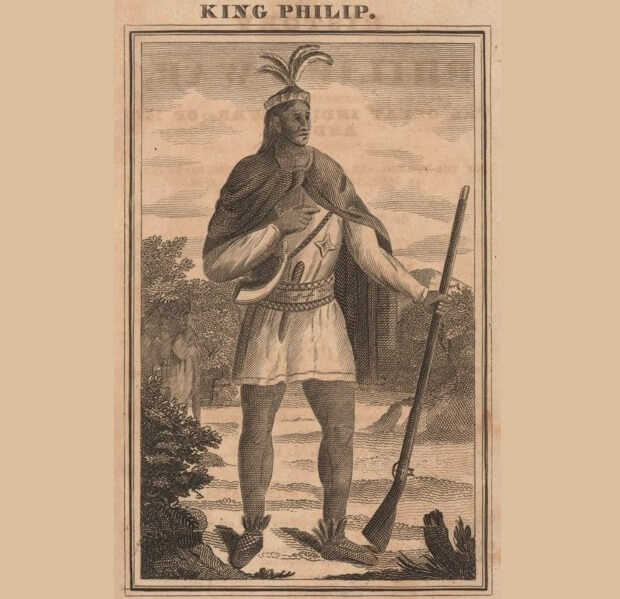
As Wampanoag chief, Philip had a coat made of shell-beads, or wampum. These beads were made by breaking and polishing little bits of hard-clam shells, and then boring a hole through them with a stone awl, as you see in the picture. Wampum was used for money among the Indians, and even among the colonists at that time. Such a coat as Philip’s was very valuable. Philip dressed himself, also, in a red blanket; he wore a belt of wampum about his head and another long belt of wampum around his neck, the ends of which dangled nearly to the ground.
The quarrel between the colonists and the Wampanoags grew more bitter. A Wampanoag, who had told the colonists of Philip’s plans, was put to death for his treachery. The colonists retaliated by hanging the Wampanoags who had killed their informant.
The Wampanoags under Philip were now resolved on war. But their medicine men, or priests, consulted their spirits and told them that whichever side should shed the first blood would be beaten in the war. The Wampanoags burned houses and robbed farms, but they took pains not to kill anybody, until a colonist had wounded a Wampanoag. Then, when blood had been shed, the Wampanoags began to kill the colonists.
War between the Wampanoags and the colonists broke out in 1675. The New England people lived at that time in villages, most of them not very far from the sea. The more exposed towns were struck first. The colonists took refuge in strong houses, which were built to resist attacks. But everywhere colonists who moved about were killed.
The colonists sent out troops, but the Wampanoags strategically waylaid the soldiers and killed them. Philip cut up his fine wampum coat and sent the bead money of which it was made to neighboring chiefs to persuade them to join him. Soon other tribes, entered the fight against the colonists.
As the Wampanoags grew bolder, they attacked the colonists in their forts or block-houses. At Brookfield they shot burning arrows on the roof of the block-house, but the colonists tore off the shingles and put out the fire. Then the Wampanoags crept up and lighted a fire under one corner of the house; but the men inside made a dash and put the fire out. Then the Wampanoags made a cart with a barrel for a wheel. They loaded this with straw and lighted it, and backed the blazing mass up against the house, sheltering themselves behind it. Luckily for the colonists, a shower came up at that moment and put out the fire.
A very curious thing happened at Hatfield. An old gentleman named Colonel Goffe was hid away in a house in that town. He was one of the judges that had condemned Charles I to death twenty-six years before. When the son of King Charles I came to be king he put to death the people were gone to such of these judges as he could find, and Goffe had to flee from England and hide. Nobody in the village knew that Goffe was there, except those who entertained him. While the people were gone to church one Sunday, the old colonel ventured to look out of the window, which he did not dare to do at other times. He saw the Wampanoags coming to attack the town. He rushed out and gave the alarm, and, with long white hair and beard streaming in the wind, the old soldier took command of the villagers and saved the town. But when the fight was over, the people could not find the old man who had led them, nor did they know who he was or where he came from. They said that a messenger had been sent from heaven to deliver them.
The powerful tribe of the Narragansetts promised remain peaceable, but some of the Narragansetts joined Philip, and their great fort was a respite for Philip’s men. In retaliation, the colonists resolved to strike against the Narragansett town while it was yet winter. A thousand men from Massachusetts and Connecticut assaulted the Narragansett town by night, which was inside a fortification having but one entrance, and that by a bridge. Nearly two hundred of the colonists were killed in this fight, and many hundreds of Narragansett people were slain, and their fort and all their provisions were burned.
After the colonists burned their town, the Narragansetts joined Philip at once. The colonists in armor could not catch the nimble Indians, who attacked one village only to disappear and strike another village far away.
Before the Dutch colony of New Netherland was conquered by the English, in 1664, it was given by Charles II to his brother, the Duke of York, who afterward became King of England as James II. James kept that portion of it that is now called New York to himself. What we call New Jersey he gave to Lord John Berkeley and Sir George Carteret, who, after a few years, sold their interest to others. The colony already contained several settlements of Dutch and Swedes. In 1674 New Jersey was divided into East Jersey and West Jersey.
It was a time of religious persecution. Many people emigrated to the colonies in order to get a chance to be religious in their own way, and the proprietors of the New Jersey colonies promised to all who came liberty to worship in their own way. The people of Scotland, who were Presbyterians, suffered horribly from persecutions after the restoration of Charles II, and East Jersey received many Scotch emigrants, driven out of their own country by the cruelty of the government. Some people from New England also moved into East Jersey.
The religious sect most severely persecuted in England after the restoration of the king was the Society of Friends, whose members are sometimes called Quakers. Some of these came to East Jersey. West Jersey was bought by certain leading Friends, and a great many members of that society flocked to this province, where they established a popular form of government.
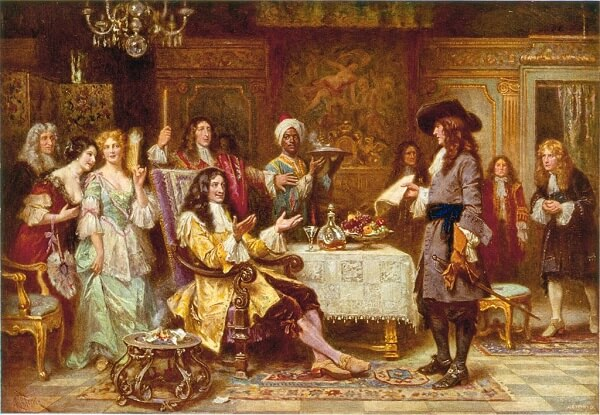
Just across the Delaware River from West Jersey was a territory not then occupied except by a few Swedes, who had come over long before to the old colony of New Sweden. Among those who had to do with the management of the West Jersey colony was a famous Quaker minister named William Penn. His father had been a great sea-commander, and William Penn had a claim against the King of England for a considerable sum of money due to his father. The king was in debt, and found it hard to pay what he owed. William Penn therefore persuaded Charles II to settle the debt by granting him a territory on the west side of the river Delaware. This the king called Pennsylvania, which means something like Penn’s Forest. The name was given in honor of Penn’s father, the admiral.
What is now the State of Delaware was also put under Penn’s government by the Duke of York. Everything was done with ceremony in those days. When Penn got to Newcastle, in Delaware, its government was transferred to him in the following way: The key to the fort at Newcastle was delivered to him. With this he locked himself into the fort and then let himself out in sign that the government was his. To show that the land with the trees on it belonged to him, a piece of sod with a twig in it was given to him. Then a porringer filled with water from the river was given to him, that he might be lord of the rivers as well as of the land.
Penn sent his first emigrants to Pennsylvania in 1681. Philadelphia, where they landed, was yet a woods, and the people had to dig holes in the river-banks to live in through the winter. Nearly thirty vessels came to the new colony during the first year.
Although Pennsylvania was the last colony settled except Georgia, it soon became one of the most populous and one of the richest. Before the Revolution, Philadelphia had become the largest town in the thirteen colonies. This was chiefly owing to the very free government that William Penn founded in his colony. Not only English, but Welsh and Irish people, and many thousands of industrious Germans, came to Pennsylvania. People were also attracted by the care that Penn took to maintain friendly relations with the American Indians, and to satisfy them for their lands. Another thing which drew people both to Pennsylvania and New Jersey was the fact that the land was not taken up in large bodies, as it was in New York and Virginia, for instance. In Pennsylvania and New Jersey, the poor man could get a farm of his own.
By the sale and division of shares, the proprietaries of both East and West Jersey became too numerous to manage their governments well, and at length disorders arose which they were not able to suppress. In 1702 the government of both provinces was transferred to Queen Anne, and East and West Jersey were again united into the one province of New Jersey. But even to this day, in common speech, one sometimes hears the State of New Jersey spoken of as “The Jerseys” by people who do not know that two hundred years ago there were two colonies of that name. Pennsylvania remained in the hands of the Penn family, who appointed its governors till the American Revolution.
WILLIAM PENN
William Penn was born in London in 1644, so that he was thirty-seven years old when Pennsylvania was settled. He was the son of Admiral William Penn, who was celebrated for the part he took in the wars between the English and Dutch. Penn first came under the influence of the Friends or Quakers while he was a student at Oxford, and he was expelled from the university, with others, for the resistance they made to certain religious ceremonies introduced at that time. His father sent him to Paris, and he became an accomplished man of the world. He afterward became a Friend, which so mortified his father that the admiral turned him out of his house, but later he became reconciled to him. Penn was repeatedly imprisoned, and he boldly asserted in the English courts the great principle of religious liberty. He traveled into Wales, Ireland, Holland, and Germany, in his preaching journeys, and many of his acquaintances in those countries afterward came to Pennsylvania. Though Penn would never take off his hat in the presence of the king, he had considerable influence at court, which he used to lessen the sufferings of the Quakers and others. Penn died in 1718.
Thirteen years after the first settlement at Jamestown, a colony was planted in New England. We have seen that the rough-and-ready John Smith was the man negotiated best with the American Indians in Virginia. So the first colony in New England had also its soldier, a brave and rather hot-tempered little man — Captain Myles Standish.
Myles Standish was born in England in 1584. He became a soldier, and, like John Smith, went to fight in the Low Country — that is in what we now call Holland — which was at that time fighting to gain its liberty from Spain.
The Government of Holland let people be religious in their own way, as our country does now. In nearly all other countries at that time, people were punished if they did not worship after the manner of the established church of the land. A little band of people in the north of England had set up a church of their own. For this they were persecuted. To get out of the way of their troubles, they sold their houses and goods and went over to Holland. These are the people that we now call “the Pilgrims,” because of their wanderings.
Captain Standish, who was also from the north of England, met these countrymen of his in Holland. He liked their simple service and honest ways, and he lived among them though he did not belong to their church.
The Pilgrims remained about thirteen years in Holland. By this time, they had made up their minds to seek a new home in the wild woods of America. About a hundred of them bade the rest goodbye and sailed for America in the Mayflower in 1620. As there might be some fighting to do, the brave soldier Captain Myles Standish went along with them.
The ship first reached land at Cape Cod. Captain Standish and sixteen men landed and marched along the shore looking for a place to settle. In one spot, they found the ground freshly patted down. Digging here, they discovered Indian baskets filled with corn. Indian corn is an American plant, and they had never before seen it. The beautiful grains, red, yellow, and white, were a “goodly sight,” as they said. Some of this corn they took with them to plant the next spring. The Pilgrims paid the Indians for this seed corn when they found the right owners.
Standish made his next trip in a boat. This time he found some Indian wigwams covered and lined with mats. In December, Captain Standish made a third trip along the shore. It was now so cold that the spray froze to the clothes of his men while they rowed. At night they slept behind a little barricade made of logs and boughs, so as to be ready if the Indians should attack them.
One morning some of the men carried all their guns down to the waterside and laid them in the boat, in order to be ready for a start as soon as breakfast should be finished. But all at once there broke on their ears a sound they had never heard before. It was the wild war-whoop of a band of Indians whose arrows rained around Standish and his men. Some of the men ran to the boat for their guns, at which the Indians raised a new yell and sent another lot of arrows flying after them. But once the Pilgrims were in possession of their guns, they fired a volley which made the Indians retreat. One brave Indian lingered behind a tree to fight it out alone; but when a bullet struck the tree and sent bits of bark and splinters rattling about his head, he thought better of it, and retreated after his friends into the woods.
Captain Standish and his men at length came to a place which John Smith, when he explored the coast, had called Plymouth. Here the Pilgrims found a safe harbor for ships and some running brooks from which they might get fresh water. They therefore selected it for their landing place. There had once been an Indian town here, but all the Indians in it had died of a pestilence three or four years before this time. The Indian corn fields were now lying idle, which was lucky for the Pilgrims, since otherwise they would have had to chop down trees to clear a field.
The Pilgrims landed on the 21st day of December, in our way of counting, or, as some say, the 22d. They built some rough houses, using paper dipped in oil instead of window-glass. But the bad food and lack of warm houses or clothing brought on a terrible sickness, so that here, as at Jamestown, one half of the people died in the first year. Captain Standish lost his wife, but he himself was well enough to nurse the sick. Though he was a leader, he did not neglect to do the hardest and most disagreeable work for his sick and dying neighbors.
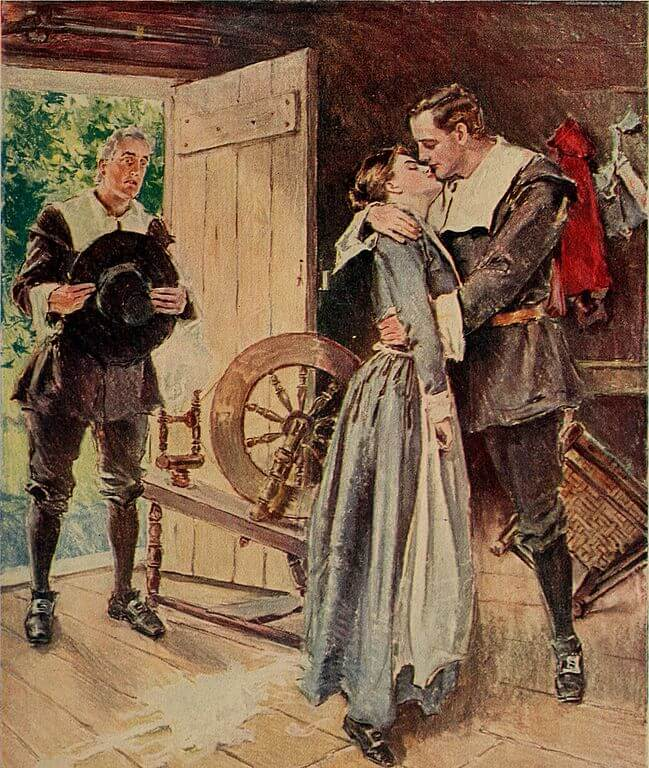
As there were not many houses, the people in Plymouth were divided into nineteen families, and the single men had to live with one or another of these families. A young man named John Alden was assigned to live in Captain Standish’s house. Some time after Standish’s wife died, the captain thought he would like to marry a young woman named Priscilla Mullins. But as Standish was much older than Priscilla, and a rough spoken soldier in his ways, he asked his young friend Alden to go to the Mullins house and try to secure Priscilla for him.
It seems that John Alden loved Priscilla, and she cared for him in return. But Standish did not know this, and poor Alden felt bound to do as the captain requested. In that day, the father of the young lady was asked first. So Alden went to Mr. Mullins and told him what a brave man Captain Standish was. Then he asked if Captain Standish might marry Priscilla.
“I have no objection to Captain Standish,” said Priscilla’s father, “but this is a matter she must decide.” So he called in his daughter and told her in Alden’s presence that the young man had come to ask her hand in marriage with the brave Captain Standish. Priscilla had no notion of marrying the captain. She looked at the young man a moment, and then said: “Why don’t you speak for yourself, John?”
The result was that she married John Alden, and Captain Standish married another woman. You may read this story, a little changed, in Longfellow’s poem called “The Courtship of Miles Standish.”
 articlesforchristians