A place to grow your relationship with God

Posts tagged ‘egypt’

Understanding the Ten Plagues of Egypt for Kids

LORD sent Moses and Aaron to ask pharaoh to let God’s people go so they may worship God in the wilderness, but Pharaoh said no so God sent the 10 plagues on Egypt. After all of that Pharaoh said get out and take your people with you. So, Mose led the people out of Egypt. That is the story of the exodus when the people left Egypt. Here are the 10 Plagues, if you have a bible turn to them.

  1. Nile rivers turn to blood 
    • Genesis 7:17-18 Thus saith the Lord, In this thou shalt know that I am the Lord: behold, I will smite with the rod that is in mine hand upon the waters which are in the river, and they shall be turned to blood. And the fish that is in the river shall die, and the river shall stink; and the Egyptians shall lothe to drink of the water of the river.
  2. Frogs
    • Genesis 8:1-5 And the Lord spake unto Moses, Go unto Pharaoh, and say unto him, Thus saith the Lord, Let my people go, that they may serve me. And if thou refuse to let them go, behold, I will smite all thy borders with frogs: And the river shall bring forth frogs abundantly, which shall go up and come into thine house, and into thy bedchamber, and upon thy bed, and into the house of thy servants, and upon thy people, and into thine ovens, and into thy kneading troughs: And the frogs shall come up both on thee, and upon thy people, and upon all thy servants. And the Lord Spake unto Moses, say unto Aaron, stretch forth thine hand with thy rod over the streams, over the rivers, and over the ponds, and cause frogs to come up upon the land of Egypt.
  3. Lice
    • Exodus 8:16-17 And the Lord said unto Moses, say unto Aaron, stretch out thy rod, and smite the dust of the land, that it may become lice throughout all the land of Egypt. And they did so; for Aaron stretched out his hand with his rod, and smote the dust of the earth, and it became lice in man, and in beast; all the dust of the land became lice throughout all the land of Egypt.
  4. Flies: The Egyptians had flies, but the Israelites did not.
    • Genesis 8:20-23 And the Lord said unto Moses, Rise up early in the morning, and stand before Pharaoh; lo, he cometh forth to the water; and say unto him, Thus saith the Lord, Let my people go, that they may serve me. Else, if thou wilt not let my people go, behold, I will send swarms of flies upon thee, and upon thy servants, and upon thy people, and into thy houses: and the houses of the Egyptians shall be full of swarms of flies, and also the ground whereon they are. And I will sever in that day the land of Goshen, in which my people dwell, that no swarms of flies shall be there; to the end thou mayest know that I am the Lord in the midst of the earth. And I will put a division between my people and thy people: tomorrow shall this sign be.
  5. The cattle of Egypt died, but the cattle of the children of Israel didn’t die.
    • Genesis 9:3-6 Behold, the hand of the Lord is upon thy cattle which is in the field, upon the horses, upon the asses, upon the camels, upon the oxen, and upon the sheep: there shall be a very grievous murrain. And the Lord shall sever between the cattle of Israel and the cattle of Egypt: and there shall nothing die of all that is the children’s of Israel. And the Lord appointed a set time, saying, Tomorrow the Lord shall do this thing in the land. And the Lord did that thing on the morrow, and all the cattle of Egypt died: but of the cattle of the children of Israel died not one.
  6. Boils:
    • Genesis 9:8-10 And the Lord said unto Moses and unto Aaron, Take to you handfuls of ashes of the furnace, and let Moses sprinkle it toward the heaven in the sight of Pharaoh. And it shall become small dust in all the land of Egypt, and shall be a boil breaking forth with blains upon man, and upon beast, throughout all the land of Egypt. And they took ashes of the furnace, and stood before Pharaoh; and Moses sprinkled it up toward heaven; and it became a boil breaking forth with blains upon man, and upon beast.
  7. Thunder, Hail, and Fire
    • Genesis 9:18-20 Behold, tomorrow about this time I will cause it to rain a very grievous hail, such as hath not been in Egypt since the foundation thereof even until now. Send therefore now, and gather thy cattle, and all that thou hast in the field; for upon every man and beast which shall be found in the field, and shall not be brought home, the hail shall come down upon them, and they shall die. He that feared the word of the Lord among the servants of Pharaoh made his servants and his cattle flee into the houses: And he that regarded not the word of the Lord left his servants and his cattle in the field. And the Lord said unto Moses, Stretch forth thine hand toward heaven, that there may be hail in all the land of Egypt, upon man, and upon beast, and upon every herb of the field, throughout the land of Egypt. And Moses stretched forth his rod toward heaven: and the Lord sent thunder and hail, and the fire ran along upon the ground; and the Lord rained hail upon the land of Egypt.
    • Genesis 9:26 Only in the land of Goshen, where the children of Israel were, was there no hail.
  8. Locusts
    • Genesis 10:4-6 Else, if thou refuse to let my people go, behold, tomorrow will I bring the locusts into thy coast: And they shall cover the face of the earth, that one cannot be able to see the earth: and they shall eat the residue of that which is escaped, which remaineth unto you from the hail, and shall eat every tree which groweth for you out of the field: And they shall fill thy houses, and the houses of all thy servants, and the houses of all the Egyptians; which neither thy fathers, nor thy fathers’ fathers have seen, since the day that they were upon the earth unto this day. And he turned himself and went out from Pharaoh.
  9. Darkness
    • Genesis 10:21-23 And the Lord said unto Moses, Stretch out thine hand toward heaven, that there may be darkness over the land of Egypt, even darkness which may be felt. And Moses stretched forth his hand toward heaven; and there was a thick darkness in all the land of Egypt three days: They saw not one another, neither rose any from his place for three days: but all the children of Israel had light in their dwellings.
  10. All of the first-born both human and animal in the land of Egypt died
    • All that did not have the lamb’s blood on their door died, but all that had the blood of the Lamb the Lord passed over them that is how we get Passover. Many people now call part of Passover Easter.
    • Genesis 11:4-7 And Moses said, Thus saith the Lord, About midnight will I go out into the midst of Egypt: And all the firstborn in the land of Egypt shall die, from the first born of Pharaoh that sitteth upon his throne, even unto the firstborn of the maidservant that is behind the mill; and all the firstborn of beasts. And there shall be a great cry throughout all the land of Egypt, such as there was none like it, nor shall be like it any more. But against any of the children of Israel shall not a dog move his tongue, against man or beast: that ye may know how that the Lord doth put a difference between the Egyptians and Israel.
The Flight From Egypt

THE FLIGHT FROM EGYPT

When Moses was forty years old he had to flee from Egypt. He went to Midian, where he dwelt for forty years; at the end of which time God appeared to him, and instructed him to return to Egypt; where he was appointed by God to lead the Israelites from bondage to the land of Canaan. Moses and Aaron went to Pharaoh, king of Egypt, and delivered to him God’s command to let the people of Israel go; telling him that if he disobeyed terrible plagues would come upon his land. Pharaoh hardened his heart against God, and refused to let the people go; so ten dreadful plagues were sent, the last of which was that the firstborn of every Egyptian should die, whether it were man or beast. But not a single Israelite was to suffer harm. This plague God said should come in the night; when an angel would pass through the land, destroying the Egyptians but sparing the Israelites.

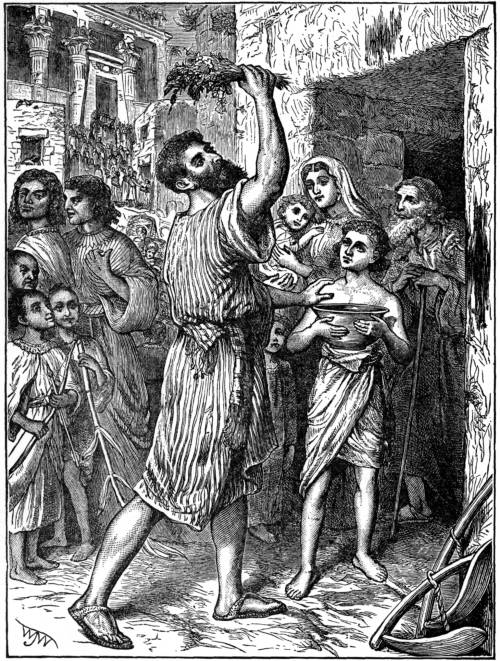
Each family of the Israelites was commanded, on the evening that God had appointed, to kill a lamb, and to dip a bunch of hyssop in its blood, sprinkling this blood upon the top and side posts of the door. All the houses thus marked God said would be spared when the destroying angel passed through the land. In the night, while the Israelites were, according to God’s command, eating the lambs that had been slain, all ready to depart, a great cry arose among the Egyptians. In every house, from the palace downwards, the eldest child lay dead.

Then the Egyptians arose, and thrust the Israelites out; and they left Egypt, and journeyed towards the Red Sea.

Joseph and His Brethren

JOSEPH AND HIS BRETHREN

How wonderful is the way in which God works for those who fear Him! The history of Joseph teaches us this truth.

Joseph had one younger and ten elder brothers. The name of the younger brother was Benjamin. Jacob was the father of them all; and Rachel was the mother of Joseph and Benjamin. Jacob loved Joseph more than all his other sons, and made him a coat of many colours; but his elder brothers hated him, and one day, when far away from home, proposed to kill him. They cast him into a pit instead, and afterwards sold him as a slave to some merchants who were travelling from Gilead to Egypt. When they returned to their father, they took Joseph’s coat of many colours, which they had dipped in blood, and brought it to Jacob, saying: “This have we found: know now if it be thy son’s coat or no.” Jacob knew the coat; and thought Joseph had been killed by some wild beast, and mourned for him greatly.

The merchants carried Joseph into Egypt, and sold him to one of the king’s officers, named Potiphar. But, though a slave, he was not forsaken by God. No, God was with him, and made all that he did to prosper. His master placed him over all his house, but his mistress wanted him to commit a great sin. When he refused, she accused him unjustly to his master, and Potiphar had him cast into prison.

God was with Joseph in the prison, and gave him such favour with the keeper that he set him over all the other prisoners. Among them were two; one who had been the king’s butler, and the other his baker. Both had dreams which troubled them much, but Joseph was enabled by God to interpret their dreams for them. By-and-by Pharaoh, the king, dreamed a dream. He was standing on the banks of a river, and saw seven fat cows come up out of the water and feed in a meadow; afterwards seven very lean cows came up and devoured the fat ones. Then Pharaoh awoke; but he dreamed again, and saw that seven very poor ears of corn devoured seven that were full and good. In the morning he was greatly troubled. What could the dreams mean? He called for the magicians and the wise men, but they could not tell. At last it was told him how Joseph had interpreted the dreams in the prison; so he sent for Joseph, who came from the prison, and stood before the king.

Pharaoh said, “I have dreamed a dream, and there is none that can interpret it; and I have heard say of thee, that thou canst understand a dream to interpret it.” Joseph answered, “It is not in me: God shall give Pharaoh an answer of peace.” Then Joseph told Pharaoh that the dreams had been sent by God, to show him that after seven years of great plenty had passed there would come seven years of famine. He also advised Pharaoh to lay up corn in cities during the years of plenty, so that the people might be fed during the years of famine. Pharaoh saw what great wisdom God had given Joseph, and made him ruler over all the land of Egypt. The corn was stored up; and after the years of plenty the famine came.

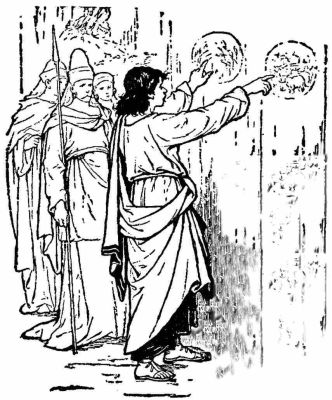
JOSEPH BEFORE THE PHAROAH

During all this time Jacob and his sons had been dwelling in Canaan; where, through the famine, they were now in want of food. So Jacob sent his sons to Egypt to buy corn. The Bible tells us, in the book of Genesis, how they came to Egypt, and all that befell them there; and how at last Joseph, the ruler of the mighty kingdom, made himself known to them as the brother they had cruelly sold for a slave. But he forgave them, and sent to fetch his father Jacob, saying that all were to come into Egypt, where he would provide for them.

Jacob could not at first believe the good news his sons brought; but when he saw the waggons which Joseph had sent to carry him and the little ones, he said, “It is enough; Joseph my son is yet alive; I will go and see him before I die.” So he journeyed to Egypt, with his sons, and all that he had; and as he drew near Joseph went to meet him. When Joseph met his father, he fell on his neck, and wept there. And Jacob said, “Now let me die, since I have seen thy face, because thou art yet alive.” He was so full of joy that it seemed to him there was nothing else worth living for. Afterwards Joseph presented his father to Pharaoh; and Jacob blessed Pharaoh; who allowed him and his family to dwell in the land of Goshen.

JACOB PRESENTED TO PHARAOH

THE STORY OF THE MONEY IN THE SACKS

THE STORY OF THE MONEY IN THE SACKS

When Joseph was made ruler over the land of Egypt, he did just as he had always done. It was not Joseph’s way to sit down, to rest and enjoy himself, and make others wait on him. He found his work at once, and began to do it faithfully and thoroughly. He went out over all the land of Egypt, and saw how rich and abundant were the fields of grain, giving much more than the people could use for their own needs. He told the people not to waste it, but to save it for the coming time of need.

And he called upon the people to give him for the king one bushel of grain out of every five, to be stored up. The people brought their grain, after taking for themselves as much as they needed, and Joseph stored it up in great storehouses in the cities; so much at last that no one could keep account of it.

The king of Egypt gave a wife to Joseph from the noble young women of his kingdom. Her name was Asenath; and to Joseph and his wife God gave two sons. The oldest son he named Manasseh, a word which means “Making to Forget.”

“For,” said Joseph, “God has made me to forget all my troubles and my toil as a slave.”

The second son he named Ephraim, a word that means “Fruitful.” “Because,” said Joseph, “God has not only made the land fruitful; but he has made me fruitful in the land of my troubles.”

The seven years of plenty soon passed by, and then came the years of need. In all the lands around people were hungry, and there was no food for them to eat; but in the land of Egypt everybody had enough. Most of the people soon used up the grain that they had saved; many had saved none at all, and they all cried to the king to help them.

“Go to Joseph!” said king Pharaoh, “and do whatever he tells you to do.”

Then the people came to Joseph, and Joseph opened the storehouses, and sold to the people all the grain that they wished to buy. And not only the people of Egypt came to buy grain, but people of all the lands around as well, for there was great need and famine everywhere. And the need was as great in the land of Canaan, where Jacob lived, as in other lands. Jacob was rich in flocks and cattle, and gold and silver, but his fields gave no grain, and there was danger that his family and his people would starve. And Jacob—who was now called Israel also—heard that there was food in Egypt and he said to his sons: “Why do you look at each other, asking what to do to find food? I have been told that there is grain in Egypt. Go down to that land, and take money with you, and bring grain, so that we may have bread, and may live.”

Then the ten older brothers of Joseph went down to the land of Egypt. They rode upon asses, for horses were not much used in those times, and they brought money with them. But Jacob would not let Benjamin, Joseph’s younger brother, go with them, for he was all the more dear to his father, now that Joseph was no longer with him; and Jacob feared that harm might come to him.

Then Joseph’s brothers came to Joseph to buy food. They did not know him, grown up to be a man, dressed as a prince, and seated on a throne. Joseph was now nearly forty years old, and it had been almost twenty-three years since they had sold him. But Joseph knew them all, as soon as he saw them. He wished to be sharp and stern with them, not because he hated them; but because he wished to see what their spirit was, and whether they were as selfish, and cruel, and wicked as they had been in other days.

They came before him, and bowed, with their faces to the ground. Then, no doubt, Joseph thought of the dream that had come to him while he was a boy, of his brothers’ sheaves bending down around his sheaf. He spoke to them as a stranger, as if he did not understand their language, and he had their words explained to him in the language of Egypt.

“Who are you? And from what place do you come?” said Joseph, in a harsh, stern manner.

They answered him very meekly: “We have come from the land of Canaan to buy food.”

“No,” said Joseph, “I know what you have come for. You have come as spies, to see how helpless the land is, so that you can bring an army against us, and make war on us.”

“No, no,” said Joseph’s ten brothers. “We are no spies. We are the sons of one man, who lives in the land of Canaan; and we have come for food, because we have none at home.”

“You say that you are the sons of one man, who is your father? Is he living? Have you any more brothers? Tell me all about yourselves.”

And they said: “Our father is an old man in Canaan. We did have a younger brother, but he was lost; and we have one brother still, who is the youngest of all, but his father could not spare him to come with us.”

“No,” said Joseph. “You are not good, honest men. You are spies. I shall put you all in prison, except one of you; and he shall go and bring that youngest brother of yours; and when I see him, then I will believe that you tell the truth.”

So Joseph put all the ten men in prison, and kept them under guard for three days; then he sent for them again. They did not know that he could understand their language, and they said to each other, while Joseph heard, but pretended not to hear: “This has come upon us because of the wrong that we did to our brother Joseph, more than twenty years ago. We heard him cry, and plead with us, when we threw him into the pit, and we would not have mercy on him. God is giving us only what we have deserved.”

And Reuben, who had tried to save Joseph, said: “Did I not tell you not to harm the boy? and you would not listen to me. God is bringing our brother’s blood upon us all.”

When Joseph heard this, his heart was touched, for he saw that his brothers were really sorry for the wrong that they had done to him. He turned away from them, so that they could not see his face, and he wept. Then he turned again to them and spoke roughly as before, and said:

“This I will do, for I serve God. I will let you all go home, except one man. One of you I will shut up in prison; but the rest of you can go home and take food for your people. And you must come back and bring your youngest brother with you, and I shall know then that you have spoken the truth.”

Then Joseph gave orders, and his servants seized one of his brothers, whose name was Simeon, and bound him in their sight and took him away to prison. And he ordered his servants to fill the men’s sacks with grain, and to put every man’s money back into the sack before it was tied up, so that they would find the money as soon as they opened the sack. Then the men loaded their asses with the sacks of grain, and started to go home, leaving their brother Simeon a prisoner.

When they stopped on the way to feed their asses, one of the brothers opened his sack, and there he found his money lying on the top of the grain. He called out to his brothers: “See, here is my money given again to me!” And they were frightened, but they did not dare to go back to Egypt and meet the stern ruler of the land. They went home and told their old father all that had happened to them, and how their brother Simeon was in prison, and must stay there until they should return, bringing Benjamin with them.

When they opened their sacks of grain, there in the mouth of each sack was the money that they had given; and they were filled with fear. Then they spoke of going again to Egypt and taking Benjamin, but Jacob said to them:

“You are taking my sons away from me. Joseph is gone, and Simeon is gone, and now you would take Benjamin away. All these things are against me!” Reuben said: “Here are my own two boys. You may kill them, if you wish, in case I do not bring Benjamin back to you.” But Jacob said: “My youngest son shall not go with you. His brother is dead, and he alone is left to me. If harm should come to him, it would bring down my gray hairs with sorrow to the grave.”

THE DREAMS OF A KING

THE DREAMS OF A KING

The men who bought Joseph from his brothers were called Ishmaelites, because they belonged to the family of Ishmael, who, you remember, was the son of Hagar, the servant of Sarah. These men carried Joseph southward over the plain which lies beside the great sea on the west of Canaan; and after many days they brought Joseph to Egypt. How strange it must have seemed to the boy who had lived in tents to see the great river Nile, and the cities thronged with people, and the temples, and the mighty pyramids!

The Ishmaelites sold Joseph as a slave to a man named Potiphar, who was an officer in the army of Pharaoh, the king of Egypt. Joseph was a beautiful boy, and cheerful and willing in his spirit, and able in all that he undertook; so that his master Potiphar became very friendly to him, and after a time, he placed Joseph in charge of his house, and everything in it. For some years Joseph continued in the house of Potiphar, a slave in name, but in reality the master of all his affairs, and ruler over his fellow-servants.

But Potiphar’s wife, who at first was very friendly to Joseph, afterward became his enemy, because Joseph would not do wrong to please her. She told her husband falsely, that Joseph had done a wicked deed. Her husband believed her, and was very angry at Joseph, and put him in the prison with those who had been sent to that place for breaking the laws of the land. How hard it was for Joseph to be charged with a crime, when he had done no wrong, and to be thrust into a dark prison among wicked people!

But Joseph had faith in God, that at some time all would come out right; and in the prison he was cheerful, and kind, and helpful, as he had always been. The keeper of the prison saw that Joseph was not like the other men around him, and he was kind to Joseph. In a very little while, Joseph was placed in charge of all his fellow-prisoners, and took care of them, just as he had taken care of everything in Potiphar’s house. The keeper of the prison scarcely looked into the prison at all; for he had confidence in Joseph, that he would be faithful and wise in doing the work given to him. Joseph did right, and served God, and God blessed Joseph in everything.

While Joseph was in the prison, two men were sent there by the king of Egypt, because he was displeased with them. One was the king’s chief butler, who served the king with wine; the other was the chief baker, who served him with bread. These two men were under Joseph’s care; and Joseph waited on them, for they were men of rank.

One morning, when Joseph came into the room where the butler and the baker were kept, he found them looking quite sad. Joseph said to them:

“Why do you look so sad today?” Joseph was cheerful and happy in his spirit; and he wished others to be happy also, even in prison.

And one of them said, “Each one of us dreamed last night a very strange dream, and there is no one to tell us what our dreams mean.”

For in those times, before God gave the Bible to men, he often spoke to men in dreams; and there were wise men who could sometimes tell what the dreams meant.

“Tell me,” said Joseph, “what your dreams are. Perhaps my God will help me to understand them.”

Then the chief butler told his dream. He said, “In my dream I saw a grape-vine with three branches; and as I looked, the branches shot out buds; and the buds became blossoms; and the blossoms turned into clusters of ripe grapes. And I picked the grapes, and squeezed their juice into king Pharaoh’s cup, and it became wine; and I gave it to king Pharaoh to drink, just as I used to do when I was beside his table.”

Then Joseph said, “This is what your dream means. The three branches mean three days. In three days, king Pharaoh shall call you out of prison and shall put you back in your place; and you shall stand at his table, and shall give him his wine, as you have given it before. But when you go out of prison, please to remember me, and try to find some way to get me, too, out of this prison. For I was stolen out of the land of Canaan, and sold as a slave; and I have done nothing wrong to deserve being put in this prison. Do speak to the king for me, that I may be set free.”

Of course, the chief butler felt very happy to hear that his dream had so pleasant a meaning. And the chief baker spoke, hoping to have an answer as good:

“In my dream,” said the baker, “there were three baskets of white bread on my head, one above another, and on the topmost basket were all kinds of roasted meat and food for Pharaoh; and the birds came, and ate the food from the baskets on my head.”

And Joseph said to the baker:

“This is the meaning of your dream, and I am sorry to tell it to you. The three baskets are three days. In three days, by order of the king you shall be lifted up, and hanged upon a tree; and the birds shall eat your flesh from your bones as you are hanging in the air.”

And it came to pass just as Joseph had said. Three days after that, king Pharaoh sent his officers to the prison. They came and took out both the chief butler and the chief baker. The baker they hung up by his neck to die, and left his body for the birds to pick in pieces. The chief butler they brought back to his old place, where he waited at the king’s table, and handed him his wine to drink.

You would have supposed that the butler would remember Joseph, who had given him the promise of freedom, and had shown such wisdom. But in his gladness, he forgot all about Joseph. And two full years passed by, while Joseph was still in prison, until he was a man thirty years old.

But one night, king Pharaoh himself dreamed a dream—in fact, two dreams in one. And in the morning he sent for all the wise men of Egypt, and told to them his dreams; but there was not a man who could give the meaning of them. And the king was troubled, for he felt that the dreams had some meaning which it was important for him to know.

Then suddenly the chief butler who was by the king’s table remembered his own dream in the prison two years before, and remembered, too, the young man who had told its meaning so exactly. And he said:

“I do remember my faults this day. Two years ago king Pharaoh was angry with his servants, with me and the chief baker; and he sent us to the prison. While we were in the prison, one night each of us dreamed a dream; and the next day a young man in the prison, a Hebrew from the land of Canaan, told us what our dreams meant; and in three days they came true, just as the young Hebrew had said. I think that if this young man is in the prison still, he could tell the king the meaning of his dreams.”

You notice that the butler spoke of Joseph as “a Hebrew.” The people of Israel, to whom Joseph belonged, were called Hebrews as well as Israelites. The word Hebrew means, “One who crossed over,” and it was given to the Israelites because Abraham, their father, had come from a land on the other side of the great river Euphrates, and had crossed over the river on his way to Canaan.

Then king Pharaoh sent in haste to the prison for Joseph; and Joseph was taken out, and he was dressed in new garments, and was led in to Pharaoh in the palace. And Pharaoh said:

“I have dreamed a dream; and there is no one who can tell what it means. And I have been told that you have power to understand dreams and what they mean.”

And Joseph answered Pharaoh:

“The power is not in me; but God will give Pharaoh a good answer. What is the dream that the king has dreamed?”

“In my first dream,” said Pharaoh, “I was standing by the river: and I saw seven fat and handsome cows come up from the river to feed in the grass. And while they were feeding, seven other cows followed them up from the river, very thin, and poor, and lean—such miserable creatures as I had never seen before. And the seven lean cows ate up the seven fat cows; and after they had eaten them up, they were as lean and miserable as before. Then I awoke.

“And I fell asleep again, and dreamed again. In my second dream, I saw seven heads of grain growing up on one stalk, large, and strong, and good. And then seven heads came up after them, that were thin, and poor, and withered. And the seven thin heads swallowed up the seven good heads; and afterward were as poor and withered as before.

“And I told these two dreams to all the wise men, and there is no one who can explain them. Can you tell me what these dreams mean?”

And Joseph said to the king:

“The two dreams have the same meaning. God has been showing to king Pharaoh what he will do in this land. The seven good cows mean seven years, and the seven good heads of grain mean the same seven years. The seven lean cows and the seven thin heads of grain also mean seven years. The good cows and the good grain mean seven years of plenty, and the seven thin cows and thin heads of grain mean seven poor years. There are coming upon the land of Egypt seven years of such plenty as have never been seen; when the fields shall bring greater crops than ever before; and after those years shall come seven years when the fields shall bring no crops at all. And then for seven years there shall be such need, that the years of plenty will be forgotten, for the people will have nothing to eat.


The two dreams have the same meaning

“Now, let king Pharaoh find some man who is able and wise, and let him set this man to rule over the land. And during the seven years of plenty, let a part of the crops be put away for the years of need. If this shall be done, then when the years of need come, there will be plenty of food for all the people, and no one will suffer, for all will have enough.”

And king Pharaoh said to Joseph: “Since God has shown you all this, there is no other man as wise as you. I will appoint you to do this work, and to rule over the land of Egypt. All the people shall be under you; only on the throne of Egypt I will be above you.”

And Pharaoh took from his own hand the ring which held his seal, and put on Joseph’s hand, so that he could sign for the king, and seal in the king’s place. And he dressed Joseph in robes of fine linen, and put around his neck a gold chain. And he made Joseph ride in a chariot which was next in rank to his own. And they cried out before Joseph, “Bow the knee.” And thus Joseph was ruler over all the land of Egypt.

The Story of Mankind: The Nile Valley

The history of humanity is the record of a hungry creature in search of food. Wherever food was plentiful, thither people have travelled to make their home.

The fame of the Valley of the Nile must have spread at an early date. From the interior of Africa and from the desert of Arabia and from the western part of Asia people had flocked to Egypt to claim their share of the rich farms. Together these invaders had formed a new race which called itself “Remi” or “the Men” just as we sometimes call America “God’s own country.” They had good reason to be grateful to a Fate which had carried them to this narrow strip of land. In the summer of each year the Nile turned the valley into a shallow lake and when the waters receded all the grain fields and the pastures were covered with several inches of the most fertile clay.

In Egypt a kindly river did the work of a million men and made it possible to feed the teeming population of the first large cities of which we have any record. It is true that all the arable land was not in the valley. But a complicated system of small canals and well-sweeps carried water from the river-level to the top of the highest banks and an even more intricate system of irrigation trenches spread it throughout the land.

While people of the prehistoric age had been obliged to spend sixteen hours out of every twenty-four gathering food for themselves and the members of their tribe, the Egyptian peasant or the inhabitant of the Egyptian city found himself possessed of a certain leisure. They used this spare time to make themselves many things that were merely ornamental and not in the least bit useful.

More than that. One day people discovered that their brain was capable of thinking all kinds of thoughts which had nothing to do with the problems of eating and sleeping and finding a home for the children. The Egyptian began to speculate upon many strange problems that confronted people. Where did the stars come from? Who made the noise of the thunder which frightened them so terribly? Who made the River Nile rise with such regularity that it was possible to base the calendar upon the appearance and the disappearance of the annual floods? Who were people, themselves, strange little creatures surrounded on all sides by death and sickness and yet happy and full of laughter?

Humanity asked these many questions and certain people obligingly stepped forward to answer these inquiries to the best of their ability. The Egyptians called them “priests” and they became the guardians of humanity’s thoughts and gained great respect in the community. They were highly learned men who were entrusted with the sacred task of keeping the written records. They understood that it is not good for people to think only of their immediate advantage in this world and they drew attention to the days of the future when humanity’s soul would dwell beyond the mountains of the west and must give an account of their deeds to Osiris, the mighty god who was the Ruler of the Living and the Dead and who judged the acts of men according to their merits. Indeed, the priests made so much of that future day in the realm of Isis and Osiris that the Egyptians began to regard life merely as a short preparation for the Hereafter and turned the teeming valley of the Nile into a land devoted to the Dead.

In a strange way, the Egyptians had come to believe that no soul could enter the realm of Osiris without the possession of the body which had been its place of residence in this world. Therefore, as soon as a person was dead their relatives took their corpse and had it embalmed. For weeks it was soaked in a solution of natron and then it was filled with pitch. The Persian word for pitch was “Mumiai” and the embalmed body was called a “Mummy.” It was wrapped in yards and yards of specially prepared linen and it was placed in a specially prepared coffin ready to be removed to its final home. But an Egyptian grave was a real home where the body was surrounded by pieces of furniture and musical instruments (to while away the dreary hours of waiting) and by little statues of cooks and bakers and barbers (that the occupant of this dark home might be decently provided with food and need not go about unshaven).

Originally these graves had been dug into the rocks of the western mountains but as the Egyptians moved northward they were obliged to build their cemeteries in the desert. The desert however is full of wild animals and equally wild robbers and they broke into the graves and disturbed the mummy or stole the jewelry that had been buried with the body. To prevent such unholy desecration the Egyptians used to build small mounds of stones on top of the graves. These little mounds gradually grew in size, because the rich people built higher mounds than the poor and there was a good deal of competition to see who could make the highest hill of stones. The record was made by King Khufu, whom the Greeks called Cheops and who lived thirty centuries before our era. His mound, which the Greeks called a pyramid (because the Egyptian word for high was pir-em-us) was over five hundred feet high.

It covered more than thirteen acres of desert which is three times as much space as that occupied by the church of St. Peter, the largest edifice of the Christian world.

During twenty years, over a hundred thousand men were busy carrying the necessary stones from the other side of the river—ferrying them across the Nile (how they ever managed to do this, we do not understand), dragging them in many instances a long distance across the desert and finally hoisting them into their correct position. But so well did the King’s architects and engineers perform their task that the narrow passage-way which leads to the royal tomb in the heart of the stone monster has never yet been pushed out of shape by the weight of those thousands of tons of stone which press upon it from all sides.