A place to grow your relationship with God

Posts tagged ‘exodus’

THE FINDING OF MOSES

THE FINDING OF MOSES

Pharoah, becoming alarmed at the increasing power and numbers of the Israelites in Egypt, ordered that every male child who might be born to them should be cast into the river, and drowned. But the wife of a man named Levi felt that she could not give up her babe, and for three months she hid him. When she could hide him no longer, she prepared a basket of rushes, and coated it with pitch, so that it would float upon the river and keep out the water. In this ark she placed her infant son, and hid the ark among the flags and bulrushes on the river-bank, and set the child’s sister to watch it.

Now it happened that the daughter of Pharaoh came with her maidens to bathe in the river; and when she saw the basket she sent one of her maids to fetch it. And when she looked at the child he wept, and she had compassion for him, and said, “This is one of the Hebrews’ children.” Then the child’s sister came forward and said to Pharaoh’s daughter, “Shall I call to thee a Hebrew woman that she may nurse the child for thee?” And when the princess said, “Go!” she, the maid, went and called her own mother, to whom Pharaoh’s daughter said, “Take this child and nurse him for me, and I will give thee thy wages.” And the woman took the child and nursed him. And when he had grown, his mother took him to the princess, who adopted him as her son, and called his name Moses, which means drawn out, because she took him from the water. Afterwards he grew to be a great man: he was learned in all the wisdom of the Egyptians; and we are told, “he was mighty in words and deeds.”

The Finding of Moses

Understanding the Tabernacle’s Spiritual Significance

The Tabernacle-Man’s Approach to God

A picture showing the various parts of the Tabernacle


When the Lord gave Moses the plan of the Tabernacle on Mt. Sinai, He admonished Moses to follow His specifications in its construction to the letter (Exodus 25:1-9). The Tabernacle was more than just a place to worship while in the wilderness. Its design and layout was a shadow of the redemptive work of Jesus, as well as a pattern of the salvation experienced in the present church age.

  1. The Court of the Tabernacle
    • The court of the Tabernacle was approximately 150 feet long and 75 feet wide. It had one gate on the east side. Four doorposts supported hangings of four colors of cloth: purple, scarlet, blue, and white. There was only one entrance into the courtyard. Likewise, there is also only one way of salvation-through Jesus Christ (John 10:9).
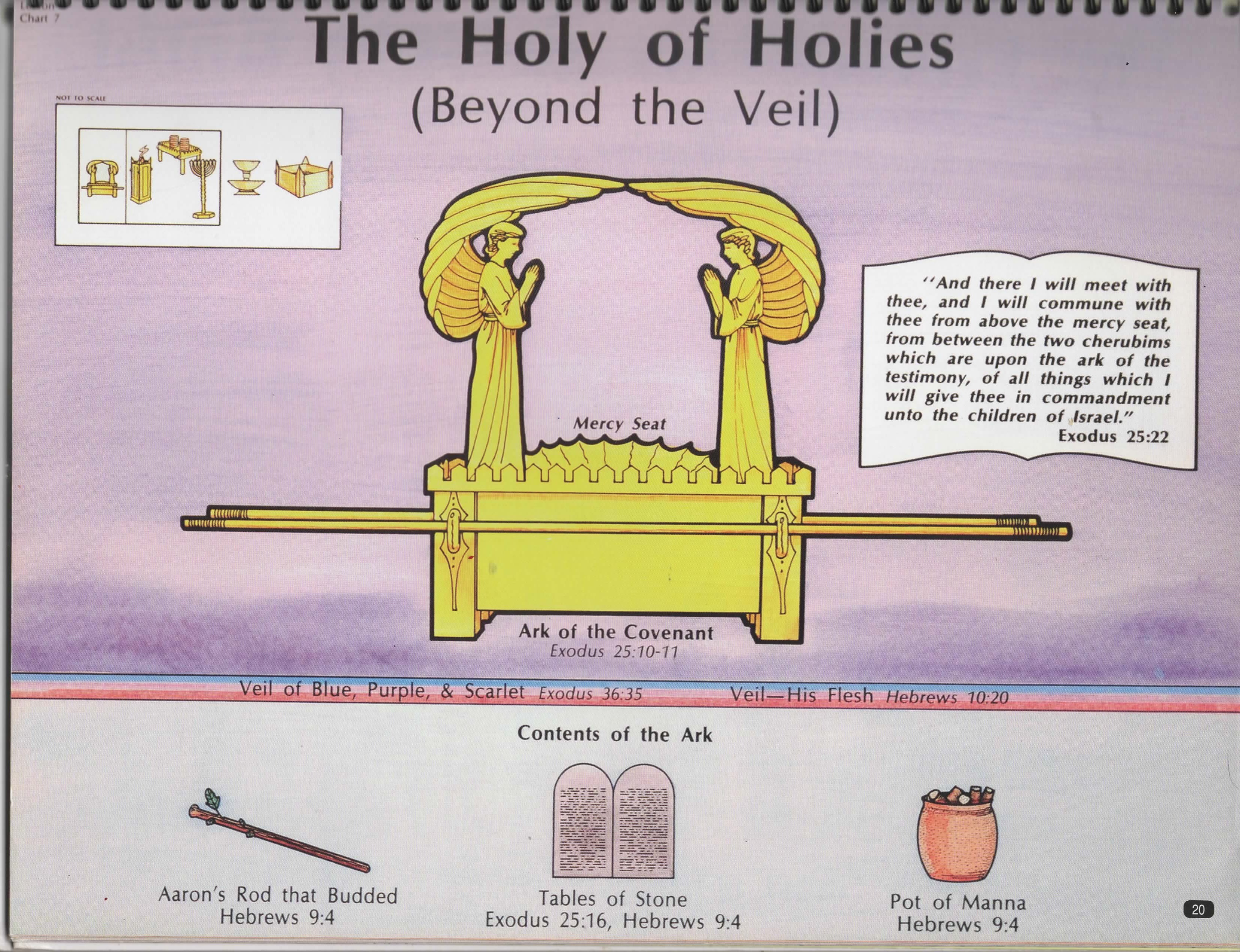
    • Inside the courtyard was the brazen altar, the brazen laver, and the Tabernacle itself. The Tabernacle was approximately 15 feet high, 15 feet wide, and 45 feet long. It consisted of the Holy Place and the Holy of Holies. These two rooms were separated by a veil of blue, purple, and scarlet. In the Holy Place was the golden candlestick, the table of showbread, and the altar of incense. In the Holy of Holies was the ark of the covenant. There abode the Spirit of God between two golden cherubims located on the lid of the ark, which was called the mercy seat.
      Of course. God is omnipresent, or present everywhere, but He manifested His glory there to show His covenant relationship with Israel. God has always desired to dwell with His people, but sin has always separated humanity from God. From the Day of Pentecost, fifty days after the death of Christ, God has dwelt in the hearts of His people in a new and wonderful way. “Know ye not that ye are the temple of God, and that the Spirit of God dwelleth in you?” (I Corinthians 3:16).
  2. The Altar of Sacrifice
    • The priest approached the Tabernacle first by way of the brazen altar, and there he offered the sacrifice for sin. The brazen altar was approximately seven and a half feet square and four and a half feet high. It was made of acacia wood overlaid with brass. It was a place of death and shedding of blood. It represents the death of Jesus, which purchased our salvation. It also points to repentance, which is our identification with the death of Jesus and our personal death to sin and self-will. Everyone must approach God through repentance. Jesus said, “Except ye repent, ye shall all likewise perish’ (Luke 13:3).
    • The altar was a prominent feature of the Tabernacle and its worship. It was placed immediately in front of the gate of the court of the Tabernacle. It was the first object that met the eye of the worshiper as he came into the court to present his sacrifice unto the Lord. The altar was not hidden in some remote place in the court, removed from the gaze of the people, nor did it stand inside the Tabernacle where only a few could approach it. It was placed where all could see it and where all could approach it. Only the priests could see the golden lampstand, the table of showbread, and the altar of incense, which were inside the Tabernacle itself. No one but the high priest was permitted to enter the Holy of Holies and he did so only on the Day of Atonement. By contrast, the altar was plainly visible from without. In fact, no one could enter into the Holy Place except by passing this sacred emblem where the sacrificial blood of the animals was offered. The altar teaches that not one will enter heaven except by the blood of Jesus, who stands as an altar of sacrifice for all who would approach God (John 14:6).
The Altar of Sacrifice
  • It was not merely the altar that gave the worshiper access to the Holy Place, by the putting away of his sins, for there had to be a sacrifice upon the altar. The relationship of the brazen altar to every other part of the Tabernacle service and its furniture was like that of the root to a tree, the heart to the body, and the foundation to a building. Everything inside and even the brazen laver in front of the door of the Tabernacle depended upon the work done at the altar.
  • Without the brazen altar, all else, no matter how magnificent, was useless. Everyone had to come to God by the way of the altar.
  • All the priests, their garments, the sacred vessels, and everything else were unfit for service until the blood shed at the brazen altar touched and sanctified them.
  • Here is the story of the Cross of Christ, Calvary. There is no pardon, no righteousness, no peace, no grace, no blessings, and no salvation without the sacrifice of the Cross. The altar represents the shedding of blood and the death of Jesus. And without the shedding of blood there is no remission of sins (Hebrews 9:27).
  • The fire upon the altar was never to go out (Leviticus 6:13). There is no hour, day or night, that a transgressor cannot find the atonement of Calvary.

3. The Laver of Water

The Laver of Water
  • The laver points to the cleansing from sin we have in Jesus – the initial washing at water
    baptism, which is for the remission of sins and the continual cleansing we have thereafter
    • Exo 30:21 So they shall wash their hands and their feet, that they die not: and it shall be a
      statute for ever to them, even to him and to his seed throughout their generations.
  • In the New Testament
    • Acts 2:38 Then Peter said unto them, Repent, and be baptized every one of you in the name
      of Jesus Christ for the remission of sins, and ye shall receive the gift of the Holy
      Ghost.
    • 1 John 1:7 But if we walk in the light, as he is in the light, we have fellowship one with
      another, and the blood of Jesus Christ his Son cleanseth us from all sin.
  • When we are baptized, God washes away our sins
    • Acts 22:16 And now why tarriest thou? arise, and be baptized, and wash away thy sins,
      calling on the name of the Lord.
  • Without believeth, we are not saved. This belief is demonstrated by baptism.
    • Mark 16:16 He that believeth and is baptized shall be saved; but he that believeth not shall
      be damned.
    • 1 Pet 3:21 The like figure whereunto even baptism doth also now save us (not the putting
      away of the filth of the flesh, but the answer of a good conscience toward God,) by
      the resurrection of Jesus Christ:
  • In the New Testament experience of salvation, repentance comes first, which is a death with
    Christ, a death to sin.
  • Then comes water baptism, which is a washing and burial with Christ.
    • Rom 6:3-4 Know ye not, that so many of us as were baptized into Jesus Christ were
      baptized into his death? 4 Therefore we are buried with him by baptism into death:
      that like as Christ was raised up from the dead by the glory of the Father, even so we
      also, should walk in newness of life.

4. The Holy Place

The Holy Place
  • The Holy Place was the golden candlestick (lampstand), the altar of incense, and the table of
    showbread show bread (sh½”brud”) n. The 12 loaves of blessed unleavened bread placed
    every Sabbath in the sanctuary of the Tabernacle as an offering by the Hebrew priests of
    ancient Israel.
  • These pieces of furniture point to Jesus and to our life in Christ through the indwelling of
    the Holy Spirit.
  • 1. THE GOLDEN CANDLESTICK
    • The candlestick was of pure gold and provided the only light in the Tabernacle. Just as
      Jesus is the light to the world
      • John 8:12 Then spake Jesus again unto them, saying, I am the light of the world: he that
        followeth me shall not walk in darkness, but shall have the light of life.
  • 2. THE TABLE OF SHOWBREAD
    • The showbread provided sustenance for the priest and also points to Jesus who is the Bread
      of Life and to His Word, which is food for the soul.
    • Just as the table exhibited the bread, so the Christian life shows forth Jesus to a dying world
      • John 6:51 I am the living bread which came down from heaven: if any man cat of this
        bread, he shall live for ever: and the bread that I will give is my flesh, which I will
        give for the life of the world.
  • 3. THE ALTAR OF INCENSE
    • The Altar of incense represents prayers to God each morning and evening.
      • We also should pray each morning and evening
    • God hears the prayers of a righteous person
      • 1 Pet 2:9 But ye are a chosen generation, a royal priesthood, an holy nation, a peculiar
        people; that ye should show forth the praises of him who hath called you out of
        darkness into his marvellous light:
      • James 5:16… The effectual fervent prayer of a righteous man availeth much.
        • fer vent (für”v…nt) adj. 1. Having or showing great emotion or zeal; ardent: fervent
          protests; a fervent admirer. 2. Extremely hot; glowing

4. The Holy of Holies (Beyond the Veil)

EPSON MFP image
  • The Holy of Holies represents God himself
  • By His mercy He saved us
    • Titus 3:5 Not by works of righteousness which we have done, but according to his mercy
      he saved us, by the washing of regeneration, and renewing of the Holy Ghost;

Understanding the Exodus: God’s Plan of Redemption

The Exodus-The Plan of Redemption

  • Nearly four centuries passed after the Israelites came to Egypt in the days of Joseph. “And the children of Israel were fruitful and increased abundantly, and multiplied and waxed exceeding mighty; and the land was filled with them. Now there arose up a new king over Egypt, which knew not Joseph” (Exodus 1:7-8). The new king set harsh taskmasters over the Israelites and set them at hard labor in the fields and in constructing cities and walls. This story is rich in typology, for the deliverance of Israel from bondage illustrates God’s plan of redemption for fallen humanity. I Corinthians 10:1-11 teaches that we can use the flight from Egypt as an example for us today.
  • Forty Years in Egypt
    • The Birth of Moses
      • Pharaoh became fearful that the Hebrews would rise up and overthrow the Egyptians, so he commanded the midwives to kill every newborn male Hebrew at the time of birth.
      • “But the midwives feared God, and did not as the king of Egypt commanded them, but saved the men children alive” (Exodus 1:17).
      • Then Pharaoh commanded all his people to destroy the baby boys by throwing them into a river (Exodus 1:22). After Moses was born, he was hid three months by his parents, Jochebed and Amram. When they could no longer hide him in their home, his mother made an ark of bulrushes and waterproofed it with slime and pitch. She hid him each day in the reeds along the river. His sister, Miriam, watched the baby Moses from the shore.
      • One day while on her way to wash herself at the river, Pharaoh’s daughter chanced to find the ark there among the reeds. She had the ark brought to her, and when she opened it, Moses wept and Pharaoh’s daughter had compassion on the small baby. She determined to take the child and bring him up in the palace. Miriam offered to contact a Hebrew woman to nurse the child for the daughter of Pharaoh. “And Pharaoh’s daughter said unto her, Take this child away, and nurse it for me, and I will give thee thy wages. And the woman took the child, and nursed it” (Exodus 2:9). The woman, who was Jochebed, took the child to her home, nursed him, and received wages for nursing her own baby. “And the child grew, and she brought him [Moses] unto Pharaoh’s daughter, and he became her son” (Exodus 2:10). The same river that could have been the means of destruction of Moses became his salvation, just as Jesus becomes our Savior instead of our Judge if we follow His plan of salvation for us.
    • Moses’ Choice
      • When Moses was grown, he went out one day among his brethren and saw an Egyptian beating a Hebrew. He killed the Egyptian and hid him in the sand. The next day he saw two Hebrews fighting and attempted to separate them. One of them said, “Who made thee a prince and a judge over us? intendest thou to kill me, as thou killedst the Egyptian?” (Exodus 2:14). Because Moses had acted out of God’s will, his efforts to lead were rejected by the people. He was unprepared at this stage for the task that he would later perform. (See also Hebrews 11:23-29.)
  • Forty Years in Midian
    • Moses realized that his deed was known, and fearing revenge by Pharaoh, he fled to the land of Midian. There he met and married Zipporah, a daughter of the Midianite priest Jethro.
    • Moses’ Call
      • One day as Moses was tending sheep, he beheld a bush burning. Upon closer examination, he was amazed when he saw it was not consumed with the fire. God called to him out of the midst of the bush, giving him his call for his life’s work. God told Moses that He had heard the cries of the people and that He would use him to deliver them from bondage and lead them to their promised land.
    • God Proves Himself to Moses
      • Moses expressed doubts that he could do the job, so God had him to cast down the rod he held in his hand. When he did so, the rod changed into a serpent. God had him pick it up by the tail, and it turned back into the rod. God then told Moses to put his hand into his bosom. Moses obeyed, and when he took his hand out it was white with leprosy. Then Moses was told to thrust his hand back into his garment. When he removed his hand, this time it was healed. Thus he was shown that God could make him victorious over everything that would confront him. Likewise God’s people today can totally trust in the Lord, knowing that He will bring triumph over the devil, the world, and the flesh.
  • Moses the Deliverer
    • Moses Before Pharaoh-Ten Plagues
      • Moses obeyed the Lord, returned to Egypt, went to Pharaoh, and told him that God had said, “Let my people go.” Pharaoh desired to keep the Hebrews in bondage and rebelled against God’s will. Disaster came to Egypt in the form of ten plagues from God. Significantly, God used the things the Egyptians worshiped-frogs, cattle, the sun, and the Nile river-to demonstrate His great power. After each of the first nine plagues, Pharaoh agreed to let the Israelites go, but in each instance, he later had a change of heart. His deceit set the stage for the most dreadul plague yet to come.
    • Passover-Deliverance by the Blood
      • The Lord told Moses to speak to the congregation and tell them to take a male lamb of the first year without blemish for each household. He instructed them to kill the lamb and to apply its blood to the two doorposts and the lintel of each house. They were then to roast the lamb and eat it that night, along with unleavened bread and bitter herbs. They were to eat in haste with shoes on their feet, belts on their waist, and a staff in their hand, because it was time to leave Egypt. At midnight the Lord passed through the land of Egypt and killed the firstborn of every household that did not have blood upon the doorpost. When he saw blood on the doorpost, He passed by that house and the inhabitants inside were safe.
      • Salvation in this age is dependent upon the blood of the Lamb, Jesus Christ. “For even Christ our passover is sacrificed for us” (1 Corinthians 5:7). The blood of Jesus must be applied through obedience to the gospel. If the Lord did not find blood applied to the doorpost, instant death resulted. The blood of the innocent lamb is symbolic of the blood of the Lamb of God that delivers from spiritual bondage.
    • Deliverance through the Red Sea
      • Pharaoh at last agreed to let the Hebrews go. The Lord led them out of Egypt with a pillar of fire by night and a pillar of cloud by day (Exodus 13:21). After the people left Egypt, Pharaoh changed his mind again and sent his army after the Israelites. God led the Israelites to the Red Sea. When the people saw Pharaoh’s chariots closing in on them, they cried out against Moses. Moses told the people, “Fear ye not, stand still, and see the salvation of the LORD which he will shew to you to day: for the Egyptians whom ye have seen to day, ye shall see them again no more for ever’ (Exodus 14:13). Moses lifted his rod, and the Lord caused the sea to go back by a strong east wind all that night (Exodus 14:7-21). The people miraculously crossed over upon dry ground with the waters as a great wall on either side. In every situation the Lord will always make a way of escape for His people. (See I Corinthians 10:13.) The Egyptians were in pursuit, but as soon as the Israelites got across, the Lord had Moses to stretch out his hand over the sea. The waters fell on the Egyptians and they were all drowned. “And Israel saw the Egyptians dead upon the sea shore” (Exodus 14:30). Salvation is the whole process by which Christ rescues a person from sin and makes him a child of God.
  • Jesus Christ rescues from sin and death; He restores the soul, and He puts a new song into the heart.
  • In typology, Egypt represents bondage, or sin. The Red Sea is a type of baptism for “all our fathers.. baptized unto Moses in the cloud and in the sea” (I Corinthians 10:1-2). A future lesson will show that entering the promised land is a type of receiving God’s promise. There were battles to be fought, giants to face, and walls to bring down. Thus we see God’s plan of salvation: repentance (leaving Egypt), baptism (crossing the Red Sea), and moving into the promise of God (the Holy Spirit).

Understanding the Exodus: God’s Deliverance of Israel

Exodus = to exit
Exodus 3:9(NKJV)
“Now, therefore. behold. the cry of the children of Israel has come to Me, and | have
also seen the oppression with which the Egyptians oppress them.
Exodus 3:10(NKJV)
“Come now, therefore, and I will send you to Pharaoh that you may bring My people,
the children of Israel, out of Egypt.”
  • Author
    • Moses
  •  Date
    • About 1400 B.C.
    • Moses wrote Exodus during the forty years in the wilderness
  • Theme
    • Redemption
    • Deliverance
  • Purpose
    • God delivering His people from bondage and developing them as a prosperous possessors of His promises
    • Exodus isa continuation of Genesis dealing with the development of a small family of 70 people who migrated to the land of Egypt under Joseph’s leadership. The Israelites grew into a large nation of millions. The Hebrews lived in Egypt for 430 years most of them in bondage. Exodus means “to exit” or “out of.”
  • Content
    • Moses God’s Called Leader: Exodus 1:1-4:31
      • Exodus 3:10 (NKJV) Come now, therefore, and I will send you to Pharaoh that you may bring My people, the children of Israel, out of Egypt.”
      • God calls with a purpose!
      • If God calls you to do something, then with His help you can do it!
    • The Contest with Pharaoh Exodus 5:1-13:19
      • Exodus 5:1(NKJV) Afterward Moses and Aaron went in and told Pharaoh, “Thus says the Lord God of Israel: ‘Let My people go, that they may hold a feast to Me in the wilderness.”
    • From Egypt to Mount Sinai: Exodus 13:20-19:2
    • Covenant and Law Exodus 19:3-24:8
      • Ten commandments Exodus 20:1-17
      • Exodus 19:5(NKJV) “Now therefore, if you will indeed obey My voice and keep My covenant, then you shall be a special treasure to Me above all people; for all the earth is Mine.
      • Exodus 19:6(NKJV) And you shall be to Me a kingdom of priests and a holy nation.’ These are the words which you shall speak to the children of Israel. “
    • Tabernacle Exodus 24:9-40:38
      • Exodus 25:8(NKJV) And let them make Me a sanctuary, that I may dwell among them.
  • Christ in Exodus
    • Moses is a type of Christ as “The Deliverer”
    • Aaron is a type of Christ as “The High Priest”
    • The Passover Lamb
    • I AM WHO I AM
    • The Tabernacle as Christ Dwelling with His people