A place to grow your relationship with God

Posts tagged ‘faith’

Biblical Parallels: Abraham, Isaac, and Christ’s Sacrifice

THE PARALLELS BETWEEN ABRAHAM AND ISAAC’S STORY AND CHRIST’S DEATH

Abraham and Isaac’s StoryChrist’s Crucifixion Account
Mount Moriah in Jerusalem
Gen. 22:2 And he said, Take now thy son, thine only son Isaac, whom thou lovest, and get thee into the land of Moriah; and offer him there for a burnt offering upon one of the mountains which I will tell thee of.
Crucified near Mount Moriah in Jerusalem: Golgotha and Mount Moriah aren’t the exact same spot, but they’re pretty close to each other. Mount Moriah is traditionally linked to the site of the Jewish Temple, where sacrifices took place. The whole area, including Golgotha, holds deep meaning in God’s redemptive story. According to Jewish tradition, Mount Moriah was home to the Holy of Holies, where God’s presence dwelled in the temple (2 Chronicles 3:1). Both places clearly reflect the strong connection between sacrifice and atonement.
Abraham was the fatherGod is Jesus’ Father: John 3:16 For God so loved the world, that he gave his only begotten Son, that whosoever believeth in him should not perish, but have everlasting life.
Isaac was the covenant sonChrist is the only begotten Son of God
Two unnamed men were there: Gen 22:3 And Abraham rose up early in the morning, and saddled his ass, and took two of his young men with him, and Isaac his son, and clave the wood for the burnt offering, and rose up, and went unto the place of which God had told him.May represent the two unnamed men crucified on Golgotha: John 19:18 Where they crucified him, and two other with him, on either side one, and Jesus in the midst.
Saw the mount on the third day: Gen 22:4 Then on the third day Abraham lifted up his eyes, and saw the place afar off.Jesus was raised from the grave on the third day: 1 Corinthians 15:4 And that he was buried, and that he rose again the third day according to the scriptures:
The wood was laid on Isaac: Gen 22:6 And Abraham took the wood of the burnt offering, and laid it upon Isaac his son; and he took the fire in his hand, and a knife; and they went both of them together.The cross was laid on Christ: John 19:17 And he bearing his cross went forth into a place called the place of a skull, which is called in the Hebrew Golgotha:
Isaac got up off the altar Gen 22:13 And Abraham lifted up his eyes, and looked, and behold behind him a ram caught in a thicket by his horns: and Abraham went and took the ram, and offered him up for a burnt offering in the stead of his son.Christ arose from the grave: 1 Cor. 15:3-6 For I delivered unto you first of all that which I also received, how that Christ died for our sins according to the scriptures; And that he was buried, and that he rose again the third day according to the scriptures: And that he was seen of Cephas, then of the twelve: After that, he was seen of above five hundred brethren at once; of whom the greater part remain unto this present, but some are fallen asleep.
A ram replaced Isaac Gen 22:13 And Abraham lifted up his eyes, and looked, and behold behind him a ram caught in a thicket by his horns: and Abraham went and took the ram, and offered him up for a burnt offering in the stead of his son.Christ was sacrificed in our place: Hebrews 10:9-12 Then said he, Lo, I come to do thy will, O God. He taketh away the first, that he may establish the second. By the which will we are sanctified through the offering of the body of Jesus Christ once for all. And every priest standeth daily ministering and offering oftentimes the same sacrifices, which can never take away sins: But this man, after he had offered one sacrifice for sins for ever, sat down on the right hand of God;
God will provide a lamb: Gen 22:8 And Abraham said, My son, God will provide himself a lamb for a burnt offering: so they went both of them together.Christ is the “lamb of God”: John 1:29  The next day John seeth Jesus coming unto him, and saith, Behold the Lamb of God, which taketh away the sin of the world.


Abraham takes Isaac to the same land where, years earlier, he had met the king-priest Melchizedek (Gen. 14). When Isaac asks, “Where is the lamb?” Abraham assures him that God will “provide Himself a lamb.” Yet, it’s a ram—not a lamb—that takes Isaac’s place. Upon the ram’s appearance, Abraham names the place Jehovah-Jireh, meaning “the Lord will see to it.” Moses writes, “In the mount of the Lord it shall be seen” (Gen. 22:14). So, what will be seen there? I believe, through the revelation of the Holy Spirit, Abraham glimpsed something not recorded in the story—he knew a lamb would one day appear on that mountain to bring redemption. That lamb is Christ, the One Jesus referred to when He said, “Abraham rejoiced to see my day; and he saw it” (John 8:56).

Weekly Recap of Articles for Christians Dec 7th to Dec 13th

Understanding the Lineage of Noah’s Sons

The sons of Noah and their name meaning

And Noah was five hundred years old: and Noah begat Shem, Ham, and Japheth. Genesis 5:32

The name Shem means: שֵׁם Shêm, shame; the same as H8034; name; Shem, a son of Noah (often includ. his posterity):—Sem, Shem.
The name Ham means: חָם Châm, khawm; the same as H2525; hot (from the tropical habitat); Cham, a son of Noah; also (as a patronymic) his descendants or their country:—Ham.
The name Japheth means: יֶפֶת Yepheth, yeh’-feth; from H6601; expansion; Jepheth, a son of Noah; also his posterity:—Japheth.

Who was which Father?

Japheth is the Father of the Gentiles
Shem is the Father of the Israelites
Ham is the Father of the Philistines

Sons of Japeth

See Genesis 10:2-5 {Japheth had 7 Sons}

The name Gomer means :גֹּמֶר Gômer, go’-mer; from H1584; completion; Gomer, the name of a son of Japheth and of his descendants; also of a Hebrewess:—Gomer.
The name Magog means: מָגוֹג Mâgôwg, maw-gogue’; from H1463; Magog, a son of Japheth; also a barbarous northern region: —Magog.
 The name Madai means: מָדַי Mâday, maw-dah’-ee; of foreign derivation; Madai, a country of central Asia: —Madai, Medes, Media.
The name Javan means: יָוָן Yâvân, yaw-vawn’; probably from the same as H3196; effervescing (i.e. hot and active); Javan, the name of a son of Joktan, and of the race (Ionians, i.e. Greeks) descended from him, with their territory; also of a place in Arabia:—Javan.
The name Tubal means: תּוּבַל Tûwbal, too-bal’; or תֻּבַל Tubal; probably of foreign derivation; Tubal, a postdiluvian patriarch and his posterity:—Tubal.
The name Meshech means: מֶשֶׁךְ Meshek, meh’-shek; the same in form as H4901, but probably of foreign derivation; Meshek, a son of Japheth, and the people descended from him:—Mesech, Meshech.
The name Tiras means: תִּירָס Tîyrâç, tee-rawce’; probably of foreign derivation; Tiras, a son of Japheth:—Tiras

Sons of Gomer

Gensis 10:3 [Gomer had 3 sons]

The name Ashkenaz means: אַשְׁכְּנַז ʼAshkᵉnaz, ash-ken-az’; of foreign origin; Ashkenaz, a Japhethite, also his descendants: —Ashkenaz.
The name Riphath means: רִיפַת Rîyphath, ree-fath’; or (probably by orthographical error) דִּיפַת Dîyphath; of foreign origin; Riphath, a grandson of Japheth and his descendants:—Riphath.
The name Togarmah means: תּוֹגַרְמָה Tôwgarmâh, to-gar-maw’; or תֹּגַרְמָה Tôgarmâh; probably of foreign derivation; Togarmah, a son of Gomer and his posterity: —Togarmah.

Sons of Javan

Gensis 10:4 [Javan had 4 sons]

The name Elishah means :אֱלִישָׁה ʼĔlîyshâh, el-ee-shaw’; probably of foreign derivation; Elishah, a son of Javan: —Elishah.
The name Tarhish means:תַּרְשִׁישׁ Tarshîysh, tar-sheesh’; probably the same as H8658 (as the region of the stone, or the reverse); Tarshish, a place on the Mediterranean, hence, the ephithet of a merchant vessel (as if for or from that port); also the name of a Persian and of an Israelite:—Tarshish, Tharshish.
The name Kittim means:כִּתִּי Kittîy, kit-tee’; or כִּתִּיִּי Kittîyîy; patrial from an unused name denoting Cyprus (only in the plural); a Kittite or Cypriote; hence, an islander in general, i.e. the Greeks or Romans on the shores opposite Palestine:—Chittim, Kittim.
The name Dodanim means: דֹּדָנִים Dôdânîym, do-daw-neem’; or (by orthographical error) רֹדָנִים Rôdânîym (1 Chronicles 1:7); a plural of uncertain derivation; Dodanites, or descendants of a son of Javan:—Dodanim.

Sons of Ham

Gensis 10:6 [Ham had  4 sons]

The name Cush means: כּוּשׁ Kûwsh, koosh; probably of foreign origin; Cush (or Ethiopia), the name of a son of Ham, and of his territory; also of an Israelite:—Chush, Cush, Ethiopia.
The name Mizraim means: מִצְרַיִם Mitsrayim, mits-rah’-yim; dual of H4693; Mitsrajim, i.e. Upper and Lower Egypt: —Egypt, Egyptians, Mizraim.
The name Phut means: פּוּט Pûwṭ, poot; of foreign origin; Put, a son of Ham, also the name of his descendants or their region, and of a Persian tribe:—Phut, Put
The name Canaan means: כְּנַעַן Kᵉnaʻan, ken-ah’-an; from H3665; humiliated; Kenaan, a son a Ham; also the country inhabited by him:—Canaan, merchant, traffick.

Sons of Cush

Gensis 10:7-9 [Cush had 6 sons]

The name Seba means: סְבָא Çᵉbâʼ, seb-aw’; of foreign origin; Seba, a son of Cush, and the country settled by him: —Seba.
The name Havilah means: חֲוִילָה Chăvîylâh, khav-ee-law’; probably from H2342; circular; Chavilah, the name of two or three eastern regions; also perhaps of two men:—Havilah.
The name Sabtah means: סַבְתָּא Çabtâʼ, sab-taw’; or סַבְתָּה Çabtâh; probably of foreign derivation; Sabta or Sabtah, the name of a son of Cush, and the country occupied by his posterity:—Sabta, Sabtah.
The name Raamah means: רַעְמָה Raʻmâh, rah-maw’; the same as H7483; Ramah, the name of a grandson of Ham, and of a place (perhaps founded by him):—Raamah.
The name Sabtecha means: סַבְתְּכָא Çabtᵉkâʼ, sab-tek-aw’; probably of foreign derivation; Sabteca, the name of a son of Cush, and the region settled by him:—Sabtecha, Sabtechah
The name Nimrod means:נִמְרוֹד Nimrôwd, nim-rode’; or נִמְרֹד Nimrôd; probably of foreign origin; Nimrod, a son of Cush:—Nimrod.

Nimrod = “rebellion” or “the valiant”
the son of Cush, grandson of Ham, and great grandson of Noah; a mighty hunter, he established an empire in the area of Babylon and Assyria

Son of Raamah

Gensis 10:7 {The end of verse 7}[ Raamah had 2 sons]

The name Sheba means: שְׁבָא Shᵉbâʼ, sheb-aw’; of foreign origin; Sheba, the name of three early progenitors of tribes and of an Ethiopian district:—Sheba, Sabeans.
The name Dedan means: דְּדָן Dᵉdân, ded-awn’; or (prolonged) דְּדָנֶה Dᵉdâneh; (Ezekiel 25:13), of uncertain derivation; Dedan, the name of two Cushites and of their territory:—Dedan.

Sons of Mizram

Gensis 10:13-14 Mizraim had 6 sons

The name Ludim means: לוּדִי Lûwdîy, loo-dee’; or לוּדִיִּי Lûwdîyîy; patrial from H3865; a Ludite or inhabitants of Lud (only in plural):—Ludim. Lydians.
The name Anamic means: עֲנָמִים ʻĂnâmîym, an-aw-meem’; as if plural of some Egyptian word; Anamim, a son of Mizraim and his descendants, with their country:—Anamim.
The name Lehabim means: לְהָבִים Lᵉhâbîym, leh-haw-beem’; plural of H3851; flames; Lehabim, a son of Mizraim, and his descendants:—Lehabim.
The name Naphtuhim means:נַפְתֻּחִים Naphtuchîym, naf-too-kheem; plural of foreign origin, Naphtuchim, an Egyptian tribe:—Naptuhim.
The name Pathrusim means: פַּתְרֻסִי Pathruçîy, path-roo-see’; patrial from H6624; a Pathrusite, or inhabitant of Pathros: —Pathrusim.
The name Casluhim means: כַּסְלֻחִים Kaçluchîym, kas-loo’-kheem; a plural probably of foreign derivation; Casluchim, a people cognate to the Egyptians:—Casluhim.

Sons of Casluhim

Gensis 10:14 {The end of 14} [Casluhim had 2 sons}

The name Philistima means: פַּתְרֻסִי Pathruçîy, path-roo-see’; patrial from H6624; a Pathrusite, or inhabitant of Pathros:—Pathrusim.
The name Caphtorim means: כַּסְלֻחִים Kaçluchîym, kas-loo’-kheem; a plural probably of foreign derivation; Casluchim, a people cognate to the Egyptians:—Casluhim.

Sons of Canaan

Gensis 10:15-20 [Canaan had 11 sons]

The name Sidon means :צִידוֹן Tsîydôwn, tsee-done’; or צִידֹן Tsîydôn; from H6679 in the sense of catching fish; fishery; Tsidon, the name of a son of Canaan, and of a place in Palestine:—Sidon, Zidon.
The name Heth means: חֵת Chêth, khayth; from H2865; terror; Cheth, an aboriginal Canaanite:—Heth.
The name Jebusite means: יְבוּסִי Yᵉbûwçîy, yeb-oo-see’; patrial from H2982; a Jebusite or inhabitant of Jebus: —Jebusite(-s).
The name Amorite means: אֱמֹרִי ʼĔmôrîy, em-o-ree’; probably a patronymic from an unused name derived from H559 in the sense of publicity, i.e. prominence; thus, a mountaineer; an Emorite, one of the Canaanitish tribes:—Amorite.
The name Girgasite means: גִּרְגָּשִׁי Girgâshîy, ghir-gaw-shee’; patrial from an unused name (of uncertain derivation); a Girgashite, one of the native tribes of Canaan:—Girgashite, Girgasite.
The name Hivite means: חִוִּי Chivvîy, khiv-vee’; perhaps from H2333; a villager; a Chivvite, one of the aboriginal tribes of Palestine:—Hivite.
The name Arkite means: עַרְקִי ʻArqîy, ar-kee’; patrial from an unused name meaning a tush; an Arkite or inhabitant of Erek:—Arkite.
The name Sinite means: סִינִי Çîynîy, see-nee’; from an otherwise unknown name of a man; a Sinite, or descendant of one of the sons of Canaan:—Sinite.
The name Arvadite means: אַרְוָדִי ʼArvâdîy, ar-vaw-dee’; patrial from H719; an Arvadite or citizen of Arvad:—Arvadite.
The name Zemarite means: צְמָרִי Tsᵉmârîy, tsem-aw-ree’; patrial from an unused name of a place in Palestine; a Tsemarite or branch of the Canaanites:—Zemarite.
The name Hamathite means: חֲמָתִי Chămâthîy, kham-aw-thee’; patrial from H2574; a Chamathite or native of Chamath:—Hamathite.

Sons of Shem

Genesis 10:22 [Shem had 5 sons]

The name Elam means: עֵילָם ʻÊylâm, ay-lawm’; or עוֹלָם ʻÔwlâm; (Ezra 10:2; Jeremiah 49:36), probably from H5956; hidden, i.e. distant; Elam, a son of Shem and his descendants, with their country; also of six Israelites:—Elam.
The name Asshur means: אַשּׁוּר ʼAshshûwr, ash-shoor’; or אַשֻּׁר ʼAshshur; apparently from H833 (in the sense of successful); Ashshur, the second son of Shem; also his descendants and the country occupied by them (i.e. Assyria), its region and its empire:—Asshur, Assur, Assyria, Assyrians. See H838.
The name Arphaxad means:אַרְפַּכְשַׁד ʼArpakshad, ar-pak-shad’; probably of foreign origin; Arpakshad, a son of Noah; also the region settled by him:—Arphaxad.
The name Lud means: לוּד Lûwd, lood; probably of foreign derivation; Lud, the name of two nations:—Lud, Lydia.
The name Aram means: אֲרָם ʼĂrâm, arawm’; from the same as H759; the highland; Aram or Syria, and its inhabitants; also the name of the son of Shem, a grandson of Nahor, and of an Israelite:—Aram, Mesopotamia, Syria, Syrians.

Son of Aram

Gensis 10: 23 [Aram had 4 sons]

The name Uz means: עוּץ ʻÛwts, oots; apparently from H5779; consultation; Uts, a son of Aram, also a Seirite, and the regions settled by them.:—Uz.
The name Hul means: חוּל Chûwl, khool; from H2342; a circle; Chul, a son of Aram; also the region settled by him:—Hul.
The name Gether means: גֶּתֶר Gether, gheh’-ther; of uncertain derivation; Gether, a son of Aram, and the region settled by him:—Gether.
The name Mash means: מַשׁ Mash, mash; of foreign derivation; Mash, a son of Aram, and the people descended from him:—Mash.

Son of Arphaxed

Gensis 10:24 [Arphaxad had 1 son]

The name Salah means: שֶׁלַח Shelach, sheh’-lakh; the same as H7973; Shelach, a postdiluvian patriarch:—Salah, Shelah. Compare H7975.

Son of Salah

Gensis 10:24 [Salah had 1 son]

The name Eber means: עֵבֵר ʻÊbêr, ay’-ber; the same as H5676; Eber, the name of two patriarchs and four Israelites: —Eber, Heber. H5676: עֵבֶר ʻêber, ay’-ber; from H5674; properly, a region across; but used only adverbially (with or without a preposition) on the opposite side (especially of the Jordan; usually meaning the east):

Sons of Eber

Gensis 10:25 [Eber had 2 sons]

The name Peleg means: פֶּלֶג Peleg, peh’-leg; the same as H6388; earthquake; Peleg, a son of Shem:—Peleg.
The name Jaktan means: יׇקְטָן Yoqṭân, yok-tawn’; from H6994; he will be made little; Joktan, an Arabian patriarch:—Joktan.

Sons of Jaktan

Gensis 10:26-32 [Joktan had 13 sons]

The name Almodad means: אַלְמוֹדָד ʼAlmôwdâd, al-mo-dawd’; probably of foreign derivation Almodad, a son of Joktan:—Almodad.
The name Sheleph means:שֶׁלֶף sheleph, sheh’-lef; from H8025; extract; Sheleph, a son of Jokthan:—Sheleph.
The name Hazarmaveth means:]חֲצַרְמָוֶת Chătsarmâveth, khats-ar-maw’-veth; from H2691 and H4194; village of death; Chatsarmaveth, a place in Arabia:—Hazarmaveth.
The name Jerah means: יֶרַח Yerach, yeh’-rakh; the same as H3391; Jerach, an Arabian patriarch:—Jerah.
The name Hadoram means: הֲדוֹרָם Hădôwrâm, had-o-rawm’; or הֲדֹרָם Hădôrâm; probably of foreign derivation; Hadoram, a son of Joktan, and the tribe descended from him:—Hadoram.
The name Uzal means: אוּזָל ʼÛwzâl, oo-zawl’; of uncertain derivation; Uzal, a son of Joktan:—Uzal.
The name Diklah means: דִּקְלָה Diqlâh, dik-law’; of foreign origin; Diklah, a region of Arabia:—Diklah.
The name Obal means: עוֹבָל ʻÔwbâl, o-bawl’; of foreign derivation; Obal, a son of Joktan:—Obal.
The name Abimael means: אֲבִימָאֵל ʼĂbîymâʼêl, ab-ee-maw-ale’; from H1 and an elsewhere unused (probably foreign) word; father of Mael (apparently some Arab tribe); Abimael, a son of Joktan:—Abimael.
The name Sheba means: סְבָא Çᵉbâʼ, seb-aw’; of foreign origin; Seba, a son of Cush, and the country settled by him:—Seba.
The name Ophir means: אוֹפִיר ʼÔwphîyr, o-feer’; or (shortened) אֹפִיר ʼÔphîyr; and אוֹפִר ʼÔwphir; of uncertain derivation; Ophir, the name of a son of Joktan, and of a gold region in the East:—Ophir.
The name Havilah means: חֲוִילָה Chăvîylâh, khav-ee-law’; probably from H2342; circular; Chavilah, the name of two or three eastern regions; also perhaps of two men:—Havilah.
The name Jobab means: יוֹבָב Yôwbâb, yo-bawb’; from H2980; howler; Jobab, the name of two Israelites and of three foreigners:—Jobab.

Christmas Eve Poem

And there were in the same country shepherds abiding in the field, keeping watch over their flock by night.

And, lo, the angel of the Lord came upon them, and the glory of the Lord shone round about them: and they were sore afraid.

And the angel said unto them, Fear not: for, behold, I bring you good tidings of great joy, which shall be to all people.

For unto you is born this day in the city of David a Saviour, which is Christ the Lord.

And this shall be a sign unto you; Ye shall find the babe wrapped in swaddling clothes, lying in a manger.

And suddenly there was with the angel a multitude of the heavenly host praising God, and saying,

Glory to God in the highest, and on earth peace, good will toward men.

Taken from the Bible

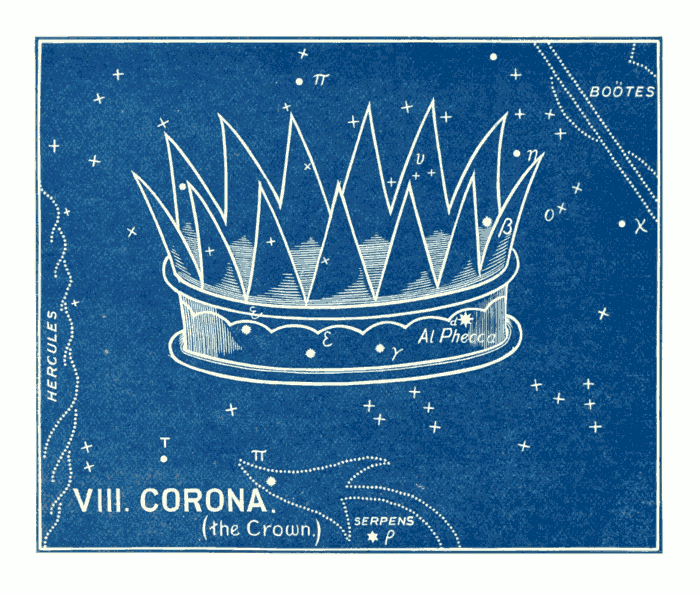
Witness of the Stars: CORONA (The Crown)

CORONA (The Crown)

The Crown Bestowed

“Wherefore God also hath highly exalted Him, and given Him a name which is above every name, that at the name of Jesus every knee should bow.”

This is what is foreshown by this concluding section of the second chapter. Each chapter ends with glory. As in the written Word of God, we frequently have the glory of the Second Coming mentioned without any allusions to the sufferings of the First Coming, but we never have the First Coming in humiliation mentioned without an immediate reference to the glory of the Second Coming.

So here, the Cross is closely followed by the Crown! True, “we see not yet all things put under Him, but we see Jesus … for the suffering of death crowned with glory and honour” (Heb. ii. 9).

Yes, “the crowning day is coming,” and all heaven shall soon resound with the triumphant song, “Thou art worthy, … for Thou wast slain and hast redeemed us to God by Thy blood” (Rev. v. 9).

The shameful Cross will be followed by a glorious crown, and “every tongue shall confess that Jesus. Christ is Lord, to the glory of God the Father.”

“Mighty Victor, reign for ever,

Wear the crown so dearly won;

Never shall Thy people, never

Cease to sing what Thou hast done.

Thou hast fought Thy people’s foes;

Thou wilt heal Thy people’s woes!”

The Hebrew name for the constellation is Ataraha royal crown, and its stars are known to-day in the East by the plural, Ataroth!

Its Arabic name is Al Iclilan ornament, or jewel.

Plate 8: CORONA (the Crown)

It has 21 stars: one of the 2nd magnitude and six of the 4th. It is easily known by the stars θ, β, α, γ, δ, and ε, which form a crescent.

Its brightest star, α, has the Arabic name of Al Pheccathe shining.

Thus ends this solemn chapter of Libra, which describes the great work of Redemption, beginning with the Cross and ending with the Crown. The Redeemer’s work of Atonement is most blessedly set forth, and He alone is seen as the substitute for lost sinners.

“What wondrous love, what mysteries

In this appointment shine!

My breaches of the law are His,

And His obedience mine.”

The Gospel Train

The Gospel Train (Old Spiritual)

Git on board, little children,
Dere’s room for many a mo’.

De Gospel train’s a-comin’,
I hear it jus’ at han’,
I hear de car wheels rumblin’,
An’ rollin’ thro’ de lan’.

Git on board, little children,
Dere’s room for many a mo’.

De fare is cheap an’ all can go,
De rich an’ poor are dere,
No second class aboard dis train,
No diff’rence in de fare. 

Git on board, little children,
Dere’s room for many a mo’.

The Creation

The Creation by James Weldon Johnson (1871-1938)

And God stepped out on space,
And he looked around and said:
I’m lonely-
I’ll make me a world.

And far as the eye of God could see
Darkness covered everything,
Blacker than a hundred midnights
Down in a cypress swamp.

Then God smiled,
And the light broke,
And the darkness rolled up on one side,
And the light stood shining on the other,
And God said: That’s good!

Then God reached out and took the light in his hands,
And God rolled the light around in his hands
Until he made the sun;
And he set that sun a-blazing in the heavens.
And the light that was left from making the sun
God gathered it up in a shining ball
And flung it against the darkness,
Spangling the night with the moon and stars.
Then down between
The darkness and the light
He hurled the world;
And God said: That’s good!

Then God himself stepped down-
And the sun was on his right hand,
And the moon was on his left;
The stars were clustered about his head,
And the earth was under his feet.
And God walked, and where he trod
His footsteps hollowed the valleys out
And bulged the mountains up.

Then he stopped and looked and saw
That the earth was hot and barren.
So God stepped over to the edge of the world
And he spat out the seven seas-
He batted his eyes, and the lightnings flashed-
He clapped his hands, and the thunders rolled-
And the waters above the earth came down,
The cooling waters came down.

Then the green grass sprouted,
And the little red flowers blossomed,
The pine tree pointed his finger to the sky,
And the oak spread out his arms,
The lakes cuddled down in the hollows of the ground,
And the rivers ran down to the sea;
And God smiled again,
And the rainbow appeared,
And curled itself around his shoulder.

Then God raised his arm and he waved his hand
Over the sea and over the land,
And he said: Bring forth! Bring forth!
And quicker than God could drop his hand,
Fishes and fowls
And beasts and birds
Swam the rivers and the seas,
Roamed the forests and the woods,
And split the air with their wings.
And God said: That’s good!

Then God walked around,
And God looked around
On all that he had made.
He looked at his sun,
And he looked at his moon,

And he looked at his little stars;
He looked on his world
With all its living things,
And God said: I’m lonely still.

Then God sat down-
On the side of a hill where he could think;
By a deep, wide river he sat down;
With his head in his hands,
God thought and thought,
Till he thought: I’ll make me a man!

Up from the bed of the river
God scooped the clay;
And by the bank of the river
He kneeled him down;
And there the great God Almighty
Who lit the sun and fixed it in the sky,
Who flung the stars to the most far corner of the night,
Who rounded the earth in the middle of his hand;
This Great God,
Like a mammy bending over her baby,
Kneeled down in the dust
Toiling over a lump of clay
Till he shaped it in his own image;
Then into it he blew the breath of life,
And man became a living soul.
Amen. Amen.

Understanding Deuteronomy 16:21-22: A Message for Worship

Thou shalt not plant thee a grove of any trees near unto the altar of the Lord thy God, which thou shalt make thee. Neither shalt thou set thee up any image, which the Lord thy God hateth.

Deuteronomy 16:21-22

Context

Author: Moses
Audience: Children of Israel
When:1400 B.C.
Style: Teaching
Purpose: To teach God’s People

Other Translations

Amplified Holy Bible: Deuteronomy 16:21-22 “You shall not plant for yourself an Asherah of any kind of tree or wood beside the altar of the Lord your God, which you shall make. You shall not set up for yourself a sacred pillar which the Lord your God hates.

Holman Christian Standard Bible: Deuteronomy 16:21-22
 “Do not set up an Asherah of any kind of wood next to the altar you will build for the Lord your God, and do not set up a sacred pillar; the Lord your God hates them.

Other Verses

  • Exodus 20:1-5
    • And God spake all these words, saying,
    • I am the Lord thy God, which have brought thee out of the land of Egypt, out of the house of bondage.
    • Thou shalt have no other gods before me.
    • Thou shalt not make unto thee any graven image, or any likeness of any thing that is in heaven above, or that is in the earth beneath, or that is in the water under the earth.
    • Thou shalt not bow down thyself to them, nor serve them: for I the Lord thy God am a jealous God, visiting the iniquity of the fathers upon the children unto the third and fourth generation of them that hate me;
  • Exodus 20:23
    • Ye shall not make with me gods of silver, neither shall ye make unto you gods of gold.
  • Exodus 34:14
    • For thou shalt worship no other god: for the Lord, whose name is Jealous, is a jealous God:
  • Leviticus 26:1
    • Ye shall make you no idols nor graven image, neither rear you up a standing image, neither shall ye set up any image of stone in your land, to bow down unto it: for I am the Lord your God.
  • Deuteronomy 5:7-9
    • Thou shalt have none other gods before me.
    • Thou shalt not make thee any graven image, or any likeness of any thing that is in heaven above, or that is in the earth beneath, or that is in the waters beneath the earth:
    • Thou shalt not bow down thyself unto them, nor serve them: for I the Lord thy God am a jealous God, visiting the iniquity of the fathers upon the children unto the third and fourth generation of them that hate me,
  • 1 John 5:21
    • Little children, keep yourselves from idols. Amen.
  • Galatians 5:19-21
    • Now the works of the flesh are manifest, which are these; Adultery, fornication, uncleanness, lasciviousness,
    • Idolatry, witchcraft, hatred, variance, emulations, wrath, strife, seditions, heresies,
    • Envyings, murders, drunkenness, revellings, and such like: of the which I tell you before, as I have also told you in time past, that they which do such things shall not inherit the kingdom of God.
      • Idolatry is the worship of idols
  • Revelations 9:20
    • And the rest of the men which were not killed by these plagues yet repented not of the works of their hands, that they should not worship devils, and idols of gold, and silver, and brass, and stone, and of wood: which neither can see, nor hear, nor walk:

Where was it written
It was probably written in the wilderness, aka, in the Middle of nowhere.

What does it say ?

It says that God doesn’t Want a grove of any trees near his altar. It says that God hates it. It also says that God doesn’t like us Worship any other images [gods].

Word Meanings

  • Plant= H5193
    • נָטַע nâṭaʻ, naw-tah’; a primitive root; properly, to strike in, i.e. fix; specifically, to plant (literally or figuratively):—fastened, plant(-er).
  • Grove =H842
    • אֲשֵׁרָה ʼăshêrâh, ash-ay-raw’; or אֲשֵׁירָה ʼăshêyrâh; from H833; happy; Asherah (or Astarte) a Phoenician goddess; also an image of the same:—grove. Compare H6253.
  • Image = H4676
    • מַצֵּבָה matstsêbâh, mats-tsay-baw’; feminine (causatively) participle of H5324; something stationed, i.e. a column or (memorial stone); by analogy, an idol:—garrison, (standing) image, pillar.
  • Hateth =H8130
    • שָׂנֵא sânêʼ, saw-nay’; a primitive root; to hate (personally):—enemy, foe, (be) hate(-ful, -r), odious, × utterly.
  • Alter = H4196
    • מִזְבֵּחַ mizbêach, miz-bay’-akh; from H2076; an altar:—altar.
  • Alter= H2076
    • זָבַח zâbach, zaw-bakh’; a primitive root; to slaughter an animal (usually in sacrifice):—kill, offer, (do) sacrifice, slay.

What does it mean to me?

It means that we should not put up any Kind of tree near the God of heaven & Earth’s altar. It means the church Should not put up Christmas trees. The verse says any grove of trees, a Christmas tree is a tree, real or not real Christmas trees are trees.

How this verse  makes me feel

This verse makes me feel sad because the churches are not obeying it. God told Moses to write it down, he wrote it down, but we are not listening to it.

Devil/Satan
Devil, accuser, Slanderer, the main title for the fallen angelic being who wanted to be God the supreme, the Maker of all. The term devil comes from a Greek word that means, a false Witness” or malicious accuser. The Devil does not want people to fellow God; The Devil doesn’t care who you Worship. He just doesn’t want you to worship God.

Thought Provoking Questions:

  • What do you do when you Worship?
    • You Sing, dance, and bow down.
    • God said not to Worship any other gods, See Exodus 34:14, Leviticus 26:1, Exodus 20:15 & 23, Deuteronomy 5:7-9.
  • What is going on in the churches near Christmas time?
    • They are putting up tree near the altar but Deuteronomy 16:21-22, Said No! that is what they are doing near Christmas time.
  • Do you think the Song, “Oh Christmas Tree” is Worshiping the Christmas tree?
    • I know what I think but What do you think?

Gideon’s Battle

GIDEON’S THREE HUNDRED-A PREVIEW OF THE BATTLE OF ARMAGEDDON (Judges Chapters 6-8)
The Biblical narrative of Gideon and his three hundred men encodes numerous prophetic parallels that apply to the battle of all battles, the battle of Armageddon, alluded to in Revelation 16:16. The English translation reads, “He (God) gathered them together…”

Recorded in Judges chapters 6 through 8, the Midianites were invading Israel and there were no judges to prevent their invasion. God raised up Gideon and his small army to deliver the Israelites from their captors.

GideonArmageddon
Gideon’s battle occurred during the time of the threshing of the wheat (Judges 6:11)
Christ alludes to the time of the end as the time of “harvest” calling his final harvest of souls for the kingdom the “end of the world” or as some translations say, “the end of an age” (Matthew 13:39, 49)
In ancient times, the wheat harvest was gathered and separated on a threshing floor.In Roman times, rocks or other rough objects were embedded into large wooden boards used to separate the stem and shell from the hard wheat. In Latin this board is called tribulem. The final harvest before the return of the Messiah will occur in the time of the Tribulation.
In Judges 6:25, God instructed Gideon to offer a bullock of seven years.
In Judges 6:27 that 10 men accompanied Gideon at night.
These two numbers are significant in the future Tribulation, as the Tribulation will be seven yours in length
(Dan. 9:27) and there will be ten kings at the end of days when the Messiah returns (see Dan 7:24 & Rev. 17:12)
In Judges 6:33, the children of the east” are mentioned.A similar phrase is sound in Revelation 16:12, John records that the “kings of the east” cross the Euphrates River to join in the battle of Armageddon.
In Judges 6:33 it says, “The Children of the east were gathered together.”.The word “gather” is also used in Zechariah 14:2, when the prophet saw the time of the end and how all nations would be gathered together against Jerusalem for the final battle.
These “Children of the east” “pitched in the valley of Jezeel” This is the same valley where the future nations will gather. In Revelation 16:12, “these kings of the east” are gathering to battle at Armageddon. The area of Armageddon is actually the valley of Jezreel, which today is a two-hundred-square-mile area of open farmland in central Israel.
Prior to Gideon’s war he blew a trumpet (Judges 6:34) to gather his people together.there will be the sound of trumpets at the gathering together of the believers (see 1 Thess 4:16-17)
Gideon began with 32000 men, and the army was reduced to a final group of a “remnant” of three hundred men.The Bible predicts that the Lord will blow
a trumpet (Hebrew shofar) and bring together a remnant (see 1 Thess 4:16 & Isa. 10:20-22)
In the battle, Gideon and his army slew two princes.
1. Ored: name means raven
2. Zeeb, meaning “wolf” (see Judges 7:25)
These two princes were the leaders of the battle.
At the conclusion of the seven-year Tribulation there will be two men identified.
1. the first beast or Antichrist (see Rev13:1-2)
2. the second beast, the false prophet (a wolf in lamb’s clothing so to speak)
Both will be defeated at the battle of Armageddon (see Rev. 19:20)
We read in Judges 7:25 that the leaders Oreb and Zeeb were slain at the winepress of Zeeb.The word winepress is also used in the book of Revelation it refers to God pouring out his wrath during the Tribulation. John uses the image of the crushing of grapes when he calls this the winepress of the wrath of God” (Rev. 14:19-20)
Gideon’s battle was concluded at a winepress.This battle will be identified with a winepress.
After crossing the Jordan, the men met at Succoth (see Judges 8:15) Sukkot (Succoth) is the Hebrew word for Tabernacles, the seventh and final festival. The Feast of Tabernacles is a prophetic picture of the future kingdom of Christ in which he will reign on earth for one thousand years (see Rev. 20:4)
An interesting phrase in the Gideon
narrative indicates that they “taught” the enemy with thorns and briars (see Judges 8:7, 16)
The prophetic parallel is that when Christ returns, he will tread down his enemies. (Psalm 60:11-12)
Gideon’s three hundred soldiers blew trumpets and broke clay pitchers to create confusion in the camp of the Midianites (see Judges 7:20-22). In Revelation 2:27 we read “And he shall rule them with a rod of iron; as the vessels of a potter shall they be broken to shivers: even as I received of my Father.”
The Ishmaelites brought Gideon an offering after the battle concluded (see Judges 8:24-26). These son of Ishmael were Arab descendants from Abraham’s son Ishmael who lived in the area.At the return of Christ, the nations surrounding Israel will be the sons of Esau and Ishmael. The sons of Ishmael will join the other nations in worshipping the Messiah when he returns, as the Bible says: “All nations shall come and worship before thee”
(Zech. 14:16)
In Judges 8:21, Gideon removed the ornaments around the camels’ necks. The Hebrew word for ornaments means “a round disk like the moon.” Ornaments were moon-like emblems placed around the necks of the camelsA common symbol of Islam is the crescent moon, often seen atop mosques worldwide. Today, Israel is surrounded by Islamic nations, and some believe the future Antichrist may come from an Islamic background.
Two statements that summarize Gideon’s leadership are: “The Lord shall rule over you” (Judges 8:23) and the “Country was in quietness” (Judges 8:28).These statements describe the state of the earth at the end of the Tribulation when the Messiah returns. Christ will reign over the nations for a thousand years (see Rev. 20:4), bringing peace throughout this entire period.

The Brass Serpent: A Precursor to Christ’s Redemption

THE BRASS SERPENT ON THE POLE Numbers chapter 21

The fiery serpents were venomous snakes that lived in the desert and wilderness. Some wonder why God told Moses to place a serpent on a pole, since the serpent is often seen as a symbol of evil and Satan (see Gen. 3:1; Isa. 27:1; Rev. 20:2), and had caused death to many who were bitten. Christ speaks of the brass serpent when He says, “As Moses lifted up the serpent in the wilderness, even so must the Son of man be lifted up: That whosoever believeth in him should not perish, but have eternal life” (John 3:14-15). Though He was perfect and without sin in His birth, life, and ministry, the sins of all humanity were placed on Him, much like the scapegoat bearing Israel’s sins on the Day of Atonement. The serpent’s image thus became a symbol of the ultimate sin offering being lifted up. Just as the fiery serpents brought death, unrepentant sin brings death to the soul. Only the cross can undo the serpent’s bite and restore life to those who look to Christ.
Two questions arise in this comparison:

  1. If gold symbolizes divinity, and the brass serpent represented Christ, why was it made of brass instead of gold?
    • First, brass symbolizes humanity, and Christ became flesh, taking on humanity to redeem mankind (see John 1:14)—hence the use of brass.
  2. If the lamb is Christ’s symbol of redemption, why was a serpent placed on the pole instead of a lamb?
    • Secondly, the serpent symbolizes sin, and Christ took on the sins of all humanity before His crucifixion. He served as a substitute, carrying our sins to the cross. “For he hath made him to be sin for us, who knew no sin; that we might be made the righteousness of God in him” (2 Cor. 5:21). We read, “Blotting out the handwriting of ordinances that was against us, which was contrary to us, and took it out of the way, nailing it to his cross…” (Col. 2:14).

Since brass symbolizes humanity and the serpent symbolizes sin, the serpent on the pole represents the sin of humanity, which Christ overcame and redeemed once and for all at the cross. Refer to the chart below.

The Brass SerpentThe Power of Jesus’ death on the cross
The people complained against God. (Num. 21:5) And the people spake against God, and against Moses, Wherefore have ye brought us up out of Egypt to die in the wilderness? for there is no bread, neither is there any water; and our soul loatheth this light bread.The world was under sin and death (Rom 5:12) Wherefore, as by one man sin entered into the world, and death by sin; and so death passed upon all men, for that all have sinned:
Fiery serpents bit the people (Num. 21:6) And the Lord sent fiery serpents among the people, and they bit the people; and much people of Israel died.The serpent introduced sin (Gen. 3:1-13)
Those bitten died (Num. 21:6) And the Lord sent fiery serpents among the people, and they bit the people; and much people of Israel died.Sin brought death (Rom. 3:23) For all have sinned, and come short of the glory of God;
Moses made a brass serpent (Num. 21:8-9) And the Lord said unto Moses, Make thee a fiery serpent, and set it upon a pole: and it shall come to pass, that every one that is bitten, when he looketh upon it, shall live. And Moses made a serpent of brass, and put it upon a pole, and it came to pass, that if a serpent had bitten any man, when he beheld the serpent of brass, he lived.Christ in human form bore our sins (1 Pet. 2:24) Who his own self bare our sins in his own body on the tree, that we, being dead to sins, should live unto righteousness: by whose stripes ye were healed.
Moses used a pole (Num. 21:8-9) And the Lord said unto Moses, Make thee a fiery serpent, and set it upon a pole: and it shall come to pass, that every one that is bitten, when he looketh upon it, shall live. And Moses made a serpent of brass, and put it upon a pole, and it came to pass, that if a serpent had bitten any man, when he beheld the serpent of brass, he lived.Christ died on a tree (1 Pet. 2:24) Who his own self bare our sins in his own body on the tree, that we, being dead to sins, should live unto righteousness: by whose stripes ye were healed.
Those looking to the brass serpent were healed (Num. 21:9) And Moses made a serpent of brass, and put it upon a pole, and it came to pass, that if a serpent had bitten any man, when he beheld the serpent of brass, he lived.Those who believe in Christ are saved (Mark 16:16) He that believeth and is baptized shall be saved; but he that believeth not shall be damned.