A place to grow your relationship with God

Posts tagged ‘faith’

The Brass Serpent: A Precursor to Christ’s Redemption

THE BRASS SERPENT ON THE POLE Numbers chapter 21

The fiery serpents were venomous snakes that lived in the desert and wilderness. Some wonder why God told Moses to place a serpent on a pole, since the serpent is often seen as a symbol of evil and Satan (see Gen. 3:1; Isa. 27:1; Rev. 20:2), and had caused death to many who were bitten. Christ speaks of the brass serpent when He says, “As Moses lifted up the serpent in the wilderness, even so must the Son of man be lifted up: That whosoever believeth in him should not perish, but have eternal life” (John 3:14-15). Though He was perfect and without sin in His birth, life, and ministry, the sins of all humanity were placed on Him, much like the scapegoat bearing Israel’s sins on the Day of Atonement. The serpent’s image thus became a symbol of the ultimate sin offering being lifted up. Just as the fiery serpents brought death, unrepentant sin brings death to the soul. Only the cross can undo the serpent’s bite and restore life to those who look to Christ.
Two questions arise in this comparison:

  1. If gold symbolizes divinity, and the brass serpent represented Christ, why was it made of brass instead of gold?
    • First, brass symbolizes humanity, and Christ became flesh, taking on humanity to redeem mankind (see John 1:14)—hence the use of brass.
  2. If the lamb is Christ’s symbol of redemption, why was a serpent placed on the pole instead of a lamb?
    • Secondly, the serpent symbolizes sin, and Christ took on the sins of all humanity before His crucifixion. He served as a substitute, carrying our sins to the cross. “For he hath made him to be sin for us, who knew no sin; that we might be made the righteousness of God in him” (2 Cor. 5:21). We read, “Blotting out the handwriting of ordinances that was against us, which was contrary to us, and took it out of the way, nailing it to his cross…” (Col. 2:14).

Since brass symbolizes humanity and the serpent symbolizes sin, the serpent on the pole represents the sin of humanity, which Christ overcame and redeemed once and for all at the cross. Refer to the chart below.

The Brass SerpentThe Power of Jesus’ death on the cross
The people complained against God. (Num. 21:5) And the people spake against God, and against Moses, Wherefore have ye brought us up out of Egypt to die in the wilderness? for there is no bread, neither is there any water; and our soul loatheth this light bread.The world was under sin and death (Rom 5:12) Wherefore, as by one man sin entered into the world, and death by sin; and so death passed upon all men, for that all have sinned:
Fiery serpents bit the people (Num. 21:6) And the Lord sent fiery serpents among the people, and they bit the people; and much people of Israel died.The serpent introduced sin (Gen. 3:1-13)
Those bitten died (Num. 21:6) And the Lord sent fiery serpents among the people, and they bit the people; and much people of Israel died.Sin brought death (Rom. 3:23) For all have sinned, and come short of the glory of God;
Moses made a brass serpent (Num. 21:8-9) And the Lord said unto Moses, Make thee a fiery serpent, and set it upon a pole: and it shall come to pass, that every one that is bitten, when he looketh upon it, shall live. And Moses made a serpent of brass, and put it upon a pole, and it came to pass, that if a serpent had bitten any man, when he beheld the serpent of brass, he lived.Christ in human form bore our sins (1 Pet. 2:24) Who his own self bare our sins in his own body on the tree, that we, being dead to sins, should live unto righteousness: by whose stripes ye were healed.
Moses used a pole (Num. 21:8-9) And the Lord said unto Moses, Make thee a fiery serpent, and set it upon a pole: and it shall come to pass, that every one that is bitten, when he looketh upon it, shall live. And Moses made a serpent of brass, and put it upon a pole, and it came to pass, that if a serpent had bitten any man, when he beheld the serpent of brass, he lived.Christ died on a tree (1 Pet. 2:24) Who his own self bare our sins in his own body on the tree, that we, being dead to sins, should live unto righteousness: by whose stripes ye were healed.
Those looking to the brass serpent were healed (Num. 21:9) And Moses made a serpent of brass, and put it upon a pole, and it came to pass, that if a serpent had bitten any man, when he beheld the serpent of brass, he lived.Those who believe in Christ are saved (Mark 16:16) He that believeth and is baptized shall be saved; but he that believeth not shall be damned.

The Children’s Six Minutes: The First Month

THE FIRST MONTH

What month is this? December. It is the first month in the year. “No, no,” you say, “December is the last month.” I cannot entirely agree with you. December is last on the calendar but first in importance. Now you agree with me, do you not?

How many days has December? One day. “No, no,” I again hear you say, “December has thirty-one days.” I think we can reach an agreement on this point too. There is one day in December of unexcelled importance and loveliness; that day is the twenty-fifth. Yes, we all say there is but one day in December. How readily we agree when we understand one another!

What is the twenty-fifth? It is the pivotal day in the history of the world. It is the day upon which the King of Kings and the Lord of Lords was born. Jesus, son of man and son of God, came into the world as we all come, as a tiny babe. It brings him much nearer to us, does it not, to think that our Saviour was once as we are? He grew up as a child, a boy, a youth, a man. It is the birthday of Christ the Saviour we celebrate on the twenty-fifth of each December.

To whom did Jesus come? He came to a lowly people. He was revealed first of all to the shepherds. The shepherd’s task was not an enviable one. He was out in the open, subject to storms and winds and wild beasts. His business was to shepherd the sheep, to lead them to good pasture, to protect them from all harm and danger. The shepherd’s task was lonely as well as lowly. His days and nights were passed in solitude. Occasionally a group of shepherds would come together, but for the most part they were alone with their flocks. God chose these people, whose minds were clear, whose lives were pure, to be the first messengers of the glad tidings of great joy.

MEMORY VERSE, Luke 2: 8

“And there were in the same country shepherds abiding in the field, keeping watch over their flocks by night.”

MEMORY HYMN

“While shepherds watched their flocks.”

Weekly Recap of Articles for Christians for Nov 30th to Dec 6th

Peter and the Tribue Money

PETER AND THE TRIBUTE-MONEY

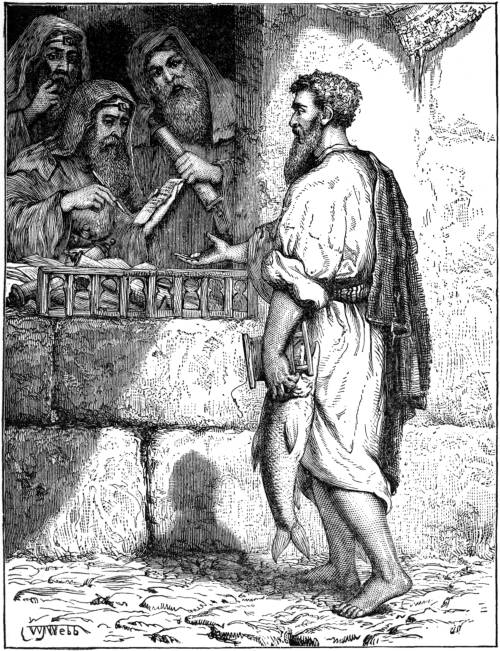
It was a part of the Jewish law that all strangers passing among the Jews should pay to the priests of the Temple an offering to the Lord, or tribute-money as it was called.

Soon after our Lord’s Transfiguration He came to Capernaum, together with His disciples. When they had entered the city, there came to them the priests who usually collected this tribute-money, and they said unto Peter, “Doth not thy Master pay tribute?” And he answered, “Yes.” But when they had come to the house, Jesus said to Peter, “What thinkest thou, Simon? Of whom do they take tribute; of their own people or of strangers?” And Peter answered Him, “Of strangers.”

Jesus saith unto him, “Then their own people are free; but lest we should offend them by not paying, go thou down to the sea, and cast in thy hook and line, and take up the first fish that taketh the hook into his mouth. And when thou hast opened his mouth, thou shalt find a piece of money there. Take it and give it unto the priests as tribute for Me and for thee.” And Peter went down to the sea and cast in his line, and took a big fish. And when he had opened its mouth he found the piece of silver, and took it to the men in payment of the tribute.

This tribute was collected to pay the expenses of the Temple worship. Jesus sought to show that, as He himself was the Son of God, the King for whose service the tribute was paid, He might justly be exempted from paying it; yet to save giving offence He miraculously provided the piece of money to pay tribute for Himself and Peter.

Seeking God’s Kingdom: What Matthew 6:33 Teaches Us

But see ye first the Kingdom of God, and his righteousness and all these things shall be added unto you Matthew 6:33

What Does it Say

It says we should seek God Kingdom.

WORD MEANINGS

  • Seek: G2212
    • ζητέω zētéō, dzay-teh’-o; of uncertain affinity; to seek (literally or figuratively); specially, (by Hebraism) to worship (God), or (in a bad sense) to plot (against life):—be (go) about, desire, endeavour, enquire (for), require, (X will) seek (after, for, means). Compare G4441.
  • Kingdom: G932
    • βασιλεία basileía, bas-il-i’-ah; from G935; properly, royalty, i.e. (abstractly) rule, or (concretely) a realm (literally or figuratively):—kingdom, + reign.
  • Righteousness: G1343
    • δικαιοσύνη dikaiosýnē, dik-ah-yos-oo’-nay; from G1342; equity (of character or act); specially (Christian) justification:—righteousness.

What does it mean?
When you do God, work he Will the give you things you need

Context

Author: Audience:When :Style: Purpose:
Matthew Jews70 ADTeaching To instruct

What happening in the verse

Jesus was teaching

OTHER TRANSLATIONS

  • Amplified
    •  But first and most importantly seek (aim at, strive after) His kingdom and His righteousness [His way of doing and being right—the attitude and character of God], and all these things will be given to you also. Matthew 6:33
  • Holman  Christian  Standard
    •  But seek first the kingdom of God and His righteousness, and all these things will be provided for you. Matthew 6:33

RELATED VERSES

  • Matthew 5:6
    • Blessed are they which do hunger and thirst after righteousness: for they shall be filled.
  • Luke 12:31
    • But rather seek ye the kingdom of God; and all these things shall be added unto you.
  • Matthew 3:2
    •  “Repent, for the kingdom of heaven is at hand.”
  • Romans 1:17
    • For therein is the righteousness of God revealed from faith to faith: as it is written, The just shall live by faith.

What should we do?

We should seek God’s Kingdom and his righteousness. When we do this God will provide for ours needs.

THE WOMAN OF CANAAN

THE WOMAN OF CANAAN

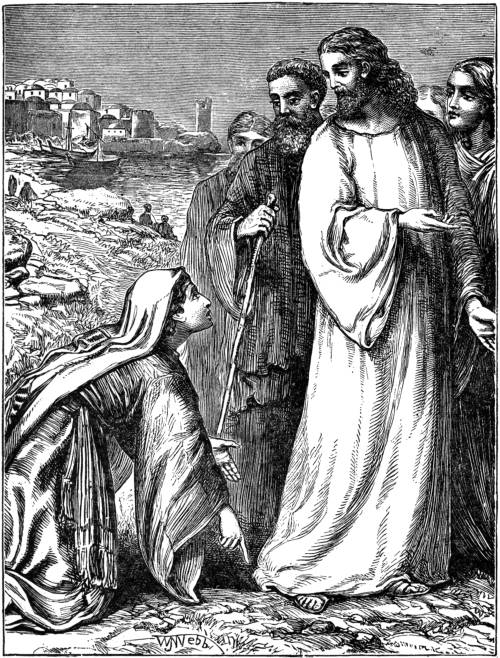
Jesus came unto the borders of Tyre and Sidon, where the people were not Jews, but Gentiles. And there came to Him a woman of Canaan, who cried out to Him, saying, “Have mercy on me, O Lord, Thou son of David; my daughter is grievously vexed with a devil.” She besought Him to cast out this evil spirit from her daughter. But He answered not a word, and His disciples counselled Him to send her away. Then He told her He was not sent unto the Gentiles, but unto the lost sheep of Israel; meaning the Jews. This was said to try her faith. Then she came and worshipped Him, saying, “Lord, help me.” But He said, “It is not meet to take the children’s food and to cast it to dogs;” meaning that His help was due rather to the Jews than to the Gentiles. And she said, “Truth, Lord, yet the dogs sometimes eat of the crumbs which fall from their masters’ table;” meaning that, though she was a Gentile, she believed in Him as the Son of God.

Then Jesus answered, and said unto her, “O woman, great is thy faith; be it unto thee even as thou desirest. Go thy way; the devil has gone out of thy daughter.” And when she was come to her house she found her daughter made whole and laid upon the bed.

Jesus, with His knowledge of our hearts, knew the faith this poor woman had, and tried it so that it might shine the brighter. Then He granted her the blessing she had asked Him for; and how she must have rejoiced when she reached home and found her daughter quite well and restored to her right mind.

Prophecies of Balaam Concerning Israel

THE FOUR PROPHECIES OF BALAAM (Numbers 23:9-17)
Balaam makes some major predictions called “parables” which are actually prophecy concerning Israel.

  • Numbers 23:5-7 And the Lord put a word in Balaam’s mouth, and said, Return unto Balak, and thus thou shalt speak. And he returned unto him, and, lo, he stood by his burnt sacrifice, he, and all the princes of Moab. And he took up his parable, and said, Balak the king of Moab hath brought me from Aram, out of the mountains of the east, saying, Come, curse me Jacob, and come, defy Israel.
  • Numbers 23:18 And he took up his parable, and said, Rise up, Balak, and hear; hearken unto me, thou son of Zippor:
  • Numbers 24:2-3 And Balaam lifted up his eyes, and he saw Israel abiding in his tents according to their tribes; and the spirit of God came upon him. And he took up his parable, and said, Balaam the son of Beor hath said, and the man whose eyes are open hath said:

The First Prophecy (Numbers 23:9-10)

  • Numbers 23:9-10 For from the top of the rocks I see him, and from the hills I behold him: lo, the people shall dwell alone, and shall not be reckoned among the nations. Who can count the dust of Jacob, and the number of the fourth part of Israel? Let me die the death of the righteous, and let my last end be like his!
    • Balaam’s first prophecy predicts that Jacob (Israel) will become a countless multitude as plentiful as dust.
      • God gave Abram (Abraham) a similar prediction when He said Abram’s seed would be numerous as dust. (see Gen. 13:16)
    • Balaam says Israel will “dwell alone” and not be “reckoned among the nations.”
      • From AD 70 to 1948, Israel did not exsis as a nation; thus, other nations did not recognize her.
      • Since 1948, the Jewish state has often stood alone as enemies have risen from within and without. Israel has conducted six major wars.
      • The “fourth part of Israel” may allude to the division of the camps into four sections around the tabernacle. From the mountain, Balaam could not even count one-fourth of the number of people in one section of the camp

The Second Prophecy (Numbers 23:21-24)

  •  Numbers 23:21-24 He hath not beheld iniquity in Jacob, neither hath he seen perverseness in Israel: the Lord his God is with him, and the shout of a king is among them. God brought them out of Egypt; he hath as it were the strength of an unicorn. Surely there is no enchantment against Jacob, neither is there any divination against Israel: according to this time it shall be said of Jacob and of Israel, What hath God wrought! Behold, the people shall rise up as a great lion, and lift up himself as a young lion: he shall not lie down until he eat of the prey, and drink the blood of the slain.
    • Balaam says that Israel has kept its spiritual integrity, steered clear of perverseness, and is destined to become a ruling nation. He speaks of a great lion and a young lion, echoing Jacob’s final blessing to his son Judah. Jacob foretold that Judah would be like a lion and that a ruler would come from him.
      • Genesis 49:9-10 Judah is a lion’s whelp: from the prey, my son, thou art gone up: he stooped down, he couched as a lion, and as an old lion; who shall rouse him up? The sceptre shall not depart from Judah, nor a lawgiver from between his feet, until Shiloh come; and unto him shall the gathering of the people be.
    • Shiloh is referring to the Messiah.


The Third Prophecy (24:5-9)

  • Numbers 24:5-9 How goodly are thy tents, O Jacob, and thy tabernacles, O Israel! As the valleys are they spread forth, as gardens by the river’s side, as the trees of lign aloes which the Lord hath planted, and as cedar trees beside the waters. He shall pour the water out of his buckets, and his seed shall be in many waters, and his king shall be higher than Agag, and his kingdom shall be exalted. God brought him forth out of Egypt; he hath as it were the strength of an unicorn: he shall eat up the nations his enemies, and shall break their bones, and pierce them through with his arrows. He couched, he lay down as a lion, and as a great lion: who shall stir him up? Blessed is he that blesseth thee, and cursed is he that curseth thee.
    • The promise of blessing on those who bless and cursing on those who curse Israel is the same promise given Abram (Abraham) at the beginning of the Abrahamic covenant.
      • Gen. 12:1-3 Now the Lord had said unto Abram, Get thee out of thy country, and from thy kindred, and from thy father’s house, unto a land that I will shew thee: And I will make of thee a great nation, and I will bless thee, and make thy name great; and thou shalt be a blessing: And I will bless them that bless thee, and curse him that curseth thee: and in thee shall all families of the earth be blessed.
    • The phrase his seed shall be in many waters may allude to the Jewish people who will eventually dwell throughout the world.
    • As in the second prophecy, the lion emblem represents Judah, the tribe of David, and Jesus Christ.
    • “his king shall be higher than Agag”
      • 1 Samual 15:7-8 And Saul smote the Amalekites from Havilah until thou comest to Shur, that is over against Egypt. And he took Agag the king of the Amalekites alive, and utterly destroyed all the people with the edge of the sword.
    • “God brought him forth out of Egypt”
      •  Matthew 2:15 And was there until the death of Herod: that it might be fulfilled which was spoken of the Lord by the prophet, saying, Out of Egypt have I called my son.

The Fourth Prophecy Numbers 24:17

  • Numbers 24:17-19 I shall see him, but not now: I shall behold him, but not nigh: there shall come a Star out of Jacob, and a Sceptre shall rise out of Israel, and shall smite the corners of Moab, and destroy all the children of Sheth. And Edom shall be a possession, Seir also shall be a possession for his enemies; and Israel shall do valiantly. Out of Jacob shall come he that shall have dominion, and shall destroy him that remaineth of the city.
    • The prophecy “a Star out of Jacob” is believed to be what the wise men allude to when they search for the infant Christ Child and reported, “We have seen his star in the east” (Matt. 2:2).
      • Christ’s birth, accompanied by a unique cosmic sign, occurred in Bethlehem of Judea (see Matt. 2:1).
    • The word Scepter used in Numbers 24:17 relates to rulership; Jacob used the word when he predicted that the sceptre would not depart from Judah until Shiloh (a name used to identify the Messiah) comes (see Gen. 49:10).
    • The phrase “Out of Jacob shall come he that shall have dominion” is about Jesus. He came out of Jacob (Israel).
      • Matthew 28:18 And Jesus came and spake unto them, saying, All power is given unto me in heaven and in earth.

How Balaam Led Israel into Sin: A Biblical Analysis

THE BALAAM STRATEGY (Numbers Chapters 22-25)
The story of the prophet Balaam offers an important spiritual lesson relevant for believers today. God grants a unique gift to speak blessings or curses into existence. The King of Moab, Balak, tries to hire Balaam to curse the people of Israel.

  • Numbers 22:5-7 He sent messengers therefore unto Balaam the son of Beor to Pethor, which is by the river of the land of the children of his people, to call him, saying, Behold, there is a people come out from Egypt: behold, they cover the face of the earth, and they abide over against me:
  • Come now therefore, I pray thee, curse me this people; for they are too mighty for me: peradventure I shall prevail, that we may smite them, and that I may drive them out of the land: for I wot that he whom thou blessest is blessed, and he whom thou cursest is cursed.
  • And the elders of Moab and the elders of Midian departed with the rewards of divination in their hand; and they came unto Balaam, and spake unto him the words of Balak.

However, every time Balaam opens his mouth to curse, blessings pour out instead. Balak keeps pressuring him with rewards, but Balaam tells the king, “How shall I curse whom God has not cursed? Or how shall I defy whom the Lord has not defied?” (Num. 23:8). After several attempts, Balaam cannot speak evil against Israel. So why is his name viewed so negatively in Scripture? The New Testament mentions Balaam in three passages, and when we put them together, a different side of the story emerges.

  • 2 Peter 2:15 Which have forsaken the right way, and are gone astray, following the way of Balaam the son of Bosor, who loved the wages of unrighteousness;
  • Jude 11 Woe unto them! for they have gone in the way of Cain, and ran greedily after the error of Balaam for reward, and perished in the gainsaying of Core.
  • Revelation 2:14 But I have a few things against thee, because thou hast there them that hold the doctrine of Balaam, who taught Balac to cast a stumblingblock before the children of Israel, to eat things sacrificed unto idols, and to commit fornication.

Balaam’s wrongdoing was one of compromise, accepting payment from Balak to plot against God’s people. When his attempt to curse them failed and he could only speak the words God gave him, Balaam devised a plan that would tarnish his name among the Hebrews forever. Knowing he couldn’t directly curse Israel, he realized that if they sinned against God, God Himself would be obliged to bring judgment on them. His new scheme aimed to lead the Hebrew people into breaking God’s commandments, ensuring they brought disfavor and punishment upon themselves.

The plan involved introducing some Moabite women to the young Hebrew men in the Israelite camp. These women could entice the men into acts of sexual immorality, leading to a plague on the nation. Numbers 25:1-3 describes how this unfolded.

  • And Israel abode in Shittim, and the people began to commit whoredom with the daughters of Moab. And they called the people unto the sacrifices of their gods: and the people did eat, and bowed down to their gods. And Israel joined himself unto Baalpeor: and the anger of the Lord was kindled against Israel.

The plan works. The women of Moab mix with the sons of the Hebrews, and a plague sweeps through the camp, taking twenty-four thousand lives (see Num. 25:9). Moses calls for harsh punishment for those who broke the rules. With so many people, sin and rebellion could quickly spread and cause the loss of God’s favor.

As believers, when we walk in love and live by the New Covenant, we enjoy God’s blessings in every area of life—spirit, mind, soul, family, finances, and health.

  • 3 John 2 Beloved, I wish above all things that thou mayest prosper and be in health, even as thy soul prospereth.

When we drift from the truth and fall into sin, we not only give the enemy an opportunity but also cut off the flow of spiritual blessings. Knowing he can’t curse believers—since we’ve been “redeemed from the curse”

  • Galatians 3:13 Christ hath redeemed us from the curse of the law, being made a curse for us: for it is written, Cursed is every one that hangeth on a tree:

The enemy works to tempt us into disobeying God and His Word. Without repentance, we open ourselves to discipline and judgment for our sins.

  • Hebrews 12:5-8 And ye have forgotten the exhortation which speaketh unto you as unto children, My son, despise not thou the chastening of the Lord, nor faint when thou art rebuked of him:
  • For whom the Lord loveth he chasteneth, and scourgeth every son whom he receiveth.
  • If ye endure chastening, God dealeth with you as with sons; for what son is he whom the father chasteneth not?
  • But if ye be without chastisement, whereof all are partakers, then are ye bastards, and not sons.

Feeding Five Thousand

FEEDING FIVE THOUSAND

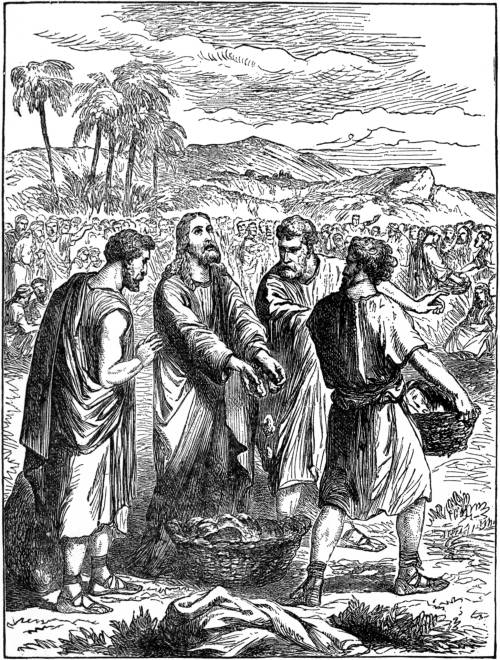
One day Jesus went on board a ship and sailed to another part of the coast, where He and His disciples might have rest. For the people in the cities crowded them so closely that they did not even have time to eat. They landed and went into a desert place; but the people had seen them depart and marked which way the ship sailed. Then they all flocked out of the cities and came on foot to the place where Jesus was. When Jesus saw what a great number of people had come, He had compassion on them, and spoke to them, and healed their sick. But in the evening the disciples came to Jesus and said, “This is a desert place, and the day has gone; send the people away, that they may go into the villages and buy food.”

Jesus was too kind to send them away hungry like that. He said, “They need not depart; give ye them food to eat.” But they said to Him, “We have here but five loaves and two fishes, which we have just purchased of a lad.” He said, “Bring them to Me.” Then He told the people to sit down on the grass; and He took the five loaves and the two fishes, and looking up to heaven, blessed them and broke them into pieces. The disciples carried the bread and fish to the people, and they all ate and had plenty, although there were about five thousand men, besides women and children. And yet, when the disciples took up the fragments that were left, these fragments filled twelve baskets. How kind was Jesus! He not only taught the people and healed their sick, but He fed them when out in the desert place and hungry.

Winter Themes: Bible, Cooking, Educational, Poems, and More

Stories/ Books

Hanukkah