A place to grow your relationship with God

Posts tagged ‘faith’

SEEKING FOR HIDDEN TREASURE

SEEKING FOR HIDDEN TREASURE

The people of Canaan, both in ancient and modern days, have made a practice of hiding their treasures. This they have done to secure them in times of danger. When invaders flocked into the land, the people buried their gold and jewels and fled. And often they died, or were overtaken by their enemies and killed, so that they were unable to return and regain their buried riches. Earthquakes also have taken place, destroyed towns and villages, and burying all the riches in them beneath their ruins. Thus, there is much hidden treasure in Canaan, and numbers of the inhabitants spend their time seeking diligently and anxiously for it.

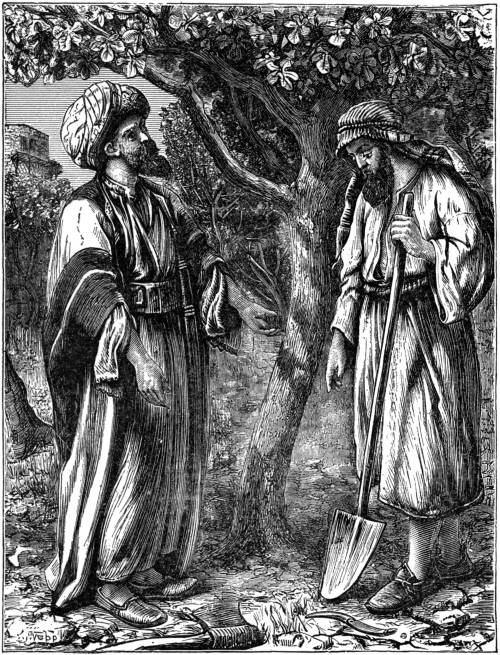
Our artist shows us a man who is thus seeking. He has heard that in old times a great treasure was hidden in a particular field. So, he digs away patiently in various places until, at last, he finds out that what he heard is quite true. He is sure the treasure is there; and his desire is to become possessed of the field, so that he may obtain the buried riches. He is willing to sell all that he has if by so doing he may buy that field. So, he hastens home and gathers together the whole of his property and sells it. Then he takes his money to the man who has the land for sale and buys the field of him. Thus, he becomes possessed of the treasure he has sought after. Jesus says that the Kingdom of Heaven is like that treasure. It is so precious, that when a man finds out its value, and knows how it can be obtained, he will be willing to give up everything he has for it—all his companions, pleasures, sins, riches—indeed everything he possesses, in order to gain this great treasure.
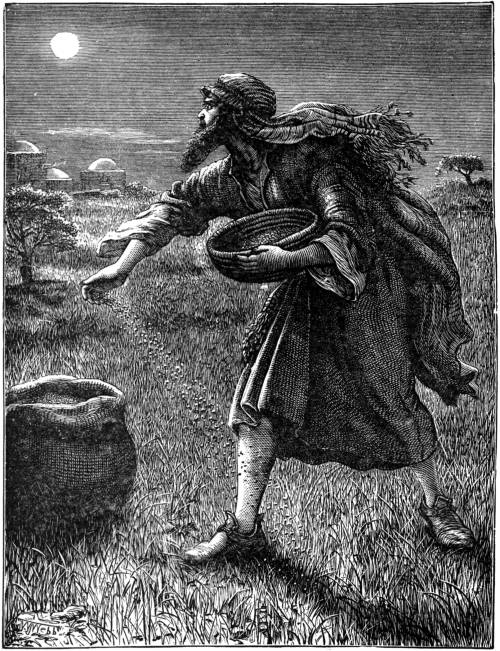
The Enemy Sowing Tares

THE ENEMY SOWING TARES

A certain man sowed good seed in his field, but in the night, whilst men slept, his enemy came and sowed tares among the wheat and went his way. When the wheat-blade had sprung up and showed the ear, then appeared the tares also. So, the servants of the householder came to him and said, “Sir, didst not thou sow good seed in thy field? Whence then come these tares?”

He said unto them, “An enemy hath done this.” Then the servants asked, “Shall we go, then, and gather them up?” But he said, “Nay, lest whilst you gather up the tares, you root up the wheat with them. Let both grow together until the harvest, and in that time, I will say to the reapers, ‘Gather ye together first the tares and bind them into bundles to burn them, but gather the wheat into my barn.'”

THE ENEMY SOWING TARES

Jesus’ disciples asked Him to explain this parable to them, and He said: “The field represents the world, and He that sowed the good seed is Christ Himself. The good seed is the Word He preached; the wheat plants are the good people who believe in Christ and do as He teaches. The enemy who sows the bad seed is Satan, and the tares that spring from them are wicked people who follow the promptings of the evil one in their hearts. The harvest is the end of the world, and the reapers are the angels of God. As therefore the tares are gathered and burned in the fire, so shall it be in the end of this world with wicked people. Christ shall send forth His angels, and they shall gather out of His Kingdom all things that offend and them that do evil and shall cast them into a furnace of fire; there shall be wailing and gnashing of teeth. Then shall the righteous shine forth as the sun in the kingdom of their Father.”

“For the Lord our God shall come, and shall take His harvest home; From His field shall in that day All offences purge away.

“Give His angels charge at last in the fire the tares to cast, But the fruitful grain to store In His garner evermore.”

The Children’s Six Minutes: What Did You See?

WHAT DID YOU SEE?

A few days ago I made a trip on the train. When I returned home one of the first questions my little boy asked me was, “What did you see?” I shall tell you what I told him.

Looking out of the car window I saw an immense field, acres and acres, and in that field were planted hundreds, yes thousands, of little trees. I inquired of the man who sat next me, “What are those little trees for?” He said, “They are growing those little trees to reforest the desolate, burned over regions of the Adirondacks.” I said to myself, “That is just what we are doing in my church. We are growing girls and boys to reforest the needy places of the earth.” I inquired, “How long do they keep those little trees there?” “Not very long,” said he, “just long enough to give them a good start. Then they transplant them.” Again I said to myself, “That is exactly what we do. We keep the girls and boys only a little while, then they are transplanted.”

I had another question. “When they transplant these little trees how do they plant them, haphazard, every-which-way?” “No, indeed,” was his answer, “they are planted in rows, and close together.” Exactly what we are doing in our church, I thought. We are growing our girls and boys, and we are keeping them close together, because they are such a help to one another, and there is great inspiration in numbers.

Looking out of the train window at those trees of future forests, I thought of the verse in Isaiah, “The mountains and the trees shall break forth before you into singing, and all the trees of the field shall clap their hands.” I can hear the mountains and the hills of the Adirondacks singing because of the growing trees, and I hear the mountains and the hills of earth singing because of the millions of growing girls and boys who shall reforest the desolate places of earth.

MEMORY VERSE, Psalm 92: 13

“Those that be planted in the house of the Lord shall flourish in the courts of our God.”

MEMORY HYMN

“Saviour, like a shepherd lead us.”

Weekly Recap of Articles for Christians posted Nov 9th through Nov 15th

Cooking/ House Keeping

Exploring Noah’s Descendants and Their Modern Connections

Noah had three sons. From those three sons all of the nations of the world came from. Here is a list of the sons of Noah, where they settled, and some of their descendants.

The Descendants of Japhet

Son’s NameThe Modern Land Area of Nations (People groups)
GomerThe Land of Germany in Europe
MagogDwellers north of the Black Sea
MadaiMedes in the Northwest of Iran
JavanSome of the original Greek tribes
TubalRegions of Spain and Portugal
MeshechRussia, especially regions in and around Georgia
TirasThe Persians and the area of Iran
Son of JaphetGrandsons of Japhet
Gomer1. Ashken
2. Riphath
3. Togarmah
Magog?
Madai?
Javan1. Elishah
2. Tarshish
3. Kittim
4. Dodanim
Tubal?
Meshech?
Tiras?

The Descendants of Ham

Son’s NameModern Land Areas or Nations (People Groups)
CushSouth of Egypt in northern Africa
MizraimAreas of upper and lower Egypt
PhutLibya
CanaanAncient land of Israel and Lebanon
Sons Of HamGrandsons of Ham
Cush1. Seba
2. Havilah
3. Sabtah
4. Raamah (had 2 sons: Sheba and Dedan)
5. Sabtecha
6. Nimrod (lived in babel which is the area of Babylon)
Mizraim1. Ludim
2. Anamim
3. Lehabim
4. Naphtuhim
5. Pathrusim
6. Casluhim (The Philistines descended from him)
7. Caphtorim
Phut?
Canaan (the father of the various groups that the Israelites had to fight to possess the promise land)1. Sidon
2. Heth
3. Jebusite
4. Amorite
5. Girgasite
6. Hivite
7. Arkite
8. Sinite
9. Aradite
10. Zemarite
11. Hamathite

The Descendants of Shem

Sons of ShemModern Land area or Nations (people groups)
ElamConsidered part of Iran
AshurAssyria, which is Syria today
ArphaxadThe banks of the Euphrates, Turkey, and Iraq
LudAncient people living in Iraq
AramThe region of Syria and Lebanon
Sons of ShemGrandsons of Shem
Elam?
Ashur?
Arphaxad1. Salah (the father of Eber)
Lud?
Aram1. Uz
2. Hul
3. Gether
4. Mash

Understanding Jesus’ Return: Myths and Truths

The subject of when Jesus is returning has gotten a lot of attention lately. It seems that many people have an idea, a thought, or a theory. It is not wrong to try to look at the Bible and then try to think about what is happening in the world around you. I even have thoughts, ideas, and theories, but until Jesus arrives it will stay a thought, idea, or theory. It is wrong however, to say that you know when Jesus is coming.

  • Matthew 24:36-39  But of that day and hour knoweth no man, no, not the angels of heaven, but my Father only. But as the days of Noah were, so shall also the coming of the Son of man be. For as in the days that were before the flood they were eating and drinking, marrying and giving in marriage, until the day that Noe entered into the ark, And knew not until the flood came, and took them all away; so shall also the coming of the Son of man be.

Anyone who says that they know the day and hour when Jesus is returning is a false prophet.

  • Matthew 24:24 For there shall arise false Christs, and false prophets, and shall shew great signs and wonders; insomuch that, if it were possible, they shall deceive the very elect.

As time draws near, it may be possible to have a really good idea of the season.

People have had various ideas for the last few centuries. Even Paul had to deal with some false prophets spreading false information.

  • 2 Thessalonians 2:1-5 Now in regard to the coming of our Lord Jesus Christ and our [a]gathering together to meet Him, we ask you, brothers and sisters, not to be quickly unsettled or alarmed either by a [so-called prophetic revelation of a] spirit or a message or a letter [alleged to be] from us, to the effect that the day of the Lord has [already] come. Let no one in any way deceive or entrap you, for that day will not come unless the apostasy comes first [that is, the great rebellion, the abandonment of the faith by professed Christians], and the man of lawlessness is revealed, the son of destruction [the Antichrist, the one who is destined to be destroyed], who opposes and exalts himself [so proudly and so insolently] above every so-called god or object of worship, so that he [actually enters and] takes his seat in the temple of God, publicly proclaiming that he himself is God. Do you not remember that when I was still with you, I was telling you these things?

Today, we still have people proclaiming that they have had prophetic revelation. The best way to test a prophet is the wait and see test. If what the prophet says is true, it will come to pass otherwise the prophet is false.

Instead of running after every prophet that comes around, how about being more productive. There are several things that would be more productive than chasing after new prophetic revelations.

  • Reading and studying your Bible.
  • Praying.
  • Sharing the gospel with others.
  • Helping others by:
    • volunteering
    • donating
    • visiting the shut-ins
      • in their homes
      • in the nursing homes
      • in the hospitals
    • looking in on the widows.
    • being concerned about the orphans.
    • caring for the weakest in society.

Not everyone is called to do everything, but everyone is called to do something. Pray about what you are called to do. It could be simply helping others with what they are doing, or it could be something more. That is between you and God.

  • 1 Corinthians 12:27-31 Now ye are the body of Christ, and members in particular. And God hath set some in the church, first apostles, secondarily prophets, thirdly teachers, after that miracles, then gifts of healings, helps, governments, diversities of tongues. Are all apostles? are all prophets? are all teachers? are all workers of miracles? Have all the gifts of healing? do all speak with tongues? do all interpret? But covet earnestly the best gifts: and yet shew I unto you a more excellent way.

The Great Destruction of a City

The Old Testament prophets continually foretold the gathering again of the Jews to their land. However, the Romans dispersed the Jews from their land and destroyed the city of Jerusalem. Jesus foretold this to His disciples. In Luke 49:41-44, Jesus told of the coming destruction of the city of Jerusalem.

  • Luke 49:41-44 And when he was come near, he beheld the city, and wept over it, Saying, If thou hadst known, even thou, at least in this thy day, the things which belong unto thy peace! but now they are hid from thine eyes. For the days shall come upon thee, that thine enemies shall cast a trench about thee, and compass thee round, and keep thee in on every side, And shall lay thee even with the ground, and thy children within thee; and they shall not leave in thee one stone upon another; because thou knewest not the time of thy visitation.

Jerusalem: Jewish Pivotal point

  • Jerusalem was the center of activity for the Jews, the center of their religion because the Temple was there.
  • Jerusalem was also the center of commerce.

Jesus Wept over Jerusalem

  • When Jesus was on His way to Jerusalem just before He was arrested. He stopped and wept over Jerusalem and said:
    • Matthew 23:37-38 O Jerusalem, Jerusalem, thou that killest the prophets, and stonest them which are sent unto thee, how often would I have gathered thy children together, even as a hen gathereth her chickens under her wings, and ye would not! Behold, your house is left unto you desolate.

Jerusalem Destroyed by the Armies of Titus

  • After the death of Jesus, the Jews revolted against Roman rule.
  • In the year 70 A.D., General Titus and the Roman army laid siege to the city of Jerusalem.
  • The people of Jerusalem would not feel the strong might of the Roman Empire.
  • The city was destroyed because:
    • The was God’s judgment for their sin.
    • The Romans wanted to stamp out the Jewish religion.
    • The Romans wanted to destroy the Jewish nation.
  • The destruction was quite a feat itself.
  • The historian Josephus said that some of the stones were 94 feet long, 10.5 feet tall, and 13 feet thick.
  • Jesus had said:
    • Matthew 24:2 And Jesus said unto them, See ye not all these things? verily I say unto you, There shall not be left here one stone upon another, that shall not be thrown down.

Unlocking Biblical Prophecies Through History

THE FUTURE IS ENCODED IN THE PAST

The thing that hath been, it is that which shall be; and that which is done is that which shall be done: and there is no new thing under the sun. Ecclesiastes 1:9

There is a saying that says: If you don’t learn from the past, you are doomed to repeat it.

Jewish sages observe that history is cyclical, with events repeating in patterns. One approach to predicting future events is to examine a historical event or a chapter in the Bible by reading its order in reverse rather than forward. For example, when reading the list of nations in Genesis 10 from verse 32 back to verse 2, the chapter appears to outline the sequence of prophetic events expected to happen in the future, particularly concerning the nation of Israel.

Please take a look at Exploring Noah’s Descendants and Their Modern Connections. It will help you understand the various connections between the different events.

The earth after the flood

  • Gen. 10:32 These are the families of the sons of Noah, after their generations, in their nations: and by these were the nations divided in the earth after the flood.
  • The earth was covered with water. Genesis 1:2

The Seth genealogy

  • Gen 10:31 These are the sons of Shem, after their families, after their tongues, in their lands, after their nations.
  • The Seth genealogy (Gen. 5:3-8)
    •  And Adam lived an hundred and thirty years, and begat a son in his own likeness, and after his image; and called his name Seth:
    • And the days of Adam after he had begotten Seth were eight hundred years: and he begat sons and daughters:
    • And all the days that Adam lived were nine hundred and thirty years: and he died.
    • And Seth lived an hundred and five years, and begat Enos:
    • And Seth lived after he begat Enos eight hundred and seven years, and begat sons and daughters:
    • And all the days of Seth were nine hundred and twelve years: and he died.

The land of the east

  • Gen 10:30  And their dwelling was from Mesha, as thou goest unto Sephar a mount of the east.
  • The land of the east (near Eden) Gen. 11:2
    • And it came to pass, as they journeyed from the east, that they found a plain in the land of Shinar; and they dwelt there.

Men Listed in the Generations

  • Gen 10:26-29 And Joktan begat Almodad, and Sheleph, and Hazarmaveth, and Jerah, And Hadoram, and Uzal, and Diklah, And Obal, and Abimael, and Sheba, And Ophir, and Havilah, and Jobab: all these were the sons of Joktan.
    • There were 13 sons.
  • Thirteen generations from Adam to Eber (Gen 5:3-32 and Gen 10:21-25)
    • Adam – Seth – Enos – Cainan – Mahalaleel – Jard – Enoch – Methuselah – Lamech – Noah – Shem – Arphaxad – Salah – Eber

Beginning of Shem’s family

  • Gen 10:21 Unto Shem also, the father of all the children of Eber, the brother of Japheth the elder, even to him were children born.
  • Beginning of Israel as a nation. (Gen 12)
    •  Gen. 12:1-2 Now the Lord had said unto Abram, Get thee out of thy country, and from thy kindred, and from thy father’s house, unto a land that I will shew thee: And I will make of thee a great nation, and I will bless thee, and make thy name great; and thou shalt be a blessing:

The land of Ham (Egypt)

  • Gen 10:20 These are the sons of Ham, after their families, after their tongues, in their countries, and in their nations.
  • Israel leaves Egyptian slavery (Exodus 12)
    • Exodus 12:26-28 And the Lord gave the people favour in the sight of the Egyptians, so that they lent unto them such things as they required. And they spoiled the Egyptians. And the children of Israel journeyed from Rameses to Succoth, about six hundred thousand on foot that were men, beside children.
    • And a mixed multitude went up also with them; and flocks, and herds, even very much cattle.

Canaan

  • Gen 10:19 And the border of the Canaanites was from Sidon, as thou comest to Gerar, unto Gaza; as thou goest, unto Sodom, and Gomorrah, and Admah, and Zeboim, even unto Lasha.
  • Israel enters Canaan land (Joshua chapters 6-7)

The Canaanites

  • Gen 10:15-18 And Canaan begat Sidon his first born, and Heth, And the Jebusite, and the Amorite, and the Girgasite, And the Hivite, and the Arkite, and the Sinite, And the Arvadite, and the Zemarite, and the Hamathite: and afterward were the families of the Canaanites spread abroad.
  • Israel battles the Canaanites. (the book of Judges)
    • Judges 1:2-6 And the Lord said, Judah shall go up: behold, I have delivered the land into his hand. And Judah said unto Simeon his brother, Come up with me into my lot, that we may fight against the Canaanites; and I likewise will go with thee into thy lot. So Simeon went with him. And Judah went up; and the Lord delivered the Canaanites and the Perizzites into their hand: and they slew of them in Bezek ten thousand men. And they found Adonibezek in Bezek: and they fought against him, and they slew the Canaanites and the Perizzites. But Adonibezek fled; and they pursued after him, and caught him, and cut off his thumbs and his great toes.

The Philistines

  • Gen 10:13-14 And Mizraim begat Ludim, and Anamim, and Lehabim, and Naphtuhim, And Pathrusim, and Casluhim, (out of whom came Philistim,) and Caphtorim.
  • Israel battles the Philistines. (1 Samuel and 2 Samuel)
    • 1 Samuel 1:1-3 Now the Philistines gathered together their armies to battle, and were gathered together at Shochoh, which belongeth to Judah, and pitched between Shochoh and Azekah, in Ephesdammim. And Saul and the men of Israel were gathered together, and pitched by the valley of Elah, and set the battle in array against the Philistines. And the Philistines stood on a mountain on the one side, and Israel stood on a mountain on the other side: and there was a valley between them.

Assyria

  • Gen 10:11-12 Out of that land went forth Asshur, and builded Nineveh, and the city Rehoboth, and Calah, And Resen between Nineveh and Calah: the same is a great city.
  • Israel taken into Assyrian captivity (1 Kings 11:31-35)
    •  And he said to Jeroboam, Take thee ten pieces: for thus saith the Lord, the God of Israel, Behold, I will rend the kingdom out of the hand of Solomon, and will give ten tribes to thee:
    • (But he shall have one tribe for my servant David’s sake, and for Jerusalem’s sake, the city which I have chosen out of all the tribes of Israel:)
    • Because that they have forsaken me, and have worshipped Ashtoreth the goddess of the Zidonians, Chemosh the god of the Moabites, and Milcom the god of the children of Ammon, and have not walked in my ways, to do that which is right in mine eyes, and to keep my statutes and my judgments, as did David his father.
    • Howbeit I will not take the whole kingdom out of his hand: but I will make him prince all the days of his life for David my servant’s sake, whom I chose, because he kept my commandments and my statutes:
    • But I will take the kingdom out of his son’s hand, and will give it unto thee, even ten tribes.

Babylon

  • Gen 10:10 And the beginning of his kingdom was Babel, and Erech, and Accad, and Calneh, in the land of Shinar.
  • Israel taken captive into Babylon. (the book of Daniel)
    • Daniel 1:1 In the third year of the reign of Jehoiakim king of Judah came Nebuchadnezzar king of Babylon unto Jerusalem, and besieged it.

Nimrod King of Babylon

  • Gen 10:7-9 And the sons of Cush; Seba, and Havilah, and Sabtah, and Raamah, and Sabtechah: and the sons of Raamah; Sheba, and Dedan. And Cush begat Nimrod: he began to be a mighty one in the earth. He was a mighty hunter before the Lord: wherefore it is said, Even as Nimrod the mighty hunter before the Lord.
  • Nebuchadnezzar, King of Babylon (Daniel Chapters 1-4)

The four sons of Ham

  • Gen 10:6 And the sons of Ham; Cush, and Mizraim, and Phut, and Canaan.
  • The four kingdoms of bondage (Daniel’s prophecy’s)
    • Daniel 7:17 These great beasts, which are four, are four kings, which shall arise out of the earth.
      • 1st beast
        • Traditionally identified as Babylon
          • The first was like a lion, and had eagle’s wings: I beheld till the wings thereof were plucked, and it was lifted up from the earth, and made stand upon the feet as a man, and a man’s heart was given to it.
      • 2nd beast
        • It is thought to represent the Medes-Persian Empire that overthrew Babylon.
          • And behold another beast, a second, like to a bear, and it raised up itself on one side, and it had three ribs in the mouth of it between the teeth of it: and they said thus unto it, Arise, devour much flesh.
      • 3rd beast
        • It is thought to represent the kingdom of Greece. Alexander the Great was the leader of Greece who overthrew the Medes-Persian Empire.
          • After this I beheld, and lo another, like a leopard, which had upon the back of it four wings of a fowl; the beast had also four heads; and dominion was given to it.
          • The four wings are thought to represent the four generals of Alexander the Great that divided the land after Alexander’s death.
            • Daniel 11:3-4 And a mighty king shall stand up, that shall rule with great dominion, and do according to his will. And when he shall stand up, his kingdom shall be broken, and shall be divided toward the four winds of heaven; and not to his posterity, nor according to his dominion which he ruled: for his kingdom shall be plucked up, even for others beside those. And the king of the south shall be strong, and one of his princes; and he shall be strong above him, and have dominion; his dominion shall be a great dominion.
GeneralThe Region TakenModern Geographical Area
PtolemyEgypt and northern AfricaEgypt, Libya, and Northern Africa
SeleucusAssyria, Mesopotamia and PersiaLebanon, Syria and Iraq, Iran
LysimachusThrace and Asia MinorTurkey and southern Russia
CassanderGreece and MacedoniaGreece, Bulgaria, and Romania
  • 4th beast
    • Traditionally taught that it is Rome.
      • After this I saw in the night visions, and behold a fourth beast, dreadful and terrible, and strong exceedingly; and it had great iron teeth: it devoured and brake in pieces, and stamped the residue with the feet of it: and it was diverse from all the beasts that were before it; and it had ten horns.

The isles of the Gentiles

  • Gen 10:5  By these were the isles of the Gentiles divided in their lands; every one after his tongue, after their families, in their nations.
  • Israel scattered among the Gentiles (Jeremiah 50:17)
    • Israel is a scattered sheep; the lions have driven him away: first the king of Assyria hath devoured him; and last this Nebuchadrezzar king of Babylon hath broken his bones.

Four Interesting Geographical locations

  • Gens 10:4 And the sons of Javan; Elishah, and Tarshish, Kittim, and Dodanim.
    •  The Sons of Javan
      • The names here mentioned are evidently geographical. Javan’s sons are well known Greek colonies and settlements or communities. This example will serve to illustrate the composition of the genealogical list.
        • Elishah: Mentioned in Ezekiel 27:7 as a place from which there was a trade in purple. Josephus identified it with the Æolians. Other conjectures have been Hellas, Elis, Sicily, and Carthage. Possibly, it is Alasa, the modern Cyprus.
        • Tarshish: Probably the ancient commercial town of Tartessus, at the mouth of the river Guadalquivir. It is classed with the isles in Psalm 72:10Isaiah 60:9. Its trade is mentioned in Ezekiel 27:12. On “the ships of Tarshish” in King Solomon’s time, see 1 Kings 10:221 Kings 22:48. There were Greek settlements at Tartessus. Cf. Herodotus, i. 163.
        • Kittim: Usually identified with Cyprus and its inhabitants. The chief town was Κιτίον, the modern Larnaca, and was probably occupied at an early time by Greek-speaking people. The name “Kittim” became transferred from Cyprus to other islands. Cf. Jeremiah 2:10Ezekiel 27:6.
        • Dodanim: In 1 Chronicles 1:7Rodanim. The LXX and Sam. agree with 1 Chronicles 1:7; and this reading is generally preferred, Rodanim being identified with the island of Rhodes. In Ezekiel 27:15, “the men of Dedan” similarly appear in LXX as ῥόδιοι, i.e. the Rhodians trafficking with the city of Tyre.

Gomer and Magog

  • Gen 10:2-3 The sons of Japheth; Gomer, and Magog, and Madai, and Javan, and Tubal, and Meshech, and Tiras. And the sons of Gomer; Ashkenaz, and Riphath, and Togarmah.
  • The war of Gog and Magog (Ezekiel Chapters 38-39)

THE UNFRUITFUL TREE

THE UNFRUITFUL TREE

A certain man had a fig-tree planted in his vineyard, and he came and sought fruit thereon, but found none. Then he called to the gardener who attended to his vineyard, and said to him, “Behold these three years I come seeking fruit on this fig-tree, and find none. Cut it down. Why does it encumber the ground?”

The gardener answered him and said, “Lord, let it alone this year also, till I shall dig about it and manure it. And if it bear fruit then, it is well; but if not, then, after that, thou shalt cut it down.”

In this parable the vineyard means the world, and the fig-tree ungodly people whose lives do not produce good works—do not produce fruit in the service of God. The Lord of the vineyard, that is, God, would destroy such people, but Christ intercedes in their behalf, that time for repentance may be given. “He is not willing that any should perish, but that all should come to repentance.” Christ came and sought to change men’s hearts, and make their lives fruitful for God. The warning has been given, and when the Lord of the vineyard comes again to seek good fruit the unfruitful trees shall be destroyed.

Am I a barren tree, dear Lord? A cumberer of the ground. OH! give me grace to fruitful be, And in Thy work abound.

THE UNFRUITFUL TREE

Paul’s Missionary Journeys: From Thessalonica to Athens

Paul was a chosen vessel (Acts9:15). His mission was to bear the name of the Lord before the Gentiles, kings, and Israelites. Paul took three missionary journeys: Thessalonica, Berea, and then Athens. In Acts 17, Paul preached in Thessalonica and Berea, and then Athens.

Paul on Mar’s Hill

  • Mar’s Hill: Strong’s G697 – areios pagos
    • Ἄρειος Πάγος Áreios Págos, ar’-i-os pag’-os; from Ἄρης Árēs (the name of the Greek deity of war) and a derivative of G4078; rock of Ares, a place in Athens:—Areopagus, Mars’ Hill.
  • His discussions were with the philosophers of Athens.
    • Acts 17:18-19 Then certain philosophers of the Epicureans, and of the Stoicks, encountered him. And some said, What will this babbler say? other some, He seemeth to be a setter forth of strange gods: because he preached unto them Jesus, and the resurrection. And they took him, and brought him unto Areopagus, saying, May we know what this new doctrine, whereof thou speakest, is?
  • Paul preached to the Athenians about their altar with the dedication to the unknown god.
    •  Acts 17:22 Then Paul stood in the midst of Mars’ hill, and said, Ye men of Athens, I perceive that in all things ye are too superstitious. For as I passed by, and beheld your devotions, I found an altar with this inscription, To The Unknown God. Whom therefore ye ignorantly worship, him declare I unto you.
    • Notice that he started with something that they knew about and then explained things from that starting point.
  • Paul preached the message of one God who is self-existing, the giver and supported of life.
    • Acts 17:24-26 God that made the world and all things therein, seeing that he is Lord of heaven and earth, dwelleth not in temples made with hands; Neither is worshipped with men’s hands, as though he needed any thing, seeing he giveth to all life, and breath, and all things; And hath made of one blood all nations of men for to dwell on all the face of the earth, and hath determined the times before appointed, and the bounds of their habitation;
  • He explained that everyone could find the Lord.
    • Acts 17:27 That they should seek the Lord, if haply they might feel after him, and find him, though he be not far from every one of us:
    • Jeremiah 29:13 And ye shall seek me, and find me, when ye shall search for me with all your heart.
  • Paul declared that God tolerated the foolishness of people for a while, but not anymore.
    •  Acts 17:30 And the times of this ignorance God winked at; but now commandeth all men every where to repent:
  • Paul explained that judgement would come by Jesus, who rose from the dead.
    • Acts 17:31 Because he hath appointed a day, in the which he will judge the world in righteousness by that man whom he hath ordained; whereof he hath given assurance unto all men, in that he hath raised him from the dead.
  • Some mocked Paul, some wanted to hear more about it, and others believed.
    • Acts 17:32-34 And when they heard of the resurrection of the dead, some mocked: and others said, “We will hear thee again of this matter“. So Paul departed from among them. Howbeit certain men clave unto him, and believed: among the which was Dionysius the Areopagite, and a woman named Damaris, and others with them.

Paul in Prison writing Epistles

  • An important part of Paul’s ministry was writing letters (Epistles) of instructions to the various churches.
  • Paul wrote some of them while in prison and awaiting trial.
  • While imprisoned, Paul witnessed to many of the guards and visitors.
  • Paul was finally put to death.
    • 2 Timothy 4:6-8 For I am now ready to be offered, and the time of my departure is at hand. I have fought a good fight, I have finished my course, I have kept the faith: Henceforth there is laid up for me a crown of righteousness, which the Lord, the righteous judge, shall give me at that day: and not to me only, but unto all them also that love his appearing.