A place to grow your relationship with God

Posts tagged ‘faith’

Persecution of the Church

Stephen Chosen

  • The church was growing so fast, they had as start sharing responsibilities. They were not spending enough time in prayer, preaching, and teaching the Word of God. Seven men were chosen, one was Stephen.
  • Stephen’s Qualifications
    • Stephen was full of “faith and power”
      • Acts 6:8 And Stephen, full of faith and power, did great wonders and miracles among the people.
    • He not only did what God wanted him to do, but he looked for other opportunities to serve.
    • He was so successful that he was picked as a target by the enemies of the church.
  • Stephen on Trial
    • Stephen’s opponents were no match for his wisdom and spirit.
      • Acts 6:10 And they were not able to resist the wisdom and the spirit by which he spake.
    • They hired false witnesses to testify against him.
      • Acts 6:13 And set up false witnesses, which said, This man ceaseth not to speak blasphemous words against this holy place, and the law:
      • This is similar to what they did against Jesus.
        • Mark 14:55 And the chief priests and all the council sought for witness against Jesus to put him to death; and found none. For many bare false witness against him, but their witness agreed not together. And there arose certain, and bare false witness against him, saying, We heard him say, I will destroy this temple that is made with hands, and within three days I will build another made without hands. But neither so did their witness agree together.
  • Stephen Preaches and Dies
    • Men testified against Stephen, but they could not change his character.
    • The Jewish leaders became alarmed when they saw his shining face as an angel.
    • He preached about the way God dealt with Israel in the Old Testament.
    • He preached truths they could not contradict.
    • He finished up by proclaiming that his listeners had betrayed and slain the Son of God.
    • In anger, they cast him out of the city and stoned him to death.
      • Acts 7:57-60 Then they cried out with a loud voice, and stopped their ears, and ran upon him with one accord, And cast him out of the city, and stoned him: and the witnesses laid down their clothes at a young man’s feet, whose name was Saul. And they stoned Stephen, calling upon God, and saying, Lord Jesus, receive my spirit. And he kneeled down, and cried with a loud voice, Lord, lay not this sin to their charge. And when he had said this, he fell asleep.
    • One of the leaders of the persecution was Saul of Tarsus, who was a witness of and gave consent to have Stephen killed
    • As a result of the persecution, the truth spread into all of Judea and Samaria and into all the world.

Saul’s Part

  • Chapter 9 of The Book of Acts describes the conversion of Saul who became known as
    Paul.
  • Paul is a key figure in the New Testament.
  • Saul the Persecutor
    • When the Jewish leaders had stoned Stephen to death, Saul was in agreement with their
      actions
    • Saul launched an all-out persecution of the church.
      • Acts 8:3 (KJV) As for Saul, he made havoc of the church, entering into every house, and
        haling men and women committed them to prison
        • Hale: to compel to go
  • Saul on the Damascus Road
    • On the way to Damascus, a bright light from heaven shone around Paul; then be heard a
      voice.
    • Paul had an encounter with Jesus and was fully persuaded to surrender to Him.
      • Acts 9:2-9 (KJV) And desired of him letters to Damascus to the synagogues, that if he found any of this way, whether they were men or women, he might bring them bound unto Jerusalem.
      • 3 And as he journeyed, he came near Damascus: and suddenly there shined round about him a light from heaven:
      • 4 And he fell to the earth, and heard a voice saying unto him, Saul, Saul, why persecutest thou me?
      • 5 And he said, Who art thou, Lord? And the Lord said, I am Jesus whom thou persecutest: it is hard for thee to kick against the pricks.
      • 6 And he trembling and astonished said, Lord, what wilt thou have me to do? And the Lord said unto him, Arise, and go into the city, and it shall be told thee what thou must do.
      • 7 And the men which journeyed with him stood speechless, hearing a voice, but seeing no man.
      • 8 And Saul arose from the earth; and when his eyes were opened, he saw no man: but they led him by the hand, and brought him into Damascus.
      • 9 And he was three days without sight, and neither did eat nor drink.
    • Paul’s life was never the same from that point on.
    • It is the same with our conversion to Jesus:
  • Saul Receives His Sight
    • Saul was blinded by what he saw.
    • He was led to Damascus where the Lord sent him for further instructions, telling him he would find help there.
    • After Paul prayed and fasted for three days, the Lord sent a messenger to him.
    • A disciple named Ananias visited Saul, laid hands on him, and prayed,
    • Immediately, Saul received his sight and was filled with the Holy Ghost and Ananias baptized Paul.
      • Acts 9:17-18 (KJV) And Ananias went his way, and entered into the house; and putting his hands on him said, Brother Saul, the Lord, even Jesus, that appeared unto thee in the way as thou camest, hath sent me, that thou mightest receive thy sight, and be filled with the Holy Ghost. And immediately there fell from his eyes as it had been scales: and he received sight forthwith, and arose, and was baptized.
    • Paul received both physical and spiritual sight that day.
      • Acts 9:19-21 And when he had received meat, he was strengthened. Then was Saul certain days with the disciples which were at Damascus. And straightway he preached Christ in the synagogues, that he is the Son of God.  But all that heard him were amazed, and said; Is not this he that destroyed them which called on this name in Jerusalem, and came hither for that intent, that he might bring them bound unto the chief priests?

        • straightway: Strong’s G2112 – eutheōs
          • εὐθέως euthéōs, yoo-theh’-oce; adverb from G2117; directly, i.e. at once or soon:—anon, as soon as, forthwith, immediately, shortly, straightway.

Think Before You Speak: Biblical Lessons on Words

Be careful what you say. Remember life and death is in the Power of the tongue (Proverbs 18:21)
Jesus said, “But I say unto you, That every idle word that men shall speak, they shall give account thereof in the day of judgment. For by thy words thou shalt be justified, and by thy words thou shalt be condemned.” (Matthew 12:36-37).

Sometimes God will give you exactly what you say. That is not always a good thing. God hears everything that you say. So, think before you speak. Ask yourself, “Do I really want God to hear my say this?”

The Israelites learned this the hard way. They complained and frequently said, “Would that God that we had died in the land of Egypt or would God that we had died in the wilderness.” (Numbers 14:2)

On the journey to the promise land, they kept complaining and talking about dyeing. So, in Numbers 14:27-32 God says, “How long shall I bear with this evil congregation, which murmur against me? I have heard the murmurings of the children of Israel, which they murmur against me. Say unto them, As truly as I live, saith the Lord, as ye have spoken in mine ears, so will I do to you: Your carcases shall fall in this wilderness; and all that were numbered of you, according to your whole number, from twenty years old and upward which have murmured against me. Doubtless ye shall not come into the land, concerning which I sware to make you dwell therein, save Caleb the son of Jephunneh, and Joshua the son of Nun. But your little ones, which ye said should be a prey, them will I bring in, and they shall know the land which ye have despised. But as for you, your carcases, they shall fall in this wilderness.” Thankful he had mercy on the children. The children did not receiver that which the parents said that they would.

Be careful what you wish for and speak.

Remember the old song that has a verse in it saying Be careful little tongue what you say.

The Children’s Six Minutes: Worship and Toil

WORSHIP AND TOIL

One day about one hundred years ago a little boy named Jean stood by his father’s side watching the setting sun sink into the waves of the sea. The glory of the scene stirred his boyish enthusiasm and he poured out his heart in an ecstasy of joy. The father reverently took off his cap and said, “My son, it is God.” The boy never forgot that word, “It is God.”

Jean came of a peasant family, so he had to take his place in the field and earn his bread “by the sweat of his brow.” On Sundays the fields were forsaken, and the family went to the village church where the father was the leader of the choir. After church friends and relatives sometimes came home to spend the afternoon with the family. One Sunday, soon after the return from church, the bent figure of an aged peasant slowly made his way along the road. There was something about the figure that struck the boy Jean. He took a piece of charcoal and hurriedly drew a sketch upon the wall. Every movement and attitude was so perfectly depicted that everybody laughed—everybody but the father. He sensed the gift possessed by his boy, whose growing talent he had been watching. “My Jean,” he said, “I will no longer hinder you from learning that which you are so anxious to know.”

Jean Francis Millet, for such is his full name, became the artist of peasantry. He never made any other boast. His character was of the highest. He had a firm faith in God. He believed in the Bible as the Word of God. He looked upon his use of the brush as preaching upon canvas the purity and truth he believed.

“The Angelus” is the name of the best-known picture that he painted. It shows two workers in a potato field, a man and a woman, who hear from the near-by village the faint tones of the Angelus bell calling them to prayer. They pause, stand erect, bow their heads and worship. It is a beautiful picture. I hope you have a copy framed in your room.

MEMORY VERSE, Luke 11: 1

“Lord, teach us to pray.”

MEMORY HYMN

“From every stormy wind that blows.”

Weekly Recap of Articles for Christians posted Oct 19th through Oct 25th

Understanding the Fruit of the Spirit

But the fruit of the Spirit is love, joy, peace, longsuffering, gentleness, goodness, faith, Meekness, temperance: against such there is no law. Galatians 5:22-23

Vocabulary

  • Spirit: G415
    • ἀνελεήμων aneleḗmōn, an-eleh-ay’-mone; from G1 (as a negative particle) and G1655; merciless:—unmerciful.
  • Longsuffering: G3115
    • μακροθυμία makrothymía, mak-roth-oo-mee’-ah; from the same as G3116; longanimity, i.e. (objectively) forbearance or (subjectively) fortitude:—longsuffering, patience.
  • Gentleness: G5544
    • χρηστότης chrēstótēs, khray-stot’-ace; from G5543; usefulness, i.e. morally, excellence (in character or demeanor):—gentleness, good(-ness), kindness.
  • Temperance: G1466 
    • ἐγκράτεια enkráteia, eng-krat’-i-ah; from G1468; self-control (especially continence):—temperance.
  • Law: G3551
    • νόμος nómos, nom’-os; from a primary νέμω némō (to parcel out, especially food or grazing to animals); law (through the idea of prescriptive usage), genitive case (regulation), specially, (of Moses (including the volume); also of the Gospel), or figuratively (a principle):—law

Context

Author:Paul
Audience: Church of Galatia
When was it wrote: Around A.D. 49
Style:Epistle
PurposeInstruction

What does it say ?

It talks about the fruit of the spirit.

What Does it mean?

These fruits are the evidence of a developing Christian life; you can tell if someone is truly trying to walk with God by their being fruit.

Cross references:

King James Version

  • Acts 24:25 And as he reasoned of righteousness, temperance, and judgment to come, Felix trembled, and answered, go thy way for this time; when I have a convenient season, I will call for thee.

  • Ephesians 5:9 For the fruit of the Spirit is in all goodness and righteousness and truth

  • 1Timothy 1:9 Knowing this, that the law is not made for a righteous man, but for the lawless and disobedient, for the ungodly and for sinners, for unholy and profane, for murderers of fathers and murderers of mothers, for manslayers,

  • James 3:17-18 But the wisdom that is from above is first pure, then peaceable, gentle, and easy to be intreated, full of mercy and good fruits, without partiality, and without hypocrisy. And the fruit of righteousness is sown in peace of them that make peace.

  • Colossians 3:12-14 Put on therefore, as the elect of God, holy and beloved, bowels of mercies, kindness, humbleness of mind, meekness, longsuffering; Forbearing one another, and forgiving one another, if any man have a quarrel against any: even as Christ forgave you, so also do ye. And above all these things put on charity, which is the bond of perfectness.

Other translations

  • Amplified Holy Bible
    • Galatians 5:22-23 But the fruit of the Spirit [the result of His presence within us] is love [unselfish concern for others], joy, [inner] peace, patience [not the ability to wait, but how we act while waiting], kindness, goodness, faithfulness, 23 gentleness, self-control. Against such things there is no law.
  • Holman Bible
    •  Galatians 5:22-23 But the fruit of the Spirit is love, joy, peace, patience, kindness, goodness, faith, gentleness, self-control. Against such things there is no law
  • New revised Standard Version
    • Galatians 5:22-23 By contrast, the fruit of the Spirit is love, joy, peace, patience, kindness, generosity, faithfulness gentleness, and self-control. There is no law against such things.

What should We do?

We all should try to grow in the fruit of the spirit by praying and reading our Bibles.

Understanding the New Testament Church

The New Testament Church

  • Luke, in A.D. 63, wrote the book of Acts of the Apostles. This book records the birth, and inauguration of the New Testament church.
  • The church became a dynamic organism.
  • They proclaimed, with the anointing of the Holy Ghost, the purpose of God manifested
    through the life, death, resurrection, and ascension of Jesus Christ.
    • 2 Peter 1:16 (KJV) For we have not followed cunningly devised fables, when we made known unto you the power and coming of our Lord Jesus Christ, but were eyewitnesses of his majesty

FELLOWSHIP

  • Apostles’ Teaching (Matthew 28:20; Acts 2:42)
    • We need the Word of God to live by.
      • Matthew 28:20 (KJV) Teaching them to observe all things whatsoever I have commanded
        you: and, lo, I am with you alway, even unto the end of the world. Amen.
      • Romans 10:17 (KJV) So then faith cometh by hearing, and hearing by the word of God.
  • Fellowship of the Church
    • A phrase that describes the life of the early church is steadfast.
      • Acts 2:42-44 (KJV) And they continued stedfastly in the apostles’ doctrine and fellowship,
        and in breaking of bread, and in prayers. And fear came upon every soul: and many wonders and signs were done by the apostles. And all that believed were together, and had all things common;
    • We are to first fellowship with Jesus Christ
      • 1 John 1:3 (KJV) That which we have seen and heard declare we unto you, that ye also may have fellowship with us: and truly our fellowship is with the Father, and with his Son Jesus Christ
  • Breaking Bread from House to House
    • Witnesses told everyone about what God was doing in their day.
    • They went from house-to-house sharing the gospel.
      • Acts 20:20 (KJV) And how I kept back nothing that was profitable unto you, but have showed you, and have taught you publicly, and from house to house,
  • Prayer
    • After the outpouring of the Holy Ghost the church kept praying.
    • Because of prayer, God gave the church favor with all the people and added to it daily.
      • Acts 2:47 Praising God, and having favour with all the people. And the Lord added to the church daily such as should be saved.

THE FIRST MIRACLE OF THE CHURCH

  • The first miracle performed after the ascension of Jesus was the healing of the lame man.
    • Acts 3:6-8  Then Peter said, Silver and gold have I none; but such as I have give I thee: In the name of Jesus Christ of Nazareth rise up and walk. And he took him by the right hand, and lifted him up: and immediately his feet and ankle bones received strength. And he leaping up stood, and walked, and entered with them into the temple, walking, and leaping, and praising God. And all the people saw him walking and praising God:
  • The miracle produced evidence that the power of Christ was upon His followers.
  • As a result of the healing, people gathered Peter preached his second sermon, and many
    believed, more souls were added.
    • This second sermon is recorded in Acts 3:12-26
    • After the initial outpouring of the Holy Ghost, 3,000 more souls were added
    • After this miracle many more were added, 5,000
      • Acts 4:4 Howbeit many of them which heard the word believed; and the number of the men was about five thousand.

THE GIVING SPIRIT OF THE CHURCH

  • There was a singleness of devotion and dedication of the early church.
  • They were God-centered and had a concerned with one another’s needs.
    • Acts 4:32 And the multitude of them that believed were of one heart and of one soul: neither said any of them that ought of the things which he possessed was his own; but they had all things common.
  • The Lord’s Stewards
    • As stewards of the Lord’s blessings, those who prospered materially shared with others that had needs
      • Acts 4:34-35 (KJV) Neither was there any among them that lacked: for as many as were possessors of lands or houses sold them, and brought the prices of the things that were sold, And laid them down at the apostles’ feet: and distribution was made unto every man according as he had need.
  • Barnabas Shows the Way
    • Barnabas was a Levite.
      •  Acts 4:36 And Joses, who by the apostles was surnamed Barnabas, (which is, being interpreted, The son of consolation,) a Levite, and of the country of Cyprus,
    • He gave money after selling some land.
      • Acts 4:37 Having land, sold it, and brought the money, and laid it at the apostles’ feet.
    • He uplifted and inspired many of the churches in his ministry and encouraged the apostolic circle to receive Paul as a fellow preacher.
      • Acts 9:26-28 And when Saul was come to Jerusalem, he assayed to join himself to the disciples: but they were all afraid of him, and believed not that he was a disciple. But Barnabas took him, and brought him to the apostles, and declared unto them how he had seen the Lord in the way, and that he had spoken to him, and how he had preached boldly at Damascus in the name of Jesus. And he was with them coming in and going out at Jerusalem.
      • Acts 11:25-26 Then departed Barnabas to Tarsus, for to seek Saul: And when he had found him, he brought him unto Antioch. And it came to pass, that a whole year they assembled themselves with the church, and taught much people. And the disciples were called Christians first in Antioch.
      • Acts 131-4  Now there were in the church that was at Antioch certain prophets and teachers; as Barnabas, and Simeon that was called Niger, and Lucius of Cyrene, and Manaen, which had been brought up with Herod the tetrarch, and Saul. As they ministered to the Lord, and fasted, the Holy Ghost said, Separate me Barnabas and Saul for the work whereunto I have called them. And when they had fasted and prayed, and laid their hands on them, they sent them away. So they, being sent forth by the Holy Ghost, departed unto Seleucia; and from thence they sailed to Cyprus.

Should We Call God by His Hebrew Name?

It has been making the rounds for quite some time that we need to call God and Jesus by the Hebrew names. Some say that this may not apply to everybody. Others declare that you are worshiping an idol by not calling God by His Hebrew name. I am addressing those that make this a salvation issue.

Now I want you to think about this carefully. Yes, we are supposed to worship God as he desires and not by the traditions of men. However, I want you to answer two very important questions.

  1. Who created the languages?
  2. Who knows man’s heart?

The answer to question #1 can be found in Genesis 11:9. Therefore, is the name of it called Babel; because the Lord did there confound the language of all the earth: and from thence did the Lord scatter them abroad upon the face of all the earth. God created the languages when he confounded the language of all the earth. Therefore, isn’t logical that since he created the languages that he also understands the languages. I am not getting into the argument that says the words were mistranslated (that is for linguistics to figure out). God knows that those that speak English use the words that are English. Learning the Bible is hard enough without having to learn a new language just to pray. Remember that on the Day of Pentecost, God poured out His Spirit.

  • Acts 2:4-11 And they were all filled with the Holy Ghost, and began to speak with other tongues, as the Spirit gave them utterance. And there were dwelling at Jerusalem Jews, devout men, out of every nation under heaven. Now when this was noised abroad, the multitude came together, and were confounded, because that every man heard them speak in his own language. And they were all amazed and marvelled, saying one to another, Behold, are not all these which speak Galilaeans? And how hear we every man in our own tongue, wherein we were born? Parthians, and Medes, and Elamites, and the dwellers in Mesopotamia, and in Judaea, and Cappadocia, in Pontus, and Asia, Phrygia, and Pamphylia, in Egypt, and in the parts of Libya about Cyrene, and strangers of Rome, Jews and proselytes, Cretes and Arabians, we do hear them speak in our tongues the wonderful works of God.

Notice how that God started the church by translating the wonderful works of God into many different languages.

The answer to question #2 can be found in 1 Samuel 16:7 But the Lord said unto Samuel, Look not on his countenance, or on the height of his stature; because I have refused him: for the Lord seeth not as man seeth; for man looketh on the outward appearance, but the Lord looketh on the heart. If what is in your heart is correct, then your actions will be correct. Thankfully God is all knowing. He knows what you are trying to say. He knows the intent of your heart.

Now if you have a heart’s desire to learn Hebrew, by all means learn it, but don’t make others feel bad by acting like they are dishonoring God by not learning Hebrew. I would rather that people pray in whatever language that they know and seek God with all their heart, soul, and mind than get discouraged by not knowing how to pray in Hebrew.

It is good to learn Hebrew and Greek for studying the Bible, but when it is time to witness to others, even God on the Day of Pentecost translated it into their language. He started the church by translating what needed to be translated and it wasn’t just Hebrew that he translated the words into.

Elisha

Elisha means My God Saves. Elisha did many things. Elijah and Elisha are often confused with each other. An easy way of knowing which one came first it to look at the two names. Elijah is spelled with a “j” and Elisha is spelled with an “s”. J comes before s in the alphabet and Elijah comes before Elisha.

Here is a summary of some of the things that Elisha did.

  • He was called by Elijah.
    • 1 Kings 19:19-21  So he departed thence, and found Elisha the son of Shaphat, who was plowing with twelve yoke of oxen before him, and he with the twelfth: and Elijah passed by him, and cast his mantle upon him. And he left the oxen, and ran after Elijah, and said, Let me, I pray thee, kiss my father and my mother, and then I will follow thee. And he said unto him, Go back again: for what have I done to thee? And he returned back from him, and took a yoke of oxen, and slew them, and boiled their flesh with the instruments of the oxen, and gave unto the people, and they did eat. Then he arose, and went after Elijah, and ministered unto him.
  • He saw Elijah being taken up. He received a double portion.
    • 2 Kings 2:9-12 And it came to pass, when they were gone over, that Elijah said unto Elisha, Ask what I shall do for thee, before I be taken away from thee. And Elisha said, I pray thee, let a double portion of thy spirit be upon me. And he said, Thou hast asked a hard thing: nevertheless, if thou see me when I am taken from thee, it shall be so unto thee; but if not, it shall not be so. And it came to pass, as they still went on, and talked, that, behold, there appeared a chariot of fire, and horses of fire, and parted them both asunder; and Elijah went up by a whirlwind into heaven. And Elisha saw it, and he cried, My father, my father, the chariot of Israel, and the horsemen thereof. And he saw him no more: and he took hold of his own clothes, and rent them in two pieces.
  • He divided water to cross on dry land.
    • 2 Kings 2:13-15  He took up also the mantle of Elijah that fell from him, and went back, and stood by the bank of Jordan; And he took the mantle of Elijah that fell from him, and smote the waters, and said, Where is the Lord God of Elijah? and when he also had smitten the waters, they parted hither and thither: and Elisha went over. And when the sons of the prophets which were to view at Jericho saw him, they said, The spirit of Elijah doth rest on Elisha. And they came to meet him, and bowed themselves to the ground before him.
  • A spring in Jericho is healed.
    • And the men of the city said unto Elisha, Behold, I pray thee, the situation of this city is pleasant, as my lord seeth: but the water is naught, and the ground barren. And he said, Bring me a new cruse, and put salt therein. And they brought it to him. And he went forth unto the spring of the waters, and cast the salt in there, and said, Thus saith the Lord, I have healed these waters; there shall not be from thence any more death or barren land. So the waters were healed unto this day, according to the saying of Elisha which he spake.
  • He was bald
    •  2 Kings 2:23 And he went up from thence unto Bethel: and as he was going up by the way, there came forth little children out of the city, and mocked him, and said unto him, Go up, thou bald head; go up, thou bald head.
  • Helped the king of Edom defeat the king of Moab.
    • 2 Kings 3:1-19
  • He helped a widow of a prophet pay debts.
    • 2 Kings 4:1-7 Now there cried a certain woman of the wives of the sons of the prophets unto Elisha, saying, Thy servant my husband is dead; and thou knowest that thy servant did fear the Lord: and the creditor is come to take unto him my two sons to be bondmen. And Elisha said unto her, What shall I do for thee? tell me, what hast thou in the house? And she said, Thine handmaid hath not any thing in the house, save a pot of oil. Then he said, Go, borrow thee vessels abroad of all thy neighbours, even empty vessels; borrow not a few. And when thou art come in, thou shalt shut the door upon thee and upon thy sons, and shalt pour out into all those vessels, and thou shalt set aside that which is full. So she went from him, and shut the door upon her and upon her sons, who brought the vessels to her; and she poured out. And it came to pass, when the vessels were full, that she said unto her son, Bring me yet a vessel. And he said unto her, There is not a vessel more. And the oil stayed. Then she came and told the man of God. And he said, Go, sell the oil, and pay thy debt, and live thou and thy children of the rest.
  • A Shunammite woman builds a room for him because he is a true prophet.
    •  2 Kings 4:8-11 And it fell on a day, that Elisha passed to Shunem, where was a great woman; and she constrained him to eat bread. And so it was, that as oft as he passed by, he turned in thither to eat bread. And she said unto her husband, Behold now, I perceive that this is an holy man of God, which passeth by us continually. Let us make a little chamber, I pray thee, on the wall; and let us set for him there a bed, and a table, and a stool, and a candlestick: and it shall be, when he cometh to us, that he shall turn in thither. And it fell on a day, that he came thither, and he turned into the chamber, and lay there.
  • A son is promised to the Shunammite woman.
    • 2 Kings 4:12-17 And he said to Gehazi his servant, Call this Shunammite. And when he had called her, she stood before him. And he said unto him, Say now unto her, Behold, thou hast been careful for us with all this care; what is to be done for thee? wouldest thou be spoken for to the king, or to the captain of the host? And she answered, I dwell among mine own people. And he said, What then is to be done for her? And Gehazi answered, Verily she hath no child, and her husband is old. And he said, Call her. And when he had called her, she stood in the door. And he said, About this season, according to the time of life, thou shalt embrace a son. And she said, Nay, my lord, thou man of God, do not lie unto thine handmaid. And the woman conceived, and bare a son at that season that Elisha had said unto her, according to the time of life.
  • Shunammite woman’s son is raised from the dead.
    • 2 Kings 4:27-36 And when she came to the man of God to the hill, she caught him by the feet: but Gehazi came near to thrust her away. And the man of God said, Let her alone; for her soul is vexed within her: and the Lord hath hid it from me, and hath not told me. Then she said, Did I desire a son of my lord? did I not say, Do not deceive me? Then he said to Gehazi, Gird up thy loins, and take my staff in thine hand, and go thy way: if thou meet any man, salute him not; and if any salute thee, answer him not again: and lay my staff upon the face of the child. And the mother of the child said, As the Lord liveth, and as thy soul liveth, I will not leave thee. And he arose, and followed her. And Gehazi passed on before them, and laid the staff upon the face of the child; but there was neither voice, nor hearing. Wherefore he went again to meet him, and told him, saying, The child is not awaked. And when Elisha was come into the house, behold, the child was dead, and laid upon his bed. He went in therefore, and shut the door upon them twain, and prayed unto the Lord. And he went up, and lay upon the child, and put his mouth upon his mouth, and his eyes upon his eyes, and his hands upon his hands: and stretched himself upon the child; and the flesh of the child waxed warm. Then he returned, and walked in the house to and fro; and went up, and stretched himself upon him: and the child sneezed seven times, and the child opened his eyes. And he called Gehazi, and said, Call this Shunammite. So he called her. And when she was come in unto him, he said, Take up thy son.
  • Naaman is cured of Leprosy
    • 2 Kings 5:8-14 And it was so, when Elisha the man of God had heard that the king of Israel had rent his clothes, that he sent to the king, saying, Wherefore hast thou rent thy clothes? let him come now to me, and he shall know that there is a prophet in Israel. So Naaman came with his horses and with his chariot, and stood at the door of the house of Elisha. And Elisha sent a messenger unto him, saying, Go and wash in Jordan seven times, and thy flesh shall come again to thee, and thou shalt be clean. But Naaman was wroth, and went away, and said, Behold, I thought, He will surely come out to me, and stand, and call on the name of the Lord his God, and strike his hand over the place, and recover the leper. Are not Abana and Pharpar, rivers of Damascus, better than all the waters of Israel? may I not wash in them, and be clean? So he turned and went away in a rage. And his servants came near, and spake unto him, and said, My father, if the prophet had bid thee do some great thing, wouldest thou not have done it? how much rather then, when he saith to thee, Wash, and be clean? Then went he down, and dipped himself seven times in Jordan, according to the saying of the man of God: and his flesh came again like unto the flesh of a little child, and he was clean.
  • Advises the King of Israel of the plans of the Assyrians.
    • 2 Kings 6:8-10 Then the king of Syria warred against Israel, and took counsel with his servants, saying, In such and such a place shall be my camp. And the man of God sent unto the king of Israel, saying, Beware that thou pass not such a place; for thither the Syrians are come down. And the king of Israel sent to the place which the man of God told him and warned him of, and saved himself there, not once nor twice.
  • He had a house in Samaria.
    • 2 Kings 6:32 But Elisha sat in his house, and the elders sat with him; and the king sent a man from before him: but ere the messenger came to him, he said to the elders, See ye how this son of a murderer hath sent to take away mine head? look, when the messenger cometh, shut the door, and hold him fast at the door: is not the sound of his master’s feet behind him?
  • Warned the Shunammite woman of a coming famine and then helped her get back her property at the end of the famine.
    • 2 Kings 8:1-6 Then spake Elisha unto the woman, whose son he had restored to life, saying, Arise, and go thou and thine household, and sojourn wheresoever thou canst sojourn: for the Lord hath called for a famine; and it shall also come upon the land seven years. And the woman arose, and did after the saying of the man of God: and she went with her household, and sojourned in the land of the Philistines seven years. And it came to pass at the seven years’ end, that the woman returned out of the land of the Philistines: and she went forth to cry unto the king for her house and for her land. And the king talked with Gehazi the servant of the man of God, saying, Tell me, I pray thee, all the great things that Elisha hath done. And it came to pass, as he was telling the king how he had restored a dead body to life, that, behold, the woman, whose son he had restored to life, cried to the king for her house and for her land. And Gehazi said, My lord, O king, this is the woman, and this is her son, whom Elisha restored to life. And when the king asked the woman, she told him. So the king appointed unto her a certain officer, saying, Restore all that was hers, and all the fruits of the field since the day that she left the land, even until now.
  • He was there for the overthrowing of Jezebel and the dynasty of Ahab.
    • 2 Kings 9:1-10
  • A dead man came to life after being placed on the bones of Elisha.
    • 2 Kings 13:21 And it came to pass, as they were burying a man, that, behold, they spied a band of men; and they cast the man into the sepulchre of Elisha: and when the man was let down, and touched the bones of Elisha, he revived, and stood up on his feet.
  • Elisha ministered for about 50 years to the Northern Kingdom.

Hezekiah and Sennacherib

HEZEKIAH AND SENNACHERIB

Sennacherib, the King of Assyria, invaded the land of Judah, and threatened to lay siege to Jerusalem. Then Hezekiah took counsel with his princes and mighty men, and repaired the broken walls, and made them higher. He made many other preparations for the defense of the city, and went among his people, exhorting them to trust in God, and be of good courage. But Sennacherib sent messengers to induce those that guarded the walls of the city to revolt against Hezekiah, saying, “Do not believe this Hezekiah when he tells you that your God will deliver you; hath any of the nations against which I have made war been delivered by their gods?”

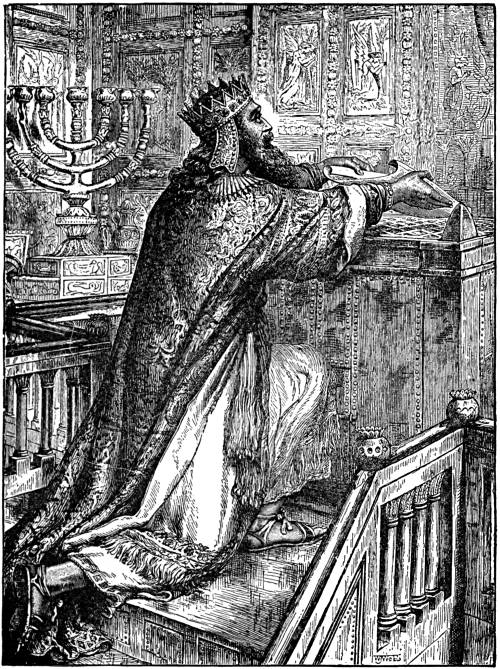
When Hezekiah heard these words he went into the house of the Lord, and sent messengers to Isaiah, asking for his prayers. Isaiah said to them, “Thus saith the Lord, ‘Be not afraid of the words with which the King of Assyria hath blasphemed Me. I will send a blast upon him, and he shall return and shall fall by the sword in his own land.'” Afterwards the King of Assyria sent a letter to Hezekiah, in which he repeated his sneers at the power of God. When Hezekiah read it, he went into the house of the Lord, and spreading the letter before the Lord, prayed for His help. God answered, by the mouth of Isaiah, that the King of Assyria should not enter Jerusalem, nor shoot over it, but be turned back the way he came. And the same night the angel of the Lord went into the camp of the Assyrians, and smote one hundred and eighty-five thousand. Then Sennacherib returned to Nineveh, and as he was worshipping in the house of his god, there came to him two of his sons, who killed him.

HEZEKIAH LAYING THE LETTER BEFORE GOD.

Overcoming Worry: Biblical Insights and Prayer

Worrying about anything is the least productive thing you can do. Worry and stressing about things can cause health problems. Look at what the bible says about worrying, stressing, and being anxious.

Philippians 4:6 (amp) Do not be anxious or worried about anything, but in everything [every circumstance and situation] by prayer and petition with thanksgiving, continue to make your [specific] requests known to God.

Jesus says it like this:

Matthew 6: 25-34 “Therefore I tell you, stop being worried or anxious (perpetually uneasy, distracted) about your life, as to what you will eat or what you will drink; nor about your body, as to what you will wear. Is life not more than food, and the body more than clothing? Look at the birds of the air; they neither sow [seed] nor reap [the harvest] nor gather [the crops] into barns, and yet your heavenly Father keeps feeding them. Are you not worth much more than they? And who of you by worrying can add one hour to [the length of] his life? And why are you worried about clothes? See how the lilies and wildflowers of the field grow; they do not labor nor do they spin [wool to make clothing], yet I say to you that not even Solomon in all his glory and splendor dressed himself like one of these. But if God so clothes the grass of the field, which is alive and green today and tomorrow is [cut and] thrown [as fuel] into the furnace, will He not much more clothe you? You of little faith!  Therefore, do not worry or be anxious (perpetually uneasy, distracted), saying, ‘What are we going to eat?’ or ‘What are we going to drink?’ or ‘What are we going to wear?’ For the [pagan] Gentiles eagerly seek all these things; [but do not worry,] for your heavenly Father knows that you need them. But first and most importantly seek (aim at, strive after) His kingdom and His righteousness [His way of doing and being right—the attitude and character of God], and all these things will be given to you also. “So do not worry about tomorrow; for tomorrow will worry about itself. Each day has enough trouble of its own.”

So instead of worrying do something much more productive and healthier, Pray. Take you problems to Jesus. Whatever you are concerned about, worried about, or anxious about take it to the Lord in Prayer. There is an old song that talked about what to do with your distress and grief. Here is verse 1:

Sweet hour of prayer! sweet hour of prayer!

That calls me from a world of care,

And bids me at my Father’s throne

Make all my wants and wishes known.

In seasons of distress and grief,

My soul has often found relief,

And oft escaped the tempter’s snare

By thy return, sweet hour of prayer!

Here is the whole song. Why not listen to it and then pray.