Children separate a larger group of up to 12 objects into two smaller groups.
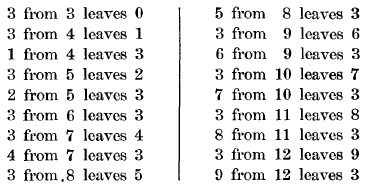
Repeatedly separate a group of objects into smaller groups per the table below. For example, 3 pencils from 4 pencils leaves 1 pencil, 8 coins from 11 coins leaves 3 coins, and 9 cars from 12 cars leaves 3 cars, etc.
When children are ready, have them separate the object groups themselves.
Children must perfectly master the operations listed in the table before proceeding to the next phase of the lesson.
STEP 2
Children separate groups of objects they can’t see, but can imagine (bears, mountains, trees).
Using the table above as a guide, ask children to call out the answer to questions such as, ‘How many are one shoe from four shoes?’ and ‘How many are nine frogs from twelve frogs?’
Give numerous exercises on each number, with constant reviews, until children can recite each operation in the table with great accuracy and rapidity.
STEP 3
In this phase, do not mention objects. Children subtract numbers directly.
Using the table above as a guide, ask children to call out the answer to questions such as, ‘How many are one from four?’ and ‘How many are four from seven?’
Give numerous exercises on each number, with constant reviews, until children can perform each operation with great accuracy and rapidity.
STEP 4
Direct children to practice writing and reciting the subtraction problems listed in the table above. For example, they would write and then recite:
3 from 12 leaves 9
12 minus 3 is 9
12 – 3 = 9
Repeat for each combination in the table until the children master the tasks.
STEP 5
Have children copy, solve, and recite the following table:
Assess mastery by reading aloud the word problems below and having the children mentally compute and recite the solutions. If children have difficulties, repeat the prior phases and then reassess.
This is a fictional story about a Missionary family who lives in a Submarine. Parts 1 and 2 are finished. I will be writing a few more parts as time goes on.
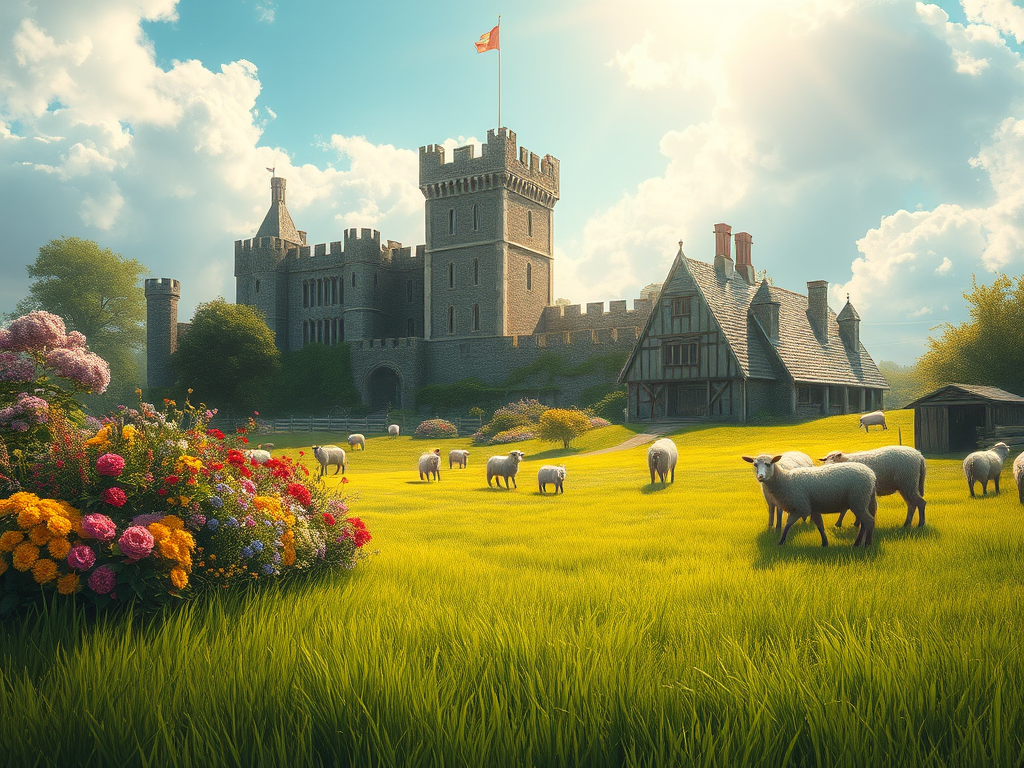
After the storm at sea, we were all glad to be on dry land. After one day of rest, we went to visit our grandparents. Our Grandparents live in an old castle. The castle has 3 floors plus the attic. When we got to the castle. Our Grandparents. Welcome us with hugs, kisses, and lunch. Then we talk a little bit about what happen last time we were together.
Then we had to go meet Pastor David Campbell. So, we said our goodbyes and jumped into the rental car. Pastor David, and his family were aways so nice to us. When we got to the church, we saw Pastor David and Mrs. Campbell. Pastor David had two kids of his own one was around Joy’s age and her name is Fiona. The other was around Mark’s age, and his name is Patrick. Well, that is how many kids he had last time we were here. When we all got out of the car, we saw that Pastor David was holding a baby! “Pastor David has a baby!” Danny said loudly as he ran around in the grass. “Yes,” Little Danny, “I do.” “What is the baby’s name our mother asks?” “His name is Jack,” said Mrs. Campbell. Now that we have said our hellos, I think I know two people who want to see their friends. Danny, Joy, Mark, and I knew who Mrs. Campbell was talking about, Fiona and Patrick. They are in the back waiting on you guys. So, we ran to the house near the church where the Campbell’s live to play with Fiona and Patrick and their 2 dogs. While the grownups went inside the church to talk about next Sunday. After a while of playing, Mother and Father said it is time to go back to the castle to eat Dinner.
When we got there, grandma had made a shepherd’s pie. Grandma’s shepherd’s pie is so always so good. So, we ate our dinner. Our grandparents insisted on putting us up for the night. They put us children in the old children’s room. Maybe it was just Mark and me, but we couldn’t sleep. We kept hearing something. “Rebecca” yes Mark, “I hear something do you?” “Yes, Mark I do it is at the door.” Mark and I walked to the door to open it. When we opened the door, we saw our grandparents’ dog Honey. “Look Rebecca it’s only Honey.” “Okay now we should go to sleep Mark tomorrow is Saturday than its Sunday.” So, we went back to sleep.
When we woke up in the morning, we woke to the singing of birds, and the sun coming through the window. Honey was at the foot of the bed. “Good morning, Rebecca,” said Joy. “We are waiting on you so we can go down together.” “Okay let me get my clothes on.” So, I hurried to put my clothes and shoes on. After that Danny, Joy, Mark and I walk downstairs to the kitchen. “Go on and sat down kids eat up then you may explore the castle grounds.” “Okay grandma.” “Where mom and dad?” “They went to the stores for food for the sub. They will be back in an hour. Now eat up.” “Okay grandma.” So, we hurried and ate so that we could go exploring.
The castle has so much to explore. A few visits ago, Joy found a secret room where Mark found an old tea set. Another time, Danny and I found an old picture of our great, great, great okay let just said really great Aunt Mary and Uncle Eric Brennan. So, we don’t know what we will find next. But sometimes we don’t find anything. Like today but that’s okay.
After mom and dad got back the day went by so quickly, but it was fun too. Soon, it was dinner then it was bedtime. When we woke up the next morning it was Sunday. So, after breakfast, we got ready for church. When we got there, Dad went with Pastor David, and we went with Mrs. Campbell.
When everyone got there, Pastor David introduced us to everyone. Then our dad started to preach and just guess what he preached about. He preached that we all need to keep our faith in God so even if the water gets too high, keep your faith. Everyone loves the story dad told them.
After the service as we were walking to the car, we ask the Campbells to please join us for lunch at the castle. They said yes. So, we all were walking to the car when we heard a meow Joy and Fiona look around then Joy saw it 4 little kittens and their mother in a basket near the church. “Dad, Dad come look!” Dad went over where Joy was. Can we keep them please?” When Danny, Mark and I saw them we start begging, too. “No!” our dad said firmly. When Dad said that we move to let our mom to see them. Then we remind mom that she wants a cat or two. Our dad looked for help from Paster David. He said sorry we have too many pets with 2 dogs. “Mother, Father ” our dad said to our grandma and grandpa, “Help”. Paster David asked, “What are you guy going to call your new pets?” Thank a lot for helping to remind us of names. Look at this. It’s a note. It says to whoever finds this please take care of the kittens and their mother. Their names are Little Peep, Sunrise, Rose, Molly and Mary Ann. Little Peep is the black one with blue eyes [boy]. Sunrise is the yellow one with green [boy]. Rose the one that one just like her mother [girl]. Molly the one that look like just like her mother but with a white chest [girl] and their mother Mary Anne with Green eyes.
Lift to Right side. Little Peep, Sunrise, Molly, Rose, and Mary Ann
Mom, can we keep them? Absolutely yes!” What?” Our father said. Come a long children let’s put the basket in the car and go. After we got to the castle we ate lunch. Then baby Jake sat down to play with Honey and us children went the children’s room with the kittens, and their mother. Fiona and I would keep them, but you heard what our dad said. Thanks Patrick. “Rebecca” “Yes, Fiona do you think you dad will let you keep the kittens?” “I hope so”. Why don’t you children ask him yourself? Dad? “Your mom talked me into it.” “Thank dad” “You guys are welcome.” After that it was time for Fiona and Patrick to go home. That night at dinner Grandma made cupcakes that looked like kittens. Grandpa made some cat toys out of some rope for the kittens. Soon, it was bedtime. So, we made the kittens and their mother to lie down in the baskets.
Before we left Dublin to go to Iceland [Reykjavík] Fiona and Patrick ran up to us. We are so happy you guys are still here. We know you have a cat tower, food and treats, but here are some toys. Thank you so much Fiona and Patrick. See you when come back to visit. Rebecca, Mark, Joy, Danny, it’s time to go. “Goodbye.” “Goodbye Fiona and Patrick.” And that’s the story of how our family grew.
Family is important to God. He created the first family. His word has much to say about family. When the family is in correct alignment with God’s Word, everything is easier. Here is some Bible Studies to help you understand what the Bible says about various issues that may come up in your family.
Biblical Insights on Marriage: A Divine Blueprint– The Bible outlines the significance of marriage as instituted by God, emphasizing companionship, partnership, and a selfless bond. Guidelines for marriage encourage faithfulness, respectful relationships, and marrying based on shared beliefs. Additionally, it highlights the importance of intimacy while recognizing that not everyone is meant for marriage, underscoring the sacred nature of this union.
The Biblical Perspective on Women’s Responsibilities: The Bible describes women’s roles as teachers, keepers of the home, and supportive partners, emphasizing obedience to husbands while also highlighting the importance of their honor in marriage.
Biblical Guidance for Raising Godly Children: The Bible provides extensive guidance on raising children, emphasizing instruction, compassion, discipline, and bringing them to Jesus, ensuring spiritual growth and development.
God’s Perspective on Children in Scripture: The Bible emphasizes the value of children, their divine purpose, and the joy they bring to families, highlighting their unique relationship with God and their future significance.
Prayers that can be said for Children: The content emphasizes the significance of praying for children as they navigate various challenges in today’s world. It provides guidance through two specific prayers: one for overcoming rebellion in teens and another focused on dedicating a child’s future to God, underscoring the importance of faith, guidance, and nurturing relationships. More Prayers will be added soon.
What does the Bible say about the role of woman? The Bible has much to say.
Teachers
Women are to be teachers of good things.
Titus 2:3-5 The aged women likewise, that they be in behaviour as becometh holiness, not false accusers, not given to much wine, teachers of good things; That they may teach the young women to be sober, to love their husbands, to love their children, To be discreet, chaste, keepers at home, good, obedient to their own husbands, that the word of God be not blasphemed.
Provers 31:26 She openeth her mouth with wisdom; and in her tongue is the law of kindness.
Keepers of the home
This means that maintaining her home is high on her list of priorities.
Titus 2:3-5 The aged women likewise, that they be in behaviour as becometh holiness, not false accusers, not given to much wine, teachers of good things; That they may teach the young women to be sober, to love their husbands, to love their children, To be discreet, chaste, keepers at home, good, obedient to their own husbands, that the word of God be not blasphemed.
Proverbs 14:1 Every wise woman buildeth her house: but the foolish plucketh it down with her hands.
This means that:
She works to create a loving, caring inviting environment.
She tries to have a tidy organized home.
She tries to keep the home as clean as possible.
She does her best to have a peaceful home.
Obedient to their own husbands (for the unmarried, please see the notes at the bottom of the page)
This means that she is to submit to the leadership of her husband.
Titus 2:5 To be discreet, chaste, keepers at home, good, obedient to their own husbands, that the word of God be not blasphemed.
Colossians 3:28 Wives, submit yourselves unto your own husbands, as it is fit in the Lord.
Proverbs 12:4 A virtuous woman is a crown to her husband: but she that maketh ashamed is as rottenness in his bones.
Ephesians 5:22-24 Wives, submit yourselves unto your own husbands, as unto the Lord. For the husband is the head of the wife, even as Christ is the head of the church: and he is the saviour of the body. Therefore, as the church is subject unto Christ, so let the wives be to their own husbands in everything.
1 Peter 3:1-2 Likewise, ye wives, be in subjection to your own husbands; that, if any obey not the word, they also may without the word be won by the conversation of the wives; While they behold your chaste conversation coupled with fear.
1 Peter 3:5-7 For after this manner in the old time the holy women also, who trusted in God, adorned themselves, being in subjection unto their own husbands: Even as Sara obeyed Abraham, calling him lord: whose daughters ye are, as long as ye do well, and are not afraid with any amazement. Likewise, ye husbands, dwell with them according to knowledge, giving honour unto the wife, as unto the weaker vessel, and as being heirs together of the grace of life; that your prayers be not hindered.
Please take note of the warning to the husband: giving honour unto the wife, as unto the weaker vessel, and as being heirs together of the grace of life; that your prayers be not hindered. The wife is commanded to submit to the leadership of her husband, but the husband is directly accountable to God for his treatment of her. If he does not give her honor his prayers will not be answered.
A Helper to her husband
Genesis 2:18 And the Lord God said, It is not good that the man should be alone; I will make him an help meet for him.
Genesis 2:21 And the Lord God caused a deep sleep to fall upon Adam, and he slept: and he took one of his ribs, and closed up the flesh instead thereof;
Notice that woman was made from man’s side. This is important because it tells us a few things about the relationship between man and woman.
She was not taken from his feet.
She is not meant to be walked on.
She was not taken from his head.
She is not meant to be the leader who has to make the hard choices.
She was taken from his side. The ribs are near the lungs and the heart.
She is meant to be held close to his heart. She is meant to be valued and loved.
If you are not marriedlisten to the words of Paul.
1 Corinthians 7:8-9 But I say to the unmarried and to the widows, [that as a practical matter] it is good if they remain [single and entirely devoted to the Lord] as I am. But if they do not have [sufficient] self-control, they should marry; for it is better to marry than to burn with passion.
Some women can do a better job of teaching others if they are not married because they will be able to devote more time to the work of the Lord. However, even those women live somewhere. They are still expected to tend to their homes.
Not everyone was made for marriage.
Matthew 19:11-12 But He (Jesus) said to them, “Not all men can accept this statement, but only those to whom [the capacity to receive] it has been given. For there are eunuchs who have been born that way from their mother’s womb [making them incapable of consummating a marriage]; and there are eunuchs who have been made eunuchs by men [for royal service]; and there are eunuchs who have made themselves so for the sake of the kingdom of heaven. He who is able to accept this, let him accept it.”
When I was about 16 years old, I heard a story about a woman who was getting her affairs in order. It is an interesting story. I am going to repost it here.
Keep Your Fork… (Author Unknown) There was an older lady who was getting her affairs in order. According to her doctors she did not have long to live. She called the pastor over. She told him which songs she wanted sung at the service, which scriptures she would like read, and which outfit she wanted to be buried in. Everything was in order, and the pastor was preparing to leave when the lady suddenly remembered something very important to her.
“There’s one more thing,” she said excitedly.
“What’s that?” came the pastor’s reply.
“This is very important,” the lady continued. “I want to be buried with a fork in my right hand.” The pastor stood looking at the lady, not knowing quite what to say.
“That surprises you, doesn’t it?” the lady asked.
“Well, to be honest, I’m puzzled by the request,” said the pastor. She answered by saying, “In all my years of attending church socials and potluck dinners, I always remember that when the dishes of the main course were being cleared, someone would inevitably lean over and say, “Keep your fork.” It was my favorite part because I knew that something better was coming… like velvety chocolate cake or deep-dish apple pie. Something wonderful, and with substance! So, she said, “I just want people to see me there in that casket with a fork in my hand and I want them to wonder, “What’s with the fork?” Then I want you to tell them, “Keep your fork … the best is yet to come.” The pastor’s eyes welled up with tears of joy as he hugged the lady goodbye. He knew this would be one of the last times he would see her before her death. But he also knew that the lady had a better grasp of heaven than he did.
At the funeral, people were walking by the lady’s casket, and they saw the cloak she was wearing and the fork placed in her right hand. Over and over, the pastor heard the question, “What’s with the fork?” And over and over he smiled.
During his message, the pastor told the people of the conversation he had with the lady shortly before she died. He also told them about the fork and about what it symbolized to her. He told the people how he could not stop thinking about the fork and told them that they probably would not be able to stop thinking about it, either.
He was right. So, the next time you reach down for your fork, let it remind you, ever so gently, that the best is yet to come.
The fork was needed to enjoy the dessert. Faith in God is needed to go to heaven. So, keep your fork “faith”.
Molech is an ancient demon who demanded the killing of humans. The younger the human was the more he liked it. Today he is still wanting human sacrifice. It is just called by another name. It is now called abortion. Just look at what the Satanic Temple says about abortion.
Feb 2023 press release by the Satanic Temple.
Notice that is considers abortions to be a religious ritual. The last sentence says that “the procedure is an essential part of a religious practice.”
The Bible calls Molech an abomination.
1 Kings 11:7 Then did Solomon build an high place for Chemosh, the abomination of Moab, in the hill that is before Jerusalem, and for Molech, the abomination of the children of Ammon.
In the epic poem Paradise Lost, John Milton writes:
“First MOLOCH, horrid King besmear’d with blood Of human sacrifice, and parents tears, Though for the noyse of Drums and Timbrels loud Their childrens cries unheard, that past through fire To his grim Idol.”
In the book of Isiah God asks a question.
Isaiah 49:15 Can a woman forget her sucking child, that she should not have compassion on the son of her womb? yea, they may forget, yet will I not forget thee.
The Greek Philosopher Plutarch talks about the music that would accompany the sacrifices of children and its purpose:
“… and the whole area before the statue was filled with a loud noise of flutes and drums so that the cries of wailing should not reach the ears of the people.”
If you would like to know what God says about children, please look at this article:
What does the Bible say about children? It has much to say regarding children and families.
God’s original design was for family.
Genesis 1:28 And God blessed them, and God said unto them, Be fruitful, and multiply, and replenish the earth, and subdue it: and have dominion over the fish of the sea, and over the fowl of the air, and over every living thing that moveth upon the earth.
Children are a heritage and a reward.
Psalm 127:3-5 Lo, children are an heritage of the Lord: and the fruit of the womb is his reward. As arrows are in the hand of a mighty man; so are children of the youth. Happy is the man that hath his quiver full of them: they shall not be ashamed, but they shall speak with the enemies in the gate.
Childlessness was a source of sorry.
Genesis 11:30 But Sarai was barren; she had no child.
1 Samuel 1:9-10 So Hannah rose up after they had eaten in Shiloh, and after they had drunk. Now Eli the priest sat upon a seat by a post of the temple of the Lord. And she was in bitterness of soul, and prayed unto the Lord, and wept sore.
Pregnancy is cause for joy.
Psalm 113:9 He maketh the barren woman to keep house, and to be a joyful mother of children. Praise ye the Lord.
Unborn babies can feel and experience emotions.
Luke 1:44 For, lo, as soon as the voice of thy salutation sounded in mine ears, the babe leaped in my womb for joy.
God has plans for children.
Jeremiah 1:5 Before I formed thee in the belly I knew thee; and before thou camest forth out of the womb I sanctified thee, and I ordained thee a prophet unto the nations.
Galatians 1:15 But when it pleased God, who separated me from my mother’s womb, and called me by his grace,
Grandchildren are a source of delight.
Proverbs 17:6 Children’s children are the crown of old men; and the glory of children are their fathers.
Children are to be dedicated to God.
1 Samuel 1:21-28 And the man Elkanah, and all his house, went up to offer unto the Lord the yearly sacrifice, and his vow. But Hannah went not up; for she said unto her husband, I will not go up until the child be weaned, and then I will bring him, that he may appear before the Lord, and there abide for ever. And Elkanah her husband said unto her, Do what seemeth thee good; tarry until thou have weaned him; only the Lord establish his word. So the woman abode, and gave her son suck until she weaned him. And when she had weaned him, she took him up with her, with three bullocks, and one ephah of flour, and a bottle of wine, and brought him unto the house of the Lord in Shiloh: and the child was young. And they slew a bullock, and brought the child to Eli. And she said, Oh my lord, as thy soul liveth, my lord, I am the woman that stood by thee here, praying unto the Lord. For this child I prayed; and the Lord hath given me my petition which I asked of him: Therefore, also I have lent him to the Lord; as long as he liveth he shall be lent to the Lord. And he worshipped the Lord there.
Luke 2:22 And when the days of her purification according to the law of Moses were accomplished, they brought him to Jerusalem, to present him to the Lord;
Little children have guardian angels.
Matthew 18:10 Take heed that ye despise not one of these little ones; for I say unto you, That in heaven their angels do always behold the face of my Father which is in heaven.
The kingdom of heaven belongs to children.
Luke 18:15-17 And they brought unto him also infants, that he would touch them: but when his disciples saw it, they rebuked them. But Jesus called them unto him, and said, Suffer little children to come unto me, and forbid them not: for of such is the kingdom of God. Verily I say unto you, Whosoever shall not receive the kingdom of God as a little child shall in no wise enter therein.
Unborn children are:
Designed and formed by God.
Psalm 139:13-14 For thou hast possessed my reins: thou hast covered me in my mother’s womb. I will praise thee; for I am fearfully and wonderfully made: marvellous are thy works; and that my soul knoweth right well.
Seen and known by God.
Psalm 22:10 I was cast upon You from birth; From my mother’s womb You have been my God.
Psalm 139:15-16 My frame was not hidden from You, When I was being formed in secret, And intricately and skillfully formed [as if embroidered with many colors] in the depths of the earth. Your eyes have seen my unformed substance; And in Your book were all written The days that were appointed for me, When as yet there was not one of them [even taking shape].
Acknowledged and valued.
Psalm 22:30-31 Posterity will serve Him; They will tell of the Lord to the next generation. They will come and declare His righteousness To a people yet to be bor —that He has done it [and that it is finished].
Psalm 78:5-6 For He established a testimony (a specific precept) in Jacob And appointed a law in Israel, Which He commanded our fathers That they should teach to their children [the great facts of God’s transactions with Israel], That the generation to come might know them, that the children still to be born May arise and recount them to their children,
Psalm 102:18 Let this be recorded for the generation to come, That a people yet to be created will praise the Lord.
Brought out of the womb by God.
Psalm 22:9 Yet You are He who pulled me out of the womb; You made me trust when on my mother’s breasts.
Psalm 71:6 Upon You have I relied and been sustained from my birth; You are He who took me from my mother’s womb and You have been my benefactor from that day. My praise is continually of You.
At break of day I was waked by the crowing of the cock. I summoned my wife to council, to consider on the business of the day. We agreed that our first duty was to seek for our shipmates, and to examine the country beyond the river before we came to any decisive resolution.
My wife saw we could not all go on this expedition, and courageously agreed to remain with her three youngest sons, while Fritz, as the eldest and boldest, should accompany me. I begged her to prepare breakfast immediately, which she warned me would be scanty, as no soup was provided.
We began our preparation; we each took a game-bag and a hatchet. I gave Fritz a pair of pistols in addition to his gun, equipped myself in the same way, and took care to carry biscuit and a flask of fresh water. The lobster proved so hard at breakfast, that the boys did not object to our carrying off the remainder; and, though the flesh is coarse, it is very nutritious.
I proposed before we departed, to have prayers, and my thoughtless Jack began to imitate the sound of church-bells “Ding, dong! to prayers! to prayers! ding, dong!” I was really angry, and reproved him severely for jesting about sacred things. Then, kneeling down, I prayed God’s blessing on our undertaking, and his pardon for us all, especially for him who had now so grievously sinned. Poor Jack came and kneeled by me, weeping and begging for forgiveness from me and from God. I embraced him, and enjoined him and his brothers to obey their mother. I then loaded the guns I left with them, and charged my wife to keep near the boat, their best refuge. We took leave of our friends with many tears, as we did not know what dangers might assail us in an unknown region. But the murmur of the river, which we were now approaching, drowned the sound of their sobs, and we bent our thoughts on our journey.
The bank of the river was so steep, that we could only reach the bed at one little opening, near the sea, where we had procured our water; but here the opposite side was guarded by a ridge of lofty perpendicular rocks. We were obliged to ascend the river to a place where it fell over some rocks, some fragments of which having fallen, made a sort of stepping-stones, which enabled us to cross with some hazard. We made our way, with difficulty, through the high grass, withered by the sun, directing our course towards the sea, in hopes of discovering some traces of the boats, or the crew. We had scarcely gone a hundred yards, when we heard a loud noise and rustling in the grass, which was as tall as we were. We imagined we were pursued by some wild beast, and I was gratified to observe the courage of Fritz, who, instead of running away, calmly turned round and presented his piece. What was our joy when we discovered that the formidable enemy was only our faithful Turk, whom we had forgotten in our distress, and our friends had doubtless dispatched him after us! I applauded my son’s presence of mind; a rash act might have deprived us of this valuable friend.
We proceeded, and entering a little wood that extended to the sea, we rested in the shade, near a clear stream, and took some refreshment. We were surrounded by unknown birds, more remarkable for brilliant plumage than for the charm of their voice. Fritz thought he saw some monkeys among the leaves, and Turk began to be restless, smelling about, and barking very loud. Fritz was gazing up into the trees,
“We rested in the shade, near a clear stream, and took some refreshment.”
when he fell over a large round substance, which he brought to me, observing that it might be a bird’s nest. I thought it more likely to be a cocoa-nut. The fibrous covering had reminded him of the description he had read of the nests of certain birds; but, on breaking the shell, we found it was indeed a cocoa-nut, but quite decayed and uneatable.
Fritz was astonished; where was the sweet milk that Ernest had talked of?
I told him the milk was only in the half-ripe nuts; that it thickened and hardened as the nut ripened, becoming a kernel. This nut had perished from remaining above ground. If it had been in the earth, it would have vegetated, and burst the shell. I advised my son to try if he could not find a perfect nut.
After some search, we found one, and sat down to eat it, keeping our own provision for dinner. The nut was somewhat rancid; but we enjoyed it, and then continued our journey. We were some time before we got through the wood, being frequently obliged to clear a road for ourselves, through the entangled brushwood, with our hatchets. At last we entered the open plain again, and had a clear view before us. The forest still extended about a stone’s throw to our right, and Fritz, who was always on the look-out for discoveries, observed a remarkable tree, here and there, which he approached to examine; and he soon called me to see this wonderful tree, with wens growing on the trunk.
On coming up, I was overjoyed to find this tree, of which there were a great number, was the gourd-tree, which bears fruit on the trunk. Fritz asked if these were sponges. I told him to bring me one, and I would explain the mystery.
“There is one,” said he, “very like a pumpkin, only harder outside.”
“Of this shell,” said I, “we can make plates, dishes, basins, and flasks. We call it the gourd-tree.”
Fritz leaped for joy. “Now my dear mother will be able to serve her soup properly.” I asked him if he knew why the tree bore the fruit on its trunk, or on the thick branches only. He immediately replied, that the smaller branches would not bear the weight of the fruit. He asked me if this fruit was eatable. “Harmless, I believe,” said I; “but by no means delicate. Its great value to savage nations consists in the shell, which they use to contain their food, and drink, and even cook in it.” Fritz could not comprehend how they could cook in the shell without burning it. I told him the shell was not placed on the fire; but, being filled with cold water, and the fish or meat placed in it, red-hot stones are, by degrees, introduced into the water, till it attains sufficient heat to cook the food, without injuring the vessel.
We then set about making our dishes and plates. I showed Fritz a better plan of dividing the gourd than with a knife. I tied a string tightly round the nut, struck it with the handle of my knife till an incision was made, then tightened it till the nut was separated into two equally-sized bowls. Fritz had spoiled his gourd by cutting it irregularly with his knife. I advised him to try and make spoons of it, as it would not do for basins now. I told him I had learnt my plan from books of travels. It is the practice of the savages, who have no knives, to use a sort of string, made from the bark of trees, for this purpose. “But how can they make bottles,” said he. “That requires some preparation,” replied I. “They tie a bandage round the young gourd near the stalk, so that the part at liberty expands in a round form, and the compressed part remains narrow. They then open the top, and extract the contents by putting in pebbles and shaking it. By this means they have a complete bottle.”
We worked on. Fritz completed a dish and some plates, to his great satisfaction, but we considered, that being so frail, we could not carry them with us. We therefore filled them with sand, that the sun might not warp them, and left them to dry, till we returned.
As we went on, Fritz amused himself with cutting spoons from the rind of the gourd, and I tried to do the same with the fragments of the cocoa-nut; but I must confess my performances were inferior to those I had seen in the museum in London, the work of the South Sea islanders. We laughed at our spoons, which would have required mouths from ear to ear to eat with them. Fritz declared that the curve of the rind was the cause of that defect: if the spoons had been smaller, they would have been flat; and you might as well eat soup with an oyster-shell as with a shovel.
We proceeded towards a pleasant wood of palm-trees; but before reaching it, had to pass through an immense number of reeds, which greatly obstructed our road. We were, moreover, fearful of treading on the deadly serpents who choose such retreats. We made Turk walk before us to give notice, and I cut a long, thick cane as a weapon of defence. I was surprised to see a glutinous juice oozing from the end of the cut cane; I tasted it, and was convinced that we had met with a plantation of sugar-canes. I sucked more of it, and found myself singularly refreshed. I said nothing to Fritz, that he might have the pleasure of making the discovery himself. He was walking a few paces before me, and I called to him to cut himself a cane like mine, which he did, and soon found out the riches it contained. He cried out in ecstasy, “Oh, papa! papa! syrup of sugar-cane! delicious! How delighted will dear mamma, and my brothers be, when I carry some to them!” He went on, sucking pieces of cane so greedily, that I checked him, recommending moderation. He was then content to take some pieces to regale himself as he walked home, loading himself with a huge burden for his mother and brothers.
We now entered the wood of palms to eat our dinner, when suddenly a number of monkeys, alarmed by our approach, and the barking of the dog, fled like lightning to the tops of the trees; and then grinned frightfully at us, with loud cries of defiance. As I saw the trees were cocoa-palms, I hoped to obtain, by means of the monkeys, a supply of the nuts in the half-ripe state, when filled with milk. I held Fritz’s arm, who was preparing to shoot at them, to his great vexation, as he was irritated against the poor monkeys for their derisive gestures; but I told him, that though no patron of monkeys myself, I could not allow it. We had no right to kill any animal except in defence, or as a means of supporting life. Besides, the monkeys would be of more use to us living than dead, as I would show him. I began to throw stones at the monkeys, not being able, of course, to reach the place of their retreat, and they, in their anger, and in the spirit of imitation, gathered the nuts and hurled them on us in such quantities, that we had some difficulty in escaping from them. We had soon a large stock of cocoa-nuts. Fritz enjoyed the success of the stratagem, and, when the shower subsided, he collected as many as he wished.
We then got up, I tied some nuts together by their stems, and threw them over my shoulder. Fritz took his bundle of canes, and we set out homewards.



 articlesforchristians