A place to grow your relationship with God

Posts tagged ‘fantasy’

The Tale of Solomon Owl Chapter II A NEWCOMER

Chapter II A NEWCOMER

Upon his arrival, as a stranger, in Pleasant Valley, Solomon Owl looked about carefully for a place to live. What he wanted especially was a good, dark hole, for he thought that sunshine was very dismal.

Though he was willing to bestir himself enough to suit anybody, when it came to hunting, Solomon Owl did not like to work. He was no busy nest-builder, like Rusty Wren. In his search for a house he looked several times at the home of old Mr. Crow. If it had suited him better, Solomon would not have hesitated to take it for his own. But in the end he decided that it was altogether too light to please him.

That was lucky for old Mr. Crow. And the black rascal knew it, too. He had noticed that Solomon Owl was hanging about the neighborhood. And several times he caught Solomon examining his nest.

But Mr. Crow did not have to worry long. For as it happened, Solomon Owl at last found exactly what he wanted. In an old, hollow hemlock, he came across a cozy, dark cavity. As soon as he saw it he knew that it was the very thing! So he moved in at once. And except for the time that he spent in the meadow–which was considerably later–he lived there for a good many years.

Once Fatty Coon thought that he would drive Solomon out of his snug house and live in it himself. But he soon changed his mind—after one attempt to oust Solomon.

Solomon Owl–so Fatty discovered–had sharp, strong claws and a sharp, strong beak as well, which curled over his face in a cruel hook.

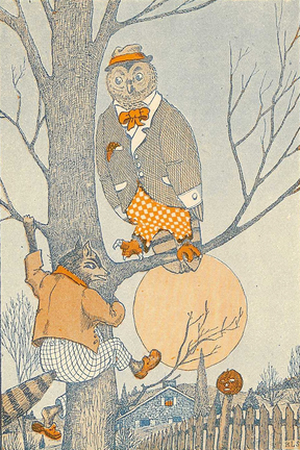
It was really a good thing for Solomon Owl–the fight he had with Fatty Coon. For afterward his neighbors seldom troubled him–except when Jasper Jay brought a crowd of his noisy friends to tease Solomon, or Reddy Woodpecker annoyed him by rapping on his door when he was asleep.

But those rowdies always took good care to skip out of Solomon’s reach. And when Jasper Jay met Solomon alone in the woods at dawn or dusk he was most polite to the solemn old chap. Then it was “Howdy-do, Mr. Owl!” and “I hope you’re well to-day!” And when Solomon Owl turned his great, round, black eyes on Jasper, that bold fellow always felt quite uneasy; and he was glad when Solomon Owl looked away.

If Solomon Owl chanced to hoot on those occasions, Jasper Jay would jump almost out of his bright blue coat. Then Solomon’s deep laughter would echo mockingly through the woods.

You see, though not nearly so wise as he appeared, Solomon Owl knew well enough how to frighten some people.
The Tale of Solomon Owl by Arthur Scott Bailey

THE TALE OF SOLOMON OWL

BY

ARTHUR SCOTT BAILEY

“The Tale of Solomon Owl” by Arthur Scott Bailey is a children’s book written in the early 20th century. This delightful tale is playful and imaginative, focusing on the life of Solomon Owl and his interactions with other forest animals in Pleasant Valley. The book explores themes of friendship, cleverness, and the humorous adventures of various animal characters. In the story, Solomon Owl is portrayed as both wise and somewhat foolish, and he becomes embroiled in different situations involving other animals like Mr. Frog, Fatty Coon, and Reddy Woodpecker. Throughout the chapters, Solomon navigates encounters that reveal his character traits, such as his penchant for hooting and his amusing attempts to catch food. As various events unfold, including Solomon’s encounters with mischief and misunderstandings in the animal community, readers get a charming glimpse into a whimsical animal world filled with laughter and lessons. The narrative carries a lighthearted tone, making it enjoyable for children while imparting moral lessons about caution, wisdom, and friendship. 

Contents:

The Tale of Solomon Owl Chapter 1 SCARING JOHNNIE GREEN

Chapter I

When Johnnie Green was younger, it always scared him to hear Solomon Owl’s deep-toned voice calling in the woods after dark.

“Whoo-whoo-whoo, whoo-whoo, to-whoo-ah!” That weird cry was enough to send Johnnie Green hurrying into the farmhouse, though sometimes he paused in the doorway to listen–especially if Solomon Owl happened to be laughing. His “haw-haw-hoo-hoo,” booming across the meadow on a crisp fall evening, when the big yellow moon hung over the fields of corn-shocks and pumpkins, sounded almost as if Solomon were laughing at the little boy he had frightened. There was certainly a mocking, jeering note in his laughter.

Of course, as he grew older, Johnnie Green no longer shivered on hearing Solomon’s rolling call. When Solomon laughed, Johnnie Green would laugh, too. But Solomon Owl never knew that, for often he was half a mile from the farm buildings.

A “hoot owl,” Johnnie Green termed him. And anyone who heard Solomon hooting of an evening, or just before sunrise, would have agreed that it was a good name for him. But he was really a barred owl, for he had bars of white across his feathers.

If you had happened to catch Solomon Owl resting among the thick hemlocks near the foot of Blue Mountain, where he lived, you would have thought that he looked strangely like a human being. He had no “horns,” or ear-tufts, such as some of the other owls wore; and his great pale face, with its black eyes, made him seem very wise and solemn.

In spite of the mild, questioning look upon his face whenever anyone surprised him in the daytime, Solomon Owl was the noisiest of all the different families of owls in Pleasant Valley. There were the barn owls, the long-eared owls, the short-eared owls, the saw-whet owls, the screech owls–but there! there’s no use of naming them all. There wasn’t one of them that could equal Solomon Owl’s laughing and hooting and shrieking and wailing–at night.

During the day, however, Solomon Owl seldom had anything to say — or if he had, he was quiet about it. One reason for his silence then was that he generally slept when the sun was shining. And when most people were sleeping, Solomon Owl was as wide awake as he could be.

He was a night-prowler–if ever there was one. And he could see a mouse on the darkest night, even if it stirred ever so slightly.

That was unfortunate for the mice. But luckily for them, Solomon Owl couldn’t be in more than one place at a time. Otherwise, there wouldn’t have been a mouse left in Pleasant Valley–if he could have had his way.

And though he didn’t help the mice, he helped Farmer Green by catching them. If he did take a fat pullet once in a while, it is certain that he more than paid for it.

So, on the whole, Farmer Green did not object to Solomon Owl’s living in the wood-lot. And for a long time Solomon raised no objection to Farmer Green’s living near Swift River.

But later Solomon Owl claimed that it would be a good thing for the forest folk if they could get rid of the whole Green family–and the hired man, too.

THE ADVENTURES OF OLD MR. TOAD: OLD MR. TOAD’S MUSIC BAG

Never think that you have learned
    All there is to know.
  That's the surest way of all
    Ignorance to show.

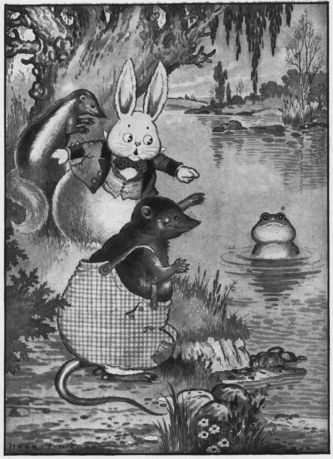
“I’ve found Old Mr. Toad!” cried Peter Rabbit, hurrying after Jimmy Skunk.

“Where?” demanded Jimmy.

“In the water,” declared Peter. “He’s sitting right over there where the water is shallow, and he didn’t notice me at all. Let’s get Unc’ Billy, and then creep over to the edge of the Smiling Pool and watch to see if Old Mr. Toad really does try to sing.”

So they hunted up Unc’ Billy Possum, and the three stole very softly over to the edge of the Smiling Pool, where the bank was low and the water shallow. Sure enough, there sat Old Mr. Toad with just his head out of water. And while they were watching him, something very strange happened.

“What—what’s the matter with him?” whispered Peter, his big eyes looking as if they might pop out of his head.

“If he don’t watch out, he’ll blow up and bust!” exclaimed Jimmy.

“Listen!” whispered Unc’ Billy Possum. “Do mah ol’ ears hear right? ‘Pears to me that that song is coming right from where Brer Toad is sitting.”

It certainly did appear so, and of all the songs that glad spring day there was none sweeter. Indeed there were few as sweet. The only trouble was the song was so very short. It lasted only for two or three seconds. And when it ended, Old Mr. Toad looked quite his natural self again; just as commonplace, almost ugly, as ever. Peter looked at Jimmy Skunk, Jimmy looked at Unc’ Billy Possum, and Unc’ Billy looked at Peter. And no one had a word to say. Then all three looked back at Old Mr. Toad.

And even as they looked, his throat began to swell and swell and swell, until it was no wonder that Jimmy Skunk had thought that he was in danger of blowing up. And then, when it stopped swelling, there came again those beautiful little notes, so sweet and tremulous that Peter actually held his breath to listen. There was no doubt that Old Mr. Toad was singing just as he had said he was going to, and it was just as true that his song was one of the sweetest if not the sweetest of all the chorus from and around the Smiling Pool. It was very hard to believe, but Peter and Jimmy and Unc’ Billy both saw and heard, and that was enough. Their respect for Old Mr. Toad grew tremendously as they listened.

“How does he do it?” whispered Peter.

“With that bag under his chin, of course,” replied Jimmy Skunk. “Don’t you see it’s only when that is swelled out that he sings? It’s a regular music bag. And I didn’t know he had any such bag there at all.”

“I wish,” said Peter Rabbit, feeling of his throat, “that I had a music bag like that in my throat.”

And then he joined in the laugh of Jimmy and Unc’ Billy, but still with something of a look of wistfulness in his eyes.

Stories of Don Quixote Written Anew for Children Chapter 7: The Adventure with the Windmills

Very early the next morning, the knight and his squire set out on their travels. They stole silently away from the village without bidding goodbye to anyone; and they made such haste that at sunrise they felt themselves quite safe from pursuit.

Don Quixote, riding in full armor astride of gaunt Rozinante, felt that he was indeed the most valorous knight in the world; and no doubt he was a formidable sight. As for Sancho Panza, he rode like a patriarch, with his knapsack on one side of him and a leather bottle on the other, his feet almost dragging on the ground. His mind was full of thoughts about that island of which he hoped to be the governor.

The sun rose high above the hills. The two travelers jogged onward across the plains of Montiel. Both were silent, for both had high purposes in view.

At length Sancho Panza spoke: “I beseech you, Sir Knight-errant, be sure to remember the island you promised me. I dare say I shall make out to govern it, let it be ever so big.”

Don Quixote answered with becoming dignity: “Friend Sancho, you must know that it has always been the custom of knights-errant to conquer islands and put their squires over them as governors. Now it is my intention to keep up that good custom.”

“You are indeed a rare master,” said Sancho Panza.

“Well, I am thinking I might even improve upon that good custom,” said Don Quixote. “What if I should conquer three or four islands and set you up as master of them all?”

“You could do nothing that would please me better,” answered Sancho.

While they were thus riding and talking, they came to a place where there were a great many windmills. There seemed to be thirty or forty of them scattered here and there upon the plain; and when the wind blew, their long white arms seemed to wave and beckon in a droll and most threatening manner.

Don Quixote drew rein and paused in the middle of the road.

“There! there!” he cried. “Fortune is with us. Look yonder, Sancho! I see at least thirty huge giants, and I intend to fight all of them. When I have overcome and slain them we will enrich ourselves with their spoils.”

“What giants?” asked Sancho Panza.

“Why, those who are standing in the fields just before us,” answered the knight. “See their long arms! I have read that some of their race had arms which reached more than two miles.”

“Look at them better, master,” said Sancho. “Those are not giants; they are windmills. The things which you call arms are sails, and they flap around when the wind blows.”

“Friend Sancho,” said the knight, very sternly, “it is plain that you are not used to adventures. I tell you those things are giants. If you are afraid, go and hide yourself and say your prayers. I shall attack them at once.”

Without another word he spurred Rozinante into a sturdy trot and was soon right in the midst of the windmills.

“Stand, cowards!” he cried. “Stand your ground! Do not fly from a single knight who dares you all to meet him in fair fight.”

At that moment the wind began to blow briskly and all the mill sails were set moving. They seemed to be answering his challenge.

He paused a moment. “O my Dulcinea, fairest of ladies,” he cried, “help me in this perilous adventure!”

Then he couched his lance; he covered himself with his shield; he rushed with Rozinante’s utmost speed upon the nearest windmill.

The long lance struck into one of the whirling sails and was carried upward with such swiftness that it was torn from the knight’s firm grasp. It was whirled into the air and broken into shivers. At the same moment the knight and his steed were hurled forward and thrown rolling upon the ground.

Sancho Panza hurried to the place as quickly as his dappled donkey could carry him. His master was lying helpless by the roadside. The helmet had fallen from his head, and the shield had been hurled to the farther side of the hedge.

“Mercy on me, master!” cried the squire. “Didn’t I tell you they were windmills?”

“Peace, friend Sancho,” answered Don Quixote, rubbing the dust from his eyes. “There is nothing so uncertain as war. That wicked enchanter, Freston, who stole my books has done all this. They were giants, as I told you; but he changed them into windmills so that I should not have the honor of victory. But mind you, Sancho, I will get even with him in the end.”

“So be it, say I!” cried Sancho, as he dismounted from his donkey.

He lifted the fallen knight from the ground. He brought his shield and adjusted the helmet. Then he led his unlucky steed to his side and helped him to remount.

The sun was now sloping towards the west, and the knight and squire rode thoughtfully onward across the plain of Montiel.

Stories of Don Quixote Written Anew for Children Chapter 3: The Adventure with the Farmer

At the earliest break of day, Don Quixote made ready to ride out in quest of adventures. He buckled on his armor. He took his lance and his shield in his hands. His gallant steed, Rozinante, stood saddled and bridled at the door of the inn.

He again embraced the innkeeper. “Farewell, thou greatest of my benefactors,” he cried. “May heaven bless thee for having made me a knight.”

Then, with the help of a groom, he mounted and rode forth into the world.

Right gayly did he ride. For he felt that he was now in truth a knight, and his mind was filled with lofty thoughts.

Right gayly also did Rozinante canter along the highway, and proudly did he hold his head. For did he not know that he was carrying the bravest of brave men?

They had gone but a little way when Don Quixote suddenly remembered the innkeeper’s command to provide himself with money, clean shirts, and some salve.

“The command must be obeyed,” he said. “I must go home to get those necessary things.”

So he turned his horse’s head and took the first byroad that led towards his village. And now Rozinante seemed to have new life put into his lean body. He sniffed the air and trotted so fast that his heels seemed scarcely to touch the ground.

“This is after the manner of heroes,” said Don Quixote. “Yet I still lack one thing. I need a faithful squire to ride with me and serve me. All the knights I have ever read about had squires who followed in their footsteps and looked on while they were fighting. I think, therefore, that while I am providing myself with money and shirts, I will also get me a squire.”

Presently, as they were passing through a lonely place, the knight fancied that he heard distressing cries. They seemed to come from the midst of a woody thicket near the roadside.

“I thank Heaven for this lucky moment,” he said to himself. “I shall now have an adventure. No doubt I shall rescue someone who is in peril, or I shall correct some grievous wrong.”

He put spurs to Rozinante and rode as fast as he could to the spot from which the cries seemed to issue.

At the edge of the woody thicket he saw a horse tied to a small oak tree. Not far away, a lad of about fifteen years was tied to another oak. The lad’s shoulders and back were bare, and it was he who was making the doleful outcry. For a stout country fellow was standing over him and beating him unmercifully with a horsewhip.

“Hold! hold!” cried Don Quixote, rushing up. “It is an unmanly act to strike a person who cannot strike back.”

The farmer was frightened at the sudden appearance of a knight on horseback. He dropped his whip. He stood with open mouth and trembling hands, not knowing what to expect.

“Come, sir,” said Don Quixote, sternly. “Take your lance, mount your horse, and we will settle this matter by a trial of arms.”

The farmer answered him very humbly. “Sir Knight,” he said, “this boy is my servant, and his business is to watch my sheep. But he is lazy and careless, and I have lost half of my flock through his neglect.”

“What of that?” said Don Quixote. “You have no right to beat him, when you know he cannot beat you.”

“I beat him only to make a better boy of him,” answered the farmer. “He will tell you that I do it to cheat him out of his wages: but he tells lies even while I am correcting him.”

“What! what!” cried Don Quixote. “Do you give him the lie right here before my face? I have a good mind to run you through the body with my lance. Untie the boy and pay him his money. Obey me this instant, and let me not hear one word of excuse from you.”

The farmer, pale with fear, loosed the boy from the cords which bound him to the tree.

“Now, my young man,” said Don Quixote, “how much does this fellow owe you?”

“He owes me nine months’ wages at seven dollars a month,” was the answer.

“Nine times seven are sixty-three,” said the knight. “Sir, you owe this lad sixty-three dollars. If you wish to save your life pay it at once.”

The farmer was now more alarmed than before. He fell upon his knees. He lifted his hands, imploring mercy. He sobbed with fright.

“Noble sir,” he cried, “it is too much; for I have bought him three pairs of shoes at a dollar a pair; and twice when he was sick, I paid the doctor a dollar.”

“That may be,” answered Don Quixote, “but we will set those dollars against the beating you have given him without cause. Come, pay him the whole amount.”

“I would gladly do so,” said the farmer, “but I have not a penny in my pocket. If you will let the lad go home with me, I will pay him every dollar.”

“Go home with him!” cried the lad. “Not I. Why, he would beat me to death and not pay at all.”

“He won’t dare to do it,” answered Don Quixote. “I have commanded him and he must obey. His money is at his house. I give him leave to go and get it. His honor as a knight will make him pay his debt to you.”

“A knight!” said the lad. “He is no knight. He is only John Haldudo, the farmer.”

“What of that?” said Don Quixote. “Why may not the Haldudos have a knight in the family?”

“Well, he is not much of a knight. A knight would pay his debts,” said the lad.

“And he will pay you, for I have commanded him,” said Don Quixote.

Then turning to the farmer, he said, “Go, and make sure that you obey me. I will come this way again soon, and if you have failed, I will punish you. I will find you out, even though you hide yourself as close as a lizard.”

The farmer arose from his knees and was about to speak, but the knight would not listen.

“I will have no words from you,” he said. “You have naught to do but to obey. And if you would ask who it is that commands you, know that I am the valorous Don Quixote de la Mancha, the righter of wrongs and the friend of the downtrodden. So, goodbye!”

Having said this, he gave spurs to Rozinante and galloped away.

The farmer watched him until he was quite out of sight. Then he turned and called to the boy.

“Come, Andrew,” he said. “Come to me now, and I will pay thee what I owe thee. I will obey this friend of the downtrodden.”

“You will do well to obey him,” said the boy. “He is a knight, and if you fail to pay me, he will come back and make things hot for you.”

“Yes, I know,” answered the farmer. “I will pay you well and show you how much I love you.”

Then, without another word, he caught hold of the boy and again tied him to the tree. The boy yelled lustily, but Don Quixote was too far away to hear his cries. The farmer fell upon him and beat him with fists and sticks until he was almost dead. Finally he loosed him and let him go.

“Now, Andrew, go find your friend of the downtrodden,” he said. “Tell him how well I have paid you.”

Poor Andrew said nothing. He hobbled slowly away, while the farmer mounted his horse and rode grimly homeward.

In the meanwhile, Don Quixote was speeding toward his own village. He was very much pleased with himself and with his first adventure as a knight.

“O Dulcinea, most beautiful of beauties,” he cried, “well mayest thyself be happy. For thy knight has done a noble deed this day.”

And thus he rode gallantly onward, his lance clanging against his coat of mail at every motion of his steed.

Stories of Don Quixote Written Anew for Children Chapter 2: The Adventure at the Inn

Chapter 2: The Adventure at the Inn

One morning in midsummer, Don Quixote arose very early, long before anyone else was awake.

He put on his coat of mail and the old helmet which he had patched with pasteboard and green ribbons.

He took down the short sword that had been his great-grandfather’s, and belted it to his side. He grasped his long lance. He swung the leather shield upon his shoulder.

Then he went out very quietly by the back door, lest he should awaken his niece or the housekeeper.

He went softly to the barn and saddled his steed. Then he mounted and rode silently away through the sleeping village and the quiet fields.

He was pleased to think how easily he had managed things. He was glad that he had gotten away from the house and the village without any unpleasant scenes.

“I trust that I shall presently meet with some worthy adventure,” he said to himself.

But soon a dreadful thought came into his mind: He was not a knight, for no one had conferred that honor upon him; and the laws of chivalry would not permit him to contend in battle with anyone of noble rank until he himself was knighted.

“Whoa, Rozinante!” he said. “I must consider this matter.”

He stopped underneath a tree, and thought and thought. Must he give up his enterprise and return home?

“No, that I shall never do!” he cried. “I will ride onward, and the first worthy man that I meet shall make me knight.”

So he spoke cheeringly to Rozinante and resumed his journey. He dropped the reins loosely upon the horse’s neck, and allowed him to stroll hither and thither as he pleased.

“It is thus,” he said, “that knights ride out upon their quests. They go where fortune and their steeds may carry them.”

Thus, leisurely, he sat in the saddle, while Rozinante wandered in unfrequented paths, cropped the green herbage by the roadside, or rested himself in the shade of some friendly tree. The hours passed, but neither man nor beast took note of time or distance.

“We shall have an adventure by and by,” said Don Quixote softly to himself.

The sun was just sinking in the west when Rozinante, in quest of sweeter grass, carried his master to the summit of a gentle hill. There, in the valley below him, Don Quixote beheld a little inn nestling snugly by the roadside.

“Ha!” he cried. “Did I not say that we should have an adventure?”

He gathered up the reins; he took his long lance in his hand; he struck spurs into his loitering steed, and charged down the hill with the speed of a plow horse.

He imagined that the inn was a great castle with four towers and a deep moat and a drawbridge.

At some distance from the gate he checked his steed and waited. He expected to see a dwarf come out on the wall of the castle and sound a trumpet to give notice of the arrival of a strange knight; for it was always so in the books which he had read.

But nobody came. Don Quixote grew impatient. At length he urged Rozinante forward at a gentle pace, and was soon within hailing distance of the inn. Just then a swineherd, in a field near by, blew his horn to call his pigs together.

“Ah, ha!” cried Don Quixote. “There is the dwarf at last. He is blowing his bugle to tell them that I am coming.” And with the greatest joy in the world he rode onward to the door of the inn.

The innkeeper was both fat and jolly; and when he saw Don Quixote riding up, he went out to welcome him. He could not help laughing at the war-like appearance of his visitor — with his long lance, his battered shield, and his ancient coat of mail. But he kept as sober a face as possible and spoke very humbly.

“Sir Knight,” he said, “will you honor me by alighting from your steed? I have no bed to offer you, but you shall have every other accommodation that you may ask.”

Don Quixote still supposed that the inn was a castle; and he thought that the innkeeper must be the governor. So he answered in pompous tones:—

“Senior Castellano, anything is enough for me. I care for nothing but arms, and no bed is so sweet to me as the field of battle.”

The innkeeper was much amused. “You speak well, Sir Knight. Since your wants are so few, I can promise that you shall lack nothing. Alight, and enter!” And with that he went and held Don Quixote’s stirrup while he dismounted.

The poor old man had eaten nothing all day. His armor was very heavy. He was stiff from riding so long. He could hardly stand on his feet. But with the innkeeper’s help he was soon comfortably seated in the kitchen of the inn.

“I pray you, Senior Castellano,” he said, “take good care of my steed. There is not a finer horse in the universe.”

The innkeeper promised that the horse should lack nothing, and led him away to the stable.

When he returned to the kitchen he found Don Quixote pulling off his armor. He had relieved himself of the greater part of his coat of mail; but the helmet had been tied fast with the green ribbons, as I have told you, and it could not be taken off without cutting them.

“Never shall anyone harm those ribbons,” cried Don Quixote; and after vainly trying to untie them he was obliged to leave them as they were. It was a funny sight to see him sitting there with his head enclosed in the old patched-up helmet.

“Now, Sir Knight,” said the innkeeper, “will you not deign to partake of a little food? It is quite past our supper time, and all our guests have eaten. But perhaps you will not object to taking a little refreshment alone.”

“I will, indeed, take some with all my heart,” answered Don Quixote. “I think I shall enjoy a few mouthfuls of food more than anything else in the world.”

As ill luck would have it, it was Friday, and there was no meat in the house. There were only a few small pieces of salt fish in the pantry, and these had been picked over by the other guests.

“Will you try some of our fresh trout?” asked the landlord. “They are very small, but they are wholesome.”

“Well,” answered Don Quixote, “if there are, several of the small fry, I shall like them as well as a single large fish. But whatever you have, I pray you bring it quickly; for the heavy armor and the day’s travel have given me a good appetite.”

So a small table was set close by the door, for the sake of fresh air; and Don Quixote drew his chair up beside it.

Then the innkeeper brought some bits of the fish, ill-dressed and poorly cooked. The bread was as brown and moldy as Don Quixote’s armor; and there was nothing to drink but cold water.

It was hard for the poor man to get the food to his mouth, for his helmet was much in his way. By using both hands, however, he managed to help himself. Then you would have laughed to see him eat; for, indeed, he was very hungry.

“No true knight will complain of that which is set before him,” he said to himself.

Suddenly, however, the thought again came to him that he was not yet a knight. He stopped eating. The last poor morsel of fish was left untouched on the table before him. His appetite had left him.

“Alas! alas!” he groaned. “I cannot lawfully ride out on any adventure until I have been dubbed a knight. I must see to this business at once.”

He arose and beckoned to the innkeeper to follow him to the barn. “I have something to say to you,” he whispered.

“Your steed, Sir Knight,” said the innkeeper, “has already had his oats. I assure you he will be well taken care of.”

“It is not of the steed that I wish to speak,” answered Don Quixote; and he carefully shut the door behind them.

Then falling at the innkeeper’s feet, he cried, “Sir, I shall never rise from this place till you have promised to grant the boon which I am about to beg of you.”

The innkeeper did not know what to do. He tried to raise the poor man up, but he could not. At last he said, “I promise. Name the boon which you wish, and I will give it to you.”

“Oh, noble sir,” answered Don Quixote, “I knew you would not refuse me. The boon which I beg is this: Allow me to watch my armor in the chapel of your castle tonight, and then in the morning — oh, in the morning — “

“And what shall I do in the morning?” asked the innkeeper.

“Kind sir,” he answered, “do this: Bestow on me the honor of knighthood. For I long to ride through every corner of the earth in quest of adventures; and this I cannot do until after I have been dubbed a knight.”

The innkeeper smiled, and his eyes twinkled. For he was a right jolly fellow, and he saw that here was a chance for some merry sport.

“Certainly, certainly,” he said, right kindly. “You are well worthy to be a knight, and I honor you for choosing so noble a calling. Arise, and I will do all that you ask of me.”

“I thank you,” said Don Quixote. “Now lead me to your chapel. I will watch my armor there, as many a true and worthy knight has done in the days of yore.”

“I would gladly lead you thither,” said the innkeeper, but at the present time there is no chapel in my castle. It will do just as well, however, to watch your armor in some other convenient place. Many of the greatest knights have done this when there was no chapel to be found.”

“Noble sir, I believe you are right,” said Don Quixote. “I have read of their doing so. And since you have no chapel, I shall be content with any place.”

“Then bring your armor into the courtyard of my castle,” said the innkeeper. “Guard it bravely until morning, and at sunrise I will dub you a knight.”

“I thank you, noble sir,” said Don Quixote. “I will bring the armor at once.”

“But stop!” cried the innkeeper. “Have you any money?”

“Not a penny,” was the answer. “I have never read of any knight carrying money with him.”

“Oh, well, you are mistaken there,” said the innkeeper. “The books you have read may not say anything about it. But that is because the authors never thought it worth while to write about such common things as money and clean shirts and the like.”

“Have you any proof of that?”

“Most certainly I have. I know quite well that every knight had his purse stuffed full of money. Everyone, also, carried some clean shirts and a small box of salve for the healing of wounds.”

“It does look reasonable,” agreed Don Quixote, “but I never thought of it.”

“Then let me advise you as a father advises his son,” said the innkeeper. “As soon as you have been made a knight, ride homeward and provide yourself with these necessary articles.”

“I will obey you, most noble sir,” answered Don Quixote.

He then made haste and got his armor together. He carried it to the barnyard and laid it in a horse trough by the well.

The evening was now well gone, and it was growing dark. Don Quixote took his shield upon his left arm. He grasped his long lance in his right hand. Then he began to pace to and fro across the barnyard. He held his head high, like a soldier on duty; and the old patched helmet, falling down over his face, gave him a droll if not fearful appearance.

The full moon rose, bright and clear. The barnyard was lighted up, almost as by day. The innkeeper and his guests stood at the windows of the inn, and watched to see what would happen.

Presently a mule driver came into the yard to water his mules. He saw something lying in the trough, and was stooping to take it out before drawing water from the well. But at that moment Don Quixote rushed upon him.

“Stop, rash knight!” he cried. “Touch not those arms. They are the arms of the bravest man that ever lived. Touch them not, or instant death shall be your doom.”

The mule driver was a dull fellow and very slow. He but dimly understood what was said to him, and so paid no attention to the warning. He laid hold of the coat of mail and threw it upon the ground.

“O my lady Dulcinea! Help me in this first trial of my valor!” cried Don Quixote.

At the same moment he lifted his lance with both hands and gave the mule driver a thrust which laid him flat in the dust of the barnyard.

Another such knock would have put an end to the poor fellow. But Don Quixote was too brave to think of striking a fallen foe.

He picked up the coat of mail and laid it again in the horse trough. Then he went on, walking back and forth as though nothing had happened.

The poor mule driver lay senseless by the side of the trough. The innkeeper and his friends still watched from the inn.

“He is a hard-headed fellow,” said one. “He is used to rough knocks, and will soon recover.”

In a few moments a noisy wagoner drove into the barnyard. He took his team quite close to the trough. Then he began to clear it out in order to give water to his horses.

Don Quixote, however, was ready for him. He said not a word, but lifted his lance and hurled it at the wagoner’s head. It is a wonder that the fellow’s skull was not broken.

The wagoner fell to the ground, yelling most grievously. The people in the inn were frightened, and all ran quickly to the barnyard to put an end to the rough sport.

When Don Quixote saw them coming, he braced himself on his shield and drew his sword.

“O my Dulcinea, thou queen of beauty!” he cried. “Now give strength to my arm and courage to my beating heart.”

He felt brave enough to fight all the wagoners and mule drivers in the world. But just then several of the wagoner’s friends came running into the barnyard, and each began to throw stones at Don Quixote.

The stones fell in a shower about his head, and he was forced to shelter himself under his shield. Yet he stood bravely at his post, and nothing could make him abandon his arms.

“Fling on!” he cried. “Do your worst. I dare you to come within my reach.”

He spoke with such fierceness that every man shrank back in fear. Some took refuge in the barn, but kept on throwing stones.

“Let him alone,” cried the innkeeper. “He is a harmless fellow who wishes to become a knight. He has lost his senses through too much reading. Come away and leave him in peace.”

The men stopped throwing stones. Don Quixote put down his shield and began again to pace back and forth between the horse trough and the barn. He allowed the servants to carry away the wounded wagoner and the unconscious mule driver; but he glared at them so fiercely that they were glad to be out of his reach.

The innkeeper began to think that he had carried the sport far enough. He was afraid that more and worse mischief might be done. So he spoke right gently to Don Quixote:—

“Brave sir, you have done nobly. You have guarded your armor with courage. You have shown yourself worthy of knighthood, and I will give you that honor without further delay.”

“But it is not yet daybreak,” answered Don Quixote. “I must guard my armor till the dawn appears.”

“It is not at all necessary,” said the innkeeper. “I have read of some very famous knights who stood guard only two hours; and you have watched for more than four hours although beset by many foes.”

“Time flies swiftly when one is doing his duty,” said Don Quixote. “The brave man is bravest when he curbs his anger; but if I am again attacked, I shall not be able to restrain my fury. Not a man in this castle shall be left alive unless it be to please you.”

“You shall not be attacked,” said the innkeeper. “You have guarded your armor quite long enough, and I will make you a knight at once, if you are willing.”

“Nothing can please me better,” answered Don Quixote; and he laid his lance gently down by the side of his armor.

The innkeeper, thereupon, called to his guests and servants to come and see the ceremony. A book was brought to him in which he kept his accounts of hay and straw. He opened it with much dignity while Don Quixote stood with closed eyes beside his armor.

The women of the inn gathered in a circle about them. A boy held a piece of lighted candle, while the innkeeper pretended to read a chapter from the book.

The reading being finished, Don Quixote knelt down in the dust of the barnyard. The innkeeper stood over him and mumbled some words without meaning. He gave him a blow on the neck with his hand. Then he slapped him on the back with the flat of his sword.

“Arise, Sir Knight,” he said. “Thou are Don Quixote de la Mancha, the most valorous of men. Be brave, be brave, be always brave.”

Don Quixote arose, feeling that he was now in truth a knight and ready to do valorous deeds.

One of the women handed him his sword. “May your worship be a lucky knight,” she said.

Another arranged the green ribbons which held his helmet in place. “May you prosper, brave sir, wherever you go,” she said.

Don Quixote threw his arms around the innkeeper’s neck and thanked him. He could not rest until he had done some gallant deed. So he sat up all the rest of the night, polishing his armor and thinking impatiently of the morrow.