A place to grow your relationship with God

Posts tagged ‘fiction’

The Tale of Solomon Owl Chapter XVIII A COUSINLY QUARREL

Chapter XVIII A COUSINLY QUARREL

It proved to be just as Solomon Owl had told his cousin, Simon Screecher. Solomon had so much on his mind that he had no sooner fallen asleep than he awoke again, to study over the question that perplexed him. He certainly did not want Simon to have twice as many mice as he. But Simon’s argument was a good one. He had said that since Solomon was more than twice his size, it was proper that he should have a chance to grow. And everybody knew–Solomon reflected–everybody knew that eating made one larger.

The longer Solomon pondered, the farther he seemed from any answer that he liked. And he had begun to fear that he would not succeed in getting more than thirty-nine winks all day–instead of forty–when all at once an idea came into his mind.

Solomon knew right away that he had nothing more to worry about. He dropped into a sound sleep with a pleasant smile upon his usually solemn face. And when he opened his eyes again it was time for Simon Screecher to arrive.

Yes! Solomon could hear his cousin’s whistle even then. So he hurried to his door; and there was Simon, sitting on a limb of the big hemlock waiting for him!

“It’s all right!” said Solomon to his cousin. “I agree to your suggestion. We’ll hunt together again to-night; and if you will give me one-third of all the mice you catch, I promise to give you two-thirds of all the mice that I capture.”

“Good!” said Simon Screecher. And he looked vastly relieved. “Just hoot when you have any mice for me!”

“Whistle when you have any for me!” Solomon Owl replied.

And at that they started out for their night’s sport. It was not long before Simon Screecher’s well known whistle brought Solomon hurrying to him. Simon already had three mice, one of which he gave to Solomon, according to their agreement.

That same thing happened several times; until at last Simon Screecher began to grumble.

“What’s the matter?” he asked his cousin. “You are not hooting, as you promised you would.”

“But I haven’t caught any mice yet!” Solomon Owl replied.

Again and again and again Simon’s call summoned Solomon. But not once did Solomon’s summon Simon. And all the time Simon Screecher grew more discontented. Toward the end of the night he declared flatly that he wasn’t going to hunt any more with his cousin.
“I’ve done exactly as I agreed!” Solomon Owl protested.

“You’re altogether too slow and clumsy,” Simon Screecher told him bluntly. “If I’m going to hunt with anybody after this I’m going to choose someone that’s as spry as I am. There’s no sense in my working for you. Here I’ve toiled all night long and I’m still hungry, for I’ve given you a third of my food.”

They parted then–and none too pleasantly.

In Simon’s whistle, as he flew away toward his home, there was unmistakable anger. But Solomon Owl’s answering hoots–while they were not exactly sweet–seemed to carry more than a hint of laughter.

One would naturally think that Solomon might have been even hungrier than his small cousin. But it was not so. He had had more to eat than usual; for he had been very busy catching locusts and katydids–and frogs, too. Solomon Owl had not tried to catch a single mouse that night.

You know now the idea that had come to him while he was lying awake in his house during the daytime. He had made up his mind that he would not hunt for mice. And since he had not promised Simon to give him anything else, there was no reason why he should not eat all the frogs and katydids and locusts that he could find.

Perhaps it was not surprising that Simon Screecher never guessed the truth. But he seemed to know that there was something queer about that night’s hunting, for he never came to Solomon Owl’s house again.

The Tale of Solomon Owl Chapter XVII COUSIN SIMON SCREECHER

Chapter XVII COUSIN SIMON SCREECHER

Solomon Owl had a small cousin named Simon Screecher. He was unlike Solomon in some respects, because he always wore ear-tufts, and his eyes were yellow instead of black. But in some other ways he was no different from Solomon Owl, for he was a noisy chap and dearly loved mice–to eat.

It happened that the two met in the woods one fine fall evening; and they agreed to go hunting mice together.
Now, being so much smaller than Solomon, Simon Screecher was all the spryer. In fact, he was so active that he could catch mice faster than Solomon Owl could capture them. And they had not hunted long before Solomon discovered that Simon had succeeded in disposing of six mice to his three.

That discovery did not please Solomon at all.

“Look here!” he said. “Since we are hunting together it’s only fair to divide what we catch, half and half.”

Simon Screecher hesitated. But after reflecting that his cousin was very big and very strong, he agreed to Solomon’s suggestion.

So they resumed their hunting. And every time one of them caught two mice, he gave one mouse to his cousin.

Still Solomon Owl was not satisfied.

“Wait a moment!” Solomon called to Simon Screecher. “It has just occurred to me that I am more than twice as big as you are; so I ought to have twice as many mice as you.”

This time Simon Screecher hesitated longer. He did not like the second suggestion even as well as the first. And in the end he said as much, too.

But Solomon Owl insisted that it was only fair.

“You surely ought to be glad to please your own cousin,” he told Simon.

“It’s not that,” said Simon Screecher. “It seems to me that since I’m not half your size, I ought to have twice as many mice to eat, so I’ll grow bigger.”

Well, Solomon Owl hadn’t thought of that. He was puzzled to know what to say. And he wanted time in which to ponder.

“I’ll think over what you say,” he told Simon Screecher. “And now, since it’s almost dawn, we’d better not hunt any longer to-night. But I’ll meet you again at dusk if you’ll come to my house.”
“Very well, Cousin Solomon!” Simon answered. “I’m sure that after you’ve had a good sleep you’ll be ready to agree with me.”

“If that’s the case, I may not take any nap at all,” Solomon replied.

“Oh! You ought to have your rest!” his cousin exclaimed. Simon knew that if Solomon went all day without sleep he would be frightfully peevish by nightfall.

“Well–I’ll try to get forty winks,” Solomon promised. “But I don’t believe I can get more than that, because I have so much on my mind that I’m sure to be wakeful.”

Simon Screecher was somewhat worried as they parted. His wailing, tremulous whistle, which floated through the shadowy woods, showed that he was far from happy.

The Tale of Solomon Owl Chapter XVI NINE FIGHTS

Chapter XVI NINE FIGHTS

The next evening, just at dusk, Jasper Jay and old Mr. Crow returned to Solomon Owl’s house, looking much bedraggled. One of Mr. Crow’s eyes was almost closed; and Jasper Jay’s crest seemed to have been torn half off his head.

“What’s the matter?” asked Solomon, as soon as he saw them.

“We’ve had three fights,” said Jasper Jay.

“Yes! And I’ve whipped him each time!” cried Mr. Crow. “So I must be in the right. And you’d better decide our dispute in my favor at once.”

But Solomon Owl was still in no hurry.

“It’s a difficult question to settle,’ said he. ‘I don’t want to make any mistake. So I shall have to ask you to come back here to-morrow at this time.”

Both Jasper and Mr. Crow seemed disappointed. Although Mr. Crow had won each fight, he was very weary, for he was older than Jasper Jay.

As they went off, Solomon Owl began to feel much pleased with himself.

The following evening, at sunset, old Mr. Crow and Jasper Jay visited Solomon Owl once more. And they looked more battered than ever.
“We’ve had three more fights,” said Mr. Crow.

“Yes! And I won each time!” Jasper Jay piped up. “So I must be in the right. And you’d better decide in my favor without any further delay.”

Solomon Owl thought deeply for some time.

“Maybe I ought to wait until to-morrow—-” he began.

But his callers both shouted “No!”

“Well,” said Solomon, “Mr. Crow has won three fights; and Jasper Jay has won three. So it is certain that each must be in the wrong.”

But that announcement did not satisfy Jasper and Mr. Crow. And they left the hemlock grove, disputing more loudly than ever.

And the next day, at dusk, they came back again.

“We’ve had three more fights; and I won!” they both cried at the same time.

“That proves my claim,” said Solomon Owl. “You’re both wrong.”

They whispered together for a few minutes.

“We don’t like your way of settling disputes,” Mr. Crow remarked shortly. “But we’ve decided to stop quarreling.”

“Good!” said Solomon Owl. “That shows that you are sensible.”

“Yes!” replied Jasper. “We’ve decided to stop quarreling and fight you!”

“Wait a moment!” said Solomon Owl hastily, as they drew nearer. “I don’t want my new suit spoiled.” And he ducked inside the hollow tree before they could reach him.

Jasper and Mr. Crow waited and waited. But Solomon Owl did not reappear. And since his two visitors did not dare follow him into the dark cavern where he lived, they decided at last that they would go home–and get into bed.

“Let’s take away his sign, anyhow!” Jasper Jay suggested.

So they pulled down Solomon’s sign, which said “Disputes Settled Within,” and they carried it off with them and hid it in some bushes.

That same night Solomon Owl hunted for it for a long time. But he never found it.

He decided not to hang out another, for he saw that settling disputes was a dangerous business.

The Tale of Solomon Owl Chapter XV DISPUTES SETTLED

Chapter XV DISPUTES SETTLED

Solomon Owl looked so wise that many of his neighbors fell into the habit of going to him for advice. If two of the forest folk chanced to have a dispute which they could not settle between them they frequently visited Solomon and asked him to decide which was in the right. And in the course of time Solomon became known far and wide for his ability to patch up a quarrel.

At last Jimmy Rabbit stopped Solomon Owl one night and suggested that he hang a sign outside his house, so that there shouldn’t be anybody in the whole valley that wouldn’t know what to do in case he found himself in an argument.

Solomon decided on the spot that Jimmy Rabbit’s idea was a good one. So he hurried home and before morning he had his sign made, and put out where everyone could see it. It looked like this: DISPUTES SETTLED WITHIN.

There was only one objection to the sign. As soon as Jimmy Rabbit saw it he told Solomon that it should have said: DISPUTES SETTLED WITHOUT.

“Without what?” Solomon Owl inquired.

“Why, without going into your house!” said Jimmy Rabbit. “I can’t climb a tree, you know. And neither can Tommy Fox. We might have a dispute to-night; and how could you ever settle it?”

“Oh, I shall be willing to step outside,” Solomon told him. And he refused to change the sign, declaring that he liked it just as it was.

Now, there was only one trouble with Solomon Owl’s settling of disputes. Many of the forest folk wanted to see him in the daytime. And night was the only time he was willing to see them. But he heard so many objections to that arrangement that in the end Solomon agreed to meet people at dusk and at dawn, when it was neither very dark nor very light. On the whole he found that way very satisfactory, because there was just enough light at dusk and at dawn to make him blink. And when Solomon blinked he looked even wiser than ever.

Well, the first disputing pair that came to Solomon’s tree after he hung out his new sign were old Mr. Crow and Jasper Jay. They reached the hemlock grove soon after sunset and squalled loudly for Solomon. “Hurry!” Mr. Crow cried, as soon as Solomon Owl stepped outside his door. “It will be dark before we know it; and it’s almost our bedtime.”

“What’s your difficulty?” Solomon asked them.

Mr. Crow looked at Jasper Jay. And then he looked at Solomon again.

“Maybe you won’t like to hear it,” he said. And he winked at Jasper. “But you’ve put out this sign–so we’ve come here.”

“You’ve done just right!” exclaimed Solomon Owl. “And as for my not liking to hear the trouble, it’s your dispute and not mine. So I don’t see how it concerns me–except to settle it.”

“Very Well,” Mr. Crow answered. “The dispute, then, is this: Jasper says that in spite of your looking so wise, you’re really the stupidest person in Pleasant Valley.”

“He does, eh?” cried Solomon Owl, while Jasper Jay laughed loudly. “And you, of course, do not agree with him,” Solomon continued.

“I do not!” Mr. Crow declared.

“Good!” said Solomon, nodding his head approvingly.

“No, I do not agree with Jasper Jay,” Mr. Crow said. “I claim that there’s one other person more stupid than you are–and that’s Fatty Coon.”

Well, Solomon Owl certainly was displeased. And it didn’t make him feel any happier to hear Jasper Jay’s boisterous shouts, or the hoarse “haw-haw” of old Mr. Crow.

“I hope you can decide which one of us is right,” Mr. Crow ventured.

“I am, of course!” cried Jasper Jay.

“You’re not!” Mr. Crow shouted. And to Solomon Owl he said, “We’ve been disputing like this all day long.”

Solomon Owl didn’t know what to say. If he announced that Jasper was right it would be the same as admitting that he was the stupidest person in the whole neighborhood. And if he said that old Mr. Crow’s opinion was correct he would not be much better off. Naturally he didn’t want to tell either of them that he was right.

“I’ll have to think about this,” Solomon observed at last.

“We don’t want to wait,” said Mr. Crow. “If we keep on disputing we’re likely to have a fight.”

Now, Solomon Owl hoped that they would have a fight. So he was determined to keep them waiting for his decision.

“Come back tomorrow at this time,” he said.

The Tale of Solomon Owl Chapter XIV HANGING BY THE HEELS

Chapter XIV HANGING BY THE HEELS

It was several nights before Solomon Owl and Benjamin Bat chanced to meet again in the forest.

“Hullo!” said Solomon.

“Hullo!” said Benjamin Bat. “I’m glad to see you, because I want to thank you for letting me spend the day in your house, so I wouldn’t have to stay out in the storm.”

“You must be a light sleeper,” Solomon observed. (He did not tell Benjamin that he was welcome!)

“What makes you think that?” Benjamin Bat inquired.
“Why–you left my house before noon,” Solomon told him.

“Oh, no!” said Benjamin. “I slept soundly until sunset. When I came away the crickets were chirping. And I was surprised that you hadn’t waked up yourself.”

“You were gone before midday,” Solomon Owl insisted. And they had something very like a dispute, while Solomon Owl sat in one tree and Benjamin Bat hung head downward from another. “I ought to know,” said Solomon. “I was awake about noon; and I looked everywhere for you.”

“What for?” asked Benjamin.

Naturally, Solomon didn’t like to tell him that he had intended to eat him. So he looked wise–and said nothing.

“You didn’t look on the ceiling, did you?” Benjamin Bat inquired.

“No, indeed!” Solomon Owl exclaimed.

“Well, that’s where I was, hanging by my feet,” Benjamin Bat informed him.

Solomon Owl certainly was surprised to hear that.

“The idea!” he cried. “You’re a queer one! I never once thought of looking on the ceiling for a luncheon!” He was so astonished that he spoke before he thought how oddly his remark would sound to another.

When he heard what Solomon Owl said, Benjamin Bat knew at once that Solomon had meant to eat him. And he was so frightened that he dropped from the limb to which he was clinging and flew off as fast as he could go. For once in his life he flew in a straight line, with no zigzags at all, he was in such a hurry to get away from Solomon Owl, who–for all he knew–might still be very hungry.

But Solomon Owl had caught so many mice that night that he didn’t feel like chasing anybody. So he sat motionless in the tree, merely turning his head to watch Benjamin sailing away through the dusky woods. He noticed that Benjamin didn’t dodge at all–except when there was a tree in his way. And he wondered what the reason was.

“Perhaps he’s not so crazy as I supposed,” said Solomon Owl to himself. And ever afterward, when he happened to awake and feel hungry, Solomon Owl used to look up at the ceiling above him and wish that Benjamin Bat was there.

But Benjamin Bat never cared to have anything more to do with Solomon Owl.

He said he had a good reason for avoiding him.

And ever afterward he passed for a very brave person among his friends. They often pointed him out to strangers, saying, “There’s Benjamin Bat! He doesn’t know what fear is. Why, once he even spent a whole day asleep in Solomon Owl’s house! And if you don’t think that was a bold thing to do, then I guess you don’t know Solomon Owl.”

Heidi Chapter 1 – Part 3

Going Up To The Alm Uncle

The child, feeling free and comfortable, started to converse with Peter, and he had to answer many questions. She asked him how many goats he had, and where he led them, what he did with them when he got there, and so forth.

1

At last the children reached the summit in front of the hut. When Deta saw the little party of climbers she cried out shrilly: “Heidi, what have you done? What a sight you are! Where are your dresses and your shawl? Are the new shoes gone that I just bought for you, and the new stockings that I made myself? Where are they all, Heidi?”

The child quietly pointed down and said “There.”
The aunt followed the direction of her finger and descried a little heap with a small red dot in the middle, which she recognized as the shawl.

“Unlucky child!” Deta said excitedly. “What does all this mean? Why have you taken your things all off?”

“Because I do not need them,” said the child, not seeming in the least repentant of her deed.

“How can you be so stupid, Heidi? Have you lost your senses?” the aunt went on, in a tone of mingled vexation and reproach. “Who do you think will go way down there to fetch those things up again? It is half-an-hour’s walk. Please, Peter, run down and get them. Do not stand and stare at me as if you were glued to the spot.”
“I am late already,” replied Peter, and stood without moving from the place where, with his hands in his trousers’ pockets, he had witnessed the violent outbreak of Heidi’s aunt.

“There you are, standing and staring, but that won’t get you further,” said Deta.

“I’ll give you this if you go down.” With that she held a five-penny-piece under his eyes. That made Peter start and in a great hurry he ran down the straightest path. He arrived again in so short a time that Deta had to praise him and gave him her little coin without delay. He did not often get such a treasure, and therefore his face was beaming and he laughingly dropped the money deep into his pocket.

“If you are going up to the uncle, as we are, you can carry the pack till we get there,” said Deta. They still had to climb a steep ascent that lay behind Peter’s hut. The boy readily took the things and followed Deta, his left arm holding the bundle and his right swinging the stick. Heidi jumped along gaily by his side with the goats.
After three quarters of an hour they reached the height where the hut of the old man stood on a prominent rock, exposed to every wind, but bathed in the full sunlight. From there you could gaze far down into the valley. Behind the hut stood three old fir-trees with great shaggy branches. Further back the old grey rocks rose high and sheer. Above them you could see green and fertile pastures, till at last the stony boulders reached the bare, steep cliffs.

Overlooking the valley the uncle had made himself a bench, by the side of the hut. Here he sat, with his pipe between his teeth and both hands resting on his knees. He quietly watched the children climbing up with the goats and Aunt Deta behind them, for the children had caught up to her long ago. Heidi reached the top first, and approaching the old man she held out her hand to him and said: “Good evening, grandfather!”

“Well, well, what does that mean?” replied the old man in a rough voice. Giving her his hand for only a moment, he watched her with a long and penetrating look from under his bushy brows. Heidi gazed back at him with an unwinking glance and examined him with much curiosity, for he was strange to look at, with his thick, grey beard and shaggy eyebrows, that met in the middle like a thicket.
Heidi’s aunt had arrived in the meantime with Peter, who was eager to see what was going to happen.

“Good-day to you, uncle,” said Deta as she approached. “This is Tobias’s and Adelheid’s child. You won’t be able to remember her, because last time you saw her she was scarcely a year old.”

“Why do you bring her here?” asked the uncle, and turning to Peter he said: “Get away and bring my goats. How late you are already!”
Peter obeyed and disappeared on the spot; the uncle had looked at him in such a manner that he was glad to go.

“Uncle, I have brought the little girl for you to keep,” said Deta. “I have done my share these last four years and now it is your turn to provide for her.”
The old man’s eyes flamed with anger. “Indeed!” he said. “What on earth shall I do, when she begins to whine and cry for you? Small children always do, and then I’ll be helpless.”

“You’ll have to look out for that!” Deta retorted. “When the little baby was left in my hands a few years ago, I had to find out how to care for the little innocent myself and nobody told me anything. I already had mother on my hands and there was plenty for me to do. You can’t blame me if I want to earn some money now. If you can’t keep the child, you can do with her whatever you please. If she comes to harm you are responsible and I am sure you do not want to burden your conscience any further.”

Deta had said more in her excitement than she had intended, just because her conscience was not quite clear. The uncle had risen during her last words and now he gave her such a look that she retreated a few steps. Stretching out his arm in a commanding gesture, he said to her: “Away with you! Begone! Stay wherever you came from and don’t venture soon again into my sight!”

Deta did not have to be told twice. She said “Good-bye” to Heidi and “Farewell” to the uncle, and started down the mountain. Like steam her excitement seemed to drive her forward, and she ran down at a tremendous rate. The people in the village called to her now more than they had on her way up, because they all were wondering where she had left the child. They were well acquainted with both and knew their history. When she heard from door and windows: “Where is the child?” “Where have you left her, Deta?” and so forth, she answered more and more reluctantly: “Up with the Alm-Uncle,—with the Alm-Uncle!” She became much provoked because the women called to her from every side: “How could you do it?” “The poor little creature!” “The idea of leaving such a helpless child up there!” and, over and over again: “The poor little dear!” Deta ran as quickly as she could and was glad when she heard no more calls, because, to tell the truth, she herself was uneasy. Her mother had asked her on her deathbed to care for Heidi. But she consoled herself with the thought that she would be able to do more for the child if she could earn some money. She was very glad to go away from people who interfered in her affairs, and looked forward with great delight to her new place.

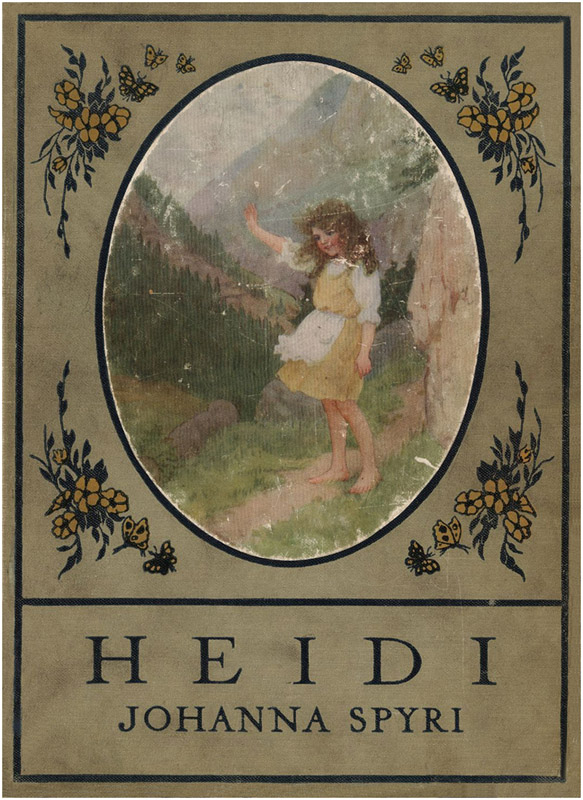
Heidi by Johanna Spyri

Heidi
By: JOHANNA SPYRI

“Heidi” by Johanna Spyri is a novel written in the mid-19th century. The story revolves around a young girl named Heidi who, after being taken to live with her stern grandfather in the Swiss Alps, embarks on a journey filled with adventure and personal growth. The narrative explores themes of family, nature, and the importance of home, as well as the contrast between Heidi’s idyllic mountain life and her experiences in urban settings. At the start of the story, Heidi is being taken by her aunt Deta up the mountain to meet her grandfather, known as the Alm-Uncle, who lives in isolation. The journey reveals the villagers’ apprehensions about the uncle, hinting at the mysterious and potentially troubled past he carries. Upon reaching the uncle’s hut, Heidi’s cheerful and curious nature brings her into contact with her grandfather, who is initially gruff and unwelcoming. As Heidi begins to adapt to her new mountain home, she experiences the joys of nature and the companionship of animals, foreshadowing the profound impact she will have on her grandfather and the blossoming relationship between them. The opening sets the stage for Heidi’s adventures and the transformative power of love and acceptance amidst the rugged beauty of the Alps.

The Tale of Solomon Owl Chapter XIII THE LUCKY GUEST

Chapter XIII THE LUCKY GUEST

In the middle of the day Solomon Owl happened to awake. He was sorry that he hadn’t slept until sunset, because he was very hungry. Knowing that it was light outside his hollow tree, he didn’t want to leave home to find something to eat.

Then, suddenly, he remembered that he had brought Benjamin Bat to his house early that morning, so Benjamin might escape the storm…. Why not eat Benjamin Bat?

As soon as the thought occurred to him, Solomon Owl liked it. And he moved stealthily over to the bed of leaves he had made for his guest just before daybreak.

But Benjamin Bat was not there. Though Solomon looked in every nook and cranny of his one-room house, he did not find him.

“He must have left as soon as it stopped raining,” said Solomon Owl to himself. “He might at least have waited to thank me for giving him a day’s lodging. It’s the last time I’ll ever bring any worthless vagabond into my house. And I ought to have known better than to have anything to do with a crazy person like Benjamin Bat.”

Anybody can see that Solomon Owl was displeased. But it was not at all astonishing, if one stops to remember how hungry he was, and that he had expected to enjoy a good meal without the trouble of going away from home to get it.

Solomon Owl went to the door of his house and looked out. The sun was shining so brightly that after blinking in his doorway for a few minutes he decided that he would go to bed again and try to sleep until dusk. He never liked bright days. “They’re so dismal!” he used to say. “Give me a good, dark night and I’m happy, for there’s nothing more cheering than gloom.”

In spite of the pangs of hunger that gnawed inside him, Solomon at last succeeded in falling asleep once more. And he dreamed that he chased Benjamin Bat three times around Blue Mountain, and then three times back again, in the opposite direction. But he never could catch him, because Benjamin Bat simply wouldn’t fly straight. His zigzag course was so confusing that even in his dream Solomon Owl grew dizzy.

Now, Benjamin Bat was in Solomon’s house all the time. And the reason why Solomon Owl hadn’t found him was a very simple one. It was merely that Solomon hadn’t looked in the right place.

Benjamin Bat was hidden–as you might say–where his hungry host never once thought of looking for him. And being asleep all the while, Benjamin didn’t once move or make the slightest noise.

If he had snored, or sneezed, or rustled his wings, no doubt Solomon Owl would have found him.
When Benjamin awakened, late in the afternoon, Solomon was still sleeping. And Benjamin crept through the door and went out into the gathering twilight, without arousing Solomon.

“I’ll thank him the next time I meet him,” Benjamin Bat decided. And he staggered away through the air as if he did not quite know, himself, where he was going. But, of course, that was only his queer way of flying.

When he told his friends where he had spent the day they were astonished.

“How did you ever dare do anything so dangerous as sleeping in Solomon Owl’s house?” they all asked him.

But Benjamin Bat only said, “Oh! There was nothing to be afraid of.” And he began to feel quite important.

The Tale of Solomon Owl Chapter XII BENJAMIN BAT

Chapter XII BENJAMIN BAT

Solomon Owl was by no means the only night-prowler in Pleasant Valley. He had neighbors that chose to sleep in the daytime, so they might roam through the woods and fields after dark. One of these was Benjamin Bat. And furthermore, he was the color of night itself.

Now, Benjamin Bat was an odd chap. When he was still he liked to hang by his feet, upside down. And when he was flying he sailed about in a zigzag, helter-skelter fashion. He went in so many different directions, turning this way and that, one could never tell where he was going. One might say that his life was just one continual dodge–when he wasn’t resting with his heels where his head ought to be.

A good many of Benjamin Bat’s friends said he certainly must be crazy, because he didn’t do as they did. But that never made the slightest difference in Benjamin Bat’s habits. He continued to zigzag through life–and hang by his heels–just the same. Perhaps he thought that all other people were crazy because they didn’t do likewise.

Benjamin often dodged across Solomon Owl’s path, when Solomon was hunting for field mice. And since Benjamin was the least bit like a mouse himself–except for his wings–there was a time, once, when Solomon tried to catch him.

But Solomon Owl soon found that chasing Benjamin Bat made him dizzy. If Benjamin hadn’t been used to hanging head downward, maybe he would have been dizzy, too.

Though the two often saw each other, Benjamin Bat never seemed to care to stop for a chat with Solomon Owl. One night, however, Benjamin actually called to Solomon and asked his advice. He was in trouble. And he knew that Solomon Owl was supposed by some to be the wisest old fellow for miles around.

It was almost morning. And Solomon Owl was hurrying home, because a terrible storm had arisen. The lightning was flashing, and peals of thunder crashed through the woods. Big drops of rain were already pattering down. But Solomon Owl did not care, for he had almost reached his house in the hollow hemlock near the foot of Blue Mountain.

It was different with Benjamin Bat. That night he had strayed a long distance from his home in Cedar Swamp. And he didn’t know what to do. “I want to get under cover, somewhere,” he told Solomon Owl. “You don’t know of a good place near-by, do you, where I can get out of the storm and take a nap?”

“Why, yes!” answered Solomon Owl. “Come right along to my house and spend the day with me!”

But Benjamin Bat did not like the suggestion at all.

“I’m afraid I might crowd, you,” he said. He was thinking of the time when Solomon Owl had chased him. And sleeping in Solomon Owl’s house seemed far from a safe thing to do.

Solomon was wise enough to guess what was going on inside Benjamin’s head.

“Come along!” he said. “We’ll both be asleep before we know it. I’m sorry I can’t offer you something to eat. But I haven’t a morsel of food in my house. No doubt, though, you’ve just had a good meal. I ate seven mice tonight. And I certainly couldn’t eat anything more.”

When Solomon Owl told him that, Benjamin Bat thought perhaps there was no danger, after all. And since the rain was falling harder and harder every moment, he thanked Solomon and said he would be glad to accept his invitation.

“Follow me, then!” said Solomon Owl. And he led the way to his home in the hemlock.

For once, Benjamin Bat flew in a fairly straight line, though he did a little dodging, because he couldn’t help it.

There was more room inside Solomon’s house than Benjamin Bat had supposed. While Benjamin was looking about and telling Solomon that he had a fine home, his host quickly made a bed of leaves in one corner of the room–there was only one room, of course.

“That’s for you!” said Solomon Owl. “I always sleep on the other side of the house.” And without waiting even to make sure that his guest was comfortable, Solomon Owl lay down and began to snore–for he was very sleepy.

It was so cozy there that Benjamin Bat was glad, already, that he had accepted Solomon’s invitation.

The Tale of Solomon Owl Chapter XI CURED AT LAST

Chapter XI CURED AT LAST

“How do you feel now?” Aunt Polly Woodchuck asked Solomon Owl, when he had come back to her house after a week’s absence.

“No better!” he groaned. “I still have pains. But they seem to have moved and scattered all over me.”

“Good!” she exclaimed with a smile. “You are much better, though you didn’t know it. The wishbone is broken. You broke it by flying against the trees. And you ought not to have any more trouble. But let me examine you!” she said, prodding him in the waistcoat once more.

“This is odd!” she continued a bit later. “I can feel the wishbone more plainly than ever.”

“That’s my own wishbone!” Solomon cried indignantly. “I’ve grown so thin through not eating that it’s a wonder you can’t feel my backbone, too.”

Aunt Polly Woodchuck looked surprised.

“Perhaps you’re right!” said she. “Not having a wishbone of my own, I forgot that you had one.”

A look of disgust came over Solomon Owl’s face.

“You’re a very poor doctor,” he told her. “Here you’ve kept me from eating for a whole week–and I don’t believe it was necessary at all!”

“Well, you’re better, aren’t you?” she asked him.

“I shall be as soon as I have a good meal,” replied Solomon Owl, hopefully.

“You ought not to eat anything for another week,” Aunt Polly told him solemnly.

“Nonsense!” he cried.

“I’m a doctor; and I ought to know best,” she insisted.

But Solomon Owl hooted rudely.

“I’ll never come to you for advice any more,” he declared. “I firmly believe that my whole trouble was simply that I’ve been eating too sparingly. And I shall take good care to see that it doesn’t happen again.”

No one had ever spoken to Aunt Polly in quite that fashion–though old Mr. Crow had complained one time that she had cured him too quickly. But she did not lose her temper, in spite of Solomon’s jeers.

“You’ll be back here again the very next time you’re ill,” she remarked. “And if you continue to swallow your food whole—-”

But Solomon Owl did not even wait to hear what she said. He was so impolite that he flew away while she was talking. And since it was then almost dark, and a good time to look for field mice, he began his night’s hunting right there in Farmer Green’s pasture.

By morning Solomon was so plump that Aunt Polly Woodchuck would have had a good deal of trouble finding his wishbone. But since he did not visit her again, she had no further chance to prod him in the waistcoat.

Afterward, Solomon heard a bit of gossip that annoyed him. A friend of his reported that Aunt Polly Woodchuck was going about and telling everybody how she had saved Solomon’s life.

“Mice!” he exclaimed (he often said that when some would have said “Rats!”). “There’s not a word of truth in her claim. And if people in this neighborhood keep on taking her advice and her catnip tea they’re going to be sorry someday. For they’ll be really ill the first thing they know. And then what will they do?”