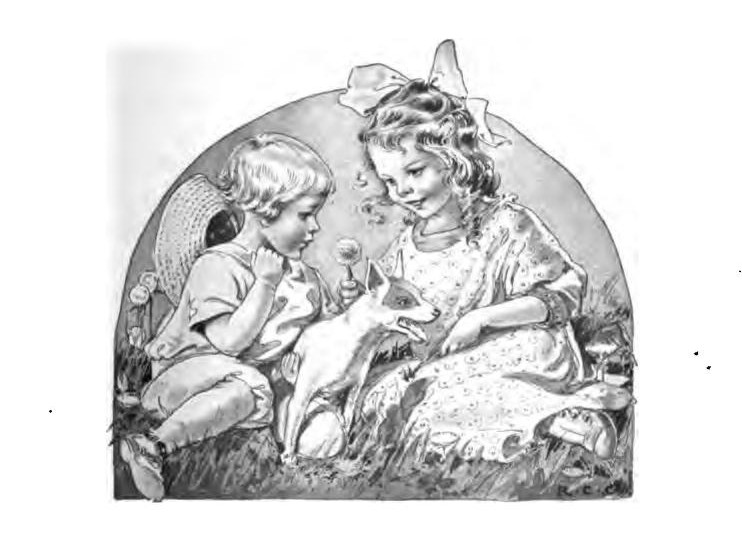
This book is about Polly Howe when she was eight years old. It is about her brother Peter, too. It is about Wag-wag. He is Peter’s dog. And about Brownie. She is a pony. Then there is Tim, a httle boy who lives near Peter. Tim’s dog is named Collie.
Look at the map in the front of this book. It will show you where all these people live.
Do you wish to know what Peter and Polly play? If you do, you must read these stories.
Peter and Polly live in the country. There are no tall buildings near their house. There are no crowded streets in their village.
But there are many trees along the streets. There are large fields near the houses. And there are hills all around.
In the spring the fields are yellow with buttercups. In the summer they are green with tall grass. In the winter they are white with snow.
It is very, very cold in the winter. The snow is deep. Sometimes it covers the fences.
Peter and Polly like to play in the snow. They like to build snow forts and to make snow men. But Polly is glad when the snow melts. She knows that spring is coming. She watches for the first birds to come back. She looks for the first flowers.
One day she said to father, “I have a hole in my rubber boots.”
” That will not do,” said father. ” We must mend it, if we can. If we cannot, you must have a new pair.
” It is nearly spring. Soon the roads and the sidewalks will be wet.”
” Yes,” said Polly. ” All the snowflakes will turn into water fairies again. Then they will run away to their homes in the brook.
“We can go fishing and wading. We shall not have to put on so many clothes. I shall be glad of that.”
“Peter likes winter best. But I like spring and summer.”
” Sugaring comes in the spring,” said Peter. “I like that. May we tap our maple trees, father ?”
” Yes,” said father. ” I think this will be a good sugar year. Perhaps you can make enough sugar to keep you sweet for a long time. You may try.”
Solomon Owl had pains–sharp pains–underneath his waistcoat. And not knowing what else to do, he set off at once for Aunt Polly Woodchuck’s house under the hill, in the pasture, which he had not visited since the previous fall. Luckily, he found the old lady at home. And quickly he told her of his trouble.
“What have you been eating?” she inquired.
“I’ve followed your advice. I’ve been eating chickens,” said he–“very small chickens, because they were all I could get.”
Aunt Polly Woodchuck, who was an herb doctor–and a good one–regarded him through her spectacles.
“I’m afraid,” said she, “you don’t chew your food properly. Bolting one’s food is very harmful. It’s as bad as not eating anything at all, almost.”
Solomon Owl showed plainly that her remark surprised him.
“Why,” he exclaimed, “I always swallow my food whole–when it isn’t too big!”
“Gracious me!” cried Aunt Polly, throwing up both her hands. “It’s no wonder you’re ill. It’s no wonder you have pains; and now I know exactly what’s the matter with you. You have a wishbone inside you. I can feel it!” she told him, as she prodded him in the waistcoat.
“I wish you could get it out for me!” said Solomon with a look of distress.
“All the wishing in the world won’t help you,” she answered, “unless we can find some way of removing the wishbone so you can wish on that. Then I’m sure you would feel better at once.”
“This is strange,” Solomon mused. “All my life I’ve been swallowing my food without chewing it. And it has never given me any trouble before….What shall I do?”
“Don’t eat anything for a week,” she directed. “And fly against tree-trunks as hard as you can. Then come back here after seven days.”
Solomon Owl went off in a most doleful frame of mind. It seemed to him that he had never seen so many mice and frogs and chipmunks as he came across during the following week. But he didn’t dare catch a single one, on account of what Aunt Polly Woodchuck had said.
His pains, however, grew less from day to day–at least, the pains that had first troubled him. But he had others to take their place. Hunger pangs, these were! And they were almost as bad as those that had sent him hurrying to see Aunt Polly Woodchuck.
On the whole, Solomon passed a very unhappy week. Flying head foremost into tree-trunks (as Aunt Polly had instructed him to do) gave him many bumps and bruises. So he was glad when the time came for him to return to her house in the pasture.
Solomon’s neighbors had been so interested in watching him that they were all sorry when he ceased his strange actions. Indeed, there was a rumor that Solomon had become very angry with Farmer Green and that he was trying to knock down some of Farmer Green’s trees. Before the end of that unpleasant week Solomon had often noticed as many as twenty-four of the forest folk following him about, hoping to see a tree fall.
But they were all disappointed. However, they enjoyed the sight of Solomon hurling himself against tree-trunks. And the louder he groaned, the more people gathered around him.
Chapter IX HALLOWEEN (There are no content issues with this chapter despite the title.)
Solomon Owl was afraid of fire. And when he looked down from his perch in the tree and saw, through the hole in the stranger’s crown, that all was aglow inside his big, round head, Solomon couldn’t help voicing his horror. He “whoo-whooed” so loudly that Tommy Fox, at the foot of the tree, asked him what on earth was the matter.
“His head’s all afire!” Solomon Owl told him. “That’s what makes his eyes glare so. And that’s why the fire shines through his mouth and his nose, too. It’s no wonder he didn’t answer my question–for, of course, his tongue must certainly be burned to a cinder.”
“Then it ought to be safe for anybody to enter the chicken house,” Tommy Fox observed. “What could the stranger do, when he’s in such a fix?”
“He could set the chicken house afire, if he followed you inside,” replied Solomon Owl wisely. “And I, for one, am not going near the pullets to-night.”
“Nor I!” Fatty Coon echoed. “I’m going straight to the cornfield. The corn is still standing there in shocks; and I ought to find enough ears to make a good meal.”
But Solomon Owl and Tommy Fox were not interested in corn. They never ate it. And so it is not surprising that they should be greatly disappointed. After a person has his mouth all made up for chicken it is hard to think of anything that would taste even half as good.
“It’s queer he doesn’t go and hold his head under the pump,” said Solomon Owl. “That’s what I should do, if I were he.”
“Jimmy Rabbit had better not go too near him, or he’ll get singed,” said Tommy Fox, anxiously. “I don’t want anything to happen to him.”
“Jimmy Rabbit is very careless,” Solomon declared. “I don’t see what he’s thinking of–going so near a fire! It makes me altogether too nervous to stay here. And I’m going away at once.”
Tommy Fox said that he felt the same way. And the moment Fatty Coon, with his sharp claws, started to crawl down the tree on his way to the cornfield, Tommy Fox hurried off without even stopping to say good-bye.
“Haw-haw-hoo!” laughed Solomon Owl. “Tommy Fox is afraid of you!” he told Fatty Coon. But Fatty didn’t seem to hear him. He was thinking only of the supper of corn that he was going to have. “Better come away!” Solomon Owl called to Jimmy Rabbit, turning his head toward the fence where Jimmy had been lingering near the hot-headed stranger.
But Jimmy Rabbit didn’t answer him, either. He was no longer there. The moment he had seen Tommy Fox bounding off across the meadow Jimmy had started at once for Farmer Green’s vegetable garden.
So Solomon Owl was the last to leave.
“There’s really nothing else I can do,” he remarked to himself. “I don’t know what Aunt Polly Woodchuck would say if she knew that I didn’t follow her advice to-night and eat a pullet for my supper…. But I’ve tried my best…. And that’s all anybody can do.”
Solomon Owl was upset all the rest of that night. And just before daybreak he visited the farmyard again, to see whether the strange man with the flaring head still watched the chicken house. And Solomon found that he had vanished.
So Solomon Owl alighted on the fence. There was nothing there except a hollowed-out pumpkin, with a few holes cut in it, which someone had left on one of the fence-posts.
“Good!” said he. “Maybe I can get my pullet after all!” He turned to fly to the chicken house. But just then the woodshed door opened again. And Farmer Green stepped outside, with a lantern in his hand. He was going to the barn to milk the cows. But Solomon Owl did not wait to learn anything more.
He hurried away to his house among the hemlocks. And having quickly settled himself for a good nap, he was soon fast asleep.
That was how Johnnie Green’s jack-o’-lantern kept Tommy Fox and Fatty Coon and Solomon Owl from taking any chickens on Halloween.
Solomon Owl and Fatty Coon couldn’t help laughing at what Tommy Fox said to them, as they sat in their tree near the farmhouse, looking down at him in the moonlight.
“I’m here to watch Farmer Green’s chickens for him–” said he–“to see that no rat–or anybody else–runs away with a pullet.”
“Farmer Green has someone else watching for him to-night,” said Solomon Owl, when he had stopped laughing. “There’s that strange man! You can see how he keeps his glaring eyes fixed on the chicken house. And unless I’m mistaken, he’s on the lookout for you.”
“No such thing!” Tommy Fox snapped. And he looked up at Solomon as if he wished that he could climb the tree.
“Here comes somebody else!” Fatty Coon exclaimed suddenly. His keen eyes had caught sight of Jimmy Rabbit, hopping along on his way to the vegetable garden, to see if he couldn’t find a stray cabbage or a turnip.
Solomon Owl called to him. Whereupon, Jimmy Rabbit promptly sat up and looked at the odd trio. If it hadn’t been for Tommy Fox he would have drawn nearer.
“Do you know that stranger?” Solomon Owl asked him, pointing out the horrible head to Jimmy.
“I haven’t the pleasure,” said Jimmy Rabbit, after he had taken a good look.
“Well,” said Solomon, “won’t you kindly speak to him; and ask him to go away?”
“Certainly!” answered Jimmy Rabbit, who always tried to be obliging.
“I hope the stranger won’t eat him,” remarked Tommy Fox, “because I hope to do that some day, myself.”
It was queer–but Jimmy Rabbit was the only one of the four that wasn’t afraid of those glaring features. He hopped straight up to the big round head, which was just a bit higher than one of the fence posts, against which the stranger seemed to be leaning. And after a moment or two Jimmy Rabbit called to Solomon and Fatty and Tommy Fox: “He won’t go away! He’s going to stay right where he is!”
“Come here a minute!” said Tommy.
Jimmy Rabbit shook his head.
“You come over here!” he answered. And he did not stir from the side of the stranger. He knew very well that Tommy Fox was afraid of the man with the head with the glaring eyes.
As for Tommy Fox, he did not even reply–that is, to Jimmy Rabbit. But he spoke his mind freely enough to his two friends in the tree.
“It seems to me one of you ought to do something,” said he. “We’ll eat no pullets tonight if we can’t get rid of this meddlesome stranger.”
Fatty Coon quite agreed with him.
“The one who was here first is the one to act!” Fatty declared. “That’s you!” he told Solomon Owl.
So Solomon Owl felt most uncomfortable.
“I don’t know what I can do,” he said. “I spoke to the stranger–asked him who he was. And he wouldn’t answer me.”
“Can’t you frighten him away?” Tommy Fox inquired. “Fly right over his head and give him a blow with your wing as you pass!”
Solomon Owl coughed. He was embarrassed, to say the least. “He’s afraid!” Fatty Coon cried. And both he and Tommy Fox kept repeating, over and over again, “He’s afraid! He’s afraid! He’s afraid!”
It was really more than Solomon Owl could stand.
“I’m not!” he retorted angrily. “Watch me and you’ll see!” And without another word he darted out of the tree and swooped down upon the stranger, just brushing the top of his head. Solomon Owl knew at once that he had knocked something off the top of that dreadful head–something that fell to the ground and made Jimmy Rabbit jump nervously.
Then Solomon returned to his perch in the tree. “He hasn’t moved,” he said. “But I knocked off his hat.”
“You took off the top of his head!” cried Fatty Coon in great excitement. “Look! The inside of his head is afire.” And peering down from the tree-top, Solomon Owl saw that Fatty Coon had told the truth.
It was some three hours after sunset when Solomon Owl at last reached Farmer Green’s place. All was quiet in the chicken house because the hens and roosters and their families had long since gone to roost. And except for a light that shone through a window, the farmhouse showed not a sign of life.
Everything was as Solomon Owl wished it–or so he thought, at least, as he alighted in a tree in the yard to look about him. He wanted no one to interrupt him when he should go nosing around the chicken house, to find an opening.
To his annoyance, he had not sat long in the tree when the woodshed door opened. And Solomon stared in amazement at the strange sight he saw.
A great head appeared, with eyes and mouth–yes! and nose, too–all a glaring flame color. Solomon had never seen such a horrible face on man or bird or beast. But he was sure it was a man, for he heard a laugh that was not to be mistaken for either a beast’s or a bird’s. And the worst of it was, those blazing eyes were turned squarely toward Farmer Green’s chicken house!
Solomon Owl was too wary to go for his fat pullet just then. He decided that he would wait quietly in the tree for a time, hoping that the man would go away.
While Solomon watched him the stranger neither moved nor spoke. And, of course, Solomon Owl was growing hungrier every minute. So at last he felt that he simply must say something.
“Who-who-who-are-you?” he called out from his tree.
But the strange man did not answer. He did not even turn his head.
“He must be some city person,” Solomon Owl said to himself. “He thinks he’s too good to speak to a countryman like me.”
Then Solomon sat up and listened. He heard a scratching sound. And soon he saw a plump figure crawl right up into his tree-top.
It was Fatty Coon!
“What are you doing here?” Solomon Owl asked in a low voice, which was not any too pleasant.
“I’m out for an airing,” Fatty answered. “Beautiful night–isn’t it?”
But Solomon Owl was not interested in the weather.
“I don’t suppose you’ve come down here to get a chicken, have you?” he inquired.
Fatty Coon seemed greatly surprised at the question. “Why–no!” he exclaimed. “But now that you speak of it, it reminds me that Farmer Green’s saving a pullet for me. He was heard to say not long ago that he would like to catch me taking one of his hens. So he must have one for me. And I don’t want to disappoint him.”
At first Solomon Owl didn’t know what answer to make. But at last he turned his head toward Fatty.
“Why don’t you go and get your pullet now?” he asked.
“There’s that man down below, with the glaring eyes–” said Fatty Coon. “I’ve been waiting around here for quite a long time and he hasn’t looked away from the chicken house even once…. Do you know him?”
“No! And I don’t want to!” said Solomon Owl.
“S-sh!” Fatty Coon held up a warning hand. “Who’s that?” he asked, peering down at a dark object at the foot of their tree.
Then both he and Solomon saw that it was Tommy Fox, sitting on his haunches and staring at the big head, with its blazing eyes and nose and mouth.
“Not looking for chickens, I suppose?” Solomon Owl called in a low tone, which was hardly more than a whisper.
But Tommy Fox’s sharp ears heard him easily. And he looked up, licking his chops as if he were very hungry indeed. And all the while the stranger continued to stare straight at the chicken house, as if he did not intend to let anybody go prowling about that long, low building to steal any of Farmer Green’s poultry.
It was no wonder that the three chicken-lovers (two in the tree and one beneath it) hesitated. If the queer man had only spoken they might not have been so timid.
For six days Don Quixote lay in bed, sullen and sorrowful because of his overthrow. And all this time Sancho Panza sat beside him and tried to comfort him.
“My master,” he said, “pluck up your head and be of good cheer if you can. Let us go home and quit seeking adventures in lands and places we do not know. And if you will only think, I am the one who loses most, though it is you that are in the worst pickle.”
The squire’s cheerful words gave fresh hope to the knight. Gradually his courage came back to him, and at length the two bade goodbye to Barcelona and started for home. Don Quixote rode on Rozinante. He was unarmed and clad in a traveling coat. Sancho followed him on foot, leading his donkey, which was laden with Don Quixote’s armor.
“I should not have been defeated had it not been for Rozinante’s weakness,” said the knight.
They traveled for many days with their faces turned steadfastly towards La Mancha. But their steeds made slow progress and they stopped often by the way.
At length they got to the top of a hill from which they could see their own peaceful little village lying in the green valley below. At this sight Sancho fell upon his knees and cried out:—
“O thou long-wished-for village, open thy eyes and behold thy child, Sancho Panza. He has come back to thee again, not very rich, yet very well flogged. O village, open thy arms, and receive also thy son, Don Quixote. While he has been vanquished by others, he has gained the victory over himself — and that is the best of all victories.”
“Hush your prattle,” said Don Quixote, “and let us put our best foot foremost to enter our village.”
So they went down the hill, and were soon met by their old friends, the curate and the barber and faithful Samson Carrasco. Don Quixote alighted and embraced them all quite lovingly.
“I have returned home for a year,” he said; “and I have a mind to turn shepherd and enjoy the solitude of the fields. If you have not much to do, I shall be pleased to have you for my companions.”
They answered him pleasantly, and then, surrounded by a troop of boys, they made their way to Don Quixote’s house.
The housekeeper and the niece were at the door to welcome the wanderer.
“My dear niece,” he said, “I have come home for a little while. I think that I shall soon leave you again, to live the simple life of a shepherd. But help me to bed, now, for it seems to me that I am not very well.”
They led him in, and made him as comfortable as they could. They cared most lovingly for him day and night. But all the strength seemed to have gone from his poor body.
The curate, the barber, and Samson Carrasco came often to see him. His good squire, Sancho Panza, sat all the time by his bedside. But in spite of every care he steadily grew more feeble.
On the sixth day the doctor told him that he was in danger and might not live long. Don Quixote asked them to leave him alone a little while, for he thought that he could sleep.
They went out of the room. He soon fell into a deep slumber, and he lay so still, with such a look of peace upon his face, that they thought he would never wake in this world.
At the end of six hours, however, he opened his eyes, and cried out: “Blessed be Almighty God, who has done me so much good. His mercies are without end.”
Then they saw that his madness had left and that his mind was clear and bright.
“Send for my good friends, the curate and the barber and Samson Carrasco,” he said; “for I am at the point of death, and I would make my will.”
But these gentlemen had all the time been waiting at the door, and now they entered the room. Don Quixote was overjoyed to see them. “Welcome, my friends!” he said. “I am no longer Don Quixote de la Mancha, but plain Alonzo Quixana, whom our townspeople used to call The Good. My mind is clear now, and I see the great folly that I was led into through the reading of foolish books. All those vulgar stories of knights and magicians are hateful to me, and I abhor them. But now send for my lawyer, that he may draw up my will, for my hours are numbered.”
They looked at one another, wondering, and Samson Carrasco went to fetch the lawyer. The sick man roused himself and his face brightened when the man of law came and sat down by his bedside.
The will was drawn up in due form. It provided that a small sum of money should be paid to Sancho Panza for his good services, and that all the rest of the estate should go to the niece. It was signed by Alonzo Quixana, and witnessed by the curate and the barber.
Then the sick man fell back in his bed, and lay for three days without knowing anything at all. In the afternoon of the third day he fell into a gentle sleep from which he never awoke.
So ended the adventures of as good a man and as brave as Spain has ever seen.
For some time Solomon Owl had known that a queer feeling was coming over him. And he could not think what it meant. He noticed, too, that his appetite was leaving him. Nothing seemed to taste good any more.
So at last, one fine fall evening he went to see Aunt Polly Woodchuck, who was an herb doctor; for he had begun to worry about his health.
“It’s lucky you came today,” said Aunt Polly. “Because to-night I’m going to begin my winter’s nap. And you couldn’t have seen me again till spring–unless you happened to come here on ground-hog day, next February…. What appears to be your trouble?” she inquired.
“It’s my appetite, partly,” Solomon Owl said. “Nothing tastes as it did when I was a youngster. And I keep longing for something, though what it is I can’t just tell.”
Aunt Polly Woodchuck nodded her head wisely. “What have you been eating lately?” she asked.
Solomon Owl replied that he hadn’t eaten anything but mice since the leaves began to turn.
“Hmm–the leaves are nearly all off the trees now,” the old lady remarked. “How many mice have you eaten in that time?”
Solomon said that as nearly as he could remember he had eaten twenty-seven–or a hundred and twenty-seven. He couldn’t say which–but one of those numbers was correct.
Aunt Polly Woodchuck threw up her hands. “Sakes alive!” she cried. “It’s no wonder you don’t feel well! What you need is a change of food. And it’s lucky you came to me now. If you’d gone on like that much longer I’d hate to say what might have happened to you. You’d have had dyspepsia, or some other sort of misery in your stomach.”
“What shall I do?” asked Solomon Owl. “Insects are scarce at this season of the year. Of course, there are frogs–but I don’t seem to care for them. And there are fish–but they’re not easy to get, for they don’t come out of the water and sit on the bank, as the frogs do.”
“How about pullets?” Aunt Polly inquired.
At that Solomon Owl let out a long row of hoots because he was pleased.
“The very thing!” he cried. “That’s what I’ve been wanting all this time. And I never guessed it…. I’ll pay you for your advice the next time I see you,” he told Aunt Polly. And Solomon Owl hurried away before she could stop him. Since he had no intention of visiting her on ground-hog day, he knew it would be spring before he saw Aunt Polly Woodchuck again.
The old lady scolded a bit. And it did not make her feel any pleasanter to hear Solomon’s mocking laughter, which grew fainter and fainter as he left the pasture behind him. Then she went inside her house, for she was fast growing sleepy. And she wanted to set things to rights before she began her long winter’s nap.
Meanwhile, Solomon Owl roamed restlessly through the woods. There was only one place in the neighborhood where he could get a pullet. That was at Farmer Green’s chicken house. And for some reason he did not care to visit the farm buildings until it grew darker.
So he amused himself by making the woods echo with his strange cry, “Whoo-whoo-whoo, whoo-whoo, to-whoo-ah!” And now and then he threw in a few “wha-whas,” just for extra measure.
Many of the forest folk who heard him remarked that Solomon Owl seemed to be in extra fine spirits.
“Probably it’s the hunter’s moon that pleases him!” Jimmy Rabbit remarked to a friend of his. “I’ve always noticed that old Solomon makes more noise on moonlight nights than at any other time.”
The hunter’s moon, big and yellow and round, was just rising over Blue Mountain. But for once it was not the moon that made Solomon Owl so talkative. He was in fine feather, so to speak, because he was hoping to have a fat pullet for his supper. And as for the moon, he would have been just as pleased had there been none at all that night. For Solomon Owl never cared to be seen when he visited Farmer Green’s chicken house.
One morning Don Quixote, fully armed, rode out to the seashore to take the air. He felt very brave, and was in fine fighting humor.
“Arms,” he said, “are my best attire, and combat is my meat and drink.”
Suddenly he saw a strange knight riding towards him. The knight was armed from head to foot, and on his shield a bright moon was painted.
As soon as he was within hearing, he called out: “Most illustrious, most valorous Don Quixote, de la Mancha, I am the Knight of the White Moon. I have come to enter into combat with thee. I have come to make thee confess that my lady, whoever she may be, is more beautiful by far than thy Dulcinea del Toboso.”
“That I will never confess,” answered Don Quixote; “but I will force thee to confess the contrary. Thou hast never seen the illustrious Dulcinea. If thou hadst, the sight of her would have made thee know that there is no beauty like unto hers.”
“I challenge you to prove it in fair combat,” cried the Knight of the White Moon. “If I vanquish you, I shall require of you to go to your home, and for the space of one year give up your arms and your knight-errantry and live there in peace and quiet.”
“But what do you agree to do if I shall vanquish you?” said Don Quixote.
“I agree that my head shall be at your disposal,” answered the knight. “My horse and arms shall be your spoils, and the fame of my deeds shall be added to that of your own achievements.”
“I accept your challenge,” said Don Quixote; “and will faithfully comply with all its conditions; but I am content with the fame of my own deeds, and do not wish to assume yours. Choose whichever side of the field you prefer, and let us settle this business at once.”
The two knights turned their horses and rode apart some distance. Then they again faced each other. The next moment, without waiting for any signal, they made the onset.
The White Moon’s steed was much swifter than Rozinante, and he thundered down upon Don Quixote ere he had run one third of the distance. Our knight had no time to use his spear. The stranger struck him with such force that both he and his steed were hurled helpless to the ground.
Quickly the White Moon dismounted. He held his spear at Don Quixote’s throat and cried: “Yield, knight! Fulfill the conditions of our challenge or your life is forfeit!”
Don Quixote was bruised and stunned. But he answered in a faint and feeble voice, “I maintain that Dulcinea del Toboso is the most beautiful lady in the world, and I am the most unfortunate knight. Press on thy spear, and rid me of life.”
“That I will not do,” said he of the White Moon. “I will not dispute the fame of the beautiful Dulcinea. I shall be satisfied if the great Don Quixote will only return to his home for a year as was agreed to in our challenge.”
“Very well,” answered Don Quixote. “Since you require nothing that will tarnish the fame of the Lady Dulcinea, I will do all the rest as you desire.”
They lifted Don Quixote from the ground and uncovered his face. He was very pale and weak. Rozinante still lay in the sand unable to rise. As for Sancho Panza, he was so sad and dismayed that he did not know what to do.
The Knight of the White Moon galloped away toward the city, and some of those who had seen the combat followed him. They asked him who he was, and why he had dealt so roughly with the famous but harmless Don Quixote.
“My name is Samson Carrasco,” said the knight, “and I am a friend and near neighbor of Don Quixote. All that I wished in this combat was not to harm my friend, but to make him promise to return home. I think that if he can be induced to rest there quietly for a year, this madness about knight-errantry will be cured.”
It was, indeed, Samson Carrasco, the same who once before, as the Knight of the Mirrors, had tried to cure his friend of his folly but had failed.
Yes! As he held up his new coat and looked at it, Solomon Owl was puzzled. He turned his head toward Mr. Frog and stared at him for a moment. And then he turned his head away from the tailor and gazed upon the coat again.
Mr. Frog was most uncomfortable–especially when Solomon looked at him. “Everything’s all right, isn’t it?” he inquired.
Solomon Owl slowly shook his head.
“This is a queer coat!” he said. “What’s this bag at the top of it?”
“Oh!” exclaimed Mr. Frog. “That’s the hood! Knowing that you spend your winters here in Pleasant Valley, I made a hood to go over your head…. You’ll find it very comfortable in cold weather–and it’s the latest style, too. All the winter coats this year will have hoods, with holes to see through, you know.”
Solomon Owl looked relieved at Mr. Frog’s explanation. But there was still something more that appeared to trouble him.
“How shall I get into the coat?” he inquired. “It doesn’t open in front, as it should.”
“Another cold-weather style!” Mr. Frog assured him. “It’s wind-proof! And instead of buttoning the coat, you pull it on over your head.”
Solomon Owl said he didn’t like that style very well.
“Then I can easily change it,” the tailor told him. “But just try it on!” he urged. “It may please you, after all.” So Solomon Owl pulled the coat over his head. And it fell down about him, almost reaching his feet. But the coat did not seem to suit him at all, for he began to splutter and choke.
“What’s the matter now?” Mr. Frog asked him.
“I can’t see–that’s what’s the matter!” Solomon Owl cried in a voice that sounded hollower than ever, because it was muffled by the hood, which covered his head.
“I declare–I haven’t cut the holes for your eyes!” the tailor exclaimed. “Just wait a moment and I’ll make everything satisfactory.” He clinked his shears together sharply as he spoke.
But Solomon Owl told him that he wouldn’t think of letting anybody use shears so near his eyes.
“I’ll take off the coat,” he said. “And I know now that you’re a very poor tailor, or you wouldn’t have made such a mistake.” He began to tug at the coat. But he soon found that taking it off was not so easy as putting it on. Solomon’s sharp claws caught in the cloth; and his hooked beak, too, fastened itself in the hood the moment he tried to pull the coat over his head. “Here!” he cried to Mr. Frog. “Just lend me a hand! I can’t see to help myself.”
But Mr. Frog did not even answer him.
“Don’t you hear me?” Solomon Owl shouted, as he struggled with his new coat, only to become tangled in it more than ever.
Still, the tailor said never a word, though something very like a giggle, followed by a splash, caught Solomon’s ear.
“He’s left me!” Solomon Owl groaned.
“Mr. Frog has left me to get out of this coat alone. And goodness knows how I’m ever going to do it.”
He threshed about so vigorously that he tripped himself and fell upon the bank of the brook, rolling over and over toward the water. He had a very narrow escape. If he hadn’t happened to bring up against an old stump he would certainly have tumbled into the stream.
Though Solomon couldn’t see, he knew that he was in danger. So he lay on his back on the ground and carefully tore his new coat into strings and ribbons.
At last he was free. And he rose to his feet feeling very sheepish, for he knew that Mr. Frog had played a sly trick on him.
“Never mind!” said Solomon Owl, as he flew way. “I’ll come back to-morrow and ask Mr. Frog to make me a waistcoat and trousers. And then—-” He did not finish what he was saying. But there is no doubt that whatever it was, it could not have been very pleasant for Mr. Frog.
Just as he had planned, Solomon Owl returned to the brook the next day. And he was both surprised and disappointed at what he found.
The door of Mr. Frog’s tailor’s shop was shut and locked. And on it there was a sign, which said: TO LET. (note: This means it’s for rent.)
“He’s moved away!” cried Solomon Owl. And he went off feeling that he had been cheated out of a good dinner–to say nothing of a new waistcoat—and new trousers, too.
He had not been gone long when the door opened. And Mr. Frog leaped nimbly outside. He took the sign off the door; and sitting down cross-legged upon the bank, he began to sew upon Jasper Jay’s new blue suit, while his face wore a wider smile than ever.
He had suddenly decided not to let his shop, after all.
One morning towards the end of summer Don Quixote surprised the duke by calling for his armor and his steed.
“My Lord Duke, I must away, to seek new adventures,” he said. “I cannot tarry here any longer.”
“But has not your stay with us been agreeable to you?” asked the duke. “Why should you wish to leave us?”
“You have indeed been kind, and I thank you for it,” answered the knight. “But it is wrong to linger here among the dainties and delights which you have provided, while there are so many things in the world that need doing. I shall have to give an account for all these idle days.”
So, bidding the duke and duchess a kind farewell, he mounted his steed and rode away towards Saragossa; and Sancho, on his dappled donkey, followed him as before.
Time would fail me to tell of the many happenings on the road. They traveled leisurely along, making no plans, and letting each day and hour take care of itself. Yet the knight was ever on the alert for some new adventure.
One evening they arrived at an inn on the outskirts of the city, feeling very tired and hungry. The innkeeper met them at the door.
“Have you lodgings for two weary travelers and their beasts?” asked Sancho.
“Yes,” answered the innkeeper, “there are no better lodgings in Saragossa.”
So they alighted. Sancho led the beasts to the stable and gave them their food. Then he returned to the house to wait on his master.
“What have you for supper, my good host?” he asked.
“You may measure your mouth and ask for anything you like,” said the innkeeper. “Here you will find everything in abundance — fowls of the air, birds of the earth, and fishes of the sea.”
“Well,” said Sancho, “if you will roast a couple of chickens for us it will be enough. My master eats but little, and I am not a glutton.”
“I am sorry,” said the innkeeper, “but I have not a single chicken left. The hawks have carried them all away.”
“Why, then, if that is the case, you may roast us a duck,” said Sancho.
“A duck, sir!” cried the innkeeper, “I sent fifty to the market yesterday, and there is not another one. But, aside from ducks and chickens, ask for anything you like.”
“Well,” said Sancho, “a little veal or boiled kid would taste quite good.”
“Next week, my friend, we shall have plenty of both,” said the host, “but now we are just out of such meats.”
“Bring on some fried eggs and bacon, then,” said Sancho.
“You are a good one at guessing,” cried the host. “But I told you that I had neither chickens nor ducks, and so how can I have eggs?”
“Oh, bother!” said Sancho, losing his patience. “Have done with your ramblings, Mr. Landlord, and tell me just what you have.”
“I will do so,” answered the innkeeper. “What I really have is nothing more nor less than a pair of cow heels, dressed with beans, onions, and bacon; and all these are cooked to a turn and even now crying, ‘Eat me, eat me!’ “
“I set my mark on them this minute,” said Sancho. “Let nobody else touch them.”
“Nobody else will wish to touch them,” said the innkeeper; “for all the other guests are of such quality that they take their cook and their larder with them.”
“As for quality,” cried Sancho, “my master is as good as the best, but his profession doesn’t allow him to carry a pantry wherever he goes.”
Presently the host brought in the kettle, and they all sat down to a supper of cow’s heel and onions.
The knight and his squire were used to rough fare, and they had learned to take things as they found them. They rested well that night, and in the morning set forth again upon their travels. But now, instead of going into Saragossa, they took another road and journeyed on to Barcelona.
The fame of Don Quixote had gone before him, and at Barcelona there were those who gladly received him and entertained him. And so they spent some days in that great city, looking at its wonders and most of all at the sea which neither of them had ever before beheld.

 articlesforchristians