A place to grow your relationship with God

Posts tagged ‘fiction’

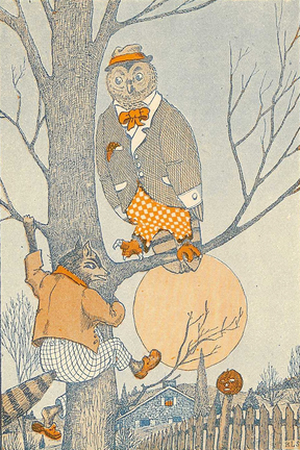
The Tale of Solomon Owl Chapter IV AN ODD BARGAIN

Chapter IV AN ODD BARGAIN

While Mr. Frog was swallowing nothing rapidly, he was thinking rapidly, too. There was something about Solomon Owl’s big, staring eyes that made Mr. Frog feel uncomfortable. And if he had thought he had any chance of escaping he would have dived into the brook and swum under the bank.

But Solomon Owl was too near him for that. And Mr. Frog was afraid his caller would pounce upon him any moment. So he quickly thought of a plan to save himself. “No doubt—” he began. But Solomon Owl interrupted him.

“There!” cried Solomon. “You can speak, after all. I supposed you’d swallowed your tongue. And I was just waiting to see what you’d do next. I thought maybe you would swallow your head.”

Mr. Frog managed to laugh at the joke, though, to tell the truth, he felt more nervous than ever. He saw what was in Solomon Owl’s mind, for Solomon was thinking of swallowing Mr. Frog’s head himself.

“No doubt–” Mr. Frog resumed–“no doubt you’ve come to ask me to make you a new suit of clothes.”

Now, Solomon Owl had had no such idea at all. But when it was mentioned to him, he rather liked it. “Will you?” he inquired, with a highly interested air.

“Why, certainly!” the tailor replied. And for the first time since he had turned his backward somersault into the bulrushes, he smiled widely. “I’ll tell you what I’ll do!” he said. “First, I’ll make you a coat free. And second, if you like it I will then make you a waistcoat and trousers, at double rates.”

Solomon Owl liked the thought of getting a coat for nothing. But for all that, he looked at the tailor somewhat doubtfully. “Will it take you long?” he asked.

“No, indeed!” Mr. Frog told him. “I’ll make your coat while you wait.”

“Oh, I wasn’t going away,” Solomon assured him with an odd look which made Mr. Frog shiver again. “Be quick, please! Because I have some important business to attend to.”

Mr. Frog couldn’t help wondering if it wasn’t he himself that Solomon Owl was going to attend to. In spite of his fears, however, he caught up his shears and set to work to cut up some cloth that hung just outside his door.

“Stop!” Solomon Owl cried in a voice that seemed to shake the very ground.” You haven’t measured me yet!”

“It’s not necessary,” Mr. Frog explained glibly. “I’ve become so skillful that one look at an elegant figure like yours is all that I need.”

Naturally, Mr. Frog’s remark pleased Solomon Owl. And he uttered ten rapid hoots, which served to make Mr. Frog’s fingers fly all the faster. Soon he was sewing Solomon’s coat with long stitches; and though his needle slipped now and then, he did not pause to take out a single stitch. For some reason, Mr. Frog was in a great hurry.

Solomon Owl did not appear to notice that the tailor was not taking much pains with his sewing. Perhaps Mr. Frog worked so fast that Solomon could not see what he was doing.

Anyhow, he was delighted when Mr. Frog suddenly cried:

“It’s finished!” And then he tossed the coat to Solomon. “Try it on!” he said. “I want to see how well it fits you.”

Solomon Owl held up the garment and looked at it very carefully. And as he examined it a puzzled look came over his great pale face.

There was something about his new coat that he did not understand.

Stories of Don Quixote Written Anew for Children Chapter 25: Sancho in His Island

Chapter 25: Sancho in His Island

The duke and the duchess were so well pleased with the success of their latest jest that they soon formed plans for another; and this time Sancho Panza was to be the chosen hero.

“Sancho Panza,” said the duke one day, “is it true that your master has promised to make you the governor of an island?”

“Aye, so he has,” answered Sancho; “and I am he that deserves it as well as anybody. I have kept my master company many a month; and if he live and I live, there will be no lack of islands for me to govern.”

“Well,” said the duke, “I have a few spare islands of my own lying around, and I will give you one for the sake of my good friend Don Quixote.”

“Down on thy knees, Sancho,” cried Don Quixote, “and kiss the duke’s feet for this favor.”

And Sancho obeyed.

A few days later the duke said to the squire, “Sancho, do you remember the island which I promised you?”

“Most assuredly, sir, I have not forgotten it,” said Sancho.

“Well, you must prepare to take possession of your government tomorrow,” said the duke. “The islanders are longing for you as a farmer longs for rain in summer. They will not be put off any longer.”

Sancho bowed humbly and answered, “Well then, I will do my best. But since I looked down from the sky the other day and saw the earth so very small, I don’t care half so much about being a governor. What does it matter to rule over half-a-dozen men no bigger than hazelnuts?”

“Oh, Sancho,” said the duke, “when once you have had a taste of ruling you will never leave off licking your fingers, you will find it so sweet to command and so pleasant to be obeyed.”

“Indeed it is a dainty thing to command,” said Sancho. “I know it, for I once commanded a flock of sheep.”

“Well, I hope you will be as good a governor as you were a shepherd,” said the duke. “Now get ready to set out for your island tomorrow morning. My servants will furnish you with dress suitable to your high office.”

“Let them dress me as they will, I’ll be Sancho Panza still,” answered the squire.

When Don Quixote heard that Sancho was to leave for his island in the morning he sat down with him and gave him a great deal of good advice. Among a thousand other things, he said:—

“First of all, fear God; for the fear of Him is wisdom.

“Second, make it thy business to know thyself.

“Pride thyself more on being humble and virtuous than proud and vicious.

“Despise not thy poor relations.

“Let the tears of the poor find more compassion than the testimony of the rich.

“Revile not with words him whom thou hast to punish in deed.

“In the trial of a criminal remember the temptations of our depraved nature, and show thyself full of pity and mercy.

“As to the government of thy person, my first command is cleanliness.

“Pare thy nails.

“Keep thy clothes well-fitted about thee.

“Defile not thy breath with onions and garlic.

“Walk softly, speak with deliberation.

“Drink moderately.

“Be careful not to chew on both sides.

“Sleep with moderation.

“As for thy dress, wear long hose, an ample coat, and a cloak a little longer.

“Lastly, do not overlard thy discourse with proverbs, as thou art wont to do.”

Sancho listened quietly to all this advice and promised that he would observe as much of it as he could remember.

“But please let me have it all in black and white,” he said; “for my memory is poor. True, I can neither write nor read, but I will give it to the priest of my island and tell him to hammer it into me as often as I need it.”

“Oh, sinner that I am!” cried Don Quixote. “How scandalous it is that a governor should not be able to read or write! I would have thee at least learn to write thy name.”

“Oh, I can write my name.” answered Sancho. “I used to scrawl a sort of letters, and they told me it was my name. Besides, I can pretend that I’ve hurt my hand, and get somebody else to sign for me. For there is a remedy for all things but death. Let them backbite me to my face, I will bite-back the biters. Let them come for wool and go home shorn. The rich man’s follies pass for wise sayings. What a man has, so much is he worth, said my grandmother.”

“Enough! enough!” said Don Quixote. “We have had enough of your proverbs. They will make your islanders plot against you and pull you down.”

“For pity’s sake, master!” said Sancho, “don’t grudge me the use of my own goods. Proverbs are all my stock. Whether the pitcher hit the stone, or the stone hit the pitcher, it is bad for the pitcher.”

“Well, Sancho,” answered Don Quixote, “you have a good disposition, and you mean well. So let us go to dinner.”

The very next day Sancho set out for his island. He was dressed in fine clothes, and rode a tall mule in gaudy trappings. Behind him was led his own donkey, adorned like a horse of state.

He kissed the hands of the duke and duchess, and bowed his head to receive his master’s blessing. Then he rode tearfully away with a great train of servants, every one of whom had been told how to behave towards him.

It was not a long journey. Soon they came to a little town which belonged to the duke, and Sancho was told that it was his island. Its name was Barataria.

At the gates of the town he was met by the chief officers. The bells rang, and the people shouted their joy. Then he was led to the church, and the keys of the town were put in his hands.

“Hail to our noble governor!” shouted young and old; and Sancho began to feel very much elated.

He was so short and fat, and he looked so funny in his fine clothes, that all who did not know that it was one of the duke’s jokes were puzzled to think what kind of man he was. But still they shouted, “Hail to our lord, Don Sancho Panza!”

Sancho turned to his secretary and asked, “Whom do they call Don Sancho Panza?”

“Why, your lordship, yourself,” answered the secretary.

“Well, friend,” said Sancho, “take notice that Don does not belong to me. Plain Sancho Panza is my name. My father and my grandfather and all of us have been plain Panzas without Dons or Donnas added. Now, I guess the Dons are as thick as stones on this island, but if my government lasts four days I’ll clear them out, like so many flies.”

From the church Sancho was taken with much ceremony to the Hall of Justice. There he was set in a great chair, and all who wished to appeal to him for justice came and made their wants known.

The first who came were two men, one dressed like a country fellow, the other like a tailor.

“My lord governor,” said the tailor, “this farmer and I have come for you to settle a dispute between us. Yesterday the farmer came into my shop with a piece of cloth. He asked me if there was enough of it to make a cap. I measured the stuff and answered, Yes. Then he asked if there was enough for two caps, and I again said, Yes. At last, I told him there was enough for five caps. This morning he came for his caps. They were finished and I gave them to him. But he would not pay me. He says I must give him his cloth again, or the price of it.”

Sancho turned to the farmer and said, “Is this true, my friend?”

“Yes,” answered the man, “but let him show you the five caps he has made.”

“With all my heart,” said the tailor; and with that he held up his hand, showing four tiny caps on his fingers and one on his thumb.

“There,” said he, “you see the five caps he asked for, and I have not a snip of cloth left.”

Everybody in the room laughed to see the number of caps and their smallness.

Sancho put his hand to his chin and thought for a little while. Then he said, “It is the judgment of this court that the tailor shall lose his making, and the farmer his cloth. The caps shall be given to the prisoners in jail; and that ends the whole matter.”

All who heard this decision were pleased because of its justice.

Two old men next came before the governor. One of them carried a cane, which he used to help him along.

“My lord,” said the other man, “some time ago I lent this good man ten gold crowns. I did it as an act of kindness, and he was to repay me whenever I asked him. I did not demand it for a long time; but since he seemed so careless about it, I at last said to him that I wanted the money. What do you think? He not only refuses to pay me, but he says I never lent him the money, or if I did, he returned it. I have no witnesses, but I beg you to put him on his oath. If he will swear that he has paid me, I will forgive him.”

“Old man of the staff,” said Sancho, “what say you to this?”

“Sir,” answered the old man, “I own that he lent me the money. And if you will hold out your rod of office, I will swear upon it that I have returned it in full.”

Sancho held out the rod. The old man handed his staff to the other man to hold while he took the oath. Then he put his hands on the cross of the governor’s rod, and swore that it was true that the other had lent him the money, but that he had returned the same sum into his hands.

Sancho turned to the other man and asked, “What do you say to that?”

“Well,” said the poor man, “my neighbor is a good Christian, and I don’t believe he would swear falsely. Perhaps I have forgotten when and how he repaid me.”

Then the owner of the staff took his stick, and the two men left the court.

Sancho leaned his head over his breast, he put his forefinger on his eyebrows, and sat silent for a time. Then he suddenly said:— “Where is that man with the staff? Bring him back to me instantly.”

Soon both men were again brought before him.

“Good man,” said he to the one with the staff, “let me see your cane. I have use for it.”

“Certainly, sir. Here it is,” answered the man. Sancho took the staff and immediately gave it to the other man.

“There,” he said, “go your way in peace, for now you are paid.”

“How so, my lord?” cried the man. “Is this cane worth ten gold crowns?”

“Well, if it is not, then I am the greatest fool in the world,” said Sancho. “If you will but return the cane to me for a moment, you shall see with your own eyes.”

He took the staff between his hands and broke it in two; and out fell the ten gold crowns.

Everybody in the court was amazed. They began to think that Sancho was a second Solomon, whose wisdom was past finding out. The truth was, however, that Sancho had once heard of the same kind of trick being played in a distant town. It was an old story, but unknown in Barataria.

The end of the matter was that one old man went away very much ashamed, and the other returned home well satisfied.

Thus, one case after another was brought before the “governor,” and he gave such wise judgment that the people wondered how such wisdom could be contained in a little round head like his. And yet, with all the attention that was shown him, Sancho was not happy in his island.

He was never allowed to eat a good meal; for the doctor always stood by and refused to let him touch anything that would hurt his digestion. He could not even eat roast partridge, although it was set on the table before him, and was of all things the dish which he liked best.

He was wearied, too, with all the tedious ceremonies at court. His fine clothes were irksome. His night’s sleep was broken into by the cares of state. And then, at last, there came a dreadful letter from the duke.

The letter was full of warnings. Some enemies, it said, were marching against the island. Four men had gone to the town for the purpose of killing the governor. The duke therefore advised Sancho to be careful, and not eat anything that was set before him, lest he should be poisoned.

All this was a part of the duke’s great joke, and it frightened Sancho Panza terribly.

Seven days had passed since he came to Barataria. He had had no rest. He was tired and hungry. It was very late when he was at last allowed to go to bed.

He was just dropping off to sleep when he heard a great noise in the street. He was alarmed and jumped up to see what was the matter.

Bells were ringing, drums were beating, men were shouting. Sancho trembled with fear. He put on his slippers, and hurried to the door.

Several men with torches and drawn swords came running up. They shouted:— “Arm, arm, Lord Governor! The enemy have got into the island. Come and lead us against them. We have arms for you!”

“Why, then arm me, and good luck to us all,” said Sancho, trying to be very brave.

They brought two shields and put them over his shirt, one behind and one before. They fastened these shields together with cords drawn as tightly as possible. Then they put a spear in his hand and said, “Lead on, now, Lord Governor!”

“How can I lead on, when I am trussed up like this?” asked Sancho; and indeed he looked much like a turtle between two great shells.

“I cannot so much as bend my legs,” said he. “You must carry me.”

“Nonsense, my Lord Governor,” said one of the men. “It is fear that keeps you from moving. Lead on, for the danger is greater every minute.”

Poor Sancho tried to walk; but he fell to the floor with such a crash that he thought himself broken to pieces. He lay there, helpless and praying for deliverance.

Suddenly all the lights went out. He could hear men fighting all around. Some tripped on him. Some stood on him and shouted. He was never so frightened in his life.

“Oh, that this island were taken,” he moaned, “or that I were dead and out of this trouble.”

Then he heard shouts of “Victory! victory! Where is our lord governor?”

Sancho could only cry in a weak voice, “Here I am. Help me up!”

His shields were taken off, and he was carried into his chamber. There he fell back on his bed in a dead swoon, and those who had been playing this joke upon him became really frightened.

By and by, however, he began to come to himself.

“What time is it?” he asked.

“It is near daybreak,” they answered.

He spoke not again, but very quietly began to put on his clothes.

When he was dressed he went out slowly and feebly, for he was too much bruised to move fast. He went to the stable and found the stall where his donkey was standing.

He flung his arms around the beast’s neck and kissed him.

“Oh, my dear Dapple!” he said, while tears fell from his eyes. “My faithful companion, my best friend! When all my cares were only to feed thy little body, my hours, my days, my years were happy. But since I clambered up upon the tower of ambition, I have a thousand woes, a thousand toils, and four thousand tribulations.”

While he was talking he bridled and saddled the donkey. Then he slowly got upon him and took hold of the reins.

“Make way, gentlemen!” he cried to those who were standing around. “Let me return to liberty. I was not born to be a governor, or to defend islands. May heaven bless you, my good people! Tell my lord duke that I have neither won nor lost; for I came into this island without a penny, and without a penny I leave it. Clear the way, then, and let me go!”

So saying, he chirruped to his donkey and rode slowly away to rejoin his master, Don Quixote.

Everybody appeared to be astonished when he finally arrived at the duke’s castle. Yet all welcomed him kindly and heartily, and listened to his story of what had happened to him.

“It is now eight days since I began to govern the island that was given me,” he said. “In all that time I never had enough to eat. I had no leisure either to take bribes or to receive what were my just dues. Enemies trampled over my bones. My life was a burden. But man proposes, and God disposes. Heaven knows what is best for us all. Let no man say, I will not drink of this water. I say no more.”

“Never mind, Sancho, never mind,” said Don Quixote. “If a governor returns rich from his government, they say he has robbed. If he returns poor, then they call him a do-little. But if thy conscience is clear, thou hast nothing to fear.”

“Yes,” said Sancho, “but this time they will be likelier to call me an idiot than a robber.”

The Tale of Solomon Owl Chapter III SOLOMON LIKES FROGS

Chapter III SOLOMON LIKES FROGS

It was a warm summer’s evening–so warm that Mr. Frog, the tailor, had taken his sewing outside his tailor’s shop and seated himself cross-legged upon the bank of the brook, where he sang and sewed without ceasing—except to take a swim now and then in the cool water, “to stretch his legs,” as he claimed.

He was making a new suit of blue clothes for Jasper Jay. And since Jasper was a great dandy, and very particular Mr. Frog was taking special pains with his sewing.

Usually he did his work quickly. But now after every five stitches that he put into his work he stopped to take out ten. And naturally he was not getting on very fast. He had been working busily since early morning; and Jasper Jay’s suit was further than ever from being finished.

Since he was a most cheerful person, Mr. Frog did not mind that. Indeed, he was more than pleased, because the oftener he took a swim the fewer stitches he lost. So he sang the merriest songs he knew.

The light was fast fading when a hollow laugh startled Mr. Frog. It seemed to come from the willow tree right over his head. And he knew without looking up that it was Solomon Owl’s deep voice.

Mr. Frog tried to leap into the brook. But when he uncrossed his legs, in his haste he tangled them up in his sewing. And all he could do was to turn a somersault backward among some bulrushes, hoping that Solomon Owl had not seen him.

It is no secret that Mr. Frog was terribly afraid of Solomon Owl. Some of Mr. Frog’s friends had mysteriously disappeared. And they had last been seen in Solomon’s company.

As it happened, Mr. Frog had hoped in vain. For Solomon Owl only laughed more loudly than before. And then he said:”What are you afraid of, Mr. Frog?”
The tailor knew at once that he was caught. So he hopped nimbly to his feet and answered that there was nothing to be afraid of, so far as he could see.

It was a true statement, too; because Mr. Frog had not yet discovered Solomon Owl’s exact whereabouts.

But he learned them soon; for Solomon immediately dropped down from the big willow and alighted on the bank near Mr. Frog–altogether too near him, in fact, for the tailor’s comfort.

Solomon looked at Mr. Frog very solemnly. And he thought that he shivered.

“What’s the matter? Are you ill?” Solomon Owl inquired. “You seem to be shaking.”

“Just a touch of chills and fever, probably!” replied Mr. Frog with an uneasy smile. “You know it’s very damp here.”

“You don’t look in the best of health–that’s a fact!” Solomon Owl remarked. “You appear to me to be somewhat green in the face.”

And he laughed once more–that same hollow, mirthless laugh.

Mr. Frog couldn’t help jumping, because the sound alarmed him.

“Don’t be disturbed!” said Solomon Owl. “I like all the Frog family.”

At that remark, Mr. Frog started violently. That was exactly the trouble! Solomon Owl was altogether too fond of frogs, whether they were old or young, big or little.

It was no wonder that Mr. Frog swallowed rapidly sixteen times before he could say another word.

The Tale of Solomon Owl Chapter II A NEWCOMER

Chapter II A NEWCOMER

Upon his arrival, as a stranger, in Pleasant Valley, Solomon Owl looked about carefully for a place to live. What he wanted especially was a good, dark hole, for he thought that sunshine was very dismal.

Though he was willing to bestir himself enough to suit anybody, when it came to hunting, Solomon Owl did not like to work. He was no busy nest-builder, like Rusty Wren. In his search for a house he looked several times at the home of old Mr. Crow. If it had suited him better, Solomon would not have hesitated to take it for his own. But in the end he decided that it was altogether too light to please him.

That was lucky for old Mr. Crow. And the black rascal knew it, too. He had noticed that Solomon Owl was hanging about the neighborhood. And several times he caught Solomon examining his nest.

But Mr. Crow did not have to worry long. For as it happened, Solomon Owl at last found exactly what he wanted. In an old, hollow hemlock, he came across a cozy, dark cavity. As soon as he saw it he knew that it was the very thing! So he moved in at once. And except for the time that he spent in the meadow–which was considerably later–he lived there for a good many years.

Once Fatty Coon thought that he would drive Solomon out of his snug house and live in it himself. But he soon changed his mind—after one attempt to oust Solomon.

Solomon Owl–so Fatty discovered–had sharp, strong claws and a sharp, strong beak as well, which curled over his face in a cruel hook.

It was really a good thing for Solomon Owl–the fight he had with Fatty Coon. For afterward his neighbors seldom troubled him–except when Jasper Jay brought a crowd of his noisy friends to tease Solomon, or Reddy Woodpecker annoyed him by rapping on his door when he was asleep.

But those rowdies always took good care to skip out of Solomon’s reach. And when Jasper Jay met Solomon alone in the woods at dawn or dusk he was most polite to the solemn old chap. Then it was “Howdy-do, Mr. Owl!” and “I hope you’re well to-day!” And when Solomon Owl turned his great, round, black eyes on Jasper, that bold fellow always felt quite uneasy; and he was glad when Solomon Owl looked away.

If Solomon Owl chanced to hoot on those occasions, Jasper Jay would jump almost out of his bright blue coat. Then Solomon’s deep laughter would echo mockingly through the woods.

You see, though not nearly so wise as he appeared, Solomon Owl knew well enough how to frighten some people.

The Tale of Solomon Owl by Arthur Scott Bailey

THE TALE OF SOLOMON OWL

BY

ARTHUR SCOTT BAILEY

“The Tale of Solomon Owl” by Arthur Scott Bailey is a children’s book written in the early 20th century. This delightful tale is playful and imaginative, focusing on the life of Solomon Owl and his interactions with other forest animals in Pleasant Valley. The book explores themes of friendship, cleverness, and the humorous adventures of various animal characters. In the story, Solomon Owl is portrayed as both wise and somewhat foolish, and he becomes embroiled in different situations involving other animals like Mr. Frog, Fatty Coon, and Reddy Woodpecker. Throughout the chapters, Solomon navigates encounters that reveal his character traits, such as his penchant for hooting and his amusing attempts to catch food. As various events unfold, including Solomon’s encounters with mischief and misunderstandings in the animal community, readers get a charming glimpse into a whimsical animal world filled with laughter and lessons. The narrative carries a lighthearted tone, making it enjoyable for children while imparting moral lessons about caution, wisdom, and friendship. 

Contents:

The Tale of Solomon Owl Chapter 1 SCARING JOHNNIE GREEN

Chapter I

When Johnnie Green was younger, it always scared him to hear Solomon Owl’s deep-toned voice calling in the woods after dark.

“Whoo-whoo-whoo, whoo-whoo, to-whoo-ah!” That weird cry was enough to send Johnnie Green hurrying into the farmhouse, though sometimes he paused in the doorway to listen–especially if Solomon Owl happened to be laughing. His “haw-haw-hoo-hoo,” booming across the meadow on a crisp fall evening, when the big yellow moon hung over the fields of corn-shocks and pumpkins, sounded almost as if Solomon were laughing at the little boy he had frightened. There was certainly a mocking, jeering note in his laughter.

Of course, as he grew older, Johnnie Green no longer shivered on hearing Solomon’s rolling call. When Solomon laughed, Johnnie Green would laugh, too. But Solomon Owl never knew that, for often he was half a mile from the farm buildings.

A “hoot owl,” Johnnie Green termed him. And anyone who heard Solomon hooting of an evening, or just before sunrise, would have agreed that it was a good name for him. But he was really a barred owl, for he had bars of white across his feathers.

If you had happened to catch Solomon Owl resting among the thick hemlocks near the foot of Blue Mountain, where he lived, you would have thought that he looked strangely like a human being. He had no “horns,” or ear-tufts, such as some of the other owls wore; and his great pale face, with its black eyes, made him seem very wise and solemn.

In spite of the mild, questioning look upon his face whenever anyone surprised him in the daytime, Solomon Owl was the noisiest of all the different families of owls in Pleasant Valley. There were the barn owls, the long-eared owls, the short-eared owls, the saw-whet owls, the screech owls–but there! there’s no use of naming them all. There wasn’t one of them that could equal Solomon Owl’s laughing and hooting and shrieking and wailing–at night.

During the day, however, Solomon Owl seldom had anything to say — or if he had, he was quiet about it. One reason for his silence then was that he generally slept when the sun was shining. And when most people were sleeping, Solomon Owl was as wide awake as he could be.

He was a night-prowler–if ever there was one. And he could see a mouse on the darkest night, even if it stirred ever so slightly.

That was unfortunate for the mice. But luckily for them, Solomon Owl couldn’t be in more than one place at a time. Otherwise, there wouldn’t have been a mouse left in Pleasant Valley–if he could have had his way.

And though he didn’t help the mice, he helped Farmer Green by catching them. If he did take a fat pullet once in a while, it is certain that he more than paid for it.

So, on the whole, Farmer Green did not object to Solomon Owl’s living in the wood-lot. And for a long time Solomon raised no objection to Farmer Green’s living near Swift River.

But later Solomon Owl claimed that it would be a good thing for the forest folk if they could get rid of the whole Green family–and the hired man, too.

Stories of Don Quixote Written Anew for Children Chapter 24: The Wooden-Peg Horse

Chapter 24: The Wooden-Peg Horse

One evening the duke and the duchess were amusing themselves by listening to Don Quixote’s valorous talk.

“Do you know of any case of injured innocence?” he asked. “I will avenge it. I will go to the ends of the earth to combat error. I am not afraid of giants nor even of enchanters. I will fight them, one and all, in defense of truth.”

While he was thus boasting of his valor there was a sound of fifes and drums, and twelve elderly women entered, all clad in the dress of nuns. After them came a noble lady, heavily veiled and wearing a gown with a long trail divided into three parts.

The twelve women ranged themselves in two rows, and thus made a lane for the strange lady to march through as she approached the duke and duchess. Then her squire, who followed her, announced that she was the Countess Trifaldin, otherwise known as the Disconsolate Lady, and that she had come from a distant land to make known her misfortunes.

The duke received her graciously. He took her by the hand and placed her in a chair by the side of the duchess. Don Quixote and Sancho stood anxiously near, both wishing very much to see the veiled lady’s face.

After the usual compliments had been passed, the lady suddenly asked, “Is there in this illustrious company a knight called Don Quixote de la Manchissima with his squirissimo Panza?”

“Panza is here,” cried Sancho, before anybody else could speak; “and here is Don Quixotissimo also. So you may tell your tale, fair lady, for we are all ready to be your servitorissimos.”

Then Don Quixote spoke. “I am the valorous Don Quixote de la Mancha,” he said. “My profession is to succor the distressed, and I therefore dedicate my service to you. Tell us of your troubles, madam, and if they do not admit of a cure, we can at least sympathize with you.”

The veiled lady, with sighs and sobs and many high-sounding words, at length related her story.

She declared that she had come from the distant kingdom of Candaya, where she had once ranked among the noblest of the land. A giant wizard named Malambruno had bewitched her and placed her under a spell of enchantment. Until that spell could be removed she was doomed to wander over the earth in search of a champion who would restore her to her rightful place and honors.

“Ah, madam!” cried Don Quixote, “behold in me your champion. Point out the way, and I will go to the ends of the earth to serve you.”

Then the lady told him that the kingdom of Candaya was thousands of leagues away, and that to travel thither by any ordinary means would require many years.

“But the wizard Malambruno will send you a steed,” said she; “he will send you a magic steed that will carry you to Candaya quickly and with the greatest ease. For he has heard of your prowess, and he is anxious to test it by meeting you in mortal combat.”

“Pray tell me, of what nature is that steed which he will send for my conveyance?” said Don Quixote.

“It is the steed Clavileño,” answered the lady — “the same wooden horse, in fact, which the wizard Merlin lent to his friend Peter of Provence. It is indeed a wondrous steed. It never eats nor sleeps nor needs shoeing. It has no wings, and yet it goes ambling through the air, so smoothly that you may carry a cup of water in your hand and not spill a drop of it. If you are bold enough to ride this horse, and — “

“Bold enough!” interrupted Don Quixote. “Who questions my boldness? Bring the steed to me, and you shall see that I shrink from nothing.”

“The steed shall be ready for you in the morning,” answered the lady.

Early the next day, therefore, the duke, with his household and guests, went into the garden to see the outcome of this adventure. They were all greatly delighted, for the whole matter had been arranged on purpose for their amusement.

Don Quixote soon arrived. He was clad in his armor, with his sword dangling from his side, and he seemed very impatient of delay. Sancho was close at his heels, but by no means pleased with the undertaking.

About the middle of the forenoon a trumpet sounded and four woodsmen came into the garden. They were dressed in green, with wreaths of ivy about their heads. They carried between them a misshapen, long-legged wooden horse, which they set down upon the ground.

“Here is the famous Clavileño,” cried their leader. “There is none like him upon the earth. Now let the man who is not afraid mount him, and away at once for Candaya. And let his squire, if he has one, mount behind him; for the steed flies best when fully weighted.”

“But I see no bridle,” said Sancho. “How is the noble beast to be guided?”

“Simply by turning this wooden peg which you see in his forehead,” answered the woodsman. “It is very easy to direct him either to the right or to the left. But the knight and his squire must both be blindfolded; otherwise they become giddy in their flight through the upper air and tumble headlong to the earth.”

Don Quixote did not hesitate a moment. He climbed into the saddle. He pulled a handkerchief from his pocket and asked one of the ladies to hoodwink him with it. Then he noticed that Sancho hung back and seemed afraid.

“What! you rascal!” he cried. “Are you afraid to sit where many better than you have sat? Come, suffer yourself to be blindfolded, and let me not hear a word of complaint from you.”

Soon both knight and squire were astride of the steed and blindfolded. They were ready to begin their perilous flight.

The duke and the duchess and all their household came around and bade them goodbye. Then Don Quixote leaned forward and began to turn the pin in the horse’s head. He fancied that he was rising in the air, and that he was sailing right up to the sky.

“Speed you well, brave knight!” cried all the people in the garden. “May Heaven be your guide, bold squire!”

Then they clapped their hands, and shouted: “How high you are! How like a blazing star you shoot through the sky. Hold fast, Sancho! Don’t loosen your hold and fall from that giddy height.”

“Sir,” said Sancho, clinging close to his master “how does it happen that we can hear them so plainly although we are soaring so high above them? One would think that they were standing close beside us.”

“It is all very natural,” answered Don Quixote; “for in these grand aerial flights you can see and hear things plainly which are a thousand leagues away. But don’t hold me so hard; you will make me tumble off.”

“I wish only to steady you,” said Sancho.

“Well, I wonder what makes you tremble so,” said Don Quixote. “As for myself, I never rode easier in my life. The horse goes as if he were not moving at all.”

After a few minutes, he said, “I think that we must now be somewhere in the second region of the air, where hail and snow are produced. If we keep on at this rate we shall soon reach the third region, from which the lightnings and the thunderbolts are hurled upon the earth. I hope that we shall not go too near the sun, for in that case we shall surely be scorched.”

At that moment one of the duke’s men set fire to some flax at the end of a pole and swished it near their faces.

“Well! well!” cried Sancho. “We are in the region of fire already; for the half of my beard is singed off. I have a great mind to peep out under the blindfold and see what sort of country we are coming to.”

“Don’t do it, for — your life,” said Don Quixote. “The whole issue of this adventure depends upon obedience. Be brave, be patient; for we only mount high in order that we may come straight down upon the kingdom of Candaya.”

“Shall we be there soon, master?” asked Sancho.

“I know not,” was the answer; “but we have certainly already traversed a vast distance.”

“Well, I should like it better if I had a softer saddle,” said Sancho.

The duke and duchess were mightily pleased at the success of their joke. The question now was how they could put a fitting end to the well-contrived adventure.

One of the servants ran up and set fire to Clavileño’s tail. The horse, being filled with fireworks, burst open with a tremendous noise. Don Quixote and his squire were, of course, thrown to the ground. They were scorched a little, but not otherwise hurt.

They scrambled to their feet and pulled the bandages from their eyes. They looked around, and were surprised to find themselves still in the duke’s garden, where they had begun their flight. As they recovered from their confusion, they saw a lance sticking in the ground near by, and on the lance was a scroll of white parchment bound around with two green ribbons.

Don Quixote looked at the scroll, and seeing his name upon it, picked it off to read what was written. The inscription was in golden characters, and read as follows:—

“The renowned knight, Don Quixote, has achieved this adventure by honestly trying to perform it. Malambruno is fully satisfied. The enchantment is removed from all who have suffered by it. This is ordered by “MERLIN, Prince of enchanters.”

“What wonderful fortune is ours!” cried Don Quixote, after reading it. “Let us have courage, for the adventure is finished, and we have accomplished everything without damage to anybody.”

And now the duke came forward and greeted him as the bravest knight the world had ever seen. The duchess, her face wreathed with smiles, shook hands with both knight and squire.

“How did you fare on your long and perilous journey?” she asked.

“Very pleasantly, madam,” answered Sancho. “I never had so wonderful a view of creation in my life. For, as we were flying through the region of fire, I shoved my handkerchief over a little and peeped down. Ah! it was a sight to gladden the eyes. I spied the earth, far, far below us, and it looked no bigger than a mustard seed.”

“Indeed, it must have been very wonderful,” said the duchess.

“It was nothing short of wonderful,” said Sancho. “Why, I could see the men walking about on the earth, and I declare they looked no bigger than hazelnuts.”

The duchess laughed. “Men the size of hazelnuts walking on an earth the size of a mustard seed!” she said. “It must have been very, very, wonderful.”

“Truly it was,” answered Sancho. “And at one time when I looked between my eyelashes, I saw myself so near to heaven that I could almost reach out and touch it. Then we passed the place where the seven stars are, and I saw seven frisky goats in a great pasture. What did I do but slip off of Clavileño without telling a soul? And there I played and leaped with the goats for fully three quarters of an hour.”

“And what became of your master and the horse while you were playing?” asked the duchess.

Sancho scratched his head and was at a loss for an answer.

“Well, madam, I— I—” he stammered. “Well, I—”

“Speak out,” said the duke. “Say that the noble steed stirred not a foot, but waited patiently about till the game was over.”

“Truly, he did that very thing,” said Sancho.

The duke and his servants laughed heartily, but they were not quite sure whether Sancho was in earnest or otherwise. What if, after all, he had seen through their cunning little play, and was now slyly making game of them?

Don Quixote said but little; and yet he looked and acted as though he were very proud and well satisfied with the result of his achievement.

And so ended the famous adventure with the wooden-peg horse.

Stories of Don Quixote Written Anew for Children Chapter 23: The Duke and the Duchess

Chapter 23: The Duke and the Duchess

One fine day, just before sunset, our travelers came suddenly into a broad, green meadow which was bordered on three sides by a wood. In this meadow they saw a company of men and women whom Don Quixote guessed to be fine people out for a hunt. Nor was he at all mistaken.

He stopped and watched them from a distance. The chief person in the company was a lady, dressed in green attire so rich that nothing could be richer. She was riding on a white horse appareled with a silver saddle and trappings of green. On her left wrist sat a hawk; and by this sign Don Quixote knew her to be the mistress of the company.

Presently, he called softly to his squire. “Friend Sancho,” he said, “go quickly and tell that lady on the white palfrey that I, the Knight of the Lions, humbly salute her great beauty. But be careful what you say, and don’t make a show of yourself by quoting proverbs.”

“Your command shall be obeyed,” said Sancho; and he at once set forward as fast as his donkey would carry him. As he drew near to the fair huntress he alighted and fell on his knees before her.

“Fair lady,” he said, “yonder knight is called the Knight of the Lions, and he is my master. I am his squire, and my name is Sancho Panza. He has sent me to tell you that he has no mind but to serve your hawking beauty and—and—”

“Pray rise, good squire,” said the lady. “I have heard of this Knight of the Lions, and it is not at all fitting that his squire should remain on his knees. Rise, sir, rise.”

Sancho got up. He was surprised at the lady’s beauty. He was also surprised to learn that she had heard of his master. He stood before her with wide-open mouth, waiting for her further commands.

“Tell me,” she said, “is not your master the ingenious gentleman, Don Quixote de la Mancha?”

“The very same, may it please your worship,” answered Sancho; “and that squire of his is Sancho Panza by name, my own self.”

“I am very glad to hear all this,” said the lady.

“And I, too,” said Sancho.

“Now, go, friend Panza,” said the lady, “and tell your master that I am glad to welcome him to my estates. Nothing could give me more happiness.”

Sancho was overjoyed. He hastened back to his master and repeated every word that had been said to him.

Don Quixote listened quietly. Then he fixed himself in his saddle, and arranged his armor. He roused up Rozinante, and set off at a good round pace to kiss the hand of the fair huntress.

By this time, the lady, who was indeed a duchess, had been joined by her husband, the duke, and both stood waiting for his coming; for they had heard of his many exploits, and they wished to become acquainted with him.

As Don Quixote rode up and was about to alight, Sancho hastened to be ready to hold his stirrup. But as he was sliding from the donkey’s back his foot was caught in the pack saddle, and there he hung by the heel with head on the ground.

It was a funny sight, but everybody was looking at Don Quixote, and Sancho was left to struggle as he might.

Don Quixote, who was used to having his stirrup held, now made bold to alight without his squire’s help. He came suddenly down into the stirrup with all his weight; and Rozinante’s saddle girth turning, he tumbled upon the ground between the poor horse’s feet.

The duke’s men ran to help Don Quixote to his feet. He was not hurt much. He brushed the dust from his hands and went limping toward the spot where the duke and duchess were waiting.

The duke met him and embraced him. “I am sorry,” he said, “that such a mischance should happen to you here on my territories.”

“Valorous prince,” said Don Quixote, “I count it no mischance when I may have the happiness of seeing your grace. My squire is much more apt to let his tongue loose than to tighten my saddle girth. But, whether I be down or up, on horseback or on foot, I am always at your command.”

Then he went on to salute the duchess and to pay many a pretty compliment to her beauty and her wisdom.

The end of the whole matter was that the duke invited him to stay for a while at his castle, which was not far away.

“I entreat you, most valorous Knight of the Lions,” he said, “to favor us with your company. You shall have such entertainment as is due to a person so justly famous.”

Don Quixote thereupon mounted his Rozinante again, the duke got upon his own stately steed, and the duchess riding between them, they moved toward the castle, which was situated among the hills not far away.

The duchess was delighted with Sancho. He was always so ready with an excuse or a proverb that he amused her beyond measure.

“Why not let your squire ride with us?” she presently asked.

Sancho needed no further invitation. He crowded in between the duke and the duchess, and thus made a fourth rider in the notable procession that was ambling toward the duke’s castle.

They were yet some little distance from the gates when the duke gave spurs to his steed and galloped on ahead. He hastened homeward to put things in readiness for his guests and to direct his people how to behave themselves toward the valorous knight, Don Quixote.

When at length the party arrived at the gate of the castle, they were met by two of the duke’s servants. These servants were dressed in long vests of crimson satin, cut and shaped like nightgowns.

They went directly to Don Quixote. They took him in their arms, and lifted him from the saddle to the ground.

Then they said to him, “Go, great and mighty sir, and help our Lady Duchess down.”

Don Quixote hastened to obey, but the lady objected. Many pretty compliments were passed back and forth while the fair duchess sat upon her palfrey.

“I will not alight,” she said, “except in my husband’s arms.”

So the duke came and took her down; and Don Quixote bowed his apologies and walked by her side through the broad gateway. As they entered the courtyard they were met by two beautiful girls who threw a mantle of fine scarlet over Don Quixote’s shoulders. Then all the servants of the duke, both men and women, shouted, “Welcome, welcome, flower and cream of knight-errantry!”

All these things pleased Don Quixote amazingly. For this was the first time he had felt that he was really and truly a knight. He now found himself treated just like the famous heroes he had read about, and it did his heart good.

They led him up a stately staircase and into a noble hall, all hung with rich gold brocade. There his armor was taken off by six young ladies, who served him instead of pages.

“This is, indeed, like the glorious days of chivalry,” he said to himself.

But what a poor piece of humanity he was when unarmed! Raw-boned and meager, tall and lank, lantern-jawed and toothless, he was indeed an odd-looking figure. The young ladies who waited on him had much ado to stifle their laughter.

With much dignity, however, he retired to his own room, where he dressed himself for dinner. He put on his belt and sword, threw a scarlet cloak over his shoulders, and set a jaunty cap of green velvet upon his head. When he came back into the hall you would not have known him.

Twelve pages at once came forward to lead him to the dinner table. Some walked before, some followed behind, and all waited upon him with the greatest show of respect.

The table was set for four persons only, and there Don Quixote was received by the duke and the duchess and a priest who was with them. Courtly compliments were passed on all sides, and then they seated themselves, one at each of the four sides of the table.

Now the reason for all the kindness shown to Don Quixote was this: The duke and duchess had nothing to do but to pass away the time, and they had found this to be the very hardest kind of work. They had become tired of hunting, tired of playing chess, tired of watching the servants at work, tired of music, tired of everything.

“Oh, life is so dull and wearisome!” they said to each other. “Can’t something be done to make it more enjoyable?”

So, when Don Quixote and his squire happened to come to them, they were overjoyed. “We shall have great sport with this rare couple,” said the duke. “We shall have something to laugh at for the rest of our lives.”

The duchess agreed to all his plans, and Don Quixote was therefore invited to make his home in the castle. He would give them more amusement than any fool at the king’s court. And every day of his stay with them, the duke and the duchess studied how they might invent some new and pleasant joke upon the knight or his squire. Everything was done kindly so as to hurt no one’s feelings; and so many tricks were played that it would take more pages than there are in this book to tell about them all.

I will relate only one or two.

Stories of Don Quixote Written Anew for Children Chapter 22: The Enchanted Bark

Chapter 22: The Enchanted Bark

Fair and softly, and step by step, did Don Quixote and his squire wend their way through field and wood and village and farmland. Many and strange were their adventures — so many and strange, indeed, that I shall not try to relate the half of them.

At length, on a sunny day, they came to the banks of the river Ebro. As the knight sat on Rozinante’s back and gazed at the flowing water and at the grass and trees which bordered the banks with living green, he felt very happy. His squire, however, was in no pleasant humor; for the last few days had been days of weary toil.

Presently Don Quixote observed a little boat which was lying in the water near by, being moored by a rope to the trunk of a small tree. It had neither oars nor sail, and for that reason it seemed all the more inviting.

The knight dismounted from his steed, calling at the same time to his squire to do the same.

“Alight, Sancho,” he said. “Let us tie our beasts to the branches of this willow.”

Sancho obeyed, asking, “Why do we alight here, master?”

“You are to know,” answered Don Quixote, “that this boat lies here for us. It invites me to embark in it and hasten to the relief of some knight, or other person of high degree, who is in distress.”

“I wonder if that is so,” said Sancho.

“Certainly,” answered his master. “In all the books that I have read, enchanters are forever doing such things. If a knight happens to be in danger, there is sometimes only one other knight that can rescue him. So a boat is provided for that other knight, and, in the twinkling of an eye, he is whisked away to the scene of trouble, even though it be two or three thousand leagues.”

“That is wonderful,” said Sancho.

“Most assuredly,” answered Don Quixote; “and it is for just such a purpose that this enchanted bark lies here. Therefore let us leave our steeds here in the shade and embark in it.”

“Well, well,” said Sancho, “since you are the master, I must obey. But I tell you this is no enchanted bark. It is some fisherman’s boat.”

“They are usually fishermen’s boats,” said Don Quixote. “So, let us begin our voyage without delay.”

He leaped into the little vessel. Sancho followed, and untied the rope. The boat drifted slowly out into the stream.

When Sancho saw that they were out of reach of the shore and had no means of pushing back, he began to quake with fear.

“We shall never see our noble steeds again,” he cried. “Hear how the poor donkey brays and moans because we are leaving him. See how Rozinante tugs at his bridle. Oh, my poor, dear friends, goodbye!”

Then he began such a moaning and howling that Don Quixote lost all patience with him.

“Coward!” he cried. “What are you afraid of? Who is after you? Who hurts you? Why, we have already floated some seven or eight hundred leagues. If I’m not mistaken, we shall soon pass the equinoctial line which divides the earth into two parts.”

“And when we come to that line, how far have we gone then?” asked Sancho.

“A mighty way,” answered the knight.

They were now floating down the river with some speed. Below them were two great water mills near the middle of the stream.

“Look! look, my Sancho!” cried Don Quixote. “Do you see yon city or castle? That is where some knight lies in prison, or some princess is detained against her will.”

“What do you mean?” asked Sancho. “Don’t you see that those are no castles? They are only water mills for grinding corn.”

“Peace, Sancho! I know they look like water mills, but that is a trick of the enchanters. Why, those vile fellows can change and overturn everything from its natural form. You know how they transformed my Dulcinea.”

The boat was now moving quite rapidly with the current. The people in the mills saw it and came out with long poles to keep it clear of the great water wheels. They were powdered with flour dust, as millers commonly are, and therefore looked quite uncanny.

“Hello, there!” they cried. “Are you mad, in that boat? Push off, or you’ll be cut to pieces by the mill wheels.”

“Didn’t I tell you, Sancho, that this is the place where I must show my strength?” said Don Quixote. “See how those hobgoblins come out against us! But I’ll show them what sort of person I am.”

Then he stood up in the boat and began to call the millers all sorts of bad names.

“You paltry cowards!” he cried. “Release at once the captive whom you are detaining within your castle. For I am Don Quixote de la Mancha, the Knight of the Lions, whom heaven has sent to set your prisoner free.”

He drew his sword and began to thrust the air with it, as though fighting with an invisible enemy. But the millers gave little heed to his actions, and stood ready with their poles to stop the boat.

Sancho threw himself on his knees in the bottom of the boat and began to pray for deliverance. And, indeed, it seemed as though their time had come, for they were drifting straight into the wheel. Quickly the millers bestirred themselves, and thrusting out their poles, they overturned the boat.

Don Quixote and Sancho were, of course, spilled out into the stream. It was lucky that both could swim. The weight of the knight’s armor dragged him twice to the bottom and both he and his squire would have been drowned had not two of the millers jumped in and pulled them out by main force.

Hardly had our exhausted heroes recovered their senses when the fisherman who owned the boat came running down to the shore. When he saw that the little craft had been broken to pieces in the mill wheel, he fell upon Sancho and began to beat him unmercifully.

“You shall pay me for that boat,” he cried.

“I am ready to pay for it,” said Don Quixote, “provided these people will fairly and immediately surrender the prisoners whom they have unjustly detained in their castle.”

“What castle do you mean? and what prisoners?” asked the millers. “Explain yourself, sir. We don’t know what you are talking about.”

“I might as well talk to a stump as try to persuade you to do a good act,” answered Don Quixote. “Now, I see that two rival enchanters have clashed in this adventure. One sent me a boat, the other overwhelmed it in the river. It is very plain that I can do nothing where there is such plotting and counter-plotting.”

Then he turned his face toward the mill and raised his eyes to the window above the wheel.

“My friends!” he cried at the top of his voice; “my friends, whoever you are who lie immured in that prison, hear me! Pardon my ill luck, for I cannot set you free. You must needs wait for some other knight to perform that adventure.”

Having said this, he ordered Sancho to pay the fisherman fifty reals for the boat.

Sancho obeyed sullenly, for he was very unwilling to part with the money.

“Two voyages like that will sink all our stock,” he muttered.

The fisherman and the millers stood with their mouths open, wondering what sort of men these were who had come so strangely into their midst. Then, concluding that they were madmen, they left them, the millers going to their mill, and the fisherman to his hut.

As for Don Quixote and Sancho, they trudged sorrowfully back to their beasts; and thus ended the adventure of the enchanted bark.

The Adventures of Old Mr. Toad Chapter 8: Old Mr. Toad’s Babies

Old Mr. Toad’s Babies

The Smiling Pool’s a nursery
Where all the sunny day
A thousand funny babies
Are taught while at their play.

Really the Smiling Pool is a sort of kindergarten, one of the most interesting kindergartens in the world.  Little Joe Otter’s children learn to swim there.  So do Jerry Muskrat’s babies and those of Billy Mink, the Trout and Minnow babies, and a lot more.  And there you will find the children and grandchildren of Grandfather Frog and Old Mr. Toad.

Peter Rabbit had known for a long time about the Frog babies, but though he knew that Old Mr. Toad was own cousin to Grandfather Frog, he hadn’t known anything about Toad babies, except that at a certain time in the year he was forever running across tiny Toads, especially on rainy days, and each little Toad was just like Old Mr. Toad, except for his size.  Peter had heard it said that Toads rain down from the sky, and sometimes it seems as if this must be so.  Of course he knew it couldn’t be, but it puzzled him a great deal.  There wouldn’t be a Toad in sight.  Then it would begin to rain, and right away there would be so many tiny Toads that it was hard work to jump without stepping on some.

He remembered this as he went to pay his daily call on Old Mr. Toad in the Smiling Pool and listen to his sweet song.  He hadn’t seen any little Toads this year, but he remembered his experiences with them in other years, and he meant to ask about them.

Old Mr. Toad was sitting in his usual place, but he wasn’t singing.  He was staring at something in the water.  When Peter said “Good morning,” Old Mr. Toad didn’t seem to hear him.  He was too much interested in what he was watching.  Peter stared down into the water to see what was interesting Old Mr. Toad so much, but he saw nothing but a lot of wriggling tadpoles.

“What are you staring at so, Mr. Sobersides?” asked Peter, speaking a little louder than before.

Old Mr. Toad turned and looked at Peter, and there was a look of great pride in his face.  “I’m just watching my babies.  Aren’t they lovely?” said he.

Peter stared harder than ever, but he couldn’t see anything that looked like a baby Toad.

“Where are they?” asked he.  “I don’t see any babies but those of Grandfather Frog, and if you ask me, I always did think tadpoles about the homeliest things in th’ world.”

Old Mr. Toad grew indignant.  “Those are not Grandfather Frog’s children; they’re mine!” he sputtered.  “And I’ll have you know that they are the most beautiful babies in th’ world!”

Peter drew a hand across his mouth to hide a smile.  “I beg your pardon, Mr. Toad,” said he.  “I- ­I thought all tadpoles were Frog babies.  They all look alike to me.”

“Well, they’re not,” declared Old Mr. Toad.  “How any one can mistake my babies for their cousins I cannot understand.  Now mine are beautiful, while ”

“Chug-arum!” interrupted the great deep voice of Grandfather Frog.  “What are you talking about?  Why, your babies are no more to be compared with my babies for real beauty than nothing at all!  I’ll leave it to Peter if they are.”

But Peter wisely held his tongue.  To tell the truth, he couldn’t see beauty in any of them.  To him they were all just wriggling pollywogs.  They were more interesting now, because he had found out that some of them were Toads and some were Frogs, and he hadn’t known before that baby Toads begin life as tadpoles, but he had no intention of being drawn into the dispute now waxing furious between Grandfather Frog and Old Mr. Toad.