When Daniel Webster was a young lawyer, he was going home one night. There was snow on the ground. It was very cold. It was late, and there was nobody to be seen.
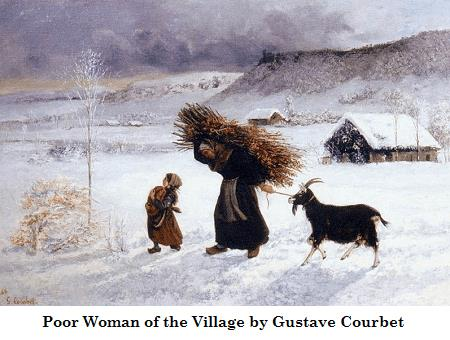
But after a while he saw a poor woman. She was ahead of him. He wondered what had brought her out on so cold a night.
Sometimes she stopped and looked around. Then she would stand and listen. Then she would go on again. Webster kept out of her sight. But he watched her. After looking around, she turned down the street in which Webster lived. She stopped in front of Webster’s house. She looked around and listened.
Webster had put down some loose boards to walk on. They reached from the gate to the door of his house. After standing still a minute, the woman took one of the boards, and went off quickly.
Webster followed her. But he kept out of her sight. She went to a distant part of the town. She went into a poor little house.
Webster went home without saying anything to the woman. He knew that she had stolen the board for firewood.
The next day the poor woman got a present. It was a nice load of wood.
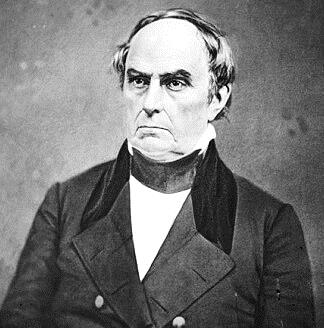
Daniel Webster was a great statesman. As a little boy, he was called “Little Black Dan.” When he grew larger, he was thin and sickly-looking. But he had large, dark eyes. People called him “All Eyes.”
He was very fond of his brother Ezekiel. Ezekiel was a little older than Daniel. Both the boys had fine minds. They wanted to go to college. But their father was poor.
Daniel had not much strength for work on the farm. So little “All Eyes” was sent to school, and then to college. Ezekiel stayed at home, and worked on the farm.
While Daniel was at school, he was unhappy to think that Ezekiel could not go to college also. He went home on a visit. He talked to Ezekiel about going to college. The brothers talked about it all night. The next day Daniel talked to his father about it. The father said he was too poor to send both of his sons to college. He said he would lose all his little property if he tried to send Ezekiel to college. But he said, that, if their mother and sisters were willing to be poor, he would send the other son to college.
So the mother and sisters were asked. It seemed hard to risk the loss of all they had. It seemed hard not to give Ezekiel a chance. They all shed tears over it.
The boys promised to take care of their mother and sisters if the property should be lost. Then they all agreed that Ezekiel should go to college too.
Daniel taught school while he was studying. That helped to pay the expenses. After Daniel was through his studies in college, he taught a school in order to help his brother. When his school closed, he went home. On his way, he went around to the college to see his brother. Finding that Ezekiel needed money, he gave him a hundred dollars. He kept but three dollars to get home with.
The father’s property was not sold. The two boys helped the family. Daniel soon began to make money as a lawyer. He knew that his father was in debt. He went home to see him. He said, “Father, I am going to pay your debts.”
The father said, “You cannot do it, Daniel. You have not money enough.”
“I can do it,” said Daniel; “and I will do it before Monday evening.”
When Monday evening came around, the father’s debts were all paid.
When Daniel became a famous man, it made Ezekiel very happy. But Ezekiel died first. When Daniel Webster made his greatest speech, all the people praised him.
But Webster said, “I wish that my poor brother had lived to this time. It would have made him very happy.”
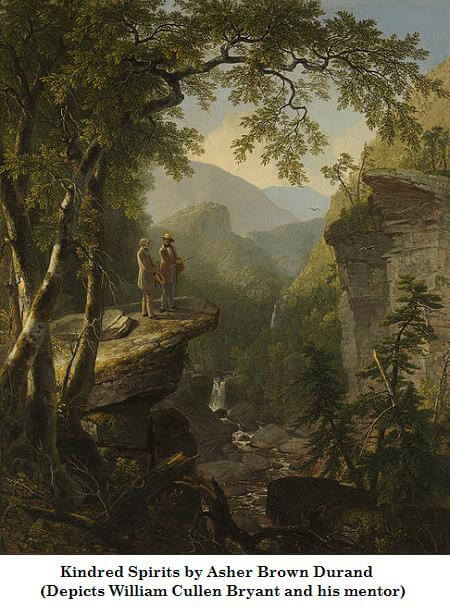
William Cullen Bryant was the first great poet in this country. He was a small man. When he was a baby, his head was too big for his body. His father used to send the baby to be dipped in a cold spring every day. The father thought that putting his head into cold water would keep it from growing.
Bryant knew his letters before he was a year and a half old. He began to write rhymes when he was a very little fellow. He wanted to be a poet. He used to pray that he might be a poet. His father printed some verses of his when he was only ten years old.
Bryant wrote many fine poems. Here are some lines of his about the bird we call a bobolink:
Robert of Lincoln is gaily dressed,
Wearing a bright black wedding coat,
White are his shoulders and white his crest.
Hear him call in his merry note:
Bobolink, bobolink,
Spink, spank, spink;
Look, what a nice new coat is mine,
Sure there was never a bird so fine.
Chee, chee, chee.
Nathaniel Hawthorne was one of our greatest writers of stories. He was a pretty boy with golden curls. He was fond of all the great poets, and he read Shakespeare and Milton and many other poets as soon as he was old enough to understand them.
Hawthorne grew up a very handsome young fellow. One day he was walking in the woods. He met an old gypsy woman. She had never seen anybody so fine-looking.
“Are you a man, or an angel?” she asked him.
Some of Hawthorne’s best books are written for girls and boys. One of these is called “The Wonder Book.” Another of his books for young people is “Tanglewood Tales.”
William H. Prescott wrote beautiful histories. When Prescott was a boy, a schoolmate threw a crust of bread at him. It hit him in the eye. He became almost blind.
He had to do his writing with a machine. This machine was made for the use of the blind. There were no typewriters in those days.
It was hard work to write history without good eyes. But Prescott did not give up. He had a man to read to him. It took him ten years to write his first book.
When Prescott had finished his book, he was afraid to print it. But his father said, “The man who writes a book, and is afraid to print it, is a coward.”
Then Prescott printed his book. Everybody praised it. When you are older, you will like to read his histories.
Doctor Oliver Wendell Holmes, the poet, was a boy full of fancies. He lived in an old house. Soldiers had stayed in the house at the time of the Revolution. The floor of one room was all battered by the butts of the soldiers’ muskets.
Little Oliver Holmes used to think he could hear soldiers in the house. He thought he could hear their spurs rattling in the dark passages. Sometimes he thought he could hear their swords clanking.
The little boy was afraid of a sign that hung over the sidewalk. It was a great, big, wooden hand. It was the sign of a place where gloves were made. This big hand swung in the air. Little Oliver Holmes had to walk under it on his way to school. He thought the great fingers would grab him someday. Then he thought he would never get home again. He even thought that his other pair of shoes would be put away till his little brother grew big enough to wear them.
But the big wooden hand never caught him.
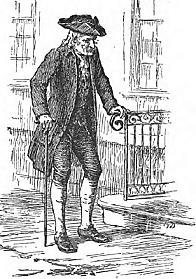
Here are some verses that Doctor Holmes wrote about a very old man:
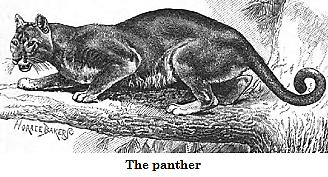
Audubon was traveling in the woods in Mississippi. He found the little cabin of a settler. He stayed there for the night. The settler told him that there was a panther in the swamp near his house. A panther is a very large and fierce animal. It is large enough to kill a man. This was a very bad panther. It had killed some of the settler’s dogs.
Audubon said, “Let us hunt this panther, and kill it.”
So, the settler sent out for his neighbors to come and help kill the panther. Five men came. Audubon and the settler made seven. They were all on horseback.
When they came to the edge of the swamp, each man went a different way. They each took their dogs with them to find the track of the wild beast. All of the hunters carried horns. Whoever should find the track first was to blow his horn to let the others know.
In about two hours after they had started, they heard the sound of a horn. It told them that the track had been found. Every man now went toward the sound of the horn. Soon all the yelping dogs were following the track of the fierce panther. The panther was running into the swamp farther and farther.
I suppose that the panther thought that there were too many dogs and men for him to fight. All the hunters came after the dogs. They held their guns ready to shoot if the panther should make up his mind to fight them.
After a while the sound of the dogs’ voices changed. The hunters knew from this that the panther had stopped running, and gone up into a tree.
At last, the men came to the place where the dogs were. They were all barking round a tree. Far up in the tree was the dangerous beast. The hunters came up carefully. One of them fired. The bullet hit the panther, but did not kill him.
The panther sprang to the ground, and ran off again. The dogs ran after. The men got on their horses, and rode after.
But the horses were tired, and the men had to get down, and follow the dogs on foot.
The hunters now had to wade through little ponds of water. Sometimes they had to climb over fallen trees. Their clothes were badly torn by the bushes. After two hours more, they came to a place where the panther had again gone up into a tree.
This time three of the hunters shot at him. The fierce panther came tumbling to the ground. But he was still able to fight. The men fought the savage beast on all sides. At last, they killed him. Then they gave his skin to the settler. They wanted him to know that his enemy was dead.
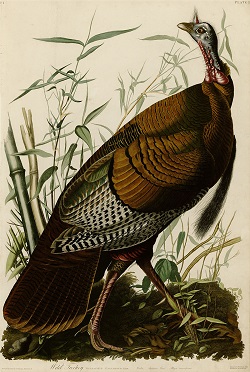
When Audubon was making his great book about birds, he had to live much in the woods. Sometimes he lived among the Indians. He once saw an Indian go into a hollow tree. There was a bear in the tree. The Indian had a knife in his hand. He fought with the bear in the tree, and killed it.
Audubon could shoot very well. A friend of his one day threw up his cap in the air. He told Audubon to shoot at it. When the cap came down, it had a hole in it.
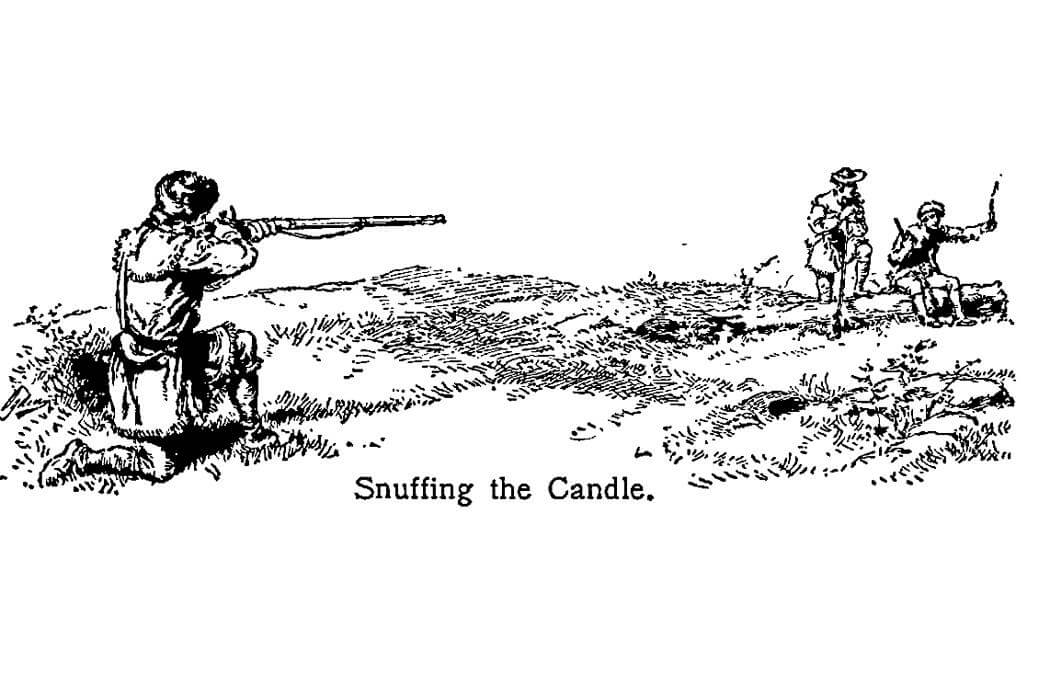
But the hunters who lived in the woods could shoot better. They would light a candle. Then one of the hunters would take his gun, and go a hundred steps away from the candle. He would then shoot at the candle. He would shoot so as to snuff it. He would not put out the candle. He would only cut off a bit of the wick with the bullet. But he would leave the candle burning.
Once Audubon came near being killed by some robbers. He stopped at a cabin where lived an old white woman. He found a young Indian in the house. The Indian had hurt himself with an arrow. He had come to the house to spend the night.
The old woman saw Audubon’s fine gold watch. She asked him to let her look at it. He put it into her hands for a minute. Then the Indian passed by Audubon, and pinched him two or three times. That was to let him know that the woman was bad, and that she might rob him.
Audubon went and lay down with his hand on his gun. After a while two men came in. They were the sons of the old woman. Then the old woman sharpened a large knife. She told the young men to kill the Indian first, and then to kill Audubon and take his watch. She thought that Audubon was asleep. But he drew up his gun ready to fire.
Just then two hunters came to the cabin. Audubon told them what the robbers were going to do. They took the old woman and her sons, and tied their hands and feet. The Indian, though he was in pain from his hurt, danced for joy when he saw that the robbers were caught. The woman and her sons were afterward punished.
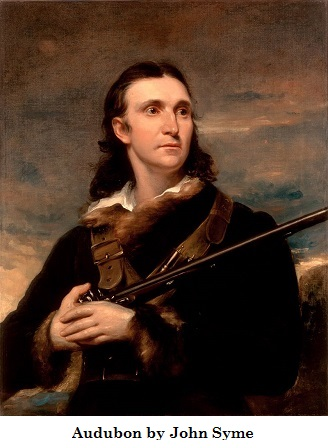
John James Audubon knew more about the birds of this country than any man had ever known before. He was born in the State of Louisiana. His father took him to France when he was a boy. He went to school in France.
The little John James was fond of studying about wild animals. But most of all he wished to know about birds. Seeing that the boy liked such things, his father took pains to get birds and flowers for him.
While he was yet a boy at school, he began to gather birds and other animals for himself. He learned to skin and stuff them. But his stuffed birds did not please him. Their feathers did not look bright, like those of live birds. He wanted living birds to study.
His father told him that he could not keep so many birds alive. To please the boy, he got him a book with pictures in it. Looking at these pictures made John James wish to draw. He thought that he could make pictures that would look like the live birds.
But when he tried to paint a picture of a bird, it looked worse than his stuffed birds. The birds he drew were not much like real birds. He called them a “family of cripples.” As often as his birthday came around, he made a bonfire of his bad pictures. Then he would begin over again.
All this time he was learning to draw birds. But he was not willing to make pictures that were not just like the real birds. So when he grew to be a man he went to a great French painter whose name was David. David taught him to draw and paint things as they are.
Then he came back to this country, and lived awhile in Pennsylvania. Here his chief study was the wild creatures of the woods.
He gathered many eggs of birds. He made pictures of these eggs. He did not take birds’ eggs to break up the nests. He was not cruel. He took only what he needed to study.
He would make two little holes in each egg. Then he would shake the egg, or stir it up with a little stick or straw, or a long pin. This would break up the inside of the egg. Then he would blow into one of the holes. That would blow the inside of the egg out through the other hole.
These egg shells he strung together by running strings through the holes. He hung these strings of egg shells all over the walls of his room. On the mantelpiece, he put the stuffed skins of squirrels, raccoons, opossums, and other small animals. On the shelves his friends could see frogs, snakes, and other animals. He married a young lady, and brought her to live in this museum with his dead snakes, frogs, and strings of birds’ eggs. She liked what he did, and was sure that he would come to be a great man.
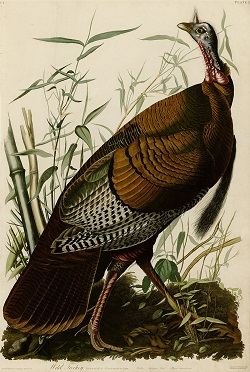
He made up his mind to write a great book about American birds. He meant to tell all about the birds in one book. Then in another book he would print pictures of the birds, just as large as the birds themselves. He meant to have them look just like the birds.
To do this he must travel many thousands of miles. He must live for years, almost all of the time in the woods. He would have to find and shoot the birds, in order to make pictures of them. And he must see how the birds lived, and how they built their nests, so that he could tell all about them. It would take a great deal of work and trouble. But he was not afraid of trouble.
That was many years ago. Much of our country was then covered with great trees. Audubon sometimes went in a boat down a lonesome river. Sometimes he rode on horseback. Often, he had to travel on foot through woods where there were no roads. Many a time he had to sleep out of doors.
He lost his money and became poor. Sometimes he had to paint portraits to get money to live on. Once he turned dancing master for a while. But he did not give up his great idea. He still studied birds, and worked to make his books about American birds. His wife went to teaching to help make a living.
After years of hard work, he made paintings of nearly a thousand birds. That was almost enough for his books. But, while he was traveling, two large rats got into the box in which he kept his pictures. They cut up all his paintings with their teeth, and made a nest of the pieces. This almost broke his heart for a while. For many nights, he could not sleep, because he had lost all his work.
But he did not give up. After some days, he took his gun, and went into the woods. He said to himself, “I will begin over again. I can make better paintings than those that the rats spoiled.” But it took him four long years and a half to find the birds, and make the pictures again.
He was so careful to have his drawings just like the birds, that he would measure them in every way. Thus, he made his pictures just the size of the birds themselves.
At last, the great books were printed. In this country, in France, and in England, people praised the wonderful books. They knew that Audubon was indeed a great man.
Everybody in the United States has heard the song about the star-spangled banner. Nearly everybody has sung it. It was written by Francis Scott Key.
Key was a young lawyer. In the War of 1812 he fought with the American army. The British landed soldiers in Maryland. At Bladensburg, they fought and beat the Americans. Key was in this battle on the American side.
After the battle the British army took Washington and burned the public buildings. Key had a friend who was taken prisoner by the British. He was on one of the British ships. Key went to the ships with a flag of truce. A flag of truce is a white flag. It is carried in war when one side sends a message to the other.
When Key got to the British ships, they were sailing to Baltimore. They were going to try to take Baltimore. The British commander would not let Key go back. He was afraid that he would let the Americans know where the ships were going.
Key was kept a kind of prisoner while the ships attacked Baltimore. The ships tried to take the city by firing at it from the water. The British army tried to take the city on the land side.
The ships did their worst firing at night. They tried to take the little fort near the city.
Key could see the battle. He watched the little fort. He was afraid that the men in it would give up. He was afraid that the fort would be broken down by the cannon balls.
The British fired bombshells and rockets at the fort. When these burst, they made a light. By this light Key could see that the little fort was still standing. He could see the flag still waving over it. He tells this in his song in these words:
“And the rocket’s red glare, the bombs bursting in air Gave proof through the night that our flag was still there.”
Key did not know whether the fort had been knocked down or not. He could not see whether the flag was still flying or not. He thought that the Americans might have given up. He felt what he wrote in the song:
“Oh! say, does that star-spangled banner yet wave O’er the land of the free, and the home of the brave?”
When the break of day came, Key looked toward the fort. It was still standing. There was a flag flying over it. It grew lighter. He could see that it was the American flag. His feelings are told in two lines of the song:
“Tis the star-spangled banner, oh, long may it wave O’er the land of the free, and the home of the brave!”
Key was full of joy. He took an old letter from his pocket. The back of this letter had no writing on it. Here he wrote the song about the star-spangled banner.
The British commander now let Key go ashore. When he got to Baltimore, he wrote out his song. He gave it to a friend. This friend took it to a printing office. But the printers had all turned soldiers. They had all gone to defend the city.
There was one boy left in the office. He knew how to print. He took the verses and printed them on a broad sheet of paper.
The printed song was soon in the hands of the soldiers around Baltimore. It was sung in the streets. It was sung in the theaters. It traveled all over the country. Everybody learned to sing:
“Then conquer we must, for our cause it is just; And this be our motto–’In God is our trust’– And the star-spangled banner in triumph shall wave O’er the land of the free, and the home of the brave.”
Fred was talking to his sister one day. He said, “Alice, what makes people say, ‘Don’t give up the ship’?”
Alice said, “I don’t know. That’s what the teacher said to me yesterday when I thought that I could not get my lesson.”
“Yes,” said Fred, “and that’s what father said to me. I told him I never could learn to write well.” He only said, “You must not give up the ship, my boy.”
“I haven’t any ship to give up,” said Alice.
“And what has a ship to do with my writing?” said Fred.
“There must be some story about a ship,” Alice said.
“Maybe grandfather would know,” said Fred. “Let’s ask him.”
They found their grandfather writing in the next room. They did not wish to disturb him. They turned to leave the room.
But grandfather looked up just then. He smiled, and laid down his pen.
“Did you want something?” he asked. “We wanted to ask you a question,” said Alice. “We want to know why people say, ‘Don’t give up the ship.'”
“We thought maybe there is a story to it,” said Fred.
“Yes, there is,” said their grandfather. “And I know a little rhyme that tells the story.”
“Could you say it to us?” asked Alice.
“Yes, if I can think of it. Let me see. How does it begin?”
Grandfather leaned his head back in the chair. He shut his eyes for a moment. He was trying to remember.
The Revolution was about over. Americans were very happy. Their country was to be free.
At this time, a little boy was born in New York. His family was named Irving. What should this little boy be named?
His mother said, “Washington’s work is done. Let us name the baby Washington.” So he was called Washington Irving.
When this baby grew to be a little boy, he was one day walking with his nurse. The nurse was a Scotch girl. She saw General Washington go into a shop. She led the little boy into the shop also.
The nurse said to General Washington, “Please, your Honor, here is a bairn that is named for you.”
“Bairn” is a Scotch word for child. Washington put his hand on the little boy’s head and gave him his blessing. When Irving became an author, he wrote a life of Washington.
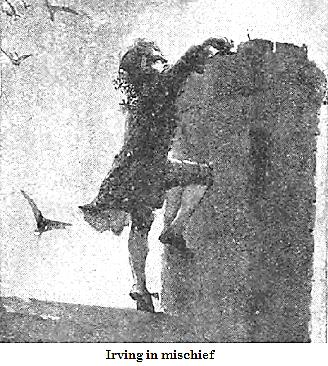
Little Irving was a merry, playful boy. He was full of mischief.
Sometimes he would climb out of a window to the roof of his father’s house. From this he would go to roofs of other houses. Then the little rascal would drop a pebble down a neighbor’s chimney. Then he would hurry back and get into the window again. He would wonder what the people thought when the pebble came rattling down their chimney. Of course, he was punished when his tricks were found out. But he was a favorite with his teacher. With all his faults, he would not tell a lie. The teacher called the little fellow “General.”
In those days, naughty schoolboys were whipped. Irving could not bear to see another boy suffer. When a boy was to be whipped, the girls were sent out. Irving always asked the schoolmaster to let him go out with the girls.
Like other boys, Irving was fond of stories. He liked to read about Sindbad the Sailor, and Robinson Crusoe. But most of all he liked to read about other countries. He had twenty small volumes called “The World Displayed.” They told about the people and countries of the world. Irving read these little books a great deal.
One day the schoolmaster caught him reading in school. The master slipped behind him and grabbed the book. Then he told Irving to stay after school.
Irving expected a punishment. But the master told him he was pleased to find that he liked to read such good books. He told him not to read them in school.
Reading about other countries made Irving wish to see them. He thought he would like to travel. Like other wild boys, he thought of running away. He wanted to go to sea.
But he knew that sailors had to eat salt pork. He did not like salt pork. He thought he would learn to like it. When he got a chance, he ate pork. And sometimes he would sleep all night on the floor. He wanted to get used to a hard bed.
But the more he ate pork, the more he disliked it. And the more he slept on the floor, the more he liked a good bed. So he gave up his foolish notion of being a sailor boy.
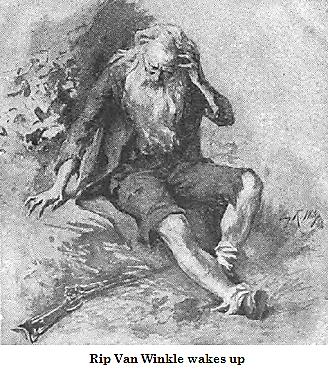
Someday, you will read Irving’s “Sketch Book.” You will find some famous stories in it. There is the story of Rip Van Winkle, who slept twenty years. And there is the funny story of the Headless Horseman. When you read these amusing stories, you will remember the playful boy who became a great author.
The first good steamboat was built in New York. She was built by Robert Fulton. Her name was “Clermont.” When the people saw her, they laughed. They said that such a boat would never go. For thousands of years, boatmen had made their boats go by using sails and oars. People had never seen any such boat as this. It seemed foolish to believe that a boat could be pushed along by steam.
The time came for Fulton to start his boat. A crowd of people were standing on the shore. The black smoke was coming out of the smokestack. The people were laughing at the boat. They were sure that it would not go. At last, the boat’s wheels began to turn around. Then the boat began to move. There were no oars. There were no sails. But still the boat kept moving. Faster and faster she went. All the people now saw that she could go by steam. They did not laugh anymore. They began to cheer.
The little steamboat ran up to Albany. The people who lived on the river did not know what to make of it. They had never heard of a steamboat. They could not see what made the boat go.
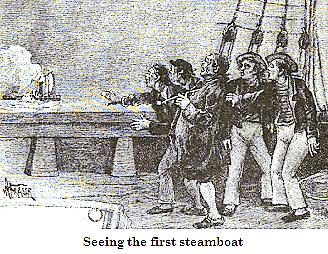
There were many sailing vessels on the river. Fulton’s boat passed some of these in the night. The sailors were afraid when they saw the fire and smoke. The sound of the steam seemed dreadful to them. Some of them went downstairs in their ships for fear. Some of them went ashore. Perhaps they thought it was a living animal that would eat them up.
But soon there were steamboats on all the large rivers.


 articlesforchristians