General Francis Marion was one of the best fighters in the Revolution. He was a homely little man. He was also a very good man. Another general said, “Marion is good all over.”
The American army had been beaten in South Carolina. Marion was sent there to keep the British from taking the whole country.
Marion got together a little army. His men had nothing but rough clothes to wear. They had no guns but the old ones they had used to shoot wild ducks and deer with.
Marion’s men wanted swords. There were no swords to be had. But Marion sent men to take the long saws out of the saw mills. These were taken to blacksmiths. The blacksmiths cut the saws into pieces. These pieces they hammered out into long, sharp swords.
Marion had not so many men as the British. He had no cannon. He could not build forts. He could not stay long in one place, for fear the British should come with a strong army and take him. He and his men hid in the dark woods. Sometimes he changed his hiding place suddenly. Even his own friends had hard work to find him.
From the dark woods he would come out suddenly. He would attack some party of British soldiers. When the battle was over, he would go back to the woods again.
When the British sent a strong army to catch him, he could not be found. But soon he would be fighting the British in some new place. He was always playing hide and seek.
The British called him the Swamp Fox. That was because he was so hard to catch. They could not conquer the country until they could catch Marion. And they never could catch the Swamp Fox. At one time Marion came out of the woods to take a little British fort. This fort was on the top of a high mound. It was one of the mounds built a long time ago by the Indians.
Marion put his men all around the fort, so that the men in the fort could not get out to get water. He thought that they would have to give up. But the men in the fort dug a well inside the fort. Then Marion had to think of another plan.
Marion’s men went to the woods and cut down stout poles. They got a great many poles. When night came, they laid a row of poles alongside one another on the ground. Then they laid another row across these. Then they laid another row on top of the last ones, and across the other way again.
They laid a great many rows of poles one on top of another. They crossed them this way and that. As the night went on, the pile grew higher. Still they handed poles to top of the pile.
Before morning came, they had built a kind of tower. It was higher than the Indian mound.
As soon as it was light, the men on Marion’s tower began to shoot. The British looked out. They saw a great tower with men on it. The men could shoot down into the fort. The British could not stand it. They had to give up. They were taken prisoners.
Washington had been fighting for seven years to drive the British soldiers out of this country. But there were still two strong British armies in America.
One of these armies was in New York. It had been there for years. The other army was far away at Yorktown in Virginia. The British general at Yorktown was Cornwallis. You have read how Washington got away from him at Trenton.
The King of France had sent ships and soldiers to help the Americans. But still Washington had not enough men to take New York from the British. Yet he went on getting ready to attack the British in New York. He had ovens built to bake bread for his men. He bought hay for his horses. He had roads built to draw his cannons on.
He knew that the British in New York would hear about what he was doing. He wanted them to think that he meant to come to New York and fight them. When the British heard what the Americans were doing, they got ready for the coming of Washington and the French. All at once they found that Washington had gone. He and his men had marched away. The French soldiers that had come to help him had gone with him.
Nobody knew what it meant. Washington’s own men did not know where they were going. They went from New Jersey into Pennsylvania. Then they marched across Pennsylvania. Then they went into Maryland. They marched across that State, and then they went into Virginia.
By this time everybody could tell where Washington was going. People could see that he was going straight to Yorktown. They knew that Washington was going to fight his old enemy at Yorktown.
But he had kept his secret long enough. The British in New York could not send help to Cornwallis. It was too late. The French ships sailed to Virginia, and shut up Yorktown on the side of the sea. Washington’s men shut it up on the side of the land. They built great banks of earth round it. On these banks of earth, they put cannons.
The British could not get away. They fought bravely. But the Americans and French came closer and closer.
Then the British tried to fight their way out. But they were driven back. Then Cornwallis tried to get his men across the river. He wanted to get out by the back door, as Washington had done. But the Americans on the other side of the river drove them back again. Washington had now caught Cornwallis in a trap.
The Americans fired red hot cannon balls into Yorktown. These set the houses on fire. At last, Cornwallis had to give up. The British marched out and laid down their guns and swords.
The British army in New York could not fight the Americans by itself. So the British gave it up. Then there was peace after the long war. The British pulled down the British flag and sailed away. The country was free at last.
After the battle of Trenton, Washington went back across the Delaware River. He had not men enough to fight the whole British army.
But the Americans were glad when they heard that he had beaten the Hessians. They sent him more soldiers. Then he went back across the river to Trenton again.
There was a British general named Cornwallis. He marched to Trenton. He fought against Washington. Cornwallis had more men than Washington had. Night came, and they could not see to fight. There was a little creek between the two armies.
Washington had not boats enough to carry his men across the river. Cornwallis was sure to beat him if they should fight a battle the next morning.
Cornwallis said, “I will catch the fox in the morning.”
He called Washington a fox. He thought he had him in a trap. Cornwallis sent for some more soldiers to come from Princeton in the morning. He wanted them to help him catch the fox.
But foxes sometimes get out of traps.
When it was dark, Washington had all his campfires lighted. He put men to digging where the British could hear them. He made Cornwallis think that he was throwing up banks of earth and getting ready to fight in the morning.
But Washington did not stay in Trenton. He did not wish to be caught like a fox in a trap. He could not get across the river. But he knew a road that went around the place where Cornwallis and his army were. He took that road and got behind the British army.
It was just like John waiting to catch James. James is in the house. John is waiting at the front door to catch James when he comes out. But James slips out by the back way. John hears him call “Hello!” James has gone around behind him and got away.
Washington went out of Trenton in the darkness. You might say that he marched out by the back door. He left Cornwallis watching the front door. The Americans went away quietly. They left a few men to keep up the fires, and make a noise like digging. Before morning these slipped away too.
When morning came, Cornwallis went to catch his fox. But the fox was not there. He looked for the Americans. There was the place where they had been digging. Their campfires were still burning. But where had they gone?
Cornwallis thought that Washington had crossed the river by some means. But soon he heard guns firing away back toward Princeton. He thought that it must be thunder. But he found that it was a battle. Then he knew that Washington had gone to Princeton.
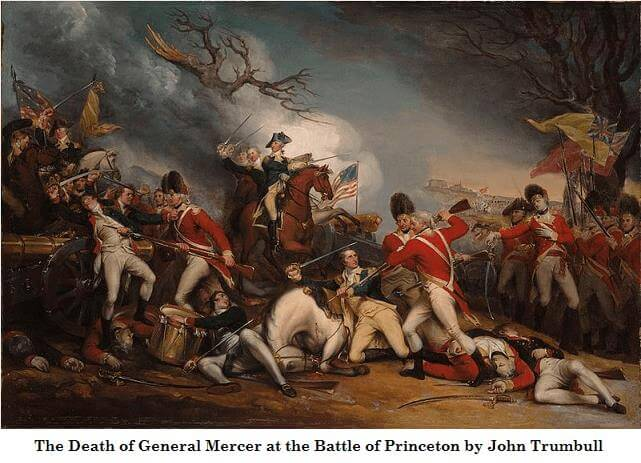
Washington had marched all night. When he got to Princeton, he met the British coming out to go to Trenton. They were going to help Cornwallis to catch Washington. But Washington had come to Princeton to catch them. He had a hard fight with the British at Princeton. But at last he beat them.
When Cornwallis knew that the Americans had gone to Princeton, he hurried there to help his men. But it was too late. Washington had beaten the British at Princeton, and had gone on into the hills, where he was safe.
It was Saturday morning. Little Elizabeth Brown sat by a window in the big kitchen, hemming a tiny pink dress for a doll she was making for her little sister Hope.
On the chair beside her lay the doll, though you might not have thought of calling it a doll. It did not have curly hair and eyes that open and shut, or even a jointed body, and no amount of pinching or squeezing could make it cry. In those days no child had dolls like ours. Hope’s doll was made of a corncob, and the face was painted on a piece of white linen stretched over a little ball of wool on the end of the cob.
When the last neat little stitches were taken, Elizabeth dressed the doll in the pink gown and the tiny blue sunbonnet which Aunt Faith had made for it. Then she folded a small white kerchief about its neck, and when Hope awoke all rosy and smiling from her nap, there lay the little lady on the bed beside her.
Could any child have been happier than was Hope with her first doll! What did it matter that its body was a corncob and its face a bit of white cloth? It was a perfectly beautiful doll to Hope. She called it Mary Ellen and carried it about with her wherever she went.
In another room their mother was looking over the clothes to be worn to meeting the next day.
“It was a perfectly beautiful doll to Hope” When the last button was sewed on and the clothes were well brushed, she laid them out on chairs, ready to be put on on Sunday morning.
Nothing that could be done on Saturday was ever left over until Sunday. Even the potatoes were peeled, and the meat for Sunday’s dinner was cooked on Saturday.
About noon shouts were heard outside, and down the hill came a merry group of boys with axes over their shoulders. They had been cutting wood in the forest all the morning, As they passed the window where Elizabeth sat darning stockings, they called to her, “Come to the hill this afternoon. The ice is frozen on the pond, and we can coast down the long hill and away across the ice.”
It took Hope some time to decide whether she would rather go coasting or stay at home and play with Mary Ellen. But Aunt Faith thought even doll babies ought to have naps sometimes, so Mary Ellen was rocked to sleep and warmily covered in Hope’s little bed.
Elizabeth and Hope took their . . . sled and went to the hill”
Then Elizabeth and Hope took their clumsy wooden sled and went to the-hill. Many boys and girls of the village were already flying down the long, smooth track. The air rang with their merry voices.
All too soon they heard the boom! boom! of the sunset gun The happy holiday was at an end.
“What a pity it gets dark so early in the winter, when we want to coast,” they sighed, as they started toward home.
For the Puritans the Sabbath began at sunset on Saturday, and no child might play after the sunset gun was heard. The evening was spent in reading the Bible and learning verses from it.
When the children reached home, Hope ran to her bed to get Mary Ellen. Presently her mother came in and said, ‘‘This is the Sabbath now, Hope. You must not play with your doll on the Sabbath.”
So Hope kissed her baby and carried it into the bedroom to find a safe warm place for it to stay until the next evening. There lay her father’s Sunday coat; what cozier nest could she find for Mary Ellen than its big pocket?
Early Sunday morning, Mistress Brown came to the children’s bed and awakened them. ‘“‘Get up, little girls,” she said. ‘“‘This is the Lord’s Day and we must not waste it in bed.”
After breakfast the family had prayers, after which they did such work as must be done, and then dressed for meeting.
Master Brown filled the little tin foot stove with hot coals from the hearth. Then he took down his gun from its hook and looked to see that it was ready for use. In those days no man went anywhere without his gun,-—not even to church, for the Indians were likely to come at any time.
Rub-a-dub-dub! Rub-a-dub-dub!
Is that a call to arms? Are the Indians about? Oh, no, that is only the drummer calling the people to church.
There were no bells on the first meetinghouses in New England. Sometimes the firing of a gun was the call to worship. More often a big drum, beaten on the steps of the meetinghouse, told the people it was time to come together.
At the sound of the drum Master Brown and his wife, with Elizabeth, Hope, and Aunt Faith, started to church. From every house in the village came men, women, and children. They were always ready when the drum began to beat. It was not the custom to be late to meeting and as for staying away one had to be very ill indeed to do that.
Elizabeth saw her dear friend, Mary, just ahead of her. Do you suppose she skipped along to speak to her, or walked to meeting by her side? No, indeed. “The Sabbath day is not the time for light talk,’ her mother told her.
When the meetinghouse was reached, Master Brown led his family to their pew. He opened a little door to let them in. The pew was much like a large box with seats around the sides.
The church was very cold, for there was no fire; but the children warmed their toes and fingers by the queer little foot stove their father had brought from home.
The boys were not allowed to sit with their
“From every house im the ‘village came men, women, and children’ parents. They all sat together at one side of the church or on the pulpit stairs. When all the people were in their seats, the minister climbed the steps to his high pulpit.
Only a very few people had hymn books. The minister read two lines of the hymn and they all sang them to some well-known tune. Then he read two more lines, and all sang them, and so on until they had sung all the verses.
The sermon was always very long, three hours at the least. The children could not understand what it was all about, and it was very hard for them to sit up and listen quietly.
Elizabeth was four years older than Hope, so she felt quite like a little woman. She sat up
A colonial foot stove
beside her mother and looked at the minister almost all the time. But sometimes she had to wink hard to keep awake.
When she thought she could not hang her feet down another minute she would slip on to the footstool to rest.
But she was often much ashamed of Hope. Poor little Hope could not sit still ten minutes.
Hope enjoyed singing the hymns. She stood up on the footstool at her father’s side and sang with all her might. Then she sat down and tried to listen to the sermon. When she began to stir about a little, her mother shook her head at her. She tried to sit still, but was soon restless again.
Then Aunt Faith gave her a sprig of some sweet, spicy plant. This kept her quiet for a while, but at last leaves, stems, and all were eaten. Hope folded her hands and for a few minutes looked straight at the minister. She was trying hard to be good.
Presently she began to be sleepy and nestled her head upon her father’s arm, fora nap. But now she felt something in his pocket she was sure she knew. A happy smile came over Hope’s face. She was wide awake now.
Slipping her hand into the wide pocket, she drew out Mary Ellen, and smoothed her wrinkled gown.
Master Brown’s thoughts were all on the sermon, and even Mistress Brown did not notice her for a little time. When she did, what do you suppose she saw? Hope standing up on the seat, showing her doll to the little girl in the pew behind her!
Oh, oh, how ashamed her mother was! She pulled her little daughter down quickly and whispered, ‘“‘Do you want the tithingman to come with his rod? Well, then, sit down and listen.” Then taking Mary Ellen, she slipped her into her big muff.
Little Hope did sit down and listen. She did not even turn around when the kind lady behind them dropped a peppermint over the high-backed pew for her.
Hope was very much afraid of the tithingman, who sat on a high seat behind the people. He had a long rod with a hard knob on one end and a squirrel’s tail on the other.
When he saw a lady nodding during the sermon, he stepped around to her pew and tickled her face with the fur end of the rod. She would waken with a start and be, oh, so ashamed. She would be very glad the pew had such high sides to hide her blushing face.
Perhaps you think the boys on the other side of the church had a good time with no parents near to keep them quiet. But there was the tithingman again. When he saw a boy whispering or playing, as children sometimes do when so many are together, he rapped him on the head with the knob end of the rod.
The whispering would stop at once, for the rod often brought tears and left a headache. But the tithingman and his rod could not always keep the boys in order. We read that in one church the boys were fined for cutting the seats with their knives. In another, whips were placed here and there, and certain persons chosen to use them when they thought the boys needed to be punished.
“What shall we do with our boys?” the fathers often asked each other. At last some one thought of a plan which worked very well. What do you suppose it was? Simply this: to let each little boy sit with his own father and mother.
“They had quite forgotten the tithingman”
Besides keeping the boys from playing and the grown people from going to sleep, the tithingman must turn the hourglass. In those days very few people could afford clocks, but every one could have an hourglass. It took the fine sand just one hour to pour from the upper part of the glass through the tiny hole into the lower part.
When the sand had all run through, the tithingman turned the glass over and the sand began to tell another hour. When the glass had been turned three times, the minister closed the service. Then the men picked up their muskets and foot stoves, the women wrapped their long capes more closely about them, and all went home.
Often there was another service in the afternoon. At sunset the Puritan Sabbath ended. Then the women brought out their knitting or spinning, or prepared for Monday’s washing and the children were free to play until bedtime.
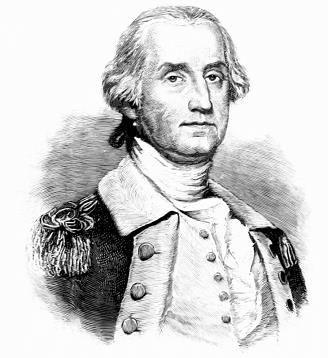
George Washington was fighting to set this country free. But the army that the King of England sent to fight him was stronger than Washington’s army. Washington was beaten and driven out of Brooklyn. Then he had to leave New York. After that, he marched away into New Jersey to save his army from being taken. At last, he crossed the Delaware River. Here he was safe for a while.
Some of the Hessian soldiers that the king had hired to fight against the Americans came to Trenton. Trenton is on the Delaware River.
Washington and his men were on the other side of the Delaware River from the Hessians. Washington’s men were discouraged. They had been driven back all the way from Brooklyn. It was winter, and they had no warm houses to stay in. They had not even warm clothes. They were dressed in old clothes that people had given them. Some of them were barefooted in this cold weather.
The Hessians and other soldiers of the king were waiting for the river to freeze over. Then they would march across on the ice. They meant to fight Washington once more, and break up his army. But Washington was thinking about something too.
He was waiting for Christmas. He knew that the Hessian soldiers on the other side of the river would eat and drink a great deal on Christmas Day.
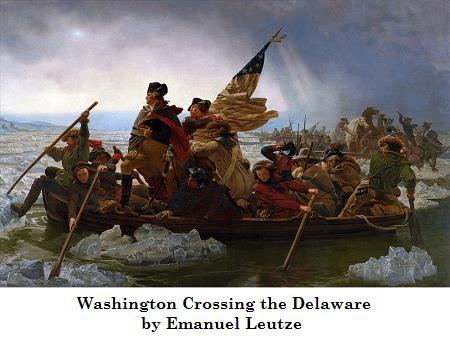
The afternoon of Christmas came. The Hessians were singing and drinking in Trenton. But Washington was marching up the river bank. Some of his barefoot men left blood marks on the snow as they marched.
The men and cannons were put into flat boats. These boats were pushed across the river with poles. There were many great pieces of ice in the river. But all night long the flat boats were pushed across and then back again for more men. It was three o’clock on the morning after Christmas when the last Americans crossed the river. It was hailing and snowing, and it was very cold. Two or three of the soldiers were frozen to death.
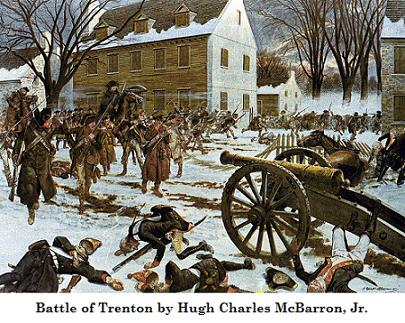
It was eight o’clock in the morning when Washington got to Trenton. The Hessians were sleeping soundly. The sound of the American drums waked them. They jumped out of their beds. They ran into the streets. They tried to fight the Americans.
But it was too late. Washington had already taken their cannons. His men were firing these at the Hessians. The Hessians ran into the fields to get away. But the Americans caught them.
The battle was soon over. Washington had taken nine hundred prisoners.
This was called the battle of Trenton. It gave great joy to all the Americans. It was Washington’s Christmas gift to the country.
IN a very few years after the Pilgrims settled at Plymouth, there were many children in the colonies.
Of course these children went to school, but their school was not at all like ours. For the first few years there was not a schoolhouse in New England.
The children went to the home of one of the neighbors, who was teacher and housekeeper too. They sat on a long seat by the fireplace and studied. When their lessons were learned, they stood in a row, with their toes on a crack in the floor, and recited.
“They stood in a row, with their toes on a crack”
The good woman went on with her spinning or weaving while they read aloud. The girls were taught to spin and sew, as well as to read and write. Each little girl took her box of sewing to school.
In those days nearly every little girl made a sampler of linen. On this sampler she worked in colored silks, all the letters of the alphabet and the numbers to ten. She worked her name, and age, and the date on it, too. Have you ever seen any of these quaint old samplers? It took a child a long, long time to work all the pretty stitches on one.
After a few years log schoolhouses were built, each having at one end a log chimney with a wide fireplace and oiled paper in the windows instead of glass. There were long benches made of logs split in two running quite across the room.
The largest boys and girls sat on the higher back seats, and the little ones sat in front near the teacher. All studied their lessons aloud, that the teacher might know they were doing it well.
The hum of their voices might be heard as far as the road. If you had been passing a school in those days, you would have thought there must be a very large hive of bees near by.
The little ones learned their lessons from a strange little book called “The New England Primer.” It did not have pretty pictures and interesting stories in it, as our primers have. There was an odd little picture for each letter of the alphabet, and beside it, a rhyme. The children also learned many verses from the Bible.
When a boy did not learn his lessons, he had to wear a tall paper cap called a “dunce cap,” and stand on a stool in the corner.
There were wide cracks between the logs of the schoolhouse, and in the winter the room, except near the fire, was very cold.
The parents of each child had to send a load of wood to heat the schoolhouse. If they did not do this, their child had to sit shivering in the coldest part of the room. His little hands would be blue and numb with the cold, and his stiff little feet would ache.
This seems pretty hard, and I am sure the teacher must sometimes have brought the poor little fellow to a seat near the warm blaze. But they must have wood for the schoolhouse, and there was plenty of it in the forest near by; all the people had to do was to get it.
If a man would not take the trouble to cut the wood and bring it to the schoolhouse, his little ones must go cold. No father could stand that, so the wood was usually brought within a few days.
The parents of the children paid the teacher in corn, barley, and other things which they raised on their farms. Or, if the teacher were a man, the mothers sometimes wove cloth for his coat, or knitted stockings and mittens for him.
The Indians among whom Captain Clark and Captain Lewis traveled had many strange ways of doing things. They had nothing like our matches for making fire. One tribe of Indians had this way of lighting a fire. An Indian would lay down a dry stick. He would rub this stick with the end of another stick. After a while this rubbing would make something like sawdust on the stick that was lying down. The Indian would keep on rubbing till the wood grew hot. Then the fine wood dust would smoke. Then it would burn. The Indian would put a little kindling wood on it. Soon he would have a large fire.
In that time the European settlers had not yet found out how to make matches. They lighted a fire by striking a piece of flint against a piece of steel. This would make a spark of fire. By letting this spark fall on something that would burn easily, they started a fire.
White men had another way of lighting a fire when the sun was shining. They used what was called a burning glass. This was a round piece of glass. It was thick in the middle, and thin at the edge. When you held up a burning glass in the sun, it drew the sun’s heat so as to make a little hot spot. If you put paper under this spot of hot sunshine, it would burn. Men could light the tobacco in their pipes with one of these glasses.
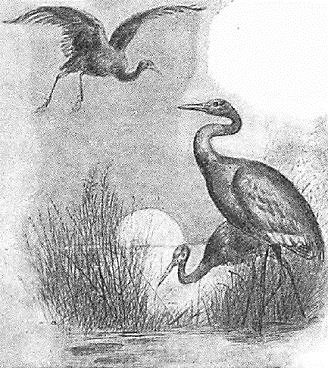
Captain Clark had something funny happen to him on account of his burning glass. He had walked ahead of the rest of his men. He sat down on a rock. There were some Indians on the other side of the river. They did not see the captain. Captain Clark saw a large bird called a crane flying over his head. He raised his gun and shot it.
The Indians on the other side of the river had never seen a white man in their lives. They had never heard a gun. They used bows and arrows.
They heard the sound of Clark’s gun. They looked up and saw the large bird falling from the sky. It fell close to where Captain Clark sat. Just as it fell, they caught sight of Captain Clark sitting on the rocks. They thought they had seen him fall out of the sky. They thought that the sound of his gun was a sound like thunder that was made when he came down.
The Indians all ran away as fast as they could. They went into their wigwams and closed them.
Captain Clark wished to be friendly with them. So, he got a canoe and paddled to the other side of the river. He came to the Indian houses. He found the flaps which they use for doors shut. He opened one of them and went in. The Indians were sitting down, and they were all crying and trembling.
Among the Indians the sign of peace is to smoke together. Captain Clark held out his pipe to them. That was to say, “I am your friend.” He shook hands with them and gave some of them presents. Then they were not so much afraid.
He wished to light his pipe for them to smoke. So he took out his burning glass. He held it in the sun. He held his pipe under it. The sunshine was drawn together into a bright little spot on the tobacco. Soon the pipe began to smoke.
Then he held out his pipe for the Indians to smoke with him. That is their way of making friends. But none of the Indians would touch the pipe. They thought that he had brought fire down from heaven to light his pipe. They were now sure that he fell down from the sky. They were more afraid of him than ever.
At last, Captain Clark’s Indian man came. He told the other Indians that the white man did not come out of the sky. Then they smoked the pipe, and were not afraid.
In old times there lived in Pennsylvania a little fellow whose name was Benjamin West. He lived in a long stone house.
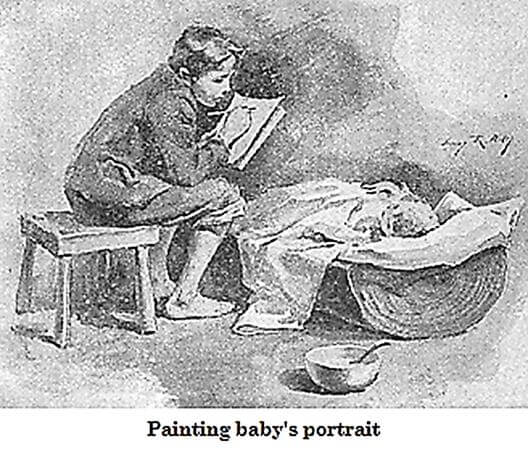
He had never seen a picture. The country was new, and there were not many pictures in it. Benny’s father was a Friend or Quaker. The Friends of that day did not think that pictures were useful things to make or to have. Before he was seven years old, this little boy began to draw pictures. One day he was watching the cradle of his sister’s child. The baby smiled. Benny was so pleased with her beauty, that he made a picture of her in red and black ink. The picture of the baby pleased his mother when she saw it. That was very pleasant to the boy.
He made other pictures. At school, he used to draw with a pen before he could write. He made pictures of birds and of animals. Sometimes he would draw flowers.
He liked to draw so well, that sometimes he forgot to do his work. His father sent him to work in the field one day. The father went out to see how well he was doing his work. Benny was nowhere to be found. At last, his father saw him sitting under a large pokeweed. He was making pictures. He had squeezed the juice out of some pokeberries. The juice of pokeberries is deep red. With this, the boy had made his pictures. When the father looked at them, he was surprised. There were portraits of every member of the family. His father knew every picture.
Up to this time Benny had no paints nor any brushes. The Indians had not all gone away from that neighborhood. The Indians paint their faces with red and yellow colors. These colors they make themselves. Sometimes they prepare them from the juice of some plant. Sometimes they get them by finding red or yellow earth. Some of the Indians can make rough pictures with these colors.
The Indians near the house of Benny’s father must have liked the boy. They showed him how to make red and yellow colors for himself. He got some of his mother’s indigo to make blue. He now had red, yellow, and blue. By mixing these three, the other colors that he wanted could be made.
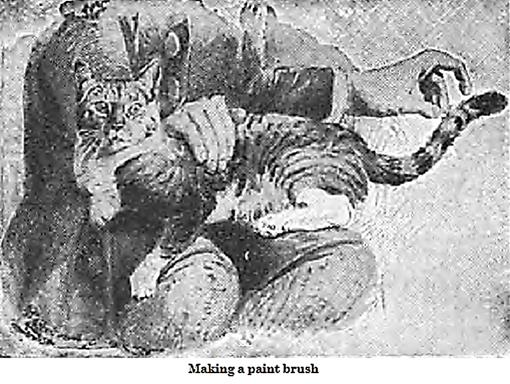
But he had no brush to paint with. He took some long hairs from the cat’s tail. Of these he made his brushes. He used so many of the cat’s hairs, that her tail began to look bare. Everybody in the house began to wonder what was the matter with pussy’s tail. At last, Benny told where he got his brushes.
A cousin of Benny’s came from the city on a visit. He saw some of the boy’s drawings. When he went home, he sent Benny a box of paints. With the paints were some brushes. And there was some canvas such as pictures are painted on. And that was not all. There were in the box six beautiful engravings.
The little painter now felt himself rich. He was so happy that he could hardly sleep at all. At night, he put the box that held his treasures on a chair by his bed. As soon as daylight came, he carried the precious box to the garret. The garret of the long stone house was his studio. Here he worked away all day long. He did not go to school at all. Perhaps he forgot that there was any school. Perhaps the little artist could not tear himself away from his work.
But the schoolmaster missed him. He came to ask if Benny was ill. The mother was vexed when she found that he had stayed away from school. She went to look for the naughty boy. After a while she found the little truant. He was hard at work in his garret. She saw what he had been doing. He had not copied any of his new engravings. He had made up a new picture by taking one person out of one engraving, and another out of another. He had copied these so that they made a picture that he had thought of for himself.
His mother could not find it in her heart to punish him. She was too much pleased with the picture he was making. This picture was not finished. But his mother would not let him finish it. She was afraid he would spoil it if he did anything more on it.
The good people called Friends did not like the making of pictures, as I said. But they thought that Benny West had a talent that he ought to use. So he went to Philadelphia to study his art. After a while he sailed away to Italy to see the pictures that great artists had painted.
At last, he settled in England. The King of England was at that time the king of this country too. The king liked West’s pictures. West became the king’s painter. He came to be the most famous painter in England.
He liked to remember his boyish work. He liked to remember the time when he was a little Quaker boy making his paints of poke juice and Indian colors.
IN a little town not far from Boston stood an old brick house. It did not look like a brick house, for it had been covered on the outside with boards.
It was the safest house in the village, and during King Philip’s War the neighbors often used to come to this “fort-house,” as it was called, for safety. When its great oak doors were bolted and its strong shutters fastened, there was little danger from Indians. They could not burn its brick walls as they did so many log cabins.
But no Indians had been seen for a long time, and the people began to think that danger from them was past. One Sunday morning, Mr. and Mrs. Minot, who lived in the old house, went to meeting, leaving their two little ones with Experience, the maid.
It was a very hot summer day and the windows in the big kitchen were wide open. The butterflies flitted to and fro in the bright sunshine, and the bees hummed drowsily in the vines twining about the window.
The two little children sat upon the floor while Experience built a fire in the brick oven and began to prepare dinner.
When this was finished, she drew her chair up beside the open window. “Now, little one,” she said to the baby, as she picked her up, “let us sit here in the breeze and watch for mother to come.”
“Let us sit here . . . and watch for mother”
Experience sang softly and rocked to and fro, hoping the baby would go to sleep. But Baby had no thought of going to sleep. She laughed and crowed and tried to catch the pretty shadows as they danced over the window sill.
Suddenly Experience saw a sight which made her heart stand still. Behind a row of currant bushes was an Indian, creeping on his hands and knees toward the house.
Only a moment Experience sat still and stared at the native, then she quickly bolted the door and closed the windows. There was no time to close the heavy shutters.
What should she do with the children? She looked about for a safe hiding place. On the floor, bottom upward, stood the two great brass kettles which Experience had scoured the day before. She quickly raised one of the kettles and pushed the baby under it, then, before Baby’s little brother could think what had happened, down came the other kettle over him.
Then Experience rushed to the oven for a shovel of hot coals. “If that Indian comes in here I’ll give him a taste of these hot coals,” said she. But suddenly she noticed that the Indian carried a gun.
“Oh!” she thought, “he can shoot much farther than I can possibly throw these coals.” So she dropped the shovel upon the hearth and fled upstairs for the gun. “Keep still, children,” she whispered, as she ran past them.
But the children did not keep still. They did not at all like being crowded under the kettles. They tried to push them over, but the kettles were too heavy. Then they began to yell, partly in terror, and partly in anger. The sound made the kettles ring with a strange, wild noise.
When the Indian appeared at the window, he looked about the room and could see no one, yet where could that dreadful noise come from? He stared at the kettles, wondering what creatures those could be that howled and rumbled so frightfully.
Just then the children began to creep toward the light, moving the kettles, which looked like two great turtles.
“Me shoot!” cried the mystified Indian. Boom-oom-oom-m! went the bullet, glancing from kettle to kettle.
The babies were frightened, but not at all hurt, so they howled all the louder and crept faster than ever toward the window.
Now it was the Indian’s turn to be frightened. Ugh! Gun no hurt him! Him come!” Then he dropped his gun and fled. He had no wish to fight with two great monsters that could not be hurt with a gun.
Experience saw him as he ran away through the garden, and fired at him, but he was soon out of sight. She could still hear the children crying under the brass kettles, so she knew they were not hurt. Before she could get down stairs, Mr. and Mrs. Minot came home from meeting. There lay the gun before the window, and the children were still under the kettles, howling madly and struggling to be free.
“What is the matter? What has happened?” the parents cried, and Experience told the story of the Indian.
“Perhaps he is still hiding somewhere on the farm,” said Mr. Minot, seizing his gun.
He hurried across the garden, looking behind trees and bushes for the Indian. At last he found him, but the Indian could do no harm then. His body lay beside the brook, for the maid’s aim had been more true than she thought.
IN the little village of Swansea, lived a widow with her two children, Mary and Benjamin. The mother was a very good woman, always ready to nurse the sick, feed the hungry, or do anything she could to help those who needed her.
Indians lived in the forest about Swansea, and this good woman was always kind to them. When they were ill she went to see them, and made them broth, and gave them medicine. She tried to teach them about God.
Many of them came to her house, and she read the Bible to them. Nearly all of the Indians loved her and would do anything for her.
Among the Indians who came to this house was one named Warmsly. He was very fond of cider and would ask for it at every house.
When cider has stood for some time, we say it becomes “hard.” Hard cider is not fit to drink. It is only fit to make vinegar. Warmsly liked the hard cider best.
One day he came to the house and asked Mary for hard cider.
“I cannot give it to you,” she said. “It makes you drunk.”
Then Warmsly grew angry and said, “You get cider, quick.”
Mary called her mother, who said, “No, Warmsly, cider is wrong.”
Then the Indian pretended to be sick and said he needed it for medicine.
“No, you can never get cider here,” said Mary’s mother again.
Oh, how angry Warmsly was then! His wicked eyes flashed as he said, “You be sorry! Me pay you. Big fight soon! Indians kill all English. Me pay you! Ugh!”
Sure enough, the “big fight” came sooner than any one thought. The very next Sunday, as they were coming home from church, the Indians fell upon the people, killing many and burning their homes. This, you remember, was the beginning of King Philip’s War.
But the Indians remembered the kind woman who had been their friend. They did not harm her family or her home.
But she did not forget the angry words of Warmsly. “I know quite well the other Indians will not harm us, but I am afraid of Warmsly,” she would say. For a long time after this she would not allow Mary or Benjamin to go away from the house alone.
The summer passed and Warmsly did not come. At last Philip was dead and the dreadful war was ended. Autumn came, and with it, peace and thanksgiving.
“I think Warmsly must have been killed in the war,” said the mother, at last.
One day, early in November, she began to make her winter’s supply of candles. She hung two great kettles of tallow over the fire to melt.
“I think we will make a Christmas candle such as we used to have in England when I was a little girl,” she told the children.
Mary clapped her hands in delight, for she had never had a real Christmas.
There were no stockings hung up on Christmas eve in the old Puritan homes. No Christmas trees sparkled with lighted candles and bowed under their load of toys and pretty gifts. There was no Santa Claus, and no gay holiday for the Puritan fathers and mothers thought such things were foolish and wicked.
“I think there can be no harm in a Christmas candle,” thought Benjamin’s mother, as she sent him to find a goose quill.
When he came back, she showed him how to put a little powder into it. Very carefully the quill of powder was tied to a wick which hung over a small stick.
Then Mary and Benjamin held the stick and let the wick down into the melted tallow. When they drew it up, it was covered with the tallow. This soon grew hard, and they dipped it again. Now they could hardly see the quill or the wick because of the thick white coat of tallow around them. The candle grew thicker each time it was dipped, and at last it was done.
“The candle grew thicker each time it was dipped”
“Now you must not put it where it is too cold or it will crack,” said their mother. So they put it up on the kitchen shelf where they could look at it.
“Oh, it is more than a month until Christmas,” said the mother. “The candle will grow yellow and ugly if you leave it there.”
So it was carefully wrapped in paper and put away in a box; but every few days the children would get it out and look at it. They would gently rub its smooth sides and wonder just where that quill of powder was hidden.
Would Christmas never come? Weeks before, they had invited every child in the school to a Christmas party, but since there were only ten pupils, it did not make a very large party after all.
Benjamin hunted for the rosiest apples and the sweetest nuts, and put them away for the candle party. From the beams above the fireplace hung many ears of pop corn, dry and shining.
At last Christmas day came. But no one thought of staying home from school or work because it was Christmas. So the children all went to school, and it was well they did, for the day would have seemed endless to them. The party was to be in the evening, as of course the candle must not be lighted until dark.
But “dark” comes very early at Christmas time, and as soon as the little folks were made clean and ready after school, it was time to go to the party.
In the big kitchen a fire burned merrily in the fireplace. How the flames snapped and crackled as they leaped up the great chimney!
Benjamin passed the rosy-cheeked apples, and the children put them in a row on the hearth to roast. On the bricks near the fire they placed a pile of chestnuts and covered them with hot ashes.
The powder candle was lighted and placed upon the table, and all the other candles were snuffed out.
By and by the chestnuts on the hearth began to burst their shells and pop out. At each loud pop the children would jump and look at the candle.
“When that candle goes off, you will not think it a chestnut,” laughed Benjamin. “It will make a noise like a gun.”
Then the story-telling began. The children did not have story books in those days. All the stories they knew were those told them by parents and friends. These were usually true stories of the wild life of those early times.
“What a fuss Tige is making!” said Mary. “What do you suppose he is barking and growling at?”
“I hear voices outside,” answered her mother. “Very likely some of the parents have come for their children. I will go out and quiet Tige, and tell them he is tied.”
When she stepped to the door she could hear voices near the old cider press. Surely those tall, dark figures were not those of her neighbors. When her eyes had grown more used to the darkness, she could see plainly the forms of three Indians, who now came toward the house.
She hurried into the house and locked the door. She had hardly reached the room where the children were when, with a loud crash, the Indians broke open the door and came in. Great was her terror when she saw that their leader was Warmsly. “Cider, now!” said Warmsly, as he sat down near the table.
What could the woman do? She must not give him the cider. There is nothing more terrible than a drunken Indian. “It must be getting late,” she thought, “and the men will soon come for their children. If I can only get Warmsly’s mind off the cider until then!”
She passed the Indians apples, and nuts, cold meat, and bread, and they ate greedily. But they did not forget the cider. “White squaw get cider, quick,” said Warmsly, shaking his big tomahawk with an ugly look.
“Oh, if the neighbors would only come now!” thought the mother, as she went slowly to the cupboard. She took down a large brown pitcher and set it on the table. Then she slowly walked back to the cupboard and took down her pewter mugs, one at a time.
The Indians watched her with eager eyes. “White squaw get cider, quick,” repeated Warmsly, looking uglier than ever.
But the words were hardly out of his mouth when there was a great flash of light. Puff! bang! went the candle with a noise like the firing of a cannon. Benjamin had put too much powder in the quill. There was a loud rattling of dishes and windows. The children screamed in terror. Even the fire was much scattered and dimmed with a shower of ashes. Then all was strangely still. The rank powder smoke filled the room and everything was hidden in thick darkness.
When the smoke cleared away, the reviving light of the fire showed the hatchets of the Indians on the floor, and the kitchen door wide open. Not one was to be seen. No doubt they thought the white men were upon them, so they made their way back to the forest as fast as possible.
That was the last the colonists ever saw of Warmsly.
The neighbors had heard the noise of the candle, and now came to take their children home from the party. How astonished they were to hear the story of the Indians! “God has been very good to us in saving thee and our children from the natives,” they said.
Each year after that a Christmas candle was burned in many homes, and the story of how one saved the children of Swansea never grew old. When the children who were at that party grew to be men and women, they told it to their children and grandchildren. And the grandchildren have passed the story down to us.




 articlesforchristians