A place to grow your relationship with God

Posts tagged ‘history’

John Cabot and his Son Sebastian

John Cabot and his Son Sebastian

The food eaten four or five hundred years ago was mostly coarse and unwholesome. The people were therefore very fond of all sorts of spices which they mixed with almost everything they ate. These spices were brought from Asia by caravans. It was chiefly to get to the land of spices by sea that Prince Henry the Navigator tried to send ships around the southern point of Africa. Columbus had also tried to reach the “Spice Islands” of Asia in his voyage to the west.

Now another Italian was to try it. This man was John Cabot. Like Columbus, he was probably born in or near the city of Genoa; like Columbus, he studied much about geography as it was then understood; and, like Columbus, he was a great traveler. He moved to Venice and then to Bristol in England.
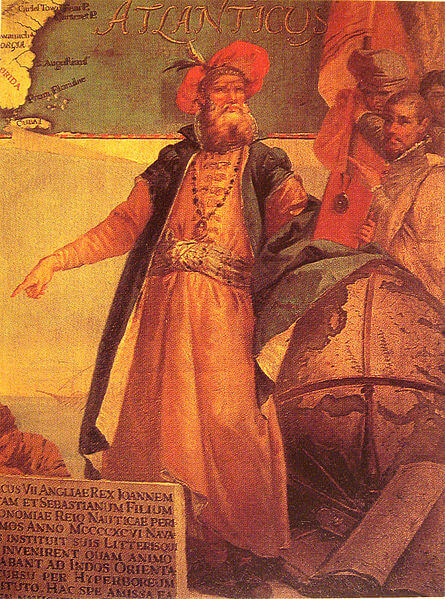
The Italian merchants traveled farther than any others in that day. One of Cabot’s long trading journeys had carried him into Arabia as far as the city of Mecca [mek’-kah]. Here he saw the caravans that brought their loads of costly spices on the backs of camels from the countries of the East. Now the people of Europe in Cabot’s time, having very few printed books, knew almost nothing about these faraway Eastern countries.

“Where do these spices come from?” Cabot asked of the men belonging to the caravan.

They answered that they brought them from a country far to the east of Mecca, where they bought spices of other caravans which brought them from a land yet farther to the east. From this Cabot reasoned as Columbus had done, that, if he should sail to the west far enough, he would get around the world to the land of spices. It would be something like going around a house to come in by the back door.

While Cabot was living in England there came great news out of Spain. One Christopher Columbus, it was said, had discovered the coasts of India by sailing to the westward, for Columbus thought the land he had found a part of India. When this was told in England, people thought it “a thing more divine than human to sail by the west into the east.” And when Cabot heard the story, there arose in his heart, as he said, “a great flame of desire to do some notable thing.”

While Columbus had waited in discouragement for Ferdinand and Isabella to accept his project, he had sent his brother Bartholomew Columbus to Henry the Seventh, then King of England, to offer the plan to him. What answer the king gave to Bartholomew is not known, for, before the latter got back to Spain, Christopher Columbus had returned from his first voyage.

But now Cabot offered to this same King Henry of England to make a voyage like that of Columbus. As the Atlantic had already once been crossed, the king readily agreed to allow Cabot to sail under his authority.

In May, 1497, Cabot set sail from Bristol in a small vessel with eighteen men, mostly Englishmen. Cabot sailed much farther north than Columbus, and he appears to have discovered first the island of Cape Breton, now part of the Dominion of Canada. He went ashore on the 24th of June, and planted a large cross and the flag of England, as well as the flag of St. Mark, the patron saint of Venice. He also discovered the mainland of North America. Cabot was thus the first to see the American continent. Columbus discovered the mainland of South America a year later. Cabot did not see any Indians, but he brought back some of their traps for catching wild animals.

He got back to England in August, having been gone but three months. He brought news that he had discovered the territory of the Emperor of China. The king gave him a pension, he dressed himself in silks, and was called “The Great Admiral.” It is to be feared this sudden rise in the world puffed him up a great deal. To one of his companions he promised an island, and another island he was going to bestow on his barber! On the strength of these promises, both of these men set themselves up for counts!

That there were many fish on the new coast was a fact which impressed the practical Bristol people, though Cabot had no thought of engaging in fishery. He imagined that by sailing a little farther south than before he might come to the large island which Marco Polo called Cipango, which is now called Japan. He did not know that the far-off country he had seen was not half so far away as Japan. Cabot believed that all the spices and precious stones in the world came from Cipango.

King Henry the Seventh fitted up Cabot with another and much larger expedition. This expedition went far to the north along the coast of America, and then away to the south as far as the shores of what is now the State of North Carolina. Cabot found Indians dressed in skins, and possessing no metal but a little copper. He found no gold, and he brought back no spices. The island of Cipango and the territories of the Emperor of China he looked for in vain, though he was sure that he had reached the coast of Asia.

Cabot’s crew brought back stories of seas so thick with codfish that their vessels were made to move more slowly by them. They even told of bears swimming out into the sea and catching codfish in their claws. But the English people lost interest in voyages that brought neither gold nor spices, and we do not know anything more about John Cabot.

John Cabot’s second son, Sebastian, who was with him in this voyage, became, like his father, famous for his knowledge of geography, and was sometimes employed by the King of Spain and sometimes by the King of England. He promoted expeditions to try to find a way to China by the north of Europe. When a very old man he took a great interest in the sailing of a new expedition of discovery and visited with a company of ladies and gentlemen the Searchthrift, a little vessel starting on a voyage of exploration to the northeast. Having tasted of “such good cheer” as the sailors could make aboard the ship, and after making them liberal presents, the little company went ashore and dined at the sign of the “Christopher,” where the lively old gentleman for joy, as it is said, at the “towardness” of the discovery, danced among the rest of “the young company,” after which he and his friends departed, “most gently commending” the sailors to the care of God.

Columbus After the Discovery of America

Columbus After the Discovery of America

Having got one of his vessels ashore on the coast of Haiti, which he called Hispaniola [his-pan-ee-o’-lah], Columbus built a fort of the timber from the wrecked vessel and left here a little colony.

But now he began to think of carrying home the good news of his great discovery. In January, 1493, he set sail for Spain. On the 12th of January, when all were looking forward to a joyful return, a terrific storm threatened the wreck of the ship and the burying in the sea all memory of the great discovery. Prayers were said and vows were made for the safety of the ship.

To preserve the memory of his discovery if all else should be lost, Columbus wrote two accounts of it, which he enclosed in cakes of wax and put into two barrels. One of these was thrown into the sea; the other was set upon the stern of the vessel, that it might float off if the ship should go down. He hoped that one of these barrels might drift to the coast of Europe and be found.

Columbus at length reached the islands called the Azores. Here, when the storm had abated, some of his men went ashore to perform their vows at a little chapel and were made prisoners by the Portuguese governor. Having got out of this difficulty, Columbus put to sea and met another gale, which split his sails and threatened to wreck the vessel. He finally came to anchor in a Portuguese port, where he no doubt felt some exultation in showing what Portugal had lost by refusing his offers.

In April, he reached Barcelona, a Spanish city, and made his entry in a triumphant procession. At the head marched the Indians whom he had brought back with him. These were well smeared with paint and decorated with the feathers of tropical birds and with golden ornaments. Then parrots and stuffed birds were borne in the procession with articles of gold. Columbus followed, escorted by Spanish knights proud to do him honor. Ferdinand and Isabella received him under a canopy of gold brocade. As a mark of special honor, they caused him to sit down while he related his discoveries.

This was the happiest moment of the troubled life of Columbus. He who had been thought insane was now the most honored man in Spain.

The rest of his story is mostly a story of misfortunes. The people in his first colony on the island of Hispaniola quarreled among themselves and maltreated the Indians, until the latter fell on them and killed them all. The second colony was also unfortunate. Columbus was not a wise governor, and he had many troubles in trying to settle a new country with unyielding and resisting people.

An officer sent out to inquire into the disorders in the colony sent Columbus home in chains. The people were shocked at this treatment of the great navigator, and so were the king and queen, who ordered the chains removed. When Columbus appeared before Isabella and saw tears in her eyes, he threw himself on his knees, while his utterance was choked by his sobs.

After this, he was not permitted to return to his colony; but in 1502 he made his fourth voyage to America, trying to find a way to get through the mainland of South America in order to reach India, which he thought must lie just beyond. He was at length forced to run his worm-eaten vessel aground near the shore of the island of Jamaica. Thatched cabins were built on the deck of the stranded ship, and here Columbus, a bedridden invalid, lived miserably for a year.

One faithful follower, named Diaz [dee’-ath], traded a brass basin, a coat, and his two shirts, to an Indian chief for a canoe, in which after horrible suffering, Diaz reached Hispaniola. Meantime the men on the wrecked ship got provisions from the Indians in exchange for trinkets. Some of the men ran away from Columbus and lived with the Indians.

The Indians now got tired of providing food in exchange for toys, and Columbus and his men were at the point of starvation. Knowing that an eclipse of the moon was about to take place, he told the Indians that a certain god would punish them if they did not provide for him, and, as a sign, he said the moon would lose its light and change color that very night. No sooner did the eclipse appear, then the Indians brought him all the provisions at hand, and the Spaniards did not lack after that.

Help at length reached Columbus, and he returned to Spain broken in health and spirits. Queen Isabella, who had been his best friend, died soon after his return. Columbus died on the 20th of May, 1506. He believed to the last that he had discovered the eastern parts of Asia. He never knew that he had found a new continent.

The Settlement of Maryland and the Carolinas

The Settlement of Maryland and the Carolinas

By the second charter given for planting the “First colony of Virginia,” as it was called, its breadth was cut down to four hundred miles along the seacoast. Virginia had formerly included all that the English claimed in America. Part of the four hundred miles was occupied by the Dutch in New Jersey and Delaware. And the territory of Virginia was, at length, further cut down by the taking of another part of it to form Maryland for Lord Baltimore.

George Calvert, afterward Lord Baltimore, was a Secretary of State to James I. In 1621 he planted a colony in Newfoundland, which he called Avalon. In 1627 he went to his colony in Newfoundland, but the climate was so cold that in 1629 he went to Virginia. Before going to Virginia, he wrote to the king, begging for territory to plant a colony there. Lord Baltimore had become a Catholic at a time when there were severe laws in England against Catholics. Even in the colonies Catholics were not allowed; and the Virginians took advantage of the orders given them from England, and insisted that he must take an oath declaring that the king was the head of the Church. As a Catholic, he could not do this, and the Virginians bade him leave the colony. Lord Baltimore returned to England, and got the king, Charles I, to give him a slice of Virginia north of the Potomac. This country King Charles named Maryland, in honor of the queen, his wife. For this, Baltimore was to pay to the king two American Indian arrows every year. But, before Lord Baltimore could send out a colony, he died.

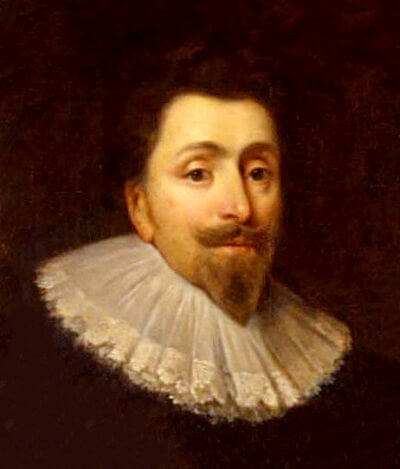
Lord Baltimore

The territory was then granted to Lord Baltimore’s son, the second Lord Baltimore. He was given all the powers of a monarch. The first settlers were sent out in 1633, and reached Maryland in 1634. This company was composed of twenty gentlemen and three hundred laboring-men, and the first governor was Leonard Calvert, the second Lord Baltimore’s brother. Roman Catholic priests were with them, and at their landing they set up a cross. But there were also a good many Protestants in the party, and Baltimore had resolved from the beginning that there should be no persecution of any Christians on account of religion in his new province. In almost every country in the world at that time the established religion, of whatever sort it might be, was enforced by law.

The colonists came in two ships called the Ark and the Dove; they settled first at a place which they called St. Mary’s, on the St. Mary’s River, not far from the Potomac. They bought from the American Indians living on the place their village and corn-ground, and for the rest of that season they lived in half of the village with the American Indians. The colony had many troubles and several little civil wars in its first years. These mostly grew out of the religious differences of the people. But after a while Maryland prospered and grew rich by raising tobacco.

After the settlement of New England by Puritans, and Maryland by Catholics, there was a period of about thirty years in which no new colonies were planted. In this period occurred the Great Rebellion in England, in which Charles I was beheaded, and his son Charles II was kept out of England by the Puritans under Oliver Cromwell. But, after Cromwell’s death, Charles II was brought back to the throne of England. This is known as the Restoration. It took place in 1660.

After the Restoration there was a new interest in colonies. New York was taken from the Dutch, and new colonies were planned. King Charles II was a very thoughtless, self-indulgent monarch, who freely granted great tracts of land in America to several of his favorites. To some of his courtiers he gave, in 1663, a large territory cut off from Virginia on the south, which had been known before this time as Carolina, but was now called Carolina, from Carolus, the Latin form of King Charles’s name. This territory included what we call North and South Carolina. Those to whom this territory was granted were called “The Lords Proprietors of Carolina.” There were eight of them.

In the northeastern corner of this territory, on the Chowan River, a settlement had been made by people from Virginia, under the lead of a minister named Roger Green, in 1653. This was ten years before the country was granted to these lords proprietors, and the land belonged to Virginia when they settled there. A settlement was made at Port Royal, in South Carolina, in 1670, but the people afterward moved to where the city of Charleston now stands. The foundation of this city was laid in 1680. A large number of Huguenots, or French Protestants, settled in South Carolina about this time.

The lords-proprietors tried to force on the little settlements in the woods a constitution which they had prepared. This constitution provided for three orders of nobility, to be called palatines [pal-a-teens’], landgraves, and caciques [cas-seeks’]. But this system of government worked so badly that it was, after a while, given up.

The Carolina colonies grew slowly. But after the introduction of rice-culture, in 1696, South Carolina became prosperous. The proprietors, living in England, conducted the government of the colonies in a selfish spirit, and the people disliked their management. In 1719 the South Carolina people rose in rebellion and threw off the yoke of the lords proprietors. In 1729 the king bought out the interest of the proprietors, and after that the governors were appointed by the king. They had already an Assembly elected by the people to pass laws.

The Coming of the Dutch

The Coming of the Dutch

While Captain John Smith was in Virginia, he had a notion that there was a passage into the Pacific Ocean somewhere to the north of the Virginia Colony. He may have got this opinion from some old maps, or from misunderstanding something that the American Indians told him while he was exploring the Chesapeake Bay. He sent to his old friend Henry Hudson, in England, a letter and a map, which showed a way to go by sea into the Pacific Ocean, a little to the north of Virginia.

Henry Hudson was an Englishman already known as a bold explorer. In 1609, soon after getting John Smith’s letter and map, Hudson went to Holland and hired himself to the Dutch East India Company. This company sent him out with a little yacht, called the Half-Moon, manned by twenty sailors, to find a passage to China, by going around the north coast of Europe. But he found the sea in that direction so full of ice that he was obliged to give up the attempt to get to China in that way. So, remembering John Smith’s map, he set sail for America.

Henry Hudson

Hudson sailed as far to the south as the entrance to the Chesapeake, and then explored the coast to the northward. He went into Delaware Bay, and afterward into New York Harbor. In hope of finding a way to the East Indies, he kept on up the river, which we now call Hudson River, for eleven days. But when he had gone nearly as far as to the place where Albany is now, Hudson became satisfied that the road to China did not lie there, and so he sailed down and returned to Europe.

Though Hudson was an Englishman, he made this voyage for the Dutch, and the very next year the Dutch merchants began a fur trade with the American Indians on this river that Hudson had discovered. In the year that followed (1611) they explored the coast northeastward beyond Boston Harbor, and to the southward they sailed into the Delaware River, claiming all this country, which was then without any inhabitants but American Indians. They called this territory New Netherland. Netherland is another name for what we call Holland.

The Dutch had built a trading post, called a “fort,” at what is now Albany, and perhaps others like it elsewhere, but they did not send out a colony until 1623. Then two principal settlements were made, the one at Albany, the other at Wallabout, now part of Brooklyn. But the island of Manhattan, on which New York now stands, had been the center of their trade, and it soon became the little capital of the colony. The town which grew about the fort that stood at the south end of what is now New York city, was called by the Dutch New Amsterdam, after the principal city of Holland, their own country.

The Dutch also had settlements on the Connecticut River and on the Delaware River. But on the Connecticut River they got into trouble with the English settlers, who claimed the whole of that country. On the Delaware River the Dutch had trouble with some Swedes, who had planted a colony there in 1638. This colony the Swedes called New Sweden, just as the Dutch called theirs New Netherland, and as the English called their northern colonies New England, while the French named their settlements in Canada New France. After a great deal of quarreling between the Swedes and Dutch, the Dutch governor, Peter Stuyvesant, in 1655, mustered a little fleet with six or seven hundred men, and, sailing to the Delaware River, captured New Sweden.

But the English at this time claimed that all the territory between Virginia and New England belonged to England. They said that all that coast had been discovered by Cabot for Henry VII more than a century and a half before. In 1664, in time of peace, four English ships appeared in the harbor of New Amsterdam and demanded its surrender. Stout old Peter Stuyvesant, the lame governor who had ruled in the Dutch colonies for many years, resolved to fight. But the city was weak and without fortifications, and the people, seeing the uselessness of contending against the ships, persuaded Stuyvesant to surrender. The name New Amsterdam was immediately changed to New York, the whole province having been granted to the Duke of York.

At the time of the surrender New York city had but fifteen hundred people, most of them speaking the Dutch language. Today there are nearly a thousand times as many people in New York city. Many thousands of the people of New York and many in other States have descended from the first Dutch settlers and bear the old Dutch names. The Dutch settlers were generally industrious, frugal, and religious.

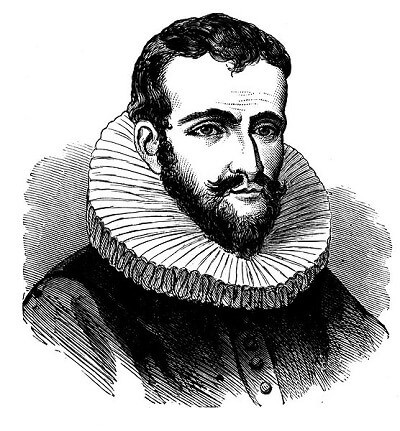
HENRY HUDSON

The time of Hudson’s birth is not known. Nor is anything known of the early voyages by which he became famous. In 1607, in the employ of an English company, he undertook to find the much-desired route to China by sailing straight across the north pole. He failed, of course, though he got farther north than any other voyager had done. In the next year, 1608, for the same company, he tried to find a passage to the East Indies by sailing to the northeast. He did not succeed, but he sets down in his journal that some of his company saw one day a mermaid, with a body like a woman and a tail like a porpoise. Intelligent people believed in such monsters in that day. In the next year Holland and France both tried to secure Hudson’s services. It is told in the text how, in this voyage in the Half-Moon, he discovered the great river of New York for the Dutch. In the year following he tried to find a way to China by the northwest, but, while sailing in what is now called Hudson Bay, part of his crew rose against him, and, putting Hudson and some of his men into an open boat, sailed away, leaving them to perish.

The Great Destruction of a City

The Old Testament prophets continually foretold the gathering again of the Jews to their land. However, the Romans dispersed the Jews from their land and destroyed the city of Jerusalem. Jesus foretold this to His disciples. In Luke 49:41-44, Jesus told of the coming destruction of the city of Jerusalem.

  • Luke 49:41-44 And when he was come near, he beheld the city, and wept over it, Saying, If thou hadst known, even thou, at least in this thy day, the things which belong unto thy peace! but now they are hid from thine eyes. For the days shall come upon thee, that thine enemies shall cast a trench about thee, and compass thee round, and keep thee in on every side, And shall lay thee even with the ground, and thy children within thee; and they shall not leave in thee one stone upon another; because thou knewest not the time of thy visitation.

Jerusalem: Jewish Pivotal point

  • Jerusalem was the center of activity for the Jews, the center of their religion because the Temple was there.
  • Jerusalem was also the center of commerce.

Jesus Wept over Jerusalem

  • When Jesus was on His way to Jerusalem just before He was arrested. He stopped and wept over Jerusalem and said:
    • Matthew 23:37-38 O Jerusalem, Jerusalem, thou that killest the prophets, and stonest them which are sent unto thee, how often would I have gathered thy children together, even as a hen gathereth her chickens under her wings, and ye would not! Behold, your house is left unto you desolate.

Jerusalem Destroyed by the Armies of Titus

  • After the death of Jesus, the Jews revolted against Roman rule.
  • In the year 70 A.D., General Titus and the Roman army laid siege to the city of Jerusalem.
  • The people of Jerusalem would not feel the strong might of the Roman Empire.
  • The city was destroyed because:
    • The was God’s judgment for their sin.
    • The Romans wanted to stamp out the Jewish religion.
    • The Romans wanted to destroy the Jewish nation.
  • The destruction was quite a feat itself.
  • The historian Josephus said that some of the stones were 94 feet long, 10.5 feet tall, and 13 feet thick.
  • Jesus had said:
    • Matthew 24:2 And Jesus said unto them, See ye not all these things? verily I say unto you, There shall not be left here one stone upon another, that shall not be thrown down.

The Story of Pocahontas

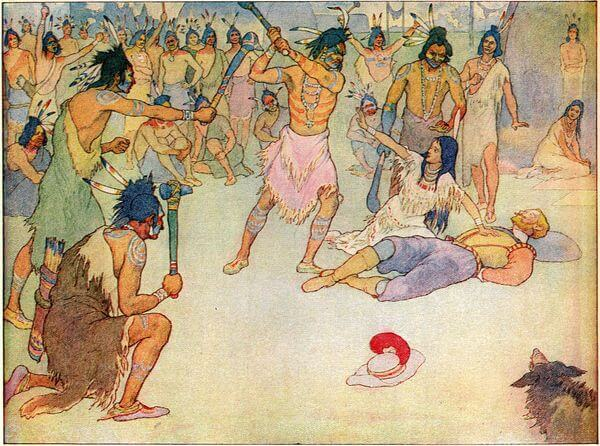
While Captain John Smith was a prisoner among the Indians of Powhatan’s tribe, he made the acquaintance of that chief’s daughter, Pocahontas [po-ca-h’un’-tas], a little girl of ten or twelve years of age, with whom he was very much pleased. Years afterward, he said that Powhatan had at one time determined to put him to death; but when Captain Smith’s head was laid upon some stones, and Indians stood ready to beat out his brains, Pocahontas laid her head on his, so that they could not kill Captain Smith without striking her; seeing which, Powhatan let him live. Captain Smith said nothing about this occurrence in the first accounts of his captivity, and many people think that it never happened.

But it is certain that, whether Pocahontas saved his life at this time or not, he was much attached to her, and she became very fond of going to Jamestown, where she played with the boys in the street. When the settlers were in danger of starving, she brought them food. When a messenger was sent from Jamestown to carry an important message to Captain Smith, then in Powhatan’s country, she hid the man and got him through in spite of Powhatan’s desire to kill him. When the Indians intended to kill Captain Smith, she went to his tent at night and gave him warning. Captain Smith offered her trinkets as a reward, but she refused them, with tears in her eyes, saying that Powhatan would kill her if he knew of her coming there. These are the stories told of her in Captain Smith’s history. And when a number of colonists then in the Indian country were put to death, she saved the life of a colonist boy named Henry Spelman by sending him away.

When Captain Smith had been in the colony ten years, ships came from London with many hundreds of people. The ships that brought this company to Jamestown in 1609 were under the command of men that were enemies of Captain Smith, who had come to be governor of the colony. These men resolved to depose John Smith, so as to get the government of Jamestown into their own hands. Smith, having been injured by an explosion of gunpowder, consented to go back to England. His enemies sent charges against him. One of these charges was that he wished to marry Pocahontas, who was now growing up, and thus to get possession of the colony by claiming it for the daughter of Powhatan, whom the English regarded as a kind of king.

The colony had every reason to be sorry that Captain Smith was sent away. The men left in charge managed badly. Powhatan ceased to be friendly, and his little daughter did not come to see the English people anymore. The people of Jamestown were now so afraid of the Indians that they dared not venture outside the town. Soon all their food was gone, and they had eaten up their horses. Some of the people were killed by the Indians. Some fled in one of the ships and became pirates, and great numbers of them died of hunger.

Ships arrived at last, bringing help to the colony. Under one governor and another, Jamestown suffered many troubles from sickness and from the Indians. There was in the colony a sea captain named Argall, who thought that, if he could get Pocahontas into his power, her father, the great chief Powhatan, might be persuaded to be peaceable.

Pocahontas was by this time a young woman of about eighteen. She was visiting an old chief named Japazaws, who lived on the Potomac River. Argall was trading with the Indians at Japazaws’s town. He told Japazaws that, if he would bring Pocahontas on board his ship, he would give him a copper kettle. Every Indian wanted to have a copper kettle, of all things. Japazaws and his wife, pretending that they wished to see the vessel, coaxed Pocahontas to go with them. Argall refused to let her go ashore again and carried her to Jamestown a prisoner.

Here she stayed a year. The English people in Jamestown refused to give her up unless Powhatan would return some guns which the Indians had taken. There was an Englishman living at Jamestown, named John Rolfe, who fell in love with Pocahontas, and proposed to marry her. When word was sent to Powhatan of this, he readily agreed to the marriage, and an old uncle and two brothers of Pocahontas went down to Jamestown to attend the wedding. Pocahontas, having been instructed in the Christian religion, was baptized in the little church, and married to Rolfe in 1614. Her real name was Matoax, but her father called her Pocahontas. When she was baptized, she took the name of Rebecca.

The marriage of Pocahontas brought peace with the Indians. In 1616, with her little baby boy, Pocahontas was taken to England. Here she was called “the Lady Rebecca,” and treated with great respect as the daughter of a king.

The people at Jamestown had told Pocahontas that John Smith was dead. When she saw him alive in England, she was very much offended. She fell into such a pout that for some time she would not speak to anybody. Then she announced her intention of calling Captain Smith her father, after the Indian plan of adoption.

She was greatly petted by the king and queen and all the English people. The change from a smoky bark hut to high life in England must have been very great, but she surprised everybody by the quickness with which she learned to behave rightly in any company. She was much pleased with England and was sorry to go back. When she was ready to sail, she was attacked by smallpox and died.

Her little boy was now left in England. Captain Argall, who had made Pocahontas prisoner, was now made Governor of Virginia. He was a very dishonest man, and he and some partners of his appear to have had a scheme to get possession of the colony by claiming it for the child of Pocahontas as the grandson of “King Powhatan.” Argall sent word to England that the Indians had resolved to sell no more land, but to keep it all for this child. This was no doubt, a falsehood. Argall was a bad governor, and he was soon recalled, and a better man took his place. The son of Pocahontas returned to Virginia when he was grown.

But when Pocahontas was dead, and Powhatan also, there was nothing to keep the Indians quiet, and in 1622 they suddenly fell upon the settlement and killed more than three hundred people in one day. Long and bloody wars followed, but the colony of Virginia lived through them all.

How Columbus Discovered America

About two hundred years before Columbus sailed, there arrived in the city of Venice one day three travelers, coarsely dressed in Chinese fashion. They said that they were three gentlemen named Polo, who had left Venice many years before. They had almost forgotten how to speak Italian, and at first their own relatives thought them foreigners and impostors. But they gave a magnificent banquet at which they all appeared in rich robes. They changed their garments again and again as the feast went on. Every robe taken off was cut up and given to the servants. At last they took their old garments and ripped them open and poured out before the guests a collection of precious stones of untold value.

One of these gentlemen, Marco Polo, wrote a book of his travels, describing the vast riches of Eastern countries, before unknown to people in Europe. Columbus had read this book, and it was to find a new way to reach the rich countries seen by Polo that he was now resolved to sail partly around the globe.

In spite of the power which the King of Spain gave him to force ships and seamen to go with him, Columbus found the greatest trouble in fitting out his expedition, so much were the sailors afraid of the ocean. But at last all was ready. Those who were to sail into “The Sea of Darkness” with Columbus took the sacrament and bade a solemn farewell to their friends, feeling much like men condemned to death. They embarked in three little vessels, only one of which had a deck over it.

Columbus went to the Canary Islands first. Then with bitter lamentations the men took leave of the last known land and sailed into seas in which no ship had ever been. Columbus tried to cheer them with the stories he had read in Marco Polo’s book, of the riches of the great country of China. But he also deceived them by keeping two separate accounts of his sailing. In the one which he showed to his companions he made the distance from Spain much less than it really was.

But they were greatly alarmed to find that, as they went west, the needle of the compass did not point directly to the north star. This change, though well-known now, was probably as surprising to Columbus as to his men, but he did his best to keep up their courage.

The weather was fine, and the winds blew always from the east. This alarmed the sailors more than ever, for they were sure they would get no wind to come back with. One day the wind came around to the southwest, which was a great encouragement.

But presently the ships struck great masses of seaweed, and all was grumbling and lamentation again. The frightened sailors remembered old stories of a frozen ocean, and imagined that this must be the very place. When the wind fell to a calm, they thought the ships might lie there and rot for want of wind to fill the sails.

They were getting farther and farther away from Europe. Where would they find food and water to last them till they got home? They thought their commander a crackbrained fool, who would go on to their destruction. They planned, therefore, to throw him into the sea, and go back. They could say that, while he was gazing at the stars, after his fashion, he had tumbled over.

But the worst disappointments were to come. One day the glad cry of “Land!” was raised. Columbus fell on his knees to return thanks, while the men scrambled up into the rigging. But it proved to be only a cloud. On the 7th of October another false alarm disheartened the sailors more than ever.

From the first Columbus had pointed to seaweed, and other supposed signs of land, until the men would no longer listen to his hopeful words. Now the appearance of some songbirds, a heron, and a duck, could not comfort them. The great enterprise was about to end in failure, after all, when, on the 11th of October, the sailors found a branch of a thorn tree with berries on it. At length a carved stick was found, and the men began to believe that they were really near to some inhabited land.

During the night which followed this discovery no one on the ships slept. About ten o’clock Columbus saw a glimmering light appearing and disappearing, as though some one on shore were carrying a torch. At two o’clock a sailor sighted land.

The morning light of Friday, October 12, 1492, showed the Spaniards a beautiful little island. Columbus dressed himself in scarlet, and planted the Spanish standard on the shore, throwing himself on the earth and kissing it, while the native Indians wondered whether these men in bright armor had flown from the skies in their winged boats or had sailed down upon the clouds. The sailors, lately so ready to cast Columbus into the sea, now crowded about him, embracing him and kissing his hands.

When the Indians had recovered from their first surprise, they visited the ships, some of them in canoes, and others by swimming. They brought with them a ball of cotton yarn, bread made from roots, and some tame parrots, which, with a few golden ornaments, they exchanged for caps, glass beads, tiny bells, and other trifles, with which they could adorn themselves.

The island which Columbus first discovered was a small one, which he called San Salvador, but we do not now know which of the West India Islands it was. He thought that he was on the coast of Asia. But where were the rich islands and great cities and houses roofed with gold, of which Marco Polo had written two hundred years before?

From island-to-island Columbus sailed, looking for these things, not knowing that they were thousands of miles away. Finding the island of Cuba very large, he concluded that it was a part of the mainland of Asia.

Captain John Smith

On the estate of Lord Willoughby, in the eastern part of England, there was a family of poor tenants named Smith, who had a son born in 1579. They named him John. John Smith is the most common of names, but this was the most uncommon of all the John Smiths. He was apprenticed to learn a trade, but he ran away from his master and became, for a while, a servant to Lord Willoughby, who was going to Holland.

Like most runaway boys, he found the world a hard place, and had to lead a very rough-and-tumble life. He enlisted as a soldier; he was shipwrecked; he was robbed and reduced to beggary; and, if we may believe his own story, he was once pitched into the sea by a company of pilgrims, who thought that he had caused the storm, like Jonah in the Bible. This must have happened not far from shore, for he reached land without the aid of a whale and went into the war against the Turks. There he killed three Turks in single combat, and cut off their heads, but Captain John Smith came near losing his own head in the fight with the last one.

The Turks captured Smith afterward and made him a slave. His Turkish master was very cruel and put an iron collar on his neck. While Smith was thrashing wheat one day with his dog-collar on, the Turk began to thrash him. Smith grew angry, and, leaving the wheat, hit his master with the flail, killing him on the spot. Then he took a bag of wheat for food, mounted his master’s horse and escaped to the wilderness, and got out of Turkey.

When, at last, Captain Smith got back to England with his wonderful budget of stories about narrow escapes and bloody fights, he probably found it hard to settle down to a peaceful life. The English people were just then talking a great deal about settling a colony in North America, which was quite wild and almost wholly unexplored. Nothing suited the wandering and daring Captain Smith better. He joined the company which set sail for America, in three little ships, in 1606. The largest of these was called the Susan Constant.

I am sorry to say the people sent out in this first company were what we should call nowadays a hard set. They were most of them men who knew nothing about work. They had heard how the Spaniards grew rich from the gold and silver in South America, and they expected to pick up gold without trouble.

The colony was settled at a place called Jamestown. Soon after the settlers landed, the American Indians attacked them and the settlers might all have been put to death with the bows and arrows and war-clubs of the Indians, if the people on one of the ships had not fired a cross-bar shot. This cross-bar shot happened to cut down a limb of a tree over the heads of the Indians. When they heard the noise of the cannon, like thunder, and saw the treetops come tumbling on their heads, the Indians thought it was time to make good use of their heels.

The people of that day did not know how to establish colonies, and the lack of good food and shelter caused the death of more than half of the Jamestown settlers. The Indians who lived near them had fields of Indian corn, whose streaming blades and waving tassels were a strange sight to Englishmen. When at last the corn was ripe, Captain John Smith set sail in a small boat and traded a lot of trinkets with the Indians for coin, and so saved the lives of many of the people. The English thought America was only a narrow strip of land. They were still looking for a way to India, as Columbus had looked for it more than a hundred years before. The King of England had told them to explore any river coming from the northwest. Smith therefore set out to sail up the little Chickahominy River to find the Pacific Ocean, not knowing that this ocean was nearly three thousand miles away.

The daring captain left his two men in charge of the boat while he went on farther. The Indians killed the men and then pursued Smith. Smith had taken an Indian prisoner, and he saved himself by putting this prisoner between him and his enemies. But the Indians caught Smith after he had fled into a swamp, where he sank up to his waist in the mud, so that he could neither fight nor run. He made friends with the head Indian of the party by giving him a pocket compass and trying to explain its use.

As all the Indians had a great curiosity to see a colonist, Smith was marched from one Indian village to another; but he was treated with a great deal of respect. Perhaps the Indians thought that men who sailed in big canoes and discharged guns that blazed and smoked and made a noise like thunder and knocked the trees down, must have some mysterious power. But they also thought that if they could persuade the colonists to give them some big guns they could easily conquer all the Indian tribes with whom they were at war.

The Indians surrounded Smith with curious charms by way of finding out whether he was friendly to them or not. They fed him very well; but Smith, who was as ignorant of Indians as they were of colonists, thought that they were fattening him to eat him, so he did not have much appetite.

Powhatan [pow-at-tan’] was the name of the great chief of these Indians. This chief set Smith free. He sent some men along with him on his return to Jamestown to bring back two cannons and a grindstone in exchange for the prisoner; but the Indians found these things rather too heavy to carry, and they were forced to return with nothing but trinkets.

Captain Smith seems to have been the best man to control the unruly settlers and manage the Indians. The people in England who had sent out this colony thought they could make the chief, Powhatan, friendly by sending him presents. They sent him a crown, a wash-basin, and a bedstead, also a red robe, and other things quite unnecessary to living in America. But when Powhatan for the first time in his life had a bedstead and a wash-basin and a red gown, he thought himself so important that he would not sell corn to the settlers, who were in danger of starving. Captain Smith, however, showed him some blue glass beads, pretending that he could not sell them because they were made of some substance like the sky, and were only to be worn by the greatest princes. Powhatan became half crazy to get these precious jewels, and Smith bought a large boatload of corn in exchange for a pound or two of beads.

Myles Standish and the Indians

The American Indians, recognizing the superior firepower of the Pilgrims, did not attack Plymouth. But they thought that they might get rid of the Pilgrims by witchcraft. So they held a powwow in a big swamp to persuade the spirits to kill or drive away the newcomers. Sometimes the Pilgrims would see some Indians on a hilltop near Plymouth. Perhaps they came to see whether the Plymouth people had all been killed by the spirits.

But in the spring, a chief from a place farther east came to visit the Indians near Plymouth. He had met English fishermen and learned a little English. He was not afraid to visit the Pilgrims. Walking boldly into the little town, he said, “Welcome, Englishmen.” The Pilgrims were surprised to hear two English words from the mouth of an Indian.

They treated this Indian well, and he came again bringing an Indian named Squanto [squon’-to] who could speak more English. Squanto, who had lived at Plymouth, was one of the Indians carried away to Spain and sold into slavery by English explorer Captain Thomas Hunt. From Spain, he had been taken to England and then brought back to America. When he got home to Plymouth, he found that all the people of his village had died from pestilence.

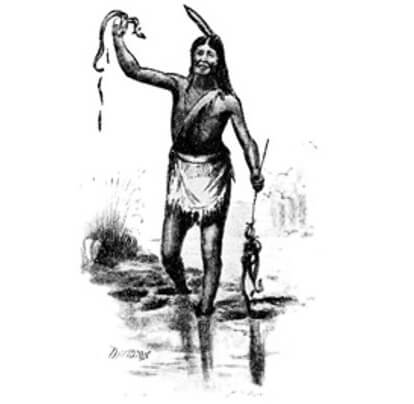
Squanto now came again to the old home of his people at Plymouth and lived with the Pilgrims. He showed the English a way to catch eels by treading them out of the mud with his feet. He knew the woods and waters well, and he showed them how to hunt and fish. He taught them how to plant Indian corn as the Indians did, putting a fish or two in every hill for manure, and then watching the fields for a while to keep the wolves from digging up the buried fish. Without the seed corn and the help of Squanto the whole colony would have starved.

Squanto told the other Indians about the dreadful gunpowder kept in the cellar at Plymouth. He also told them that the horrid pestilence was kept in the same cellar with the powder.

Massasoit [mas-sa-so’-it], the chief of Squanto’s tribe, came to see the Pilgrims, bringing some other Indians with him. They were taken into the largest house in Plymouth and seated on a green mat and some cushions. The Governor of the colony was then brought in while the trumpets were blowing and the drums beating. This parade pleased the Indians. Afterward, the Pilgrims sent Massasoit a red cotton coat and a copper chain, and by degrees a firm friendship was made between him and the Pilgrims.

The Narragansett Indians were enemies of Massasoit. None of their people had died from pestilence, and they were therefore stronger than Massasoit’s tribe. The Narragansetts sent a bundle of arrows to Plymouth tied up in a snake’s skin. Squanto told the English that this meant to say that they would come and make war on Plymouth. The Pilgrims filled the snake’s skin with bullets and sent it back. This was to say, “Shoot your arrows at us and we will kill you with our bullets.” The Narragansetts smartly realized that arrows could not easily defeat bullets. They sent the bullets back to Plymouth, and there was no war.

When the Pilgrims had been settled at Plymouth more than a year, a ship brought them news of the dreadful massacre that had taken place in Virginia. The Pilgrims were afraid something of the kind might happen to them. So Captain Standish trained the Plymouth men, and they kept guard every night. They put cannon on the roof of their meeting house and carried their guns to church.

A company of people from England made a settlement at Weymouth [way’-muth], not very far from Plymouth. They were rude and familiar, and the Indians soon despised them. Some Indian warriors made a plan to kill them all. They intended to kill the Plymouth people at the same time. But Massasoit told the Pilgrims about it and said they must go and kill the leaders before they had a chance to kill the Pilgrims.

Captain Standish was a little man, and one of his enemies once nicknamed him “Captain Shrimp.” However, Captain Standish was also brave. Captain Standish set out for the colony at Weymouth. He took but few men, so that the Indians might not guess what he came for. But they saw that the little captain was very “angry in his heart,” as they said. Seeing how few his men were they tried to frighten him.

One of these Indians named Wittamut sharpened the knife which he wore hanging about his neck. While sharpening it he said to Captain Standish: “This is a good knife. On the handle is the picture of a woman’s face. But I have another knife at home with which I have killed both Frenchmen and Englishmen. That knife has a man’s face on it. After a while these two will get married.”

A large Indian named Pecksuot said: “You are a captain, but you are a little man. I am not a chief, but I am strong and brave.”

It was now a question whether Standish would attack the Indians or wait for them to begin. One day when Wittamut, Pecksuot, and two other Indians were in the room with Standish and some of his men, the captain made a signal, and himself snatched the knife that hung on Pecksuot’s neck and stabbed him to death after a terrible struggle. His men killed the other Indians in the same way. After that the English were called “stabbers” in the Indian language.

The Pilgrims were often very near to starvation during the first years after they settled at Plymouth. At one time, they lived on clams and lobsters and such fish as they could catch. Standish made many voyages along the coast, trading with the Indians for furs, which were sent to England and exchanged for whatever the settlers might need.

A few years after the Pilgrims settled Plymouth, additional colonists began to settle near them. In 1630, there came over a large number of people, who founded Boston and other Massachusetts towns. Captain Standish lived to be more than seventy years old and to see many thousands of people in New England. He owned a place at Duxbury, just across the bay from Plymouth. He died there in 1656. The hill which he owned is still called “Captain’s Hill.”

 Other Discoveries in America

Americus Vespucius was born in Florence in 1451. He went into mercantile life at Florence, and afterward removed to Spain a little before Columbus sailed on his first voyage. Vespucius claimed to have made four voyages to the New World, the first in 1497. But it is now believed that this first date is not correct, and that Vespucius was in Spain during all of that year. He undoubtedly went to America several times, both from Spain and Portugal. In 1503 Vespucius built a fort on the coast of what is now Brazil; and he left there a little colony, the first in that part of South America. Ferdinand of Spain made him pilot-major of his kingdom in 1508, and he died in 1512.

A part of the glory of Columbus’s great discovery was taken away from him by accident. An Italian, Amerigo Vespucci [am-a-ree’-go ves-poot’-chee], whose name in Latin was written Amer’icus Vespu’cius, was with an expedition that discovered part of South America in 1499. A false claim was made, indeed, that Americus saw that continent two years earlier, which would be before Columbus discovered it in 1498. Americus Vespucius wrote pleasantly about the new lands which he had seen, and some German geographers were so pleased with his descriptions that they called the country America, in honor of Americus, supposing him to have first seen the continent. When North America came to be placed on the maps, this name was applied to it also. Thus, nearly half the world goes by the name of a man who had no claim to be called its discoverer.

Americus Vespucius’ by Cristofano dell’Altissimo

The voyage of Columbus was undertaken, as we have seen, to open a trade with the Spice Islands of Asia, and the failure to find these was disappointing. There was another great Italian navigator living at the same time as Columbus, whose name was Zuan Cab-ot’-o. He is called in English John Cab’-ot. He had been in the city of Mecca, in Arabia, and had there seen the caravans bringing spices from India. He inquired of the people of these caravans where they got their spices. They said that other caravans brought them to their country, and that the people in those caravans said that they bought them from people who lived yet farther away. From all this John Cabot concluded that the spices so much valued in Europe must grow in the most easterly part of Asia, and that he could reach this part of Asia by sailing to the west, as Columbus had done.

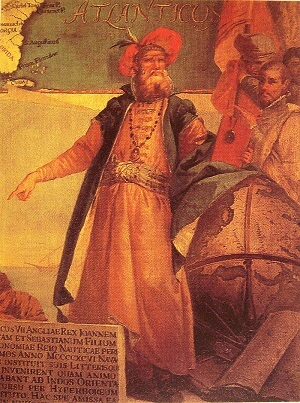
John Cabot’ by Giustino Menescardi

The King of England at this time was Henry VII. While Columbus was trying to persuade Ferdinand and Isabella to send him on a voyage of discovery, he had sent his brother, Bartholomew Columbus, to make a like offer to the English king. When Bartholomew returned to Spain with King Henry VII’s answer, Christopher Columbus had already discovered the New World.

But though Columbus had found what he believed to be a part of Asia, he had not found the region of gold and spices. John Cabot, who was then living in England, believed that he might be more fortunate. He got permission from Henry VII to sail at the expense of certain English merchants, and in May 1497, nearly five years after Columbus had started on his first voyage, Cabot set sail from Bristol with only one small vessel and eighteen persons. He discovered the Continent of North America, which he of course supposed to be a part of Asia. He did not meet any American Indians, but he brought to King Henry one of their traps for catching game, and a needle for making nets. He was received with great honor, and he who had gone away a poor Venetian pilot was now called “the Great Admiral,” and dressed himself in silks, after the manner of great men of that time.

The next year, accompanied by his son Sebastian, he set sail with a much larger expedition, to find his way to Japan or China. After going far to the north, he sailed along what is now the coast of Canada and the United States as far to the south as North Carolina. But, as he did not find the riches of Asia, the English appear to have lost much of their interest in Western voyages.

After both Columbus and John Cabot were dead, people began to suspect that the newly discovered lands were not part of Asia. In 1513 Vasco Nunez de Balboa [vas’-co noon-yeth deh bal-bo’-ah] crossed the Isthmus of Panama [pan-ah-mah’] and discovered the Pacific Ocean at the west of America.

It now became a question of finding a way through or around America, so as to come to the rich trade of the East Indies, which the Portuguese had reached in 1498, when Vasco da Gama [vas’-co dah gah’-mah] sailed there around the Cape of Good Hope. In 1520 Magellan [ma-jel’-lan], a Portuguese in the employ of Spain, sailed through the straits which bear his name, and so into the Pacific. It was not then known that one could pass around Cape Horn. Magellan lost his life in the Philippine Islands, but one of his smallest ships succeeded in making- the circuit of the earth – the first that ever accomplished that feat.

Magellan’s route was too long a course for trade, and many other navigators sailed up and down the American coast, expecting to find some passage by which they could get through the continent to go to China, India, and Japan, They thought America very narrow, and, indeed, they believed that it might prove to be cut through in some places by straits, if they could only find them. Several great English navigators tried to discover what they called the Northwest Passage, by sailing along the coast of Labrador. and into the rivers and bays of America.

For a long time nobody in England thought it worthwhile to send colonies to North America; it was regarded only as a bar to all attempts to reach Asia by the west. The colonists sent from Spain having found gold in great quantities in Mexico and South America, the English at length began to think of settling colonies in North America, to look for gold there also. Frobisher and Sir Humphrey Gilbert, in” the time of Queen Elizabeth, proposed to settle such colonies, but it was not until Sir Walter Raleigh undertook it that a hopeful beginning was made.

JOHN CABOT

John Cabot, or Zuan Caboto, as he was called in the Venetian dialect, was probably born in Genoa, but he was naturalized in Venice. He was living in Bristol, in England, with his wife and three sons, in 1495, when he laid his plans before Henry VII. He received a charter for discovery from that king in 1496, in which his three sons were named, and he sailed on his first voyage in 1497, and the second in 1498. It is probable that his son Sebastian went with him on both voyages. There is no account of John Cabot’s second return, nor do we know any more about him after his sailing to America the second time. His son Sebastian, who was a great geographer, and who lived to be very old, seems to have always spoken of the voyages as though he had made them alone, but we now know that it was John Cabot who discovered North America.

FERNANDO DA MAGALHAENS

Fernando da Magalhaens [mah-gal-yah’-ens], as his name is written and pronounced in Portuguese, but who is known in English as Magellan, was born in Portugal. He served the Portuguese government in the East Indies, and was in the expedition that discovered some of the Spice Islands. Having received a slight from the Portuguese government, he publicly renounced his country and entered the service of the King of Spain. He sailed on his famous voyage in September, 1519, with five ships. On the coast of South America, he lost one of his vessels and suppressed a mutiny. In October, 1520, he entered the straits that bear his name. His men were very reluctant to go on, and one ship turned back out of the channel and sailed home. With the three ships left he entered the Pacific. At the Philippine Islands he was killed in a battle with the natives. Only one of his ships, the Victoria, succeeded in getting around the world, and she had but eighteen men left alive when she got back, and they were sick and almost starving.

Ferdinand Magellan’ by Anonymous