A place to grow your relationship with God

Posts tagged ‘history’

The little book of the war: The Americans as Helpers

Chapter 10

The Americans as Helpers

It is one thing to become an ally, and quite another to have an army prepared to make our proffered alliance of value. After the indifference with which Germany met American protests in regard to the sinking of the Lusitania and the U-boat warfare, the thinking people of the country realized that war would probably be forced upon us. In the summer of 1915 training camps were formed at Plattsburg and elsewhere; and there business men, college professors and students, lawyers, authors, publishers, and others spent a month in learning how to be soldiers. Here was the “intensive training” of which we hear so much. The only difference between this and ordinary training is that in the intensive there is no dawdling; every man has a reason for doing his best, and he does it. The result at Plattsburg was that in one month many hundreds of men learned about warfare and the use of arms what would ordinarily have required four months of training. They were not prepared to command armies in battle, but they were prepared to train raw troops in the manual of arms, to teach them how to care for their health in a campaign, and, perhaps most valuable of all, to inspire them with a fuller appreciation of team work, with an eagerness to serve their country and a comprehension of, the nobility of such service.

An army was raised by “selective draft,” that is, composed of strong, well men upon whom, as far as possible, no one was dependent for support, and who were not engaged in work necessary to the war, such as shipbuilding, munition-making, etc. To every soldier or sailor the Government gave a life insurance policy, in amounts varying up to $10,000; the premiums, amounting to 80 or 90 cents a month on each $1000, to be taken from his pay. The Government also gave him the privilege of taking out additional insurance up to another $10,000 at the same rates that he would pay in time of peace. For each $1000 of this he pays about $8 a year.

The preparations ordered by the Government were enormous. As one small detail, 45,000,000 yards of cotton cloth had to be purchased, besides 21,000,000 yards of drilling; the building of ships, aeroplanes, and submarine chasers was ordered. Cantonments, or camps wherein our troops may live and be trained for the army, had to be built; and it is no small matter to build almost in a night sixteen wooden cities capable of housing some 40,000 men each, with water-supply, drainage, electric lights and power, barracks, hospitals, stables, sheds, shops, and storehouses. The average cantonment has twenty miles of sewer and forty miles of water mains. In these cantonments the men are taught not only to know the manual of arms, but to dig trenches, to handle guns and take care of them, to use bayonets, hand grenades, and bombs, to keep clean, to care for their feet, to stand and run and walk in the least fatiguing manner, to obey orders, and, as one detail, to learn that the salute is a mark, not merely of the deference of a private to an officer, but of the respect due to the uniform of the United States. The prescribed form is for the man of lower rank to salute first, but if the officer neglected to return the salute, he would be punished.

Before the summer of 1918 had come to an end, some 3,300,000 American boys were under arms, half of them in France and the other half in training camps. Command of the Allied forces had been put into the hands of General Foch, whom Marshal Joffre called “the first strategist in Europe.” Week after week Foch repulsed the drives of the Germans, holding firmly to his positions. At length the hour came for which he had been planning and preparing. He now took the offensive; blow followed blow, and from the middle of July the Germans have been in retreat. Territory has been gained, of course, but the greatest gain has been the defeat of Germany’s plans to win the war before the end of 1918. From all directions come praises of the bravery of the American boys. The Germans had not supposed it possible for a few months’ training to make the Americans into acceptable soldiers; but these same boys, fresh from college and farm and workshop, have held their own against the flower of the German army, the famous “Prussian Guards” and the Bavarian Guards, veterans of many battles.

Immigrants have been coming to this country in vast numbers, and we have not taken sufficient pains to see that they learned to speak English. Now that many of them are in our army, they must learn to understand orders at least, and therefore the cantonments have classes for them. A visitor to one of these classes thus pictures a lesson:—

“In one of these groups one of the exercises for the evening consisted in practicing the challenge when on sentry duty. Each pupil of the group (there were four of Italian and two of Slavic birth) shouldered in turn the long-handled stove shovel and aimed it at the teacher, who ran along the side of the room as if to evade the guard. The pupil called out in broken speech: ‘Halt! Who goes there?’ The answer came from the teacher: ‘Friend.’ And then, in as yet unintelligible English (the voices of innumerable ancestors struggling in their throats to pronounce it), the words: ‘Advance and give the countersign.’”

So it is that these men of foreign birth are learning the language of the country which has given them a home and which they are preparing to defend.

Americans who have gone to France have not all been expert linguists, and amusing stories come back to us of their struggles with the French language. One is said to have wondered why so many Frenchmen named their dogs “Ici” (here). Another wanted to tell his peasant hostess that her cow had wandered away, but could say only, “Madame du Tait promenades”; and there is also the pathetic tale of a sturdy Australian who wanted a bath, but knew no French except “Bonjour.”

In our navy officers and men had received a thorough and systematic training, and were quite accustomed to being prompt and efficient. It is now, in man power, five times as large as it was before the war; but its needs are great, for it has the task of protecting our coast, of convoying merchantmen and troop ships, of helping our allies to destroy submarines, and of being ready at a moment’s notice for anything that may need to be done. Only first-class men can find any place in the navy. Every ship maintains a school, and any man who is willing to work can acquire the education necessary for a commissioned officer.

All this preparation for war has been enormously costly. We no longer talk about hundreds of thousands of dollars, we talk about millions and billions. Every bit of wood or iron or platinum must be paid for, every workman who drives a nail into a ship must have his wages. Where does the money come from? The Government pays the bills, but the Government has no money except what it gets from the people, and there are in general only two ways in which it can get it from them. One is by taxation, and the other is by “Liberty Loans,” that is, by selling government bonds or promises to pay. This is the safest investment in the land. Manufacturers and railroads and all sorts of companies might fail, but the Government would be the last thing in the country to fail. A bond is exactly as safe as a bank bill, and in one respect it is of more value, namely, the bond draws interest, and the bank bill does not. Not every one can put $50 into even so safe an investment as a government bond; and therefore War Savings Stamps were issued at $4.12, which in 1923 will be redeemed by the Government at $5. There are also Thrift Stamps at 25 cents each. Sixteen of these, with the addition of a few cents, will purchase a War Savings Stamp.

The Government builds the cantonments, pays the troops, and feeds and clothes them; but a very large amount of money is spent on troops which is the free gift of the people at home to those who will defend them and their rights abroad. Much of this money goes through various organizations. One of these is the Young Men’s Christian Association. When this Association asked for volunteers, this is what it said:—

“This is no call to ninnies and milksops. The Y.M.C.A. needs real men, preferably men who have had some broad and grueling experience of life; men of education, yes; but, above that, men capable of understanding, sympathy, and an indefinite deal of hard, exacting work. Men who can turn a Ford inside out; men who can play the piano and lead five hundred others in singing; men who are trained in athletics; men six feet high and three feet wide and eighteen inches thick; men who understand what Christianity really means; men with humor and leadership who have been earning a hundred dollars a week and are willing to live on ten dollars a week. In other words, MEN.”

The Y.M.C.A. does its best for the soldier boys both here and across the ocean. It provides “huts,” which are sometimes a comfortable building that will hold several thousand, sometimes a tiny shed carefully camouflaged from the eyes of the enemy, and sometimes a dug-out twenty-five feet under ground; but whatever the hut may be, it is always a place where the men are welcome, where they can rest, play games, write letters, read magazines, see moving pictures and minstrel shows, and listen to concerts and phonographs. It opens classes and gets books for those who wish to study or read. It cheers up the man who is blue and discouraged and lonely, arranges talks by bright and interesting lecturers, and good strong religious talks, often by men who know what it is to be under fire. The secretaries of the “Y” are sometimes in as much danger as the men; and when a secretary hands a half-frozen soldier a cup of hot coffee, it may have been made at the risk of the secretary’s life.

Often a Y.M.C.A. secretary rather enjoys attempting the impossible, and he usually succeeds. One evening the secretary at one of the cantonments learned that four hundred men were to start on a two-days march the following day. It took quick work, but when the men arrived, in the afternoon, there stood a 40 x 60 foot tent with piano, tables, chairs, couches, graphophones, stationery, games, the daily papers, bats, balls, gloves, etc. Even a telephone had been installed, and souvenir postals from the nearest town were on sale.

The Y.M.C.A. is a Protestant organization, and the Knights of Columbus is a Roman Catholic. Mass is celebrated in the Knights of Columbus building, and is not in the huts, unless a priest borrows one for the purpose; but the work of the two organizations is exactly the same, and one description applies to both. Every man in camp is invited to both buildings at all times, and is just as free to go to one secretary as to the other.

It is estimated that at least 50,000 Jews are in the American army, and to add to their comfort and give them the services of their own faith, the Young Men’s Hebrew Association and the order of B’nai B’rith have been most active. In the cantonments the rooms of the Y.M.C.A. are thrown open for the use of the Jewish chaplains; and Protestants, Roman Catholics, and Jews work together in sincere harmony and appreciation of one another’s value.

The Red Cross is known wherever there is war or fire or famine or earthquake or any suffering that needs its help. To respect its flag is not only common decency, but it is international law, which forty-three nations have solemnly agreed to observe. To fire upon a Red Cross ship or hospital is an atrocious crime; yet this crime has been committed by the Germans over and over. Of course, in the European war the Red Cross is on hand. Large numbers of the best doctors and nurses have entered its work, and by their skillful treatment have saved thousands of lives. Prisoners worked by Germany until they are feeble and helpless are sent back to France to die; but the Red Cross cares for them and restores them to health if possible.

The Red Cross specializes in emergencies. Nearly 7,000,000 slings, bandages, hammocks, etc., were asked for, and within two weeks they were on their way. One hundred and seventy Americans were rescued from a ship torpedoed on the French coast. A telegram went to Paris, and on the instant a worker started for the spot, telegraphed to Washington the names of the survivors, lent money to those who had lost their own, and saw to it that the injured were well cared for. A more startling summons was received by a Red Cross official in Paris. It said, “750 children have been thrust upon my hands.” It is no wonder that it added, “Send help.” These were children from a town under bombardment. Gas bombs were used, and as the children were too young to wear gas masks, they had been hurried away. The day after the reception of the telegram, eight Red Cross workers were on hand, and in an amazingly short time the little folk were clean and comfortable and well cared for. Each nation has its own branch of the Red Cross. The Red Cross in France not only cares for the children and the sick, but it sees to it that the families of soldiers do not starve. It teaches young mothers how to care for their babies. It has even established lines of transportation. The railroads had more than they could do, and the Red Cross, without regard to weather or red tape or anything else, set lines of motor trucks to work, and before long was doing its own transporting both promptly and well.

The Omaha Indians of this country have a chapter of the Red Cross, and early in 1918 they held an auction sale for its benefit. After a prayer the bidding began, and it was reckless bidding, for every Indian was ready to open his purse wide to buy chickens, pigs, corn, goats, preserved fruit—no matter what—so long as the money went to help the soldiers. The Indians from the first have been deeply interested in the war. “I have heard of a peaceful people brought low by mighty guns,” said an aged chief. He promptly sold a load of corn and sent twenty dollars to the Belgian Minister at Washington, who responded by a note thanking him “not alone for his gift of money, but more particularly for the kindness of an understanding heart.” The Indians fully appreciated the need of Liberty Loans and to the first three they subscribed $13,000,000. Who was it that said the only good Indian was a dead Indian?

Since the war began, societies without number have been formed to help the suffering people of Europe. One of the oldest is that of the “American Fund for French Wounded.” We have never forgotten that France came to our help in Revolutionary days, when we were struggling—not with the people of England—they were never against us—but with an obstinate and short-sighted sovereign. Moreover, to help France was to keep the enemy from our own shores. So it was that surgical dressings, garments of all needed varieties, and all sorts of hospital supplies went to France from the “French Wounded” by thousands, and did much to strengthen the old friendship between the two countries.

The Society of Friends does not as a whole approve of fighting, but it does approve of helping to build up again. Friends have gone to France, Italy, Russia, wherever there is need, and there is need everywhere. They make an old chateau into a hospital, a former barracks into a children’s home, they run a factory for making the most practical sort of artificial limbs and also one to make furniture for the people who are coming back to their ruined homes. They sew and nurse and care for refugees. Every week they send great cases of clothing across the water, and they do not forget to slip in boxes of candy for the little folk. The Friends go to the barren and ragged country where once stood neat little villages and happy homes. They repair the cottages or set up portable ones, and give to the suffering refugees a hope of having once more a home.

The college boys were prompt in looking about to see what they could do for the country in her hour of need. Many enlisted. Some entered aviation, some drove ambulances for the wounded, often a college sent half her students to the army or navy. Others formed companies and were drilled by army officers so as to be ready when their time should come. Soon it was plain that with the Allies depending upon us for food and so many of our men in the army, some one must do farmwork. Thousands of boys from colleges and high schools set to work and helped to raise corn and potatoes and whatever else would help to keep hunger away.

College girls, too, were thinking hard. They knit and sewed and gave their spending money for the soldiers and sailors. War courses in hygiene were promptly arranged. Canning, first aid, food conservation, and care of the sick were soon added to their studies. Several colleges for women sent each an ambulance or more to the field. Many college girls spent their summer vacation doing farmwork—not the kind that is composed of one hour in the field and three in a hammock, but eight hours a day of real work for the season. “I didn’t raise my hand to be a blister,” said one, looking ruefully at her palm; but evidently she changed her mind, for she and every other girl of her group worked till the end of the summer. In the spring of 1918 Vassar announced that as soon as commencement was over the college buildings and grounds would become a great training camp for college women from twenty-one to thirty-one years of age who wished to become trained nurses. This is the college women’s Plattsburg, and just as at Plattsburg men were rapidly and “intensively” trained to become officers, so at this training camp for nurses the summer’s work was arranged to count for one year in the three-years course for registered nurses. Before the middle of May five hundred had applied for admission, and a waiting list was begun.

The Salvation Army has from the first been at the front in war work. It has no wealthy members, but during the first year of the war the American branch raised $25,000 for the troops. It has no office hours, and even when the drivers of the supply wagons come in at unearthly times in the morning, biscuits, hot coffee, doughnuts, and sometimes even pies are waiting with a word of cheer and appreciation for every man. “Salvationists go,” said Commander Evangeline Booth, “to comfort and encourage in every way possible—with rest rooms, refreshment bars, recreation arrangements; with song, with music, with dispatching and securing messages to and from the boys’ homes, with the Bible, with affection, with advice, with teaching, with prayer, and with a glad spirit.” A soldier who had lost his way and was creeping cautiously about in the darkness described the joy that he felt when he heard singing,—

“Then we’ll roll the old chariot along,
And we won’t drag on behind,”—

and realized that he was close to a Salvationist tent. It is the rule for the military salute to be given to men only, but the French troops at Rheims always gave it to two women officers of the Salvation Army who fearlessly remained in town and served them in every possible way. The climax came when the hungry soldiers brought a whole ox for the two women to cook for them over a small gas stove and an oil lamp. It was done within twenty-four hours, and surely women who could accomplish that feat deserved the salute of at least one army.

The Boy Scouts had decided, even before we entered the war, what they could do to help. They carry no guns, but it is not the man with the gun who does all the work of a great war. Not every one realizes that there are about 200,000 on the lists of the Boy Scouts, besides 350,000 young men who have had the valuable Boy Scout training, to say nothing of 50,000 men who have been connected with them as advisers and scout masters. More than half a million of boys and men who have been trained to see and hear exactly, to think quickly, and to know what to do in an emergency, is a valuable asset for any country, whether in war or out of it. In war a Scout can render first aid to the sick or injured. He can send messages by wire, wireless, or wigwagging, he can carry a message promptly and repeat it accurately, and he can get through places where a man cannot. He can work on a farm; he can act as guard of property and give alarm in case of danger. All these things he has often done, and when the United States entered the war, the Boy Scouts was one of the few organizations that were prepared to do their part from the first.

Girl Scouts, too, and Camp-Fire Girls had promised to be loyal, and when war came, they translated their promise of loyalty into service. Their work was not limited to carrying pretty knitting-bags by any means, for they offered themselves promptly to the Red Cross for orders, and the work assigned them was not always agreeable. From Eastport, Maine, to Portland, Oregon, they swept workroom floors and picked oakum. In New York they opened a Red Cross workroom of their own. In Philadelphia they raised by a bazaar $800 for buying knitting yarn. They have learned the best methods of canning, and some of them have been specially trained to teach these things to schools, clubs, and churches. In short, “wherever a girl’s size war job has offered itself, these Girls have taken it on.” Both they and the Boy Scouts have been excellent solicitors for the Liberty Loans, and both fully deserve to wear a badge on which is written “America first.”

The Government, of course, provides for the care of its animals in the war, but many emergencies arise in which a private society can act much more quickly. Therefore, the Secretary of War invited the American Humane Association to aid in this work, and the American Red Star was promptly organized. More than six hundred anti-cruelty societies were eager to help, and even the natives of Alaska are contributing generously and wearing Red Star buttons with the utmost pride and satisfaction. The Red Star, like the Red Cross, “specializes in emergencies,” and at times of immediate need officers are free to call for whatever is needed. Their requests have ranged all the way from blankets and bandages to a veterinary hospital, and every one has been promptly filled.

The American Library Association is doing a fine work in providing books for the men in camp and “over there.” Not rubbish, of course, but books of value in all lines are in demand. In one camp there are seven hundred college boys. Some colleges give credit for study done in camp, and the boys want up-to-date college textbooks. Many foreigners want simple books for beginners in English. Good novels, interesting histories and biographies, especially on French subjects, are called for. The Association collects money for books, and every public library is a station to which books for the soldiers may be sent.

So it is that every person in the land who has any genuine love for his country is trying to help her. Well-known artists are designing posters and doing rough camouflage work; actors and musicians are using their popularity to gain dollars for the soldiers, and using their talents to entertain them in the camps; men with heavy business cares are neglecting these and devoting their time and ability to the needs of the Government. “My country asks me to help her,” may well be the proud slogan of those who help make munitions, or drive nails into ships, or save food from careless waste, or do their bit in any other way. Even little children are helping to win the war; and this is right, for the war is waged expressly for their sake. Every man in the trenches of the Allies is fighting for them. “You must always remember,” one brave soldier wrote home to his boys and girls, “that your father came into this great war for the sake of all little children. The grown folk will not stay here many years longer, and it would not have been difficult for them to make some sort of peace that would endure for a time. They are not struggling for themselves, but to make the world safe for their children and the children of those children. “The glory of the Present is to make the Future Free”—and this is why we are in the war.

There is only one thing worse than war, and that is to stand one side when we ought to be fighting. We have not taken up arms for revenge, or to gain land or wealth or power. We have entered this war to make sure that right rather than might shall rule. It is a struggle between truth and falsehood, between mercy and cruelty, between freedom and slavery. It is a struggle that we have got to win.

“For right is right, since God is God;
And right the day must win;
To doubt would be disloyalty,
To falter would be sin.”

American Battleship in WWI
ONE OF OUR MOST POWERFUL BATTLESHIPS

Of our navy, Secretary Daniels writes: “Never did a nation have more right to be proud of its navy than America has now. Never were fighting ships manned by men of such skill and valor as our fleet to-day.” The British Admirality are generous in their praise of teh effective service already rendered by our forces under Admiral Sims.

American Training Camp
A PART OF ONE OF OUR GREAT ARMY TRAINING CAMPS

Each of these camps is a city complete in itself, with lodging and mess quarters, baths, kitchens, bakeries, water-supply adn drainage systems, hospitals, roads, railways, etc. After a tour of inspection, Former President Taft wrote an enthusiastic report upon the health and morale of the men in training. “They are,” he said, “the finest material for the making of an army ever seen in any country.”

CHAPTER IX. HOW THE TROUBLES OF THE ADMIRAL BEGAN

CHAPTER IX. HOW THE TROUBLES OF THE ADMIRAL BEGAN

Both the farmers and the gold hunters had a hard time of it in the land they had come to so hopefully. The farmers did not like to farm when they thought they could do so much better at gold hunting; the gold hunters found that it was the hardest kind of work to get from the water or pick from the rocks the yellow metal they were so anxious to obtain.

Columbus himself was not satisfied with the small amount of gold he got from the streams and mines of Hayti; he was tired of the wrangling and grumbling of his men. So, one day, he hoisted sail on his five ships and started away on a hunt for richer gold mines, or, perhaps, for those wonderful cities of Cathay he was still determined to find.

He sailed to the south and discovered the island of Jamaica. Then he coasted along the shores of Cuba. The great island stretched away so many miles that Columbus was certain it was the mainland of Asia. There was some excuse for this mistake. The great number of small islands he had sailed by all seemed to lie just as the books about Cathay that he had read said they did; the trees and fruits that he found in these islands seemed to be just the same that travelers said grew in Cathay.

To be sure the marble temples, the golden-roofed palaces, the gorgeous cities had not yet appeared; but Columbus was so certain that he had found Asia that he made all his men sign a paper in which they declared that the land they had found (which was, as you know, the island of Cuba) was really and truly the coast of Asia.

This did not make it so, of course; but it made the people of Spain, and the king and queen, think it was so. And this was most important. So, to keep the sailors from going back on their word and the statement they had signed, Columbus ordered that if any officer should afterward say he had been mistaken, he should be fined one hundred dollars; and if any sailor should say so, he should receive one hundred lashes with a whip and have his tongue pulled out. That was a curious way to discover Cathay, was it not?

Then Columbus, fearing another shipwreck or another mutiny, sailed back again to the city of Isabella. His men were discontented, his ships were battered and leaky, his hunt for gold and palaces had again proved a failure. He sailed around Jamaica; he got as far as the eastern end of Hayti, and then, just as he was about to run into the harbor of Isabella, all his strength gave out. The strain and the disappointment were too much for him; he fell very, very sick, and on the twenty-ninth of September, 1494, after just about five months of sailing and wandering and hunting, the Nina ran into Isabella Harbor with Columbus so sick from fever that he could not raise his hand or his head to give an order to his men.

For five long months Columbus lay in his stone house on the plaza or square of Isabella a very sick man. His brother Bartholomew had come across from Spain with three supply ships, bringing provisions for the colony. So Bartholomew took charge of affairs for a while.

And while Columbus lay so sick, some of the leading men in the colony seized the ships in which Bartholomew Columbus had come to his brother’s aid, and sailing back to Spain they told the king and queen all sorts of bad stories about Columbus. They were Spaniards. Columbus was an Italian. They were jealous of him because he was higher placed and had more to say than they had. They were angry to think that when he had promised to bring them to the gorgeous cities and the glittering gold mines of Cathay he had only landed them on islands which were the homes of naked savages, and made them work dreadfully hard for what little gold they could find. He had promised them power; they went home poorer than when they came away. So they were “mad” at Columbus—just as boys and girls are sometimes “mad” at one another; and they told the worst stories they could think of about him, and called him all sorts of hard names, and said the king and queen of Spain ought to look out for “their great Admiral,” or he would get the best of them and keep for himself the most of whatever he could find in the new lands.

At last Columbus began to grow better. And when he knew what his enemies had done he was very much troubled for fear they should get the king and queen to refuse him any further aid. So, just as soon as he was able, on the tenth of March, 1496, he sailed home to Spain.

How different was this from his splendid setting out from Cadiz two years before. Then everything looked bright and promising; now everything seemed dark and disappointing. The second voyage to the Indies had been a failure.

So, tired of his hard work in trying to keep his dissatisfied men in order, in trying to check the Indians who were no longer his friends, in trying to find the gold and pearls that were to be got at only by hard work, in trying to make out just where he was and just where Cathay might be, Columbus started for home. Sick, troubled, disappointed, threatened by enemies in the Indies and by more bitter enemies at home, sad, sorry and full of fear, but yet as determined and as brave as ever, on the tenth of March, 1496, he went on board his caravels with two hundred and fifty homesick and feversick men, and on the eleventh of June his two vessels sailed into the harbor of Cadiz.

The voyage had been a tedious one. Short of food, storm-tossed and full of aches and pains the starving company “crawled ashore,” glad to be in their home land once more, and most of them full of complaints and grumblings at their commander, the Admiral.

And Columbus felt as downcast as any. He came ashore dressed, not in the gleaming armor and crimson robes of a conqueror, as on his first return, but in the garb of what was known as a penitent—the long, coarse gown, the knotted girdle and peaked hood of a priest. For, you see, he did not know just what terrible stories had been told by his enemies; he did not know how the king and queen would receive him. He had promised them so much; he had brought them so little. He had sailed away so hopefully; he had come back humbled and hated. The greatest man in the world, he had been in 1492; and in 1496 he was unsuccessful, almost friendless and very unpopular. So you see, boys and girls, that success is a most uncertain thing, and the man who is a hero to-day may be a beggar to-morrow.

But, as is often the case, Columbus was too full of fear. He was not really in such disgrace as he thought he was. Though his enemies had said all sorts of hard things against him, the king—and especially the queen—could not forget that he was, after all, the man who, had found the new land for Spain; they knew that even though he had not brought home the great riches that were to have been gathered in the Indies, he had still found for Spain a land that would surely, in time, give to it riches, possessions and power.

So they sent knightly messengers to Columbus telling him to come and see them at once, and greeting him with many pleasant and friendly words. Columbus was, as you must have seen, quick to feel glad again the moment things seemed to turn in his favor; so he laid aside his penitent’s gown, and hurried off to court. And almost the first thing he did was to ask the king and queen to fit out another fleet for him. Six ships, he said he should want this time; and with these he was certain he could sail into the yet undiscovered waters that lay beyond Hayti and upon which he knew he should find Cathay.

I am afraid the king and queen of Spain were beginning to feel a little doubtful as to this still undiscovered Cathay. At any rate, they had other matters to think of and they did not seem so very anxious to spend more money on ships and sailors. But they talked very nicely to Columbus; they gave him a new title (this time it was duke or marquis); they made him a present of a great tract of land in Hayti, but it was months and months before they would help him with the ships and money he kept asking for.

At last, however, the queen, Isabella, who had always had more interest in Columbus and his plans than had the king, her husband, said a good word for him. The six ships were given him, men and supplies were put on board and on the twentieth of May, 1498, the Admiral set out on his third voyage to what every one now called the Indies.

There was not nearly so much excitement among the people about this voyage. Cathay and its riches had almost become an old story; at any rate it was a story that was not altogether believed in. Great crowds did not now follow the Admiral from place to place begging him to take them with him to the Indies. The hundreds of sick, disappointed and angry men who had come home poor when they expected to be rich, and sick when they expected to be strong, had gone through the land, and folks began to think that Cathay was after all only a dream, and that the stories of great gold and of untold riches which they had heard were but “sailors’ yarns” which no one could believe.

So it was hard to get together a crew large enough to man the six vessels that made up the fleet. At last, however, all was ready, and with a company of two hundred men, besides his sailors, Columbus hoisted anchor in the little port of San Lucar just north of Cadiz, near the mouth of the Guadalquivir river, and sailed away into the West.

This time he was determined to find the continent of Asia. Even though, as you remember, he made his men sign a paper saying that the coast of Cuba was Asia, he really seems to have doubted this himself. He felt that he had only found islands. If so, he said, Cathay must be the other side of those islands; and Cathay is what I must find.

So, with this plan in mind, he sent three of his ships to the little settlement of Isabella, and with the other three he sailed more to the southwest. On the first of August the ships came in sight of the three mountain peaks of the large island he called Trindad, or Trinity.

Look on your map of South America and you will see that Trinidad lies almost in the mouth of the Orinoco, a mighty river in the northern part of South America.

Columbus coasted about this island, and as he did so, looking across to the west, he saw what he supposed to be still another island. It was not. It was the coast of South America. For the first time, but without knowing it, Columbus saw the great continent he had so long been hunting for, though he had been seeking it under another name.

So you see, the story of Columbus shows how his life was full of mistakes. In his first voyage he found an island and thought it was the mainland of the Eastern Hemisphere; in his third voyage he discovered the mainland of the New World and thought it only an island off the coast of the Old World. His life was full of mistakes, but those mistakes have turned out to be, for us, glorious successes.

Great Stories for Little Americans Horace Greeley as a Boy

Horace Greeley was the son of a poor farmer. He was always fond of books. He learned to read almost as soon as he could talk. He could read easy books when he was three years old. When he was four, he could read any book that he could get.

He went to an old-fashioned school. Twice a day all the children stood up to spell. They were in two classes. Little Horace was in the class with the grownup young people. He was the best speller in the class. It was funny to see the little midget at the head of this class of older people. But he was only a little boy in his feelings. If he missed a word, he would cry. The one that spelled a word that he missed would have a right to take the head of the class. Sometimes when he missed, the big boys would not take the head. They did not like to make the little fellow cry. He was the pet of all the school.

People in that day were fond of spelling. They used to hold meetings at night to spell. They called these “spelling schools.”

At a spelling school two captains were picked out. These chose their spellers. Then they tried to see which side could beat the other at spelling.

Little Horace was always chosen first. The side that got him got the best speller in the school. Sometimes the little fellow would go to sleep. When it came his turn to spell, somebody would wake him up. He would rub his eyes, and spell the word. He would spell it right, too.

When he was four or five years old, he would lie under a tree, and read. He would lie there, and forget all about his dinner or his supper. He would not move until somebody stumbled over him or called him.

People had not found out how to burn kerosene oil in lamps then. They used candles. But poor people like the Greeleys could not afford to burn many candles. Horace gathered pine knots to read by at night.

He would light a pine knot Then he would throw it on top of the large log at the back of the fire. This would make a bright flickering light.

Horace would lay all the books he wanted on the hearth. Then he would lie down by them. His head was toward the fire. His feet were drawn up out of the way.

The first thing that he did was to study all his lessons for the next day. Then he would read other books. He never seemed to know when anybody came or went. He kept on with his reading. His father did not want him to read too late. He was afraid that he would hurt his eyes. And he wanted to have him get up early in the morning to help with the work. So when nine o’clock came, he would call, “Horace, Horace, Horace!” But it took many callings to rouse him.

When he got to bed, he would say his lessons over to his brother. He would tell his brother what he had been reading. But his brother would fall asleep while Horace was talking.

Horace liked to read better than he liked to work. But when he had a task to do, he did it faithfully. His brother would say, “Let us go fishing.” But Horace would answer, “Let us get our work done first.”

Horace Greeley’s father grew poorer and poorer. When Horace was ten years old, his land was sold. The family were now very poor. They moved from New Hampshire. They settled in Vermont. They lived in a poor little cabin.

Horace had to work hard like all the rest of the family. But he borrowed all the books he could get. Sometimes he walked seven miles to borrow a book.

A rich man who lived near the Greeleys used to lend books to Horace. Horace had grown tall. His hair was white. He was poorly dressed. He was a strange-looking boy. One day he went to the house of the rich man to borrow books. Someone said to the owner of the house, “Do you lend books to such a fellow as that?”

But the gentleman said, “That boy will be a great man someday.”

This made all the company laugh. It seemed funny that anybody should think of this poor boy becoming a great man. But it came true. The poor white headed boy came to be a great man.

Horace Greeley learned all that he could learn in the country schools. When he was thirteen, one teacher said to his father,

“Mr. Greeley, Horace knows more than I do. It is not of any use to send him to school anymore.”

The Little Book of the War

The Little Book of the War

By:
Eva March Tappan, PHD

The Little Book of the War outlines the events and consequences of World War I, detailing causes, key battles, and the involvement of various nations, including America.

  1. The Spark that exploded the Magazine
    • The Turks and Turkey — The unrest of the Balkan peoples — The Balkan Wars — Serbia — Belgrade — The independence of the Serbians. — The desire of the Balkan peoples to be divided according to their nationalities — Causes of their discontent — The assassination of the Archduke Franz Ferdinand of Austria at Serajevo — The Austro-Hungarian note and Serbia’s reply — Russia’s resources and wishes — Germany’s aims — The condition of AustriaHungary — The Triple Alliance and the Triple Entente — Austria-Hungary declares war on Serbia.
  2. The Dash toward Paris
    • Attempts to prevent war — Why Germany wished for war — Her feelings toward the Entente countries — Germany’s aims and preparations for war — Declarations of war — Mobilization of German troops — The troubles of American tourists — The Germans violate Luxemburg and Belgium — Belgium’s honor — The “scrap of paper” incident — Why England entered the war — The Germans in Belgium — The dash toward Paris — General Joffre and the battle of the Marne.
  3. “Kitchener’s Mob”
    • Japan and Montenegro join the Allies — – Japan captures Kiao-chau — German aims in Turkey — How Turkey was tricked into the war — The two groups of combatants — How Germans are trained for war — Rapidity of their mobilization — Lord Kitchener creates a volunteer army — His letter — His death — Trenches and trench fighting — Dangers in captured trenches — Pranks of the Irish — The double line of trenches — The Eastern Front — Von Hindenburg’s success — The Russians in Galicia — How Serbia was saved by King Peter — How Germany’s fleet was bottled up — Results of the war at the end of 19 14.
  4. Modern Methods of Warfare
    • Camouflage — Barbed wire — Machine guns — Liquid fire — Poison gas — Hand grenades — Shrapnel — Wire-less telegraphy and the telephone — Tanks — Flying machines and anti-aircraft guns — Work of the aircraft — Submarines — Teleferica — Value in war of mules, horses, pigeons, and dogs — The Blue Star and the Red Star.
  5. The Troubles of the Neutrals
    • “Quiet” times on the Western Front — Attacking a trench — Neuve Chapelle — The Canadians at Ypres — Energy of the French and the English — The duties and! rights of neutrals — England interferes with American trade — Germany’s undersea warfare — American sales of guns and ammunition — Torpedoing of Red Cross ships.
  6. The War in 1915
    • “Frightfulness” — Destruction of the Lusitania — Defeat of the Russians at the Mazurian Lakes — The siege of Przemysl — Retreat of the Russians in Galicia — Fall of Lemberg and Warsaw — The Grand Duke Nicholas sent to the Caucasus — Typhus fever in Serbia — Bulgaria joins the Central Powers — Serbia is overrun — Russia’s geographical difficulties — The plan to capture Constantinople — The Dardanelles and their fortifications — Failure of the fleet — The struggle at Gallipoli — The Allied forces withdraw — Results of the year 191 5.
  7. The War in 1916
    • Failure of the attempt to capture Verdun — Battle of the Somme — Naval battle of Jutland — Portugal and Italy enter the war—” Italia Irredenta ” — San Marino becomes an ally— New “Fronts”— The Turks aim at the Suez ‘ Canal — Massacres of the Armenians — The Grand Duke Nicholas captures Erzerum and Trebizond — The Russians make a successful drive into Galicia — The English surrender to the Turks in Mesopotamia — Bravery of the Italians — Rumania joins the Allies, is overrun by the Central Powers — Montenegro is devastated — Results of the year 1916.
  8. The United States enters the War
    • The United States proclaims her neutrality — German spies — Dishonorable acts of the German Embassy — The crimes of Germany — Submarine warfare — Count von Bernstorff receives his passports — The United States declares war — Democracy — Autocracy — The Government of Germany — Why we are fighting.
  9. The Crumbling of Russia
    • The grievances of the Russian people — Their revolution — Effect upon the war — “America is our ally” — Service of our Navy — Many nations join the Allies — “Spurlos versenkt” — Greece enters the war — Explosion of mines — Armored tanks at Cambrai — The Italians on the Piave — The English capture Bagdad, Beersheba, Gaza, Joppa, and at length enter Jerusalem — History of Jerusalem — Tact of General Allenby — A national home for the Jews — Capture of Jericho — Germany seizes the Ukraine — The allies in Murmansk and Vladivostok — The Czecho-Slovaks — The independence of Siberia — The unconditional surrender of Bulgaria.
  10. The Americans as Helpers
    • Plattsburg — “Intensive training” — “Selective draft” — Soldiers’ and sailors’ insurance — Cantonments — The salute — General Foch in command — Americans as soldiers — Teaching English at the cantonments — Americans struggle with French — Our Navy — How our Government gets money for the war — The Y.M.C.A. — The Knights of Columbus — The Y.M.H.A. — The Red Cross — Its Indian members — The American Fund for French Wounded — The Friends — Work of college boys and college girls — The nurses’ camp at Vassar — The Salvation Army — Boy Scouts — Girl Scouts and Campfire Girls — The Red Star — A war that must be won.

APPENDIX

The little book of the war: The Crumbling of Russia

Chapter 9

The Crumbling of Russia

In 1916, the Allies had attacked the Central Powers on all sides, and they planned to do this again in 1917, but on a larger scale. There were great hopes that this course would bring the war to an end. Before anything could be done, however, an event came to pass in Russia which gave the Allies great encouragement and delighted every lover of freedom.

Russia had a strong army, and when the war broke out the Russian troops showed themselves fine soldiers. But again and again they lost thousands of lives because of the lack of ammunition. Then their favorite commander, the Grand Duke Nicholas, was transferred to a much less important position than he had been holding. A strong pro-German was made Prime Minister, and there was reason to believe that the Czarina herself was at the head of a pro-German movement. The soldiers had suspected that the failure to send them ammunition had been caused partly because the government officials were inefficient, and partly because they meant to make money, no matter what happened to the soldiers. But far back of these grievances was the fact that the Russian people had hardly any part in their own government.

The Czar and his officials had built up a strong army, and felt safe in its protection to do what they chose; but one Sunday morning in March, 1917, there were such crowds in the streets of Petrograd that the military and especially the Cossacks, who were the special dependence of the Czar, were ordered to shoot at them to make them disperse. The Cossacks fired as ordered, but they used blank cartridges, while the crowds cheered. A regiment of soldiers commanded to shoot the people, shot their officers instead. The Duma was the nearest approach in Russia to a parliament, and the Czar had ordered it to dissolve.

Instead of this, the Duma sent him a telegram, saying, “The hour has struck. The will of the people must prevail,” and shut him up in his palace. The Duma announced promptly that the Russian people would stand by the Allies; but liberty was so new to the Russians that they did not know what to do with it. They did not understand that freedom does not mean freedom to do whatever you choose, regardless of the rights of others, and they seemed to have the notion that if only they stopped fighting, everybody would be friendly. German influence was as strong as ever, and the anarchists, who believe in having no government at all, became powerful. Kerensky, who led the new government, did his best, but a new party, the Bolsheviki, overthrew his rule, declaring openly that they meant to make peace with Germany.

Russia had failed us. She had broken all her promises to the Allies never to make a separate peace with Germany; but most thinking people realized that the Bolsheviki did not represent the Russian people as a whole, but only one party, and were more desirous of helping Russia to find herself than angry with her, though, of course, they were bitterly disappointed. With Russia making no opposition, many German troops could be released from the East and brought to the West, and so there was no longer any hope of ending the war in 1917. This was a dark moment, but it was of this very moment that the following story was told. It seems that some officers of a certain Belgian battery of artillery, relieved from active duty for four days, were at supper in their dug-out late one evening when a loud knocking was heard at the street door of the farmhouse overhead. As the story-teller puts it:—

“Presently the Colonel’s orderly showed in a mud-begrimed dispatch-rider, who, after saluting, handed the Colonel a sealed envelope. We were all electrified and could hardly wait to hear the news contained in this urgent dispatch.

“The Colonel, drawing a little closer to him one of the bottles holding a lighted candle, tore open the envelope and proceeded to read.

“Heavens, what a long time did he study that paper! Was he ever going to share the news with us? We tried to read it from his eyes. Was it good or was it bad? Were we to ‘attack at dawn,’ or did it mean ‘retreat’? Perhaps it contained news about his son, who was reported ‘missing’ in October, 1914, and whom he would not believe dead. But the Colonel was slow to solve our questions. For what seemed to us an interminably long time he sat there staring at that sheet of white paper. The old alarm clock on the table ticked the seconds, and I wondered whether it was not my heart that was beating so loudly. At last he showed some signs of action. The Colonel had sat down in order to be near the light; now he rose. For a second or so longer he stood there with large, wide-opened eyes staring straight in front of him, and then he announced, in a slow and trembling voice:—

“GENTLEMEN, AMERICA IS OUR ALLY.”

Russia had given soldiers, but, brave as they were, they could not be depended upon, for no one knew at what moment the Russian officials would do something or leave something undone that would make all their bravery of little value. The United States had no troops ready to send, but it could lend money by millions of dollars, while Russia had been a borrower. Our navy, however, could give at once a most valuable service; it could help dispose of the German submarines.

More and more countries declared war, and all on the side of the Allies. Cuba, Panama, Siam, Liberia, China, Brazil, all joined in the struggle for freedom. Siam’s declaration said that she was opposing countries “showing contempt for the principles of humanity and of respect for small nations.” Diplomatic relations were broken off by Bolivia, Guatemala, Honduras, Nicaragua, Haiti, Costa Rica, Peru, Uruguay, Ecuador. This was chiefly because of Germany’s piratical warfare and her scorn of small nations. There was much indignation at the trickery of the German charge d’affaires in Argentina, for he had induced the Swedish Legation to send as their own correspondence cipher cablegrams recommending, for instance, that Argentine vessels should either be spared altogether or else “spurlos versenkt,” that is, sunk without a trace. Not all these countries had any idea of fighting, but all wished to protest against the methods and aims of Germany.

Greece had by treaty agreed to help Serbia if she was attacked by another power; and when the capture of the Dardanelles was planned, the Premier Venizelos promptly invited the French and English to land at the Greek port of Saloniki and help his country to keep her word. The Greek people favored the Allies, but King Constantine had been educated in Berlin and had married a sister of the Kaiser. His sympathies were with the Central Powers, and he refused to keep the treaty, declaring that the country should be neutral. He dismissed the Premier, although, since Venizelos possessed the confidence of Parliament, this was contrary to the constitution. Venizelos now established a provisional government at Saloniki. There was much reason to fear, first, that the unity of Greece would be destroyed; and, second, that if Germany should offer sufficient inducement to the King, even his so-called neutrality would vanish. The Allies now interfered on three grounds: first, Greece had been made a kingdom through their efforts; second, they had placed the present dynasty upon the throne; and, third, they had guaranteed a constitutional government. They called upon Constantine to resign, permitting him to name one of his family as successor. He named Alexander, his second son. Alexander recalled Venizelos, and in a few days the Greeks formally entered the war on the side of the Allies.

There was now no hope that the war could be brought to an end in 1917, but the fighting had to go on, of course, for every loss to the enemy would make the later campaigns less difficult. The French had borne the brunt of the battles of the Marne and of Verdun, and now the English took the leading place and attacked the Germans in northeastern France and in Belgium. Here English, French, Canadians, and Belgians united. The most tremendous explosion of mines ever known was caused by a mine laid by the English, in which 1,000,000 pounds of high explosives were suddenly set off. Field Marshal Haig had a fashion of striking a blow now here, now there, just where it was not expected and of driving the Germans back at every attack. When the year was almost at an end, an advance upon the French town of Cambrai, held by the Germans, gave the armored tanks an opportunity to show what they could do. They waddled on unconcernedly, paying no attention to holes, small trees, or barbed wire, and apparently not seeing them at all. Some one said of a favorite tank, “If it cannot silence a machine gun in any other way, it can simply sit down upon it.” Against these monsters, nothing was of any power except a heavy siege gun brought to close range, not a particularly easy matter to manage. The Germans were forced to draw back in several places. As was their custom, they took pains to devastate every foot of the country over which they passed. The Allies were forced to retire somewhat, but, taken as a whole, the campaign in Flanders was in their favor.

On the Italian Front matters had been going on well through the summer. The Italians had captured many prisoners, they had taken mountains whose position made them of great value, and they had pushed on till only ten miles lay between them and Trieste. Then came the dropping-out of Russia. The Italians were splendid fighters, but German troops were set free, not only for the Western, but also for the Italian Front. German forces and guns were rushed to the rescue of Austria-Hungary. The Italians fought like the heroes they were. They were obliged to retreat slowly to the Piave River, but there they took their stand and faced the invaders. This halted the invasion, and England and France soon sent troops to Italy.

In 1916 the English were in Mesopotamia, trying to get to Baghdad; but when they reached Kut-el-Amara, they were forced to surrender or starve. They chose to surrender; but in 1917 they made a “whirlwind campaign “from Kut-el-Amara straight to Baghdad. There was a three-days battle, the Turks were completely routed, and the English soldiers were free to dream as many dreams as they liked about the good Caliph, Haroun al Raschid. But the capture of Baghdad gave more than the pleasure of dreaming; it produced a strong effect upon the people of the Orient generally. The failure of 1916 had jostled the English from their pedestal of power in the East, but now they were restored in the eyes of the Orientals.

More than six hundred miles from Baghdad, across the Syrian Desert, is the most famous country of the world, Palestine, where Jesus was born. In the southern part of Palestine is Beersheba, and people use the expression “from Dan to Beersheba,” meaning from one end of a land to the other. Near Beersheba were English troops under General Allenby, and they soon captured the place. The story of the war in the East is now connected at every turn with Bible history, for the English next took Gaza, and Gaza is where the Old Testament story says that Samson took hold of the two middle pillars of the prison and brought the building down upon his enemies and himself. It was on the road between Gaza and Jerusalem that the Apostle Philip met the treasurer of Queen Candace riding in his chariot and reading some of the prophecies of the Old Testament, and on his invitation took a seat beside him and explained to him that they referred to Jesus.

After a number of fights the Turks fell back on Jerusalem, while the English pushed on after them, the right moving up directly from Beersheba, the left marching up the Mediterranean coast to Joppa, where Saint Peter visited Simon the tanner. Joppa was captured, and soon the English were only three and a half miles from Jerusalem. A line of hills lay between them, but in two weeks they had crossed these and were before the gates of the city. The Turks were obliged to evacuate it, and retreated to the northward. In 1898 the Kaiser had visited Jerusalem, and a break was made in the walls so that he might ride in where no one had ever ridden before. The English troops entered in no such fashion. They dismounted before the Jaffa (Joppa) Gate, and walked into the Holy City as simply and reverently as the pilgrims of centuries ago.

Jerusalem has had a strange and varied history. It has been captured again and again—by Egypt, Babylon, Persia, Macedonia, Rome, and in the seventh century by the Mohammedans. In 1096 the series of expeditions called crusades began whose object was to rescue the Holy Land from the Turks. Jerusalem was captured and was Christian for a century. Then it was taken by Saladin, Sultan of Egypt and Syria. He is the brave and knightly enemy whom Scott pictures in The Talisman, the enemy whom the equally brave and knightly Richard the Lion-hearted tried in vain to conquer. Jerusalem remained in the hands of the Mohammedans from that day to the one when General Allenby brought it again under Christian control.

Jerusalem is sacred in the eyes of Jews, Christians, and Mohammedans. The Mohammedans, of course, expected no favors from the conquerors, but General Allenby, by a single act of tactful courtesy, made it clear to them that Jerusalem would be free to all. He not only issued a proclamation that every building, shrine, and holy place would be carefully maintained, but he asked the Mohammedan guardian of the Holy Sepulcher to retain his office and its salary, not as an emblem of power, but in memory of one Caliph Omar and the early Mohammedans, who, long before the days of Turkish rule, had taken the utmost care to preserve the sacred places.

The Jews have been for many centuries a people without a country, and long before the war a strong desire was felt among them to establish a national home for themselves in the Holy Land. England has expressed her interest in this plan and has declared that she will do all in her power to assist in carrying it out.

Jerusalem was taken during the last month of 1917. During this year, the piratical submarine warfare of Germany had destroyed much shipping, but it had brought the United States into the war. Germany and Austria had made gains in Italy, and Russia had fallen out of the race; but on the other hand, the Allies had made progress on the Western Front and had won important victories in Mesopotamia and Palestine.

In the early days of 1918 the English army reported the taking of Jericho. This was not especially difficult, though probably less easy than its capture as described in the Old Testament story, when its walls are said to have fallen at the sound of the Hebrew trumpets. For military reasons, this is a valuable place for the Allies to hold.

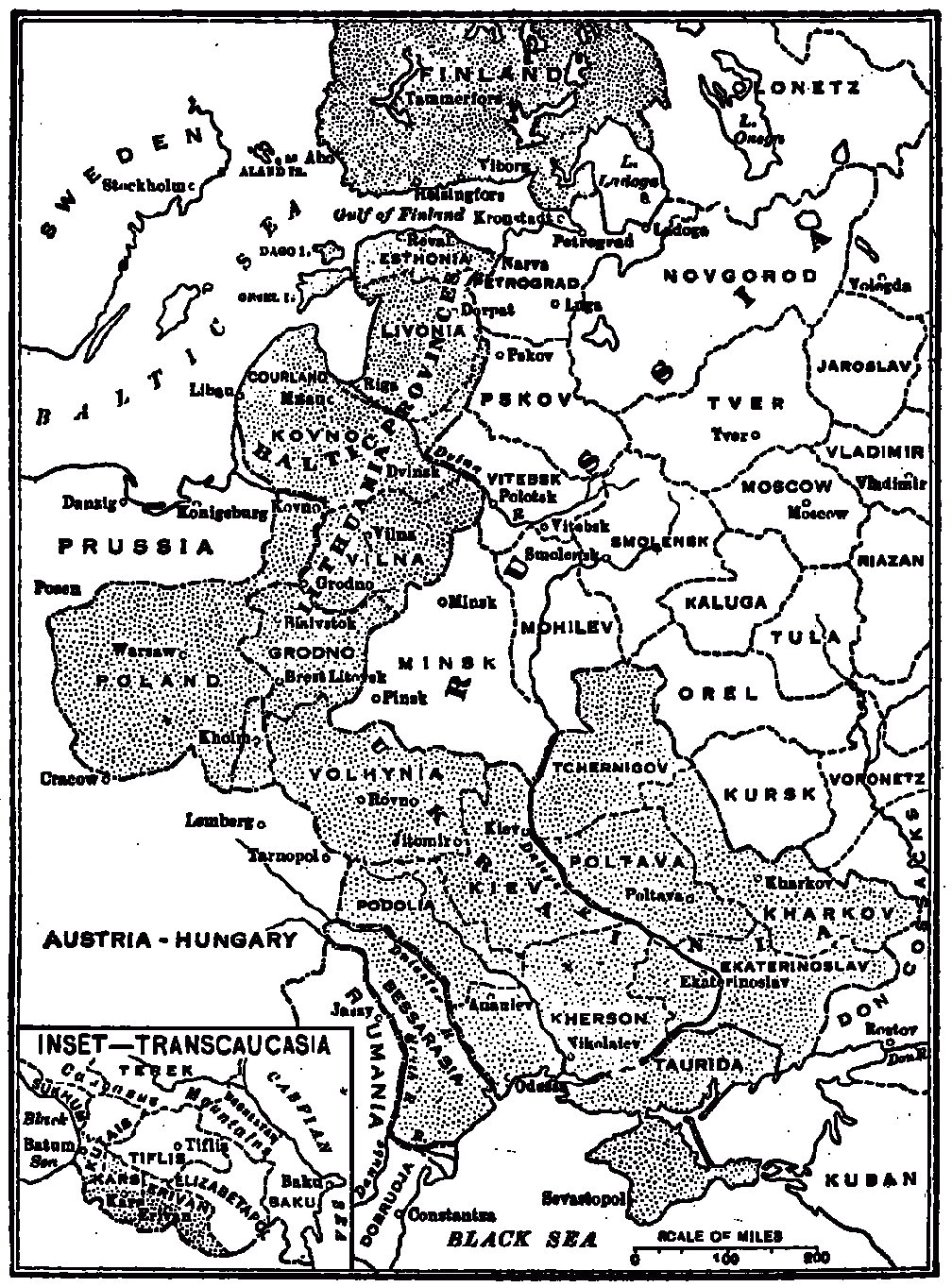
Toward the end of 1917, the Germans took Riga and threatened Petrograd. They then summoned the Bolsheviki to a peace conference at Brest-Litovsk. Meanwhile, the Ukraine, an exceedingly fertile district in southwestern Russia, the home of 20,000,000 people, declared itself independent of Russia and made peace with Germany. This was the work of the “Reactionaries” of Ukraine. The Bolsheviki of the district opposed the peace, and Germany overcame them by force of arms. The Germans, then, were fighting the Bolsheviki in the Ukraine and holding a peace conference with them in central Russia at the same time. The Bolsheviki seem to have been obliged to yield; and they signed a German peace treaty by which Germany holds not only the Ukraine, but nearly all the Baltic provinces and much of Esthonia and Poland. Germany never forgets to look far ahead, and the Bolsheviki were forced as the price of peace to grant her many commercial privileges. So much of Russia now being in her hands, Germany took from her quantities of booty—cannon, machine guns, thousands of motor cars, and a vast amount of food and other supplies.

Russia is not so much a country that has broken her promises as one that has crumbled to pieces. To help Russia to find herself is an important part of the business of the Allies. The intelligent Russians long for peace and law and order. They are eager to win liberty and to free themselves from the clutches of Germany, and are begging for the aid of the Allies; and the Allies are ready to give this aid.

In Murmansk on the Arctic Ocean and in Archangel on the White Sea immense quantities of food and munitions are stored. The Russians living in this part of the country asked the Allies to protect these, and to keep them from falling into the hands of the Germans. The result was the prompt appearance of American marines, bluejackets, and soldiers, together with English and French naval forces in the White Sea. To the eastward, on the Siberian coast, a quarter of the way around the world, lies Vladivostok, and here, too, were similar stores. Japan lies close at hand, and with the aid of the other allies, her forces entered this city and saved it from the Germans.

A new ally has arisen from the very heart of the Central Powers, the Czecho-Slovaks, inhabitants of northwestern Austria and the adjoining territory of Hungary. Four hundred years ago, these people, in order to drive back the Turks, formed a free federation with Austria and Hungary, and elected a king. Later, Austria declared the crown hereditary. The Czechs resisted in the Thirty Years’ War, but were beaten, their nobles beheaded or exiled, and their property confiscated. Although thus overpowered, the Czechs have always longed for independence. After the Franco-Prussian War of 1871, they alone among the Austrian parliaments protested against Germany’s annexation of Alsace and Lorraine.

When the war began, in 1914, the Czechs were forced to join the Austrian army, but thousands deserted and other thousands were made willing captives by the Russians, and many of these joined the Russian army. Early in 1918, the Bolsheviki Government agreed to allow these Czechs to cross Siberia and go on their way around the world to join the French army. Germany objected, and in spite of their agreement the Bolsheviki suddenly attacked the Czechs. The indignant Czechs fought fiercely and won the day, marching to the northward to the railroad that runs from Petrograd to the Pacific, and entering Vladivostok.

Thus it is that those Russians and Siberians who love liberty can gather around the Czechs as around a standard. There are 10,000,000 Czechs and about the same number of Siberians. Siberia has declared her independence and her enmity to Germany. It is the business of the Allies to strengthen Siberia and central Russia, and in so doing to hold fast many millions of strong friends of liberty and enlightenment.

The failure of the German offensive in the spring of 1918 led, throughout the following summer, to a continually improved situation for the Allies. Gains of importance were made on all fronts, and the doom of the Central Powers to ultimate defeat appeared inevitable. During September, the Allies’ success reached even to the forcing of Bulgaria to unconditional surrender. That country was put out of the war, and the first breach was made in the Pan-German plan for Middle Europe, and for the Berlin to Baghdad Railway. There seemed also to be fore-shadowed the collapse of Turkey, and perhaps of Austria. To hasten this, the Allies prepared to fight on—harder than ever.

Allied Commanders
FOUR ALLIED COMMANDERS IN FRANCE

From left to right these are: (1) General Petain, on of the leaders of the defense of Verdun, 1916; now Commander-in-Chief of the French Armies; (2) Field Marshal Sir Douglas Haig, Commander-in-Chief of the British forces in France and Flanders. He was made Field Marshal after teh battle of Somme, in 1916; (3) Marshal Foch, Commander-in-Chief of the Allied Armies; with Marshal Joffre, he was joint hero of the battle of Marne, 1914, where his daring and impetuous attack started the Germans on their retreat. Joffre styles him “the greatest strategist in France”; and (4) General John Joseph Pershing, Commander-in-Chief of the American Expeditionary Forces.

CHAPTER VIII. TRYING IT AGAIN

CHAPTER VIII. TRYING IT AGAIN

Do you not think Columbus must have felt very fine as he sailed out of Cadiz Harbor on his second voyage to the West? It was just about a year before, you know, that his feeble fleet of three little ships sailed from Palos port. His hundred sailors hated to go; his friends were few; everybody else said he was crazy; his success was very doubtful. Now, as he stood on the high quarter-deck of his big flag-ship, the Maria Galante, he was a great man. By appointment of his king and queen he was “Admiral of the Ocean Seas” and “Viceroy of the Indies.” He had servants, to do as he directed; he had supreme command over the seventeen ships of his fleet, large and small; fifteen hundred men joyfully crowded his decks, while thousands left at home wished that they might go with him, too. He had soldiers and sailors, horsemen and footmen; his ships were filled with all the things necessary for trading with the Indians and the great merchants of Cathay, and for building the homes of those who wished to live in the lands beyond the sea.

Everything looked so well and everybody was so full of hope and expectation that the Admiral felt that now his fondest dreams were coming to pass and that he was a great man indeed.

This was to be a hunt for gold. And so sure of success was Columbus that he promised the king and queen of Spain, out of the money he should make on this voyage, to, himself pay for the fitting out of a great army of fifty thousand foot soldiers and four thousand horsemen to drive away the pagan Turks who had captured and held possession of the city of Jerusalem and the sepulcher of Christ. For this had been the chief desire, for years and years, of the Christian people of Europe. To accomplish it many brave knights and warriors had fought and failed. But now Columbus was certain he could do it.

So, out into the western ocean sailed the great expedition of the Admiral. He sailed first to the Canary Isles, where he took aboard wood and water and many cattle, sheep and swine. Then, on the seventeenth of October, he steered straight out into the broad Atlantic, and on Sunday, the third of November, he saw the hill-tops of one of the West India Islands that he named Dominica. You can find it on your map of the West Indies.

For days he sailed on, passing island after island, landing on some and giving them names. Some of them were inhabited, some of them were not; some were very large, some were very small. But none of them helped him in any way to find Cathay, so at last he steered toward Hayti (or Hispaniola, as he called it) and the little ship-built fortress of La Navidad, where his forty comrades had been left.

On the twenty-seventh of November, the fleet of the Admiral cast anchor off the solitary fort. It was night. No light was to be seen on the shore; through the darkness nothing could be made out that looked like the walls of the fort. Columbus fired a cannon; then he fired another. The echoes were the only answer. They must be sound sleepers in our fortress there, said the Admiral. At last, over the water he heard the sound of oars—or was it the dip of a paddle? A voice called for the Admiral; but it was not a Spanish voice. The interpreter—who was the only one left of those ten stolen Indians carried by Columbus to Spain—came to the Admiral’s side; by the light of the ship’s lantern they could make out the figure of an Indian in his canoe. He brought presents from his chief. But where are my men at the fort? asked the Admiral. And then the whole sad story was told.

The fort of La Navidad was destroyed; the Spaniards were all dead; the first attempt of Spain to start a colony in the new world was a terrible failure. And for it the Spaniards themselves were to blame.

After Columbus had left them, the forty men in the fort did not do as he told them or as they had solemnly promised. They were lazy; they were rough; they treated the Indians badly; they quarreled among themselves; some of them ran off to live in the woods. Then sickness came; there were two “sides,” each one jealous of the other; the Indians became enemies. A fiery war-chief from the hills, whose name was Caonabo, led the Indians against the white men. The fort and village were surprised, surrounded and destroyed. And the little band of “conquerors”—as the Spaniards loved to call themselves—was itself conquered and killed.

It was a terrible disappointment to Columbus. The men in whom he had trusted had proved false. The gold he had told them to get together they had not even found. His plans had all gone wrong.

But Columbus was not the man to stay defeated. His fort was destroyed, his men were killed, his settlement was a failure. It can’t be helped now, he said. I will try again.

This time he would not only build a fort, he would build a city. He had men and material enough to do this and to do it well. So he set to work.

But the place where he had built from the wreck of the unlucky Santa Maria his unlucky fort of La Navidad did not suit him. It was low, damp and unhealthy. He must find a better place. After looking about for some time he finally selected a place on the northern side of the island. You can find it if you look at the map of Hayti in the West Indies; it is near to Cape Isabella.

He found here a good harbor for ships, a good place on the rocks for a fort, and good land for gardens. Here Columbus laid out his new town, and called it after his friend the queen of Spain, the city of Isabella.

He marked out a central spot for his park or square; around this ran a street, and along this street he built large stone buildings for a storehouse, a church and a house for himself, as governor of the colony. On the side streets were built the houses for the people who were to live in the new town, while on a rocky point with its queer little round tower looking out to sea stood the stone fort to protect the little city. It was the first settlement made by white men in all the great new world of America.

You must know that there are some very wise and very bright people who do not agree to this. They say that nearly five hundred years before Columbus landed, a Norwegian prince or viking, whose name was Leif Ericsson, had built on the banks of the beautiful Charles River, some twelve miles from Boston, a city which he called Norumbega.

But this has not really been proved. It is almost all the fancy of a wise man who has studied it out for himself, and says he believes there was such a city. But he does not really know it as we know of the city of Isabella, and so we must still say that Christopher Columbus really discovered America and built the first fort and the first city on its shores—although he thought he was doing all this in Asia, on the shores of China or Japan.

When Columbus had his people nearly settled in their new city of Isabella, he remembered that the main thing he was sent to do was to get together as much gold as possible. His men were already grumbling. They had come over the sea, they said, not to dig cellars and build huts, but to find gold—gold that should make them rich and great and happy.

So Columbus set to work gold-hunting. At first things seemed to promise success. The Indians told big stories of gold to be found in the mountains of Hayti; the men sent to the mountains discovered signs of gold, and at once Columbus sent home joyful tidings to the king and queen of Spain.

Then he and his men hunted everywhere for the glittering yellow metal. They fished for it in the streams; they dug for it in the earth; they drove the Indians to hunt for it also until the poor redmen learned to hate the very sound of the word gold, and believed that this was all the white men lived for, cared for or worked for; holding up a piece of this hated gold the Indians would say, one to another: “Behold the Christian’s god!” And so it came about that the poor worried natives, who were not used to such hard work, took the easiest way out of it all, and told the Spaniards the biggest kind of lies as to where gold might be found—always away off somewhere else—if only the white men would go there to look for it.

On the thirteenth of January, 1494, Columbus sent back to Spain twelve of his seventeen ships. He did not send back in them to the king, and queen, the gold he had promised. He sent back the letters that promised gold; he sent back as prisoners for punishment some of the most discontented and quarrelsome of his colonists; and, worst of all, he sent to the king and queen a note asking, them to permit him to send to Spain all the Indians he could catch, to be sold as slaves. He said that by doing this they could make “good Christians” of the Indians, while the money that came from selling the natives would buy cattle for the colony and leave some money for the royal money-chests.

It is not pleasant to think this of so great a man as Columbus. But it is true, and he is really the man who, started the slave-trade in America. Of course things were very different in his time from what they are to-day, and people did not think so badly of this horrible business. But some good men did, and spoke out boldly against it. What they said was not of much use, however, and slavery was started in the new world. And from that act of Columbus came much sorrow and trouble for the land he found. Even the great war between the northern and southern sections of our own United States, upon one side or the other of which your fathers, or your grandfathers perhaps, fought with gun and sword, was brought about by this act of the great Admiral Columbus hundreds of years before.

So the twelve ships sailed back to Spain, and Columbus, with his five remaining ships, his soldiers and his colonists, remained in the new city of Isabella to keep up the hunt for gold or to become farmers in the new world.

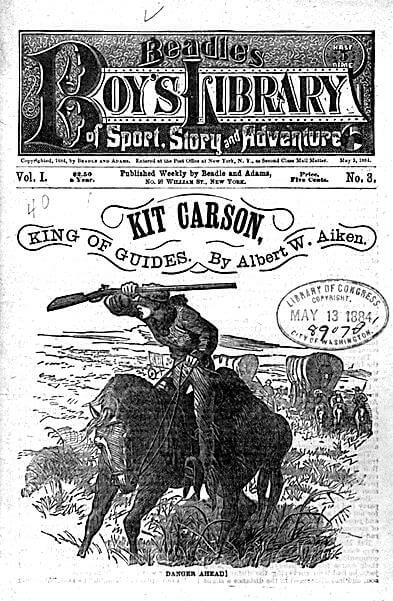
Great Stories for Little Americans Kit Carson and the Bears

Great men of one kind are known only in new countries like ours. These men discover new regions. They know how to manage the Indians. They show other people how to live in a wild country.

One of the most famous of such men was Kit Carson. He knew all about the wild animals. He was a great hunter. He learned the languages of the Indians. The Indians liked him. He was a great guide. He showed soldiers and settlers how to travel where they wished to go.

Once he was marching through the wild country with other men. Evening came. He left the others, and went to shoot something to eat. It was the only way to get meat for supper. When he had gone about a mile, he saw the tracks of some elks. He followed these tracks. He came in sight of the elks. They were eating grass on a hill, as cows do.

Kit Carson crept up behind some bushes. But elks are very timid animals. Before the hunter got very near, they began to run away. So Carson fired at one of them as it was running. The elk fell dead.

But just at that moment he heard a roar. He turned to see what made this ugly noise. Two huge bears were running toward him. They wanted some meat for supper, too.

Kit Carson’s gun was empty. He threw it down. Then he ran as fast as he could. He wanted to find a tree.

Just as the bears were about to seize him, he got to a tree. He caught hold of a limb. He swung himself up into the tree. The bears just missed getting him.

But bears know how to climb trees. Carson knew that they would soon be after him. He pulled out his knife, and began to cut off a limb. He wanted to make a club.

A bear is much larger and stronger than a man. He cannot be killed with a club. But every bear has one tender spot. It is his nose. He does not like to be hit on the nose. A sharp blow on the nose hurts him a great deal.

Kit Carson got his club cut just in time. The bears were coming after him. Kit got up into the very top of the tree. He drew up his feet, and made himself as small as he could.

When the bears came near, one of them reached for Kit. Whack! went the stick on the end of his nose. The bear drew back, and whined with pain.

First one bear tried to get him, and then the other. But whichever one tried, Kit was ready. The bear was sure to get his nose hurt.

The bears grew tired, and rested awhile. But they kept up their screeching and roaring. When their noses felt better, they tried again. And then they tried again. But every time they came away with sore noses. At last, they both tried at once. But Carson pounded faster than ever. One of the bears cried like a baby. The tears ran out of his eyes. It hurt his feelings to have his nose treated in this rude way.

After a long time, one of the bears got tired. He went away. After awhile, the other went away too. Kit Carson stayed in the tree a long time. Then he came down. The first thing he did was to get his gun. He loaded it. But the bears did not come back. They were too busy rubbing noses.

The little book of the war: The United States Enters the War

Chapter 8

The United States Enters the War

January, 1917, had come, and the war had been going on for two years and a half. When it first broke out, it was announced in big headlines in the newspapers, and some of us took down atlases to make sure just where Serbia was, but we did not expect the United States to be seriously affected by a little fighting in a remote corner of Europe. When England and France took up arms, the trouble began to seem rather nearer home; but still we were on the other side of the Atlantic, we had followed Jefferson’s advice and avoided European entanglements, and there seemed no reason why we should have anything to do with this one. Therefore we had issued promptly a proclamation of neutrality.

Of course Americans, as well as people of other nations, had read German books declaring German aims; but we had never taken them seriously. Perhaps one reason was that with our own great country, “the blessed land of room enough,” and our long lines of seacoast, we could hardly understand the feelings of a rapidly increasing people who felt themselves shut into too narrow boundaries. However that may be, there was certainly one thing which we had not suspected, and this was that German spies were scattered throughout our land. We found that the German Government was paying men to place bombs on ships sailing from the United States, to burn our factories, to bring about strikes, and to wreck railroads. These men were also attempting to use the United States as a base from which to outfit steamers to supply German raiders. They were making efforts to induce the Hindoos in this country to arouse those of their race in India to rebel against the rule of England, and they were trying to excite the people of India, Mexico, Haiti, and Cuba to hatred of the United States. They planned to involve Japan in their plots. Japan is our friend, and if we treat her fairly, there is no reason to suppose that she will ever be otherwise; but Germany schemed to unite Japan and Mexico against us, their reward to be land in our Southwest. Germans living in this country were advised from “home” to oppose military training and arming, so that the United States might be the more easily overcome in case of war. All this was before there was any break between this country and Germany.

These things were done partly in revenge for our sales of ammunition, and partly that we might be kept too busy at home to join in the war in Europe if the time should come when we discovered the wisdom of so doing. The German Embassy was the head and front of this work. It even issued passports by forging the name of the United States, a particularly dishonorable act, as a foreign minister is regarded as the guest of the country to which he is sent, and is accorded special privileges and courtesies. We learned at last that we must meet bribery, treachery, and crime.

Before the beginning of the war we had felt as kindly toward Germany as toward any other country, but as the months passed, our feelings underwent a change. War is horrible under all conditions, but civilized nations have tried to lessen its terrors by international laws and agreements forbidding certain methods of warfare. Among the forbidden acts are the destruction of private property; the bombardment of undefended towns, and the bombardment of any towns without warning; injury to churches, art galleries, hospitals, and hospital ships; the use of anything causing unnecessary suffering, such as poison on weapons or in wells, poison gas, or liquid fire. It is forbidden to impose upon any community fines or other penalties for deeds of individuals for which the community is not responsible. All these regulations, and many others, Germany had violated again and again. She had treated her prisoners with cruelty; she had spread germs of disease; in Belgium, Poland, and elsewhere she had torn many thousands from their families and driven them away into slavery; she had recognized no law but her own will.

In great free America we could hardly believe that such crimes as these could be committed anywhere in the world. When it was proved not only that the charges were true, but that the crimes had been committed, not by lawless soldiers, but under strict orders from headquarters, it was impossible not to take sides. What had happened in our own country increased our indignation. Still we waited, until at last Germany’s methods of carrying on submarine warfare became unendurable. These were briefly:—

Early in 1915 Germany marked off a large area of the high seas in which she declared she would sink all enemy ships without warning. Three months later she sank the Lusitania. One year after this, she promised to sink no more vessels without warning. Eight months later, February 1, 1917, she declared that she would sink without warning every vessel that she met. This was nothing more nor less than piracy, and it aroused the indignation of the world.

Our Government had learned before this that the German Ambassador, Count Von Bernstorff, was at the head of the plots against the United States, and two days after the declaration of unrestricted warfare, he was given his passports. This was not declaring war, but it was a threat of war if Germany did not mend her ways. Germany continued in the same course, and two months after the departure of Count Von Bernstorff, President Wilson stood before Congress, called in special session. He summed up the injuries which Germany had inflicted upon the United States and the efforts of the Government to keep the peace. Then he said: “With a profound sense of the solemn and even tragical character of the step I am taking and of the grave responsibility which it involves, but in unhesitating obedience to what I deem my constitutional duty, I advise that the Congress declare the recent course of the Imperial German Government to be in fact nothing less than war against the Government and people of the United States.” Congress voted, “Resolved, That the state of war between the United States and the Imperial German Government which has thus been thrust upon the United States is hereby formally declared.”

We are in this war for the reason which the President stated in just eight words, “The world must be made safe for democracy.” The word democracy comes from two Greek words meaning people and power, and a democratic government is one in which the people are the source of power. The United States is a democracy. We choose men to represent us, Representatives, Senators, and President; but if even the President does not do for the country what the majority think is wise and honorable, we have the right to try him, and if he is proved guilty, to put him out of his office. France, like the United States, is a republic. England is not a republic, but it is a democracy. It has a king, to be sure, but politically he is hardly more than a figurehead. The Prime Minister and his party rule; but if they propose an important measure and Parliament—chosen by the people—refuses to pass it, they understand this as a broad hint that they are not representing the will of the people; they resign and another election is held. The Government of Italy is much like that of England. Italy has a king and a legislature of two houses. Its Cabinet, like the English Prime Minister and his party, resigns if Parliament refuses to pass any important measure which it has presented. Such is a democratic government, “Of the people, by the people, and for the people,” as Lincoln so well expressed it.

The Government of Germany is an autocracy. This word comes from two Greek words meaning self and power, that is, the ruler himself and not the people is the source of power. The German Empire was formed, as has been said before, by the union of a number of kingdoms, duchies, free cities, etc. The States of the United States united on equal terms, no State having more privileges or rights than another. The number of Representatives which each State sends to Congress depends, as is fair and just, upon the number of the State’s inhabitants; but every State, whether large or small, sends two Senators. The German union of States is quite different from ours. When it was formed, some States refused to join unless they could have special privileges. Bavaria, for instance, pays no taxes to the Empire on beer and domestic liquors. Of all these States, Prussia was by far the strongest, and when her king became also German Emperor, she was able to secure whatever special privileges she wanted.

The Government of Germany consists of the Kaiser, the Chancellor, and two houses. The members of one of these, the Bundesrat, are appointed by the rulers of the twenty-five States, each one having a fixed number of votes. The other, the Reichstag, represents the people, and its members are chosen by the people’s vote. At the first glance, this seems much like the Government of England, with King, Prime Minister, and the two houses of Parliament; but there is a great difference, as will be seen later.

The Kaiser is of course at the head of the Government. Under him is the Chancellor, whom he appoints or puts out of office as he chooses. The Chancellor is President of the Bundesrat, and he has also a seat in the Reichstag. In England, as has just been said, if the Prime Minister proposes an important bill and Parliament refuses to make it a law, the Prime Minister resigns. In Germany, if the Chancellor proposes an important bill, and the Reichstag refuses to make it a law, the Reichstag may be dissolved and a new election held. This may be done again and again until a Reichstag has been formed that will vote as the Chancellor—that is, the Kaiser—wishes, and the Chancellor remains in power until the Kaiser desires to make a change. The Reichstag, then, has almost no power, and is practically, as it has often been called, only a debating club.

The Bundesrat represents the States as States; but the number of representatives varies with the different States. There are in all 61 members. Of these Prussia has 17, while 17 of the States have only one apiece. Alsace-Lorraine has three votes, but the Kaiser “instructs” how they shall be cast. The delegates from each State vote as a unit and as they have been bidden by the Prince of their State to vote. Now, the Kaiser is also King of Prussia, so the twenty delegates are subject to his will. The meetings of the Bundesrat are held in secret. If the Reichstag passes a law, it is not valid unless the Bundesrat agrees to it. As the Kaiser controls one third of the votes of the Bundesrat, it is an easy matter for the Chancellor to secure for him enough more votes to make a majority and pass whatever measures he may please. The Kaiser, then, controls both the Reichstag and the Bundesrat. He also controls the army and the navy. To make offensive war, he must ask the assent of the Bundesrat—not difficult to obtain, as has been seen—but if, in his own opinion, the war is defensive, all he needs to do is to say, “Let there be war,” and the vast war machine of the Empire is set in motion. The present war the Kaiser averred to be defensive, and he did not officially notify the Bundesrat until three days after it had been declared.

As Prussia is the leading State of Germany, it is of interest to know that Prussian voters are divided into three classes according to their property. Four per cent of the wealthy folk of the land count in voting for as much as eighty-two per cent of the working-people, and the vote of one man of wealth or of noble birth may be equal to the votes of ten thousand working-men. This is why a “junker,” that is, son of a noble house which has always been devoted to military service, holds so much power. Bismarck was a junker. The Government of the United States, of England, of France, and of Italy, is a government of the people by themselves—a democracy. The Government of Germany is a government of the people by one person—an autocracy.

Lincoln said, “This country cannot endure half slave and half free.” Neither can the nations endure half democratic and half autocratic. As long as there is a man in the world who has the power to bring war upon a country, simply by saying the word, the world is not safe. That is why we are fighting. Our boys do not cross the ocean to enter “European entanglements,” but to keep autocracy from our own land. This is our war; we fight to defend our own country and ourselves just as certainly as if German troops had landed on our shores. “Paris in three weeks, London in three months, New York in three years,” was a common saying among German officers. From the beginning of the war France and England and little Belgium have been fighting our battles. The Atlantic is wide, but if England had not been our friend and had not protected us by keeping the German fleet shut up in the North Sea, who can doubt that Germany would have strained every nerve in the effort to bombard our coast towns and turn parts at least of our country into a second Belgium?

German Penetration of Russia
GERMAN PENETRATION OF RUSSIA


THE SHADED AREAS SHOW THE PROVINCES OF RUSSIA WHICH HAD BEEN OVERRUN BY THESPRING OF 1918.

Easter Front
THE EASTERN FRONT

Great Stories for Little Americans Longfellow as a Boy

Longfellow was a noble boy. He always wanted to do right. He could not bear to see one person do any wrong to another.

He was very tenderhearted. One day he took a gun and went shooting. He killed a robin. Then he felt sorry for the robin He came home with tears in his eyes. He was so grieved, that he never went shooting again.

He liked to read Irving’s “Sketch Book.” Its strange stories about Sleepy Hollow and Rip Van Winkle pleased his fancy.

When he was thirteen he wrote a poem. It was about Lovewell’s fight with the Indians. He sent his verses to a newspaper. He wondered if the editor would print them. He could not think of anything else. He walked up and down in front of the printing office. He thought that his poem might be in the printer’s hands.

When the paper came out, there was his poem. It was signed “Henry.” Longfellow read it. He thought it a good poem.

But a judge who did not know whose poem it was talked about it that evening. He said to young Longfellow, “Did you see that poem in the paper? It was stiff. And all taken from other poets, too.”

This made Henry Longfellow feel bad. But he kept on trying. After many years, he became a famous poet.

For more than fifty years, young people have liked to read his poem called “A Psalm of Life.” Here are three stanzas of it:

“Lives of great men all remind us

We can make our lives sublime,

And, departing, leave behind us

Footprints on the sands of time,

“Footprints, that perhaps another,

Sailing o’er life’s solemn main,

A forlorn and shipwrecked brother,

Seeing, may take heart again.

“Let us, then, be up and doing,

With a heart for any fate;

Still achieving, still pursuing,

Learn to labor and to wait.”

The little book of the war: The War in 1915

Chapter 6

The War in 1915

By both words and deeds Germany had declared that she believed in conducting war with “frightfulness”; that is, with such cruelty and ferocity that her adversaries would in mortal terror yield to her at once. In accordance with this theory, she decided to destroy the Lusitania, a great passenger steamer plying between this country and England. Apparently she preferred not to become any further involved with the United States, for several persons were warned by anonymous telephone messages not to sail by this vessel, and the German Embassy in this country published a warning over its own signature. No one was alarmed, for no one supposed it possible that any country would commit such a deed as Germany had planned, and a number of Americans sailed on the steamer. To sink a transport carrying troops is as much an act of war as a battle is; but to sink a passenger vessel of non-combatants is not war, it is murder. The Lusitania was torpedoed without warning, and 1153 of her 1917 passengers were drowned, men, women, and little children, 114 of them citizens of the United States. Americans were overwhelmed with the horror of such an atrocity. Germany expressed her regret at the loss of life, but said it was the fault of her enemies; that England was trying to starve her, and she was forced to retaliate. She struck a medal in honor of the crime and gave her school-children a three-days’ holiday for rejoicing.

President Wilson sent to Germany a series of dignified notes, and declared that she would be held to strict accountability, but did not succeed in inducing her even to agree to any reparation. How little real regret was felt for the act was well indicated by one of the Berlin papers, which published a picture of an American vessel with its bow-sprit piercing a note. Germans doubled up with laughter stood on the wharf, exclaiming, “Another!”

Americans began to think. We had heard reports of the cruelty of the Germans to the Belgians and others; and we had sent money and food to the suffering people, but we could hardly believe that these reports had not been greatly exaggerated. Careful investigations were now made. It was shown that the Germans had poisoned wells, scattered germs of disease, bombed hospitals, schoolhouses, and orphan asylums; that non-combatants, not only men but women and little children, had been killed in large numbers; that they had been forced with bayonet thrusts to walk in front of German troops in order to shield them from bullets; that prisoners and wounded had been murdered in order to get rid of them. German soldiers were asked to keep diaries. From those found on prisoners and from articles in the German newspapers it was seen that these crimes had not been committed by excited, disobedient soldiers, but under strict orders from headquarters, and that this “frightfulness” was the kind of warfare which Germany deliberately planned. War is horrible at the best, and the chief nations of the world have held several conferences at The Hague in Holland, and there agreed never to commit such crimes as those that have been mentioned. Germany was one of those nations, and these acts of cruelty were violations of her solemn pledges.

In 1914, the Russians, as has been said, were in possession of most of Galicia, and they were so sure of getting it all that they appointed a governor-general for “the new Russian province.” They were besieging Przemysl at the end of the year. Russia and Germany each maintained a line of forts along the boundary; and in Poland no enemies had come within range of the Russian fortifications. At the end of 1914, the Russians held the best position. They now made a plan to advance in the same eastern corner of Germany that they had tried in 1914. On the German line of defense there were forests and swamps and lakes, with fortifications wherever they were needed. The Russians, pushed on eagerly. They made their way through forests, they dashed into frozen morasses. No large numbers of Germans had appeared, and what they had met were gradually falling back. The Russians did not guess that this was a trick, and they pushed on and on, far into the country of the Mazurian Lakes. Then there sprang up before them a great German force with Von Hindenburg as its leader. The Russians lost vast numbers of men either killed or captured. One whole corps disappeared. Many days later, one division of this corps made their appearance. They had been struggling over frozen morasses, in pathless forests, and through deep snows. Little by little, other divisions succeeded in joining their own troops.

At the end of 1914 the Russians had taken Lemberg and were besieging Przemysl. Przemysl would have fared better if it had not had so many men to use up its food. When the Austrians had been obliged to retreat before the Russians, many of them had taken refuge in this place, and there they had remained. In every siege that is kept up long enough, provisions are certain to fail. The Russians did not trouble themselves to make attacks on the fort; they had only to wait until the Austrians within were hungry enough to surrender. The Austrians without tried to slip through the Carpathian passes to help their friends. They themselves made sorties, at first trying to break the siege, then trying only to capture supplies. Scores of men were dying every day. At length, after seven months’ resistance, the Austrians within the fort surrendered to the besieging Russian army.

The 100,000 men who had been carrying on the siege of Przemysl were now free to meet the troops of the Central Powers in the Carpathian passes. Unfortunately for the Russians, these men were chiefly cavalry and artillery, neither of which is of much use in mountain fighting. The German and Austrian troops swarmed into Galicia. They had 4000 guns, half of them of large size. It has been estimated that shells enough were thrown to average 140 pounds of iron for every Russian engaged in the struggle. The Russians were in as bad a condition as the English at Neuve Chapelle, for now they had not nearly enough artillery. To save the men or save the guns was the question. There were so few guns that they did not dare to lose them, and the men were sacrificed. The Russians were forced to retreat. Then came a struggle of nearly three weeks to recapture Przemysl. The Germans were successful. Lemberg also soon fell into their hands. Warsaw had to yield, and the Russians were again driven into retreat.

Russia had vast numbers of trained men, but not many guns; and there are reasons for thinking that certain high officials favored the Germans and sent thousands of their countrymen to their death rather than harm the Central Powers. It is possible that this is why the Grand Duke Nicholas could not risk large battles, knowing that if his ammunition failed, Russia might be out of the war for months. Evidently he and the Czar had some disagreement, for the Grand Duke was sent to take command of the troops in the Caucasus, a less important position, and the Czar himself became the head of the forces on the western boundary. This leadership of the Czar was only in name, and his chief of staff was the real commander.

The Austrians had been driven out of Serbia, but they had no idea of staying out, and one commander after another tried his luck against the resolute Serbians. These Serbians had also another enemy, typhus fever. To overcome this, a company of American Red Cross nurses and physicians went to Serbia, established camps and hospitals, and so brought the disease under control. In the autumn the German general Von Mackensen massed his troops at the northern boundary of Serbia. Bulgaria now joined the Central Powers. After the Second Balkan War she had been deprived of districts wherein lived many of her nation. She was especially angry with Serbia, and it was not a difficult matter for Germany to induce her by promises of territory to become an ally. This alliance cleared the way for Germany’s direct route from Berlin to Constantinople, save for the short distance across the corner of Serbia. The struggle of Serbia against Bulgaria and the Central Powers went on for months, but at the end of the year 1915 the Serbians held only a tiny strip of territory in the west and another in the south of their country.

Russia in all her military actions was badly handicapped by her position. On a map she looks at the first glance big enough to subdue the rest of Europe all by herself; but during this war she was almost as helpless in getting supplies as little San Marino would have been if Italy had been unfriendly. What Russia needed was a way of getting into the Mediterranean, for the Mediterranean would be open at all seasons of the year. The only way to bring this about was to take the Strait of the Dardanelles, bring a fleet through it, and capture Constantinople. If this could be done, the power of Turkey would be broken; her attacks on Egypt and the Suez Canal and her mischief-making in Persia would cease. Russia would be immensely strengthened because she could then reach markets where she could buy all that she needed to carry on the war. Moreover, it was quite probable that if Constantinople was held by the Allies, the Balkan States that had not quite decided where to stand would join them. And, too, there was another reason, not so unimportant as it may seem; Constantinople is a city with a history stretching back many centuries. It has been besieged more than thirty times, but captured only three times, the last time having been nearly five hundred years ago. To take Constantinople would be a vast gain in itself, of course, but it would loom up in men’s minds even greater than it really was and would give more encouragement to the Allies than any other single event could do. It was a great undertaking with enormous risk, but the French and English decided to attempt it.

The Strait of the Dardanelles is forty-seven miles long. Most of it is three or four miles wide, although at its narrowest place it is only one mile in width, and with wind and current permitting, one could row from Europe to Asia in a few minutes. It is more like a river than a strait, only its current flows both ways at the same time, for there is a surface current from the Black Sea and an undercurrent from the Mediterranean. The surface current would help the Turks in using floating mines, and the undercurrent would help the Allies in sending their submarines from the Mediterranean toward Constantinople.

The Allies expected to have aid from Greece, because Venizelos, the Greek Premier, favored them and had invited them to come; but just at this time Venizelos was put out of office. They made no change in their plans, however, but brought a great fleet of French and English ships together and took for their base the little islands of Lemnos and Tenedos. This is the part of the world which was the scene of many of the stories of ancient times. When after the Trojan War the Greeks pretended to have sailed away from Troy and left the wooden horse behind them filled with armed men, they hid their ships behind Tenedos; and when Alexander the Great set out to conquer Asia, he built a bridge of boats across the Dardanelles.

The strait was splendidly protected by fortifications at either end, by forts between, by the best of artillery, by mine fields, floating mines, and torpedo boats. Any nation might well hesitate to attack such a place, but the English and French sent a magnificent fleet against it. The guns of the ships had a much longer range than those of the forts at the entrance of the strait, and before many days had passed, the batteries were silenced. This, however, was only the beginning. By the bombardment the mines at the western end of the strait had been cleared away, and now the ships steamed in to attack the forts at the narrowest part of the strait, which were much stronger than those at the entrance. After some resistance these forts ceased firing. Apparently they had been silenced, and the warships moved on. Suddenly the Turkish guns began to blaze and mines floated swiftly down upon the fleet. Three of the great battleships were sunk. The others withdrew into the Mediterranean.

Military experts declare that there is one lesson which has to be learned anew in almost every war. It is that coast defenses of the best sort can resist the attacks of any fleet of the day. The Allies had now found this to be true. They made another plan. They decided to land on Gallipoli, the long, narrow peninsula which forms the western shore of the strait. It is a rich, fertile country, but a particularly poor place for the landing of troops, for it is bordered by steep cliffs, and there are only a few beaches where landing is possible. These beaches were of fine, slippery sand, and back of them was a steeply rising ground or cliff of sandstone and clay. In the little hollows of the shore barbed-wire entanglements were cunningly hidden. In the face of the cliffs holes had been cut, and here sat sharp-shooters, with machine guns, while at the top of the cliffs were Turks, good fighters, particularly behind fortifications, and they had been trained by the Germans in all the latest fashions of warfare.

Nevertheless, the troops determined to land. The men were French, English, Irish, Indian, and “Anzac,” whose name was manufactured from the initials of “Australian-New Zealand Army Corps.” They have been described as a “fine lot of men, generally tall, broad-shouldered, and young. They swing along at an easy pace, their big hats turned up at one side, their jackets rather loose, high boots, and enormous spurs.” They were a very independent troop and had not much regard for military etiquette. One of them said the world was so full of officers it made him feel like a human windmill to salute whenever he met one of them.

These Anzacs had no notion of fear, and when the landing at Suvla Bay was to be made, they swung up the beach on the run, apparently not noticing the fact that they were in a storm of bullets. Straight up the cliffs they scrambled in spite of the Turks, and quite as if they were on their way to a picnic. It was two days before a line of the Allies could be formed, for there were encounters everywhere. In some the Allies won, in some the Turks. The Anzacs fought splendidly; but so did the French and the English and the Irish and the Indians. There were no cowards at Gallipoli. But there was no permanent success for the Allies. The submarines ran all risks of mines, nets, underwater bombs, and slipped into the Sea of Marmora, sinking vessel after vessel, one of them actually close to the Constantinople quay; but the Allies had no land forces to back them up. The losses from battle were enormous, and the swarms of flies and the poor water brought sickness upon the troops. Just after the close of the year the Allied forces were withdrawn; the attempt to take Constantinople had failed completely.

The Allies had but little success to show for the year 1915. On the Western Front they had met with small losses, it is true, but their gains were equally small. On the Eastern Front, Germany had practically driven the Russians out of eastern Germany, Poland, and Galicia. She had overpowered Serbia, and had held Constantinople. She had lost no territory on the Continent of Europe. On the other hand, the sinking of neutral ships and the torpedoing of the Lusitania had aroused the indignation of the United States, and the Allies had been busy among the German colonies. Japan had taken Kiao-chau in China, and also several groups of islands lying to the southeast of that district. England had taken the German settlements of New Guinea and also some neighboring islands. Germany still held some of her territory in Africa, German East Africa on the eastern coast and Kamerun on the western. If she could win the war, it would be an easy matter to recover her colonial possessions. It was a hard year for the Allies.