A place to grow your relationship with God

Posts tagged ‘history’

Great Stories for Little Americans Doctor Kane Gets Out of the Frozen Sea

After they got the seal, Doctor Kane and his men traveled on. Sometimes they were on the ice. Sometimes they were in the boats. The men were so weak, that they could hardly row the boats. They were so hungry, that they could not sleep well at night.

One day they were rowing, when they heard a sound. It came to them across the water. It did not sound like the cry of sea birds. It sounded like people’s voices.

“Listen!” Doctor Kane said to Petersen.

Petersen spoke the same language as the people of Greenland. He listened. The sound came again. Petersen was so glad, that he could hardly speak. He told Kane in a half whisper, that it was the voice of someone speaking his own language. It was some Greenland men in a boat.

The next day they got to a Greenland town. Then they got into a little ship going to England. They knew that they could get home from England. But the ship stopped at another Greenland town. While they were there, a steamer was seen. It came nearer. They could see the stars and stripes flying from her mast. It was an American steamer sent to find Doctor Kane.

Doctor Kane and his men were full of joy. They pushed their little boat into the water once more. This little boat was called the “Faith.” It had carried Kane and his men hundreds of miles in icy seas.

Once more the men took their oars, and rowed. This time they rowed with all their might. They held up the little flag that they had carried farther north than anybody had ever been before. They rowed straight to the steamer.

In the bow of the boat was a little man with a tattered red shirt. He could see that the captain of the boat was looking at him through a spyglass.

The captain shouted to the little man, “Is that Doctor Kane?”

The little man in the red shirt shouted back, “Yes!”

Doctor Kane and his men had been gone more than two years. People had begun to think that they had all died. This steamer had been sent to find out what had become of them. When the men on the steamer heard that this little man in the red shirt was Doctor Kane himself, they sent up cheer after cheer. In a few minutes more, Doctor Kane and his men were on the steamer. They were now safe among friends. They were sailing away toward their homes.

The little book of the war: The Troubles of Neutrals

Chapter 5

The Troubles of Neutrals

The old pictures of warfare with troops drawn up in opposing lines, graceful clouds of smoke rising here and there, and picturesque “tented fields” in the distance are quite out of date. In these days the men are hidden in trenches, often only two or three hundred yards apart, sometimes even less, but invisible to their opponents. Some of Kitchener’s men did not see a German for weeks, even though they kept close watch with their field-glasses and periscopes.

Something was going on, however, most of the time. Shells were tearing great holes in the trenches, rifles were cracking, and when the shrapnel, or shells full of bullets, came, “It was just like trying to dodge raindrops in a shower,” said one Tommy. At night things happened. Men slipped out in the darkness over “No Man’s Land,” a wild, shell-torn area between the lines which has been described as “all holes tied together.” There they mended the barbed-wire tangles; they cut grass and weeds lest these should protect some patrol of the enemy; they brought up food and ammunition from the wagons back of the lines; and they always had trenches to repair after the usual bomb-throwing. There were “listening parties,” who stole out in front of the enemy’s trenches to learn if possible what was going on either above ground or below it, and there were bombing parties, when men crept in the darkness close up to the enemy, threw bombs wherever they heard voices, then dropped flat upon the ground to await a chance to wriggle toward the home lines. This was what went on while the newspapers were reporting “Nothing doing on the Western Front.”

When an engagement was to come, aircraft became more numerous, watching the lines of the enemy; the front trenches and those back of them were crowded with soldiers and the batteries fired a barrage, or curtain of shells, at the enemy’s trenches. Under shelter of this, the men dashed forward “over the top.” Suddenly the barrage firing ceased, and a fierce attack on the trenches of the enemy was made. If the assault succeeded, men ran forward with sandbags to build up parapets on the farther side of the captured trench to shield them from the enemy’s return fire; men of the signal corps darted across No Man’s Land, unwinding spools of telephone wire as they ran; and the riflemen waited ready for the counter-attack.

Through 1915 there was an occasional attack on the Western Front by one side or the other. At Neuve Chapelle, not far from Lille in France, there was a three days’ struggle. The English were gaining. Then came four and a half hours when every minute seemed to them an age, for their hope of victory lay in keeping up their barrage fire till reinforcements arrived, and ammunition was low. The German guns pounded away, but the English response was more and more feeble; the ammunition had given out. Neuve Chapelle was “a victory that halted.”

In April, 1915, another struggle was made by the Germans for the town of Ypres—Tommy’s “Wipers.” Here for the first time poison gas was used. The Germans had compressed it into steel cylinders and when these were opened, the gas rolled along before the wind. It was a terrible surprise, and nearly a whole division of the French, 19,000 men, was destroyed. Germany had felt certain that England’s colonies would never stand by her, and had expected some of them to seize the opportunity to cut loose from their allegiance. Instead of this, they vied with one another in rushing to her aid, and here at Ypres was a Canadian brigade. Owing to the direction of the wind, they escaped much of the gas. They charged upon the German troops and halted their advance. Again and again after this the Germans let loose the poisonous gas against the Canadians and also a division of England’s Indian army. Gas-masks, however, were supplied, and soon the splendid valor of the Canadians had a better chance. The result was that, although the Allies were obliged to shorten their lines by Ypres, the Germans failed to take the city and were driven back to the eastward.

Both France and England had learned that they must make ready to meet an enemy who had long been preparing for this war. France had lost her coal-mines, her iron-mines, and her largest factories, and had not a ton of the chief high explosive on hand when the war opened. She sent to England for coal, to Spain for iron, to America for machinery. She made over automobile factories, repair shops, anything that contained a bit of machinery, into manufactories of shells and guns. She fed and clothed her armies. She sent ammunition to Serbia and artillery to Italy after that country entered the war. She put herself at the head of the flying business, and supplied airplanes not only for herself, but for Italy, Russia, and England. Wherever women could become the workers, men were spared to join the troops.

The English were even less prepared for war than France, but their lesson was soon learned. The later recruits to “Kitchener’s Mob” had uniforms and whatever else was needed. When the moment came to take the train, the train was ready to be taken.

Half an hour was allowed for loading. In half an hour the loading was done, the train rolled out and a second rolled in. So it went on until every man was at the wharf ready to go “somewhere in France.” Two mine-destroyers guarded each transport, one on either side, fifty yards distant.

As for the people who “kept the home fires burning,” they too were hard at work for England. Tobacco factories began to manufacture shells; people who had worked on pianos now made rifle stocks; the gramophone ceased its wails, for its makers were now making fuses. Mechanics who had been stamping out the peaceful trousers button now began to stamp out disks for cartridges. The wonder of it was the rapidity with which everybody learned to do everything. Gardeners and porters worked in iron foundries as if they had been used to such labor from boyhood. Society women handled lathes and helped make munitions as if they had always done so.

Meanwhile, what was the great republic across the Atlantic about during those tempestuous days? She was trying hard to keep neutral, to favor neither side. Of course, every man, even in a neutral land, has a right to his own opinion, and if he chooses he may even lend money to a country at war. The behavior of a neutral government, however, is a different matter. A neutral government must treat contending nations exactly alike. It must not lend or give money or supplies to either nation; it must not allow troops for either to be enlisted within its boundaries; it must not allow its territory to become a base for fitting out ships or expeditions against either side.

These are the duties of a neutral government, but it also has rights. These are chiefly concerned with its commerce. This commerce must not be interfered with except in so far as may be necessary to maintain a blockade or shut from an opponent “contraband of war”—that is, articles of use in war.

In the matter of trade our first difference of opinion was with England, who had declared a blockade of German ports. This is permitted by international law, that is, the rules upon which the principal nations have agreed; but there has always been controversy in regard to details. Only one principle has been recognized by all nations, namely, that a blockade must not be a “paper blockade,” but must be effective. This means that a coast declared to be blockaded must be so closely watched by its enemy that any vessel attempting to break through the blockade will be in real danger of capture. The mere proclamation of a blockade is not sufficient. Vessels enforcing a blockade have been expected to remain near the enemy’s harbors, so as not to interfere with ocean traffic; but in these days of submarines, mines, and aircraft, it would be exceedingly dangerous for any vessel to attempt to remain near the harbor of an enemy; therefore England declared that ships passing a line drawn from the northern point of the Hebrides through the Faroe Islands to Iceland would do so at their own peril. This shut off a large area of the ocean from neutral trade.

Such trade was also interfered with in another way. The German Government had taken possession of all the food in Germany, in order that it might see to it first of all that the troops were well provisioned; therefore, England declared that she would prevent food and other contraband from going to Germany, not only directly, but also through neutral countries. The United States protested earnestly against this. England pointed out that neutral countries had increased their importation of certain substances used in war, like copper and rubber, far beyond what they themselves could use; and that Holland, for instance, even if she agreed to send no American leather to Germany, could easily export all that she produced if she was getting from the United States what she needed for herself. England also explained that in several cases our ships had brought in contraband under false manifestoes, and that, therefore, her only course was to take the vessels into port and examine their cargoes. Of course this caused delay, and sometimes perishable cargoes might be injured or even spoiled, but she agreed to pay for all damages that might be caused by her action. This was not very different from the policy that we had followed toward England during our Civil War in regard to her trade with Mexico and the West Indies.

Meanwhile Germany had been building submarines and sending them to sea as fast as she could. Her fleet was bottled up in the Baltic Sea, and she depended upon the underwater craft to destroy merchant vessels and so prevent food and munitions of war from reaching her enemies. She now declared that just as far as possible she should destroy without warning every enemy vessel coming into the waters surrounding the British Isles, from the Faroe Islands to Spain and from Norway to the twentieth degree of west longitude. To destroy a merchant ship without examination to see whether she carries contraband is contrary to international law; and to sink her without making sure of the safety of her passengers and crew is not only contrary to law, but to common humanity. Germany said that, if she gave warning, the merchant ships would escape, and that, as for passengers, a submarine had no accommodations for them; therefore, she would not be bound by any law unless the United States would induce England to give up her attempts to keep food from the Central Powers. She advised neutrals not to make use of the vessels of the Allies, and closed with the suggestion of a threat—that the submarines might not always be able to recognize neutrals. Apparently they were not able, for American ships were sunk without warning. Thus England and Germany interfered with our trade; but Germany also took the lives of American citizens, a very different matter. As to the question of indemnity, England promptly offered to make good all damages; Germany evaded and excused. This is the way matters stood at the end of 1914.

Germany was angry with us for not attempting to control England, but she was even more angry because our Government did not forbid the sale of ammunition and guns to the Allies. She was fully prepared for the short war that she had planned; but now that it threatened to be a long war needing a vast amount of ammunition, she wished, like the Allies, to be able to buy it. The merchants of every country have the legal right to sell such articles in war as well as in peace, and Germany had been perfectly willing to sell to belligerent nations in other wars. We were willing to sell to Germany as well as to the Allies, but we had not the ships to deliver the articles to either party. The Allies could send vessels, while Germany could not; therefore, Germany wanted the trade stopped; that is, she wanted the rules changed in the middle of the game. Yet Germany had sold munitions to Russia in the Russo-Japanese War of 1904; to Spain in the Spanish-American War of 1898; and in the Boer War of 1899 she had sold to England, although the Boers, like the Germans to-day, were shut away from markets. Moreover, taking a wider view of the subject, if a nation could not in its hour of need buy munitions in the open market, then a militarist nation like Germany, which at all times makes a business of manufacturing and exporting them, one firm alone employing 42,000 men in time of peace, would have a great advantage over nations which did not engage in such manufactures. The result would be that in order to provide for its own defense, each nation would be forced to accumulate to the extent of its ability whatever would be of use in war.

Germany became more and more angry. The United States, too, was becoming aroused, for many fires and explosions in this country had been found to be the work of Germans in the pay of the German Government. American ships flying the American flag, and even Red Cross ships with their symbol and their names painted on their sides were torpedoed without warning. In one case, indeed, a warning was given, and the captain was allowed just five minutes to get off his 250 passengers and crew! The ship was torpedoed before the lifeboats could be lowered, and nearly half of those on board lost their lives. This was about as near a state of war as anything could be. Protests to Germany met the reply that Germany was not to blame; it was all the fault of England, who was trying to starve her.

Great Stories for Little Americans A Dinner on the Ice

After two winters of cold and darkness, Doctor Kane made up his mind to leave the ship fast in the ice. He wanted to get to a place in Greenland where there were people living. Then he might find some way of getting home again.

The men started out, drawing the boats on sleds. Whenever they came to open water, they put the boats into the water, and took the sleds in the boats. When they came to the ice again, they had to draw out their boats, and carry them on the sleds. At first, they could travel only about a mile a day.

It was a hard journey. Some of the men were ill. These had to be drawn on the sleds by the rest. They had not enough food. At one time, they rested three days in a kind of cave. Here they found many birds’ eggs. These made very good food for them. At another place, they stayed a week. They stayed just to eat the eggs of the wild birds.

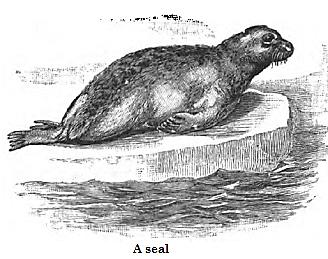
After they left this place, they were hungry. The men grew thinner and thinner. It seemed that they must die for want of food. But one day they saw a large seal. He was floating on a piece of ice. The hungry men thought, “What a fine dinner he would make for us!” If they could get the seal, they would not die of hunger.

Every one of the poor fellows trembled for fear the seal would wake up. A man named Petersen took a gun, and got ready to shoot. The men rowed the boat toward the seal. They rowed slowly and quietly. But the seal waked up. He raised his head. The men thought that he would jump off into the water. Then they might all die for want of food.

Doctor Kane made a motion to Petersen. That was to tell him to shoot quickly. But Petersen did not shoot. He was so much afraid that the seal would get away, that he could not shoot. The seal now raised himself a little more. He was getting ready to jump into the water. Just then Petersen fired. The seal fell dead on the ice.

The men were wild with joy. They rowed the boats with all their might. When they got to the seal, they dragged it farther away from the water. They were so happy, that they danced on the ice. Some of them laughed. Some were so glad, that they cried. Then they took their knives and began to cut up the seal. They had no fire on the ice, and they were too hungry to think of lighting one. So they ate the meat of the seal without waiting to cook it.

The little book of the war: Modern Methods of Warfare

Chapter 4

Modern Methods of Warfare

If some dead soldier of our Civil War could come to life and see the present methods of carrying on warfare, he would be far more dazed than Rip Van Winkle ever was. The trench system has already been spoken of. The use of camouflage, the disguise or concealment of objects of war, is not new by any means, but it never was so elaborately done before. Trenches are concealed by sods and branches of trees; vessels are painted, the lower part of the hull to look like waves, the upper in sky-blue; an apparently solid rock in a field may prove to be a gray canvas protection for a man with a gun. A little ammunition shelter was decorated with a picture of a hen and her chicks, and it easily passed for a hen-coop. The Emden changed her paint and set up an extra smokestack to persuade the English that she was one of their own cruisers. The English retaliated in kind by secretly building dummy dreadnaughts of wood, which lay idly in the harbors while the real dreadnaughts were serenely acting as convoy for transports.

Barbed wire has proved a better defense than stone walls. These can be easily shattered, but barbed wire, stretched from post to post in wild entanglements, “looking as if they had been woven by a crazy spider,” is slow to yield, even to a storm of shrapnel. It can be cut, of course, but this is rather a dangerous proceeding when under a brisk fire from the enemy. Moreover, the wire is sometimes charged with a high power of electricity, and then any attempt at cutting it has two chances of proving fatal.

Machine guns have proved of great general value, though they look anything but dangerous, “so small, so fine, and such bits of workmanship that one would think to see them that they were a child’s playthings.”

The famous French “75’s” are light in weight, but in general artillery has been growing larger and larger and able to throw shells at a constantly increasing distance. The man who fires the gun has sometimes not even a glimpse of what he is trying to hit. His orders come from the man with a view, who is perhaps hidden in some innocent-looking farm-house on a distant hill, far away from the scene of action, perhaps skillfully camouflaged in the top of a tree, perhaps high up in an airplane, whence he can “wireless” down his directions for the aim.

A weapon revived by the Germans from the Greek fire of ancient times is liquid fire, made of pitch and gasoline or similar substances. A large stream of this fire is started, then a small stream of some mixture that catches fire on reaching the air. This is so timed that it kindles the large stream at whatever moment the man in charge wishes. Besides the heat and flame, this causes a suffocating smell and a heavy smoke.

Even worse than liquid fire is the poison gas set free when the wind is in the right direction to blow it over the trenches of the enemy. It is heavier than air, and so sinks down into the trenches. Other gases are put into shells which burst on reaching the trenches. These gases not only kill men, but often, if they escape death, injure the lungs and cause years of suffering. Scientific men, however, soon invented masks, which, unless the soldier is caught unawares, will protect him from injury. Poison gas is strictly forbidden by the Articles of the Hague, but was introduced by the Germans.

Hand grenades have been much used to hurl into the trenches of the enemy. An instant before being thrown, the fuse is lighted; but if the soldier delays a moment too long, the bomb explodes in his hands.

Shrapnel consists of a case containing so many bullets that a single shell is more deadly than the machine gun at its best. Moreover, while the rifle bullets make a clean hole not difficult to heal, the shrapnel bullets fly unsteadily and tear whatever they touch. Then, too, the pieces of the shell itself make jagged and irregular wounds.

Without wireless telegraphy and the use of the telephone warfare of the present character could not be carried on. The commander of a warship can reach every part of his vessel by telephone. Even on a battle-field, the slender wire does in a moment what was in the Civil War the work of orderlies galloping about with commands. Telephone wires are strung with almost unbelievable rapidity. Two men start off on horseback. One carries a reel of slender wire which unwinds as he goes. The other carries a rod with a hook and lifts the wire to branches of trees. To make the return circuit, a metal rod is driven into the ground at each end of the line, or even into a living tree. By means of this, a commander knows the condition of every company, and they can receive his orders without a moment’s delay.

Most interesting of all to the observer is the armored tank, clumsy, unwieldy, lifting up half its body and pawing about in the air as if searching for the best way to go. It rolls itself awkwardly into a deep shell-hole as if it really must see what is down there, then climbs the bank and rumbles on its course. It plunges through small trees and houses, if any are in its way; it roams about in barbed-wire entanglements as if it did not know they were there. It never makes a misstep or misroll—and wanders around with an irresistibly comical air of going all by itself and knowing just what it is about. And all this time it is giving perfect shelter to the men and machine guns which are protected by its plates of steel armor. Some one has said that all the tank lacks is a pocket for carrying prisoners.

The various sorts of flying machines are used in vast numbers. The German Zeppelin is an enormous cucumber-shaped dirigible balloon, lifted by gas bags and propelled by gasoline engines. It has a strong, light aluminum frame and is divided into gas-tight compartments. Compared with the little French Nieuport biplane, it is slow, but it can carry a large weight of bombs, and it can keep still in one place and report by wireless to friends below just what is going on from moment to moment in the enemy’s lines. On the other hand, the “Zep” is a mark not especially difficult to hit, even if it is quite high up in the air. The Germans have employed these in raids not only upon London and Paris, but also upon little undefended villages and Red Cross hospitals. So many schools have been struck by their bombs and children killed that they are often called the “baby-killers.” Just as the Allies long refused to employ poison gas, so for many months they refused to make air raids; but a stern demand for reprisals sent great battle-planes forth to drop bombs, not upon schoolhouses and hospitals, but upon German barracks and munition factories.

Anti-aircraft guns have now become common, and when the whir of an aircraft is heard, an alarm is given to warn people to keep out of the street and to go to their cellars. Then long rays from electric searchlights flash over the sky and the guns begin to roar. A storm of shrapnel beats upon the aircraft. If the gunners are fortunate in their aim, a Zeppelin or a “plane” tumbles down from the sky. Often airplanes go out to meet airplanes, and there are battles in the air, whose results are known sometimes by the fall of an enemy’s shattered machines, sometimes by the failure of the defenders to return.

The “flyers” do many kinds of work. They take snapshots of the country beneath them, which are closely compared with the photographs of the preceding day, and if there is any new bit of camouflage or any change in the position of the enemy, it reveals itself in the film. They drop bombs to destroy railroad bridges and munition works, they direct by wireless from stationary balloons, or “sausages,” as has been said before, the fire of the artillery, and they fight with the utmost fearlessness. A later form of the airplane is the hydroplane, an amphibious sort of invention which can fly in the air or float on the water, according to the need of the hour. Airplanes differ in speed and are thus adapted to the special work required of them. One variety can fly 110 miles per hour, carrying 700 pounds of bombs; another, which is called “slow,” though it makes 80 miles per hour, can carry 4400 pounds of bombs.

One specially valuable work of the air machines is the discovery of submarines. The submarine under water is invisible at the surface, but from a distance above the surface it can be easily seen. The submarine is not wholly new; indeed, one is said to have been made three hundred years ago; but the kinds now in use were invented some years before the present war by the Americans John P. Holland and Simon Lake. The submarine is a cigar-shaped shell of steel, so filled with complicated machinery that the men who run it have very narrow quarters. It can go on water or under water, and can sink or rise at the will of its commander. When just under water a man in the conning tower can see what is on the surface by means of a periscope. This is an upright tube extending up into the air with such an arrangement of mirrors and lenses that whatever goes on above the water is reflected down into the submarine. When a ship comes into view, and the submarine has reached a convenient position, it fires a torpedo, rises to the surface to observe the result, and if necessary dives. It also carries guns of considerable range; and if the commander thinks it safe, the boat can remain on the surface and destroy any vessel whose guns are of less power.

Halfway between flying machines and railways are the teleferica of Italy. Up to the present time it had been taken for granted that fighting in the Alps must be done in the passes and on the low heights, and that no summits of lofty peaks could be held permanently, for there are no roads above the snow line, and even those below it are often deep in snow for perhaps half a winter at a time. The Italians made up their minds to use the summits if possible. Then came the question how to transport soldiers, munitions, and food from one mountain to another. The teleferica, or far carrier, was originally only a cable stretched from one point to another, on which buckets of ore could travel. The resourceful Italians adopted the idea, stretched hundreds of miles of strong wire cable from mountain to mountain, ran a cage on each cable, and set up a petrol engine to provide power. That is all, but by means of these, thousands of men and hundreds of thousands of tons of food and munitions have been carried, and not one passenger has ever lost his life in an accident. Wounded men, wrapped in blankets, are often sent a mile or so by teleferica, and sometimes—thanks to the slender cable—the prompt operation which will save a man’s life can be performed within an hour after he has been wounded.

Perhaps not exactly “methods of warfare,” but certainly of great assistance in warfare, are mules and horses, homing pigeons, and dogs. Motors do not fill the place of horses and mules by any means. It is estimated that, entirely aside from the requirements of the cavalry, one horse is needed to every four men. The horse will go over ground too rough for the motor, and even over ditches and through ploughed fields where a motor would flounder helplessly. The motor car can usually carry supplies of food and ammunition to within five miles of the fighting line, but the horse or mule must do the rest.

Homing pigeons are the best carriers of messages in the employ of the army. Pigeon lofts, looking like lunch carts, are drawn up behind the lines, and from there the birds are taken to the men who are to form scouting or attacking parties. Patrol boats and U-boats carry pigeons, aviators send them home with messages written on thin paper and fastened in a capsule to one of their legs. The pigeon never loses his sense of direction. Even if he is set free in the midst of a heavy barrage fire, he flies up as fearlessly as if he knew what an impossible mark he is for an enemy’s gun, circles around once to get his bearings, and then starts for his own loft at astounding speed. Pigeons can fly sixty miles an hour and have been known to make eight hundred miles on a single flight. At one of our camps a message of moderate length was started at the same moment by dog, wireless, and pigeon, to a distant place. The pigeon-borne message arrived in two and one half minutes. Even the wireless lagged behind, for it took longer than that to relay the message and deliver it.

The work of the dog is exceedingly valuable and greatly varied. For drawing carts the Belgians have long used a cross between the Great Dane and the mastiff, such a dog as is the hero of Ouida’s story, A Dog of Flanders. He now draws light guns, and with dogs of other breeds has been taught to search out wounded men, running back with a cap, a button gnawed from their clothing, or, as trained in some armies, carrying in his mouth a loose strap left hanging from his collar and thus showing that he has found some one in need. Dogs have been brought from Alaska to drag supplies and ammunition on narrow-gauge tracks laid over the Vosges Mountains. They also carry food and hot coffee to the men in the first trenches when the firing is protracted. They carry messages to the firing-line when communication has been in any manner cut off. They accompany sentinels and patrols and keep close beside listening-posts, ready to indicate the direction of the danger by “pointing.” They help kill the rats in the trenches; and not the least of their services is acting as pets for the soldiers. They wear gas-masks like “other folk,” though they were at first greatly mortified at appearing in public in such a costume; and if they are wounded, they are carried to hospitals and are cared for by skillful specialists. Like other folk, too, they receive badges of honor. More than one dog has got a message through, thus saving a whole battalion or system of trenches, and has received from France the highest decoration for bravery that the country can give.

England has a veterinary corps attached to every brigade. A horse that is injured hopelessly is put out of his suffering by a prompt and merciful death. One that can be saved is carried in a horse ambulance to the hospital and given water, food, and a bed of straw. If the horse is sleepy, he is first allowed to rest as long as he likes, for the veterinaries know well that sleep is his best medicine. Then he is washed, and his wounds dressed. Even after he recovers, if he needs rest he is sent to pasture for a while before returning to the front. Thousands of horses that would have died in lingering agony on the battle-field are saved by this treatment; and whenever a horse “over there” is saved, the need of sending one from “over here” is prevented. England soon found her regular corps insufficient, and appealed to the Royal Humane Society for help. The Blue Star, as the animal relief society is called in France, has twelve or more base hospitals and a number of first-aid hospitals, but very many more are needed. The American Humane Association, at the request of the Secretary of War, is doing the same kind of work under the name of the Red Star.

Dogs and horses are just as lonesome and nervous and homesick as people. In war they are just as much exposed to danger as are the men, and they suffer just as much from liquid fire burns, from gas, shrapnel wounds, and shell shock. Well deserved is the noble prayer of the Russians, “for the innocent beasts who, together with us, have borne the danger and burden of the day.”

Great Stories for Little Americans Doctor Kane in the Frozen Sea

Elisha Kent Kane was a doctor in one of the war ships of the United States. He had sailed about the world a great deal. When he heard that ships were to be sent into the icy seas of the north, he asked to be sent along. He went the first time as a doctor. Then he wanted to find out more about the frozen ocean. So he went again as captain of a ship. His ship was called the “Advance.”

Kane sailed into the icy seas. His ship was driven far into the ice by a furious storm. She was crowded by icebergs. At one time, she was lifted clear out of the water. The ship seemed ready to fall over on her side. But the ice let her down again. Then she was squeezed till the men thought that she would be crushed like an eggshell. At last, the storm stopped. Then came the awful cold. The ship was frozen into the ice. The ice never let go of her. She was farther north than any ship had ever been before. But she was so fast in the ice that she never could get away.

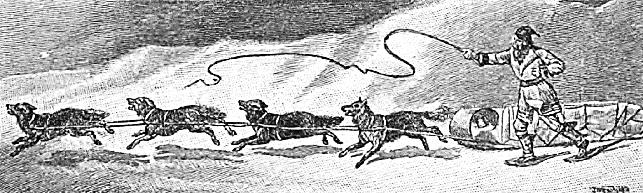
In that part of the world it is night nearly all winter. For months, there was no sun at all. Daylight came again. It was now summer, but it did not get warm. Doctor Kane took sleds, and went about on the ice to see what he could see. The sleds were drawn by large dogs. But nearly all of the dogs died in the long winter night.

Doctor Kane thought that the ice would melt. He wanted to get the ship out. But the ice did not melt at all.

At last, the summer passed away. Another awful winter came. The sun did not rise anymore. It was dark for months and months. The men were ill. Some of them died. They were much discouraged. But Kane kept up his heart, and did the best he could.

At last, the least little streak of light could be seen. It got a little lighter each day. But the sick men down in the cabin of the ship could not see the light.

Doctor Kane said to himself, “If my poor men could see this sunlight, it would cheer them up. It might save their lives.” But they were too ill to get out where they could see the sun. It would be many days before the sun would shine into the cabin of the ship. The men might die before that time.

So Doctor Kane took some looking glasses up to the deck or top of the ship. He fixed one of these so it would catch the light of the sun. Then he fixed another so that the first one would throw the light on this one. The last one would throw the sunlight down into the cabin where the sick men were.

One day the poor fellows were ready to give up. Then the sun fell on the looking glasses, and flashed down into the cabin. It was the first daylight the sick men had seen for months. The long winter night was over. Think how happy they were!

The little book of the war: Kitchener’s Mob

Chapter 3

“Kitchener’s Mob”

During the first two months of the war, two new countries joined the Allies besides those that have been named, Japan and Montenegro. Japan had before this made an agreement to stand by England, in the East; but she had also two strong reasons of her own for wishing to have a hand in the struggle. One was to win the friendship of Russia, so Russia would not interfere with her occupation of Korea and Manchuria; the other was to get possession of the district of Kiao-chau in China, and probably by returning it to China to make a firm alliance with the Chinese nation.

Some years earlier two German missionaries had been murdered in China, and in reprisal Germany had seized Kiao-chau and obliged the Chinese to give her a lease of the district for ninety-nine years together with other valuable privileges. Japan lost no time in sending her ultimatum, or last word, to Germany, advising her, in the interests of peace, to deliver up Kiao-chau within a certain number of days. The Japanese have a keen sense of humor, and they must have enjoyed writing this ultimatum, for they modeled it, phrase for phrase, upon one which Germany had sent to Japan, requiring her to give up some territory which she had taken in a war with China. Germany made no reply, and Japan promptly began a bombardment. Kiao-chau surrendered.

Montenegro, “glorious, immortal Montenegro,” as Gladstone called it, is a tiny kingdom whose capital Cettinje is perched on a mountain-top thousands of feet above the Adriatic Sea. There is a story that an emperor of Austria once said to a prince of Montenegro, “My brother the prince lives high.” “True,” replied the prince, “my brother the emperor has taken all the sea, the Turks have taken all the land; so there is nothing left for me but the sky.” The Montenegrins have always been famous as fighters and as patriots, and for centuries they maintained their freedom by frequent struggles with the Turks. They are a proud, honorable people, hospitable and courteous and brave as lions. They are Serbs by race, and they promptly joined Serbia in the war against Austria. Many Montenegrins were living in Canada when the war broke out, and as they could not reach their own country, they enlisted with the Canadian forces.

For many years Germany had been at work to gain control over Turkey. The Kaiser himself had paid a visit to Constantinople, and had declared himself to be the firm friend of all Mohammedans. Indeed, a story was spread throughout Turkey that he had become a convert to the faith of Mohammed. In the Balkan Wars, German officers aided the Turks. When the “Young Turks” brought about a revolution in 1908, Germany was more than ready to give her advice and help, to drill the Turkish troops, to provide officers and equipment, and little by little to get control into her own hands. “When our government is in shape, we shall say good-bye to Germany,” declared the Young Turks; but Germany’s aims were quite different. She wanted, first, a Turkish decree permitting her to build a railroad to Baghdad, which should open the way for Germany in the East; and this she had already obtained; second, she wanted Turkey, when “the day” should arrive, to be a well-trained and obedient military ally.

On the day that Germany began the war, Turkey signed a secret treaty with Germany, and, although posing as a neutral, soon began to perform unneutral acts. She closed the Dardanelles, thus cutting off Russia from communication with her allies, and she bombarded Russian seaports on the Black Sea. Moreover, when two of Germany’s fastest cruisers were in danger of capture in the Mediterranean Sea and reached the closed Dardanelles, they hoisted the Turkish flag and sailed through into safety, as they had been ordered by wireless to do. By German trickery there had been a mock sale of the cruisers to Turkey, who could not possibly pay for them. So it was that she was forced into the war and was now in the power of Germany. There is a story that a Turk said, in friendly fashion to a Belgian then in Constantinople, “I have terrible news for you; the Germans have captured Brussels.” “But I have even more terrible news for you,” said the Belgian, pointing to the two cruisers lying at anchor. “The Germans have captured Turkey.”

At the close of the year 1914 ten nations had entered the struggle. If a formal declaration of war had been necessary to precede fighting, matters would have been in a queer state of confusion. Japan, for instance, had declared war against Germany, but Germany had not declared war on Japan. Germany and Austria-Hungary had declared war on Belgium, but Belgium had simply tried her best to defend herself, and had not stopped for any declaration of her purposes. At the end of 1914 Germany and Austria-Hungary and their friend Turkey stood against England, France, Belgium, Russia, Serbia, Montenegro, and Japan.

Almost every country of the world maintains a standing army, and in nearly all countries men are obliged to prepare themselves for war and to serve as soldiers if there is need. In Germany, for instance, every able-bodied young man is required to begin his military training at the age of twenty, and he may be called upon at seventeen. For seven years he is a member of, first, the standing army, and then of the reserves. Of course, this does not mean that he is under arms for seven years except in war-time. Cavalrymen and artillerymen are in service three years, others two years. Students who have passed a state examination are required to serve but one year. At the age of twenty-seven, the German becomes a member of the home guards. Twelve years later, he is put into a force known as the Landsturm;  and here, for six years longer, or until he is forty-five, he may be called upon in any emergency for such services as guarding bridges or military supplies.

In the matter of equipment, too, Germany is thoroughly systematized. When the call was given to mobilize, every man in the land knew in just which storehouse his equipment was kept. His clothes, shoes, hat, etc., had all been tried on before, so there was no delay in finding a fit. All that he had to do was to walk into the storehouse, say, “I am Fritz —,” or, “I am number —,” and receive a large bundle, which he carried off to a dressing-room. In this bundle were two uniforms complete with leggings, trousers, shoes, and underwear. There were also four pairs of socks, a hat, blankets, housewife or “comfort bag,” and a brass tag stamped with his official number. He put the cord of the brass tag around his neck, dressed himself, made up the rest of his equipment into one roll to carry with him, and the clothes in which he came into another to leave with the clerk. His rifle, belt, and ammunition he got either at the same building or another, but just as quickly; and in a few minutes the civilian had become a soldier all ready to march to battle.

England, however, had never introduced compulsory service. Her troops were made up of men who had volunteered to serve. The result of the two methods was that in Germany, when the war broke out, every man had been trained as a soldier. In less than two years England had to resort to conscription, but at the beginning of the war she had only her small standing army to fall back upon for immediate service. This is why she could send only 150,000 troops to aid the French in the battle of the Marne. Evidently a large force must be raised as soon as possible, and the business was put into the hands of “Kitchener of Khartum.”

Earl Kitchener was an Irishman of brilliant military genius, which he had proved many times, but especially in the capture of Khartum in the Sudan. He now went to work to create the largest volunteer army in the history of the world. Men enlisted, but arms, equipment, even uniforms, were wanting. Before long, clothes were sometimes fastened together with shoestrings and safety pins, and shoes without holes were almost unknown. “All men needing boots, one pace forward, march!” the quartermaster once commanded a company, and the whole company moved briskly and hopefully forward. But only a single dozen pairs had arrived, and these were in just two sizes. The British soldier, whom his country nicknames “Tommy Atkins,” has a keen sense of humor, and he promptly dubbed himself and his companions “Kitchener’s Mob.” Indeed, as far as outfit went, the “Mob” were hardly better off than the little ragamuffins of the town who paraded up and down the streets of London with paper caps and wooden swords, gravely bearing a banner with the legend, “We will fight for our country and defend the King.” Among those who wished to enlist were many who were under the regulation height. Kitchener suggested that they form a division of their own. These were nicknamed the “Bantams.”

Earl Kitchener was a silent man, and he was not much given to letter-writing, but when his “Mob” was ready to embark its first troops for “somewhere in France,” each man received a copy of his letter to the troops ordered abroad. This said in part:—

You are ordered abroad as a soldier of the King to help our French comrades against the invasion of a common enemy. You have to perform a task which will need your courage, your energy, your patience. Remember that the honor of the British Army depends upon your individual conduct. . . . You can do your country no better service than in showing yourself, in France and Belgium, in the true character of a British soldier.

Be invariably courteous, considerate, and kind. Never do anything likely to injure or destroy property, and always look upon looting as a disgraceful act. You are sure to meet with a welcome and to be trusted; and your conduct must justify that welcome and that trust.

Do your duty bravely.

Fear God.

Honor the King.

Kitchener Field-Marshal

“Kitchener’s Mob” had become Kitchener’s army, and when they went into battle, it was said of them, “Nothing stops them except being killed.” Less than two years after the breaking-out of the war, Earl Kitchener was on his way to Russia on war business for the nation. His vessel either struck a mine or was torpedoed not far from the Orkney Islands. It was hard to think of the energetic soldier as quiet in death, and a myth quickly arose that he had been captured by a German submarine and was kept a prisoner in Germany.

When Kitchener’s men reached the front, they found quite a different sort of warfare from any in which Englishmen had ever been engaged before. Modern explosives are of such terrific power that forts cannot withstand them. Bodies of men, advancing in regular formation, would be mowed down like grass. This led to “trench fighting.” The general plan of the trench is a deep zigzag ditch stretching along on the front toward the enemy. Somewhat parallel with this and fourteen or fifteen yards behind it is a second trench, connected with the first by many passageways. In the walls of the second trench recesses were dug to serve as berths for the men; and running back from it were deep and narrow blind alleys in which they could take refuge when the bombs became too furious. Here and there were shell-proof “dug-outs,” twenty feet or more under ground. In some of the captured German dug-outs, evidently meant for officers and prepared for a long residence, there were armchairs, electric lights, ventilating fans, bookcases, rugs, and even wall-paper. One dug-out is described by the soldiers as large enough to hold several thousand men. It had been a quarry, but now it contained, besides places for the men, a first-aid hospital, and a cooperative store. Later, the “pill-boxes” were introduced. These are turrets of concrete and steel, connected by short trenches. They give much better protection against barrage fire than do the open trenches. Both trenches and pill-boxes are protected from infantry attack by extensive barbed-wire entanglements.

As the war progressed, a captured trench became almost as dangerous as one occupied by the enemy, for the Germans left their trenches full of traps. Cutting a thread might explode a detonator. A piece of equipment left with scraps, an empty shell, a helmet, bayonet, anything that would be likely to attract a soldier’s notice was risky to touch. Later, the brutal traps used for catching bears were sometimes chained firmly in No Man’s Land in the hope of catching an opponent between their steel teeth.

When a trench was dry, it was fairly endurable, even though great fat lazy rats roamed through it at their own will; but when it was wet—! It is no wonder that the irrepressible Tommy sang,—

“I never knew till now how muddy mud is, I never knew how muddy mud could be.”

The Irish especially were full of pranks. In one terrific charge the members of the London Rugby Club kicked a football before them as they made the first dash. “On the ball, London Irish!” they shouted, and those who were not brought down by the storm of bullets actually kicked that ball straight into the enemy’s trenches, which they captured with a jubilant shout of “Goal!” In another dash up a hill in the face of machine guns in full blast during the struggle near the Aisne, a tall Irish Guardsman rushed on in front of the line, flourishing the green flag, which he had tied round the barrel of his rifle, and shouting, “Ireland forever!”

Soon a double line of such trenches as have been described extended from the North Sea to Switzerland, one line held by the Germans, the other by the French and what the Kaiser called “the contemptible little English army.” This line swayed from time to time a few miles toward Germany or a few miles toward France, as the case might be. The Germans overran nearly all of Belgium and twice made an effort to break through the French and English lines in that country, once at the Yser River in the attempt to reach Calais, and once at Ypres, which the disrespectful Tommy insisted upon pronouncing “Wipers.” The attempts to reach Calais and Paris were unsuccessful. On the other hand, the Germans held Belgium and also northeastern France, the portion of France which is rich in coal and iron.

It was at Ypres that Tommy discovered an old printing-house with paper and ink, and in the spirit of conservation he set to work to publish a paper which he called the Wipers Times. It advises its subscribers to insure against submarines; describes the trench as “the best-ventilated hall in town”; advertises quack medicines warranted to cure cold feet; asks the loan of an umbrella as a protection against taking cold when going out to cut barbed wire; and finally bursts into verse and thus describes home life in the trenches:—

“Take a wilderness of ruin,
Spread with mud quite six feet deep;
In this mud now cut some channels,
Then you have the line we keep.

“Now you get some wire that’s spiky,
Throw it round outside your line;
Get some pickets, drive in tightly,
And round these your wire entwine,

“Get a lot of Huns and plant them
In a ditch across the way;
Now you have war in the making,
As waged here from day to day.”

But Tommy is not all fun, and he closes with,—

“Oft we’re told ‘Remember Belgium,’
In the years that are to be;
Crosses set by all her ditches
Are our pledge of memory.”

This was the condition of things on what came to be called the Western Front. There was also an Eastern Front, which gradually extended itself from Riga on the Gulf of Riga to the Black Sea. The Russians could not make their way into France, but they kept so much going on in the east that German troops had to be withdrawn from the Western Front and sent against them. Poland, in the western part of Russia, thrusts a square wedge between Germany and Austria. It looks on the map like an easy route for the Russians into the heart of the enemy’s country; but the Grand Duke Nicholas knew very well that if he took it, the Germans could come from the north and the Austrians from the south and crush his forces between them; therefore he marched straight into the part of Germany which extends farthest into Russia. Now, there was in Germany a retired general, Von Hindenburg, who had long amused the military folk of the country by insisting that in case of war this region would be of the utmost importance. He made it such, for there he won a great victory over the Russian troops. No one smiled at Von Hindenburg’s notions again.

Another army of Russians made a successful drive into Galicia, in northeastern Hungary. Unluckily for them, they were not so cautious as they were brave, and they were nearly destroyed by the German von Mackensen. They tried it again with fresh troops, and now they took Lemberg and began the siege of the unpronounceable Przemysl. This held out until well into 1915. Meanwhile, the Germans had made a drive into Poland and were aiming at Warsaw; but like Przemysl this did not change masters until 1915.

The Western and the Eastern were the two principal fronts, but as the war continued, other fronts developed. Just before the Germans occupied Louvain, the Austrians made a dash into Serbia, but were driven back. A second time they attacked Serbia, and from across the Danube they bombarded Belgrade into ruins and pushed on victoriously. Suddenly, as in Hawthorne’s story of “The Gray Champion,” there came galloping straight into the midst of the battle-field the white-haired Serbian King. More than forty years earlier King Peter had fought for the French in the Franco-Prussian War. Three times he had been captured by the Germans, and three times he had escaped. No fear had he of Prussian or Austrian, and he led his troops in so furious and unexpected an attack that the whole Austrian army retreated to their own country. Serbia’s fall was yet to come, but for a year she was safe.

Germany had planned to become mistress of the seas. She had built the famous Kiel Canal, so that her war vessels could pass easily from the Baltic into the North Sea without having to go around Denmark; and here much of her fleet was gathered. In July, 1914, England had held in the English Channel a review of her warships, 215 in all. They had not dispersed, and so, the moment that war broke out, they were ready to do their part, and they bottled up the German fleet in Wilhelmshaven, west of the Kiel Canal. A few cruisers and torpedo boats escaped the patrol. Any one who knows the career of the German commerce raider Emden, how she destroyed shipping to the value of $10,000,000 before she was sunk by an Australian war vessel, can guess what damage the whole German navy might have done had it not been for the prompt action of the British fleet.

At the end of 1914, England still ruled the seas, but Germany had acquired nearly all of Belgium, about one tenth of France, and part of Russian Poland. At the Eastern Front, as at the Western, the war seemed to have come to a deadlock. The Russians had done excellent work not only in driving the Austrians out of the passes of the Carpathian Mountains, but in occupying the greater part of Austrian Galicia. The results of the war for 1914 have been summed up in one sentence—”Germany had failed to conquer Europe, but Europe had made no progress toward conquering her.”

Great Stories for Little Americans The India-Rubber Man

Many years ago, a strange-looking man was sometimes seen in the streets of New York. His cap was made of India rubber. So was his coat. He wore a rubber waistcoat. Even his cravat was of India rubber. He wore rubber shoes in dry weather. People called this man “The India rubber man.”

His name was Charles Goodyear. He was very poor. He was trying to find out how to make India rubber useful.

India rubber trees grow in South America. The juice of these trees is something like milk or cream. By drying this juice, India rubber is made.

The Indians in Brazil have no glass to make bottles with. A long time ago, they learned to make bottles out of rubber. More than a hundred years ago, some of these rubber bottles were brought to this country. The people in this country had never seen India rubber before. They thought the bottles made out of it by the Indians very curious.

In this country, rubber was used only to rub out pencil marks. That is why we call it rubber. People in South America learned to make a kind of heavy shoe out of it. But these shoes were hard to make. They cost a great deal when they were sold in this country.

Goodyear wanted to try his rubber. That is why he wore a rubber coat and a rubber waistcoat and a rubber cravat. That is why he wore a rubber cap and rubber shoes when it was not raining. He made paper out of rubber, and wrote a book on it. He had a doorplate made of it. He even carried a cane made of India rubber. It is no wonder people called him the India rubber man.

He was very poor. Sometimes he had to borrow money to buy rubber with. Sometimes his friends gave him money to keep his family from starving. Sometimes there was no wood and no coal in the house in cold weather.

But Goodyear kept on trying. He thought that he was just going to find out. Years went by, and still he kept on trying.

One day he was mixing some rubber with Sulphur. It slipped out of his hand. It fell on the hot stove. But it did not melt. Goodyear was happy at last. That night it was cold. Goodyear took the burned piece of rubber out of doors, and nailed it to the kitchen door. When morning came, he went and got it. It had not frozen.

He was now sure that he was on the right track. But he had to find out how to mix and heat his rubber and Sulphur. He was too poor to buy rubber to try with. Nobody would lend him anymore money. His family had to live by the help of his friends. He had already sold almost everything that he had. Now he had to sell his children’s schoolbooks to get money to buy rubber with.

At last, his rubber goods were made and sold. Poor men who had to stand in the rain could now keep themselves dry. People could walk in the wet with dry feet. A great many people are alive who would have died if they had not been kept dry by India rubber.

You may count up, if you can, how many useful things are made of rubber. We owe them all to one man. People laughed at Goodyear once. But at last, they praised him. To be “The India rubber man” was something to be proud of.

The little book of the war: The Dash Toward Paris

Chapter 2

The Dash Toward Paris

Two days after the Austrian Minister left Belgrade, a telegraphic conversation began among the representatives of several of the countries of Europe, which was in effect as follows:—

Sir Edward Grey, Minister of Foreign Affairs for England: I invite the German and the Italian Ambassadors to England, as friends of Austria, to meet the French Ambassador and myself, as friends of Russia, to try to find a way out of the difficulty.

Russia, France, and Italy: We will come.

Germany: I could not call Austria in her dispute with Serbia before a European tribunal.

Sir Edward Grey: But this would be only a private and informal discussion.

Germany: It is impossible. But will not France exert a moderating influence at St. Petersburg?

France: Will not Germany, especially as Serbia has shown herself so conciliatory, exert a moderating influence upon Austria-Hungary?

Germany: Oh, no, we have decided not to interfere. Russia and Austria might discuss the matter.

Austria: I decline.

The Kaiser to the Czar: I urge you to be a spectator only and not draw all Europe into war.

The Czar: Cannot the Austro-Serbian problem be given over to the Hague Tribunal?

Sir Edward Grey: Will not Austria at least give the other powers time and opportunity to mediate between Austria and Russia? Will not Germany “press the button” in the interests of peace?

Russia: If Austria will strike out from her note to Serbia the demands affecting Serbia’s sovereignty, Russia will stop her military preparations.

Germany: That would be impossible.

Austria: I am ready to discuss the matter with the other powers.

But it was too late, as Germany had before this sent her ultimatum to Russia demanding that within twelve hours Russia cease her military measures.

The European powers, especially England, had done their best to prevent war, but their efforts had been in vain. It was evident that Germany wanted war. Most nations do all in their power to avoid war; why, then, should this nation be so eager for it? The answer is, Because she longed for empire. “A place in the sun” had long been the slogan of the Pan-German party. Jealous of Great Britain, the Kaiser determined to win by the sword the world empire to which industrial prosperity at home seemed, in his eyes, to entitle him. Other large nations had colonies. After a while, Germany, too, had some colonies; but Germany is a nation of recent formation, the best places for colonization had already been taken, and German emigrants did not care to go to the newer settlements. They made their homes in other countries, among other nations; and the result was that they or their children often gave up German citizenship, and their emigration was not, as was the case with other countries, a gain to the mother country. Then, too, Germany had but little seacoast. To reach the ocean, her ships must go around the British Isles or else pass through Dover Strait and sail within ten miles of either England or France.

Germany had some genuine fear of being crushed by Russia and France, but for England she had a hatred arising from jealousy. England held Gibraltar, the Suez Canal, and many islands scattered over the world. It is true that she threw open her ports to every nation; but Germany feared her enormous power on the sea and determined to take from her all possibility of exercising it. Germany and England were commercial rivals. Germany declared that England was trying to prevent her from reaching a market, and in the same breath boasted that she was underselling the English in England itself.

Between Germany and France there had been great bitterness ever since the war of 1870. In this war Germany had marched into Paris, she had seized Alsace and Lorraine and held them. She looked upon the French as a feeble, worn-out race, and supposed that she could easily crush them, then crush England, then attend to Russia.

The power at which Germany aimed was nothing less than the rule of the whole world. She believed that her ideals and customs were the best on earth, and that she was destined to control the world. As a beginning, she aimed at a “middle Europe,” that is, at winning a broad belt running from the shores of the North and Baltic Seas, including Belgium, northern France, Austria-Hungary, the Balkan States, and a free “corridor” to Baghdad. She would then be well on her way to the world dominion for which she thirsted. By earlier wars Germany had gained in size, wealth, and influence, and she expected to make far greater gains in this war. The “Junkers”—that is, the wealthy landed nobility—longed for it. Moreover, opposition to autocracy was on the increase, and in Germany as well as in Austria-Hungary there was much internal strife. A short and victorious war would do away with this and unite the people.

Germany was the only country in the world that was prepared for war. In army, fleet, and munitions she was ready, and the officers of her “war machine” had long been eager for the time to come. Even in public banquets her naval chiefs had for many years drunk toasts to “The Day”—that is, the day when the Kaiser’s new fleet would meet England’s in a war which should finally destroy the English navy and the British Empire. There was no secrecy about it. Even little children were taught in school that their country was “surrounded by cruel and envious nations.” Prominent writers and lecturers had taught that Germans were far superior to other races, and that the land which others were unfairly keeping from them would one day be theirs by conquest. They made ready for warfare. For three years before the war schoolhouses were so built that almost in a day they could be turned into hospitals. Machines—for making ploughs, for instance—were especially designed so they could be used in munition work. Not long before the war, Germany increased her army by sixty per cent, prepared an unusually large supply of munitions, widened and deepened the Kiel Canal to accommodate the largest warships, built more railroads to the Russian, French, and Belgian frontiers, increased greatly the importation of some articles used in war and decreased the exportation of others, called home her reservists from other countries; and only a few weeks before war was declared, she bought an enormous quantity of hospital supplies. There was no question who brought on the war.

Germany against Russia, Germany against France, England against Germany, Austria-Hungary against Russia—so much for the first week of warfare. The air fairly hissed with declarations of war, or rather with declarations that a “state of war” was existing, for each country wished to make it clear that it was at war only as a matter of self-defense. The declaration against France stated that French military aviators had dropped bombs in Germany. On the following morning Viviani, the French Minister of Foreign Affairs, declared to the Chamber of Deputies that this was entirely false. The correctness of his statement has since then been admitted in Germany.

German troops were at once mobilized—that is, called into active service—and the French troops promptly followed their example. In tiny French villages drums were beaten as a signal, and men left their harvest fields on the run, abandoning the half-cut grain. The oxen gazed at them wonderingly as they sped down the roads to their homes for the hour of making ready and the hurried good-byes before they boarded the train for the front, wherever that might be.

There was another frantic rush, and this was the race of American tourists to get away from the war. Thousands of them were scattered over the contending countries. Trains ran, but they had not room for any one but soldiers. Mails came or not, as it might happen. Telegraph and telephone wires were cut. To “go west,” to get to America, would be safety, and everybody wanted to sail by the first steamer.

Moreover, these tourists suddenly found that people would no longer cash their checks, so that many a man with a letter of credit in his pocket for thousands of dollars had to beg of some friend the money to pay for his dinner. But the United States took care of her wandering citizens. The Government sent over several million dollars to lend to them and also vessels enough to bring those home who could not get passage on regular lines.

But the tourists left behind them a continent full of trouble and anxiety. Just where Germany would strike, no one knew, but French troops were sent to the northeastern corner of France, just south of Belgium and Luxemburg, and a few miles away from the German border line. Luxemburg is a little independent duchy, a sort of toy kingdom, only four fifths as large as Rhode Island. It was a “neutralized” state; that is, by a treaty made in 1867, it was agreed that in case of war Luxemburg would be neutral, would give no aid to either side, and indeed would maintain no army. In return, France, England, Russia, and also Prussia, guaranteed her freedom from any invasion of her territory. Nevertheless, as this was the easiest road to the heart of France, the German forces took that road, saying that they would do no harm and that at the end of the war they would pay for whatever they had found it necessary to take. Luxemburg had already been violated by the French, they declared. The President of the Grand Ducal Government said that if this had been done, he knew nothing about it. The little state could make no resistance, but there is a report that the plucky Grand Duchess, an independent young girl of twenty, ran her automobile squarely across the road up which the German forces were marching, and indignantly protested against their entrance.

Belgium was also a neutralized state, protected since 1839 by treaties to which Prussia was a party. She was on friendly terms with both France and Germany, and only four years previous the Kaiser and his daughter had been guests of King Albert, ruler of Belgium, and had been received with every honor. The French Minister to Belgium had declared that his country would respect Belgium’s neutrality unless it was first violated by the Germans. The Belgians hoped that Germany would follow the example of France. But behold, the German Minister announced that the German troops wished to enter the country. If Belgium was friendly, Germany would at the close of the war pay for all damages; but if anything was done to hinder the troops Belgium would be regarded as an enemy. This was at seven in the evening of August 2. A reply was demanded within twelve hours.

Of course, the easiest way would have been to say yes and make no opposition to the coming of the troops. Belgium, however, was not looking for the easiest way, but for the most honorable. The little country had promised to be neutral. If she did not now do her best to prevent either Germany or France from entering her territory, she would be breaking her promise. The Chamber of Deputies came together, many of the members already in uniform, prepared to start for the front at a moment’s notice. Before them stood King Albert, tall, calm, and dignified. “I ask you, gentlemen,” he said, “are you absolutely resolved to maintain intact the sacred patrimony of your fathers?” They were resolved.

In the afternoon the Cabinet and Ministers of State held another meeting, and decided to appeal for help to England, France, and Russia, who, together with Prussia, had guaranteed the neutrality of their country. On the following day German troops entered Belgium, and the appeal was sent.

This had been a busy day in England as well as in Belgium. England had asked Germany to assure her before midnight that the neutrality of Belgium would be respected. The German Chancellor and the British Ambassador to Germany had held a meeting. “It is terrible,” said the Chancellor, “that just for a word—’Neutrality’— just for a scrap of paper [that is, the treaty]—Great Britain is going to make war upon a kindred nation who desires nothing better than to be friends with her.” No answer was made to England’s question. That night she declared war.

England had three reasons for entering the war. First, to keep her word to protect Belgium; second, to stand by her agreement with France; third, to protect herself. She was forced to the conviction that she would have to fight either in company with France and Russia or else, later, alone.

Meanwhile, German forces were streaming into Belgium. On the border line of France, south of Luxemburg, were forts and French troops. To pass these would be no easy matter; but with Belgium in her hands, Germany could mass her troops and supplies in that country. They pushed in toward the city of Liege. The Belgians tore up railways and blew up bridges as best they could; but the Germans built new bridges, and soon they were not far from the nine forts that stood on the heights above Liege. These forts commanded river, bridges, roads, and railroads, and until they were taken, German troops and supplies could not be brought into the town.

The forts resisted stubbornly, and the Belgian troops fought resolutely. Of course the little country could not withstand the big one, and within twenty-one days after the first German soldiers entered Belgium, they had taken Brussels, and a little later they forced the inhabitants to give them $40,000,000. They had also captured wonderful Louvain with its famous old churches, its superb cathedral, and its great university. The Germans declared that some of the people of Louvain fired upon them. Even if the charge is true, the revenge taken by the invaders was visited not upon these people only, but upon the whole town, for the city was now sacked and burned, and the famous university with its priceless library was ruthlessly destroyed.

Like the Roman hero in the story of Horatius at the bridge, Belgium with her slender might had held back the hostile armies. The Chancellor of Germany said of the invasion, “This is a breach of international law, but necessity knows no law.” Belgium had lost her treasures, her cities, her homes, but she had done the noblest thing in the world, she had kept her word even to her own hurt.

Those were the times when every day counted. The resistance of Belgium delayed the invaders for two weeks. Neither France nor England was prepared for war, but this delay gave them time to bring up their standing armies and hurl them into Belgium. The plan of the Germans was already formed. They promptly seized bases over the French line and aimed at making a sudden dash upon Paris. Belgians, French, and English were driven by the Germans, back, back, back, until they came to the Marne River.

But in Paris a quiet man with a genial, trustworthy face had been hard at work. He was the son of people who lived in the Pyrenees, and had made his way into a military school. He was not remembered at school for any special brilliancy, but he was remembered as a good scholar who never shirked or grumbled and always did his best. He had risen slowly from one position to another, until, three years before the opening of the war, he had become commander-in-chief of the French army; but he was so modest and unassuming that few people knew much about him. This quiet soldier, General Joffre, had collected half a million men, had chosen a battle-field on the Marne, and there he awaited the enemy. They came nearer and nearer. “Paris within a week!” had been their cry, and now Paris was almost in sight, only twenty-three miles away. Then came the battle of the Marne, not one battle, but a series of terrible engagements over a battle-line one hundred and forty miles long. Years ago a book was written called The Fifteen Decisive Battles of the World. One more will have to be added to the list—the battle of the Marne. The German forces were turned back and were pursued hotly to the banks of the sluggish Aisne River. The French dashed across the stream, and the Germans drove them back. There was no victory for either side. Germany still held a long strip of the land of France, but she had not taken Paris.

The little book of the war: Terms of Peace

Terms of Peace

Appendix: President Wilson’s Peace Terms

The following are the general terms of peace, as stated by President Wilson, with the agreement of the Allies.

From the President’s Message of January 8, 1918

1. Open covenants of peace, openly arrived at, after which there shall be no private international understandings of any kind, but diplomacy shall proceed always frankly and in the public view.

2. Absolute freedom of navigation upon the seas, outside territorial waters, alike in peace and in war, except as the seas may be closed in whole or in part by international action for the enforcement of international covenants.

3. The removal, so far as possible, of all economic barriers and the establishment of an equality of trade conditions among all the nations consenting to the peace and associating themselves for its maintenance.

4. Adequate guaranties given and taken that national armaments will be reduced to the lowest point consistent with domestic safety.

5. A free, open-minded, and absolutely impartial adjustment of all colonial claims based upon a strict observance of the principle that in determining all such questions of sovereignty the interests of the populations concerned must have equal weight with the equitable claims of the Government whose title is to be determined.

6. The evacuation of all Russian territory and such settlement of all questions affecting Russia as will secure the best and freest co-operation of the other nations of the world in obtaining for her an unhampered and unembarrassed opportunity for the independent determination of her own political development and national policy and assure her of a sincere welcome into the society of free nations under institutions of her own choosing; and, more than a welcome, assistance also of every kind that she may need and may herself desire. The treatment accorded Russia by her sister nations in the months to come will be the acid test of their good-will, of their comprehension of her needs as distinguished from their own interests, and of their intelligent and unselfish sympathy.

7. Belgium, the whole world will agree, must be evacuated and restored, without any attempt to limit the sovereignty which she enjoys in common with the other free nations. No other single act will serve as this will to restore confidence among the nations in the laws which they have themselves set and demanded for the government of their relations with one another. Without this healing act the whole structure and validity of international law is forever impaired.

8. All French territory should be freed and the invaded portions restored and the wrong done to France by Prussia in 1871 in the matter of Alsace-Lorraine, which has unsettled the peace of the world for nearly fifty years, should be righted in order that peace may once more be made secure in the interest of all.

9. A readjustment of the frontiers of Italy should be effected along clearly recognizable lines of nationality.

10. The peoples of Austria-Hungary, whose place among the nations we wish to see safeguarded and assured, should be accorded the freest opportunity of autonomous development.

11. Rumania, Serbia, and Montenegro should be evacuated; occupied territories restored; Serbia accorded free and secure access to the sea; and the relations of the several Balkan States to one another determined by friendly council along historically established lines of allegiance and nationality; and international guaranties of the political and economic independence and territorial integrity of the several Balkan States should be entered into.

12. The Turkish portions of the present Ottoman Empire should be assured a secure sovereignty, but the other nationalities which are now under Turkish rule should be assured an undoubted security of life and an absolutely unmolested opportunity of autonomous development, and the Dardanelles should be permanently opened as a free passage to the ships and commerce of all nations under international guaranties.

13. An independent Polish State should be erected which should include territories inhabited by indisputably Polish populations, which should be assured a free and secure access to the sea, and whose political and economic independence should be guarantied by inter-national covenant.

14. A general association of nations must be formed under specific covenants for the purpose of affording mutual guaranties of political independence and territorial integrity to great and small states alike.

The little book of the war: Postscript- The End of the War

Chapter 11

Postscript—The End of the War

When the last sentence was written, no one doubted that Germany would surrender some time; the only question was “When?” Her last frantic drive came to an end with her defeat in the second battle of the Marne. In the autumn of 1918 she requested an armistice, with a view, it was generally believed, to creating an opportunity to get her troops, ordnance, munitions, and supplies safely back into Germany. She could then rest and prepare for another drive in the spring of 1919.

Nothing but unconditional surrender could be accepted, and the Allied lines pushed on. “Are you going to France?” some one asked an American soldier as he stood waiting on the wharf. “No, ma’am; to Berlin,” he replied.

People who were following on their maps the course of the war moved every day the flags of the Allies a little nearer the German boundaries. The German plan had been to make a drive, then rest and take plenty of time to prepare for another drive. General Foch’s plan was to keep up a continuous battle, striking first at one point, then at another, then at two together, no German ever knowing where the next blow would fall. The result was that at the end of his nine weeks’ campaign the line of the Germans on the Western Front was everywhere crumbling, while the Allies’ line was as powerful as at first. Guns, supplies, and prisoners were captured in large numbers by the Allies. Japan was winning victories in Siberia, and England in Palestine. On the Italian Front and in the Balkans the Allies were moving resistlessly forward. Austria begged for peace. Turkey signed an armistice that was really a surrender. Troops of the Allies took possession of the forts on the Bosphorus and the Dardanelles. The Turkish army was demobilized, and a great force of Allied mine-sweepers set to work to clear the straits of mines.

It was evident that the end of the war was at hand. Before the middle of October, 1918, the Belgian authorities sent word to the Belgian refugees in England to prepare for a return to their own country. People watched eagerly for news of the ending of the war, and in the gray of the morning of November 11, which it has since been proposed to call “Victory Day,” the cable under the sea thrilled with the announcement of an armistice between the Allies and Germany. Sleepy travelers were aroused by the tooting of their locomotives responding to the bells and whistles and shouts in every city and village along their lines. Long before daylight the streets of cities were full of happy, good-natured crowds. “The boys are coming home!” millions of Americans were saying joyfully to themselves. It is no wonder that boys and girls danced and sang; that men tossed up their hats and raided the toy shops for everything that would make a noise; that they rang bells and blew horns; that clouds of confetti swept around the sky-scrapers of New York; that processions marched through the streets of every city; and that when evening came, buildings were illuminated, bands played, and the whole country gave itself up to rejoicing. Most interesting of all the celebrations was that of the Sioux Indians of South Dakota. They danced their ancient Victory Dance and made as many speeches as their white brothers. One chief gravely expressed his joy for the victory over “barbarism such as Indians never heard of before.” Another said of the Germans, “Let them put away their barbarism, and then we will give their nation its old place by the sacred campfire of the nations.”

This armistice was the same as a surrender, because of the strictness of its terms. They were neither cruel nor unmilitary, but they were severe, because the nations could put no trust in the word of their treacherous foe, and to protect themselves they were obliged to leave Germany powerless to renew the warfare. They required that she should withdraw from the lands that she had invaded and make good all damage as far as possible. She must also vacate a long stretch of territory on the western side of the Rhine. Three great cities in this territory, Cologne, Coblenz, and Mayence, were to be occupied by the Allies. Another stretch of land, twenty-five miles wide, lying on the eastern side of the Rhine, the German troops were required to evacuate. Military stores and equipments must be surrendered, and both military and civilian prisoners must be set free. The quantity of material to be given up was enormous; for instance, 30,000 machine guns and 10,000 motor trucks. All money and securities which had been stolen from the countries of the Allies must be restored. The treaties imposed upon Russia and Rumania must be abandoned.

Most humiliating of all, perhaps, but necessary, were the terms imposed upon the German navy. Battleships, cruisers, submarines, and destroyers in large numbers had to be surrendered. To receive their surrender, two hundred and forty British ships of war were drawn up in the North Sea, together with French and American fighting ships, “Comrades of the Mist,” as Admiral Beatty called them. No opportunity for treachery was allowed, and the guns which had last been fired at the battle of Jutland were in such order that in thirty seconds a broadside could have been poured out. “German fleet in sight on the starboard bow,” called the lookout man in a matter-of-fact fashion, as the fleet advanced in procession. “The German flag will be lowered at sunset,” commanded Admiral Beatty, “and will not be hoisted again without permission.” At the close of the ceremonial, the English sailors gave three rousing cheers for their commander. “Thank you,” said the Admiral; and added, “I always told you they would have to come out.”

So it is that the end of the war has come, but not the end of difficulties. Germany is in the uproar of anarchy, and the streets of Berlin have flowed with the blood of her citizens. The Kaiser has abdicated his throne; he fled to Holland even before the armistice was signed. The Crown Prince is virtually a prisoner on a little island belonging to Holland. Germans bitterly regret that they have lost the war and are angry with the leaders who brought them into disaster and downfall; but neither Kaiser, junkers, nor everyday citizens have expressed the least penitence for the suffering which they have brought upon the world. How can these people be helped to “put away their barbarism,” as the Sioux Indian said, and be fitted to take a place “by the sacred campfire of the nations”?

And shall this barbarism go unpunished? “The country that recklessly plunged the world into agony must accept a stern reckoning,” said Lloyd George, Premier of England. This stern “reckoning” is not because, in the madness of warfare, occasional cruelty might have been shown, but because such cruelty is the settled policy and belief of a nation of more than 60,000,000 people, and the world must never again be called upon to suffer from it.

Many other questions are pressing upon us. How shall Russia be aided to find herself? Where shall the border-lines of the various countries—new and old—be drawn? Shall there be disarmament, and to what extent? What laws of trade must be formed? What is meant by the “freedom of the seas”? How can it be made sure that the smaller peoples may live unmolested by more powerful neighbors, greedy of wealth and territory? Shall there be a League of Nations, and what shall be its province and its powers?

It is such questions as these that must be answered at the Peace Table by representatives of the nations that have struggled together to withstand the onslaught of Germany. It is upon the wisdom and justice with which these questions are answered that, perhaps for many generations to come, the peace of the world will depend.