A place to grow your relationship with God

Posts tagged ‘history’

The little book of the war: The War in 1916

Chapter 7

The War in 1916

The year 1916 began with a struggle which lasted for six long months to decide whether a certain little town in France should be captured by the Central Powers or remain in the hands of the French.

That little town was Verdun. It runs up the hill from the Meuse River to the cathedral built long before America was discovered. It is not far from the border-line between France and Germany, and after the Franco-Prussian War the French set to work to make it the strongest town in their country. It is much more than merely a “fortified town”; it is a wide area of land with fortified positions at every turn—not in plain view by any means, but concealed so cunningly that the sharpest eyes could not discover them. There are secret roads, mysterious gun-pits, where one would never think of looking for a gun, but so placed that one or another of them can command every approach. Underground there is a whole labyrinth of passageways, besides galleries, tunnels, winding staircases, and a great number of rooms for all purposes, well ventilated and lighted with electricity. One might be roaming about aboveground, thinking himself almost alone; but if an alarm was signaled, troops would suddenly spring up from cellars and caves in the rock and all sorts of unexpected places. Around Verdun are wooded hills, and they too have been skillfully fortified. All these are the older defenses. More recently trenches have been made in most intricate arrangement and wild entanglements of barbed wire have been placed.

This is the fortress that the Crown Prince of Germany strove for six months to capture. It was the military key to western France, and, like Constantinople, it had a great sentimental value. Then too, thrones are a bit uncertain in these days, and many people thought that the German Crown Prince was determined to strengthen his hold upon the German folk by so notable a conquest. However that may be, the military people of Verdun suspected early in the year that something was going to happen. Soldiers and guns were brought up in great numbers. There were attacks on the Allies here and there along the Western Front, and the Kaiser paid a visit to his troops. Moreover, there was a certain stir and restlessness which soldiers known how to interpret. In the later part of February the attack began, and it continued until almost the end of the year with now and then a lull of a few days.

The hero of Verdun was General Pétain, tall, slender, and inclined to be silent. Before the war he was a retired colonel. Joffre, however, has a way of finding out when people have anything in them, and he called him back to service. Twice he was promoted within a year, and the was put in command at Verdun. This was the silent man’s opportunity, and he showed himself a genius in military strategy. The attack upon Verdun was carried on with ammunition in unlimited quantities and guns and men in unlimited numbers. The fighting as a whole was of the most terrible nature, with all the horrors of modern guns and modern explosives, but by the skill of the French general and the bravery of the French soldiers Verdun stood.

But what was England about that she did not come to the help of Verdun? That is what the fault-finders were asking. England was no “slacker.” Within one week of the outbreak of war, she had sent 40,000 men across the Channel. Within one month 500,000 had enlisted; two months later, the sum was 1,000,000; and in three months from then, 500,000 more had joined the ranks. “As to the women,” said the superintendent of one of the government factories, “I can tell you of a surgical-dressing factory near here, where for nearly a year the women never had a holiday. They simply would not take one. ‘And what’ll our men at the front do, if we go holiday-making?’ they said.” Just now England was hard at work on her plans and had no idea of explaining them to anybody. General Haig was in command, a canny Scot, with a charming manner but an expression that said, “I purpose to see this job through.” He had been examining the lay of the land opposite the English front on the Somme River. He was quietly building roads and a railway, and before long motor trucks and caterpillar tractors were bringing guns, shells, barbed wire, howitzers, bombs, and hospital tents. Landscape painters were called upon to help in the camouflage, and airmen sailed aloft to see how well they had succeeded. One succeeded altogether too well, if we may trust the story, for he camouflaged so perfectly the van in which homing pigeons had been brought that on their return they did not recognize it.

The preparations for what is now called the battle of the Somme continued. At length the word was given, and on the morning of July 1 the struggle began, directed by General Haig and Marshal Joffre. It did not end until the November rains brought it to a close. Fighting went on furiously, frequently as severe as at Verdun. It was here that the Germans had their first experience of a great lumbering “tank,” that roamed about like a gigantic caterpillar, but sent forth death and destruction in a fashion quite unlike caterpillars or anything else that the Germans had ever seen. Of course the commanders had hoped to break through the German lines and drive the invaders out of France. They had not done this, but they had kept large forces away from Verdun and had also made it possible for Russia to win a victory in the East.

During this year 1916 there were three especially important events in the history of the war. One was the siege of Verdun; one was the battle of the Somme; and the third was an engagement which took place in the North Sea on the last day of May, between the English and the German fleets.

During the war the English took the Orkney Islands for their naval base, and frequently they made “sweeps” through the North Sea. One afternoon in May, when the English cruisers were off the coast of Jutland, they met the German fleet, “spoiling for a fight.” In the old stories of pirates a sea-fight was carried on by grappling two vessels together, the men of one boarding the other, and fighting hand to hand with swords and cutlasses and anything else that was convenient. In a modern naval battle the ships are miles apart, and the gunners would find swords and cutlasses somewhat in their way. All the afternoon the vessels of the two fleets fought, but the English kept an eye to the north, for Admiral Sir John Jellicoe, one hundred miles away, had been sent for by wireless. Just before six o’clock his fleet of battleships made their appearance. Twilight soon came on, and the rest of the fighting was done in the dark. The English had no idea of ceasing to fight, but they discovered that their enemies had slipped away. To follow them into their mine-strewn area would have been utter folly, so they waited till morning. The Germans hastened to publish it abroad that they had won a great victory; but in the morning, when the English were patrolling off Jutland, not a German vessel appeared, nor was the German fleet seen again till one day nearly three months later, when it showed itself in the North Sea. Luck was against it, for the English were there also, and the fleet withdrew. The English navy has a proud record. It has cleared the ocean of German craft, has practically ended German commerce, and has by its protection made the commerce of the Allies possible.

Several other countries had now entered the war. Portugal was bound by treaty to assist England if at any time her aid should be needed. She had other reasons for fighting Germany, however, for both countries had territory in Africa, and to make sure of her own possessions, Portugal had promptly attacked those of Germany. Early in 1916 she confiscated some German ships which lay in her harbors; and not many days later Germany declared war on the little country.

Italy had belonged to the Triple Alliance for thirty years; but in this time her relations with the Allies, and especially with France, had been growing more cordial, while her relations with the Central Powers had been growing less cordial. The cause of this was chiefly a question of territory. When the present kingdom of Italy was formed, in 1861, there was considerable territory which was inhabited by Italians, but had not become part of the new kingdom. Winning this from foreign control came to be called “redeeming Italy,” and the Italian districts still remaining in the hands of Austria were spoken of as “Italia irredenta,” or unredeemed Italy. These districts lay about Trieste and the Trentino, and the lay of the land was such that it would be comparatively easy for Austria to push down into Italy, and not at all easy for Italy to thrust herself up into Austria. Italy wanted these districts, but Austria held on to them. Moreover, Austria, supported by Germany, had violated the Treaty of Berlin and had already seized upon Bosnia and Herzegovina. If she also got possession of Serbia, she would be able to stretch still farther down the eastern side of the Adriatic. Austria had no idea of yielding, and in 1915 Italy declared war on her.

Italy’s example was followed by her little friend San Marino, the oldest state in Europe, and the smallest republic in the world, for it contains only thirty-eight square miles. It looks upon Americans as its foster children, and declares proudly that the United States has adopted the Sammarinese form of Government. The independent little republic lies in the mountains about one hundred miles south of Venice, and near the eastern coast of Italy. It has been described as “a piece of land entirely surrounded by Italy.” In 1916 Italy, but not San Marino, declared war on Germany.

The “Fronts” had become many. There was now an Italian Front, a Galician Front, and an Armenian Front, to say nothing of invasions and attacks in numerous other places.

Of course long before this, when the war was only a few months old, the Turks had set their eyes upon Egypt and the Suez Canal. Egypt is ruled by England, and the Suez Canal is of great importance to all nations that trade with the East, and especially to England. That is why the Turks determined to attack it. Aside from the question of fighting, this was rather a difficult task, for the Turks had to cross the Sinai Peninsula, which extends into the Red Sea, and carry their artillery and supplies with them. Moreover, there are no railroads on this peninsula. Nevertheless, they succeeded and launched their boats on the canal. It was night, but the English troops discovered them, and the Turks fled. Through 1916, they kept troops in sight of the canal as a threat, but the English also kept troops there and were ready at any moment to defend the canal if necessary.

Things were particularly active near the Caucasus Mountains, to which the Grand Duke Nicholas had been sent after his disagreement with the Czar. Southwest of Caucasia is Armenia, a part of Turkey in Asia. The Armenians have for hundreds of years been oppressed by the Turks. During the last quarter of a century there have been at least three savage attempts, which the Turkish Government either planned or connived at, to destroy the whole race. In 1915 came the most terrible persecution of all. Thousands of Armenians were slaughtered on the spot. Other thousands were driven from their homes out into the deserts of Arabia, where starvation and exhaustion and the brutality of their merciless guards ended their lives. So far as the Turks gave any excuse for this barbarous act, it was that the Armenians would aid the Russians. During the earlier massacres England, France, and Russia had threatened and protested and had at length brought Turkey to terms. In this, the most terrible massacre of all, there was only one country that could have stopped her—Germany. And Germany said not a word.

When the Allies gave up the attempt to capture Constantinople and their troops moved away, the Grand Duke knew very well that some of the Turks would come at once to fight his Russian army in Armenia. He had been planning an attack upon two important cities in Armenia, Erzerum and Trebizond; and now he hastened to make the attack before the coming of the Turks from Gallipoli.

The Grand Duke had the advantage of a railroad which would land his supplies only eighty miles from Erzerum; but the Turks had a hard time getting theirs, for their nearest railroad was four hundred and forty miles from Erzerum. It would have been simple and easy if the Black Sea had been open to them, but that was in the hands of the Russians, and the Russians were decidedly successful in sinking ships. The Russians captured Erzerum with its guns and ammunition and stores of all sorts. A little later they took Trebizond. The Grand Duke had made a fine record for himself in Armenia.

The Russians had been driven out of Germany and Galicia and they had lost Poland; but they held a line from the Gulf of Riga to the border of Rumania. They had had a busy winter, and they had brought together a vast amount of ammunition. They planned a drive into Galicia, and they made it, for they captured Czernovitz, a city which they had taken in 1914, but had been obliged to surrender; then took one place after another, successful in whatever they attempted and taking thousands of Austrian prisoners. Russia was in her glory.

While the Grand Duke was capturing towns in Armenia, the English were attacking the Turks in Mesopotamia, or the country between the rivers, the place where some people think the Garden of Eden was situated. Late in 1914 the English with troops from India had sailed up the Persian Gulf and defeated the Turks near the head of the Gulf. They hoped to get possession of Baghdad, the city of the Arabian Nights, and the place which Germany planned to make the terminus of her railroad. They now came within about one hundred miles of the city of many stories, but when they had reached the little Arab village of Kut-el-Amara, the Turks surrounded them and settled down comfortably to starve them out. The native Arabs tried their best to leave the town, but “the more, the hungrier,” reasoned the Turks, and drove them back. The besieged troops were not strong enough to make a sortie. Sickness appeared among them, and the medicines gave out. English aeroplanes dropped into the village, not bombs, but 1800 pounds of food; but this did not last long when there were so many starving people to eat it. An expedition sent out for their relief had to turn back; and soon the Turks were rejoicing over a surrender.

Waging war on the Italian Front was no easy matter. Indeed, the Italians have struggled under greater difficulties than any other nation. Their line of trenches is longer than the whole Western Front; and many of these trenches have been dug out of snow and ice or blasted out of solid rock. In the valleys the Italians have fought in a burning heat, in the lowlands they have fought in water up to their waists. The Italian mountaineers, the wonderful Alpini, are not only experts on skis, but they know how to drive iron pegs into rocky walls and so clamber up precipices. They can make their barracks in caverns of ice, and more than once sudden storms have shut them up on their mountain peaks from December to April.

In the struggle for Trieste the Austrians quietly brought their troops from Russia to Trent, and collected supplies and ammunition in that place. They had the great advantage of being on high land, while the Italians were on low land. Suddenly the Austrians attacked their adversaries with heavy bombardment and drove them back to their frontier. General Cadorna was now made commander-in-chief. His plans did not include retreating, and before long he pushed forward, and now it was the turn of the Austrians to retreat. The Italians drove onward, and soon did part of what they had wanted to do, they captured Gorizia, thirteen miles from Trieste, and detachments of Italian cavalry entered the city in triumph with the King of Italy at their head. But they had only begun to carry out their plans. Trieste, the port that they had longed for, was so near that they hoped to push on and capture it. But the winter came upon them and the fulfillment of their hopes was delayed.

Rumania had been hesitating whether to join Germany or the Allies. She knew just what she wanted, and she was trying to select the winning side so as to get it. Like Serbia, she wanted to bring under one rule all neighboring people of her blood.

The Russians, her next-door neighbors, had been meeting with much success, and the Germans had not succeeded in taking Verdun; therefore she decided to join the Allies. Many Rumanians lived in Transylvania, just across the Hungarian border. Poor Rumania did not stop to consider what her allies were doing, or whether she was planning the wisest course that could be taken; she dashed across the border into Transylvania so suddenly that the Austria-Hungarian forces retreated before her. Then came fierce counter-attacks under Generals Von Mackensen and Von Falkenhayn. The Russians had come to Rumania, but they were in the extreme southeast of the land. The full force of a terrible drive came upon the little country. Early in December the Central Powers captured Bucharest, the Rumanian capital, and imposed upon its people a tax amounting to $380 a head. Straight through the land they went, from Hungary to the Black Sea; they had won rich wheat-fields and oil-lands. Little Montenegro, too, had been overcome, and King Nicholas had departed for France. Neutral countries had been shown what fate would befall them if they ventured to oppose the Central Powers.

This was the story of the year 1916. It was as a whole favorable to the Allies. They had had the advantage at Verdun, on the Somme, in Armenia, and on the sea. On the other hand, the expedition to Mesopotamia was a failure and Rumania had been crushed.

Westerm Battle Lines
Italian Front
THE ITALIAN FRONT

Great Stories for Little Americans Webster and the Poor Woman

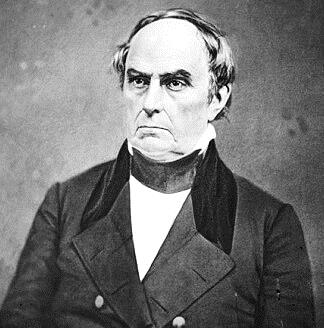
When Daniel Webster was a young lawyer, he was going home one night. There was snow on the ground. It was very cold. It was late, and there was nobody to be seen.

But after a while he saw a poor woman. She was ahead of him. He wondered what had brought her out on so cold a night.

Sometimes she stopped and looked around. Then she would stand and listen. Then she would go on again. Webster kept out of her sight. But he watched her. After looking around, she turned down the street in which Webster lived. She stopped in front of Webster’s house. She looked around and listened.

Webster had put down some loose boards to walk on. They reached from the gate to the door of his house. After standing still a minute, the woman took one of the boards, and went off quickly.

Webster followed her. But he kept out of her sight. She went to a distant part of the town. She went into a poor little house.

Webster went home without saying anything to the woman. He knew that she had stolen the board for firewood.

The next day the poor woman got a present. It was a nice load of wood.

Can you guess who sent it to her?

The little book of the war: The Spark that Exploded the Magazine

Chapter 1

The Spark that Exploded the Magazine

When the grandfathers of the present school-children were studying geography and came to the map of Europe, they found just north of Greece a broad band of country extending from the Black Sea to the Adriatic which was called Turkey. It was bounded on the north by the Save River, but at the northeast it stretched far up along the east side of the Carpathian Mountains. This was “Turkey in Europe,” but the Turks ruled a much larger territory in Asia, just across the Straits of Bosphorus.

The original home of the Turks was in Persia. They had gradually pushed on to the westward, until they held Asia Minor, Constantinople, and much of what is now known as the Balkan States. They had forced their way to the north and had even besieged Vienna. Then came struggles with Russia. Russia was successful, but the other European countries feared that she might become so powerful as to threaten them, and so made her give up most of her Turkish conquests. Europe wanted the Turks driven back into Asia, but no state was willing that any other state should become heir to their territory. An attack upon them would be likely to bring on a general European war. That is why no one ventured to interfere in 1895, when the Turks, who are Mohammedans, massacred tens of thousands of Armenian Christians.

In Turkey in Europe there were several small nations. They were inclined to quarrel among themselves, but on one point they agreed, namely, they all hated their ruler and meant to get free. Greece had freed herself long before Germany began the present war, and one by one most of the other little nations had declared their independence. Bosnia and Herzegovina had fallen into the hands of Austria-Hungary and were helpless. In 1878, after a war between Russia and Turkey, the Treaty of Berlin had been signed, which allowed Austria-Hungary to “occupy” and rule these two countries. In 1908, she announced that she should retain them as permanent parts of her empire. This was not according to the treaty, but for one reason or another nothing was done to prevent it.

The Balkan peoples—for the district took its name from the Balkan Mountains—were all excellent fighters, and if they had held together and been willing to yield a point to one another now and then, they could have driven the Turks out of Macedonia and Albania, and perhaps even across the Bosphorus. “Those peoples will never unite,” said the wiseheads of Europe; but in 1912 the unexpected happened, the little countries did unite, and they drove the Turks so far toward the Bosphorus that they had nothing left in Europe but Constantinople and a little of the country west of that city.

But now the Balkan countries began to quarrel again. Bulgaria did not think there had been a fair division of the land that she had won in the struggle. The result was that they had a little war of a few weeks among themselves, Serbia, Greece, Montenegro, and Rumania lining up against Bulgaria, and winning the day.

In the first war the influence of Germany and Austria had been in favor of Turkey; in the second war it had been in favor of Bulgaria. In both wars they had favored the side that lost. Russia had favored Serbia, and therefore was on the side that won. Not long before the Balkan Wars, the interests of France and Germany in Morocco had clashed, and France had come off victor. Within a few years, then, Russia and France had gained in prestige, while Germany and Austria-Hungary had lost. It was practically certain that as soon as an opportunity appeared, the last two countries would try to make themselves more powerful.

Taken as a whole, the people of the Balkans are a quick-tempered folk; and whatever strikes them as showing the least shade of injustice, they are ready to resent—with a gun. Indeed, in many districts, the inhabitants have such a relish for gunpowder that they delight in using it to welcome their friends as well as to make away with their enemies. Like the Russians they belong to the great Slavic family, but they are of different nations and origins.

In the Balkan States there is much that is beautiful. There are grand old mountains, deep green valleys, wide fields of swaying grain, and everywhere there are flowers. Bulgaria is so well adapted to the growing of roses that they are raised there by the million to make the delicious attar of roses; but wherever you go, there are daisies, wild clematis, poppies, and scores of other kinds of flowers, and the summer air is always sweet with the perfume of the honeysuckle.

Serbia is called the “poor man’s paradise.” In many parts of the country there are two crops a year, and the soil is so rich that a very little land will support a family. There are gypsies who wander about and beg and tell fortunes, but there are no poorhouses, and it is exceedingly rare to find a really needy person.

The capital of Serbia was Belgrade. It was a clean white city, and stood high up on a hill, looking far away to the mountains on the horizon. At the foot of the hill the Save River meets the Danube and sweeps half around the town. In the streets were trolley cars and also lumbering ox-carts drawn by the biggest and slowest of oxen. There were peasants just in from the country, the men wearing sheepskin coats, fur inside, and the women in short skirts of blue or cream-colored homespun, and always displaying an apron gorgeous with bright embroidery. On fête days the women sometimes wore long velvet coats embroidered with gold thread and fastened with gold buttons as big as marbles.

The Serbians were as independent in dress as in other matters, and when parliament was in session, some of the members wore handsome frock coats and fine linen, while others appeared in their sheep-skin coats or whatever else they might choose. They were not ignorant, these roughly clad farmers, and many of them had very good incomes; but they saw no reason for changing their garb to suit the whim of any one else. Many of them sent their sons to the university. They were a kindly folk, pleasant and hospitable, and proud of keeping their word. They loved their ballads and fairy legends; they sang the magnificent old chants in their churches; they said a bit of a prayer when they kindled their fires; and when they went to battle, they were the bravest of the brave.

There were two things that the Balkan peoples wanted with their whole hearts. One was to be free from Turkish rule; and this they had succeeded in bringing about. The other was quite a different matter, for they were not satisfied to be divided by mountains and rivers and political boundaries; they wanted to include in each state all the people of the same nationality. This would have been difficult enough even if they had been willing to keep within the limits of the group of states, but that would not answer their purpose. East of Rumania, for instance, was Bessarabia. Here lived many Rumanians; but of course Russia had no idea of giving up this fertile district, larger than Switzerland, just to accommodate Rumania. West of Rumania, in eastern Hungary, there was the same condition, for here too lived many Rumanians, and Austria-Hungary would not for a moment consider surrendering this part of her territory.

With Serbia matters were even worse. Her one great wish was to bring the Serbs under one rule by uniting Serbia, Montenegro, and the two provinces of Bosnia and Herzegovina, which were in the hands of Austria-Hungary. If this had come to pass, Serbia would have been somewhat larger than the State of Michigan. Moreover, she would have won access to the sea, and would no longer have been obliged to get permission of her neighbors when she wished to send her products to market.

This is the way it stood with the Balkan nations at the end of 1913. None of them were contented. Bulgaria was angry because in the settlement after the war so much of the land which she had won from Turkey had been taken from her. Bosnia and Herzegovina were enraged at having been made a part of Austria-Hungary. Serbia was perhaps the most wrathful of all, for she was left with no hope of uniting the Serbian race. Moreover, in order to appease Austria-Hungary a port on the Adriatic which Serbia had captured had been taken from her, thus leaving her with no approach to the sea. The Balkan States had long been called the “powder magazine of Europe,” and now the magazine was all ready to explode.

The spark that exploded the magazine flashed out in Serajevo, the capital of Bosnia. This is a wide-awake little city, whose inhabitants make a vast amount of pottery and metal ware, dye and weave silk, and carry on a large trade. It is a pleasant town. A river runs through it, and gardens are all around. Some fine modern buildings have been erected, and in contrast with them there are, high up on a hill overlooking the city, picturesque ruins of the stone walls of a castle seven centuries or more old.

One beautiful June day in 1914, a gentleman and his wife were riding in procession in Serajevo. The mayor of the place stood waiting in the town hall, all ready to make his address of welcome, for the gentleman was the Archduke Franz Ferdinand, nephew of the Emperor of Austria, and was himself heir to the Austrian throne. Suddenly a bomb exploded directly behind their automobile, evidently aimed at the Archduke and his wife. They were not harmed, but the occupants of the car following them, part of their escort, were fatally injured. Some hours later, while the royal guests were on their way to the hospital to inquire for the wounded, a student of only eighteen years sprang out of the crowd and threw a bomb at their car. This failed to explode. The young man then drew a revolver and fired three shots, two of which struck the Archduke and the third his wife. Both died within an hour.

Emerson writes, in his Concord Hymn, of the Massachusetts farmers who “fired the shot heard round the world,” and surely this shot at Serajevo was heard round the world. The assassin belonged in Herzegovina, in Bosnia, but he had been living in Serbia, in Belgrade, and the Austro-Hungarian papers declared at once that Serbian influence had made him a murderer. They demanded that Serbia should be punished.

For one whole month Austria-Hungary plotted and prepared. Then a note was sent to Serbia. This accused the Serbian Government of planning or at least conniving at the assassination, and demanded that Serbia should suppress all newspapers and societies unfriendly to Austria-Hungary, and cut out from the public schools all teaching tending to the same result and to any thought of a possible future union under Serbian rule. It demanded the arrest and punishment of all connected with the crime, especially two men who were mentioned by name, one an officer in the army. It demanded that Austria-Hungary should share in the investigation of the conspiracy. Austria-Hungary had taken a month to prepare this note, but she required Serbia to present her reply within forty-eight hours.

Then the telegraph wires began to hum, and messages whizzed back and forth among the diplomats in the attempt on the part of several countries to avert war. England did not want war, neither did France, nor did Serbia’s “big brother,” Russia, and the little country was urged to return as conciliatory a reply as possible. Serbia put her pride into her pocket and yielded, but required that if any one was to be punished, proof should be given of his crime. One demand, however, she refused flatly, a demand to which no self-respecting country could yield. This was that Austria-Hungary should take part in the investigation of the conspiracy. She expressed her willingness, however, to leave the whole question to the Hague Court in case this reply should not be satisfactory. This was given to the Austro-Hungarian Minister within the forty-eight hours, and although Sir Edward Grey, English Secretary of State for Foreign Affairs, declared that this reply was the greatest humiliation he had ever seen a country undergo, the Minister said that it could not be accepted, as Serbia had not yielded to the demands in every particular, and that same day he and his staff left Belgrade.

War between Serbia and Austria-Hungary now seemed unavoidable, but why need the other states of Europe have anything to do with it? Why, if there must be conflict between the two countries, could they not fight it out and leave the rest of the world in peace? The answer is, “Because of the aims of Germany and because of the Eastern Question.” At the outbreak of the war few people thought much about any possible aims of Germany, but they thought a great deal about the Eastern Question, that is, the relations of Turkey and the Balkan States with the rest of Europe, especially Russia, Austria-Hungary, and England.

Russia is an enormous country. That portion of it which is in Europe is one fourth larger than all the rest of the Continent. It is a land of almost endless resources. It is rich in minerals and precious stones; it raises flax, hemp, timber, cotton, and quantities of sugar beets, besides great numbers of cattle, horses, sheep, hogs, and goats. It has millions of acres of the best wheat land in the world. Of course the Russian winters are long and cold and the summers are short; but when summer does come, it is so hot that vegetation grows wonderfully fast.

Naturally, after Russia has produced all these valuable articles, she wants to sell them to other nations. Then come difficulties, for transportation is not good. If Russia had as many miles of railroads in proportion to her size as France has, the big country would have six and one half times as much mileage as at present. She has rivers and canals, and at the north she has harbors, but from three to six months of every year all these are closed by ice. On the Black Sea she has her port of Odessa, but to carry her goods out of the Black Sea her ships must pass through the Bosphorus and the Dardanelles, which are controlled by Turkey. Russia, then, would be glad to have the Turks pushed over into Asia Minor. As to Serbia, her “little brother,” both Russians and Serbians are of the same family of nations, the Slavic, and while Russia would hardly have wished Serbia to become powerful enough to rule all the Balkan States, she could not endure the thought of her becoming a part of Austria-Hungary, and thus enormously increasing the Austrian and the German power.

Germany had long felt what is called the “Drang nach Osten,” that is, the push toward the East, for trade, agriculture, and colonization. She had already, as has been said, secured the right to build a railway from the Bosphorus to Baghdad, and had built one third of it. A “middle Europe” combination, consisting of Germany, Austria-Hungary, the Balkan countries, and Turkey, would open Germany’s way to Baghdad, to the Far East, and to the rich lands of southeastern Russia, the Ukraine. With Turkey Germany had made friends; Herzegovina had become a part of Germany’s ally, Austria-Hungary; nothing blocked her way but the other Balkan countries, especially Serbia. If Serbia, then, fell under German control, Russia must give up all hope of ever holding Constantinople, and she had strong reason to fear losing the Ukraine, which was somewhat restless under Russian rule, and no one could say how much more of her territory. It is no wonder that, when Austria-Hungary threatened Serbia, Russia made her prompt declaration, “On the day that Austrian troops cross the boundary line of Serbia, Russian troops will mass for war.”

Austria-Hungary is a combination of two countries, ruled by one man, but independent in many respects. Delegations from the parliaments of the two countries meet one year in Vienna in Austria, and the following year in Budapest in Hungary. These delegations settle questions of national finance of war, and of foreign relations. Other matters are settled by each country for itself. Each half of the “Dual Monarchy” is made up of numerous small states. No one of these forgets that it was once independent, and its people do their best to maintain their old language and their old customs. They have formed one kingdom, but they have never formed any real union. Indeed, neither Austria nor Hungary is a closely united state. In Austria, about one fourth of the inhabitants are Germans; but the government is so ordered that they are in control. In Hungary, the Magyar aristocracy hold the ruling power. In each state the Slavs are the “under dog.” They have no political power, and small attention is paid to their interests or wishes. These Slavs belong to the great Aryan family whose home was in central Asia. They form nearly one half of the population of Austria-Hungary, but they are of many nations, and each little group cling together and look upon others with some jealousy and often with dislike.

The different peoples in the Dual Monarchy are discontented, and the two kingdoms are not happy together. Their union was formed merely as a matter of convenience. Between two and three centuries ago there were, instead of one Germany, two hundred or more tiny states, which were supposed to owe some allegiance to the Emperor of Austria. It was not a willing allegiance; nevertheless, a sort of union was at length formed with Austria at its head. But Prussia, one of these states, grew strong and began to rival Austria. The Prussian statesman Bismarck now brought it about that a confederation was formed with Prussia as its head and Austria left out. Then came the war with France in 1870, during which this confederation was changed into an empire, and William I, grandfather of the present Kaiser, and already King of Prussia, was proclaimed German Emperor. Neither Austria nor Hungary was quite strong enough to stand alone, and therefore they formed the twofold monarchy. Moreover, in 1879, Austria-Hungary and Germany formed an alliance for mutual defense. A little later, Italy joined them. This union was known as the Triple Alliance.

A war between Austria-Hungary and Serbia would serve Germany well, for of course the big country would subdue the little one, and the way to Constantinople would be open. But if Russia entered the fray, that was quite another matter, for if Russia gained power in the Balkans, Germany’s plans for the Far East would fall through. Therefore, if Russia was to protect Serbia, Germany would enter the war as the ally of Austria-Hungary.

But what about France? After the Germans defeated France in the war of 1870, the two provinces, Alsace and Lorraine, had been taken by Germany, and France felt the need of a friend as a support against the increasing German power; therefore she had formed an alliance with Russia, and if Russia fought, France would fight.

Then one more country must be considered, England. It was England’s policy to keep out of “Serbian quarrels,” but England had large interests in the East; she must look out for a clear way to Egypt, Persia, India, Thibet, and Afghanistan. Those who are in charge of a country’s interests must look far ahead, not only to what is reasonably certain to happen, but also to what might by any possibility happen. England had also interests in the Mediterranean, and she had agreed with France that in case of any necessity, the French navy should guard those interests. In return, England was to guard the western shores of France. Then, too, Dover Strait is hardly more than twenty miles wide at its narrowest point. If the Triple Alliance should crush France, then Belgium, then Holland, and so control the English Channel, Dover Strait, and the North Sea—England would be hemmed in by enemies. Of course, no one in England expected these things to come to pass, but it was the business of her statesmen to be on guard against whatever might be within the bounds of possibility. Therefore, some years earlier, England, Russia, and France had made an informal alliance called the Triple Entente, that is, the triple understanding or agreement. The object of this was to preserve the balance of power in Europe against the Triple Alliance. Its purpose was wholly defensive, for protection against the aggressive German plans.

At the beginning of the war, Germany announced her intention of standing by Austria-Hungary. Italy, as a member of the Triple Alliance, was bound to stand by Germany and Austria if they were attacked. They were not attacked, they were making the attack, and Italy declared her intention to be neutral.

Three days after Serbia handed her reply to the Austro-Hungarian Minister, Austria-Hungary declared war on Serbia, and two days later she began to bombard Belgrade.

A few months later it came to light that, one whole year before the Serajevo incident, Austria, certain of the aid of Germany, had determined to attack Serbia in order to clear the way to the East. The assassination of the Archduke was the spark that exploded the powder magazine of Europe; but if that had not occurred, some other pretext for war would surely have been found.

Eastern Europe in 1870

EUROPE ABOUT 1870 SHOWING TURKEY IN EUROPE. COMPARE THIS MAP WITH THE MAP OF THE PAN-GERMAN PAN.

Pan-German Plan

THE PAN-GERMAN PLAN.
SHOWING “MIDDLE EUROPE,” AND GERMANY’S MAIN ROUTE TO THE EAST (THE BERLIN TOBAGHDAD RAILWAY) AS IT WAS IN JANUARY 1918. BULGARIA SURRENDERED TO THE ALLIES, SEPTEMBER, 1918.

YOUNG BENJAMIN FRANKLIN

YOUNG BENJAMIN FRANKLIN

By Nathaniel Hawthorne.

When Benjamin Franklin was a boy he was very fond of fishing; and many of his leisure hours were spent on the margin of the mill pond catching flounders, perch, and eels that came up thither with the tide.

The place where Ben and his playmates did most of their fishing was a marshy spot on the outskirts of Boston. On the edge of the water there was a deep bed of clay, in which the boys were forced to stand while they caught their fish.

“This is very uncomfortable,” said Ben Franklin one day to his comrades, while they were standing in the quagmire.

“So it is,” said the other boys. “What a pity we have no better place to stand on!”

On the dry land, not far from the quagmire, there were at that time a great many large stones that had been brought there to be used in building the foundation of a new house. Ben mounted upon the highest of these stones.

“ Boys,” said he, “I have thought of a plan. You know what a plague it is to have to stand in the quagmire yonder. See, I am bedaubed to the knees, and you are all in the same plight. Now I propose that we build a wharf. You see these stones ? The workmen mean to use them for building a house here. My plan is to take these same stones, carry them to the edge of the water, and build a wharf with them. What say you, lads? Shall we build the wharf?”

“ Yes, yes,” cried the boys; “ let’s set about it!”

It was agreed that they should all he on the spot that evening, and begin their grand public enterprise by moonlight.

Accordingly, at the appointed time, the boys met and eagerly began to remove the stones. They worked like a colony of ants, sometimes two or three of them taking hold of one stone ; and at last they had carried them all away, and built their little wharf.

“Now, boys,” cried Ben, when the job was done, “let’s give three cheers, and go home to bed. Tomorrow we may catch fish at our ease.”

“Hurrah! hurrah! hurrah! ” shouted his comrades, and all scampered off home and to bed, to dream of tomorrow’s sport.

In the morning the masons came to begin their work. But what was their surprise to find the stones all gone! The master mason, looking carefully on the ground, saw the tracks of many little feet, some with shoes and some barefoot. Following these to the water side, he soon found what had become of the missing building stones.

“ Ah! I see what the mischief is,” said he;“ those little rascals who were here yesterday have stolen the stones to build a wharf with. And I must say that they understand their business well.”

He was so angry that he at once went to make a complaint before the magistrate ; and his Honor wrote an order to “take the bodies of Benjamin Franklin, and other evil-disposed persons,” who had stolen a heap of stones.

If the owner of the stolen property had not been more merciful than the master mason, it might have gone hard with our friend Benjamin and his comrades. But, luckily for them, the gentleman had a respect for Ben’s father, and, moreover, was pleased with the spirit of the whole affair. He therefore let the culprits off easily.

But the poor boys had to go through another trial, and receive sentence, and suffer punishment, too, from their own fathers. Many a rod was worn to the stump on that unlucky night. As for Ben, he was less afraid of a whipping than of his father’s reproof. And, indeed, his father was very much disturbed.

“Benjamin, come hither,” began Mr. Franklin in his usual stern and weighty tone. The boy approached and stood before his father’s chair. “ Benjamin,” said his father, what could induce you to take property which did not belong to you?”

“Why, father,” replied Ben, hanging his head at first, but then lifting his eyes to Mr. Franklin’s face, “if it had been merely for my own benefit, I never should have dreamed of it. But I knew that the wharf would be a public convenience. If the owner of the stones should build a house with them, nobody would enjoy any advantage but himself. Now, I made use of them in a way that was for the advantage of many persons.”

“My son,” said Mr. Franklin solemnly, “so far as it was in your power, you have done a greater harm to the public than to the owner of the stones. I do verily believe, Benjamin, that almost all the public and private misery of mankind arises from a neglect of this great truth,- — that evil can produce only evil, that good ends must be wrought out by good means.”

To the end of his life, Ben Franklin never forgot this conversation with his father; and we have reason to suppose, that, in most of his public and private career, he sought to act upon the principles which that good and wise man then taught him.

Definitions: In defining words, that meaning is given which is appropriate to them in the connection in which they are used. The pupil should look in the dictionary for the meanings of all others with which he is not perfectly familiar.

  • quagmire: soft, wet,miry land.
  • Outskirts: borders.
  • Plague: bother, great trouble.
  • Plight: condition.
  • Wharf: a platform on the shore of a harbor, river, or lake, extending some way into the water.
  • Comrades: companions, playfellows.
  • Magistrate: an officer of the law, justice of the peace.
  • Ringleader: the leader of several persons acting together.
  • Culprits: wrong-doers.
  • Solemnly: with great dignity
  • Induce: lead, persuade.
  • benefit: profit, accommodation.
  • Verily: truly.

Exercises:

  • Where is Boston?
  • How long ago did Benjamin Franklin live?
  • Learn all that you can about his life and work, and repeat it to the class at the next recitation.

Great Stories for Little Americans Daniel Webster and His Brother

Daniel Webster was a great statesman. As a little boy, he was called “Little Black Dan.” When he grew larger, he was thin and sickly-looking. But he had large, dark eyes. People called him “All Eyes.”

He was very fond of his brother Ezekiel. Ezekiel was a little older than Daniel. Both the boys had fine minds. They wanted to go to college. But their father was poor.

Daniel had not much strength for work on the farm. So little “All Eyes” was sent to school, and then to college. Ezekiel stayed at home, and worked on the farm.

While Daniel was at school, he was unhappy to think that Ezekiel could not go to college also. He went home on a visit. He talked to Ezekiel about going to college. The brothers talked about it all night. The next day Daniel talked to his father about it. The father said he was too poor to send both of his sons to college. He said he would lose all his little property if he tried to send Ezekiel to college. But he said, that, if their mother and sisters were willing to be poor, he would send the other son to college.

So the mother and sisters were asked. It seemed hard to risk the loss of all they had. It seemed hard not to give Ezekiel a chance. They all shed tears over it.

The boys promised to take care of their mother and sisters if the property should be lost. Then they all agreed that Ezekiel should go to college too.

Daniel taught school while he was studying. That helped to pay the expenses. After Daniel was through his studies in college, he taught a school in order to help his brother. When his school closed, he went home. On his way, he went around to the college to see his brother. Finding that Ezekiel needed money, he gave him a hundred dollars. He kept but three dollars to get home with.

The father’s property was not sold. The two boys helped the family. Daniel soon began to make money as a lawyer. He knew that his father was in debt. He went home to see him. He said, “Father, I am going to pay your debts.”

The father said, “You cannot do it, Daniel. You have not money enough.”

“I can do it,” said Daniel; “and I will do it before Monday evening.”

When Monday evening came around, the father’s debts were all paid.

When Daniel became a famous man, it made Ezekiel very happy. But Ezekiel died first. When Daniel Webster made his greatest speech, all the people praised him.

But Webster said, “I wish that my poor brother had lived to this time. It would have made him very happy.”

Great Stories for Little Americans Some Boys Who Became Authors

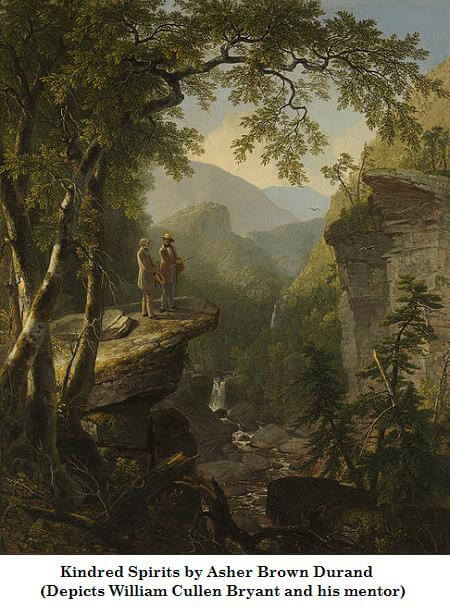
William Cullen Bryant was the first great poet in this country. He was a small man. When he was a baby, his head was too big for his body. His father used to send the baby to be dipped in a cold spring every day. The father thought that putting his head into cold water would keep it from growing.

Bryant knew his letters before he was a year and a half old. He began to write rhymes when he was a very little fellow. He wanted to be a poet. He used to pray that he might be a poet. His father printed some verses of his when he was only ten years old.

Bryant wrote many fine poems. Here are some lines of his about the bird we call a bobolink:

Robert of Lincoln is gaily dressed,

Wearing a bright black wedding coat,

White are his shoulders and white his crest.

Hear him call in his merry note:

Bobolink, bobolink,

Spink, spank, spink;

Look, what a nice new coat is mine,

Sure there was never a bird so fine.

Chee, chee, chee.

Nathaniel Hawthorne was one of our greatest writers of stories. He was a pretty boy with golden curls. He was fond of all the great poets, and he read Shakespeare and Milton and many other poets as soon as he was old enough to understand them.

Hawthorne grew up a very handsome young fellow. One day he was walking in the woods. He met an old gypsy woman. She had never seen anybody so fine-looking.

“Are you a man, or an angel?” she asked him.

Some of Hawthorne’s best books are written for girls and boys. One of these is called “The Wonder Book.” Another of his books for young people is “Tanglewood Tales.”

William H. Prescott wrote beautiful histories. When Prescott was a boy, a schoolmate threw a crust of bread at him. It hit him in the eye. He became almost blind.

He had to do his writing with a machine. This machine was made for the use of the blind. There were no typewriters in those days.

It was hard work to write history without good eyes. But Prescott did not give up. He had a man to read to him. It took him ten years to write his first book.

When Prescott had finished his book, he was afraid to print it. But his father said, “The man who writes a book, and is afraid to print it, is a coward.”

Then Prescott printed his book. Everybody praised it. When you are older, you will like to read his histories.

Doctor Oliver Wendell Holmes, the poet, was a boy full of fancies. He lived in an old house. Soldiers had stayed in the house at the time of the Revolution. The floor of one room was all battered by the butts of the soldiers’ muskets.

Little Oliver Holmes used to think he could hear soldiers in the house. He thought he could hear their spurs rattling in the dark passages. Sometimes he thought he could hear their swords clanking.

The little boy was afraid of a sign that hung over the sidewalk. It was a great, big, wooden hand. It was the sign of a place where gloves were made. This big hand swung in the air. Little Oliver Holmes had to walk under it on his way to school. He thought the great fingers would grab him someday. Then he thought he would never get home again. He even thought that his other pair of shoes would be put away till his little brother grew big enough to wear them.

But the big wooden hand never caught him.

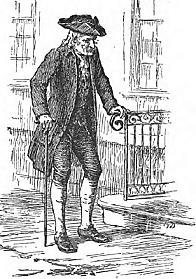
Here are some verses that Doctor Holmes wrote about a very old man:

“My grandmamma has said–

Poor old lady,

she is dead

Long ago–

That he had a Roman nose,

And his cheek was like a rose

In the snow.

“But now his nose is thin,

And it rests upon his chin

Like a staff;

And a crook is in his back,

And a melancholy crack

In his laugh.

“I know it is a sin

For me to sit and grin

At him here;

But the old three-cornered hat,

And the breeches, and all that,

Are so queer!

“And if I should live to be

The last leaf upon the tree

In the spring,

Let them smile, as I do now,

At the old forsaken bough

Where I cling.”

Great Stories for Little Americans Hunting a Panther

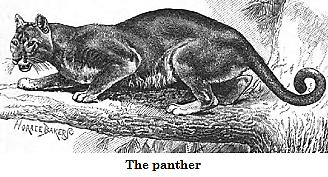
Audubon was traveling in the woods in Mississippi. He found the little cabin of a settler. He stayed there for the night. The settler told him that there was a panther in the swamp near his house. A panther is a very large and fierce animal. It is large enough to kill a man. This was a very bad panther. It had killed some of the settler’s dogs.

Audubon said, “Let us hunt this panther, and kill it.”

So, the settler sent out for his neighbors to come and help kill the panther. Five men came. Audubon and the settler made seven. They were all on horseback.

When they came to the edge of the swamp, each man went a different way. They each took their dogs with them to find the track of the wild beast. All of the hunters carried horns. Whoever should find the track first was to blow his horn to let the others know.

In about two hours after they had started, they heard the sound of a horn. It told them that the track had been found. Every man now went toward the sound of the horn. Soon all the yelping dogs were following the track of the fierce panther. The panther was running into the swamp farther and farther.

I suppose that the panther thought that there were too many dogs and men for him to fight. All the hunters came after the dogs. They held their guns ready to shoot if the panther should make up his mind to fight them.

After a while the sound of the dogs’ voices changed. The hunters knew from this that the panther had stopped running, and gone up into a tree.

At last, the men came to the place where the dogs were. They were all barking round a tree. Far up in the tree was the dangerous beast. The hunters came up carefully. One of them fired. The bullet hit the panther, but did not kill him.

The panther sprang to the ground, and ran off again. The dogs ran after. The men got on their horses, and rode after.

But the horses were tired, and the men had to get down, and follow the dogs on foot.

The hunters now had to wade through little ponds of water. Sometimes they had to climb over fallen trees. Their clothes were badly torn by the bushes. After two hours more, they came to a place where the panther had again gone up into a tree.

This time three of the hunters shot at him. The fierce panther came tumbling to the ground. But he was still able to fight. The men fought the savage beast on all sides. At last, they killed him. Then they gave his skin to the settler. They wanted him to know that his enemy was dead.

Great Stories for Little Americans Audubon in the Wild Woods

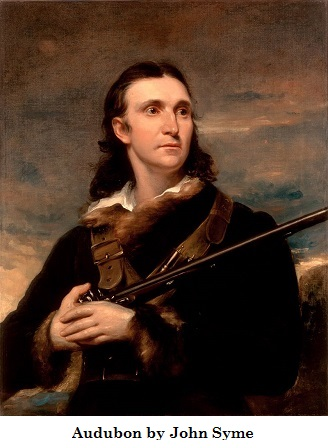
When Audubon was making his great book about birds, he had to live much in the woods. Sometimes he lived among the Indians. He once saw an Indian go into a hollow tree. There was a bear in the tree. The Indian had a knife in his hand. He fought with the bear in the tree, and killed it.


Audubon could shoot very well. A friend of his one day threw up his cap in the air. He told Audubon to shoot at it. When the cap came down, it had a hole in it.

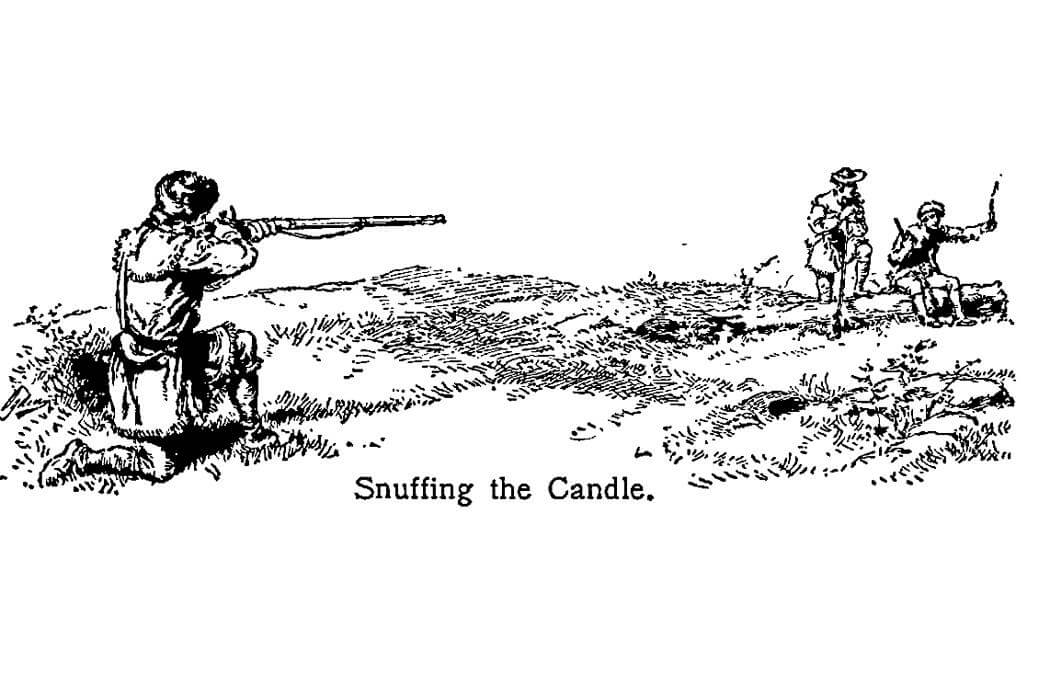
But the hunters who lived in the woods could shoot better. They would light a candle. Then one of the hunters would take his gun, and go a hundred steps away from the candle. He would then shoot at the candle. He would shoot so as to snuff it. He would not put out the candle. He would only cut off a bit of the wick with the bullet. But he would leave the candle burning.

Once Audubon came near being killed by some robbers. He stopped at a cabin where lived an old white woman. He found a young Indian in the house. The Indian had hurt himself with an arrow. He had come to the house to spend the night.

The old woman saw Audubon’s fine gold watch. She asked him to let her look at it. He put it into her hands for a minute. Then the Indian passed by Audubon, and pinched him two or three times. That was to let him know that the woman was bad, and that she might rob him.

Audubon went and lay down with his hand on his gun. After a while two men came in. They were the sons of the old woman. Then the old woman sharpened a large knife. She told the young men to kill the Indian first, and then to kill Audubon and take his watch. She thought that Audubon was asleep. But he drew up his gun ready to fire.

Just then two hunters came to the cabin. Audubon told them what the robbers were going to do. They took the old woman and her sons, and tied their hands and feet. The Indian, though he was in pain from his hurt, danced for joy when he saw that the robbers were caught. The woman and her sons were afterward punished.

Great Stories for Little Americans How Audubon Came to Know About Birds

John James Audubon knew more about the birds of this country than any man had ever known before. He was born in the State of Louisiana. His father took him to France when he was a boy. He went to school in France.

The little John James was fond of studying about wild animals. But most of all he wished to know about birds. Seeing that the boy liked such things, his father took pains to get birds and flowers for him.

While he was yet a boy at school, he began to gather birds and other animals for himself. He learned to skin and stuff them. But his stuffed birds did not please him. Their feathers did not look bright, like those of live birds. He wanted living birds to study.

His father told him that he could not keep so many birds alive. To please the boy, he got him a book with pictures in it. Looking at these pictures made John James wish to draw. He thought that he could make pictures that would look like the live birds.

But when he tried to paint a picture of a bird, it looked worse than his stuffed birds. The birds he drew were not much like real birds. He called them a “family of cripples.” As often as his birthday came around, he made a bonfire of his bad pictures. Then he would begin over again.

All this time he was learning to draw birds. But he was not willing to make pictures that were not just like the real birds. So when he grew to be a man he went to a great French painter whose name was David. David taught him to draw and paint things as they are.

Then he came back to this country, and lived awhile in Pennsylvania. Here his chief study was the wild creatures of the woods.

He gathered many eggs of birds. He made pictures of these eggs. He did not take birds’ eggs to break up the nests. He was not cruel. He took only what he needed to study.

He would make two little holes in each egg. Then he would shake the egg, or stir it up with a little stick or straw, or a long pin. This would break up the inside of the egg. Then he would blow into one of the holes. That would blow the inside of the egg out through the other hole.

These egg shells he strung together by running strings through the holes. He hung these strings of egg shells all over the walls of his room. On the mantelpiece, he put the stuffed skins of squirrels, raccoons, opossums, and other small animals. On the shelves his friends could see frogs, snakes, and other animals.

He married a young lady, and brought her to live in this museum with his dead snakes, frogs, and strings of birds’ eggs. She liked what he did, and was sure that he would come to be a great man.

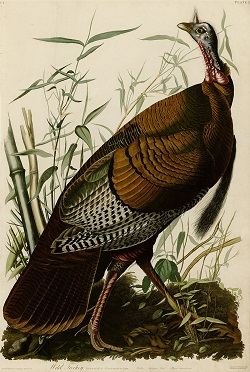
He made up his mind to write a great book about American birds. He meant to tell all about the birds in one book. Then in another book he would print pictures of the birds, just as large as the birds themselves. He meant to have them look just like the birds.

To do this he must travel many thousands of miles. He must live for years, almost all of the time in the woods. He would have to find and shoot the birds, in order to make pictures of them. And he must see how the birds lived, and how they built their nests, so that he could tell all about them. It would take a great deal of work and trouble. But he was not afraid of trouble.

That was many years ago. Much of our country was then covered with great trees. Audubon sometimes went in a boat down a lonesome river. Sometimes he rode on horseback. Often, he had to travel on foot through woods where there were no roads. Many a time he had to sleep out of doors.

He lost his money and became poor. Sometimes he had to paint portraits to get money to live on. Once he turned dancing master for a while. But he did not give up his great idea. He still studied birds, and worked to make his books about American birds. His wife went to teaching to help make a living.

After years of hard work, he made paintings of nearly a thousand birds. That was almost enough for his books. But, while he was traveling, two large rats got into the box in which he kept his pictures. They cut up all his paintings with their teeth, and made a nest of the pieces. This almost broke his heart for a while. For many nights, he could not sleep, because he had lost all his work.

But he did not give up. After some days, he took his gun, and went into the woods. He said to himself, “I will begin over again. I can make better paintings than those that the rats spoiled.” But it took him four long years and a half to find the birds, and make the pictures again.

He was so careful to have his drawings just like the birds, that he would measure them in every way. Thus, he made his pictures just the size of the birds themselves.

At last, the great books were printed. In this country, in France, and in England, people praised the wonderful books. They knew that Audubon was indeed a great man.

The Great Charter of Virginia

The Great Charter of Virginia

During all the early years of the Virginia colony the people were fed and clothed out of a common stock of provisions. They were also obliged to work for this stock. No division was made of the land, nor could the industrious man get any profit by his hard work. The laziest man was as well off as the one who worked hardest, and under this arrangement men neglected their work, and the colony was always poor. The men had been promised that after five years they should have land of their own and be free, but this promise was not kept. In 1614 Sir Thomas Dale gave to some who had been longest in Virginia three acres of ground apiece, and allowed them one month in the year to work on their little patches. For this they must support themselves and give the rest of their work to the common stock. This arrangement made them more industrious. But the cruel military laws put in force by the governor made Virginia very unpopular.

Argall, who came after Dale, governed very badly, and the colony was almost ruined. In 1618 many new emigrants were sent, and Lord De la Warr was again sent as governor, but he died on the way. The “Virginia Company,” of London, which had the government of the colony in November, 1618, granted to Virginia a “Great Charter,” under which the people of the colony were allowed a voice in making their own laws. This was the beginning of free government in America. Under this charter the government of Virginia was put into the hands of a governor, a “council of estate,” and a “general assembly.” The other American colonies afterward took pattern from this threefold government.

The government of the United States by a president, a senate, and a house of representatives shows that the ideas put into the Great Charter have left their mark on the constitution of our country. The governments of all our States also show traces of the same idea. Each State has a governor, a senate, and a house of representatives. So that the plan arranged in 1618 for a few hundred people in Virginia was a tiny stream that has spread out into a great river.

The Great Charter also gave the people of Virginia the right to divide the land into farms, and to own and work ground each for himself. When the new governor, Sir George Yeardley, got to Virginia in the spring of 1619, bringing this good news that the settlers were to live under laws of their own making, and were to enjoy the fruits of their own labors, they thought themselves the happiest people in the world.

About this time it was thought that the colony would be more firmly planted if the colonists had wives. Young women were therefore sent out to be married to the settlers. But, before any man could marry one of these, he was obliged to gain her consent, and to pay the cost of her passage, which was about a hundred and fifty pounds of tobacco. This venture proved very satisfactory to the Virginians, and women were therefore sent for wives from time to time for years afterward. When the colonists had land of their own, they felt themselves at home in America, and no longer thought of going back to England.

Before this there had been a good many small wars and troubles of one kind or other with the American Indians. But, as the American Indians had few firearms, the settlers could easily defend themselves. After 1619 many efforts were made to change and convert the American Indians. Money was given to educate their children, and a college was planned for them. One ambitious American Indian brave, whom the settlers called “Jack of the Feather,” and who was believed to be proof against bullets, was suspected of wishing war. At length he killed a settler, and the settler’s servants, in trying to take him to the governor, shot him. The American Indians did not show any resentment at his death at first, and O-pe-chan’-ka-no, who had become head chief on the death of Powhatan, said that the sky might fall sooner than he would break the peace.

But on the 22nd of March, 1622, while the men of the colony were in the fields, the American Indians suddenly fell on the settlements, killing the colonists mostly with their own axes, hatchets, and hoes. Three hundred and forty-seven men, women, and children were killed in a single day. One American Indian lad, living in a settler’s house, had given warning during the night before, and some of the settlements had time to prepare themselves for defense. From this time on there was almost continual war with the American Indians for many years.

In 1624 the Virginia Company, of London, was dissolved, and the colony was put under the government of the king. But the king, James I, when he put down the company, promised to the colony all the liberties which they then enjoyed. This promise was not well kept by his successors in after-years; the Virginians were often oppressed by the governors sent to them, but the right to pass laws in the General Assembly was never taken away.