A place to grow your relationship with God

Posts tagged ‘history’

Great Stories for Little Americans Washington Irving as a Boy

The Revolution was about over. Americans were very happy. Their country was to be free.

At this time, a little boy was born in New York. His family was named Irving. What should this little boy be named?

His mother said, “Washington’s work is done. Let us name the baby Washington.” So he was called Washington Irving.

When this baby grew to be a little boy, he was one day walking with his nurse. The nurse was a Scotch girl. She saw General Washington go into a shop. She led the little boy into the shop also.

The nurse said to General Washington, “Please, your Honor, here is a bairn that is named for you.”

“Bairn” is a Scotch word for child. Washington put his hand on the little boy’s head and gave him his blessing. When Irving became an author, he wrote a life of Washington.

Little Irving was a merry, playful boy. He was full of mischief.

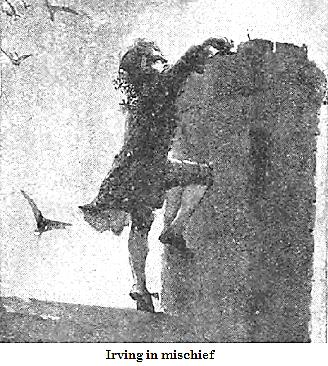
Sometimes he would climb out of a window to the roof of his father’s house. From this he would go to roofs of other houses. Then the little rascal would drop a pebble down a neighbor’s chimney. Then he would hurry back and get into the window again. He would wonder what the people thought when the pebble came rattling down their chimney. Of course, he was punished when his tricks were found out. But he was a favorite with his teacher. With all his faults, he would not tell a lie. The teacher called the little fellow “General.”
In those days, naughty schoolboys were whipped. Irving could not bear to see another boy suffer. When a boy was to be whipped, the girls were sent out. Irving always asked the schoolmaster to let him go out with the girls.

Like other boys, Irving was fond of stories. He liked to read about Sindbad the Sailor, and Robinson Crusoe. But most of all he liked to read about other countries. He had twenty small volumes called “The World Displayed.” They told about the people and countries of the world. Irving read these little books a great deal.

One day the schoolmaster caught him reading in school. The master slipped behind him and grabbed the book. Then he told Irving to stay after school.

Irving expected a punishment. But the master told him he was pleased to find that he liked to read such good books. He told him not to read them in school.

Reading about other countries made Irving wish to see them. He thought he would like to travel. Like other wild boys, he thought of running away. He wanted to go to sea.

But he knew that sailors had to eat salt pork. He did not like salt pork. He thought he would learn to like it. When he got a chance, he ate pork. And sometimes he would sleep all night on the floor. He wanted to get used to a hard bed.

But the more he ate pork, the more he disliked it. And the more he slept on the floor, the more he liked a good bed. So he gave up his foolish notion of being a sailor boy.

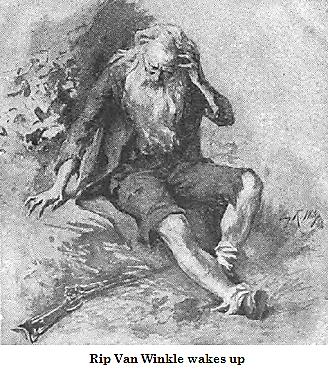
Someday, you will read Irving’s “Sketch Book.” You will find some famous stories in it. There is the story of Rip Van Winkle, who slept twenty years. And there is the funny story of the Headless Horseman. When you read these amusing stories, you will remember the playful boy who became a great author.
The Mystery of Roanoke Colony

Learn the Mystery of Roanoke Colony

  • The Roanoke Colony was England’s first attempt at a permanent settlement in North America.
  • The people of the colony disappeared under mysterious circumstances, leaving behind an empty fort.
  • The colonists and their bodies were never found.
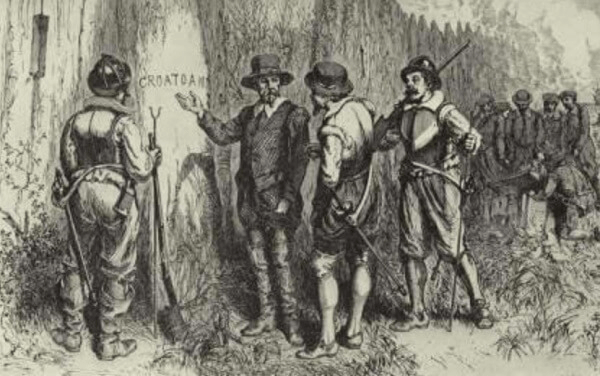
  • The only clue found was the word, ‘CROATOAN’ carved into Roanoke’s fort palisade.
  • Hypotheses include that the colonists were taken in or killed by the local Croatan Indians.
John White discovers the word “CROATOAN”
carved at Roanoke’s fort palisade
by unknown


Lost Colony of Roanoke
The Roanoke Colony was England’s first attempt to establish a settlement in the Americas. Sadly, the effort failed when the settlers vanished under mysterious conditions, earning it the nickname “The Lost Colony.”

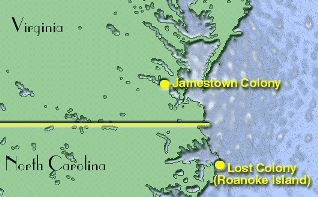
Map showing location of
Jamestown and Roanoke Island Colonies
by NOAA


Where was the colony located?

The Roanoke Colony was situated on Roanoke Island, just off the coast of what is now North Carolina. At the time, this area was considered part of Virginia.

Early Plans

In 1584, Queen Elizabeth I granted Sir Walter Raleigh the land of Virginia in North America. The British aimed to expand their empire by establishing a presence in the Americas. Raleigh sent Captain Philip Amadas and Captain Arthur Barlowe to explore the region. They came across Roanoke Island and encountered the local natives. Raleigh decided it was an ideal spot to set up a colony.

First Colony at Roanoke

The first expedition to Roanoke was led by Sir Richard Greenville. The expedition arrived at Roanoke in 1585. Greenville left 107 settlers, all men, at Roanoke under the charge of Ralph Lane. Greenville then returned to England in order to gather additional supplies for the settlement.

The settlers built a fort at Roanoke, but struggled to survive. It didn’t help matters that they were constantly fighting with the local Native Americans. When English explorer Sir Francis Drake passed by the settlement and offered to take them back to England, the colonists agreed. Not long after the colonists left, Captain Greenville finally returned with new supplies only to discover that the settlement had been abandoned. He left a small group of men on the island and then returned to England.

Second Colony at Roanoke

A second attempt at starting a colony at Roanoke occurred in 1587. This time 115 colonists travelled to Roanoke led by John White. They hoped to find the men that Greenville had left a year earlier. However, upon their arrival, all they found at the settlement was a human skeleton. Despite this setback, the colonists began to build their settlement on Roanoke. Not long after their arrival, a girl named Virginia Dare was born. She was the first child born in the Americas to English parents.

Unfortunately, the colonists continued to have disputes with the local tribes and some colonists were killed. They also discovered that they were ill-prepared to build a thriving colony. John White decided to return to England in order to gain supplies and reinforcements for the colony.


The Colony has Disappeared

After returning to England, White could find little help for the colony. England was in the middle of a large battle with Spain and the Spanish Armada. As a result, White was unable to return until three years later in 1590. When White arrived he found the colony completely abandoned. The only clues that White found included the word “Croatoan” carved into a fence post and “Cro” carved into a tree.

White found no sign of a struggle, however, and figured that the colonists had moved to Croatoan, which was what they called a nearby island (Hatteras Island). He also had reason to hope because he had told the colonists to carve a Maltese cross if they were being forced leave. Since he found no cross, he figured the colonists were okay. White was unable to search the nearby island for the colonists because of a bad storm and was forced to return to England.

The colonists were never heard from again and the colony gained the nickname the “Lost Colony.”

 Sir Walter Raleigh Tries to Settle a Colony in America

Sir Walter Raleigh

Sir Walter Raleigh, while yet a young man, fought for years on the side of the Huguenots in the French civil wars, and afterward in the war in Ireland. On his return from Ireland, it is said that he won the Queen’s favor by throwing his new plush cloak into a muddy place in the road for her to walk on. He fitted out ships and fought against the Great Armada, or fleet, of Spain, when that country tried to conquer England. He was a great statesman, a great soldier, a great seaman, and an excellent poet and historian. He is said to have first planted the potato in Ireland. King James I kept him in prison in the Tower for more than twelve years, and then released him. In 1618 the same king had this great man put to death to please the King of Spain. When Raleigh was about to be beheaded, he felt of the edge of the axe, and said, “It is a sharp medicine to cure me of all my diseases.”

Sir Walter Raleigh was the first that landed a colony of English people on the land that is now the United States. Having received from Queen Elizabeth a charter which gave him a large territory in America, he sent out an exploring expedition in 1584, ninety-two years after the discovery by Columbus. This expedition was commanded by two captains, named Amidas and Barlowe. They landed on the coast in that part of America which we now call North Carolina. The country pleased them very much. They wondered at the wild grape-vines, which grew to the tops of the highest trees, and they found the American Indians very friendly. They stayed about six weeks in the New World, and, everything here being strange to their eyes, they fell into many mistakes in trying to describe what they saw and heard. When they got back to England, they declared that the part of America they had seen was the paradise of the world.

Raleigh was much encouraged by the accounts which his two captains gave of the new country they had found. It was named Virginia at this time, in honor of Queen Elizabeth, who was often called the “Virgin Queen.” But the name Virginia, which we apply to two of our states, was then used for nearly the whole eastern part of what is now the United States, between Maine and Georgia.
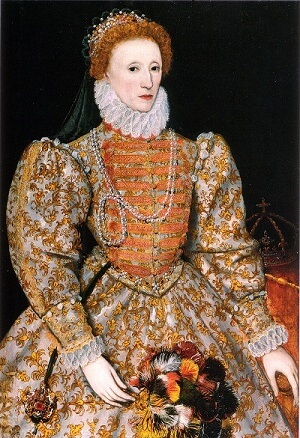
Queen Elizabeth I of England
In 1585, the year after the return of the first expedition, Raleigh sent out a colony to remain in America. Sir Richard Grenville, a famous seaman, had command of this expedition; but he soon returned to England, leaving the colony in charge of Ralph Lane. There were no women in Ralph Lane’s company. They made their settlement on Roanoke Island, which lies near to the coast of North Carolina, and they explored the mainland in many directions. They spent much time in trying to find gold, and they seem to have thought that the shell-beads worn by the American Indians were pearls. Like all the others who came to America in that time, they were very desirous of finding a way to get across America, which they believed to be very narrow. They hoped to reach the Pacific Ocean, and so open a new way of sailing: to China and the East Indies.

The American Indians by this time were tired of the settlers, and anxious to be rid of them. They told Lane that the Roanoke River came out of a rock so near to a sea at the west that the water sometimes dashed from the sea into the river, making the water of the river salt. Lane believed this story, and set out with most of his men to find a sea at the head of the river. Long before they got to the head of the Roanoke, their provisions gave out. But Lane made a brave speech to his men, and they resolved to go on. Having nothing else to eat, they killed their two dogs, and cooked the meat with sassafras leaves to give it a relish. When this meat was exhausted, they got into their boats and ran swiftly down the river, having no food to eat on the way home. Lane got back to Roanoke Island just in time to keep the American Indians from killing the men he had left there.

Sir Francis Drake came to see the colony on his return from an expedition to the West Indies. He furnished the company on the island with a ship and with whatever else they needed. But, while he remained at Roanoke, a storm arose which drove to sea the ship he had given to Lane. This so discouraged the colonists that they returned to England.
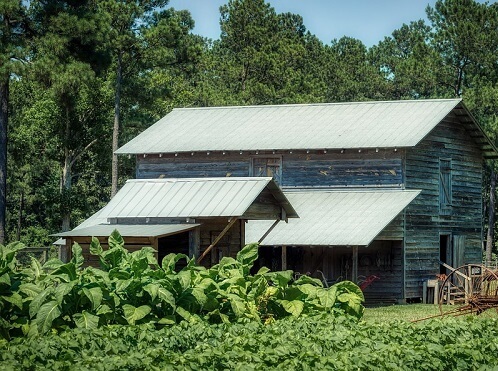
Tobacco Field in South Carolina
Ralph Lane and his companions were the first to carry tobacco into England. They learned from the American Indians to smoke it by drawing the smoke into their mouths and puffing it out through their nostrils. Raleigh adopted the practice, and many distinguished men and women followed his example. Some of the first tobacco-pipes in England were made by using a walnut-shell for the bowl of the pipe and a straw for the stem. It is related that, when Raleigh’s servant first saw his master with the smoke coming from his nose, he thought him to be on fire, and poured a pitcher of ale, which he was fetching, over Sir Walter’s head, to put the fire out.

Raleigh set to work, with the help of others, to send out another colony. This time he sent women and children, as well as men, intending to make a permanent settlement. The governor of this company was John White, an artist. Soon after White’s company had settled themselves on Roanoke Island, an English child was born. This little girl, being the first English child born in Virginia, was named Virginia Dare.

John White, the governor of the colony, who was Virginia Dare’s grandfather went back to England for supplies. He was detained by the war with Spain, and, when he got back to Roanoke Island, the colony had disappeared Raleigh had spent so much money already that he was forced to give up the attempt’ to plant a colony in America. But he sent several times to seek for the lost people of his second colony, without finding them. Twenty years after John White left them, it was said that seven of them were still alive among the American Indians of North Carolina.

Great Stories for Little Americans The First Steamboat

The first good steamboat was built in New York. She was built by Robert Fulton. Her name was “Clermont.” When the people saw her, they laughed. They said that such a boat would never go. For thousands of years, boatmen had made their boats go by using sails and oars. People had never seen any such boat as this. It seemed foolish to believe that a boat could be pushed along by steam.

The time came for Fulton to start his boat. A crowd of people were standing on the shore. The black smoke was coming out of the smokestack. The people were laughing at the boat. They were sure that it would not go. At last, the boat’s wheels began to turn around. Then the boat began to move. There were no oars. There were no sails. But still the boat kept moving. Faster and faster she went. All the people now saw that she could go by steam. They did not laugh anymore. They began to cheer.

The little steamboat ran up to Albany. The people who lived on the river did not know what to make of it. They had never heard of a steamboat. They could not see what made the boat go.

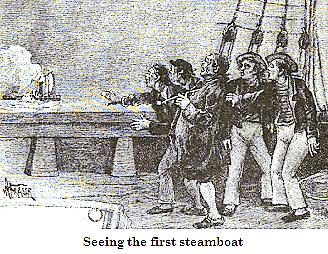
There were many sailing vessels on the river. Fulton’s boat passed some of these in the night. The sailors were afraid when they saw the fire and smoke. The sound of the steam seemed dreadful to them. Some of them went downstairs in their ships for fear. Some of them went ashore. Perhaps they thought it was a living animal that would eat them up.

But soon there were steamboats on all the large rivers.

Great Stories for Little Americans Quicksilver Bob

Robert Fulton was the man who set steamboats to running on the rivers. Other men had made such boats before. But Fulton made the first good one.

When he was a boy, he lived in the town of Lancaster in Pennsylvania. Many guns were made in Lancaster. The men who made these guns put little pictures on them. That was to make them sell to the hunters who liked a gun with pictures. Little Robert Fulton could draw very well for a boy. He made some pretty little drawings. These the gun makers put on their guns.

Fulton went to the gun shops a great deal. He liked to see how things were made. He tried to make a small air gun for himself.

He was always trying to make things. He got some quicksilver. He was trying to do something with it. But he would not tell what he wanted to do. So the gunsmiths called him Quicksilver Bob.

He was so much interested in such things, that he sometimes neglected his lessons. He said that his head was so full of new notions, that he had not much room left for school learning.

One morning he came to school late.

“What makes you so late?” asked the teacher.

“I went to one of the shops to make myself a lead pencil,” said little Bob. “Here it is. It is the best one I ever had.”

The teacher tried it, and found it very good. Lead pencils in that day were made of a long piece of lead sharpened at the end.

Quicksilver Bob was a very odd little boy. He said many curious things. Once the teacher punished him for not getting his lessons. He rapped Robert on the knuckles with a ferule. Robert did not like this any more than any other boy would.

“Sir,” said the boy, “I came here to have something beaten into my head, not into my knuckles.”

In that day people used to light candles and stand them in the window on the Fourth of July. These candles in every window lighted up the whole town. But one year candles were scarce and high. The city asked the people not to light up their windows on the Fourth.

Bob did not like to miss the fun of his Fourth of July. He went to work to make something like rockets or Roman candles. It was a very dangerous business for a boy.

“What are you doing, Bob?” someone asked him.

“The city does not want us to burn our candles on the Fourth,” he said. “I am going to shoot mine into the air.”

He used to go fishing with a boy named Chris Gumpf. The father of Chris went with them. They fished from a flat boat. The two boys had to push the boat to the fishing place with poles.

“I am tired of poling that boat,” said Robert to Chris one day when they came home.

So he set to work to think out a plan to move the boat in an easier way than by poles. He whittled out the model of a tiny paddle wheel. Then he went to work with Chris Gumpf, and they made a larger paddle wheel. This they set up in the fishing boat. The wheel was turned by the boys with a crank. They did not use the poles anymore.

Great Stories for Little Americans: A Long Journey

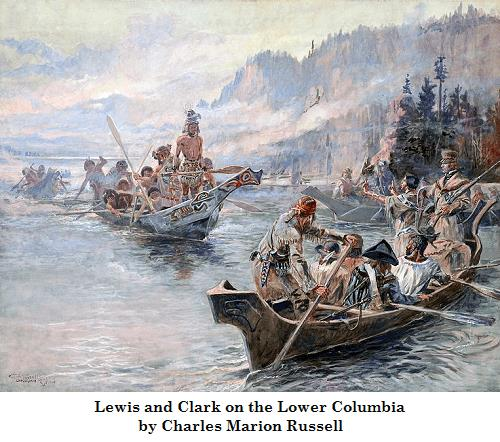
A long time ago, when Thomas Jefferson was President, most of the people in this country lived in the East. Nobody knew anything about the Far West. The only people that lived there were Indians. Many of these Indians had never seen a white man.

The President sent men to travel into this wild part of the country. He told them to go up to the upper end of the Missouri River. Then they were to go across the Rocky Mountains. They were to keep on till they got to the Pacific Ocean. Then they were to come back again. They were to find out the best way to get through the mountains. And they were to find out what kind of people the Indians in that country were. They were also to tell about the animals.

There were two captains of this company. Their names were Lewis and Clark. There were forty-five men in the party.

They were gone two years and four months. For most of that time they did not see any white men but their own party. They did not hear a word from home for more than two years.

They got their food mostly by hunting. They killed a great many buffaloes and elks and deer. They also shot wild geese and other large birds. Sometimes they had nothing but fish to eat. Sometimes they had to eat wolves. When they had no other meat, they were glad to buy dogs from the Indians and eat them. Sometimes they ate horses. They became fond of the meat of dogs and horses.

When they were very hungry, they had to live on roots if they could get them. Some of the Indians made a kind of bread out of roots. The white men bought this when they could not get meat. But there were days when they did not have anything to eat.

They were very friendly with the Indians. One day some of the men went to make a visit to an Indian village. The Indians gave them something to eat.

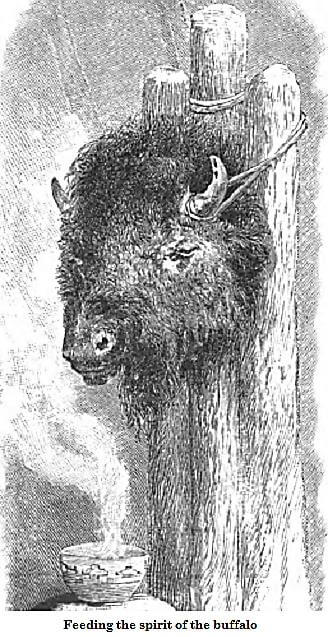
In the Indian wigwam where they were, there was a head of a dead buffalo. When dinner was over, the Indians filled a bowl full of meat. They set this down in front of the head. Then they said to the head, “Eat that.”

The Indians believed, that, if they treated this buffalo head politely, the live buffaloes would come to their hunting ground. Then they would have plenty of meat. They think the spirit of the buffalo is a kind of a god. They are very careful to please this god.

Great Stories for Little Americans Stories About Jefferson

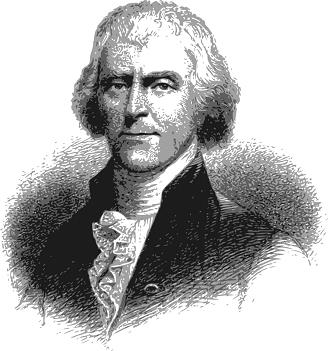
Thomas Jefferson was one of the great men of the Revolution. He was not a soldier. He was not a great speaker. But he was a great thinker. And he was a great writer.

He wrote a paper that was the very beginning of the United States. It was a paper that said that we would be free from England, and be a country by ourselves. We call that paper the Declaration of Independence.

When he was a boy, Jefferson was fond of boyish plays. But when he was tired of play, he took up a book. It pleased him to learn things. From the time when he was a boy he never sat down to rest without a book.

At school he learned what other boys did. But the difference between him and most other boys was this: he did not stop with knowing just what the other boys knew. Most boys want to learn what other boys learn. Most girls would like to know what their schoolmates know. But Jefferson wanted to know a great deal more.

As a young man, Jefferson knew Latin and Greek. He also knew French and Spanish and Italian.

He did not talk to show off what he knew. He tried to learn what other people knew. When he talked to a wagon maker, he asked him about such things as a wagon maker knows most about. He would sometimes ask how a wagon maker would go to work to make a wheel.

When Jefferson talked to a learned man, he asked him about those things that this man knew most about. When he talked with Indians, he got them to tell him about their language. That is the way he came to know so much about so many things. Whenever anybody told him anything worthwhile, he wrote it down as soon as he could.

One day Jefferson was traveling. He went on horseback. That was a common way of traveling at that time. He stopped at a country tavern. At this tavern, he talked with a stranger who was staying there.

After a while Jefferson rode away. Then the stranger said to the landlord, “Who is that man? He knew so much about law, that I was sure he was a lawyer. But when we talked about medicine, he knew so much about that, that I thought he must be a doctor. And after a while he seemed to know so much about religion, that I was sure he was a minister. Who is he?”

The stranger was very much surprised to hear that the man he had talked with was Thomas Jefferson.

Jefferson was a very polite man. One day his grandson was riding with him. They met a man. The man lifted his cap and bowed. Jefferson bowed to the man. But his grandson did not think it worthwhile to bow.

Then Jefferson said to his grandson, “Do not let another man be more of a gentleman than you are.” In the Declaration of Independence, Jefferson wrote these words: “All men are created equal.” He also said that the poor man had the same right as the rich man to live, and to be free, and to try to make himself happy.

Great Stories for Little Americans Decatur and the Pirates

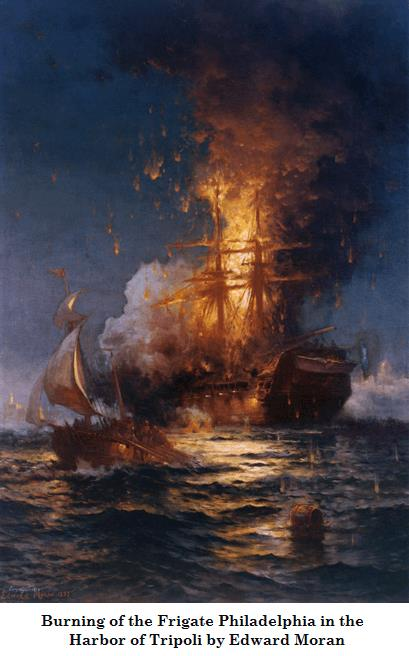
Nearly a hundred years have passed since the ship “Philadelphia” was burned. But the brave sailors who did it will never be forgotten.

The people of Tripoli in Africa were pirates. They took the ships of other nations at sea. They made slaves of their prisoners. The friends of these slaves sometimes sent money to buy their freedom. Some countries paid money to these pirates to let their ships go safe.

Our country had trouble with the pirates. This trouble brought on a war. Our ships were sent to fight against Tripoli.

One of the ships fighting against the pirates was called the “Philadelphia.” One day she was chasing a ship of Tripoli. The “Philadelphia” ran on the rocks. The sailors could not get her off. The pirates came and fought her as she lay on the rocks. They took her men prisoners. Then they went to work to get her off. After a long time, they got her into deep water. They took her to Tripoli. Our ships could not go there after her, because there were so many great cannons on the shore near the ship.

The pirates got the “Philadelphia” ready to go to sea. They loaded her cannons. They meant to slip out past our ships of war. Then they would take a great many smaller American ships.

But the Americans laid a plan to burn the “Philadelphia.” It was a very dangerous thing to try to do. The pirates had ships of war near the “Philadelphia.” They had great guns on the shore. There was no way to do it in the daytime. It could only be done by stealing into the Bay of Tripoli at night.

The Americans had taken a little vessel from the pirates. She was of the kind that is called a ketch. She had sails. She also had long oars. When there was no wind to sail with, the sailors could row her with the oars.

This little ketch was sent one night to burn the “Philadelphia.” The captain of this boat was Stephen Decatur. He was a young man, and very brave.

Decatur made his men lie down, so that the pirates would not know how many men he had on his ketch. Only about ten men were in sight. The rest were lying hidden on the boat.

They came near to the “Philadelphia.” It was about ten o’clock at night. The pirates called to them. The pilot of the ketch told them that he was from Malta. He told them that he had come to sell things to the people of Tripoli. He said that the ketch had lost her anchor. He asked them to let him tie her to the big ship till morning.

The pirates sent out a rope to them. But when the ketch came nearer, the pirates saw that they had been fooled. They cried out, “Americans, Americans!”

Then the Americans lying down took hold of the rope and pulled with all their might, and drew the ketch close to the ship. They were so close, that the ship’s cannons were over their heads. The pirates could not fire at them.

The men who had been lying still now rose up. There were eighty of them. In a minute, they were scrambling up the sides of the big ship. Some went in one way, some another. They did not shoot. They fought with swords and pikes, or short spears.

Soon they drove the pirates to one side of the ship. Then they could hear the pirates jumping over into the water. In a few minutes the pirates had all gone.

But the Americans could not stay long. They must burn the ship before the pirates on the shore should find out what they were doing.

They had brought a lot of kindling on the ketch. They built fires in all parts of the ship. The fire ran so fast, that some of the men had trouble to get off the ship.

When the Americans got back on the ketch, they could not untie the rope that held the ketch to the ship. The big ship was bursting into flames. The ketch would soon take fire.

They took swords and hacked the big rope in two. Then they pushed hard to get away from the fire. The ketch began to move. The sailors took the large oars and rowed. They were soon safe from the fire.

All this they had done without any noise. But, now that they had got away, they looked back. The fire was shooting up toward the sky. The men stopped rowing, and they gave three cheers. They were so glad, that they could not help it.

By this time the pirates on shore had waked up. They began to fire great cannon balls at the little ketch. One of the balls went through her sails. Ah! how the sailors rowed!

The whole sky was now lighted up by the fire. The pirates’ cannons were thundering. The cannon balls were splashing the water all around the ketch. But the Americans got away. At last, they were safe in their own ships.

Mayan Ball Game

Mayan Ball Game

Chichen Itza, one of the largest sites near Cancun, Mexico, features a massive ball game court, measuring around 150 by 40 feet—bigger than a football field. It’s the largest court in the Mundo Maya. The ball game, that became known as Pok-A-Tok or Pitz to the Maya, was a popular activity among all Mesoamerican peoples and originated around 3,000 B.C., serving a ritualistic purpose for the ancient Maya.

The game is featured in many myths, often representing the struggle between deities of day and night or the clashes between sky gods and underworld rulers. The ball symbolized celestial bodies like the sun, moon, or stars, while the rings represented sunrise, sunset, or equinoxes.

There were two teams, and the number of players varied depending on the region where the game was played. Most ball courts featured two sloping parallel walls with three round disks known as markers or a single stone ring positioned at right angles to the ground.

hoop in ball court at Chichen Itza

The players scored by touching the markers or passing the ball—which was 50 centimeters in diameter and weighed more than two pounds—through the rings. The markers or rings were several yards above the ground, and the players could only touch the ball with their elbows, knees, or hips. Scoring was considered such a feat that it usually ended the game.

These games could go on for days.  The losing team was usually sacrificed.  

stone carving of a ball player

Great Stories for Little Americans Clark and His Men

At the time of the Revolution there were but few people living on the north side of the Ohio River. But there were many Indians there. These Indians killed a great many settlers in Kentucky.

The Indians were sent by British officers to do this killing. There was a British fort at Vincennes in what is now Indiana. There was another British fort or post at Kaskaskia in what is now the State of Illinois.

George Rogers Clark was an American colonel. He wanted to stop the murder of the settlers by the Indians. He thought that he could do it by taking the British posts.

He had three hundred men. They went down the Ohio River in boats. They landed near the mouth of the Ohio River. Then they marched a hundred and thirty miles to Kaskaskia.

Kaskaskia was far away from the Americans. The people there did not think that the Americans would come so far to attack them. When Clark got there, they were all asleep. He marched in and took the town before they woke up.

The people living in Kaskaskia were French. By treating them well, Clark made them all friendly to the Americans.

When the British at Vincennes heard that Clark had taken Kaskaskia, they thought that they would take it back again. But it was winter. All the streams were full of water. They could not march till spring. Then they would gather the Indians to help them, and take Clark and his men.

But Clark thought that he would not wait to be taken. He thought that he would just go and take the British. If he could manage to get to Vincennes in the winter, he would not be expected.

Clark started with a hundred and seventy men. The country was nearly all covered with water. The men were in the wet almost all the time. Clark had hard work to keep his men cheerful. He did everything he could to amuse them. They had to wade through deep rivers. The water was icy cold. But Clark made a joke of it. He kept them laughing whenever he could.

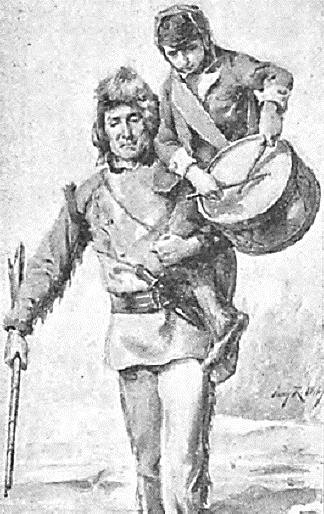
At one place the men refused to go through the freezing water. Clark could not persuade them to cross the river. He called to him a tall soldier. He was the very tallest man in Clark’s little army. Clark said to him, “Take the little drummer boy on your shoulders.” The little drummer was soon seated high on the shoulders of the tall man. “Now go ahead!” said Clark.

The soldier marched into the water. The little drummer beat a march on his drum. Clark cried out, “Forward!” Then he plunged into the water after the tall soldier. All the men went in after him. They were soon safe on the other side.

At another river the little drummer was floated over on the top of his drum. At last, the men drew near to Vincennes. They could hear the morning and evening gun in the British fort. But the worst of the way was yet to pass. The Wabash River had risen over its banks. The water was five miles wide. The men marched from one high ground to another through the cold water. They caught an Indian with a canoe. In this they got across the main river. But there was more water to cross. The men were so hungry that some of them fell down in the water. They had to be carried out.

Clark’s men got frightened at last, and then they had no heart to go any farther. But Clark remembered what the Indians did when they went to war. He took a little gunpowder in his hand. He poured water on it. Then he rubbed it on his face. It made his face black. He gave a war whoop. The men followed him again.

The men were tired and hungry. But they soon reached dry ground. They were now in sight of the fort. Clark marched his little army round and round in such a way as to make it seem that he had many men with him. He wrote a fierce letter to the British commander. He behaved like a general with a large army.

After some fighting, the British commander gave up. Clark’s little army took the British fort. This brave action saved to our country the land that lies between the Ohio River and the Lakes. It stopped the sending of Indians to kill the settlers in the West.